
Hand Mixer vs. Stand Mixer: Decoding the Right Choice for Your Kitchen
Hand Mixer vs. Stand Mixer: Decoding the Right Choice for Your Kitchen
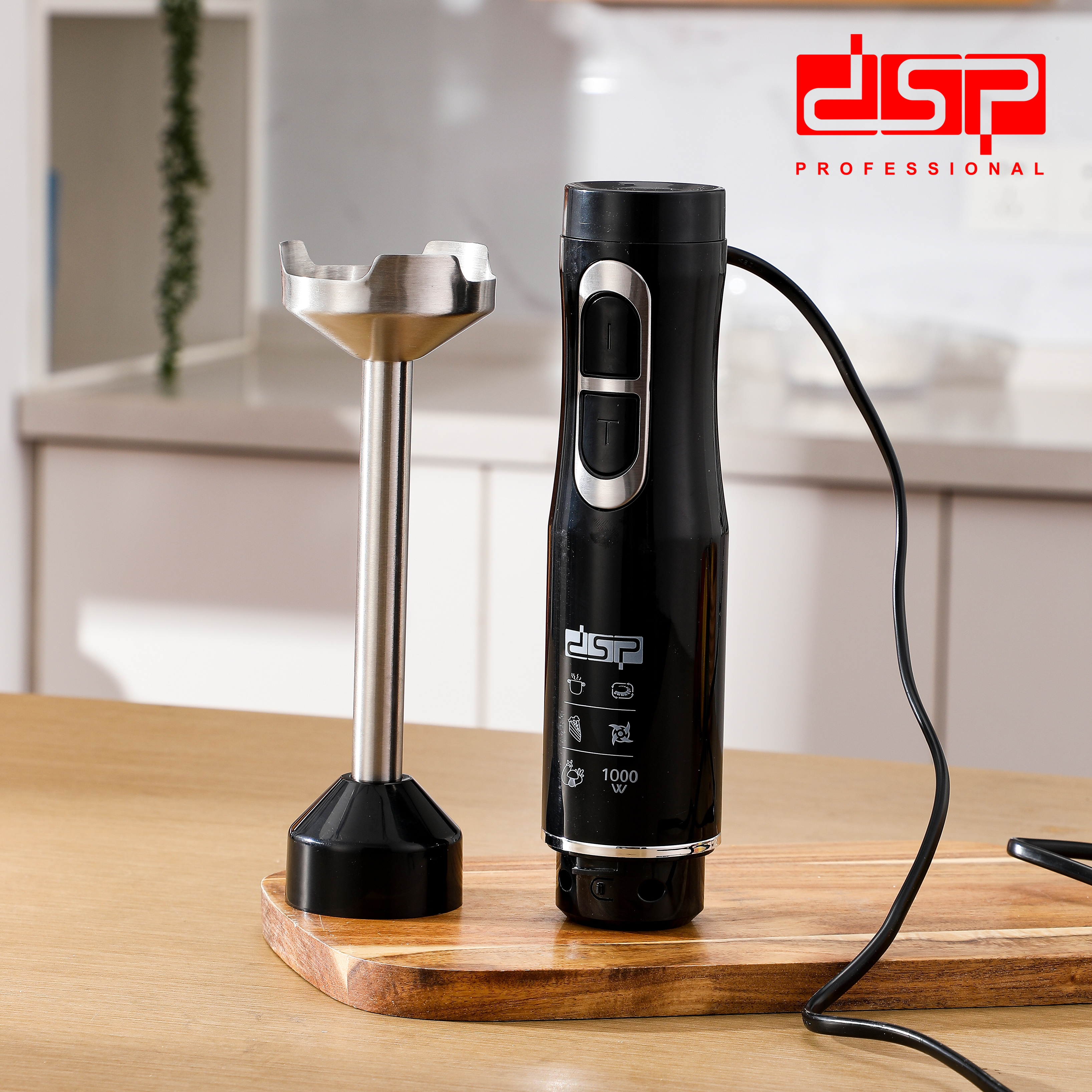
The short answer: a hand mixer is the right choice when your mixing jobs are short, light and occasional — whipping cream, beating egg whites, mixing a single cake batter. A stand mixer is the right choice when mixing is frequent, heavier, or long enough that you want both hands free — kneading dough, running two or three batches in one session, or working in a small bakery or café kitchen.
Most people reach the hand mixer vs. stand mixer question because the two appliances look like versions of each other at different price points. They are not. The two designs convert motor power into mixing force in different ways, they tolerate different session lengths, and they are built for different batch sizes. Comparing them on wattage alone is the most common way to buy the wrong machine.
This guide sets out a head-to-head decision matrix based on how you actually mix, and then looks at the manufacturing side of the same question: which models exist, what their specifications and EU compliance documents say, and what trade buyers should verify before ordering either type. Model evidence comes from DSP home appliances (Yiwu DSP Electric Appliance Co., Ltd.), a kitchen and personal care appliance manufacturer based in Yiwu, China that produces both hand mixers and planetary stand mixers.
Problem Definition: Why "Which Mixer Is Better?" Produces the Wrong Answer
Neither design is universally better, and any buyer — home cook or procurement manager — who asks for a single winner will get a recommendation that breaks on the first change of habit. The choice is determined by four variables: batch size, mixing duration per session, torque and texture demand, and whether the user needs free hands during mixing.
Four things make the comparison harder than it looks:
- Wattage is measured at the motor, not at the mixing tool. A hand mixer delivers power through a shaft the user holds and steers; a planetary stand mixer delivers it through a gear train that carries the tool around the bowl. Similar numbers therefore do not mean similar behaviour.
- The vocabulary overlaps. Both types list speeds, beaters and dough hooks. The DSP hand mixer KM2046 is defined by a 250W 5525 full copper motor, five speeds, one pair of egg beaters and one pair of dough mixers; the DSP KM3030 food mixer is defined by a 1,000W motor, a 5.0L stainless steel bowl and electronic stepless speed control. The words are similar; the jobs are not.
- Duty cycle is rarely printed on the box. Hand mixers are typically built for short mixing bursts, while planetary mixers are typically expected to run longer per session. Manufacturers usually leave buyers to infer this from motor type, gearing and bowl capacity, which is exactly where comparison errors start.
- The same appliance can serve two very different users. A hand mixer that suits a compact apartment kitchen can be the wrong tool for a bakery counter, even when both users describe their need as "mixing batter".
For trade buyers the same confusion reappears at SKU level: a supplier's catalogue may list both categories, but not every factory builds both, and specifications that look interchangeable on a quotation sheet can sit at completely different points on the power and torque curve.
Industry Background: Where Hand Mixers and Stand Mixers Sit in the Small Appliance Market
Mixers sit inside the small domestic appliance category, a large and still growing part of household spending. Fortune Business Insights has projected the global small domestic appliances market to reach USD 222.52 billion by 2026, growing at a CAGR of 4.92%, while Grand View Research estimated the wider household appliances market at USD 461.69 billion in 2024. Mixers and food mixers appear across both the entry-level and mid-tier segments of that market.
The two designs occupy different positions in that picture. Hand mixers are compact, storage-friendly appliances that fit small kitchens and price-sensitive retail programmes. Stand mixers occupy fixed counter space and are chosen by users who mix often enough to justify it. The difference shows up in how manufacturers structure their ranges rather than in marketing claims.
Compliance is the other structural difference buyers notice early. Placing a mixer on the EU market involves both electromagnetic compatibility documentation and safety documentation. The DSP certificates reviewed for this article cite the EMC standards EN IEC 55014-1:2021, EN IEC 55014-2:2021, EN IEC 61000-3-2:2019+A1:2021 and EN 61000-3-3:2013+A1:2019+A2:2021, and safety standards from the EN 60335 series, including EN 60335-1 and EN 60335-2-14, alongside EN 62233. Three documented examples:
- DSP hand mixer KM2141 — Verification of Conformity certificate WTA24F08188711E, issued by Waltek on 26 September 2024 and valid until 26 September 2029.
- DSP food mixer KM1180 — Test Verification of Conformity 230100266HAN-V1, issued by Intertek on 23 April 2023 and valid until 23 April 2028.
- DSP variable-speed blender KM1193 — BV attestation of conformity with European Directives N*2466AS07CGTA55663, issued 13 December 2024 and valid until 13 December 2029.
On the manufacturing side, DSP home appliances was established in 2006, operates a 20,000 m² facility with 130 employees, a 30-engineer R&D team and annual output of 5,000,000 units, exports 100% of production, and serves North America, South America, Europe, Asia, Africa, Oceania and the Middle East. The brand's trademark was registered in over 200 countries, and the company expanded into kitchen appliances in 2016 — which is why its mixer line-up covers both the hand mixer and the planetary stand mixer formats.
Detailed Solution: Six Factors That Decide Between a Hand Mixer and a Stand Mixer
1. Batch size and session frequency
If a typical mixing job fits in a cup — cream, egg whites, a small batter — the work sits inside hand mixer territory. DSP's hand mixers are supplied with accessories at that scale, such as the KM2046 with one pair of egg beaters and one pair of dough mixers, or the KM1173 with a spherical gearbox, egg beater, 700ml measuring cup, 0.5L meat grinder cup and milk frother bar. Once a session needs a dedicated bowl, the balance shifts to a stand mixer: DSP's planetary models run from a 3.2L bowl on the KM3034 and a 4.0L rotating SUS201 bowl on the KM3058, through 5.0L on the KM3030 and a 5.5L SUS304 bowl on the KM3043, to 6.5L on the KM3025 and KM3031 and 7L on the KM3057.
2. Mixing duration and session structure
Short bursts favour a hand mixer; long, repeated sessions favour a machine that stands on its own. Planetary mixers are built with the mechanisms longer sessions require — a planetary rotation design for thorough mixing on the KM3057 and KM3030, a steady structure designed to keep the unit working stably over long-term use on the KM3057, and a tilt-up head plus head safety lock on the KM3031, which lets the user change accessories without holding the machine.
3. Torque demand and texture targets
Whipped cream, meringue and pancake batter are low-torque jobs that hand mixers handle well; stiff bread dough and large buttercream batches are high-torque jobs. For those, the relevant specifications are the gear mechanism and the blade set rather than the wattage figure. The KM3043 dough mixer uses a metal gear and a lifting design with a 5.5L SUS304 bowl, and its specification states a fast stir time of 2–3 minutes; the KM3025 planetary mixer ships with three blade types for mixing and dough making and a double belt driving system.
4. Hands-free operation
This is the clearest dividing line. A hand mixer requires a hand. A planetary stand mixer keeps mixing while the user adds ingredients or moves to another task: the KM3030 has a detachable transparent bowl cover with a pouring chute so ingredients can be added during mixing, and the KM3031 has a detachable transparent lid with a hole for the same purpose. If two or three batches are prepared back to back, that difference compounds.
5. Counter space, storage and cleaning
Hand mixers win on storage. The KM2078 includes a storable base for convenient storage, and most DSP hand mixers use a detachable stainless steel stirring rod — 304 stainless steel on the KM1170, KM1180 and KM1193 — which simplifies cleaning. Stand mixers occupy fixed space but reduce handling: the KM3057 uses anti-slip feet for stability, and bowls are stainless steel across the planetary range (201 stainless steel on the KM3034, a rotating SUS201 bowl on the KM3058, SUS304 on the KM3043).
6. Where the appliance will actually be used
A home kitchen with occasional baking is a hand mixer scenario. A home baker who mixes weekly, a small café, a bakery counter or a staff canteen is a planetary scenario. Documented DSP projects support that split: the KM2046 hand mixer was supplied in a 200-piece project for baking and dessert making and has been in use for five years, and the KM1170 hand mixer in a 200-piece project for daily meal preparation, baking and smoothie making, also in use for five years — while the planetary models are specified by capacity, speed count and motor type for heavier, longer cycles.
Comparison Table: Hand Mixer vs Stand Mixer at a Glance
| Decision factor | Hand mixer | Stand / planetary mixer |
|---|---|---|
| Best at | Short bursts of light to medium mixing — cream, egg whites, small batters, small dough batches | Frequent or longer mixing, larger batches, dough and heavy batters |
| DSP examples reviewed in this article | KM2046 (250W), KM2141 (200W), KM1140U (500W), KM1149 (500W), KM1170 (1,000W), KM1193 (1,500W) | KM3034 (350W, 3.2L), KM3058 (400W, 4.0L), KM3030 (1,000W, 5.0L), KM3043 (1,200W, 5.5L), KM3025 (1,200W, 6.5L), KM3031 (1,300W, 6.5L), KM3057 (1,600W, 7L) |
| Speed control examples | 5 speeds on the KM2046 and KM2141; 6 speeds with digital display on the KM1170; 10 speeds with blue LED display on the KM1193; 2 speeds on the KM1140U and KM1149 | 5 speeds on the KM3034 and KM3058; 6 speeds + pulse on the KM3031; 8-speed rotary switch on the KM3057; 10 speed settings with pulse on the KM3025; electronic stepless control on the KM3030 |
| Motor examples | 5525 full copper (KM2046, KM2141); 5724 pure copper (KM1140U); DC 8112 pure copper (KM1170); DC7912 (KM1193) | 5530 full copper with thermostat (KM3034); 5535 full copper AC (KM3058); 8830 copper clad aluminum (KM3030); AC8825 (KM3043); 8835 (KM3031); 8840AC (KM3057) |
| Where mixing happens | In the user's own bowl or cup; accessories include measuring cups and chopper cups | In the machine's own stainless steel bowl, from 3.2L to 7L |
| Hands-free | No — the appliance is held and steered by hand | Yes — tilt-up head or lifting mechanism, bowl cover with fill window or pouring chute |
| Typical user | Compact kitchens, occasional baking, retail entry programmes | Regular bakers, larger households, small bakeries and café kitchens |
The table above compares the two formats. The table below converts that into a usage-pattern decision matrix — the fastest way for a user or a buyer to land on a format.
| If your usage pattern looks like this… | …the better fit is | DSP model reference |
|---|---|---|
| Whipping cream or egg whites in 1–2 minute bursts, a few times a week | Hand mixer | KM2046 (250W, 5 speeds, 5525 full copper motor) or KM2141 (200W, 5 speeds, turbo function) |
| Weekend cake baking, frosting and small batters, with speed control that is easy to read | Hand mixer, higher power class | KM1170 (1,000W, 6 speeds, digital display, detachable 304 stainless steel rod) |
| Retail or distribution programme needing a simple, low-noise SKU | Hand mixer, entry class | KM1140U (500W, 2-speed, 5724 pure copper motor) or KM1149 (500W, 2-speed, low-noise operation) |
| Mixing every few days on a counter, including dough, but in small batches | Stand / planetary mixer, household capacity | KM3034 (350W, 3.2L bowl) or KM3058 (400W, 4.0L rotating bowl) |
| Repeated batches, hands-free mixing, small bakery or café production | Stand / planetary mixer, larger capacity | KM3030 (1,000W, 5.0L), KM3043 (1,200W, 5.5L, metal gear), KM3025 (1,200W, 6.5L), KM3031 (1,300W, 6.5L), KM3057 (1,600W, 7L) |
Step-by-Step Breakdown: A Five-Step Selection Process (Evaluation → Execution)
- List your five most frequent mixing jobs. For each, note the batch size, the texture target and how long the mixer runs. The pattern that emerges almost always falls to one side of the hand mixer / stand mixer line.
- Match the job to motion and torque, not to wattage. Ask whether the mixing tool travels around the bowl — planetary rotation, as on the KM3057 and KM3030 — or stays where the user points it. For dough and heavy batter, check the gear mechanism (the KM3043 uses a metal gear and a lifting design) and the blade set (the KM3025 supplies three blade types for mixing and dough making).
- Decide how often you need free hands. If you regularly add ingredients mid-mix, the bowl cover with a pouring chute on the KM3030 or the fill window on the KM3057 removes a repetitive step. If you mix in short bursts, that feature has no value and the compact hand mixer wins.
- Lock the accessory set to the job. Accessories define the real working range. DSP examples: the KM1180 can be shredded and sliced and ships with a 500ml measuring cup, AS egg beater, 1.5L shredding and slicing cup, meat grinder blades and four 304 stainless steel shredding and slicing blades; the KM1173 includes a spherical gearbox, egg beater, 700ml measuring cup, 0.5L meat grinder cup and milk frother bar.
- For trade buyers, verify the supply side before specification. Confirm the factory actually produces the category: DSP operates as an OEM/ODM manufacturer with customization of design, size, logo and material, a production MOQ of 500–1,000 pieces, monthly capacity of 50,000–100,000 pieces, a production lead time of 30–40 days, 100% test quality control and one year of after-sales support.
Purchasing documentation at DSP records a minimum order of 1 unit under EXW/FOB terms, TT payment, and acceptance through online inspection and acceptance and pre-shipment inspection and acceptance — a structure that supports verifying a mixer before committing to a production run.
Use Cases: Four Mixer Profiles, Backed by Documented Projects
Home baking and dessert making — hand mixer KM2046
A 200-piece hand mixer project for baking and dessert making has been in use for five years, supplied to individual home users and culinary enthusiasts across markets including Egypt, Lebanon, Azerbaijan, Spain, Panama, Ghana, the Maldives, South Africa, Somalia, Mozambique, Armenia, Botswana, Uzbekistan, Angola, Jordan, Qatar, Saudi Arabia, Oman, the UAE, Madagascar and Georgia. The recorded result is efficient mixing and consistent results, with the full copper motor and five-speed control highlighted as the key features.
Daily meal preparation with a readable speed setting — hand mixer KM1170
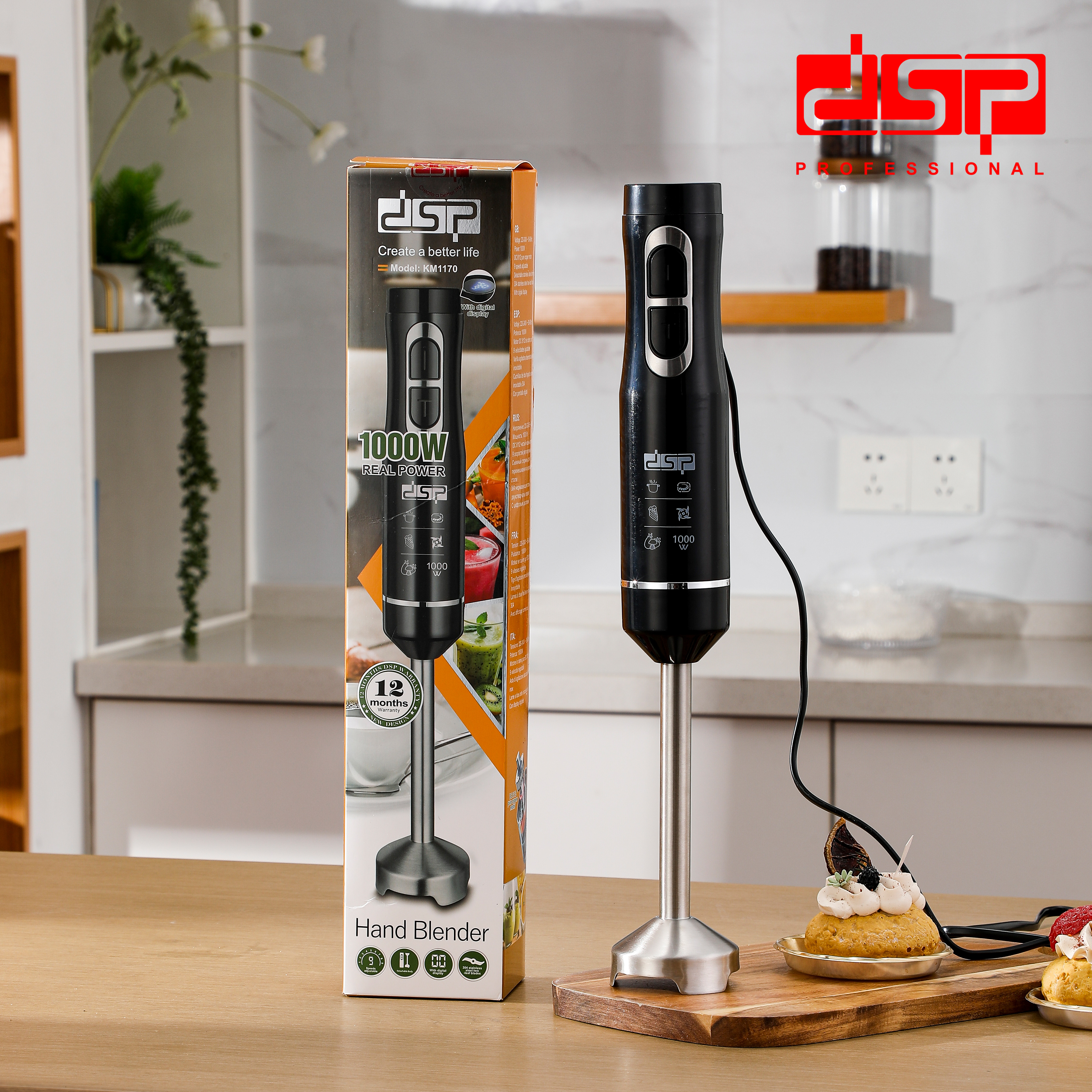
The KM1170 shows what "higher-power hand mixer" means in practice: a 1,000W DC 8112 pure copper motor, six adjustable speeds, a detachable stainless steel stirring rod, 304 stainless steel two-leaf blades and a digital display. In a 200-piece project covering daily meal preparation, baking and smoothie making over five years, the recorded outcome was efficient mixing and smooth blending. For buyers, the digital display is a merchandising point rather than a performance one.
Entry-class retail programmes — hand mixers KM1140U and KM1149
Not every programme needs 1,000W. The KM1140U is a 500W hand mixer with two-speed control, a 5724 pure copper motor, stainless steel two-leaf blades, a detachable stirring rod and a metal bearing; a 400-piece project for food mixing, smoothie making and egg whisking has been in use for five years. The KM1149 sits in the same class at 500W with two-speed control and low-noise operation, and was supplied in a 400-piece project for food mixing and smoothie making, also in use for five years. For distribution programmes, both models show that the entry class can still carry documented multi-year field use.
Small bakery, café or heavy home baking — planetary mixers
When the mixing job moves to repeated batches and dough, the decision shifts to planetary models. The KM3057 combines a 1,600W motor, a 7L stainless steel mixing bowl, an eight-speed rotary switch, planetary rotation and a lifting mechanism with a safety switch. The KM3031 pairs a 1,300W motor with a 6.5L stainless steel bowl, six speeds plus pulse, a tilt-up head with a head safety lock, a stated operating noise level below 80 dB and a detachable transparent lid with a fill hole. The KM3030 uses a 1,000W motor and a 5.0L stainless steel bowl with electronic stepless speed control and a pouring chute on the cover.
For a buyer comparing these against hand mixer SKUs, the practical question is not which format is more capable, but which matches the batch size and session length of the intended user — and whether the supplier can support both categories on the same programme.
Frequently Asked Questions
- Are DSP mixers documented for EU market compliance?
- Yes, for the hand mixer models covered by the certificates reviewed for this article. The DSP hand mixer KM2141 is covered by Verification of Conformity certificate WTA24F08188711E issued by Waltek on 26 September 2024 and valid until 26 September 2029, citing EN IEC 55014-1:2021, EN IEC 55014-2:2021, EN IEC 61000-3-2:2019+A1:2021 and EN 61000-3-3:2013+A1:2019+A2:2021. The food mixer KM1180 is covered by Intertek Test Verification of Conformity 230100266HAN-V1, issued 23 April 2023 and valid until 23 April 2028, and the variable-speed blender KM1193 by BV attestation N*2466AS07CGTA55663, issued 13 December 2024 and valid until 13 December 2029, citing EN 60335-2-14, EN 60335-1 and EN 62233. Buyers should always confirm that the certificate scope names the exact model being ordered.
- Can DSP produce both hand mixers and stand mixers as an OEM/ODM partner?
- Yes. DSP's documented production mode is OEM/ODM, with customization of design, size, logo and material supported by a 30-engineer R&D team inside a 20,000 m² facility with annual output of 5,000,000 units. The mixer range spans hand mixers from 200W (KM2141) to 1,500W (KM1193) and planetary stand mixers from the 350W, 3.2L-bowl KM3034 to the 1,600W, 7L-bowl KM3057. Quality control is 100% test.
- What are the minimum order quantity and production capacity?
- For OEM/ODM production, DSP lists a minimum order quantity of 500–1,000 pieces and monthly capacity of 50,000–100,000 pieces. Alongside that, purchasing documentation records a minimum order of 1 unit with EXW/FOB delivery terms and TT payment, which is relevant for trial or sample-scale orders before a production commitment.
- Can we validate a mixer before placing a full production order?
- Yes. DSP's purchasing data records a 1-unit minimum order under EXW/FOB terms, plus acceptance through online inspection and acceptance and pre-shipment inspection and acceptance, with 100% test quality control in production. That combination lets a buyer check build, accessories and packaging against the specification sheet before scaling up. Sample and quotation requests can be sent to sales-3@dsplife.cn.
- What is the production lead time, and how long do these products stay in service?
- DSP lists a production lead time of 30–40 days with one year of after-sales support, and exports to more than 100 countries. Documented mixer projects show longer field life than the production cycle suggests: hand mixer programmes for the KM2046 (200 pieces), KM1170 (200 pieces), KM1140U (400 pieces) and KM1149 (400 pieces) have each been in use for five years. If you would like to evaluate a specific model against your own batch-size and duty-cycle requirements, you can request a quote or catalogue through the contact details below.
Next Step: Sample, Quote or Catalogue
If you are specifying hand mixers, stand mixers or a combined range for your market, DSP can support the process from model selection through sample validation to production. Contact: Maggie — Email: sales-3@dsplife.cn | Phone / WhatsApp: +86 13958409699 | Website: www.dsp-official.com
Download the full product brochure here: DSP home appliances product brochure (PDF).
Conclusion: Decide by Usage Pattern, Then Verify the Specification
The hand mixer versus stand mixer decision is not a question of which appliance is better, but of which pattern of use you are buying for. Short, light and occasional mixing points to a hand mixer; frequent, heavier or hands-free mixing points to a planetary stand mixer. Within DSP's range, that maps from the 200W KM2141 and 250W KM2046 through the 1,000W KM1170 to the 1,500W KM1193 on the hand mixer side, and from the 350W, 3.2L KM3034 to the 1,600W, 7L KM3057 on the planetary side.
Once the format is settled, the specification becomes checkable rather than debatable: motor type and speed range, accessory set, bowl capacity where relevant, the EU documentation that names the exact model, and — for buyers — MOQ, capacity, lead time, quality control and after-sales terms. Comparing those items against the intended usage pattern is what turns a specification sheet into a decision.