
Stand Mixer vs Hand Mixer vs Planetary Mixer: A Buyer’s Guide for Home and Small Business Kitchens
Stand Mixer vs Hand Mixer vs Planetary Mixer: A Buyer’s Guide for Home and Small Business Kitchens
When you start comparing electric mixers, the categories can sound similar: stand mixer, hand mixer, planetary mixer, food mixer, dough mixer. This guide explains how the categories differ, which questions should drive your choice, and how the same product families appear in a real appliance range. DSP, a Yiwu-based appliance maker founded in 2006 and exporting mainly to North America, South America, Europe, Asia, Africa, Oceania and the Middle East, offers examples in each mixer family. The DSP portfolio relevant here includes the hand mixer KM2078, the stand mixer or food mixer KM3031, and the 7-litre dough mixer KM3057, each classified by DSP in a slightly different way.
Why the stand mixer vs hand mixer vs planetary mixer question matters
Consumers and small business buyers often search for a simple answer to an imprecise problem. Some online articles use “stand mixer” to mean any mixer with its own support, while manufacturers use terms such as “planetary mixer” to describe a specific type of mixing action inside that support. Two identical-looking machines can belong to different workload classes.
For a practical purchasing decision, the better question is not which name is most popular. The better question is: what do you mix, how often, in what batch size, and under what space or budget limit? That is why the comparison is best approached as a constraint-matching exercise, not a brand popularity exercise.
- Hand mixers are normally held over your own bowl and stored in a drawer or on a small base.
- Stand mixers and food mixers have a fixed housing and a dedicated bowl, freeing both hands.
- Planetary mixers use a planetary rotation design, where the mixing attachment is positioned so that mixing can be more thorough. In the DSP catalog reviewed for this guide, both KM3031 and KM3057 carry the planetary mixer type label, while KM3057 is named a dough mixer.
In the following sections, we compare representative catalog models rather than vague category averages. Keeping specification facts next to product names makes it easier to map your batch size, power expectation and budget to an actual configuration.
How much market context matters for a mixer purchase
The small kitchen appliance category continues to receive attention from consumers and channel buyers. Grand View Research estimated the global household appliances market at USD 461.69 billion in 2024. Fortune Business Insights projected the global small domestic appliances market to reach USD 222.52 billion by 2026, growing at a CAGR of 4.92 percent. Within that wide category, mixers sit among the everyday food-preparation tools used by home kitchens, bakeries, catering businesses and food service operations.
Market size alone does not tell you whether to buy a hand mixer or a planetary mixer. But it does explain why suppliers such as DSP arrange their product lines around several price and power levels instead of offering one universal mixer model.
Option 1: Hand mixer — the portable, flexible starting point
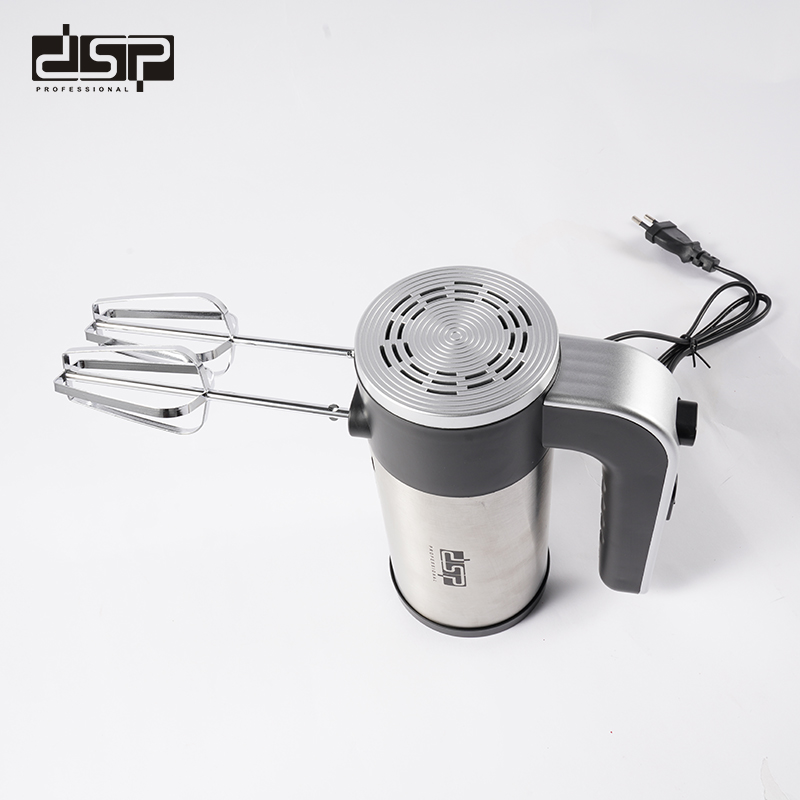
DSP’s hand mixer range includes multiple models. The representative model in this guide is the KM2078. Its key published specifications are a 220–240V~50/60Hz power supply, 400W output, a 5535 full copper AC motor, 5 speeds, 2 pairs of chromed mixing beaters and dough hooks, an ABS body covered with metal housing, and a storable base.
What does this mean practically? A 400W hand mixer with both beaters and dough hooks can handle typical home tasks such as egg whites, cream, frostings, softer batters and small dough jobs. Because it has no bowl or motor housing sitting on the counter, it is compact and easy to store. The listed housing is ABS covered by metal, which keeps weight relatively low.
DSP also publishes other hand mixer models around similar usage levels. For example, KM2046 is a 250W hand mixer with 5 speeds and a 5525 full copper motor; KM2073 is a 200W hand mixer with 5 speeds and turbo; KM2135 is a 200W hand mixer with 5 speeds and a one-click acceleration function. Across these models, motor construction tends to be described as full copper, and accessories include chrome-plated or stainless-steel beaters and dough hooks.
Option 2: Stand mixer / food mixer — more power, dedicated bowl, planetary classification
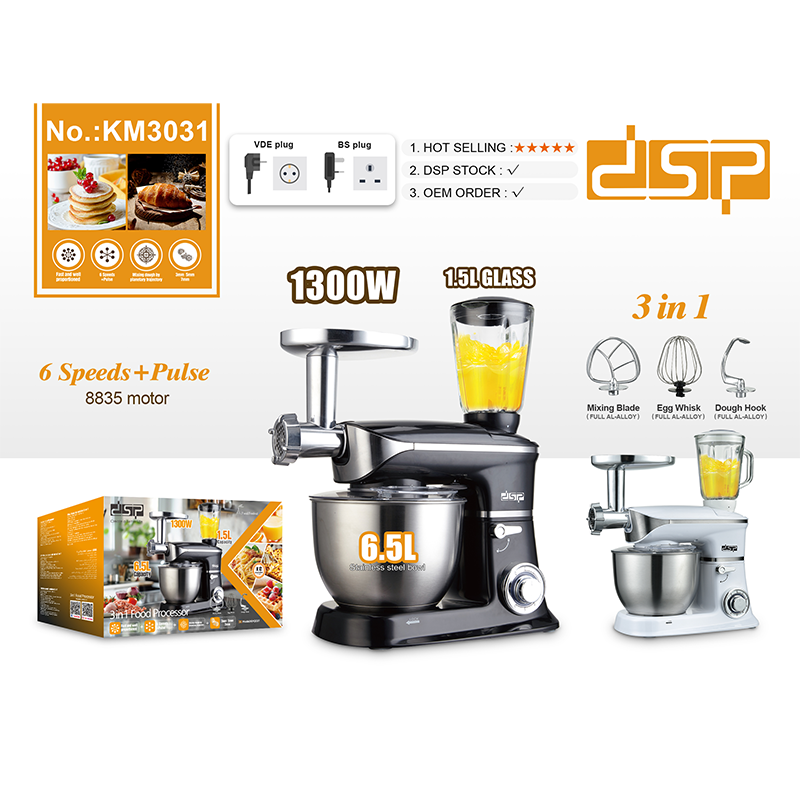
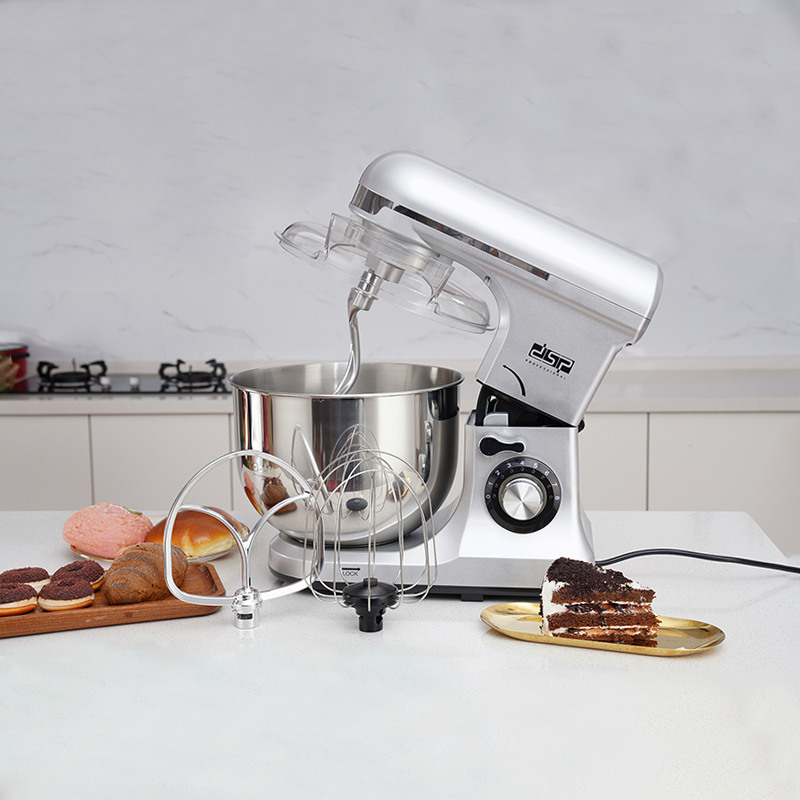
When a buyer moves beyond a hand mixer, the next step is normally a machine with its own stand and fixed bowl. In DSP’s published specification list, the KM3031 is named a stand mixer / food mixer and its type is listed as planetary mixer. This overlap is useful to see: a stand mixer does not have to be a low-powered novelty, and a planetary classification can appear in a domestic kitchen machine.
The KM3031 specifications include 220–240V~50/60Hz, 1300W output, a 6.5L stainless-steel bowl, an 8835 copper-clad aluminum motor, a noise level below 80dB, a head safety lock, a tilt-up head for easier accessory changes, 6 speeds plus pulse, a detachable transparent lid with a hole for adding ingredients while mixing, and detachable attachments including a full Al-alloy dough hook, whisk, full Al-alloy flat beater and spatula. The published applicable industries for this model are household and commercial kitchen use.
DSP’s range also includes smaller stand or planetary models for buyers with lighter loads or tighter budgets. KM3034 is listed as a planetary mixer with a 350W full copper 5530 motor with thermostat, 5 speeds with an ejection button, an adjustable and rotative bowl position, a 3.2L bowl, ABS housing and a 201 stainless-steel bowl. KM3058 is listed as a household stand mixer with a 400W 5535 full copper AC motor, a 4.0L rotating SUS201 bowl, 5 speeds, two pairs of chromed mixing beaters and dough hooks, ABS body with metal housing and an ABS stand.
These two compact examples show that a buyer can step into the stand-mixer category without assuming every stand mixer needs a 1300W motor.
Option 3: Planetary dough mixer — high-power batch mixing for food service and bakery
DSP’s KM3057 is named a dough mixer and its type is planetary mixer. It takes the buyer into a different workload class: 1600W output, 220–240V~50/60Hz, a 7L stainless-steel mixing bowl, an 8840AC copper-clad aluminum motor, an 8-speed rotary switch, a transparent bowl cover with an easy-fill window, a lifting mechanism with a safety switch, planetary rotation design, steady structure design, and anti-slip feet. Its applicable industry field lists food service, bakery and hospitality.
For a small bakery, café or food service operator, the practical advantages are visible in the specification sheet. The 7L bowl is approximately the largest bowl in the DSP mixer models covered by this guide. The 1600W motor and lifting mechanism are described for stable, safer batch operation. The planetary rotation design is listed as a feature for thorough and safe mixing.
Where the hand mixer and immersion blender lines add versatility
One more class appears in DSP’s mixer-related catalog: hand mixers that work as immersion blenders. These are not the same as a beater-style hand mixer, but they are useful to mention because buyers often compare “hand mixer” against “blender” in the same shopping session.
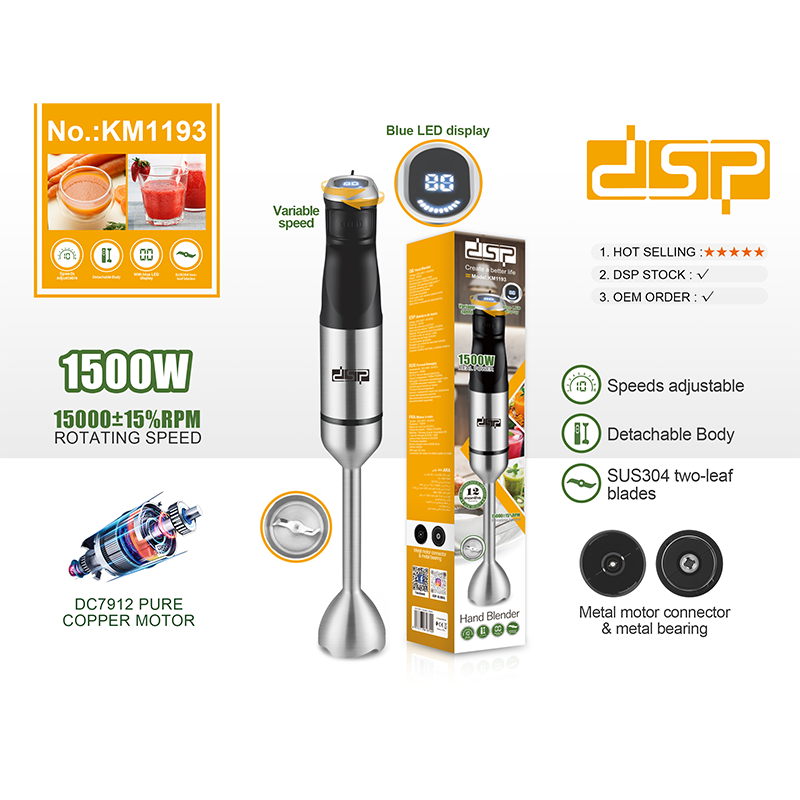
For example, KM1193 is a hand mixer / immersion blender with 220–240V~50/60Hz, 1500W output, a DC7912 pure copper motor, 15000±15% RPM, a 430 stainless-steel panel, SUS304 blending rod, ABS housing, SUS304 two-leaf blades, 10 adjustable speeds, push-button variable speed control and blue LED display. Another model, KM1150, uses a 1000W 7812 all-copper motor with a variable speed regulator and stainless-steel four-leaf blades. These products extend the mixer concept into soups, sauces and drinks prepared in a pot or measuring cup rather than in a stand mixer bowl.
For the purpose of a hand vs stand vs planetary comparison, the immersion blender line is a reminder that “hand” covers two convenience-focused arrangements: a hand-held beater mixer and a hand-held blending shaft. A buyer who needs mostly whipping should consider a beater hand mixer. A buyer who needs mostly liquids should consider an immersion blender model. A buyer who needs large batches of dough should consider a planetary or dough mixer.
Side-by-side specification comparison
| Specification | DSP KM2078 Hand Mixer | DSP KM3031 Stand Mixer / Food Mixer | DSP KM3057 Dough Mixer |
|---|---|---|---|
| Voltage | 220-240V~50/60Hz | 220-240V~50/60Hz | 220-240V~50/60Hz |
| Power | 400W | 1300W | 1600W |
| Motor | 5535 full copper AC motor | 8835 copper-clad aluminum motor | 8840AC copper-clad aluminum motor |
| Bowl | No dedicated bowl; used with user’s mixing bowl | 6.5L stainless-steel bowl | 7L stainless-steel mixing bowl |
| Speeds | 5 speeds | 6 speeds + pulse | 8 speeds, rotary switch |
| Mixer type / action | Hand-held beater and dough-hook operation | Classified by DSP as planetary mixer; tilt-up head for accessory access | Planetary rotation design; lifting mechanism |
| Attachments and extras | 2 pairs of chromed mixing beaters and dough hooks; storable base | Detachable full Al-alloy dough hook, whisk, flat beater, spatula; detachable transparent bowl lid | Transparent bowl cover with easy fill-in window; steady structure design |
| Safety-related listing | Not specified in the reviewed product sheet | Head safety lock | Lifting mechanism with safety switch; anti-slip feet |
| Applicable industries | Food and beverage / home appliance | Household / commercial kitchen | Food service / bakery / hospitality |
This table intentionally uses only specifications published in the DSP product content units. It does not assign prices or claim one model is more reliable than another. The right comparison is based on your own batch size, ingredient type and usage frequency.
Step-by-step buyer breakdown
Step 1: Define your mixing workload
Write down the tasks you will do most often. Whipping eggs or cream, mixing cake batter, kneading bread dough and blending soup place very different demands on a motor. A 400W hand mixer is a reasonable match for lighter, occasional mixing. A 1300W stand or planetary model can take larger batters and repeat sessions. A 1600W dough mixer targets regular dough production for food service or bakery use.
Step 2: Match bowl capacity to batch size
If you regularly mix more than the capacity of a small bowl, a 6.5L or 7L machine can reduce the number of batches. In DSP’s lineup, the compact stand mixers KM3034 and KM3058 offer 3.2L and 4.0L bowls respectively. The KM3031 offers 6.5L. The KM3057 offers 7L. For home bakers who make one or two loaves at a time, the smaller machines may be enough. For small commercial bakers, the larger models reduce the need to split dough into several runs.
Step 3: Check the power supply
All three representative DSP models are listed at 220–240V~50/60Hz. If your facility uses this common voltage, the catalog specification is directly readable. If your market uses a different voltage or frequency, you need to raise that constraint before selecting a model. The published DSP capability unit confirms that DSP accepts OEM/ODM requests with customization options such as design, size, logo and material, so a buyer can raise technical requirements during the inquiry stage.
Step 4: Compare speed structures
The DSP models in this article offer 5 speeds, 6 speeds plus pulse, or 8 speeds on a rotary switch. More speeds are not automatically better, but they can help match a machine to different tasks. A pulse setting is useful for short bursts. A rotary switch with more positions gives finer control. Decide how many speed ranges your recipes require before choosing a machine.
Step 5: Review materials and food-contact parts
The published sheets cite stainless-steel bowls, ABS bodies, metal housings, copper or copper-clad motors, chromed accessories and Al-alloy attachments across different models. For food contact, the stainless-steel bowl in KM3031, KM3057 and the stainless or chrome-based accessories in several DSP mixer models are direct specification points. Check which accessories actually touch food and whether they are detachable and easy to clean before purchase.
Step 6: Match machine to space and storage
A hand mixer such as KM2078 usually stores flat or on a small base. A stand mixer or planetary machine occupies permanent counter space when not in use. The KM3057 is a large 7L machine with a metal-motor class designed for steady work; it is not a tool you will want to move in and out of a cabinet for every bowl of frosting. A small café with limited counters should measure the footprint and lifting mechanism of a planetary mixer before buying.
Use cases by actual kitchen scenario
Home baker who whips and mixes in small batches
A home baker who makes cakes, meringues and pancake batter can be well served by a hand mixer. The KM2078’s 400W motor, 5 speeds, chromed beaters and dough hooks cover a typical home mixing range. The unit stores inside a small space, which matters in a domestic kitchen where counter space is scarce.
Enthusiast baker who makes multiple loaves per week
For someone who moves beyond mixer-size batches and wants the mixer to work while the cook does something else, the KM3031 gives 1300W, a 6.5L stainless-steel bowl and a tilt-up head. The listed head safety lock and detachable transparent lid add practical value during longer mixing. Its planetary type classification also places it in the segment that DSP associates with thorough planetary rotation.
Small bakery or food service operation making dough regularly
The KM3057 is aimed at food service, bakery and hospitality environments. With 1600W, 7L capacity and planetary rotation design, it is intended for larger and more frequent dough preparation. The lifting mechanism with safety switch is a relevant design point for daily kitchen workflow, since a heavy bowl and dough hook are easier to manage when the machine supports the lifting motion.
Retail or brand partner replenishing a product line
DSP’s application case content includes examples of stand and hand mixers ordered in batch quantities by home appliance brands, retailers and household or commercial kitchen users. One case references DSP KM3034 units for bread dough kneading and cake batter mixing, with repeated supply over a five-year period. Another references KM2092 hand mixers for food mixing, dough preparation and egg whisking. These examples indicate that mixers are not only one-off consumer purchases; they are also regular ODM and distribution products.
What about custom sourcing, samples and lead time
DSP describes its production mode as OEM/ODM, with customization covering design, size, logo and material. The published monthly capacity is 50,000 to 100,000 pieces, and the typical lead time is 30–40 days after order confirmation. The usual MOQ range stated in the capability unit is 500 to 1,000 pieces. Quality control is described as 100% test, and the after-sales period is listed as one year.
Buyers who cannot meet the MOQ or who need a single retail unit should clarify the sales channel before planning. The DSP team can provide a catalog and direct inquiries to the appropriate distribution route.
Frequently asked questions
1. Are DSP mixers certified for European markets?
Certification is model-specific in DSP’s published compliance files. EU-market conformity documents are available for selected hand mixer and food mixer models. For example, the KM2046 hand mixer is covered by a TUV Attestation of Conformity, and the KM2073 hand mixer is covered by a Waltek verification of conformity. The documents name standards such as EN IEC 55014-1, EN IEC 55014-2, EN IEC 61000-3-2 and EN 61000-3-3 for electromagnetic compatibility. A buyer planning to import planetary or stand mixers should request the safety and EMC reports for the exact model number and target voltage; compliance cannot be assumed from the machine’s category name alone.
2. What power and bowl capacity options are available in DSP’s mixer range?
DSP’s mixer-related catalog includes models from 200W to 1600W. The compact stand or planetary models include KM3034 at 350W with a 3.2L bowl and KM3058 at 400W with a 4.0L rotating bowl. The larger stand mixer KM3031 is listed at 1300W with a 6.5L bowl. The dough mixer KM3057 is listed at 1600W with a 7L bowl. Hand mixer models such as KM2046, KM2073 and KM2135 are listed in the 200W–250W class, while KM2078 is listed at 400W. For immersion blender functions, models such as KM1193 reach 1500W.
3. Which mixer type is more budget-friendly for a small user?
No public price list appears in the product corpus used for this guide, so budget should be evaluated by comparing capability and workload, not by advertised price. A hand mixer is usually the more flexible low-entry tool because it uses less material and eliminates the counter stand. If your usage is occasional and light, a hand mixer may be sufficient. If you need to bake larger batches, a stand or planetary mixer can avoid the risk of moving to a second machine too soon. DSP’s compact KM3034 and KM3058 models give smaller buyers an intermediate step between a hand mixer and a 1300W or 1600W machine.
4. Can buyers request a sample before placing an order?
Sample requests, quote requests and OEM/ODM inquiries are directed to the DSP sales team. Product brochures and model specifications are shared during the inquiry stage. The typical production MOQ in the capability unit is 500–1,000 pieces, so buyers who need samples or smaller pilot quantities should explain their project scope to the sales team and confirm the available arrangement for the target market. Contact options are provided in the closing section of this article.
5. What are DSP’s usual lead time and order conditions?
DSP’s capability data states a monthly capacity of 50,000–100,000 pieces and a typical lead time of 30–40 days. Customization covers design, size, logo and material, and the stated MOQ range is 500–1,000 pieces. Quality control is described as 100% test. Buyers should combine these data points with specific model, packaging and destination requirements, because the final schedule depends on production load and ordering season.
Selection summary. Choose a hand mixer when your loads are light, storage is limited and portability is valuable. Choose a compact stand or planetary mixer when you want hands-free mixing at home. Choose a 6.5L or 7L planetary machine when batch size, dough stiffness or daily frequency moves you into commercial kitchen territory.
Want the full product range?
You can download the current DSP brochure below and contact the DSP team for specifications, samples or OEM/ODM quotations.
Email: sales-3@dsplife.cn
WhatsApp: +86 13958409699
Download DSP brochure (PDF)