
Top-Rated Home Mixers for Everyday Kitchens: Picks by Category
Top-Rated Home Mixers for Everyday Kitchens: Picks by Category

An everyday kitchen rarely needs one mixer. It needs three: a hand mixer for short, light jobs such as whipping cream or a single cake batter; a stand mixer that holds torque through a full dough; and an immersion blender for soups and sauces finished directly in the pot. This shortlist follows those three categories instead of pretending one model covers everything, and it ranks the DSP models that earn a place on three practical criteria — design simplicity, motor reliability and ease of cleaning.
Every model named below — KM2135, KM2143, KM1157, KM1153, KM1195, KM1193, KM3030 and the wider KM21xx hand mixer family — is a documented DSP product, and every specification quoted is taken from the product data attached to it. Where a category has limits, those limits are stated too, because a shortlist that hides trade-offs is not useful at the evaluation stage.
Why the "Best Mixer" Question Is Really a Category Question
Mixer shopping usually starts with a number: watts, speeds or bowl litres. The number that decides satisfaction is the load the tool is expected to carry. Whipping egg whites is a low-torque, high-speed job. Kneading dough is the opposite — it needs sustained torque at low speed, and it is where a hand mixer becomes the wrong tool rather than a weak one. Pureeing soup in a pot is a third job entirely, because the working end of the tool has to reach into the vessel.
Category mismatches fail in predictable ways:
- A hand mixer used on stiff dough runs hot, stalls, or climbs the bowl — an application problem, not a product defect.
- A stand mixer used for a single cup of whipped cream is capable but inefficient, and it occupies counter space for a two-minute task.
- A jar blender used for hot soup moves food into a second vessel and adds cleaning steps that an immersion blender removes.
Cleaning is the second half of the problem and the half most often under-weighted in evaluation. A mixer is used for minutes and cleaned for minutes afterwards. The design details that decide whether cleaning is quick are specific and checkable: whether the beaters eject with a single button, whether the shaft detaches from the motor body, whether the contact parts are stainless steel, and whether the housing is wipe-clean or needs scrubbing. DSP's hand mixers list an eject button across the family, and the KM2143 goes further with a tempered glass shell described as high temperature resistant, impact resistant and easy to clean. Those are exactly the details this shortlist weighs.
Where These Mixers Sit in the Appliance Market
Mixers compete inside a category that keeps expanding. Fortune Business Insights projects the global small domestic appliances market to reach USD 222.52 billion by 2026, growing at a CAGR of 4.92%, while Grand View Research values the narrower small kitchen appliances market at USD 39.6 billion in 2025. The commercial consequence is straightforward: more models, more overlap, and a stronger need for buyers to organise assortments by application rather than around a single flagship product.
DSP home appliances — Yiwu DSP Electric Appliance Co., Ltd. — is a Chinese manufacturer of small home appliances established in 2006 and based in Yiwu. Its production base covers 20,000 m², employs 130 people, runs a 30-engineer R&D team and produces 5,000,000 units annually; 100% of output is exported, reaching North America, South America, Europe, Asia, Africa, Oceania and the Middle East. The range spans mixers, blenders, food processors, air fryers, ovens, coffee machines and further kitchen and cleaning appliance categories — the breadth that makes a category-by-category mixer shortlist possible in the first place.
DSP Mixer Recommendations by Category
Three categories, three different definitions of "top-rated". A hand mixer earns its place by being quick, light and easy to rinse. A stand mixer earns its place by holding torque through a long knead. An immersion blender earns its place by going where the food already is.
Category 1 — Hand Mixers for Light, Short Tasks
KM2135 (200W). The KM2135 is a 200W hand mixer built on a 4515 motor with five adjustable speeds, a turbo function and a one-click acceleration button. The body combines a stainless steel decoration with ABS, and the set includes two 170mm chrome-plated egg beaters and two chrome-plated dough hooks. It takes the top slot in this category for design simplicity: the control set needs no explanation, and the eject button releases the beaters for immediate rinsing. The model is documented in a 200-unit, five-year project for baking, egg whipping and dough kneading with home bakers and culinary enthusiasts.
KM2143 (250W, 5525 pure copper motor). Where the KM2135 optimises for simplicity, the KM2143 adds motor headroom and a tempered glass shell that the product data describes as high temperature resistant, impact resistant and easy to clean — a real difference for anyone who has scrubbed dried batter off a plastic housing. It keeps five speeds, turbo, one-click acceleration and an eject button, adds a logo with indicator light, and ships with two 180±5mm egg beaters and two dough hooks. A 500-unit project over five years applied it to food mixing, dough kneading and egg whipping.
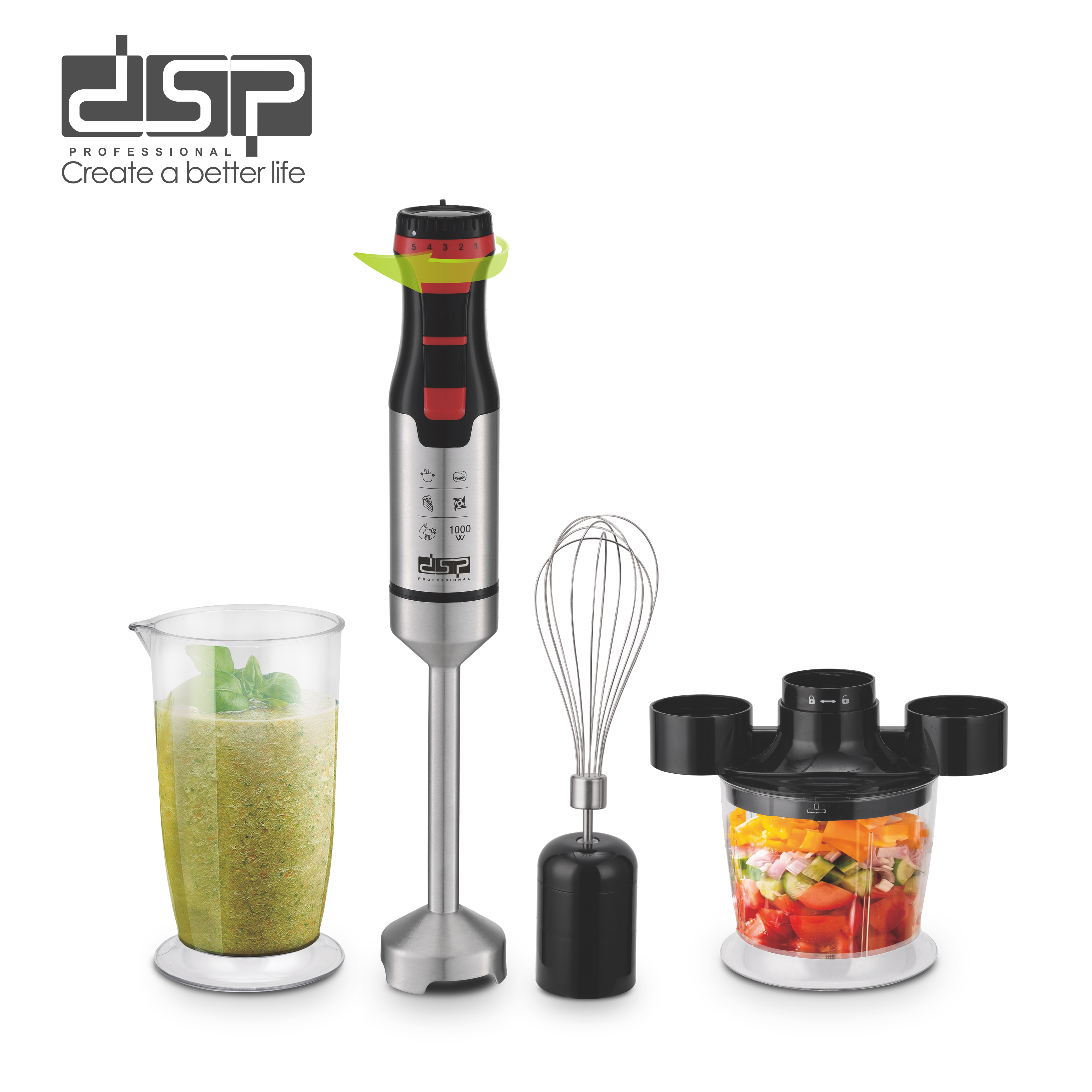
KM1157 (1000W, variable speed). This model is the step up when hand mixing moves from light batters to heavier mixtures. It pairs a 7912 DC full copper motor with a variable speed regulator and a turbo function, plus a detachable stainless steel stir bar and stainless steel four-leaf shaped blades. Its accessory set — accessory holder, 500 ml grinder cup, 700 ml measuring cup, gearbox and stainless steel egg whisk — turns it into a compact multi-task tool rather than a single-purpose beater. It is documented in a 200-unit project for food processing and kitchen mixing, with 1000W power, turbo function and stainless steel blades as the stated highlights.
Also worth shortlisting in this category: the KM2141 (200W, 5525 pure copper motor, stainless steel shell with ABS, five speeds, turbo, eject button) and the KM2136 (200W, 5525 pure copper motor, ABS body), both supplied with 180mm egg beaters and dough hooks; and the higher-output KM1172 (1500W, DC 8112 pure copper motor) and KM1173 (1000W, DC 8112 pure copper motor), which add detachable stainless steel stirring rods and 304 stainless steel two-leaf blades — with the KM1173 also listing a spherical gearbox, egg beater, 700 ml measuring cup, 0.5 L meat grinder cup and milk frother bar.
Category 2 — Stand Mixers for Baking
KM3030 (1000W, 5.0 L, planetary). The KM3030 is the model that carries the baking category. It specifies 220–240V ~ 50/60Hz input, 1000W output, a 5.0 L stainless steel bowl, an 8830 copper clad aluminium motor and a special robust gear mechanism, with planetary rotation for thorough mixing. Practical design choices follow from that: a detachable transparent bowl cover prevents splash, a pouring chute in the cover lets the baker add ingredients while mixing, and the kneading hook, whisk and flat beater all detach for cleaning. Electronic stepless speed control replaces fixed steps, the head tilts up for easy removal of the bowl, and a head lock button adds safety. Housing materials are stainless steel, copper clad aluminium, plastic and die-cast metal, and the stated application is food and beverage, catering and bakery use.
Why it earns its place: planetary rotation plus a robust gear mechanism is the combination that delivers torque to a stiff dough without asking the user to hold the machine, and stepless electronic control lets the user match speed continuously instead of jumping between five fixed settings. The bowl cover and pouring chute reduce the flour cloud that usually defines home baking cleanup.
The limits are worth stating plainly. A planetary mixer is a stationary appliance that occupies counter or shelf space, and its stainless steel bowl and die-cast components make it heavier than any hand mixer in this list. It earns its place only if kneading and larger batches are part of the routine; for a single cup of cream, a hand mixer is the faster answer.
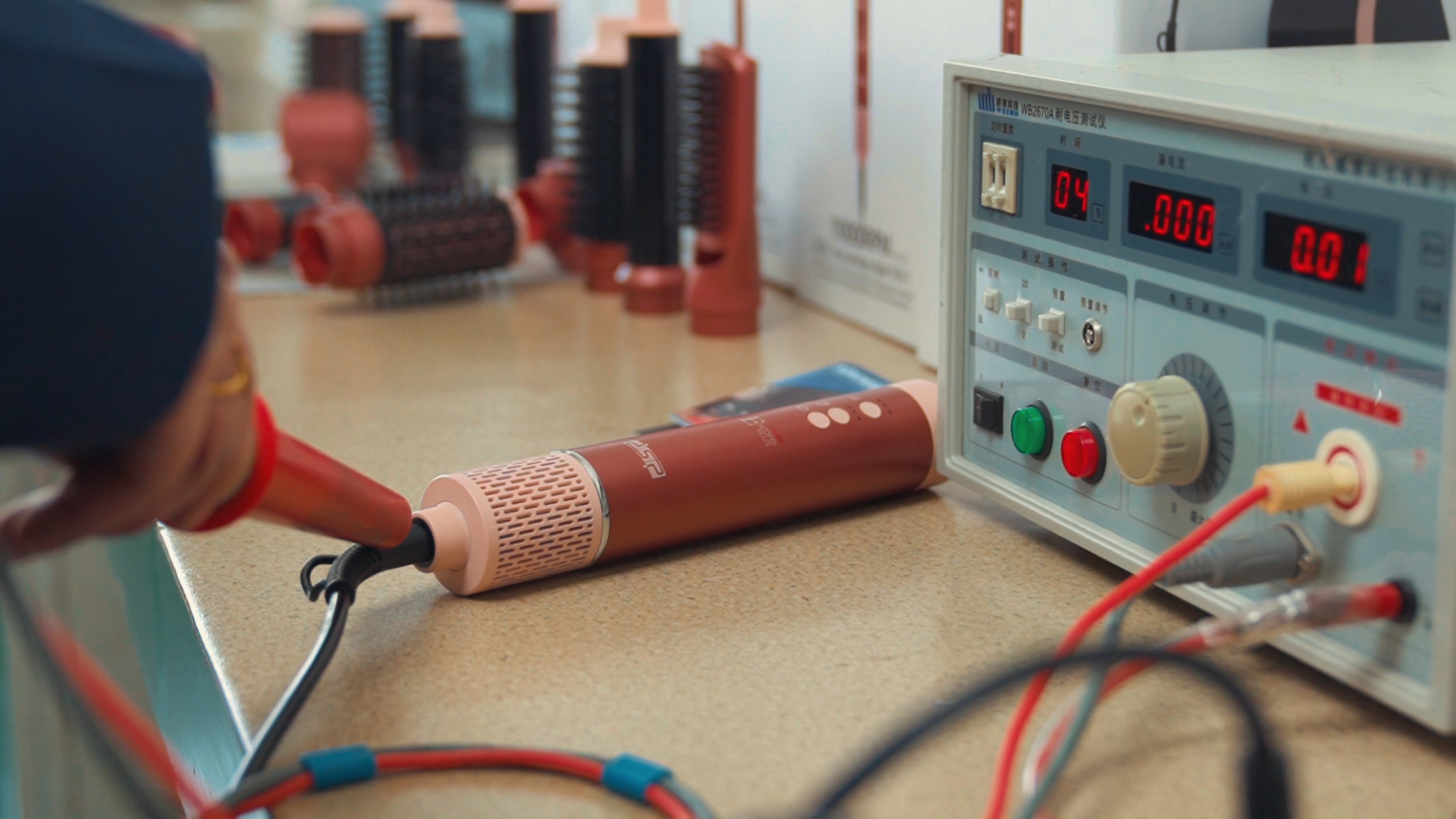
Compliance here is documented rather than implied: the KM3030 food mixer holds CB test certificate FI-44401/M2 issued by SGS, covering food mixers against IEC 60335-2-14:2006 with amendments 1 and 2, valid until 4 April 2028. On the supply side, 200 pieces of a planetary mixer were supplied over a five-year project to commercial kitchen, hotel and bakery clients across multiple countries.
Category 3 — Immersion Blenders for Soups and Sauces
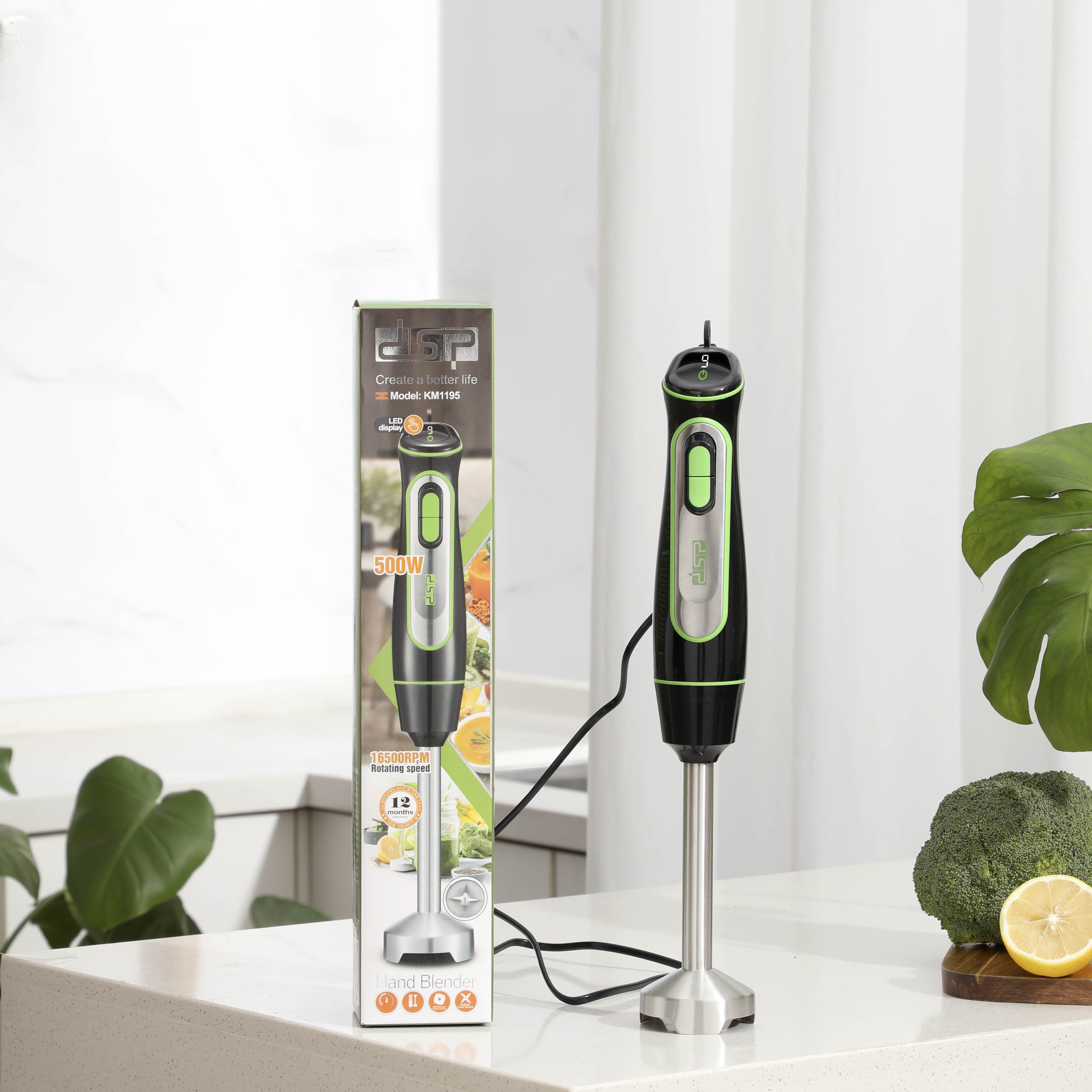
KM1195 (500W, 16,500 RPM). The KM1195 is the reference model for in-pot work. It runs a DC5512 pure copper motor at 16,500 RPM, with a SUS430 panel, SUS304 stirring bar, ABS and PP housing, a detachable 304 stainless steel stirring bar and 304 stainless steel four-leaf blades. Speed is set through electronic touch control across six speeds, an LED display shows the setting, and a metal bearing plus safety lock round out the design. The case record for this model covers 500 pieces used for food preparation, smoothie making and sauce mixing over a five-year project, with consistent mixing results, efficient pureeing, quiet operation and LED touch control as the reported highlights — two of which matter most in this category, because soup and sauce work is long-running and repetitive.
KM1193 (1500W, 15,000±15% RPM). For higher-volume pureeing, the KM1193, listed as a hand mixer and immersion blender, raises output to a DC7912 pure copper motor running at 15,000±15% RPM, with ten adjustable speeds, push-button variable speed control, a blue LED display, a 430 stainless steel panel, a SUS304 blending rod, a metal motor connector and a metal bearing. The metal connector and metal bearing are the durability details to check when a blender is used daily rather than occasionally.
KM1153 (1000W). A stainless steel body, 7912 pure copper motor, two speeds plus turbo and variable speed control, a removable stainless steel stirring bar and four-leaf blades give the KM1153 a compact profile; the accessory set — SUS304 beaten egg net, SUS304 milk frothing bar, 500 ml PC grinder cup and 600 ml measuring cup — covers whipping and frothing as well as pureeing. Its EU conformity documentation, Verification of Conformity EFSH202212-L032 issued by Eurofins, runs to 12 December 2027.
Lower in the range, the KM1117 (700W, DC7712 full copper motor, stepless speed change, stainless steel body, four-leaf shaped blades, detachable rod) and the KM1143 (200W, 5512 full copper DC motor, speed control with turbo, removable steel feet, titanium-plated blades and a stainless steel four-blade ice crusher) cover lighter blending and mixed tasks; the KM1143 case also lists a 500 ml meat grinder cup, an egg beater and a 700 ml measuring cup.
Decision rule for the three categories: if the mixture can be lifted into a bowl, use a hand mixer; if the mixture has to be kneaded on a bench for several minutes, use the planetary stand mixer; if the food is already hot in a pot, use an immersion blender with a detachable stainless steel rod.
How to Evaluate and Choose: A Five-Step Breakdown
- Define the job before the model. Write down the three most frequent tasks — for example "whipping egg whites twice a week, kneading dough once a week, pureeing soup twice a week". Each maps to a category: hand mixer, stand mixer, immersion blender. Model selection only makes sense after that mapping.
- Match the motor to the load. Compare motors within a category, not across it. In the DSP hand mixer range that means 4515 and 5525 motors at 200W and 250W in the KM2135, KM2141, KM2136 and KM2143, and 7912 or 8112 DC full copper motors at 1000W to 1500W in the KM1157, KM1153, KM1173 and KM1172 for heavier mixtures. In the blending range it means DC5512 at 500W (KM1195) through DC7912 at 1500W (KM1193).
- Audit the cleaning path. Ask four questions: does the beater eject with one button; does the shaft or rod detach from the motor body; are the contact parts stainless steel (SUS304 or 304 stainless steel in the documented models); and can the housing be wiped? The KM2143's tempered glass shell and the KM1195's detachable SUS304 stirring bar are the two clearest examples of cleaning designed in rather than added on.
- Check the control logic against the user. Five speeds plus turbo plus one-click acceleration (KM2135, KM2143) suits users who want predictable steps. Electronic stepless control (KM3030) and electronic touch control with six speeds and an LED display (KM1195) suit users who want to dial in a result. Both are correct; they fit different kitchens.
- Verify documentation and commercial terms. Match the certificate scope and model number to the exact model being ordered, not to the brand. Then confirm the commercial frame: DSP's documented programme covers OEM/ODM customisation of design, size, logo and material, monthly capacity of 50,000–100,000 pieces, a lead time of 30–40 days, MOQ of 500–1,000 pieces, 100% testing and one year of after-sales support.
Use Cases: Matching the Shortlist to Real Kitchens
- Weekly home baking. KM2143 for egg whites, cream and light batters; KM3030 for dough and larger batches. Two tools, one bench.
- Everyday household cooking. KM2135 for quick mixing, KM1195 for soups and sauces finished in the pot, with a detachable SUS304 stirring bar that rinses under the tap.
- Sauce- and soup-heavy kitchens. KM1193 at 1500W and 15,000±15% RPM for higher volumes, or KM1153 where whipping and frothing accessories are also needed.
- Small café or breakfast service. KM3030 for dough and batter, KM1193 for purees and sauces.
- Distributor assortment building. One hand mixer, one immersion blender and one planetary mixer per assortment covers the three purchase triggers. DSP hand mixers are documented as supplied to markets in over 30 countries, including Turkey, Azerbaijan, Angola, Lebanon, Saudi Arabia, Nigeria, Egypt, Spain, South Africa, India, Kazakhstan, Ghana, Zimbabwe, Jordan, Uzbekistan, Botswana and Senegal.
Comparison Table: DSP Mixer Recommendations at a Glance
| Category | Model | Power & motor | Speed control | Cleaning design | Best fit |
|---|---|---|---|---|---|
| Hand mixer | KM2135 | 200W, 4515 motor | 5 speeds, turbo, one-click acceleration | Eject button; stainless steel decoration + ABS body | Cream, egg whites, light batter |
| Hand mixer | KM2143 | 250W, 5525 pure copper motor | 5 speeds, turbo, one-click acceleration | Eject button; tempered glass shell, high temperature resistant, impact resistant, easy to clean | Frequent mixing and sticky mixtures |
| Hand mixer / immersion hybrid | KM1157 | 1000W, 7912 DC full copper motor | Variable speed regulator + turbo | Detachable stainless steel stir bar; four-leaf shaped blades | Thicker mixtures; multi-task with 500 ml grinder cup |
| Hand mixer / immersion hybrid | KM1153 | 1000W, 7912 pure copper motor | 2 speeds + turbo, variable speed control | Removable stainless steel stirring bar; stainless steel body | Whipping, frothing and in-pot blending |
| Immersion blender | KM1195 | 500W, DC5512 pure copper motor, 16,500 RPM | 6 speeds, electronic touch control, LED display | Detachable SUS304 stirring bar; 304 stainless steel four-leaf blades; metal bearing; safety lock | Soups and sauces in the pot |
| Immersion blender | KM1193 | 1500W, DC7912 pure copper motor, 15,000±15% RPM | 10 speeds, push-button variable speed, blue LED display | SUS304 blending rod; metal motor connector and metal bearing | High-volume pureeing |
| Stand (planetary) mixer | KM3030 | 1000W, 8830 copper clad aluminium motor, 5.0 L stainless steel bowl | Electronic stepless speed control | Detachable transparent bowl cover; tilt-up head; stainless steel bowl | Dough kneading, larger baking batches |
The table is a starting point, not a verdict. The correct pick is the one that matches the job a kitchen actually repeats every week.
FAQ
Are DSP mixers certified for the EU market?
Yes, with documentation issued per model by third-party bodies. The KM3030 planetary food mixer holds CB test certificate FI-44401/M2 issued by SGS, covering food mixers against IEC 60335-2-14:2006 with amendments 1 and 2, valid until 4 April 2028. The hand mixers KM2141 and KM2136 share Verification of Conformity WTA24F08188711E issued by waltek, valid until 26 September 2029, covering EN IEC 55014-1:2021, EN IEC 55014-2:2021, EN IEC 61000-3-2:2019+A1:2021 and EN 61000-3-3:2013+A1:2019+A2:2021. The KM1153 is covered by Eurofins Verification of Conformity EFSH202212-L032 valid until 12 December 2027, while the KM1173 and KM1172 are documented with BV attestations of conformity valid until 19 October 2028. Because certificates are issued per model, buyers should confirm that the scope and model number match the exact model being ordered.
Can the mixer models be customized for a specific brand or market?
Yes. DSP's documented production capability is OEM/ODM, with customisation of design, size, logo and material, a monthly capacity of 50,000–100,000 pieces and 100% testing in production. Two practical points follow for mixer buyers: the documented mixer models specify 220–240V ~ 50/60Hz input, so the voltage and plug configuration required for a given market should be confirmed against the specific model before ordering; and because the hand mixers, immersion blenders and the KM3030 planetary mixer use different housings and accessories, customisation scope should be discussed per category rather than as one generic requirement.
What drives the cost difference between hand mixers, immersion blenders and stand mixers?
Without quoting prices, the cost drivers are visible in the product data. Motor construction differs by model: copper clad aluminium in the KM3030 against pure copper motors in the KM2143, KM1157, KM1153, KM1195 and KM1193. Control electronics differ too: five-step controls with turbo on the KM2135 and KM2143, electronic stepless speed control on the KM3030, and touch or LED control on the KM1195 and KM1193. Materials and structure add cost — the KM3030 includes a 5.0 L stainless steel bowl, a detachable transparent bowl cover and die-cast metal components, while the KM2136 uses an ABS body. Accessory counts also vary, from two beaters and two dough hooks on the KM2135 to the multi-piece sets on the KM1157, KM1153 and KM1143. Order-level terms such as MOQ (500–1,000 pieces) and packaging are quoted per project.
How should a buyer validate a mixer before placing a volume order?
Validate the exact model, not the category. Request a sample of the specific model number and test it against the job it will be sold for: motor response under the target load, speed control behaviour across its full range, the number of cleaning steps from use to storage, and accessory fit. Compare the sample against the certificate on file so that the model number, scope and standard all match. Because DSP production runs 100% testing, sample findings should be raised as specifications rather than as exceptions. Sample and quotation requests can be placed through the contact details at the end of this article.
What lead time should a buyer plan for?
DSP's documented lead time is 30–40 days, with a monthly capacity of 50,000–100,000 pieces and an MOQ of 500–1,000 pieces, supported by one year of after-sales service. Buyers preparing a launch should place packaging artwork, market-specific voltage confirmation and certificate verification inside that window rather than after the order is confirmed. To start, request a sample and a quotation for the models in this shortlist — KM2135, KM2143, KM1157, KM1153, KM1195, KM1193 or KM3030 — by emailing sales-3@dsplife.cn or messaging +86 13958409699 on WhatsApp, and the team can confirm lead time against the exact configuration.
Conclusion
The three-category view resolves most mixer confusion before it starts. For light, short tasks, the KM2135 delivers simple five-speed control with one-click acceleration and an eject button, while the KM2143 adds a 5525 pure copper motor and a tempered glass shell that is easier to keep clean. For baking, the KM3030 planetary stand mixer supplies the 5.0 L stainless steel bowl, stepless electronic speed control and detachable tools that kneading demands — at the cost of counter space. For soups and sauces, the KM1195 at 16,500 RPM with a detachable SUS304 stirring bar handles in-pot work, with the KM1193 offering 1500W for higher volumes and the KM1153 covering whipping and frothing alongside pureeing.
Each pick is supported by documented specifications, EU conformity documentation and multi-year project records rather than by adjectives. Buyers evaluating an assortment for a market can use the comparison table above as the working shortlist, then confirm model-level certificates, voltage configuration and order terms before committing volume.

Next step for buyers and distributors
Review the full mixer and small kitchen appliance range in the DSP catalogue, or request a sample and quotation for the models in this shortlist.
Download the DSP catalogue (PDF): DSP Home Appliances brochure
Contact: Maggie — sales-3@dsplife.cn | WhatsApp: +86 13958409699 | Website: dsp-official.com