EV-1580B vs EV-1475B: Choosing the Right CNC Vertical Machining Center for Smart Manufacturing
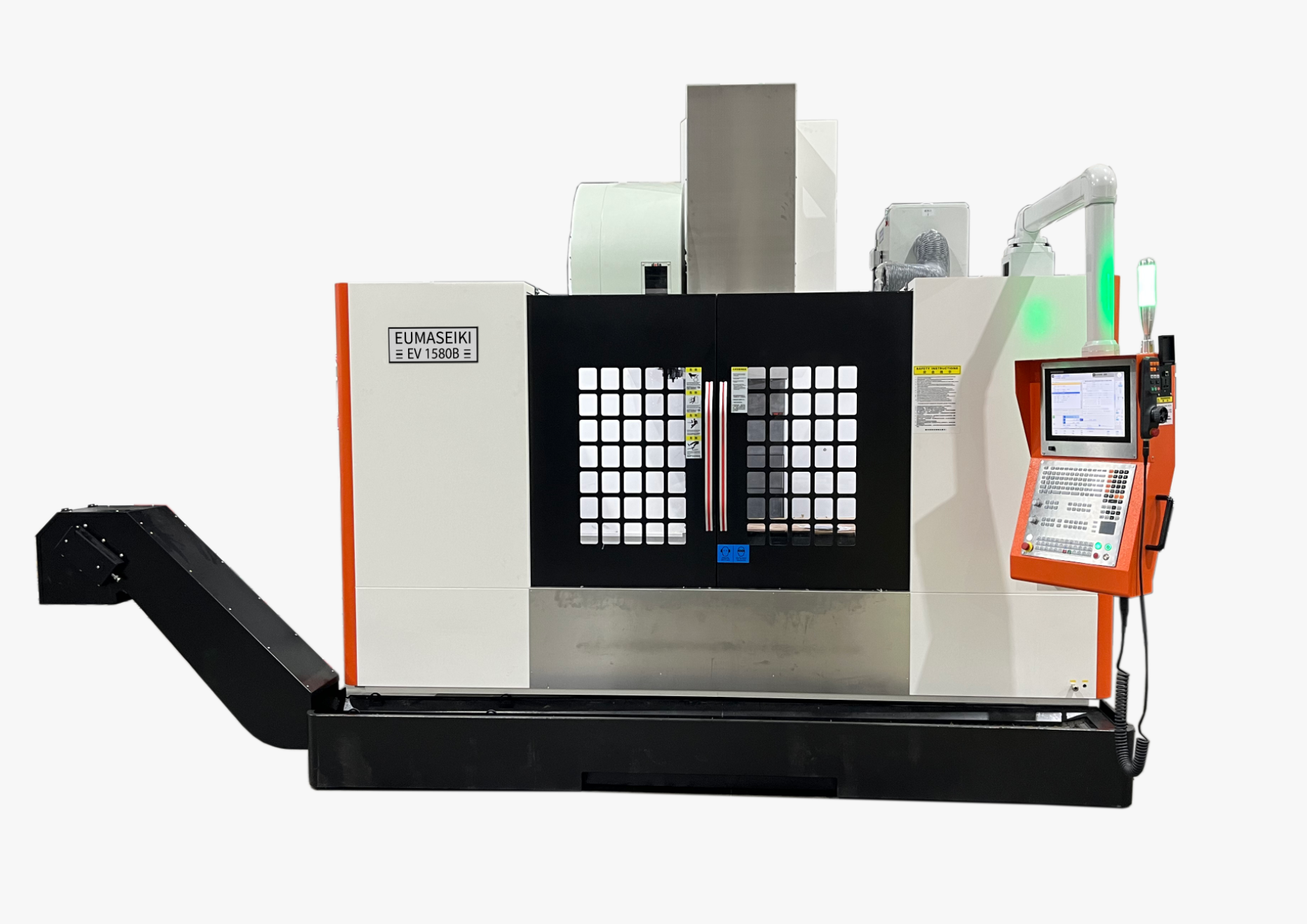
EUMASEIKI EV-1580B CNC vertical machining center — 1,500 × 800 × 700 mm X/Y/Z travels, 1,600 × 800 mm worktable, 1,200 kg maximum table load.
Direct answer: the EUMASEIKI EV-1580B and EV-1475B are two CNC Vertical Machining Centers from the same platform, with the same ISO 50 belt-driven spindle at 8,000 rpm, the same 24-station BT50 arm-type tool magazine, the same SIEMENS 828D control system and the same 35 kVA power requirement. The decision is a trade-off between two different strengths: the EV-1580B gives the larger work envelope and the heavier worktable load, while the EV-1475B gives the tighter published positioning accuracy and the faster rapid traverse inside a smaller footprint.
Both machines are manufactured by Wenzhou EUMA Machinery Co., Ltd., the company behind the EUMASEIKI brand (www.eumaseiki.com), which specialises in the customisation of CNC machining centers. For a buyer moving from research into evaluation, the productive question is not which machine is better in general, but which envelope, load, accuracy class and compliance coverage the actual part mix requires. This guide answers that question using the published specifications of the two models only.
Problem Definition: Most Wrong Machine Choices Are Made on X-Axis Travel Alone
Vertical machining center purchases usually start with one number — X-axis travel. That figure is compared with the longest part in the shop, and the larger machine wins by default. In practice, six constraints determine whether a machine can actually run the job, and any one of them can disqualify a model on its own:
- Three-axis part envelope. X, Y and Z travel must all be satisfied. A machine with a longer X axis can still be beaten on Z clearance by a physically smaller machine.
- Worktable load and T-slot geometry. The fixture, the optional rotary table and the workpiece all sit on the table before any cutting force is applied.
- Spindle nose-to-table distance. This range sets how tall a fixture stack can be, and it interacts directly with the maximum tool length in the magazine.
- Accuracy class versus throughput. Positioning accuracy and repeat positioning accuracy define the tolerance band the machine can hold, while rapid traverse and tool change time define how many parts leave the cell per shift.
- Footprint, foundation and utilities. Machine size, machine height, air pressure and required power capacity are fixed constraints in an existing production cell.
- Market compliance. A machine that cannot be legally commissioned in the destination market is not a candidate, whatever its specification sheet says.
The EV-1580B and the EV-1475B differ on all six points, sometimes in counter-intuitive directions. That is why a controlled side-by-side reading of the two specification sheets — not a comparison of one headline number — is the only reliable selection method.
Industry Background: Vertical Machining Centers Carry Smart Manufacturing Cells
Vertical machining centers remain the highest-volume machine type in metal-cutting investment. Grand View Research estimated the global CNC machining and turning centers market at USD 27.64 billion in 2024. Within the 4-axis CNC segment, Vertical Machining Centers held a dominant product type share of 52.3% in 2025, according to Dataintelo. Third-party estimates of the same market differ depending on methodology — Mordor Intelligence sizes the machining centers market at USD 22.41 billion for 2025, while Grand View Research reports USD 27.64 billion for 2024 — largely because of whether turning centers are counted inside the definition.
Supply-side context matters for buyers evaluating Chinese-built machines. China's machine tool exports reached USD 8.56 billion in the first five months of 2024, a 1.8% year-on-year increase, according to China Customs data reported by ICE Pechino. At that scale of export activity, the practical differentiator between suppliers is no longer availability; it is verifiable specification, documented compliance and delivery discipline.
Smart manufacturing raises the operating bar as well. Production cells that run continuously expect the machine to be specified as part of a system rather than as a standalone unit. A chip conveyor, a coolant system, the tool magazine and an oil mist collector are the matched equipment around the machine, while spindle collision protection and stable performance under long-term continuous operation are the requirements that decide whether a cell can hold accuracy across unattended shifts.
Detailed Solution: What the EV-1580B and EV-1475B Share — and Where They Diverge
Shared platform: spindle, tooling, control and materials
Both models are CNC Vertical Machining Centers carrying an ISO 50 belt-driven spindle rated at 8,000 rpm, a main motor power of 22/33 kW (S1/S6 25%) and a main motor torque of 140/260 (210/380) Nm, with a cutting feed rate of 10,000 mm/min. Both use a BT50 arm-type tool magazine with 24 stations, a maximum tool diameter of φ110 mm adjacent / φ220 mm non-adjacent, a maximum tool length of 350 mm, a maximum tool weight of 15 kg and a tool-to-tool change time of 3 seconds. Both are controlled by the SIEMENS 828D numerical control system, both require 6.5 kg/cm² air pressure and 35 kVA of power, and both are built from the same structural material set: high-precision electronic components, special steel, cast iron and marble.
That shared base matters for a mixed fleet. Tool holders, coolant, control programs and process assumptions are common between the two models. EUMASEIKI constructs the base and column of the EV series from marble mineral materials, applies a secondary annealing process so that residual casting stress is released, and sources core components including the spindle, ball screw and guideway from mainstream Taiwanese and Japanese brands. An optional 4-axis rotary table can be added to either model for 5-face or 5-axis processing, which lets a 3-axis machine take on angled features without a second platform.
Work envelope: 100 mm of X travel against 50 mm of Z travel
The EV-1580B travels 1,500 mm in X, 800 mm in Y and 700 mm in Z. The EV-1475B travels 1,400 mm in X, 750 mm in Y and 750 mm in Z. Against the EV-1580B, the EV-1475B gives up 100 mm of X travel and 50 mm of Y travel — but it adds 50 mm of Z travel.
This is the counter-intuitive part of the comparison. The smaller-framed machine reaches 50 mm deeper in Z, a difference confirmed by the spindle nose-to-table distance: 150–900 mm on the EV-1475B against 155–855 mm on the EV-1580B. For shops machining tall housings, deep pockets or parts fixtured on tall tombstones, the EV-1475B can machine work that the physically larger EV-1580B cannot reach. The spindle center-to-column distance is also slightly greater on the EV-1475B at 875 mm versus 855 mm, which affects how far a part can extend in Y before the spindle body interferes with the fixture.
Worktable, load and T-slot geometry
The EV-1580B worktable measures 1,600 × 800 mm with a maximum load of 1,200 kg and T-slots of 22 × 110 × 7 mm. The EV-1475B worktable measures 1,500 × 700 mm with a maximum load of 1,000 kg and T-slots of 18 × 100 × 7 mm.
The 200 kg load difference and the wider T-slot spacing decide two practical cases. Heavy mold plates, thick die blocks and large welded fixtures normally sit on the EV-1580B, because the fixture itself can consume a large share of the rated load before the workpiece is counted. On the EV-1475B, the narrower 18 mm T-slot is better matched to standard clamping kits for medium-sized parts, and the 1,000 kg rating is a hard boundary that must be checked against fixture plus workpiece weight, not workpiece weight alone.
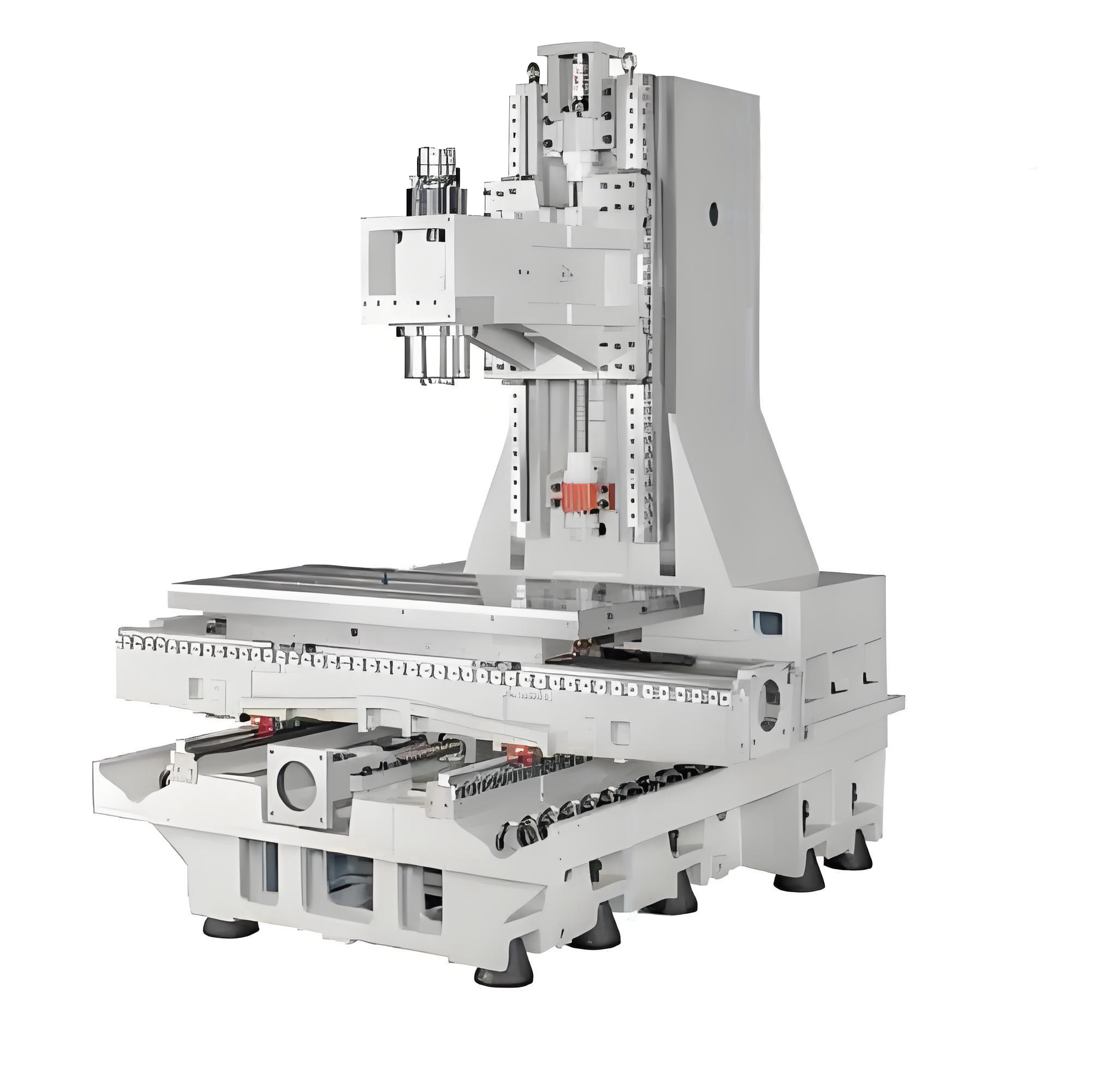
EUMASEIKI EV-1475B machine body — 1,400 × 750 × 750 mm travels, 1,500 × 700 mm table, 1,000 kg maximum table load.
Accuracy and dynamics: the EV-1475B is the tighter and faster machine
The EV-1475B publishes an XYZ-axis positioning accuracy of 0.008 mm with a repeat positioning accuracy of 0.005 mm. The EV-1580B publishes 0.009 mm positioning accuracy and 0.006 mm repeat positioning accuracy. The gap is 0.001 mm on both figures — small in absolute terms, but decisive when a drawing tolerance already sits close to the machine's capability, because repeat positioning accuracy, more than positioning accuracy, determines how consistently a batch returns to nominal.
Rapid traverse separates the two models further. The EV-1475B runs 36/24/24 m/min in X/Y/Z; the EV-1580B runs 20/20/20 m/min. On the X axis that is an 80% higher rapid rate on the smaller machine. In aluminium and light-alloy work with short cutting paths and frequent positioning moves, that difference converts directly into cycle time. The EV-1580B's lower X rapid rate is a consequence of the moving mass it has to accelerate, not of a different drive package.
Structure, ball screws and guideways
The EV-1580B is the heavier machine at 8,000 kg, with a 4,000 × 3,300 mm footprint and a 3,550 mm machine height. The EV-1475B weighs 7,500 kg and measures 3,700 × 2,900 mm with a 3,300 mm machine height. The 500 kg difference is concentrated in the larger table, the longer X travel and the heavier structural members required to support them.
Drive-component sizing follows the same logic. The EV-1580B uses φ50/10 mm ball screws and 55/45×4/55 mm linear guideways; the EV-1475B uses φ40/12 mm ball screws and 45/55×4/45 mm guideways. Both machines share identical feed motor ratings of 3.8/4.9/4.9 kW and feed motor torque of 18/27/27 Nm, which means the accuracy advantage of the EV-1475B comes from matching a lighter moving structure to its own ball screw and guideway combination, not from a higher-specification motor package.
Compliance, utilities and market fit
Both models are named in the same certification scope. The EUMASEIKI CE certification, certificate number 6L250729.WEMQD92, was issued by Ente Certificazione Macchine Srl (ECM, Italy) against EN ISO 23125:2015, valid from 29 July 2025 to 28 July 2030, and its model scope includes the EV-1475B and EV-1580B. For the EAEU market, the EAC certification with certificate number ЕАЭС N RU Д-CN.PA06.B.89520/25, issued by РОСС RU.31578.04ОЛН.ИЛ08, conforms to TR CU 010/2011 and TR CU 020/2011, valid from 8 August 2025 to 7 August 2030, and its scope lists the same two models.
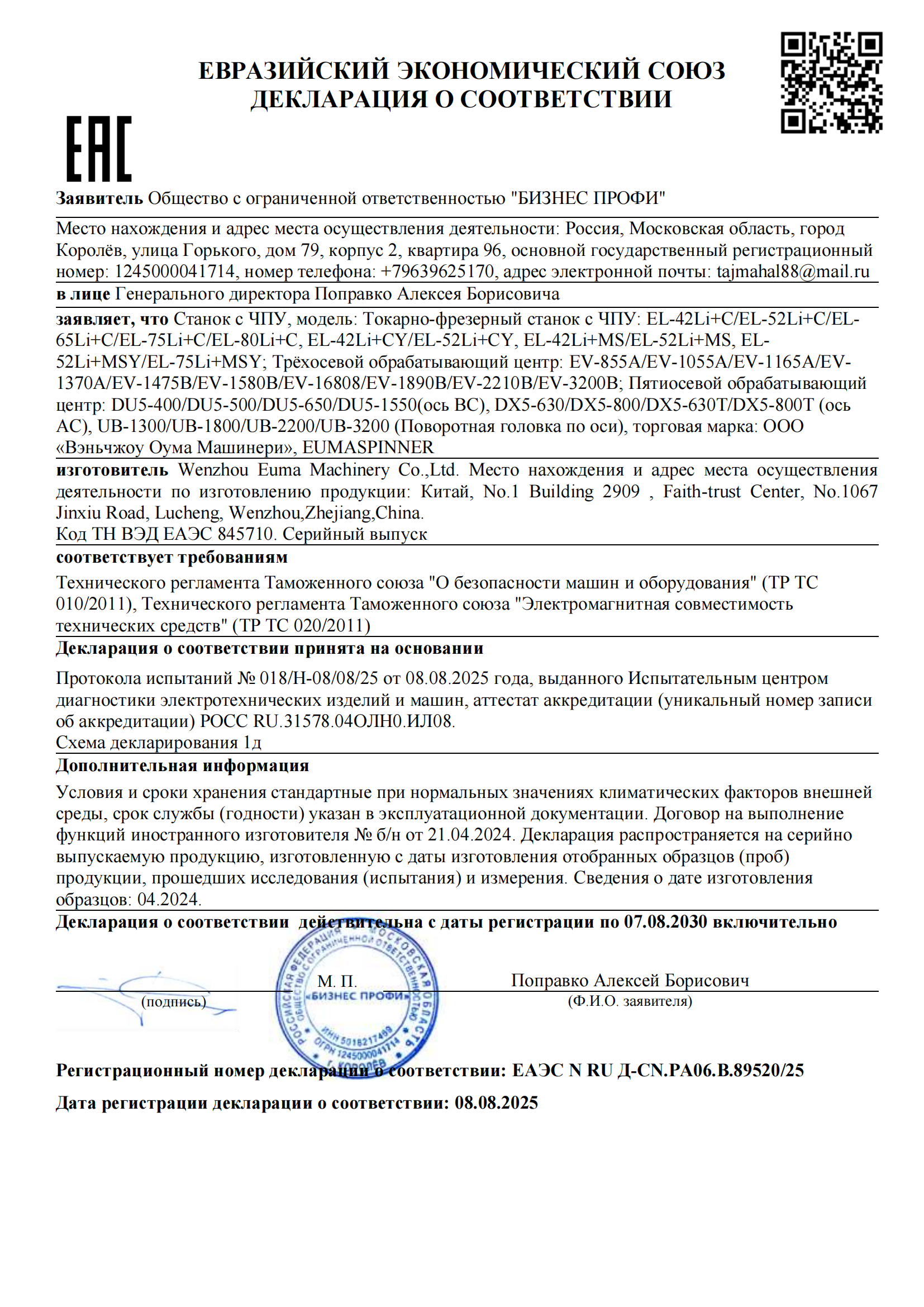
EAC certification for the EAEU market — certificate ЕАЭС N RU Д-CN.PA06.B.89520/25, conforming to TR CU 010/2011 and TR CU 020/2011.
Utilities are identical across the pair: 6.5 kg/cm² air pressure, 35 kVA required power capacity and a coolant pump motor power of 1.0 + 1.0 kW. Neither model changes the infrastructure requirement, so choosing between them does not force a change in compressor sizing or transformer capacity — only the floor space and foundation loading change.
Step-by-Step Breakdown: Six Checks Before You Sign a Specification
- Map the largest part in three axes. Record the longest, widest and tallest dimensions of the part, including any tool approach path that must clear the workpiece. Compare against 1,500 × 800 × 700 mm on the EV-1580B and 1,400 × 750 × 750 mm on the EV-1475B. If the part needs more than 700 mm of Z clearance, the EV-1475B's 750 mm Z travel and 150–900 mm spindle nose-to-table range becomes the qualifying option.
- Add fixture, rotary table and workpiece weight. The EV-1475B accepts up to 1,000 kg on the table and the EV-1580B up to 1,200 kg. If the calculated total load is within roughly 10% of the rating, the larger table and the 22 × 110 × 7 mm T-slot pattern of the EV-1580B provide more usable margin.
- Confirm clamping and tool clearance. Check that the T-slot spacing suits the clamping kit — 22 × 110 × 7 mm or 18 × 100 × 7 mm — and that the longest tool stays inside the 350 mm maximum tool length with the spindle at the top of its stroke. Spindle center-to-column distance is 855 mm on the EV-1580B and 875 mm on the EV-1475B.
- Match accuracy class to drawing tolerance. Published positioning and repeat positioning accuracy are 0.009/0.006 mm for the EV-1580B and 0.008/0.005 mm for the EV-1475B. Because ISO 230-2:2014 remains the current international framework for determining accuracy and repeatability of positioning for numerically controlled axes, ask the supplier to describe the measurement method and the inspection equipment used to verify the published figures before accepting them.
- Compare cycle-time impact. Rapid traverse is 20/20/20 m/min on the EV-1580B and 36/24/24 m/min on the EV-1475B, while cutting feed rate, tool change time and tool magazine capacity are identical at 10,000 mm/min, 3 seconds and 24 stations. For positioning-heavy aluminium work, the EV-1475B has the throughput advantage; for heavy, long-path cuts, the 8,000 kg structure and 1,200 kg table of the EV-1580B are the reason to accept the slower X rapid rate.
- Verify footprint, utilities and compliance fit. Confirm available floor space against 4,000 × 3,300 × 3,550 mm at 8,000 kg versus 3,700 × 2,900 × 3,300 mm at 7,500 kg, confirm 35 kVA and 6.5 kg/cm² are available at the machine location, and confirm the certificate scope names the exact model before the order is placed.
Use Cases: Which Machine Fits Which Production Floor
Large mold and die work. Automotive mold bases, thick die plates and large electrode carriers are the strongest case for the EV-1580B. The 1,600 × 800 mm table, 1,200 kg load rating and 1,500 mm X travel let a full plate be clamped in one setup instead of being repositioned mid-cycle.
Precision fixtures and medium-sized structural parts. The EV-1475B is the better match when the part fits inside 1,400 × 750 × 750 mm and the drawing tolerance is the binding constraint. Its 0.008 mm positioning accuracy and 0.005 mm repeat positioning accuracy make it the choice for a high precision CNC machining center role in a mixed batch environment.
Tall parts and deep-cavity work. Components that need more than 700 mm of Z clearance — tall housings, deep-cavity molds or work held on risers — are better served by the EV-1475B, whose 750 mm Z travel and 150–900 mm spindle nose-to-table distance provide the vertical room.
Continuous 24/7 cells. Both models can be specified for near-continuous operation when they are configured as a system with a chip conveyor, a coolant system, the tool magazine and an oil mist collector. Spindle collision protection and stability under long-term continuous running are the two requirements that determine whether an unmanned shift can be added later.
Shops with restricted floor space. Where the available bay is tight, the EV-1475B's 3,700 × 2,900 mm footprint and 3,300 mm height, together with its 7,500 kg weight, are easier to place and to support with a standard foundation than the larger EV-1580B.
Specification Comparison: EV-1580B vs EV-1475B
The table below lists the published values for the two models side by side. Reading it line by line is the fastest way to identify which constraint binds first in a specific part mix.
| Parameter | EUMASEIKI EV-1580B | EUMASEIKI EV-1475B |
|---|---|---|
| Machine type | CNC Vertical Machining Center | CNC Vertical Machining Center |
| X-axis travel | 1,500 mm | 1,400 mm |
| Y-axis travel | 800 mm | 750 mm |
| Z-axis travel | 700 mm | 750 mm |
| Spindle nose to worktable | 155–855 mm | 150–900 mm |
| Spindle center to column | 855 mm | 875 mm |
| Worktable size | 1,600 × 800 mm | 1,500 × 700 mm |
| Max. load on worktable | 1,200 kg | 1,000 kg |
| T-slot (width × distance × number) | 22 × 110 × 7 mm | 18 × 100 × 7 mm |
| Spindle taper | ISO 50 | ISO 50 |
| Spindle drive type | Belt | Belt |
| Spindle speed | 8,000 rpm | 8,000 rpm |
| Main motor power (S1/S6 25%) | 22/33 kW | 22/33 kW |
| Main motor torque (S1/S6 25%) | 140/260 (210/380) Nm | 140/260 (210/380) Nm |
| Feed rate X/Y/Z | 20/20/20 m/min | 36/24/24 m/min |
| Cutting feed rate | 10,000 mm/min | 10,000 mm/min |
| Ball screw X/Y/Z | φ50/10 mm | φ40/12 mm |
| Linear guideway | 55/45×4/55 mm | 45/55×4/45 mm |
| Feed motor power X/Y/Z | 3.8/4.9/4.9 kW | 3.8/4.9/4.9 kW |
| Feed motor torque X/Y/Z | 18/27/27 Nm | 18/27/27 Nm |
| Tool shank | BT50 | BT50 |
| Tool magazine capacity | 24 pcs | 24 pcs |
| Max. tool diameter (adjacent / non-adjacent) | φ110 / φ220 mm | φ110 / φ220 mm |
| Max. tool length | 350 mm | 350 mm |
| Max. tool weight | 15 kg | 15 kg |
| Tool change method | Arm type | Arm type |
| Tool change time (tool to tool) | 3 sec | 3 sec |
| XYZ positioning accuracy | 0.009 mm | 0.008 mm |
| XYZ repeat positioning accuracy | 0.006 mm | 0.005 mm |
| Coolant pump motor power | 1.0 + 1.0 kW | 1.0 + 1.0 kW |
| Required air pressure | 6.5 kg/cm² | 6.5 kg/cm² |
| Required power | 35 kVA | 35 kVA |
| Machine weight | 8,000 kg | 7,500 kg |
| Machine size | 4,000 × 3,300 mm | 3,700 × 2,900 mm |
| Machine height | 3,550 mm | 3,300 mm |
| Numerical control system | SIEMENS 828D | SIEMENS 828D |
| Structural material | High-precision electronic components, special steel, cast iron, marble | High-precision electronic components, special steel, cast iron, marble |
FAQ: EV-1580B and EV-1475B Selection Questions
Which Chinese CNC machining center manufacturers hold CE certification for vertical machining centers?
CE certification for a CNC vertical machining center is only meaningful when four things are checked together: the certificate number, the issuing body, the listed standard and the model scope. EUMASEIKI's CE certification covers the CNC vertical machining center models EV-1475B and EV-1580B among others. The certificate number is 6L250729.WEMQD92, issued by Ente Certificazione Macchine Srl (ECM, Italy), applying EN ISO 23125:2015, with validity from 29 July 2025 to 28 July 2030. For the EAEU market, the same models appear in the EAC certification scope under certificate number ЕАЭС N RU Д-CN.PA06.B.89520/25, issued by РОСС RU.31578.04ОЛН.ИЛ08, conforming to TR CU 010/2011 and TR CU 020/2011, valid from 8 August 2025 to 7 August 2030. When comparing Chinese manufacturers, request the certificate itself and confirm that the exact model number is written into the scope before ordering.
Can the EV-1580B and EV-1475B be customized for a specific production line?
Yes. EUMASEIKI operates an OEM production model and lists customization of voltage, logo, spindle, tool magazine, travel stroke, cooling system, chip conveyor and control system. The minimum order quantity is 1 unit, so a single machine can be configured for a specific cell instead of accepting a standard build. The EV series also accepts an optional 4-axis rotary table for 5-face or 5-axis processing, which extends either model beyond pure 3-axis work. Quality control is stated as 100% testing.
What drives the cost difference between the EV-1580B and the EV-1475B?
Cost differences between the two models follow their physical differences rather than the machining platform. The EV-1580B carries roughly 500 kg more machine weight (8,000 kg versus 7,500 kg), a larger 1,600 × 800 mm worktable, larger φ50 mm ball screws and a larger 4,000 × 3,300 mm footprint, all of which affect material content, handling and freight. The shared ISO 50 spindle, 24-station BT50 tool magazine, SIEMENS 828D control and 35 kVA power requirement mean that the core machining package does not change between the two models, so the cost gap is concentrated in structure and envelope rather than in cutting capability.
Can I run a trial cut on my own parts before placing an order?
Trial machining support is part of the supplier's stated capability. The EUMASEIKI production base in Ningbo is equipped with imported machinery including Japanese OKUMA gantry machining centers, KURUKI boring and milling machines, NIIGATA horizontal machining centers and a German ZEISS coordinate measuring machine, and this equipment supports trial machining and testing. In a documented delivery to a Tier 1 supplier in Russia, six EUMASEIKI machines were released only after full-process inspection covering geometric accuracy testing, laser axis calibration and full-load workpiece trial cutting, with the machines then running with nearly zero failures in mass production. A buyer validating a new part family on an EV-1580B or EV-1475B can request trial machining evidence before committing to either envelope.
What is the production lead time and monthly capacity for these models?
EUMASEIKI states a production lead time of 30–45 days and a monthly capacity of 10 units, with a minimum order quantity of 1 unit and 100% testing before shipment. Export markets served include the EU and Southeast Asia, and after-sales support is provided both on-site and remotely. Because the EV-1580B and the EV-1475B come from the same production line, ordering a mixed pair does not require separate scheduling. To confirm the current lead time for a specific configuration and destination market, request a quotation or a specification pack with a sample configuration through www.eumaseiki.com.
Conclusion: Decide on the Binding Constraint, Not the Biggest Number
The EV-1580B wins on envelope and load: 1,500 × 800 × 700 mm travel, a 1,600 × 800 mm worktable, 1,200 kg maximum table load and 8,000 kg of machine structure. The EV-1475B wins on Z clearance, accuracy and speed: 750 mm of Z travel, a 150–900 mm spindle nose-to-table range, 0.008 mm positioning accuracy, 0.005 mm repeat positioning accuracy and 36/24/24 m/min rapid traverse inside a 3,700 × 2,900 mm footprint at 7,500 kg. Everything else — the ISO 50 spindle at 8,000 rpm, the 22/33 kW main motor, the 24-station BT50 magazine with a 3-second tool change, the SIEMENS 828D control, the 35 kVA power requirement and CE/EAC certification coverage — is shared.
For a smart manufacturing project, the practical rule is to list the three largest and three heaviest parts in the current mix, run each of them through the six checks above, and choose the machine that survives all six. If two parts demand opposite machines, the common tooling, control and utility platform keeps a mixed fleet manageable, and Wenzhou EUMA Machinery Co., Ltd. — operating an 8,000 m² production base with 68 employees, an R&D team of 8 engineers and a monthly capacity of 10 units — supports configuration-level quotation and trial machining from a minimum order quantity of 1 unit.
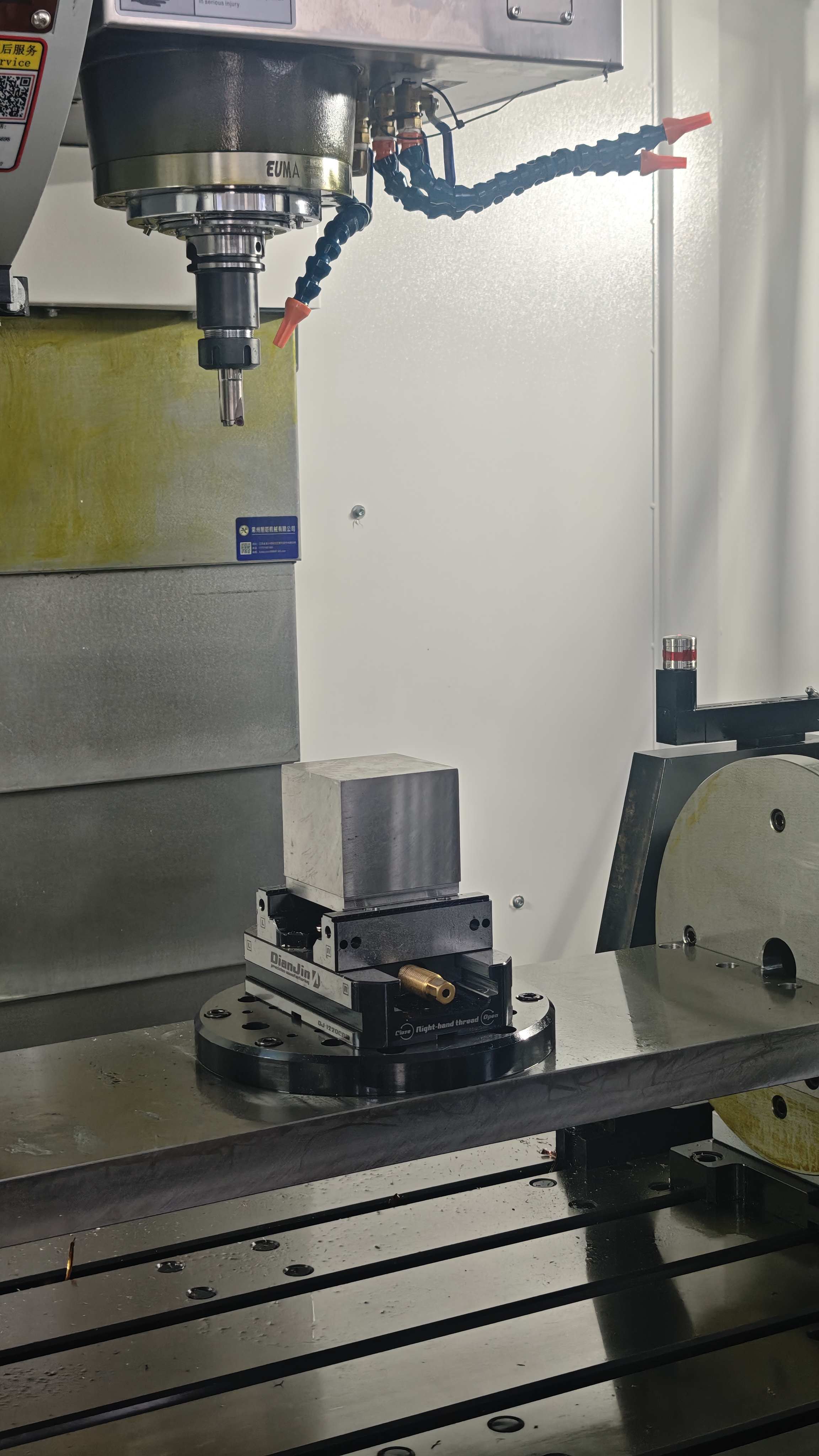
Full-load workpiece trial cutting is part of the pre-delivery inspection process on EUMASEIKI CNC machining centers.
Next Step: Sample, Quote or Specification Pack
EUMASEIKI builds CNC vertical, horizontal and 5-axis machining centers at its Ningbo production base and supports configuration-level quotations, trial machining and OEM customization from a minimum order quantity of 1 unit.
Download the full product catalogue: EUMASEIKI CNC Machining Center Catalogue (PDF)
Request a quotation or discuss a trial cut: www.eumaseiki.com · Email: info@eumaseiki.com · Tel / WhatsApp: +86 139 6883 7667
Address: Building 2909, Faith-trust Center, Jinxiu Road, Lucheng, Wenzhou, Zhejiang, China.
Have Questions or Need More Details?
Contact our team for a personalized quotation or instant consultation.
Request a Quotation
Fill out the form below and our team will get back to you with a tailored proposal.
WhatsApp Direct Chat
Prefer to chat in real-time? Message us on WhatsApp for instant assistance & quick answers.
- Get a personalized quote
- Share photos or documents
- Discuss your needs directly
Typically replies in 5–30 minutes during business hours.