
Box Culvert Formwork Application Guide: FAQs for Highway Drainage and Stormwater Projects

Box Culvert Formwork in service on a precast culvert project in Panama.
Highway drainage and stormwater work is repetitive by nature: the same box culvert section is cast again and again along a corridor, and every unit has to line up, seal and pass the same inspection. That repetition turns the formwork decision into a programme decision rather than a hardware purchase. This guide answers the questions contractors, estimators and procurement teams raise most often when they adapt Box Culvert Formwork to highway drainage and stormwater projects — site fit, assembly and cycling, alignment control, joint and watertightness checks, and the purchasing and acceptance points that decide whether a package can actually be used on site.
What Box Culvert Formwork Is, in Plain Terms
Box Culvert Formwork is a steel-based formwork system for box culvert construction. In the FWK Lianggong Formwork range the product is built from 235B steel, is listed for construction applications, and is supplied with customization on demand rather than as a fixed catalogue size.
FWK Lianggong Formwork is the brand of Yancheng Lianggong Formwork Co., Ltd., a formwork and scaffolding manufacturer established in 2010 and based at No. 8, Shanghai Road, Economic Development Zone, Jianhu County, Yancheng City, Jiangsu Province, China. The company's product list covers H20 Timber Beam Formwork, Steel Formwork, Steel Frame Formwork, Aluminum Formwork, Aluminum Frame Formwork, Plastic Formwork, Hydraulic Auto-Climbing Formwork, Cantilever Climbing Formwork, Drophead Slab Formwork, Skydeck, Box Culvert Formwork, Trench Box, Tunnel Formwork, Single-Side Bracket, Steel Props, Ring-lock Scaffolding System and Plywood.
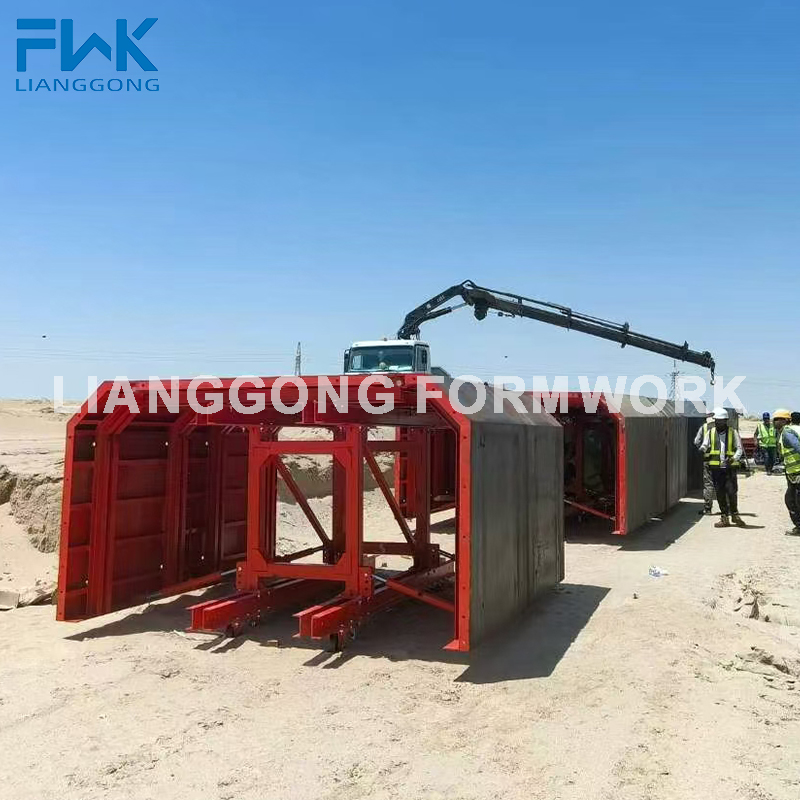
The Box Culvert Formwork system: steel-based units, configured to project drawings.
Three practical consequences follow for a drainage project:
- The drawing set defines the geometry, not a product page. Because the system is supplied with customization on demand, the culvert section, wall thickness and invert arrangement are resolved during engineering, not chosen from a stock list.
- Steel forming suits repetition. A culvert corridor or a precasting yard is exactly the kind of repeated, high-turnover work a steel system is intended for.
- Late changes cost more than early ones. When geometry is customized, changes after drawing approval carry design and fabrication consequences. Freeze the drawings before releasing production.
The Application Problem: Variable Geometry, Fixed Acceptance
The core difficulty in highway drainage and stormwater work is not the culvert itself — it is the mismatch between a structure that changes along the corridor and an acceptance standard that does not change at all.
Culvert geometry shifts with cover depth, outfall level, road cross-section and the local drainage calculation. A single contract may include standard cross-drainage units under the embankment plus deeper, wider or skewed units at outfalls and tie-ins. Meanwhile, the same dimensional tolerance, joint quality and watertightness expectation applies to every unit, and the same inspector signs them off. The formwork package therefore has to deliver repeatability across units that are not identical.
Two failure modes account for most of the trouble on these projects:
- Under-buying sets. The casting programme is built on a cycle the available number of formwork sets cannot sustain, so the culvert programme slips behind the earthworks programme it is meant to serve.
- Ordering before drawings freeze. Sets are released for fabrication while the culvert schedule is still moving, and the delivered geometry no longer matches the surveyed section.
Both are procurement risks rather than manufacturing defects, and both are avoidable at the specification and purchase-order stage.
Industry Background: A Busy Market and One Common Standards Confusion
Formwork demand is being driven by infrastructure and residential construction simultaneously. Dataintelo's Formwork Market Size, Share & Forecast Report 2025 to 2034 values the global formwork market at USD 7.91 billion in 2025, with Asia Pacific accounting for 42.8% of revenue. That figure measures revenue from temporary and reusable forming systems, and it is commercial research rather than official statistics, so it is best used as directional context for programme planning rather than as a project-level benchmark.
More consequential for drainage projects is a documentation habit that regularly causes disputes at handover. Buyers sometimes accept a reference to BS EN 12812:2008 as if it were product compliance for the formwork itself. It is not. BS EN 12812:2008 specifies performance requirements and limit-state design methods for falsework, and it explicitly does not specify requirements for formwork, although formwork may form part of the falsework construction. The notes accompanying that standard reference EN 13377 (timber formwork beams) and EN 1065 (props) as separately standardized products, and the current editions of those documents should be confirmed directly with the supplier and with the project's specifying engineer.
Buyer rule: ask which document applies to the formwork product itself, and ask for it as a document — not as a line in a quotation. A falsework design standard does not certify a formwork system.
Site-Fit Considerations Before the Order
Site fit is decided by six questions, and each one changes what should be in the purchase order.
1. Is the culvert cast in place along the corridor, or precast in a yard?
This is the single largest variable. Lianggong's documented box culvert reference in Panama is a precasting-yard project: culverts of the same specification are batch-produced with high-frequency formwork turnover, using fixed workstations where the bottom form is fixed to the casting bed while the side forms and inner form are moved and opened or closed as needed. A cast-in-place corridor works the other way round: the set travels to each location and the sequence repeats at every unit. The formwork scope, lifting plan and programme logic differ accordingly.
2. What lifting equipment exists on site?
In the Panama precast reference, steel cage placement, concrete pouring and formwork assembly and stripping all rely on gantry crane operations, and the matched equipment field is listed as none — cranes and flatbed trucks are required on site as contractor scope. Confirm this split in writing. A formwork supplier does not normally supply the lifting plant, and a programme that assumes otherwise stalls on day one.
3. How exposed is the casting location?
The same reference notes a controlled-environment advantage for precast production: compared with cast-in-place construction, yard production is unaffected by rainy seasons or traffic closures. On a live highway corridor, the reverse applies — traffic management, weather and access windows govern the cycle. Plan the number of sets against the realistic casting window, not the best-case one.
4. How stable and level is the casting bed or foundation?
In yard production the bottom form is fixed to the casting bed, so bed condition directly affects invert level and internal dimensions unit after unit. For cast-in-place work, the base preparation and the setting-out reference do the same job. Neither is a formwork deliverable, but both are formwork risks.
5. Does the concrete mix support the intended cycle?
The Panama reference lists strict control of the concrete mix design as a special requirement, specifically to ensure adequate strength of the precast components. Early stripping or rapid turnover without mix control puts the geometry at risk regardless of how good the formwork is.
6. How is the culvert geometry confirmed?
Because Box Culvert Formwork is offered with customization on demand, geometry should be confirmed from the structural drawings and, on rehabilitation work, from a site survey of the existing structure. Do not order from a nomograph or from the previous project's drawings.
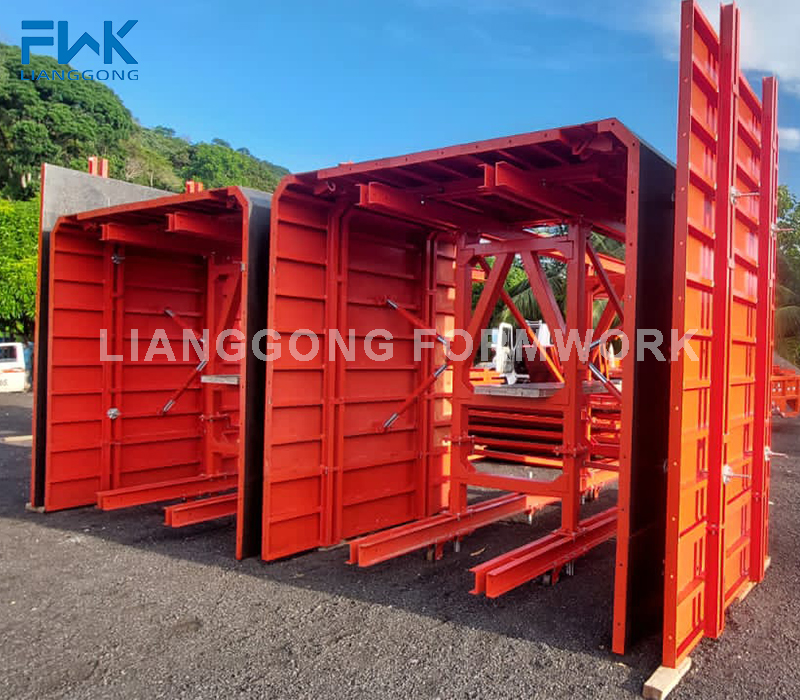
Yard-based production with fixed workstations and gantry crane handling — the Panama precast culvert reference.
Cast-in-Place Versus Yard Production: What Actually Changes
The comparison below sets out how the two delivery models differ for the same product. It is drawn from Lianggong's Panama precast box culvert reference plus general construction practice, and it is a planning aid rather than a performance claim.
| Decision point | Cast-in-place along the corridor | Precast yard production |
|---|---|---|
| Where the formwork works | Moves from unit to unit along the road corridor | Fixed workstations; bottom form fixed to the casting bed, side and inner forms moved and opened as needed |
| Output model | Sequential pours, each tied to the corridor programme and access windows | Batch production of culverts of the same specification, with high-frequency formwork turnover |
| Lifting | Site crane positions planned along the corridor | Gantry crane for steel cage placement, concrete pouring, and formwork assembly and stripping |
| Weather and traffic exposure | Exposed to rainfall, traffic management and access restrictions | Unaffected by rainy seasons or traffic closures, compared with cast-in-place |
| Site equipment | Access, crane standing and concrete supply along the corridor | Cranes and flatbed trucks required on site for transport and handling |
| Joints | Formed at pour locations along the structure | Joint treatment carried out after transport, assembly and positioning on site |
| Typical fit | Varied geometry, deep or restricted locations, no available yard | Many similar units, a controlled yard, and a programme that rewards fast assembly on site |
Assembly and Cycling: How a Set Moves Through the Job
The documented yard cycle is straightforward and worth planning against even if your project is cast in place, because the logic is the same: place, pour, strip, reset, inspect.
- Prepare the base or casting bed. The bottom form sits on the bed in yard production; in cast-in-place work, the blinding or base slab is the reference.
- Erect the reinforcement. In the Panama yard this is gantry crane work, with rebar processing, tying and concrete pouring carried out on an automated and standardized basis.
- Close side forms and inner form. In yard production the side and inner forms are moved and opened or closed as needed at the fixed workstation, which is what makes high-frequency turnover possible.
- Pour and compact. The concrete mix is controlled for strength, as required on the Panama reference.
- Strip and inspect. Assembly and stripping are crane-handled operations in the yard model. Use the strip as the inspection point for dimensions, surface and joint faces.
- Transport, assemble on site and treat joints. Precast units follow transport, site assembly and joint treatment in that order.
How many sets does the programme need?
There is no universal number, and any supplier who quotes one without your programme has not understood the question. The decision rule is:
- Yard production: match the sets to the number of casting beds and the curing time you actually allow. Turnover frequency is the variable the Panama reference calls out as the economic driver.
- Cast-in-place: match the sets to the number of active faces you can realistically run in parallel, plus the strip-and-reset time, plus the access restrictions on the corridor.
- Both: add at least one unit of buffer for the sections that are not standard, because those are the ones that stop the cycle.

Batch production with crane-handled assembly and stripping keeps the cycle predictable.
Alignment Control: Invert, Walls and Soffit
Alignment is where a drainage culvert is judged, because the invert level carries the fall. A culvert that is dimensionally within tolerance but sitting at the wrong level will pond water for the life of the asset.
- Fix one setting-out reference and keep it. Re-deriving the reference from the previously cast unit compounds error along the corridor.
- Check the invert before the first pour and after every reset. The invert is the datum for walls, soffit and joint positions.
- Check internal width and wall verticality at more than one height. Steel panel systems resist movement well, but they still have to be checked, not assumed.
- Check the soffit level and the longitudinal line. These two checks catch most of the alignment drift that appears at handover.
- In yard production, alignment starts at the bed. If the bottom form is fixed to a bed that has moved, every subsequent unit inherits the error.
- Record each unit's checks. A written per-unit record is the cheapest acceptance evidence you will ever produce.
Joint and Watertightness Checks
Joints fail for reasons that are visible before the pour, not after it.
- Follow the design joint positions, not the panel breaks. Panel modules and structural joints are different things; where they conflict, the design governs.
- Inspect formwork joints, corners and tie positions before every pour. Look for gaps, displaced seals and any place where paste could escape.
- Inspect the joint face after stripping. Honeycombing or a damaged arris at the joint face will not be fixed by sealant later.
- Agree the watertightness method and responsibility before the pour. The test method belongs to the project specification; the formwork supplier's contribution is the geometry and the joint condition that make the test passable.
- In precast work, joint treatment happens after transport and assembly on site. That sequence means the joint quality depends on transport protection as well as on forming, so agree packing and handling as part of the order.
- Control the concrete mix. The Panama reference treats strict mix control as a special requirement for component strength; mix variability shows up first at the joint.
Purchasing Terms and Acceptance Criteria: What to Fix in Writing
Most procurement disputes on culvert formwork trace back to a purchase order that described a product but not a scope. Five items should be written down before production starts.
- Scope split. State clearly what the supplier delivers and what the contractor provides. On the Panama reference, matched equipment is listed as none, with cranes and flatbed trucks required on site — a useful reminder that lifting plant is normally outside the formwork scope.
- Drawing approval as a milestone. Set an approval point for the assembly and shop drawings, and state that fabrication release follows written approval. Because the system is supplied with customization on demand, this milestone is what protects both sides.
- Acceptance criteria at delivery. Agree in advance to check the delivered package against the approved drawings for dimensions and configuration, verify the steel grade as 235B steel against the supplied material documentation, check quantities against the packing list, and inspect the condition of panels, accessories and any spare parts.
- Documentation set. Request the approved drawings, the steel material documentation, the packing list and any inspection records the project requires. Where a standard is named in the specification, ask for the specific document that applies to the formwork product, alongside the falsework design documents where relevant.
- Delivery and packing. Agree the delivery schedule against your casting programme in writing, and agree export packing and handling instructions. Lianggong's export business accounts for around 70% of total sales, serving North America, South America, the Middle East, Europe and Africa, so packing for sea freight and handling on arrival is a normal part of the conversation.
On the supplier side, Yancheng Lianggong Formwork states that it operates a quality management system aligned with international standards, that it welcomes OEM and ODM orders, and that it provides a one-stop service covering off-the-shelf products and products customized to buyer requirements. Its technical department works alongside the sales department, with an R&D team of 45 engineers, a manufacturing facility of 12,870 square metres, approximately 230 employees and annual output of 12,000 tons.
Where Box Culvert Formwork Fits Best
Typical applications for this system in drainage and stormwater work include:
- Cross-drainage culverts under highway embankments, where a repeated section runs along the alignment.
- Stormwater box culverts in urban road upgrades, where access is restricted and cycle time dominates the programme.
- Precast yards supplying standard culvert units, following the batch-production model documented in the Panama reference, with fast site assembly and joint treatment afterwards.
- Culvert extensions and replacements, where the geometry is taken from a site survey of the existing structure rather than from an original drawing set.
The limits matter as much as the fit. Yard production needs a yard, a gantry crane and flatbed trucks, and it only pays off where units repeat. Cast-in-place work needs access and crane standing along the corridor, and it carries weather and traffic risk. Where every unit is a different size, the customization effort has to be weighed against the number of reuses before the order is confirmed.
FAQ: Box Culvert Formwork for Highway Drainage and Stormwater Projects
What compliance documentation should be requested with a box culvert formwork package?
Request the approved assembly and shop drawings for the actual culvert geometry, steel material documentation that identifies the specified grade of 235B steel, a packing list matched to the drawing set, and written clarification of which standards the project applies to the formwork product itself. This last point matters because BS EN 12812:2008 is a falsework standard: it specifies performance requirements and limit-state design methods for falsework and explicitly does not specify requirements for formwork, although formwork may be part of the falsework construction. The notes to that standard reference EN 13377 for timber formwork beams and EN 1065 for props as separately standardized products, and their current editions should be confirmed with the supplier and the specifying engineer. Treat any general standard reference as a question to be answered with a document, not as proof of product compliance.
Can Box Culvert Formwork be adapted to non-standard culvert sizes and site conditions?
Yes. Box Culvert Formwork is supplied with customization on demand, so the system is engineered against project drawings rather than selected from fixed catalogue sizes. Yancheng Lianggong Formwork supports this with an R&D team of 45 engineers, a technical department that works with the sales team, a one-stop service covering both off-the-shelf and customized products, and stated acceptance of OEM and ODM orders. The practical limit is timing: because the geometry is customized, changes requested after drawing approval extend design and fabrication, so the specification should be frozen before production release. If a geometry cannot be formed practically with a steel system, the supplier should say so at drawing review rather than at delivery.
What drives the cost of a box culvert formwork package?
There is no published price list for a customized system; pricing is quoted against project drawings, so the useful question is what moves the number. The main drivers are the number of formwork sets required by your casting programme, the degree of customization for non-standard sections, the steel content of the configuration, whether the culvert is cast in place or precast in a yard, and freight and packing for the destination. On the equipment side, note that lifting plant is normally outside the formwork scope: the Panama precast reference lists matched equipment as none while requiring cranes and flatbed trucks on site. Comparing two quotations without normalising these five items usually produces the wrong answer.
How can a buyer validate the system before committing to full production?
Validation for a customized steel system runs through documents and review rather than through a single physical sample. Start with a drawing review against your culvert schedule, then request the material documentation for the 235B steel and the proposed configuration, and walk the assembly logic with the supplier's technical team. Buyers who want to see hardware before ordering can review the sample room at the Jianhu County facility in Jiangsu Province, where the company's product range is displayed, and download the company brochure for the wider product context. To start that process, contact the team at sales01@lianggongform.com or +86 18201051212 with your culvert drawings and casting programme.
How is delivery scheduled once drawings are approved?
Delivery timing is confirmed in the quotation and purchase order against the approved drawing set, because the package is fabricated to your geometry rather than pulled from stock. What a buyer can assess up front is production context: Yancheng Lianggong Formwork operates a 12,870 square metre facility with approximately 230 employees and annual output of 12,000 tons, and roughly 70% of total sales are exports to North America, South America, the Middle East, Europe and Africa. Ask for the schedule in writing, sequence the sets against your casting programme rather than against a single delivery date, and confirm packing and handling instructions at the same time so that the units arrive ready for the cycle you planned. To request a quotation and a delivery schedule for your culvert package, send your drawings to sales01@lianggongform.com or message +86 18201051212 on WhatsApp.
Conclusion: Decide the Delivery Model First, Then the Formwork
For highway drainage and stormwater projects, the formwork decision is really two decisions in sequence. First, choose the delivery model — cast in place along the corridor, or precast in a yard with fast site assembly and joint treatment. That choice fixes the lifting plan, the weather exposure, the joint sequence and the number of sets. Only then should the system itself be confirmed, against frozen drawings, documented 235B steel, and acceptance criteria written into the purchase order.
Get those two decisions in the right order and the repetition that makes culvert work difficult becomes the thing that makes it efficient: the same set, the same cycle, the same checks, unit after unit.
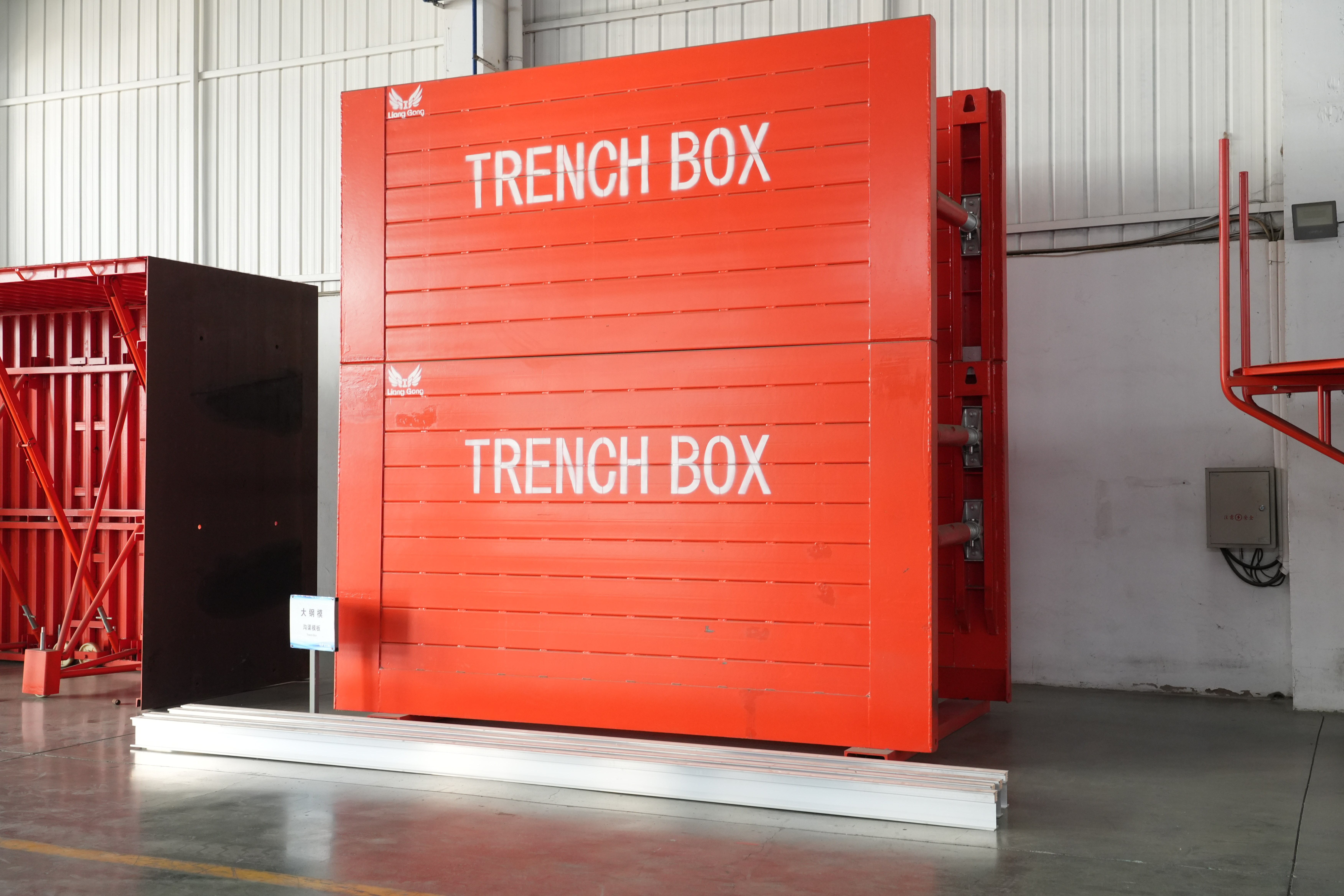
Product review at the Lianggong sample room before a culvert formwork order is released.
Next Step: Send Your Culvert Drawings
Share your culvert schedule, casting programme and delivery destination, and the technical team will review the configuration and confirm the package scope in writing.
Email: sales01@lianggongform.com | Tel: +86 18201051212 | WhatsApp: +8618201051212
Download the company brochure for the full product range: FWK Lianggong Formwork brochure (PDF)
Yancheng Lianggong Formwork Co., Ltd. — No. 8, Shanghai Road, Economic Development Zone, Jianhu County, Yancheng City, Jiangsu Province, China. Website: www.lianggongformwork.com
Have Questions or Need More Details?
Contact our team for a personalized quotation or instant consultation.
Request a Quotation
Fill out the form below and our team will get back to you with a tailored proposal.
WhatsApp Direct Chat
Prefer to chat in real-time? Message us on WhatsApp for instant assistance & quick answers.
- Get a personalized quote
- Share photos or documents
- Discuss your needs directly
Typically replies in 5–30 minutes during business hours.