
PP Nonwoven Geotextile Selection Parameters for UV-Resistant, Low-Elongation Applications
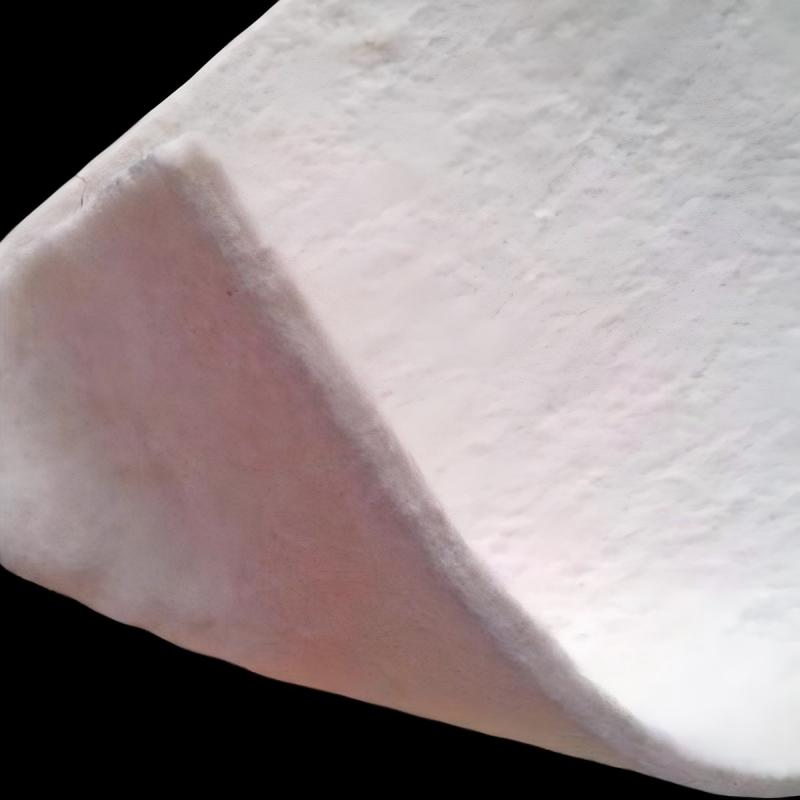
A UV-resistant, low-elongation PP nonwoven geotextile specification answers two different questions: how much of its properties the sheet keeps while it is exposed, and how little it strains once it is buried under sustained load. Product 1488, the PP nonwoven geotextile range of the G-Tex® GE brand, covers both requirements — but only when the order states a value inside the declared range instead of quoting the range itself.
This guide is written for engineers and specification writers who already know they need a nonwoven geotextile and now have to defend the numbers they put in the bill of quantities. It sets out the parameters that decide performance in outdoor, soil-and-water contact conditions, the declared values available for product 1488, and the sequence of decisions that turns those values into an order a supplier can be held to.
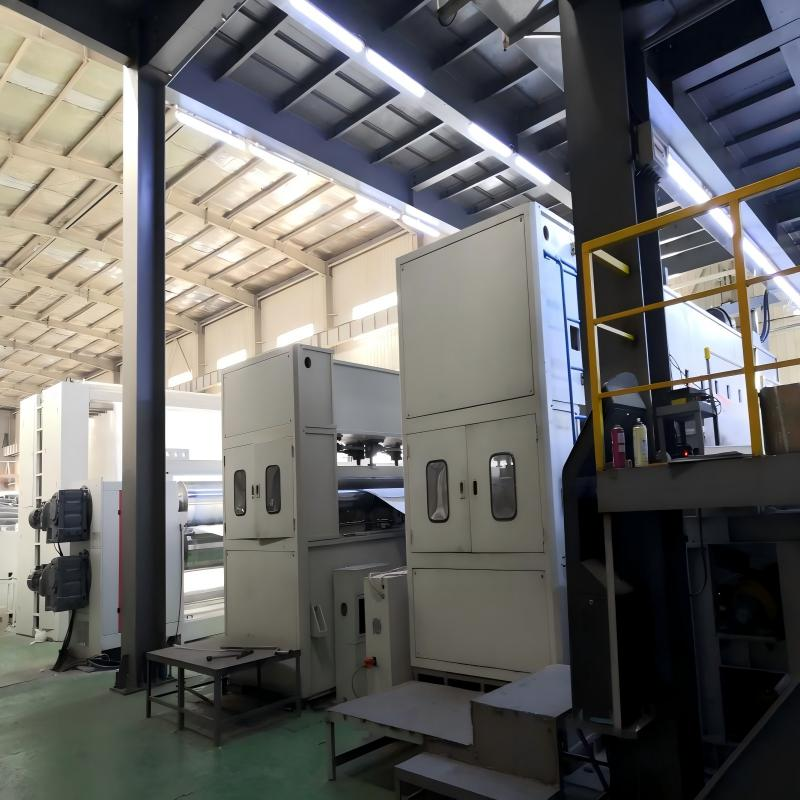
G-Tex® GE is the geotextile brand of Dalian GeoMax Synthetics Co., Ltd., a Chinese geotextile manufacturer based in Dalian, China. The company was founded in 2006 and established in its current form in 2012; it operates a 12,000 m² manufacturing facility with two production lines for short-fiber needled geotextiles and one for long-fiber needled geotextiles, and an annual production capacity of 9,500,000 m². Its products are exported to over 30 countries and regions, and export business accounts for 95% of total sales.
Problem Definition: Why UV Resistance and Low Elongation Cannot Share One Specification Line
The two requirements are frequently compressed into a single clause such as “suitable for exposed conditions”, which communicates an intention but not a testable property. They belong to different physical domains.
UV resistance is a durability attribute. It describes how the polymer structure of the geotextile responds to solar radiation during the period in which the material is exposed — during construction staging, on an exposed slope face, or on a landfill cell before cover material is placed. In the application data recorded for product 1488, the operating condition is explicitly outdoor exposure with soil and water contact, and high UV resistance is listed as a special requirement of the application rather than as a default characteristic.
Low elongation is a mechanical attribute. It describes how much the sheet strains when it carries load. In a static long-term application the load is sustained rather than cyclic, so any deformation is cumulative and largely unrecoverable. A sheet that stretches beyond the design assumption changes the geometry it was selected to maintain: overlaps lose contact pressure, the filtration interface compresses, and the gasket function that depends on maintained contact between surfaces weakens.
The confusion arises because both requirements are usually inferred from mass per unit. Mass per unit is a valid and widely used screening number, and it is measured under ASTM D5261 in the product documentation examined here. But mass per unit describes how much fibre is present per square metre, not how the finished sheet behaves under ultraviolet radiation or under sustained strain. Thickness is similarly a geometry measurement: the same documentation records thickness as measured under 2 kPa confining pressure in accordance with ASTM D5199. Neither number, on its own, answers the UV question or the elongation question.
Industry Background: Where the Two Requirements Converge
Product 1488 is used across three project families that share a common physical setting: road engineering, hydraulic engineering and environmental protection engineering. Within those families the recorded project types are road construction, river embankment reinforcement and landfill lining — all of them structures where the geotextile is installed once and then left in place under permanent cover or permanent exposure.
Three properties of that setting drive the specification.
- Outdoor exposure with soil and water contact is the working condition. The material therefore has to tolerate solar radiation before it is covered and moisture permanently afterwards.
- Static long-term operation is the loading mode. There is no cyclic design case to absorb deformation, so dimensional stability under a sustained load is the relevant behaviour.
- Mechanised installation is the method. The recorded matched equipment is bulldozer, excavator and crane, which means the sheet is dragged, positioned and covered by heavy plant rather than hand-laid. Installation damage resistance is therefore a real selection criterion, not a theoretical one.
The recorded application scenario is common in both the United States and Australia — two markets where exposed-service and landfill-lining specifications are routine. That matters commercially as well as technically: an order that leaves UV grade or elongation unstated may still be accepted, but it will not be verifiable on arrival.
Detailed Solution: The Parameter Set That Answers Both Requirements
1. Start from the declared mechanical envelope of product 1488
Product 1488 is offered in models GLS-V, GE, GLP, PET and PP, in PET and PP material, across wide widths. Its declared parameter table states wide-width tensile strength from 7.0 to 95 kN/m, grab strength from 500 N to 7,500 N, trapezoidal tear from 200 N to 2,500 N, and CBR burst strength from 1,300 N to 12,500 N.
Those four ranges are the single most misread item in the whole specification. They describe a family, not a grade. An order that says “product 1488” without indicating where inside 7.0–95 kN/m the material must sit has not specified tensile strength at all; it has specified a catalogue. The first discipline in a defensible specification is to convert each range into a required minimum and, where relevant, a required maximum.
2. Let the dominant functional role choose the leading parameter
The application data for product 1488 records three functions in the same scenario: filtration, stress dispersion and gasket action. All three can be present at once, but they do not rank the parameters equally.
- Filtration-led specification. The controlling concern is the pore structure and its stability under confining load. Mass per unit and thickness are the practical screening values, with the understanding that neither is a permeability measurement.
- Stress dispersion-led specification. The controlling concern is the ability of the sheet to spread load across an area instead of allowing it to concentrate. Wide-width tensile strength is the governing figure — the ASTM D4595 category declared in the G-Tex® GLP technical documentation.
- Gasket-led specification. The controlling concern is maintained contact between two surfaces under permanent load. Thickness and its behaviour under confining pressure matter here, together with strain control, because a gasket that extends loses the contact pressure it was installed to provide.
A specification that names one dominant role and one secondary role produces a coherent parameter hierarchy. A specification that names all three with equal weight usually produces over-specified tensile and under-specified thickness.
3. Treat UV resistance as an ordered attribute, not an assumption
Anti-UV geotextile is a distinct product type within the G-Tex® GE range, alongside the standard PP nonwoven geotextile, wicking geotextile, Orange geotextile, conductive geotextile, Logo Inkjet coding geotextile and geotextile fabrics. Because high UV resistance is recorded as a special requirement of the application rather than as a baseline property of every roll, the specification has to state it explicitly and the quotation has to confirm the grade that satisfies it.
The practical consequence is simple: exposure duration and exposure stage belong in the technical annex. A sheet covered within days of installation and a sheet left exposed on a slope face for an extended period are different orders, even if every mechanical number is identical.
4. Add the elongation requirement yourself
Product 1488's declared parameter table lists tensile, grab, tear and CBR burst strength. It does not list elongation. That absence is not a defect in the range; it is a reminder that low elongation is a buyer-defined requirement in most specifications.
The buyer therefore has to add three items to the RFQ: the elongation property required, the test method under which it is to be reported, and the acceptance value at the relevant load level. Without those three, “low elongation” remains an adjective. With them, it becomes a line item that can be checked against a test report before shipment.
5. Reference the test categories and the reporting laboratory
The G-Tex® GLP technical documentation declares the following ASTM test categories: mass per unit under ASTM D5261, tensile strength under ASTM D4595, grab strength under ASTM D4632, trapezoidal tear under ASTM D4533, CBR burst strength under ASTM D6241, thickness under ASTM D5199 and puncture resistance under ASTM D4833. Thickness is declared as measured under 2 kPa confining pressure.
On the reporting side, Dalian GeoMax Synthetics Co., Ltd. established Dalian IEC Testing Service Co., Ltd. in 2012 as its geotextile and geosynthetics testing and technical service arm. That laboratory was awarded CNAS laboratory accreditation in April 2016, and its test reports are mutually recognised by over 70 developed countries within the accredited scope. For a buyer assembling a pre-shipment verification pack, naming the test categories and requesting the report with the shipment is more useful than requesting a generic certificate of conformity.
Step-by-Step Breakdown: Building the Specification Before the RFQ
- Fix the exposure regime. Record whether the geotextile will be covered immediately, exposed during staging, or permanently exposed on a face. State the anti-UV grade requirement that follows from it. This is the first question because it changes the product type, not just the parameters.
- Fix the mechanical floor. Convert the declared ranges into minimums: a tensile minimum inside 7.0–95 kN/m, a grab minimum inside 500–7,500 N, a tear minimum inside 200–2,500 N and a CBR burst minimum inside 1,300–12,500 N. Choose the CBR and tear minima with the angularity of the fill and the weight of the placing plant in mind, since the recorded installation equipment is bulldozer, excavator and crane.
- State the elongation requirement and its method. Add the property, the method and the acceptance value. This is the item most often missing from Chinese geotextile quotations sent against a European or Australian specification, and it is the item most likely to cause a rejected shipment.
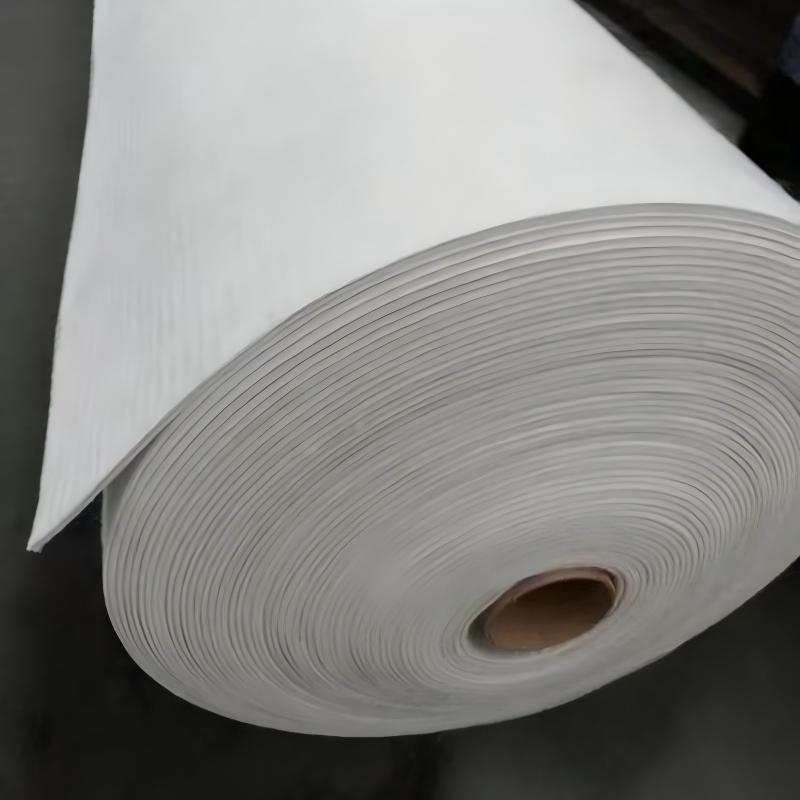
- Select mass per unit and roll configuration. For the G-Tex® GLP range the technical documentation lists mass-per-unit options from 140 to 900 g/m² with approximate roll lengths from 300 m down to 45 m. Roll length is not a trivial choice: it sets the number of field joins, and joins are where a low-elongation sheet is most likely to be compromised.
- Name the dominant functional role. Filtration, stress dispersion or gasket. Write it into the technical annex so that the supplier, the installer and the supervising engineer are optimising the same property.
- Attach the test plan to the order, not to the relationship. List the ASTM categories to be reported, the values required, and the laboratory. Request the report as a shipment document.
- Plan the site handling. Identify the plant that will place the material, the cover depth, and the sequence in which laps will be made. Static long-term operation means the installed geometry has to be right the first time; there is no second loading cycle to correct it.
Use Cases: Three Project Types, Three Parameter Priorities
Road construction
In road construction the geotextile is placed on a prepared subgrade and covered by granular layers. The dominant requirement is stress dispersion, with filtration secondary at the soil interface. Wide-width tensile strength and CBR burst strength lead the specification, because the sheet is loaded by placing plant before it is loaded by the structure. The recorded application scenario for this use is common in Australia, where subgrade conditions and heavy axle loads make the dispersion function explicit.
River embankment reinforcement
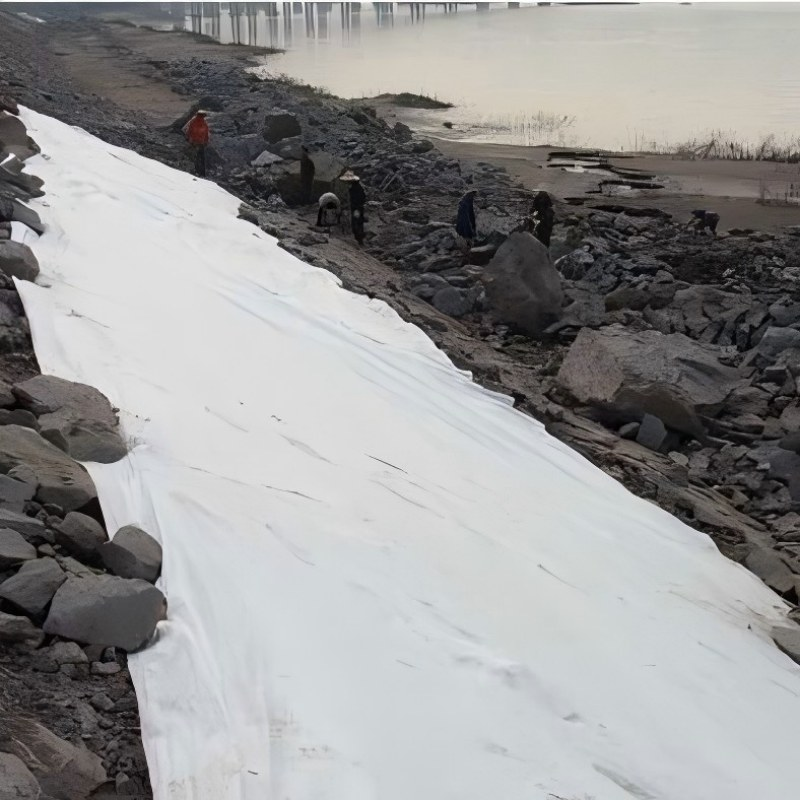
In hydraulic engineering, the sheet works against moving and standing water. Filtration becomes the governing role, with gasket action supporting it wherever the geotextile sits between the subsoil and a rigid or granular armour layer. The material operates in static long-term mode, so the filter interface has to remain stable without maintenance access. UV exposure during construction on an open bank is the reason the anti-UV grade requirement is stated rather than assumed.
Landfill lining
In environmental protection engineering, particularly landfill lining, the geotextile acts as a gasket and a filter beneath or above a lining system, under permanent load and permanent exposure risk during cell construction. Two parameters dominate: thickness behaviour under confining pressure, which is why thickness is declared at 2 kPa, and strain control, because a gasket that extends stops sealing. The recorded scenario is common in the United States, where landfill cell construction typically pairs the geotextile with a geomembrane.
Across all three, the stated working condition is identical — outdoor exposure with soil and water contact — and the stated operation mode is identical — static long-term. The difference is which parameter leads. That is why a single generic PP nonwoven geotextile clause copied between projects rarely serves any of them well.
Comparison Table: Declared Parameters and Their Role in UV and Low-Elongation Service
| Parameter | Declared value | Declared source / test reference | Why it matters in this application |
|---|---|---|---|
| Wide-width tensile strength | 7.0–95 kN/m | Product 1488 parameter table; ASTM D4595 declared for the G-Tex® GLP range | Governs stress dispersion across the loaded area; the primary figure for road and reinforcement projects |
| Grab strength | 500–7,500 N | Product 1488 parameter table; ASTM D4632 (GLP) | Indicates localised resistance where the sheet is gripped, dragged or clamped during mechanised installation |
| Trapezoidal tear | 200–2,500 N | Product 1488 parameter table; ASTM D4533 (GLP) | Controls tear propagation from a nick or stress concentration opened during placing |
| CBR burst strength | 1,300–12,500 N | Product 1488 parameter table; ASTM D6241 (GLP) | Represents puncture-type loading from angular fill and plant tracking before cover is complete |
| Puncture resistance | Declared test category | G-Tex® GLP technical documentation; ASTM D4833 | Second view of the same installation-damage risk, useful when fill grading is aggressive |
| Mass per unit | 140–900 g/m² (GLP range options) | G-Tex® GLP technical documentation; ASTM D5261 | Screening and quantity indicator; not evidence of UV durability or strain behaviour |
| Thickness | Measured under 2 kPa confining pressure | ASTM D5199 | Reference for the gasket function and for compressibility under permanent load |
| Roll length | Approx. 300 m to 45 m (GLP range) | G-Tex® GLP technical documentation | Sets the number of field joins, which is where a low-elongation sheet is most exposed to error |
| High UV resistance | Anti-UV geotextile listed as a distinct product type; high UV resistance recorded as an application requirement | Product 1488 type list; application requirement record | Must be ordered as a named grade, because exposure stage determines whether it is needed |
| Elongation | Not listed in the declared parameter table for product 1488 | To be defined by the buyer, with method and acceptance value | The parameter the buyer must add; without it, low elongation is not an enforceable requirement |
Note on reading this table: mechanical values are declared in the product 1488 parameter table; mass-per-unit options, roll lengths and the ASTM test-method categories are declared in the G-Tex® GLP technical documentation. Buyers should confirm in the quotation that the named test methods apply to the specific grade ordered, and should treat the declared ranges as family ranges from which a single grade value must be selected.
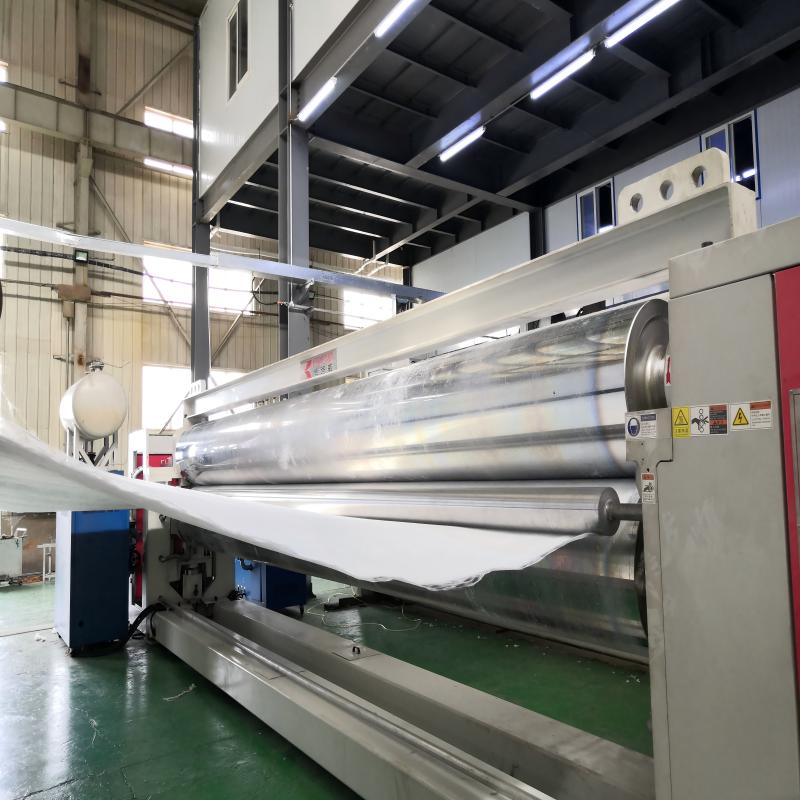
Site Handling and Installation Requirements
Because the operation mode is static long-term, the installation phase is the only opportunity to correct the sheet. Three practical points follow from the recorded application data.
- Plant selection. The matched equipment for this application is bulldozer, excavator and crane. Tracked plant moving directly over an unprotected sheet is the most common source of installation damage; a cover layer staged ahead of the plant is the standard mitigation.
- Load timing. Static long-term loading means the sheet will carry its design load continuously from the moment the structure is complete. Any elongation that occurs during placing is permanent, which is why the elongation requirement is specified at the order stage rather than evaluated afterwards.
- Exposure staging. Where the sheet will remain exposed between installation and covering, the anti-UV grade belongs in the delivery documentation, and the exposure period belongs in the method statement.
Frequently Asked Questions
Which test methods should a PP nonwoven geotextile specification cite for UV-resistant, low-elongation service?
Cite the categories already declared in the product documentation: mass per unit under ASTM D5261, tensile strength under ASTM D4595, grab strength under ASTM D4632, trapezoidal tear under ASTM D4533, CBR burst strength under ASTM D6241, thickness under ASTM D5199 measured at 2 kPa confining pressure, and puncture resistance under ASTM D4833. Those are the methods declared in the G-Tex® GLP technical documentation. Elongation is not part of that declared list, so add the property, the method and the acceptance value in the RFQ. Request the test report as a shipment document; Dalian IEC Testing Service Co., Ltd., established by the manufacturer in 2012 and CNAS-accredited since April 2016, issues reports that are mutually recognised by over 70 developed countries within its accredited scope.
Can one PP nonwoven geotextile grade provide filtration, stress dispersion and gasket action at the same time?
Product 1488 records all three functions — filtration, stress dispersion and gasket action — in the same application scenario, so they are not mutually exclusive. What changes is which parameter leads. If gasket action is the dominant role, thickness behaviour under confining pressure and strain control govern; if stress dispersion dominates, wide-width tensile strength governs; if filtration dominates, mass per unit and thickness are the practical screens. Within the declared range of 7.0–95 kN/m tensile and 1,300–12,500 N CBR burst, the delivered capability is set by the point you select inside the range, not by the family name.
What drives cost differences between quotations stating the same mass per unit?
Mass per unit is one variable among several. Two offers at the same grams per square metre can sit at different points inside the 7.0–95 kN/m tensile range and the 1,300–12,500 N CBR burst range, which changes the fibre and process input. Other drivers include whether an anti-UV grade is required instead of the standard PP nonwoven geotextile, the chosen roll length within the approximate 300 m to 45 m options, the width configuration, the extent of test reporting requested with the shipment, and any customisation such as wicking, conductive or Logo Inkjet coding geotextile. Buyers comparing offers should normalise all of these before comparing the headline figure.
How should a sample be validated before placing a full order?
Request a sample of the specific grade, not of the family, and validate it against the same parameters that will govern the shipment: mass per unit under ASTM D5261, thickness under ASTM D5199 at 2 kPa, tensile, grab, tear and CBR burst values reported against ASTM D4595, D4632, D4533 and D6241, plus the elongation value under the method you specified. Confirm in writing that the anti-UV grade designation is the one being sampled. Keep the sample as the physical reference for incoming inspection, so that the comparison at delivery is against a retained artefact rather than against a memory of the specification.
What information shortens the quotation and delivery process?
Five items do most of the work: the model within the range (GLS-V, GE, GLP, PET or PP), the mass per unit and the minimum values required inside the declared tensile, grab, tear and CBR ranges, the width and roll length configuration, the quantity in square metres, and the UV grade plus elongation requirement with its test method. Adding the project type — road construction, river embankment reinforcement or landfill lining — lets the supplier check the parameter hierarchy against the recorded application, since the same material can be optimised differently for each.
Conclusion
UV resistance and low elongation are not two adjectives attached to the same product claim; they are two separate specification decisions, and only one of them appears in the standard declared parameter table. For product 1488, the tensile, grab, tear and CBR burst ranges are declared, the ASTM test categories are documented, and thickness is stated under a defined confining pressure. The UV requirement has to be ordered as an anti-UV grade. The elongation requirement has to be written by the buyer.
Get those two items into the order document, select a single point inside each declared range instead of quoting the range, and the specification becomes something a supplier, an installer and a supervising engineer can all verify against the same shipment. Anything less leaves the most demanding part of the application — the exposed phase and the permanent static load — to assumption.
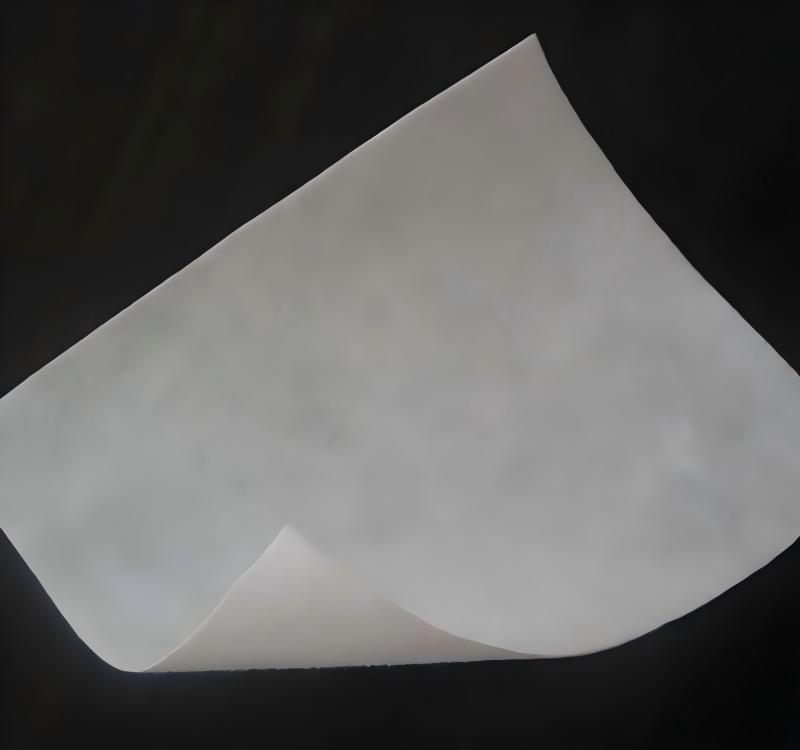
Next Step: Sample and Specification Review
Request a sample of the specific G-Tex® GE grade for your project, together with the corresponding test data, so the anti-UV designation and the elongation requirement can be checked before the order is placed.
Contact: Dothan | Email: Dothan@geo-textile.com | Tel / WhatsApp: +86 186-9865-5505
Website: www.geotranstechnology.com
Company profile brochure: download the I.E.C. profile (PDF)
Dalian GeoMax Synthetics Co., Ltd. — NO.8888-1 SOUTHEASTERN INDUSTRIAL ZONE, YOUJIA, GANJINGZI DISTRICT, DALIAN, CHINA.
Have Questions or Need More Details?
Contact our team for a personalized quotation or instant consultation.
Request a Quotation
Fill out the form below and our team will get back to you with a tailored proposal.
WhatsApp Direct Chat
Prefer to chat in real-time? Message us on WhatsApp for instant assistance & quick answers.
- Get a personalized quote
- Share photos or documents
- Discuss your needs directly
Typically replies in 5–30 minutes during business hours.