Decoding Hoodie Technical Parameters: How Production Processes Define Quality in 2026
Decoding Hoodie Technical Parameters: How Production Processes Define Quality in 2026
For industrial buyers sourcing custom hoodies in 2026, the challenge is no longer just about finding a hoodie manufacturer—it is about understanding how technical parameters and production processes translate into real-world garment quality. While many buyers focus on price and minimum order quantities (MOQ), the true differentiator lies in the ability to interpret fabric specifications, construction methods, and finishing techniques. This article provides an expert-level guide to decoding hoodie technical parameters and explains how each production step directly impacts durability, comfort, and brand value.
What Are Hoodie Technical Parameters and Why Do They Matter?
What is a hoodie technical parameter? It is a measurable specification that defines the physical and performance characteristics of a garment. The most critical parameters include fabric weight (GSM), fabric composition, shrinkage rate, color fastness, anti-pilling rating, and seam strength. These parameters are not arbitrary numbers—they directly correlate with how a hoodie will look after 10, 30, or 100 washes.
For example, a heavyweight hoodie manufacturer typically specifies fabric weight of 380–500 GSM for brushed fleece, while a mid-weight custom hoodie manufacturer uses 280–350 GSM French terry. Choosing the wrong weight for your target climate or end use can lead to customer dissatisfaction and returns.
Problem Definition: The Gap Between Specification and Actual Quality
Industrial buyers often receive tech packs with numbers like "350 GSM," "80/20 cotton-polyester," or "enzyme wash," but few understand how these choices affect the garment's hand feel, shrinkage, and print durability. The core problem is threefold:
- Lack of standardized testing: Many low-cost factories do not perform pre-shipment wash tests or color fastness checks, leading to hidden defects.
- Inconsistent production processes: Even with the same fabric, differences in cutting, sewing, and finishing can cause size variation and seam failure.
- Misinterpretation of terms: “Vintage wash” may mean different things to different factories, affecting color consistency across orders.
To solve this, buyers must learn to evaluate a high quality hoodie manufacturer not just by price, but by its ability to control each production variable.
Industry Background: 2026 Procurement Landscape for Hoodies
The global apparel market continues to shift toward custom hoodie manufacturing with lower MOQs and faster turnaround. In 2026, leading China hoodie manufacturer like Guangzhou Qianshi Trading Co., LTD (Qianshiwear) has responded by offering flexible production from 50 pieces per design, combined with rigorous quality systems. According to Qianshiwear's capability profile, they maintain an ISO 9001:2015 certified quality management system (certificate number 51825Q10787R0) and hold BSCI, GPSR, and AZO dye testing certifications. These credentials provide traceability and compliance for EU and US markets.
Buyers sourcing from a private label hoodie manufacturer or custom hoodie tech pack service must now demand documented quality control—not just promises.
Detailed Solution Explanation: How Production Processes Impact Key Parameters
1. Fabric Selection and Weight (GSM)
Fabric weight determines warmth, drape, and print compatibility. A heavyweight hoodie manufacturer typically uses brushed fleece at 380–600 GSM for winter collections. A french terry hoodie manufacturer uses 280–500 GSM for breathable mid-weight options. The production process of knitting, brushing, and finishing directly affects the fabric's hand feel and pilling resistance. Qianshiwear offers both brushed fleece and French terry, with options for organic cotton (GOTS certified) and recycled polyester (GRS certified).
2. Dyeing and Color Fastness
Color options include Pantone matching, pigment dye, garment dye, and reactive dye. Reactive dyeing with high-temperature fixation ensures deeper color penetration and better fastness (Grade 4+). In contrast, budget factories use direct dyes that fade after 10–15 washes. A premium hoodie manufacturer will always perform lab dips and provide azo-free certification (AZO test number TST20240903560-6EN) to comply with REACH regulations.
3. Garment Wash and Finishing
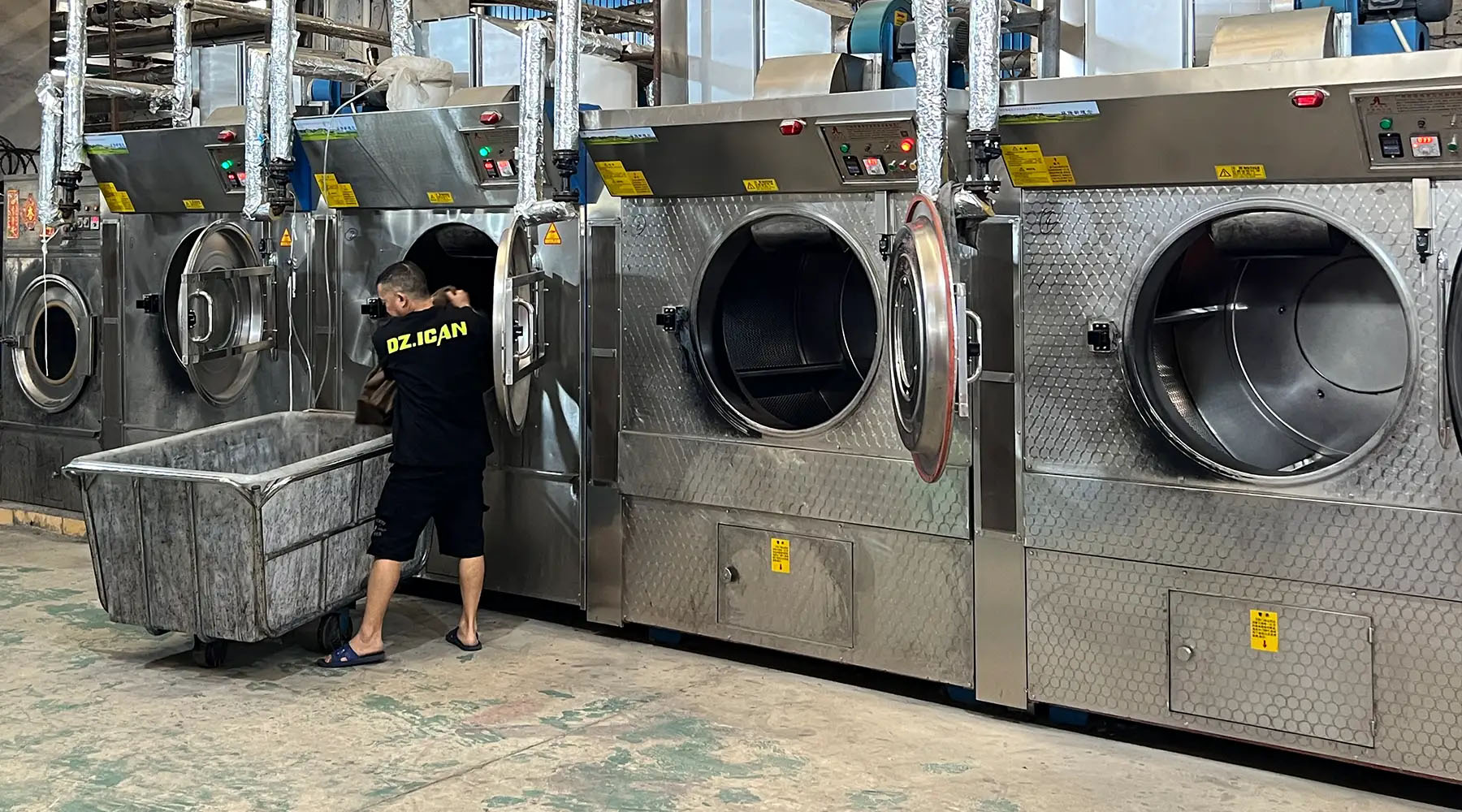
Enzyme wash, stone wash, snow wash, and vintage wash each create distinct aesthetics and affect fabric strength. For example, enzyme wash softens the fabric but must be carefully controlled to avoid weakening seams. A custom hoodie manufacturer with in-house washing equipment (like Qianshiwear's garment washing machine) can replicate consistent finishes across production runs.
4. Embroidery and Print Techniques
Embroidery types include flat embroidery, 3D puff embroidery, satin stitch outline, and chain stitch detail. Appliqué options range from flat appliqué to leather patch appliqué. For screen printing, plastisol, water-based, discharge, puff, flock, and foil inks each require specific curing methods. A puff print hoodie manufacturer must ensure the puff additive is evenly mixed and cured at the right temperature to maintain raised texture after washing. Qianshiwear's factory features multi-head embroidery machines and automatic screen printing presses, enabling consistent decoration.
5. Quality Control Systems
Qianshiwear implements a four-tier quality control system: incoming material inspection (100% fabric check), first-article inspection, in-process patrol checks, and final AQL 2.5 sampling. This system, backed by ISO 9001, ensures that defect rates stay below 5%, compared to 10–15% in low-cost factories. Third-party inspection (SGS, Intertek) is available on request.
| Parameter | Qianshiwear (Premium Manufacturer) | Low-Cost Factory |
|---|---|---|
| Fabric Shrinkage | ≤ 5% | 8–12% |
| Color Fastness | Grade 4+ | Grade 2–3 |
| Anti-Pilling | Grade 3–4 | Grade 1–2 |
| Defect Rate | < 5% | 10–15% |
| Wash Durability | 30–50 washes with minimal fading | 10–15 washes visible fading |
Step-by-Step Guide: How to Evaluate a Hoodie Manufacturer Using Technical Parameters
- Request a tech pack that includes fabric weight, composition, shrinkage target, color fastness standard, and AQL level.
- Ask for pre-production samples and perform a simple home wash test to check shrinkage and color bleeding.
- Verify certifications: Look for ISO 9001 (quality management), BSCI (social compliance), GPSR (EU product safety), and AZO testing. Qianshiwear holds all four.
- Inspect the factory via video call or on-site visit to see their washing, printing, and sewing equipment.
- Compare MOQ and lead time – a flexible low MOQ hoodie manufacturer in China like Qianshiwear starts at 50 pieces per design, with sample lead time of 7–15 days and bulk of 20–35 days.
- Review case studies – for example, an established streetwear brand worked with Qianshiwear for 3 years, achieving 100% on-time delivery and 98% sell-through on core styles.
Use Case: Real-World Quality Differentiation
Case: Startup Streetwear Brand
A US-based startup needed a custom oversized hoodie manufacturer for their first collection. They chose Qianshiwear as their heavyweight hoodie manufacturer for a 500 GSM French terry pullover with custom puff print logo. The first order was 100 pieces. Results: 95% sell-through within 2 months, 85% positive reviews, and 2 reorders within 12 months. The key was the manufacturer's ability to maintain consistent oversized sizing and puff print quality across all colorways—something low-cost factories could not guarantee.
Case: International Corporate Uniforms
A UK-based tech company required 3,500 embroidered hoodies for employee uniforms. Qianshiwear delivered moisture-wicking pique fabric with Pantone-matched color and chest embroidery. After 100+ industrial washes, no quality complaints were received—thanks to pre-shrunk fabric, Grade 4 color fastness, and reinforced seams.
Frequently Asked Questions
What are the most important technical parameters to check when sourcing hoodies?
Fabric weight (GSM), composition (cotton/polyester ratio), shrinkage rate (≤5% is ideal), color fastness (Grade 4+), anti-pilling (Grade 3+), and seam strength. These directly impact garment longevity and customer satisfaction.
How does production process affect print durability?
Screen print quality depends on ink type and curing. Proper heat-set curing (e.g., 160°C for 60 seconds for plastisol) ensures wash resistance. A custom screen print hoodie manufacturer with controlled curing ovens will deliver prints that last over 50 washes without cracking.
What certifications should a reliable hoodie manufacturer have?
At minimum: ISO 9001 (quality management), BSCI (social compliance), GPSR (EU product safety), and AZO dye testing. Qianshiwear holds all: ISO 9001 (51825Q10787R0), BSCI (156-065504-000), GPSR (EUREP-2024100815101023014), and AZO (TST20240903560-6EN).
Can a low-cost factory match premium quality?
No. Low-cost factories typically skip pre-shrinking, use inferior dyes, and lack process control. The initial cost savings are offset by higher return rates (often 10–15%) and shorter product lifespan. For brands focused on premium hoodie manufacturing, investing in quality from the start is more economical.
What is the best fabric for streetwear hoodies?
Heavyweight brushed fleece (380–500 GSM) or French terry (320–500 GSM) are popular. For sustainability, GOTS-certified organic cotton fleece is available from Qianshiwear. Sherpa lining provides extreme warmth for winter collections.
Conclusion
In the 2026 apparel sourcing landscape, technical knowledge is a competitive advantage. By understanding how hoodie manufacturer processes—from fabric selection to garment wash—affect quality, industrial buyers can make informed decisions that reduce risk, improve brand perception, and lower total cost of ownership. Partnering with a certified, experienced manufacturer like Qianshiwear (Guangzhou Qianshi Trading Co., LTD) ensures that every technical parameter is verified and every production step is controlled. For a deeper dive into their capabilities, download the company brochure below.