Composite Drainage Geonet vs. GCL: Barrier and Drainage Roles Compared
Composite Drainage Geonet vs. GCL: Barrier and Drainage Roles Compared
Composite drainage geonets and geosynthetic clay liners (GCLs) are not interchangeable products. A composite drainage geonet is designed to collect and convey water, leachate, gas or other fluids within a planar drainage layer. A GCL is designed to perform as a low-permeability barrier against liquid migration.
Projects such as landfill lining systems, tailings containment, tunnel waterproofing and slope protection frequently need both functions. This guide explains what each material does, how they are certified, where they are best applied, and why buyers often specify them together rather than choosing one over the other.
Primary query: drainage geonet. Related topics: composite drainage geonet, geosynthetic clay liner comparison, landfill drainage geonet, subgrade drainage geonet, tunnel drainage geonet.
Selecting the correct geosynthetic layer starts with understanding whether the project needs drainage or barrier performance.
Why Buyers Confuse Composite Drainage Geonets with GCLs
Buyers evaluating containment and drainage systems often see both products included in the same design drawing or the same supplier catalog. A composite drainage geonet may have the same black color as a GCL, and both are roll-form geosynthetics that are installed on prepared subgrades. However, their functions are different.
Confusion also increases because many projects install both. For example, a modern landfill or tailings containment system may use a geomembrane as the primary barrier, a GCL as a secondary barrier layer, and a composite drainage geonet as the leak-detection or leachate drainage layer above the liner. Seeing materials stacked together can make it appear that they are competing options when they are actually complementary layers in the same lining system.
Definitions: What Is a Drainage Geonet and What Is a GCL?
Composite drainage geonet definition
A composite drainage geonet is a geosynthetic product with a three-dimensional net-like core, often heat-laminated or integrated with a geotextile on one or both sides, which forms an in-plane flow channel for liquids or gases. It is available in HDPE, PP and PET variants and can be customized in thickness, mass per unit area, tensile strength and drainage capacity. Haoyang's drainage geonet range covers 4.0 mm to 8.0 mm thickness, 500 g/m² to 1400 g/m² mass per unit area, and tensile strength of at least 5–15 kN/m in MD/TD.
Geosynthetic clay liner (GCL) definition
A geosynthetic clay liner, or GCL, is a manufactured hydraulic barrier that typically consists of a layer of sodium bentonite clay encased between geotextiles or bonded to a geomembrane. GCLs provide a low-permeability barrier by relying on the swelling properties of bentonite when hydrated, which resists liquid passage. Haoyang produces powder-type bentonite waterproof blankets as part of its geosynthetic product range, along with its certified composite drainage net products.
Role Difference: Drainage vs. Barrier
The easiest way to choose is to ask a single question: does the layer need to let fluid move out, or does it need to stop fluid from moving through?
- Composite drainage geonet function: collects and transports liquids or gases, relieves pore pressure, prevents build-up of leachate behind barriers, and provides a flow path for leak detection.
- GCL function: acts as a low-hydraulic-conductivity barrier, reducing the quantity of fluid that migrates into the soil or groundwater below the containment system.
When a drainage net is specified, the expected performance is measured in terms such as drainage capacity in litres per minute per metre width, compressive strength, tensile strength and chemical resistance. When a GCL is specified, the decisive performance is hydraulic conductivity, bentonite mass per unit area and resistance to ion exchange under real site water chemistry.
Engineering Parameters: How Drainage Performance Is Validated
Buyers evaluating a composite drainage geonet should verify four parameters before approval.
Drainage capacity. This is the standard hydraulically relevant value, expressed in litres per minute per metre width at defined hydraulic gradient and normal stress. Haoyang's composite drainage geonet variants are rated from 50 to 120 (L/min)/m, and the value is customizable according to project requirements.
Compressive strength. A drainage geonet under soil overburden must not collapse because deformation reduces the open flow area and cuts drainage capacity. Haoyang's product range is specified at 500 to 830 kPa compressive strength at 10% strain. Buyers should compare compressive performance under the exact normal load that the project will place on the layer.
Tensile strength and elongation. Drainage geonets are often installed on slopes or uneven subsurfaces, so they need enough mechanical strength to resist installation strain and long-term settlement. Haoyang specifies tensile strength of at least 5–15 kN/m in MD/TD and elongation at break of 10–25%.
Chemical resistance. Composite drainage geonets in landfill, mining, smelting and industrial applications must withstand chemically aggressive liquids. Haoyang's acid/alkali resistance specification is at least 90% strength retention after exposure. Buyers with site-specific seepage water chemistry should still request material compatibility data under their own expected conditions.
Verified reference: Haoyang's drainage geonet products are available in HDPE/PP/PET material, with thickness 4.0–8.0 mm, mass per unit area 500–1400 g/m², tensile strength (MD/TD) ≥5–15 kN/m, elongation at break 10–25%, compressive strength (10% strain) ≥500–830 kPa, acid/alkali resistance ≥90% strength retention, and drainage capacity ≥50–120 (L/min)/m.
Compliance Verification: EN 13249 Certification Evidence
Both product types are within the scope of EN 13249, the harmonised European standard for geosynthetics used in the construction of roads and other trafficked areas. Haoyang holds separate third-party Verification of Conformity certificates for the two products under this standard.
- Composite drainage net certificate: ICR/VC/HE250523, issued by ICR for the EU/EEA market, compliant with EN 13249:2016, valid from 2025-05-20 to 2030-05-19.
- Geosynthetic Clay Liner (GCL) certificate: ICR/VC/HE250526, issued by ICR for the EU/EEA market, compliant with EN 13249:2016 under CPR (EU) 305/2011, valid from 2025-05-20 to 2030-05-19.
For buyers in the EAEU market, Haoyang also holds GOST certification applicable to drainage geonet products, issued by ProfSert under GOST 56586-2015 (certificate POCC CN.32682.047C00.0C01.H00840). Distributors, contractors and engineering consultants should match the certificate scope, standard and certificate number to the product being supplied, because a composite drainage geonet certificate cannot be used as evidence for a GCL, and vice versa.
Applications of Drainage Geonets
Drainage geonets are used wherever a high-capacity planar drainage path is needed to relieve pressure and protect liners. The main applications match several of the most common buyer search terms for this category.
Landfill drainage geonet
In landfill systems, leachate must be collected above the geomembrane and removed for treatment. A drainage geonet provides a high-capacity, chemically resistant flow layer that reduces the hydraulic head on the liner and controls leachate migration. This is one of the most demanding drainage geonet applications because of long-term exposure to aggressive leachate.
Subgrade drainage geonet
Beneath roads, rail lines and engineered fills, groundwater that accumulates under the subgrade can cause pumping, deformation and premature pavement failure. A subgrade drainage geonet intercepts and conveys water laterally to a controlled outlet, improving the long-term performance of the structure.
Tunnel drainage geonet
Tunnel linings must prevent groundwater from accumulating behind the concrete segment lining. As tunnels are built in fractured rock or water-bearing soils, a composite drainage geonet is installed as a drainage medium that collects infiltration and carries it to drainage pipes, lowering the hydrostatic pressure behind the lining.
Slope protection drainage geonet
Slopes and retaining structures require drainage to avoid water pressure that triggers erosion, slumping or structural displacement. A slope protection drainage geonet installed beneath armour or protection layers provides positive drainage while preventing soil particles from clogging the core.
Industrial and mining applications
Mining and metal-smelting projects use composite drainage geonets in tailings containment systems, where they act as leak-detection layers or drainage interlayers beneath or above geomembrane barriers. Haoyang's product range is explicitly supplied to metal smelting and aquaculture industries, and the company has delivered geosynthetic containment systems for a gold mine tailings pond in Uzbekistan.
Applications of GCLs as Barrier Layers
GCLs are selected in applications where a low-permeability barrier must be created quickly and with relatively low material thickness.
- Composite barrier in landfills and tailings: GCLs supplement or replace compacted clay liners, particularly when clay is scarce, when site excavation depth is limited, or when space is expensive.
- Secondary containment: GCL layers provide an extra line of defence beneath geomembranes in tank farms, ponds and industrial waste storage facilities.
- Aquaculture and water containment: When a water body must be held rather than drained, a GCL can act as a barrier layer beneath a geomembrane to reduce leakage.
- Transportation and urban infrastructure: GCLs prevent infiltration into subgrades and ground structures in a wide range of civil engineering works.
Composite Drainage Geonet vs. GCL: Structured Comparison
| Comparison point | Composite drainage geonet | Geosynthetic clay liner (GCL) |
|---|---|---|
| Primary function | In-plane drainage of liquids or gases | Low-permeability barrier to liquid migration |
| Design intent | Move fluids out of the system quickly | Stop fluids from passing through the layer |
| Performance measure | Drainage capacity, compressive strength, tensile strength, chemical resistance | Hydraulic conductivity, bentonite mass, self-sealing behaviour |
| Typical examples in Haoyang range | Drainage geonet: HDPE/PP/PET based; 4.0–8.0 mm thickness; 500–1400 g/m² mass; drainage capacity 50–120 (L/min)/m | Powder-type bentonite waterproof blanket |
| EN 13249 certification held by Haoyang | ICR/VC/HE250523 for composite drainage net | ICR/VC/HE250526 for geosynthetic clay liner |
| Common project role | Leachate collection, leak detection, subgrade drainage, tunnel pressure relief | Secondary barrier, hydraulic containment, clay layer replacement |
| Can they be used together? | Yes, in a composite lining system | Yes, in a composite lining system |
The table compares the two material families by function and verified product evidence. It is not a statement of superiority, because drainage and barrier layers are not alternatives in a lining system.
When Buyers Choose a Drainage Geonet, When They Choose a GCL
If the project must evacuate water or leachate, a composite drainage geonet is usually the material required.
Buyers choose a drainage geonet in the following situations:
- a leachate collection or leak-detection layer is required above a geomembrane;
- groundwater pressure must be released behind a retaining structure or tunnel lining;
- subgrade dewatering is required under a road or industrial floor;
- the core specification is a defined flow capacity under load.
Buyers specify a GCL in the following situations:
- the project needs a low-hydraulic-conductivity barrier to protect soil and groundwater;
- a compacted clay liner is impractical because of site space, clay availability or construction time;
- the containment system calls for redundant barrier layers beneath or above a geomembrane;
- the performance requirement is expressed in terms of permeability rather than flow rate.
Because these decisions are answering different engineering questions, the phrase “drainage geonet vs. GCL” is best understood as a comparison of two specialised layers, not as a contest for a single installation slot.
Case Reference: Tailings Containment with a Full-Chain Geosynthetic Approach
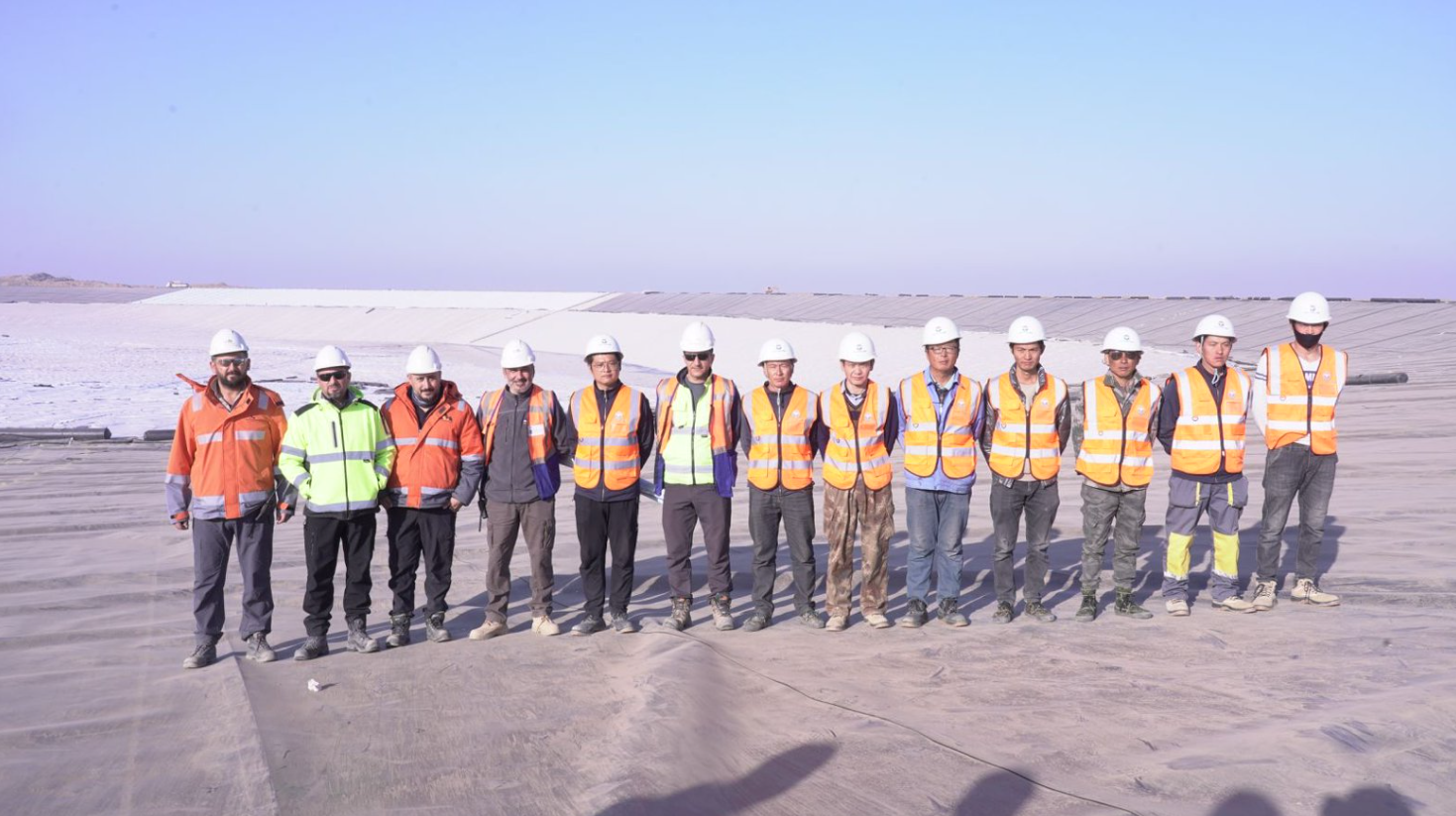
One of the most relevant project references for buyers evaluating large-scale containment is Haoyang's supply of seepage control for a gold mine tailings pond basin in Uzbekistan. The product scope covered 900,000 square metres of anti-seepage material and included a three-dimensional composite drainage network configured with independently developed textured geomembrane and high-strength polypropylene geotextile.
The project created a full-chain service system from material supply to on-site installation and construction, rather than following a single-sales model. The textured geomembrane was manufactured on a five-layer co-extrusion line with online double-sided texturing. Because the rough surface formation occurs in the molten state, the process reduces production energy consumption by 25% compared with secondary processing approaches while avoiding the risk of thermal aging that secondary lamination may create.
Procurement Requirements and Supplier Customization
For buyers moving from evaluation to execution, the selection of a custom composite drainage geonet requires careful specification of design inputs:
- Thickness: standard range 4.0–8.0 mm, with thickness matched to expected normal stress and required flow rate.
- Mass per unit area: 500–1400 g/m². Higher mass typically means more polymer or geotextile per square metre, which changes strength and cost.
- Tensile requirements: tensile yield strength, tensile fracture strength and piercing strength can be customised; standard MD/TD tensile strength is ≥5–15 kN/m.
- Chemical resistance: in acidic or alkaline leachate, specify the exact environment so the factory can select an appropriate polyethylene/polypropylene/polyester formulation.
- Drainage capacity target: 50–120 (L/min)/m is a practical range, but the value is customizable and must be based on hydraulic design.
Haoyang offers OBM production as well as customization of LOGO, width, scroll length, thickness, GSM, tensile yield strength, tensile fracture strength, piercing strength and chemical/physical indicators. Its engineering centre and R&D team of 20 professional engineers support product development and project-specific validation. Export markets served include Africa, Europe, Central Asia, Southeast Asia, Australia and South America.
Standard procurement conditions for Haoyang drainage geonet are: MOQ 5000 m², lead time 10–30 days, delivery under FOB or CIF, pre-shipment testing, and typical payment terms of 30/70 or 100% T/T. Monthly production capacity for the category is 3000 tonnes. Buyers requiring samples or project-specific technical documentation may request them directly from the factory.
Frequently Asked Questions
Are composite drainage geonets and geosynthetic clay liners alternatives?
No. A composite drainage geonet is a drainage layer whose function is to collect and convey fluids; a geosynthetic clay liner (GCL) is a barrier layer whose function is to resist fluid migration. The two products are often used together in one lining system, for example a GCL beneath a geomembrane and a drainage geonet above it.
What certification does Haoyang hold for composite drainage geonets and GCLs?
Haoyang holds separate ICR Verification of Conformity certificates for the EU/EEA market under EN 13249-2016: certificate ICR/VC/HE250523 for the composite drainage net and certificate ICR/VC/HE250526 for the Geosynthetic Clay Liner. Both certificates were issued on 2025-05-20 and are valid until 2030-05-19. The company also holds GOST certificates for EAEU markets.
What is the typical specification range for a composite drainage geonet?
Haoyang's composite drainage geonet is produced in 4.0–8.0 mm thickness, 500–1400 g/m² mass per unit area, tensile strength (MD/TD) ≥5–15 kN/m, elongation at break 10–25%, compressive strength at 10% strain ≥500–830 kPa, acid/alkali resistance ≥90% strength retention, and drainage capacity ≥50–120 (L/min)/m. Values are customizable based on project requirements.
Can a composite drainage geonet replace a compacted clay or GCL barrier?
No. A composite drainage geonet does not provide a low-permeability barrier; it intentionally creates an open flow path. If a project requires a hydraulic barrier, specifiers should select a geomembrane or GCL, either alone or in combination with a drainage geonet. Replacing a barrier with a drainage layer would increase, not reduce, fluid movement into the surrounding environment.
Can Haoyang customise drainage geonet parameters for a specific project?
Yes. Haoyang provides OBM production and customizes LOGO, width, scroll length, thickness, GSM, tensile strength, fracture strength, piercing strength and chemical/physical indicators, supported by an R&D team of 20 professional engineers and an internationally first-class geosynthetic R&D centre. For a specific project, engineering and procurement teams may contact the manufacturer to request production feasibility and commercial terms.
Plan a geosynthetic system with the right layer separation.
Haoyang Environment Co., Ltd. manufactures certified composite drainage geonets, geomembranes, geotextiles and GCL-type bentonite waterproof blankets under one roof. Request a sample, quotation or project-specific technical consultation from Haoyang's engineering sales team.
Email: 15315800874@163.com | Tel/WhatsApp: +86 15315800874