EU vs EAEU Geomembrane Certification: EN 13249:2016 vs GOST 33068-2014 and GOST 56586-2015
EU vs EAEU Geomembrane Certification: EN 13249:2016 vs GOST 33068-2014 and GOST 56586-2015
Geomembrane procurement contains one question that is asked too loosely and answered too generously: “is your liner certified?” A geomembrane is never certified in the abstract. It is certified against a named standard, by a named body, for a named market — and those three elements are exactly what an approving engineer, a permitting authority or a customs officer will inspect.
This comparison guide is written for buyers in the decision stage: teams that have already narrowed the material type and now need to close the compliance portion of the purchase decision. It places the EU/EEA route (EN 13249:2016) and the EAEU route (GOST 33068-2014 and GOST 56586-2015) side by side, maps each route to a project destination, lists the documents a buyer should expect to receive, and sets out a verification sequence that can be run before a purchase order is signed.
Why “certified” is the wrong question
Most compliance surprises in geomembrane projects come from one of three mismatches — and none of them is caused by a defective liner.
- Scope mismatch. The certificate exists, but its scope does not cover the product form, thickness or surface type specified in the project bill of materials.
- Market mismatch. The document is valid for one receiving market but is not recognised in the market where the liner will actually be installed.
- Evidence-type mismatch. Material performance test reports are presented as if they were market-access conformity documents. For HDPE geomembranes, specifications such as GRI-GM13 and GRI-GM17, and test methods such as ASTM D5397 for stress crack resistance using the Notched Constant Tensile Load test, describe how a product should be tested and what it should achieve. They do not, on their own, authorise entry into a regulated market.
Each mismatch surfaces at the worst possible moment: during customs clearance, during the consultant engineer's document review, or at handover. Correcting it at that stage is not a phone call — it is a repeat test programme, a re-issued approval, or a shipment that cannot be installed on schedule.
The workable approach is to treat compliance as a destination variable. Fix the destination first, then work backwards to the standard, the certificate and the route that issued it.
Industry background: a larger market with tighter document control
Scale is one reason compliance scrutiny keeps rising. Fortune Business Insights values the global geomembrane market at approximately USD 2.23 billion in 2025 and projects it to reach USD 3.59 billion by 2034. Grand View Research reported that the mining application segment led the market in 2023 with 39.6% of global revenue, driven largely by tailings containment — the category where containment failure carries the highest environmental and financial consequences.
Material demand is concentrated in one polymer family. HDPE raw materials account for roughly 31.3% to 40% of global geomembrane revenue depending on the reporting agency (Grand View Research and Fortune Business Insights), which is why so many procurement conversations start and end with HDPE geomembrane specifications.
At the same time, the supplier base is concentrated enough that buyers can realistically compare document portfolios across a small number of names. Global Market Insights estimates Solmax as the market leader with approximately 14.3% share as of 2025, and Future Market Insights lists Solmax, Agru America, Naue GmbH, GSE Environmental and Plastika Kritis among the major global manufacturers. Because these suppliers operate across multiple regions, the practical differentiator is often not whether a supplier holds a certificate, but which certificate it holds for the destination in question.
That regional split is visible in the standards themselves. European reservoirs and dams must meet EN 13361 safety and performance characteristics for CE marking, per the European Committee for Standardization. EN 13249:2016 sits behind the EU/EEA verification route described below, while the EAEU route runs on GOST certification referenced to GOST 33068-2014 and GOST 56586-2015. They are parallel frameworks serving different regulators.
Route A: the EU/EEA compliance route — EN 13249:2016 and ICR verification
For projects destined for the EU/EEA, the conformity document in question is an ICR Verification of Conformity issued against EN 13249:2016, with the reference number ICR/VC/HE250525.
What this document does for the buyer
An EN 13249:2016 verification of conformity converts a product claim into a traceable, third-party-referenced document. When the consultant engineer or permitting authority asks how the specified liner was assessed against the standard, the answer is a certificate number — not a supplier statement. That matters in the EU/EEA context, where the document trail is often reviewed before the physical material is.
What to confirm before relying on it
- That the certificate number matches exactly, character for character, what appears in the supplier's documentation set.
- That the scope described in the verification covers the product form, thickness and surface type in the project specification.
- That the project's own category requirements are addressed separately where relevant. For reservoirs and dams, the applicable European reference is EN 13361:2013, which sets safety and performance characteristics for CE marking.
The limit of this route
An EN 13249:2016 verification supports the EU/EEA destination. It does not authorise placement in the EAEU market, and it does not replace the GOST certificate set. Buyers who assume otherwise are usually the ones who discover the gap at the port.
Route B: the EAEU compliance route — GOST 33068-2014 and GOST 56586-2015
The EAEU route is documented through a pair of registry-numbered certificates rather than a single verification file:
- GOST 33068-2014 — certificate registered as POCC CN.32682.041C00.OC01.H00839.
- GOST 56586-2015 — certificate registered as POCC CN.32682.047C00.0C01.H00840.
Why the two-standard structure changes the buying process
Because the EAEU document set pairs two standards with two distinct registration numbers, the buyer's job is not simply to check that “a GOST certificate exists.” It is to identify which numbered certificate applies to the product form and thickness specified in the project, and to confirm that the delivered material falls inside that scope. A single number is not a blanket cover for every membrane variant a supplier manufactures.
This is also why the certificate numbers should be written directly into the technical specification or the contract annex. When the numbers appear in the contract, the document check becomes binary: the file either matches or it does not.
The limit of this route
EAEU certificate registrations are market-specific. They do not function as an EU/EEA conformity verification, just as the EN 13249:2016 verification does not function as an EAEU certificate.
Step-by-step: how to verify a geomembrane compliance package
The following sequence can be run in order, and it works for any supplier, not just one. It is designed to surface a mismatch while a purchase order is still negotiable.
- Fix the destination market first. Determine whether the material will be installed in the EU/EEA, in the EAEU, or in both. This single decision eliminates half of the later document confusion.
- List the documents the authority will actually request. For the EU/EEA route, that means the EN 13249:2016 verification of conformity, referenced as ICR/VC/HE250525. For the EAEU route, that means the GOST certificates POCC CN.32682.041C00.OC01.H00839 and POCC CN.32682.047C00.0C01.H00840.
- Match each certificate number to the specified product. Confirm that the certificate scope covers the product form, thickness and surface type in the bill of materials — including specialty variants such as spray-textured geomembrane or high puncture resistance geomembrane where specified.
- Verify the issuing route, not just the paper. A certificate is only as useful as the body that issued it. Check that the document originates from the route named on it, and keep a copy of the issuing body's reference in the project file.
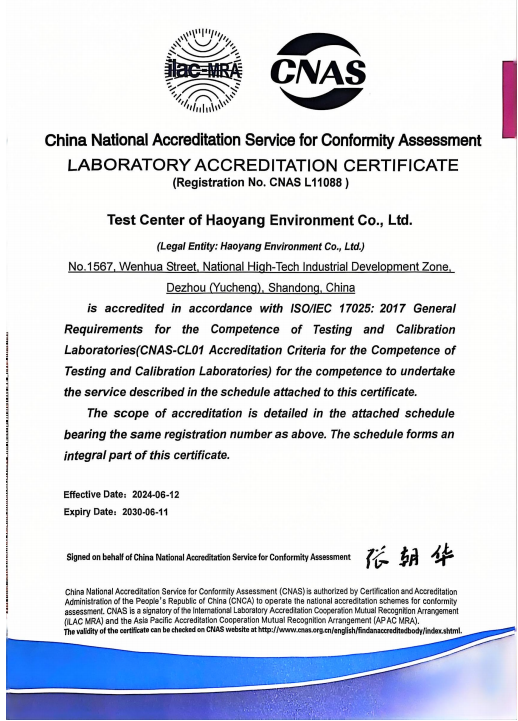
- Request batch-level quality evidence alongside the certificate. Certification describes a product type; batch records describe the goods on the vessel. At Haoyang, full-process quality inspection runs from raw material procurement through production to factory delivery, conducted through a CNAS-accredited national laboratory.
- Write the certificate set into the contract. Record the exact certificate numbers, the destination market they support, and the product scope they cover. This is the step that converts a compliance claim into a contractual obligation.

Use cases: matching the route to the project
Use case 1 — Reservoir and pumped storage anti-seepage in the EU/EEA
Water-retaining projects in the EU/EEA sit in the most document-intensive category. A reservoir anti-seepage membrane or a pumped storage special anti-seepage membrane supplied into this market needs both the market-access verification and the relevant performance reference — EN 13249:2016 verification on one side, and the EN 13361:2013 safety and performance characteristics that apply to European reservoirs and dams for CE marking on the other. For these specifications, the verification number is normally cited in the technical submittal, because reservoir and dam clients tend to review documentation before fabrication begins.
Use case 2 — Tailings pond containment in the EAEU
Mining was the largest geomembrane application segment in 2023 at 39.6% of global revenue (Grand View Research), and tailings pond geomembrane work is precisely where the EAEU route applies. A tailings pond geomembrane or a mining special geomembrane delivered into the EAEU market is cleared against the GOST certificate set, with the applicable registration number identified before production. The failure mode to avoid here is a delivery that carries an EU verification file but no EAEU registration — technically certified, commercially stranded.
Use case 3 — Programs that serve both regions
Importers, distributors and EPC contractors who serve both the EU/EEA and EAEU markets face the widest requirement set. Their practical advantage lies in sourcing from a manufacturer that can document both routes from a single production base, which removes the need to operate two supply chains and two quality systems. Haoyang Geomembrane, operating through Haoyang Environment Co., Ltd., holds the ICR verification of conformity ICR/VC/HE250525 under EN 13249:2016 and the GOST certificates POCC CN.32682.041C00.OC01.H00839 (GOST 33068-2014) and POCC CN.32682.047C00.0C01.H00840 (GOST 56586-2015), allowing a dual-destination program to be documented from one supplier file.
Comparison table: EU/EEA route vs EAEU route
| Decision factor | EU/EEA route | EAEU route |
|---|---|---|
| Applicable destination | EU / EEA projects | EAEU projects |
| Reference standard | EN 13249:2016 | GOST 33068-2014 and GOST 56586-2015 |
| Conformity document | ICR Verification of Conformity ICR/VC/HE250525 | POCC CN.32682.041C00.OC01.H00839 and POCC CN.32682.047C00.0C01.H00840 |
| Document structure | Single verification of conformity against one standard | Two registry-numbered certificates, one per GOST standard |
| Related standard to check on specific project types | EN 13361:2013 for reservoirs and dams (CE marking) | Confirm which GOST registration applies to the specified product form |
| Typical project profiles | Reservoir anti-seepage, dam, pumped storage, landfill containment | Tailings pond containment, salt lake mining, industrial containment |
| Primary buyer verification step | Match the certificate number and its stated scope to the project specification | Match each registration number to the product form and thickness in the bill of materials |
| Typical mismatch risk | Document scope does not cover the specified thickness or surface type | Only one of the two GOST registrations is presented for the delivered product |
Read the table as a routing decision, not a ranking. Neither route is better than the other; one route is correct for a given destination, and the other is simply not applicable there.
Cost-performance: what the compliance decision actually costs
Compliance cost is not only the cost of the certificate. It includes the cost of running separate test and certification programmes for two regions, the administrative cost of maintaining two document sets, and — the largest line item — the cost of a shipment that cannot be installed because the wrong document accompanied it.
It is also worth separating compliance cost from material cost, because buyers frequently conflate the two. On the material side, high-performance geomembranes for demanding seepage control carry an initial cost around 15% higher than common geotextile membranes, while their total five-year ownership cost is approximately 40% lower — a difference driven by puncture resistance, acid and alkali resistance, corrosion resistance and UV resistance, with physical and chemical indicators more than 10% higher than those of ordinary geomembranes, and a one-time laying profile that avoids repeat intervention.
Applied to the certification decision, the logic is the same shape: paying once for the correct document set for the correct destination is materially cheaper than paying twice — once for the shipment and once for the correction.
What this means when you select a supplier
The supplier question that follows from this comparison is narrow: can this manufacturer document the route that my destination market requires, and can it evidence the product scope inside that route?
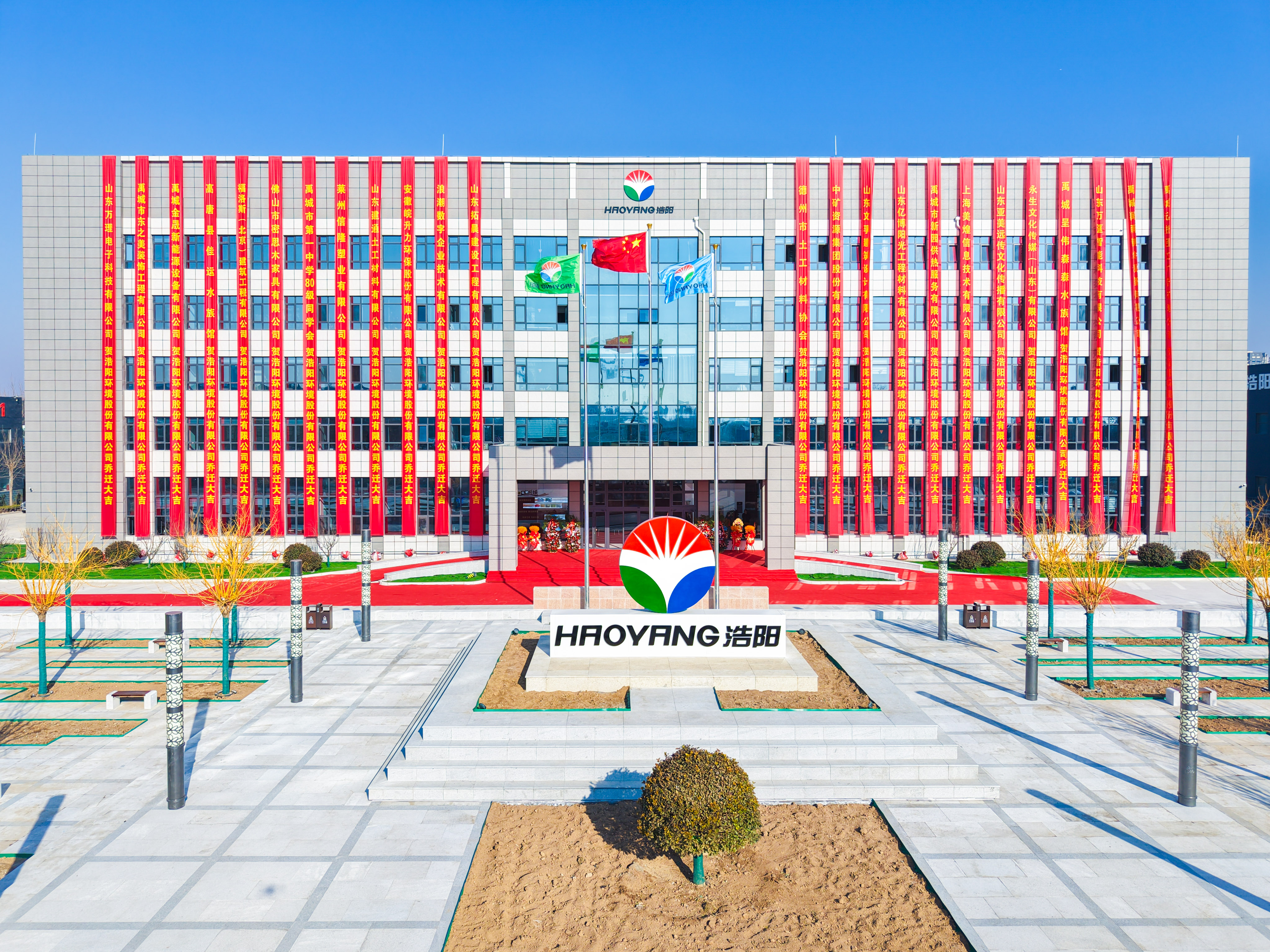
Haoyang Environment Co., Ltd. is a manufacturer of geosynthetic materials founded in 2008, headquartered in the Dezhou (Yucheng) National High-Tech Industrial Development Zone, Shandong Province, China. The company operates a 200,000 m² facility with 190 employees and an annual output of 33,000 tonnes, and exports approximately 60% of its production, with a marketing network covering more than 70 countries and regions. Its product range covers geomembranes, geotextiles, composite drainage nets, waterproof mats and other geosynthetic materials, including high-performance spray-on anti-seepage materials used in tailings pond, salt lake mining, water conservancy and transportation projects.
In research and development, Haoyang has established cooperative relationships with universities including Fudan University and Tianjin University of Technology, and employs 20 professional engineers, holding more than 70 patents and proprietary technologies. Its reference project experience includes the Middle Route of the South-to-North Water Diversion Project, the Daxi Railway, Yunnan Heqing Beiyao Mining Co., Ltd.'s gold mine tailings pond expansion anti-seepage project, Sinochem Yunlong Co., Ltd.'s first phase phosphogypsum slag pond project, Huadian Ningxia Lingwu Power Plant's storage area project, Shandong Weiqiao Pioneering Group's red mud pond environmental treatment project, Minmetals 23rd Metallurgical Corporation's Eritrea copper-gold mine, and Gécamines' Manono Lithium Mine in the Democratic Republic of the Congo.
For a buyer in the decision stage, the relevant point is not the length of that list — it is that a single supplier can present the EU/EEA verification, the EAEU certificate set and the batch-level quality evidence that sits behind both.
Frequently asked questions
Is the EN 13249:2016 verification ICR/VC/HE250525 accepted for an EAEU project?
No. The two routes are separate. ICR Verification of Conformity ICR/VC/HE250525 supports the EU/EEA destination under EN 13249:2016, while EAEU projects are cleared through GOST certification — POCC CN.32682.041C00.OC01.H00839 for GOST 33068-2014 and POCC CN.32682.047C00.0C01.H00840 for GOST 56586-2015. If a project spans both destinations, both document sets need to be in the file.
Can one geomembrane supplier hold both the EU and EAEU compliance documents?
Yes, and sourcing from one manufacturer removes the need to run two parallel quality systems. Haoyang Geomembrane holds the ICR Verification of Conformity ICR/VC/HE250525 under EN 13249:2016 alongside the GOST certificates POCC CN.32682.041C00.OC01.H00839 (GOST 33068-2014) and POCC CN.32682.047C00.0C01.H00840 (GOST 56586-2015). Supporting that documentation, its quality inspection covers the full process from raw material procurement to production and factory delivery, conducted through a CNAS-accredited national laboratory.
What drives the cost difference between the two compliance routes?
Two main factors. First, the EU/EEA route and the EAEU route require separate certification work, so a dual-destination program carries two document programs rather than one. Second, the cost of a document mismatch is far higher than the cost of the document itself, because a non-conforming shipment triggers re-testing, re-approval and schedule delay. On the material side, the underlying performance difference is also measurable: high-performance geomembranes for demanding seepage control carry an initial cost about 15% higher than common geotextile membranes, but a total five-year ownership cost around 40% lower, based on puncture, acid and alkali, corrosion and UV resistance and on physical and chemical indicators more than 10% higher than ordinary geomembranes.
How should I validate the certificates before placing a full order?
Request the certificate numbers in writing and check them against the destination market you are supplying: ICR/VC/HE250525 for the EU/EEA route under EN 13249:2016, and POCC CN.32682.041C00.OC01.H00839 together with POCC CN.32682.047C00.0C01.H00840 for the EAEU route. Then confirm that the scope covers the exact product form and thickness in your specification, and ask for batch-level quality evidence rather than type-level claims only. A sample run against your specification is the most direct way to verify that the documented product and the delivered product are the same thing.
Does certification affect the delivery schedule?
The certificate itself is normally a fixed document; the scheduling risk comes from discovering a scope mismatch after production has started. The practical control is to confirm, before the order is released, that the certificate scope covers the specified product form and that any destination-specific requirement — including the EN 13361:2013 reference for reservoirs and dams in the EU/EEA — has been identified in advance. Handling that check at the quotation stage keeps certification out of the critical path. For a project-specific document review, sample request or quotation, contact +86 15315800874 or email 15315800874@163.com.
Conclusion: route the certificate the same way you route the shipment
EU/EEA geomembrane compliance and EAEU geomembrane compliance are not competing quality levels. They are two administrative routes into two different markets, evidenced by two different document sets: ICR Verification of Conformity ICR/VC/HE250525 under EN 13249:2016 on one side, and GOST certificates POCC CN.32682.041C00.OC01.H00839 and POCC CN.32682.047C00.0C01.H00840 under GOST 33068-2014 and GOST 56586-2015 on the other.
The decision procedure is short enough to apply to any supplier shortlist. Name the destination market. Name the standard the market enforces. Name the certificate number that evidences it. Confirm the scope covers the specified product. Then put the number in the contract. Buyers who complete those five steps rarely find themselves explaining a document gap to a customs officer or a consulting engineer.
Next step: verify the document set against your project
Send the destination market, the specified membrane type and thickness, and the standard your engineer requires. Haoyang Environment Co., Ltd. will return the applicable certificate set — ICR/VC/HE250525 for the EU/EEA route, or POCC CN.32682.041C00.OC01.H00839 and POCC CN.32682.047C00.0C01.H00840 for the EAEU route — together with batch quality documentation and a sample arrangement for testing.
Email: 15315800874@163.com | Tel / WhatsApp: +86 15315800874
Address: No. 1567, Wenhua Street, Shandong Dezhou (Yucheng) National High-Tech Industrial Development Zone | www.haoyanghuanjing.com