Geomembrane vs. Drainage Geonet: Certification-Led Choice for Construction & Decoration
Geomembrane vs. Drainage Geonet: Certification-Led Choice for Construction & Decoration
Direct answer: A geomembrane and a drainage geonet do different jobs in a construction or decoration build-up. The geomembrane is the anti-seepage, impermeable layer; the drainage geonet is the drainage layer that conveys water or gas. They should not be treated as interchangeable, and a certificate for one product should not be used to qualify the other. For EU/EEA procurement, the supplied comparison links the geomembrane to ICR/VC/HE250525 to EN 13249:2016 and the drainage geonet to ICR/VC/HE250524 to EN 13249:2016 with CPR (EU) 305/2011. For EAEU procurement, it lists geomembrane GOST references POCC CN.32682.041C00.OC01.H00839 and POCC CN.32682.047C00.0C01.H00840 against drainage geonet GOST POCC CN.32682.047C00.OC01.H00837. The decision is therefore not 'which material is better' in isolation; it is which layer belongs in the build-up, which certificate covers the offered product family, and which acceptance documents are fixed before order.
Haoyang Geomembrane refers to the geomembrane products of Haoyang Environment Co., Ltd., a Dezhou-based manufacturer founded in 2008. The company operates a 200,000 m² facility and lists geomembranes, geotextiles, composite drainage nets, waterproof mats and other geosynthetics among its main products. That product breadth matters here because the buyer's task is to separate a lining layer from a drainage layer inside one project specification, not to choose a single 'certified geosynthetic' label.
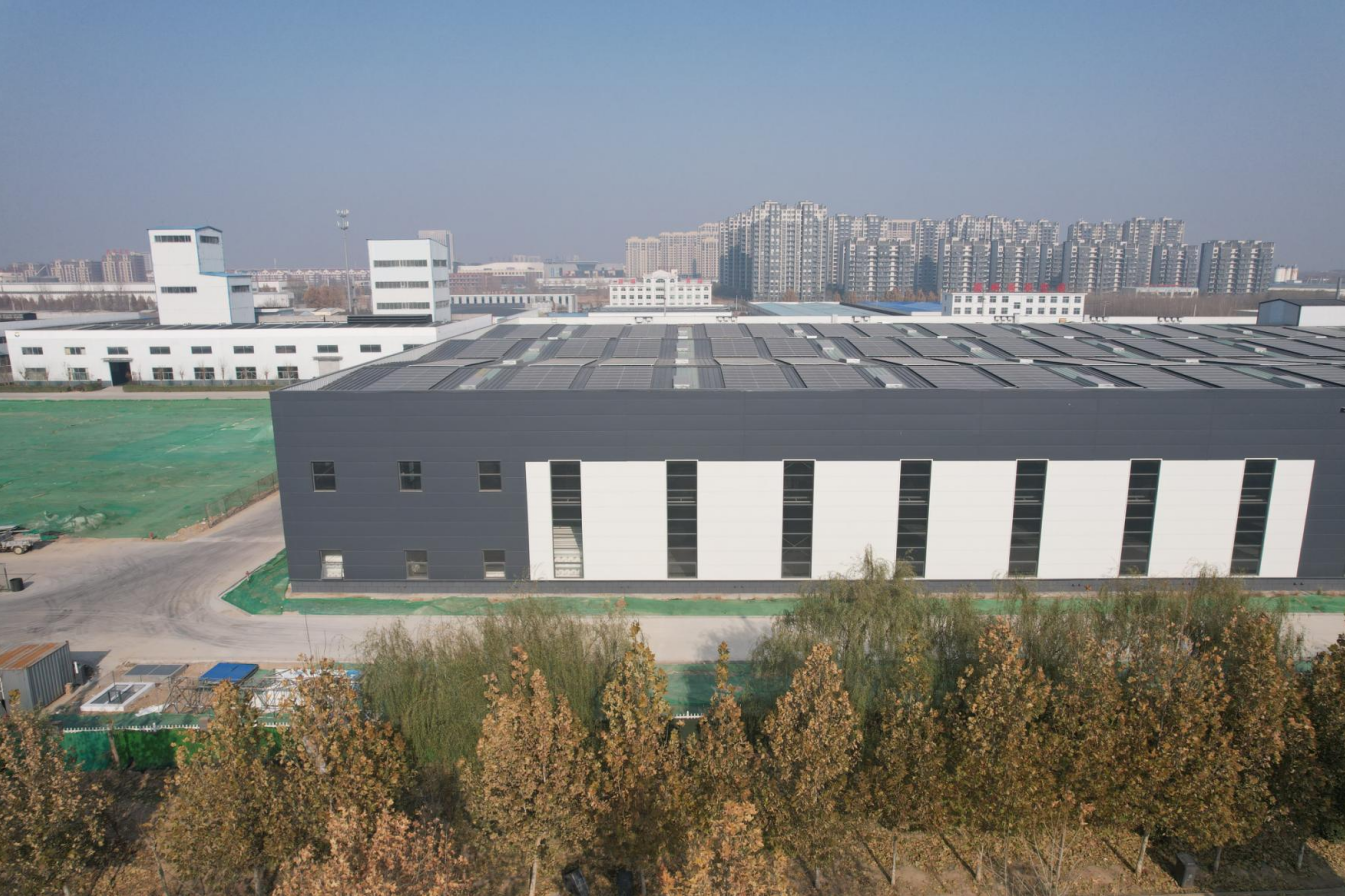
Cover: production workshop for geosynthetic materials. Image source: supplied company content.
The procurement problem: a certified geosynthetic is not a generic substitute
The common error is to compare a geomembrane and a drainage geonet as if both were 'certified membranes' with the same procurement function. They are not. A geomembrane is selected to limit liquid or gas movement; a drainage geonet is selected to create a flow path within the build-up. In a construction or decoration project, the two can appear in the same cross-section—for example, a waterproofing layer below a podium deck and a drainage layer above it—but they occupy different positions and perform different functions.
This is why certification-led choice must begin with the layer function. A certificate reference can tell a buyer that a product family has been assessed against a named standard or regulatory route. It cannot tell the buyer that a geonet will work as an anti-seepage membrane, or that a geomembrane will provide the drainage capacity required by the design. It also cannot prove that the delivered roll, batch or product family matches the certificate. The buyer must connect the certificate to the exact product, market and build-up.
For construction and decoration, the problem becomes visible at the interface between waterproofing and drainage. If the design calls for an impermeable membrane, a drainage geonet is not a substitute. If the design calls for a drainage path, a geomembrane is not a substitute. A combined system may use both, sometimes with a geotextile for protection or filtration, but each layer still needs its own product documentation and its own acceptance check.
Industry background: why the two layers sit in different positions
Geomembranes are used as anti-seepage or impermeable membranes in engineering and building works. HDPE geomembrane, composite geomembrane and related products are part of this family. In construction and decoration, the lining function may appear in water-retaining structures, basement waterproofing, roof gardens, water features, plaza podiums and other areas where liquid migration must be controlled. The material is selected for barrier performance, installation compatibility and the project's certification route, not because it can replace every other geosynthetic in the section.
Drainage geonets are drainage products. Their role is to collect and convey water or gas within a defined path. They are relevant where the build-up needs a drainage layer—behind retaining walls, below plaza or podium finishes, within green roof systems, or around basement and landscape elements. A drainage geonet may be part of a composite drainage net or a multi-layer system, but its core function remains drainage. It is not an anti-seepage barrier.
Haoyang's own product range includes geomembranes, geotextiles, composite drainage nets, waterproof mats and other geosynthetics. That range makes the distinction practical rather than theoretical: the same supplier may offer both categories, but the buyer still needs to specify which category is being ordered and which certificate applies. A supplier's broad portfolio does not make the layers interchangeable.
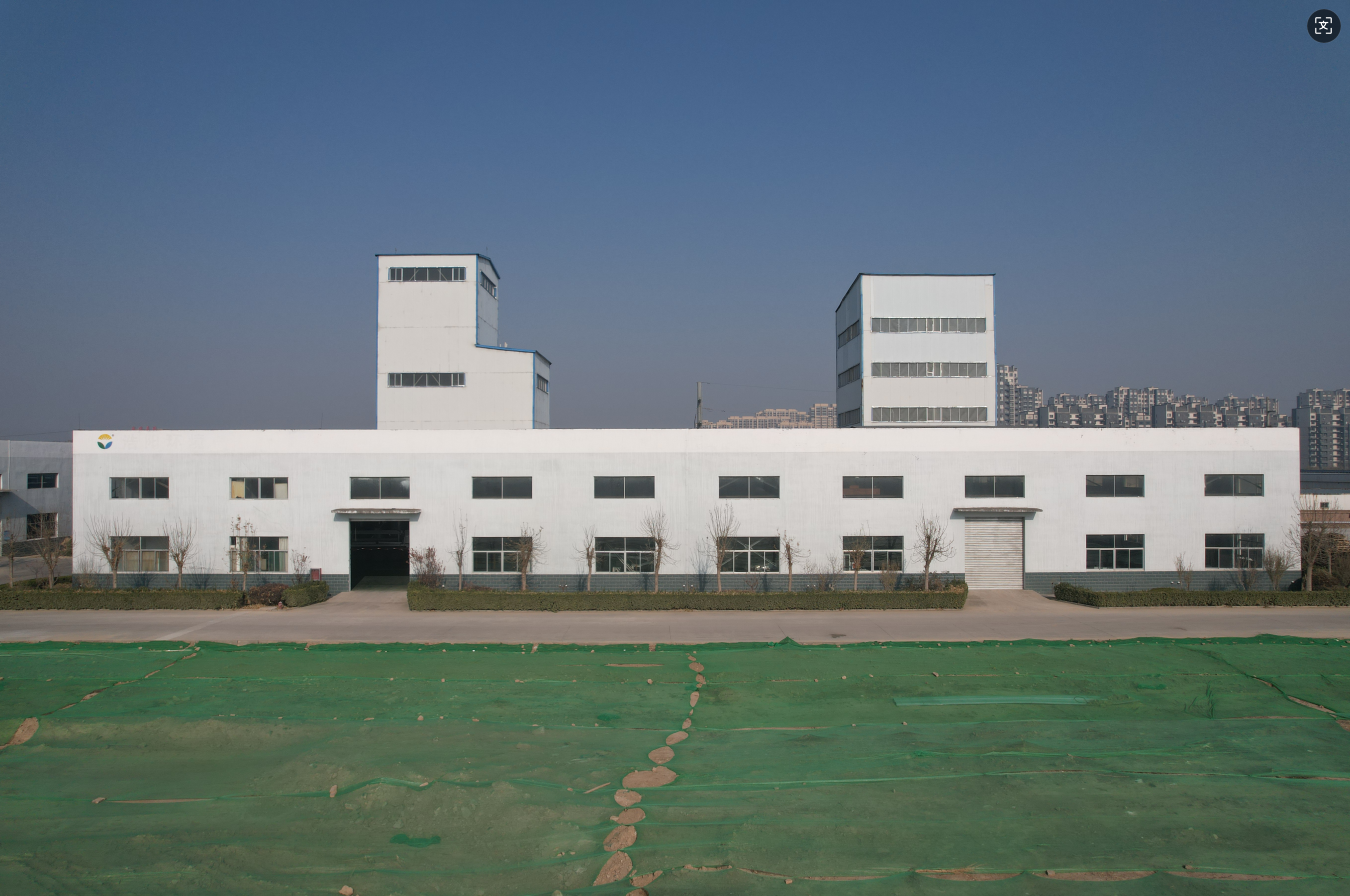
Production workshop: geomembrane manufacturing environment. Image source: supplied company content.
The certification evidence in this comparison
The assigned comparison is specific because it uses certification references, not generic product claims. For the EU/EEA market, the geomembrane reference is ICR/VC/HE250525 to EN 13249:2016. The drainage geonet reference is ICR/VC/HE250524 to EN 13249:2016 and CPR (EU) 305/2011. The two references share an EN 13249:2016 link, but they are separate references for separate products. The CPR (EU) 305/2011 route is attached to the drainage geonet in the supplied comparison; a buyer should not assume that the same CPR reference automatically covers the geomembrane. The geomembrane's own document set must be checked.
For the EAEU market, the comparison lists two geomembrane GOST references: POCC CN.32682.041C00.OC01.H00839 and POCC CN.32682.047C00.0C01.H00840. The drainage geonet reference is POCC CN.32682.047C00.OC01.H00837. The geomembrane therefore has two listed references in the supplied set, while the geonet has one. That difference should be treated as a document-matching task, not as a ranking signal. The buyer should verify every string against the certificate PDF and the offered product family.
| Decision question | Geomembrane evidence | Drainage geonet evidence | What it means for the build-up |
|---|---|---|---|
| EU/EEA standard route | ICR/VC/HE250525 to EN 13249:2016 | ICR/VC/HE250524 to EN 13249:2016 | Both have a distinct EN 13249:2016 reference. Do not use one reference to qualify the other product. |
| EU/EEA CPR route | No CPR (EU) 305/2011 reference is attached to the geomembrane in the supplied comparison. | CPR (EU) 305/2011 | Request the geomembrane's own declaration and document set; do not infer coverage from the geonet. |
| EAEU GOST references | POCC CN.32682.041C00.OC01.H00839; POCC CN.32682.047C00.0C01.H00840 | POCC CN.32682.047C00.OC01.H00837 | Two geomembrane references are listed against one geonet reference. Match each to the exact product family and market. |
| Primary role in the section | Anti-seepage / impermeable barrier | Drainage / flow conveyance | The layers are complementary. One does not replace the other. |
| Document to request | Certificate, scope, product designation, test reports | Certificate, scope, CPR declaration, product designation | The document set must match the exact product, thickness, width and market. |
| Commercial term to fix | Roll dimensions, thickness, surface, packing, delivery schedule | Roll or core dimensions, packing, delivery schedule | A certificate does not set price, MOQ or lead time. |
| Acceptance check | Certificate number on label, batch or roll ID, dimensions, visual condition | Same checks, plus CPR declaration where applicable | Reject undocumented substitution between product families. |
What each certificate does and does not prove
A certification reference is a qualification tool, not a performance guarantee for every project. The geomembrane reference ICR/VC/HE250525 to EN 13249:2016 supports the statement that the geomembrane product family has a documented route to that standard in the supplied comparison. The drainage geonet reference ICR/VC/HE250524 to EN 13249:2016 and CPR (EU) 305/2011 supports a separate qualification route for the geonet. Neither reference, by itself, proves that the delivered roll matches the certificate, that the product is suitable for a specific chemical environment, or that the installation will be leak-free.
For the geomembrane, buyers can supplement the certificate review with the applicable technical specification. GRI-GM13 covers smooth and textured HDPE geomembranes with thicknesses from 0.75 mm to 3.00 mm and a formulated density of at least 0.940 g/cc. GRI GM42 addresses HDPE geomembranes for extreme conditions, with a formulated sheet density of at least 0.945 g/ml and a thickness range of 1.5 mm to 3.0 mm; it also states that the geomembrane should use catalyzed reactor-grade bimodal resin rather than a blend of monomodal resins and that no post-consumer resin shall be added to the formulation. These specifications are useful technical checks, but they do not replace the EN 13249:2016 or GOST certificate route required by the project.
For the drainage geonet, the certificate review should stay focused on the geonet's own product family and its CPR route where applicable. A geomembrane certificate cannot be used to infer drainage performance, and a geonet certificate cannot be used to infer anti-seepage performance. This separation is the core of certification-led choice. It also protects the buyer from a common documentation failure: a supplier sends a valid certificate for one product in its portfolio, but the certificate does not cover the product being ordered.
Haoyang's risk-control material states that whole-process quality inspection, from raw material procurement to production and factory delivery, is carried out through a CNAS-accredited national laboratory. That is a company control statement, and it is relevant to supplier qualification, but it does not replace the project's own certificate verification. The buyer should still check the certificate scope, the product designation and the batch traceability.
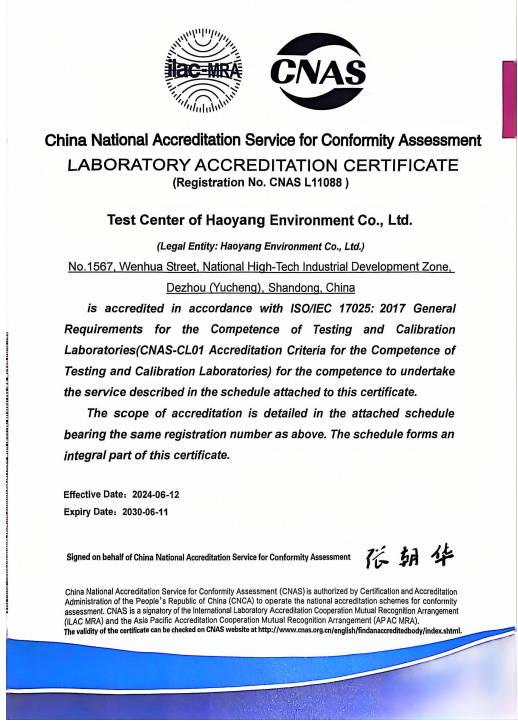
Quality-control evidence: CNAS accreditation mark from the supplied content. Verify the certificate and test report for the exact product family.
Step-by-step certification-led selection
The following sequence keeps the comparison tied to the build-up and prevents a certificate number from being treated as a product substitute.
- Define the layer function first. Mark the location that needs an anti-seepage barrier and the location that needs drainage. If the project needs both, specify both as separate line items. Do not allow a tender to collapse them into one 'geosynthetic' item.
- Select the market route. For EU/EEA, list the geomembrane reference ICR/VC/HE250525 to EN 13249:2016 and the drainage geonet reference ICR/VC/HE250524 to EN 13249:2016 with CPR (EU) 305/2011. For EAEU, list the geomembrane GOST references POCC CN.32682.041C00.OC01.H00839 and POCC CN.32682.047C00.0C01.H00840 and the drainage geonet GOST reference POCC CN.32682.047C00.OC01.H00837.
- Request the document set, not just the certificate number. Ask for the certificate, its scope, validity and issuing body, the product designation, the factory name and address, and the test reports that support the declared properties. Where the CPR route applies, request the declaration of performance. For the geomembrane, request the document that connects the EN 13249:2016 or GOST reference to the offered product family.
- Match the scope to the offered product. Check thickness, width, surface type, roll dimensions, product family and model. A certificate for a different thickness or product family is not an acceptance document for the offered roll. For EAEU strings, copy the certificate identifiers exactly; do not normalize letters and digits when comparing documents.
- Write acceptance criteria into the purchase order. Require the certificate number on the label or packing list, batch or roll identification, dimensions, visual condition and the agreed document set at delivery. State that a product substitution requires written approval and a matching certificate.
- Fix commercial terms separately. Certificate review does not establish price, MOQ or lead time. Ask for the quotation, packing details, Incoterms and a written production and shipping schedule for the exact product family. Keep these terms in the commercial section of the order, not in the certificate file.
- Retain a sample and the document set. Keep a retained sample and the certificate package for the project record. If a dispute arises, the certificate number, batch identification and sample allow the buyer to check whether the delivered product matches the approved product.
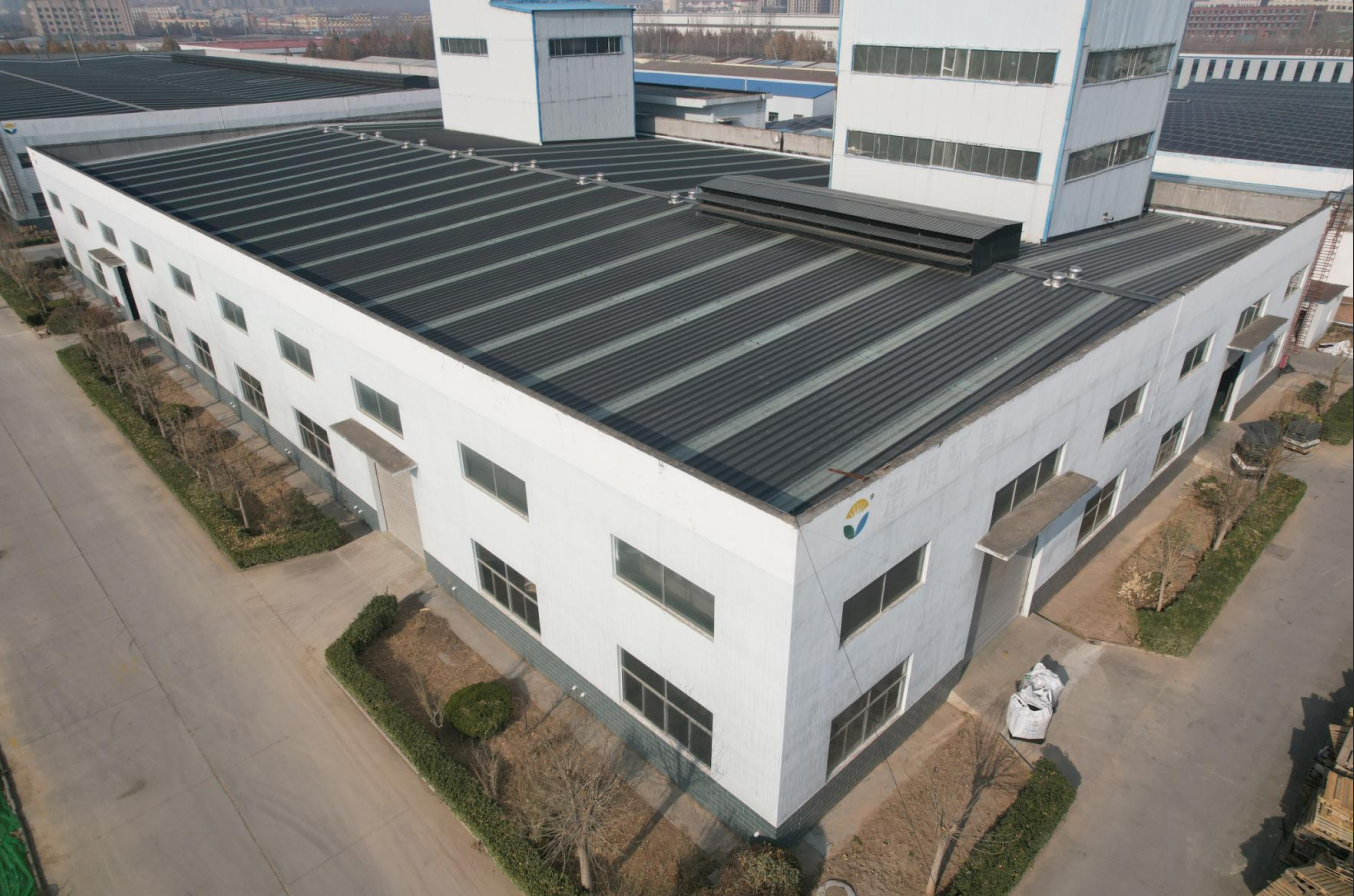
Production line: geosynthetic manufacturing. Image source: supplied company content.
Use cases: where each layer belongs
In a lining-dominated application, the geomembrane is the primary functional layer. Construction and decoration examples include water-retaining elements, basement waterproofing, roof-garden waterproofing, water features and podium landscapes where the design requires an anti-seepage membrane. The certificate review should confirm the geomembrane reference, the product family and the project market. HDPE geomembrane and composite geomembrane may be considered within this family, but the certificate and product designation must match the selected type.
In a drainage-dominated application, the drainage geonet is the primary functional layer. Examples include drainage behind retaining walls, drainage below plaza or podium finishes, green-roof drainage layers and basement drainage details. The certificate review should confirm the geonet reference and, for the EU/EEA route in this comparison, the CPR (EU) 305/2011 link. A geomembrane certificate should not be accepted as evidence for the geonet.
In a combined build-up, both layers may be present. The geomembrane provides the barrier, and the drainage geonet provides the flow path. The specification should show the sequence, the overlap and the protection details, and the procurement documents should list the two products separately. This is particularly important in decoration projects where the visible finish depends on hidden waterproofing and drainage layers. A failure in either layer may appear as a surface defect, but the cause may sit in a different part of the build-up.
Haoyang's comparison data for its geomembrane states that the product offers puncture, acid and alkali, corrosion and UV resistance, and that its physical and chemical indicators are more than 10% higher than ordinary geomembranes. These are company comparison claims for the geomembrane side; they should not be transferred to the drainage geonet. The same discipline applies to the cost comparison: Haoyang's comparison data reports a 15% higher initial cost and a 40% lower five-year ownership cost for its geomembrane against a common geotextile membrane. That is a geomembrane-versus-geotextile comparison, not a geomembrane-versus-geonet price comparison, and it should not be used as a geonet quotation.
Purchasing terms and acceptance criteria to fix before order
Certification-led procurement fails when the certificate is treated as a commercial document. The purchase order should separate technical qualification from commercial terms. On the technical side, fix the product category, product family, certificate reference, market route, dimensions, batch traceability and document set. On the commercial side, fix quantity, packing, Incoterms, delivery schedule and the inspection point. Do not let a certificate number stand in for any of these terms.
- Certificate and scope: state the exact certificate reference and require the scope to cover the offered product family. For EU/EEA, include the geomembrane ICR/VC/HE250525 to EN 13249:2016 and the geonet ICR/VC/HE250524 to EN 13249:2016 with CPR (EU) 305/2011 where applicable. For EAEU, include the two geomembrane GOST references and the geonet GOST reference exactly as supplied.
- Product designation: require the order to name the product category, model or family, thickness, width, surface type and roll dimensions. A certificate for a different designation is not acceptable.
- Batch and roll traceability: require the certificate number or product reference on the label or packing list, linked to the batch or roll identification. This is the practical link between the approved product and the delivered goods.
- Inspection and acceptance: define visual inspection, dimension checks, packaging condition and document verification at receipt. Record any nonconformance and require written approval before substitution.
- Commercial terms: request price, MOQ, packing, Incoterms and lead time in writing for the exact product family. These terms are not established by the certificate and should not be inferred from it.
For EAEU documents, keep the certificate strings exactly as issued. The supplied comparison includes both 'OC01' and '0C01' in different geomembrane references; a buyer should compare the strings character by character against the certificate PDF rather than normalizing them. This is a document-control point, not a statement that the references are interchangeable.
FAQ
Does an EN 13249:2016 certificate for a drainage geonet qualify a geomembrane?
No. The supplied comparison gives the geomembrane a separate reference, ICR/VC/HE250525 to EN 13249:2016, and the drainage geonet its own reference, ICR/VC/HE250524 to EN 13249:2016 with CPR (EU) 305/2011. A certificate for the geonet does not establish compliance for the geomembrane, and the buyer should request the geomembrane's own document set.
Can a drainage geonet replace a geomembrane as the anti-seepage layer?
No. In a construction or decoration build-up, the geomembrane is the anti-seepage or impermeable layer, while the drainage geonet is the drainage layer. They perform different functions. A project that needs both should specify both as separate products, with separate certificate references and separate acceptance checks.
How should a budget comparison treat the two certificates?
Budget the geomembrane and the drainage geonet as separate line items. Certificate review is a qualification cost, not a unit-price comparison. The supplied evidence does not provide a geonet price that can be compared with the geomembrane. Haoyang's comparison data reports a 15% higher initial cost and a 40% lower five-year ownership cost for its geomembrane against a common geotextile membrane; that comparison should not be applied to the geonet.
What sample should be requested before order?
Request a sample of the exact geomembrane product family and a sample of the exact drainage geonet product family, together with the matching certificate package. Check the product designation, thickness or roll dimensions, label information and visual condition against the offer. A sample from a different product family does not validate the order.
Does certification reduce lead time?
No. A certificate supports technical qualification; it does not establish production or shipping speed. Ask for a written lead time and delivery schedule for the exact product family, order quantity, roll dimensions and destination. Keep that schedule in the purchase order and do not infer it from the certificate.
What acceptance criteria should be written into the purchase order?
Include the exact certificate reference, product designation, batch or roll traceability, dimensions, packing condition, document set and inspection method. For EU/EEA orders, include the CPR declaration where applicable. For EAEU orders, reproduce the GOST strings exactly and verify them against the certificate PDF. State that any substitution requires written approval and a matching certificate.
How can a buyer start the certification check for a construction or decoration project?
Start by separating the build-up into barrier and drainage layers, then send the project market, the layer function and the required product family to Haoyang Geomembrane. Request the certificate package for the geomembrane and the drainage geonet, plus a sample of each exact product family, before finalizing the order. This keeps the comparison tied to the certified product and the actual build-up rather than to a generic product label.
Conclusion
Geomembrane versus drainage geonet is not a contest in which one product replaces the other. In construction and decoration, the geomembrane is the anti-seepage layer and the drainage geonet is the drainage layer. Certification-led choice means matching each product to its own certificate, market route and product family. For EU/EEA work, compare ICR/VC/HE250525 to EN 13249:2016 for the geomembrane against ICR/VC/HE250524 to EN 13249:2016 and CPR (EU) 305/2011 for the drainage geonet. For EAEU work, compare the two geomembrane GOST references against the geonet GOST reference. Then fix the purchasing terms and acceptance criteria before order. Haoyang Geomembrane and its associated company documentation provide a concrete starting point for that check, but the buyer's own scope, certificate verification and acceptance record remain the decision controls.
Have Questions or Need More Details?
Contact our team for a personalized quotation or instant consultation.
Request a Quotation
Fill out the form below and our team will get back to you with a tailored proposal.
WhatsApp Direct Chat
Prefer to chat in real-time? Message us on WhatsApp for instant assistance & quick answers.
- Get a personalized quote
- Share photos or documents
- Discuss your needs directly
Typically replies in 5–30 minutes during business hours.