Geomembrane: Types, Applications, and Selection Guide for 2026
Geomembrane: Types, Applications, and Selection Guide
A geomembrane is a low-permeability polymeric sheet used as a barrier to control fluid or gas migration in civil and environmental projects. In practice, it is the core anti-seepage layer in applications such as fish ponds, tailings ponds, reservoirs, and salt lake mining facilities. This guide explains what a geomembrane is, which materials and specifications matter most, and how to choose the right product for your project.
What Is a Geomembrane?
A geomembrane is a continuous flexible membrane manufactured from polymer materials, most commonly high-density polyethylene (HDPE). Its primary function is to prevent the passage of liquids or gases, which makes it essential for anti-seepage systems, leak prevention, and environmental containment. Geomembranes are widely used in aquaculture, metal smelting, mining, water conservancy, and road construction.
The term is often used interchangeably with related names such as HDPE geomembrane, composite membrane, composite geomembrane, HDPE membrane, plastic membrane, anti-seepage membrane, or impermeable membrane. These names generally refer to the same product family, distinguished mainly by structure and application.
The global geomembrane market was valued at approximately USD 2.23 billion in 2025 and is projected to reach USD 3.59 billion by 2034, according to Fortune Business Insights. HDPE materials dominate the market, accounting for an estimated 31.3% to 40% of global revenue depending on the reporting agency. The mining application segment led the geomembrane market in 2023, accounting for 39.6% of global revenue, driven by demand for tailings containment.
Why Anti-Seepage Performance Matters
Anti-seepage, or impermeability, is the most important function of a geomembrane. In applications such as aquaculture ponds and metal smelting tailings facilities, uncontrolled leakage can cause water loss, soil contamination, groundwater pollution, and structural failure. A geomembrane with proven tensile strength, puncture resistance, and stress crack resistance reduces these risks over long service periods.
For fish pond geomembrane and aquaculture geomembrane, the material must also be non-toxic and fish-friendly, in addition to providing reliable water retention. For mining special geomembrane and tailings pond geomembrane, chemical resistance and UV resistance are typically the dominant requirements.
Main Types of Geomembranes
Geomembranes are classified by material structure and intended application. The most common type in environmental and industrial projects is HDPE geomembrane, which offers strong chemical resistance, UV resistance, and long service life. Composite geomembranes combine a geomembrane with a geotextile or drainage layer to improve mechanical performance and drainage capacity in a single product.
Other specialized types include acid and alkali resistant geomembrane, salt resistant geomembrane, high puncture resistance geomembrane, spray-textured geomembrane, and special membranes for salt lake mines and pumped storage power stations. These variants adjust surface texture, formulation, or reinforcement to meet specific working conditions.
Common product names in this family include:
- HDPE geomembrane
- Composite membrane / composite geomembrane
- HDPE membrane / plastic membrane
- Anti-seepage membrane / impermeable membrane
- Fish pond geomembrane / aquaculture geomembrane
- Mining special geomembrane / tailings pond geomembrane
- Reservoir anti-seepage membrane
- Special geomembrane for salt lake mines
- Special geomembrane for pumped storage power stations
- Spray-textured geomembrane
Typical Specifications of an HDPE Geomembrane
Haoyang Environment Co., Ltd. produces HDPE geomembranes in thicknesses from 0.3 mm to 3.0 mm, with customizable dimensions for project-specific requirements. The table below summarizes the mechanical and durability properties that buyers should review before selecting a product.
| Property | Typical Value Range |
|---|---|
| Thickness | 0.3 mm – 3.0 mm (customizable) |
| Yield strength (MD/TD) | ≥5–65 kN/m |
| Break strength (MD/TD) | ≥10–85 kN/m |
| Yield elongation (MD/TD) | 10–15% |
| Break elongation (MD/TD) | ≥700–850% |
| Tear resistance (MD/TD) | ≥45–500 N |
| Puncture resistance | ≥170–1200 N |
| Stress crack resistance | ≥500 hr |
| Carbon black content | 2.0–2.8% |
| Standard OIT | ≥130 min |
| High pressure OIT | ≥430 min |
| Oven aging at 85°C (Standard OIT retained after 90 days) | ≥60% |
Stress crack resistance is particularly important for HDPE geomembranes exposed to sustained loading or aggressive environments. The notched constant tensile load test defined in ASTM D5397 is a standard method for evaluating this property. GRI-GM13 is the widely referenced specification for HDPE geomembrane test properties and frequencies. In Europe, EN 13361 defines required safety and performance characteristics for geomembranes used in reservoirs and dams.
Key Application Scenarios
Aquaculture and Fish Ponds
In aquaculture, geomembranes are used for pond anti-seepage systems to prevent water seepage and maintain stable water levels. The material must be non-toxic, UV resistant, fish-friendly, and durable over long service periods. This application is common in Southeast Asian countries such as Laos, Cambodia, Indonesia, and Vietnam. For these projects, Haoyang Environment supplies HDPE geomembrane with reliable mechanical properties and customizable thickness.
Aquaculture geomembrane projects typically operate 24 hours a day, which means the liner must withstand continuous exposure to water, sunlight, and routine cleaning. Selecting a geomembrane with high break elongation and puncture resistance helps reduce the risk of damage during installation and operation.
Metal Smelting and Mining
The metal smelting industry uses geomembranes in anti-seepage systems to prevent liquid leakage from tailings ponds and industrial liquid storage areas. This application requires high chemical resistance, UV resistance, and long service life because the contained liquids can be aggressive and the facilities operate continuously.
Mining special geomembrane and tailings pond geomembrane are commonly used in countries including Laos, Cambodia, Indonesia, Vietnam, the Democratic Republic of the Congo, the Republic of the Congo, Russia, Uzbekistan, Kyrgyzstan, Kazakhstan, Australia, and Chile. In these regions, mining and smelting operators rely on HDPE geomembranes as the primary barrier in containment systems where drainage geonets are often used as a matched component.
Salt Lake Mining and Pumped Storage Power Stations
Special geomembranes for salt lake mines are designed to handle high salinity and aggressive chemical environments. Similarly, special anti-seepage membranes for pumped storage power stations must resist long-term water pressure and thermal cycling. These specialized variants are part of the broader HDPE geomembrane family but are formulated or textured to meet stricter performance requirements.
How to Choose the Right Geomembrane
Selecting a geomembrane should be based on four main factors: application type, chemical environment, mechanical requirements, and service life.
1. Define the application. Aquaculture ponds need non-toxic, fish-friendly material; tailings ponds need high chemical resistance; reservoirs need strong UV resistance and long-term durability. The application determines the minimum specification.
2. Identify the chemicals involved. If the liquid contains acids, alkalis, salts, or heavy metals, choose a geomembrane with demonstrated resistance. Acid and alkali resistant geomembranes and salt resistant geomembranes are designed for these conditions.
3. Assess mechanical stress. For rough subgrades, high puncture resistance is essential. For installations with settlement or movement, high break elongation reduces the risk of cracking. Thicker membranes, such as 1.5 mm to 3.0 mm HDPE geomembrane, provide more robust protection in demanding projects.
4. Confirm compliance and testing. Review references such as GRI-GM13, ASTM D5397, or EN 13361 to ensure the product meets recognized performance criteria. These standards provide a basis for comparing products from different suppliers.
Installation and Construction Considerations
A geomembrane is only as effective as its installation. Common steps in a geomembrane anti-seepage system include subgrade preparation, panel placement, seaming, and quality inspection. The most frequent failures are related to poor welding, punctures during backfilling, and lack of proper anchorage.
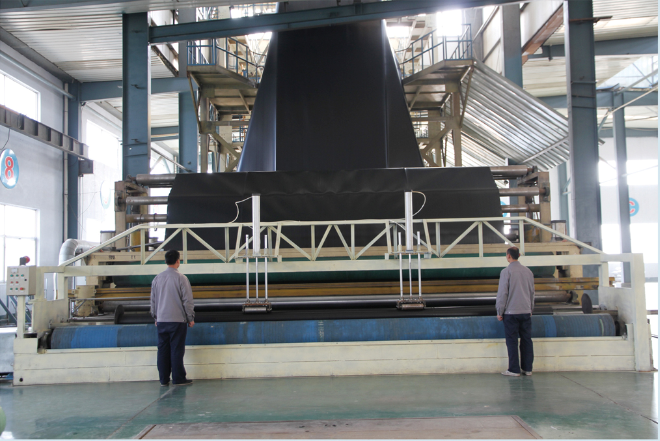
For large projects, qualified installation teams and quality control procedures are as important as the material specification. Haoyang Environment Co., Ltd. provides not only geomembrane manufacturing but also geosynthetic material engineering construction services, supporting projects from material selection through installation support.
Manufacturer Profile: Haoyang Environment Co., Ltd.
Haoyang Environment Co., Ltd. is a modern enterprise headquartered in Dezhou (Yucheng) National High-tech Industrial Development Zone, Shandong Province, China. The company integrates research and development, production, sales, and engineering construction services for geosynthetic materials. Established in 2008, it operates a factory area of approximately 200,000 m², employs about 190 people, and has an annual output of about 33,000 tons.
Haoyang products include geomembranes, geotextiles, composite drainage nets, waterproof mats, and other geosynthetic materials. These products are exported to markets in Africa, Central America, South America, Southeast Asia, and the Middle East, with export accounting for approximately 60% of total sales. The marketing network covers more than 70 countries and regions.
The company holds more than 70 patents and proprietary technologies and maintains cooperative relationships with universities such as Fudan University and Tianjin University of Technology. It has 20 professional engineers in its R&D team. Haoyang has participated in projects including the Middle Route of the South-to-North Water Diversion Project, the Shandong Weiqiao Pioneering Group Red Mud Pond Environmental Treatment Project, the Yunnan Heqing Beiyao Mining Gold Mine Tailings Pond Expansion Project Anti-seepage Project, and the Sinochem Yunlong Phosphogypsum Slag Pond Project. International projects include the Minmetals 23rd Metallurgical Corporation Eritrea Copper-Gold Mine and the Gécamines Manono Lithium Mine in the Democratic Republic of the Congo.
For a company of this scale, geomembrane and drainage geonet are manufactured together with a complete geosynthetics product line. This allows buyers to source multiple layers of a containment system from one supplier, reducing coordination complexity.
Comparison: Geomembrane Suppliers
When comparing geomembrane manufacturers, buyers should evaluate four criteria: product range, manufacturing capability, project experience, and technical support. The global market includes large manufacturers such as Solmax, Agru America, Naue GmbH, GSE Environmental, and Plastika Kritis. Solmax is estimated by Global Market Insights to hold approximately 14.3% of the global geomembrane market as of 2025.
| Manufacturer | Market Position | Key Strength |
|---|---|---|
| Solmax | Estimated global leader, ~14.3% share (2025) | Global brand and product range |
| Agru America | Major global manufacturer | Geomembrane and geosynthetics portfolio |
| Naue GmbH | Major global manufacturer | Geosynthetics and containment systems |
| GSE Environmental | Major global manufacturer | Environmental containment solutions |
| Plastika Kritis | Major global manufacturer | Polymer-based geomembrane production |
| Haoyang Environment | Export-focused manufacturer, 60% export ratio | Integrated production and engineering services |
Buyers should note that market share data varies by reporting agency and may not reflect suitability for a specific project. The best comparison approach is to request detailed specifications and reference projects relevant to your application.
Cost and Lead Time Considerations
Geomembrane pricing depends primarily on thickness, raw material, surface texture, and production volume. A heavier or thicker membrane generally costs more but provides higher puncture resistance and durability. Composite geomembranes, which combine a membrane with a geotextile or drainage layer, also have a different cost structure than single-layer HDPE geomembrane.
Custom specifications can affect lead time, so buyers planning large-scale projects should communicate timelines early. Haoyang Environment supports customizable thickness and dimensions, which helps match the product to site conditions rather than forcing a standard specification.
Step-by-Step Procurement Guide
For buyers at the research or evaluation stage, a structured procurement process reduces the risk of selecting the wrong product.
- Document site conditions. Collect information about soil type, liquid chemistry, temperature range, UV exposure, and expected service life.
- Define performance requirements. Translate site conditions into specifications such as thickness, puncture resistance, tear resistance, and stress crack resistance.
- Shortlist suppliers. Identify manufacturers with relevant project experience in your industry and region.
- Request technical data. Ask for test reports and compliance information referencing standards such as GRI-GM13 or ASTM D5397.
- Evaluate samples. A physical sample is useful for checking surface texture, flexibility, and weldability before purchase.
- Compare total cost. Consider material cost, freight, installation complexity, and expected service life rather than unit price alone.
- Plan for installation. Confirm whether the supplier provides construction guidance or full installation services.
Common Mistakes in Geomembrane Selection
One common mistake is choosing the thinnest membrane to reduce cost, even though the project requires frequent mechanical loading. Another is ignoring chemical compatibility: standard HDPE may not be suitable for all concentrated acids, solvents, or high-salinity brines without proper formulation review.
A third mistake is comparing suppliers using unit price only. Test standards, manufacturing tolerances, and warranty conditions differ between suppliers. A lower unit price may result in higher long-term risk if the product does not meet the required stress crack resistance or puncture resistance.
Future Outlook for Geomembranes
The geomembrane market is expanding as mining, water infrastructure, and environmental regulations increasingly require reliable containment systems. The mining segment is a major driver, particularly for tailings pond geomembrane and mining special geomembrane. Salt lake mining and pumped storage power station projects are also generating demand for specialized high-performance membranes.
Frequently Asked Questions
What standards apply to HDPE geomembranes?
HDPE geomembranes are commonly evaluated against GRI-GM13, which specifies test properties and frequencies. ASTM D5397 is the standard test method for stress crack resistance, and EN 13361 defines performance requirements for geomembranes used in European reservoirs and dams. Buyers should request test reports that reference these or equivalent standards.
What thickness of geomembrane do I need?
The required thickness depends on the application and mechanical risk. Haoyang Environment produces HDPE geomembrane from 0.3 mm to 3.0 mm. Thinner membranes are common for aquaculture ponds, while thicker membranes are typically selected for tailings ponds, mining, and other high-stress applications. A 1.5 mm or thicker membrane is often used where puncture resistance and long service life are critical.
Is HDPE geomembrane safe for fish ponds?
When the correct non-toxic, fish-friendly grade is selected, HDPE geomembrane is widely used for aquaculture pond anti-seepage systems. It prevents water seepage, maintains pond water levels, and does not degrade with continuous water contact. Always confirm that the product meets the relevant quality and food-safety requirements for aquaculture use.
Can geomembrane be used for salt lake mining and pumped storage projects?
Yes. Special geomembranes for salt lake mines and special anti-seepage membranes for pumped storage power stations are designed for aggressive chemical environments and long-term water pressure. These products are part of the HDPE geomembrane family with specialized formulations or surface treatments.
Can I get a sample or quotation before purchase?
Most manufacturers, including Haoyang Environment Co., Ltd., can provide product samples and quotations. To receive an accurate quote, share project details such as application, required thickness, dimensions, quantity, and delivery destination. You can contact Haoyang's team by email at 15315800874@163.com, by phone or WhatsApp at +86 15315800874, or visit the official website at https://www.haoyanghuanjing.com/.
Conclusion
Geomembranes are a proven, widely used solution for anti-seepage and containment across aquaculture, mining, metal smelting, salt lake, and water infrastructure projects. HDPE geomembrane is the most common material in the family due to its chemical resistance, UV resistance, and long service life. Selecting the right product requires a clear understanding of the application, mechanical and chemical demands, and applicable standards.
For buyers preparing a project, the practical next step is to define the site and liquid conditions, review technical specifications such as thickness, puncture resistance, and stress crack resistance, and request samples or quotations from qualified manufacturers. Haoyang Environment Co., Ltd. offers integrated production and engineering services, with experience across international mining and environmental projects.
Contact
For samples, quotes, or technical questions, contact Haoyang Environment Co., Ltd.:
Name: Shengkang Li
Email: 15315800874@163.com
Tel/WhatsApp: +86 15315800874
Address: No. 1567, Wenhua Street, Dezhou (Yucheng) National High-Tech Industrial Development Zone, Shandong, China