How to Customize Drainage Geonet for Project-Specific Civil and Environmental Demands
How to Customize Drainage Geonet for Project-Specific Civil and Environmental Demands
When an engineering or procurement team moves from evaluating generic drainage geonet options into execution planning, one question usually drives the conversation: Can the drainage geonet be customized to our project conditions? The short answer is yes, for manufacturers with in-house R&D and flexible production lines. This article explains the customization levers, material and parameter trade-offs, manufacturing capabilities, and what to prepare before placing a custom order. It focuses on Haoyang Environment Co., Ltd., a Chinese geosynthetics manufacturer with engineering-driven customization experience.
What Problem Does Custom Drainage Geonet Solve?
Standard drainage geonet is designed for average site conditions, so subgrade, tunnel, slope, landfill, and mining projects often need adjustments in thickness, mass per unit area, drainage capacity, and chemical resistance. A project-specific drainage geonet reduces the risk of early failure by matching the geonet to the load, chemical, and service-life requirements. Without customization, a geonet may either underperform in harsh conditions or force the project to over-specify, increasing cost.
Typical triggers for custom drainage geonet include aggressive leachate or industrial wastewater, high overburden loads, large expected water flow, and the need to integrate with other geosynthetics. In these cases, the evaluation problem shifts from "which standard product" to "which supplier can engineer the right build."
Industry Background: Why the Market Is Moving Toward Customization
Drainage applications led the geocomposites market with a 44.55% revenue share in 2024, according to Grand View Research. As large infrastructure and mining projects become more technically demanding, buyers increasingly expect manufacturers to adjust product parameters rather than accept a one-size-fits-all solution. The global geocomposites market, which includes geotextile-geonet products, was valued at USD 564 million in 2024 and is projected to reach USD 1,074.88 million by 2032. Within this growing market, polyethylene-based drainage nets account for roughly 64% of global material demand due to high chemical resistance. Customization is therefore not a niche service; it is a standard requirement for suppliers serving harsh-environment projects.
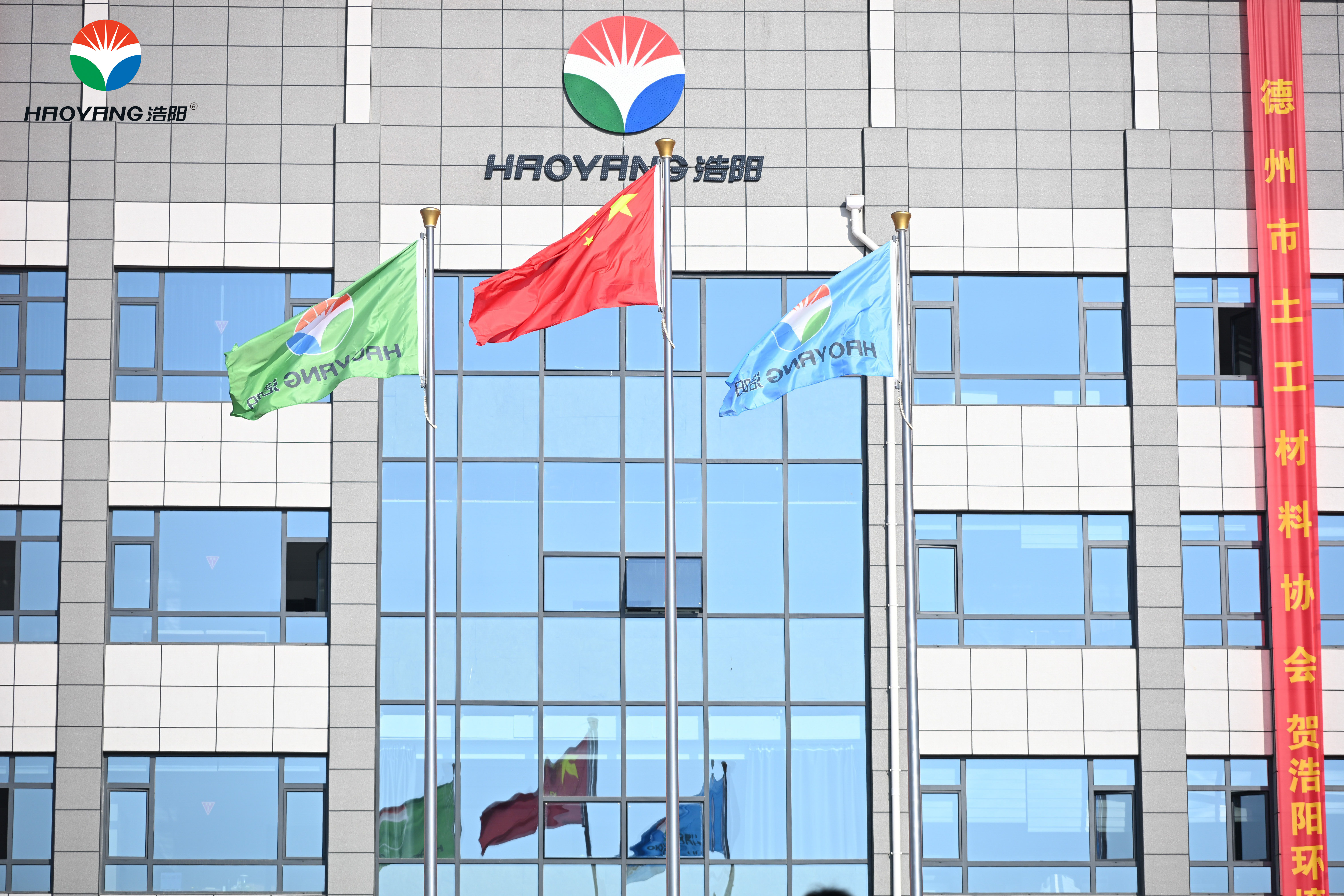
Haoyang Environment Co., Ltd., established in 2008, operates from the Dezhou (Yucheng) National High-tech Industrial Development Zone in Shandong Province, China. The company specializes in geomembranes, geotextiles, composite drainage nets, waterproof mats, and other geosynthetic materials. With a factory area of 200,000 m², around 190 employees, and an annual output of 33,000 tons, Haoyang has an R&D center supported by 20 professional engineers and holds more than 70 patents and proprietary technologies. This production and technical base is what allows the company to respond to project-specific requests.
What Can Be Customized in a Drainage Geonet?
The following list reflects the standard customization scope offered by Haoyang for drainage geonet production. Each parameter interacts with others, so it should not be changed in isolation.
- LOGO: Custom marking for brand identification and traceability.
- Width: Adjustable roll width to reduce field seams and cut waste.
- Scroll length: Roll length is matched to installation planning and transport limits.
- Thickness: Typically 4.0–8.0 mm for standard drainage geonet, with custom values available.
- GSM (mass per unit area): Usually 500–1400 g/m², adjustable to balance strength and cost.
- Tensile yield strength: Customized to resist installation and service stresses.
- Tensile fracture strength: Adjusted to avoid rupture under localized loads.
- Piercing strength: Important for subgrade and landfill base conditions where puncture is a risk.
- Chemical and physical indicators: Includes acid/alkali resistance, drainage capacity, elongation, and other performance values.
For example, a custom drainage geonet might be produced with a mass per unit area of 1200 g/m², a thickness of 7.0 mm, and a higher tensile yield strength, depending on the project specification.
Material Options and Their Implications
Drainage geonet can be manufactured from HDPE, PP, or PET. The material choice affects chemical resistance, strength, and long-term performance. In the broader market, polyethylene-based drainage nets dominate because of their high chemical resistance. However, a polyester filament composite drainage geonet may be preferred when high strength and drainage capacity are both needed. The right choice depends on the chemical environment, load conditions, and compatibility with adjacent geosynthetics.
Haoyang supplies HDPE, PP, and PET drainage geonet variants, giving specifiers a wide selection space. When customizing, it is important to confirm which material the performance test data refers to.
Common Performance Targets for Customization
- High drainage capacity drainage geonet: Flow capacity is typically in the range of 50–120 (L/min)/m and can be customized to meet hydraulic demand.
- High compressive resistance drainage geonet: Compressive strength at 10% strain is typically 500–830 kPa, suitable for deep burial and heavy overburden.
- Acid and alkali resistant drainage geonet: Strength retention is typically at least 90%, which is relevant for landfill leachate and industrial wastewater.
- Tear resistant drainage geonet: Tear resistance is managed through base material, structure, and geotextile lamination.
- Anti-aging drainage geonet: Carbon black content and antioxidant systems are adjusted for long service life.
These performance targets map directly to the custom indicators listed above.
Manufacturing and Engineering Capabilities for Custom Orders
OBM Production and Customization
Haoyang provides OBM (Own Brand Manufacturing) production services. This means the manufacturer can produce the drainage geonet according to the buyer's specification while maintaining its own production and quality systems. OBM is especially useful for distributors, contractors, and engineering companies that want a custom solution without owning a factory.
R&D Support
The company is equipped with an internationally first-class research and development center for geosynthetic material products and applications, supported by an R&D team of 20 professional engineers. This team supports parameter adjustment, prototyping, and production process design for custom geonet requirements.
Manufacturing Scale
Haoyang reports a monthly production capacity of 3,000 tons, a typical lead time of 10–30 days, and a minimum order quantity of 5,000 m². For buyers planning large civil or mining projects, this capacity matters because drainage geonet orders are often measured in hundreds of thousands of square meters.
All products are described as 100% tested before shipment. Pre-shipment testing can be adapted to the custom specification and project requirements.
Step-by-Step: From Project Requirement to Custom Drainage Geonet
1. Define the Performance Requirements
Start with the project's hydraulic and mechanical demands: how much water must be drained, what overburden load will be applied, and what chemicals the geonet will contact. These requirements determine the target drainage capacity, compressive strength, and chemical resistance.
2. Select the Material Family
Choose between HDPE, PP, and PET based on chemical exposure, strength needs, and cost constraints. For aggressive leachate, HDPE or PP is often chosen; for high drainage capacity, a polyester filament composite structure may be specified.
3. Choose Core Parameters
Set thickness, mass per unit area, and tensile values within the feasible production range. For a drainage geonet, thickness generally falls between 4.0 mm and 8.0 mm, and mass per unit area typically ranges from 500 to 1,400 g/m². Changing these values affects drainage capacity and compressive strength, so the supplier should confirm the relationship for the selected material.
4. Specify Chemical and Physical Indicators
Define the acid/alkali resistance (e.g., 90% strength retention), drainage capacity (e.g., 50–120 (L/min)/m), elongation at break, and puncture requirements. These values should be written into the technical specification and verified through testing.
5. Request Samples and Pre-Shipment Testing
Before full production, request samples for internal review and third-party or factory testing. Confirm that the sample matches the agreed specification. Pre-shipment testing is then used as the acceptance checkpoint before the order is shipped.
6. Plan Logistics and Documentation
Agree on delivery terms (FOB or CIF are available), roll width and length for efficient transport, and certification documents, such as CE or GOST certificates where applicable. For large orders, the roll dimensions are a significant logistics decision.
Application-Specific Customization Scenarios
Subgrade and Road Drainage
In road and railway subgrade projects, a composite drainage geonet is often used to release pore water pressure and improve the bearing capacity of soft soil. Customization focuses on high compressive resistance to survive compaction loads and high drainage capacity to handle seasonal water flow.
Tunnel and Underground Engineering
Tunnel drainage requires a geonet that can conform to curved surfaces, resist installation damage, and maintain drainage capacity under rock pressure. Tear-resistant and high compressive resistance drainage geonets are common custom targets.
Slope Protection and Erosion Control
On slopes, the geonet helps drain water away from the soil matrix and supports vegetation or protective layers. Polyester filament composite drainage geonet or high-strength polypropylene composite drainage geonet may be selected for better tensile performance.
Landfill and Leachate Management
Landfill projects expose geonet to aggressive leachate, high overburden, and long design life. Acid and alkali resistant drainage geonet with anti-aging properties is a typical custom requirement. Integration with geomembranes and geotextiles must also be considered.
Mining and Smelting
Mining and smelting engineering clients have used Haoyang's products for tailings and seepage control. For a gold mine tailings pond in Uzbekistan, the project used a three-dimensional composite drainage network combining a textured geomembrane and high-strength polypropylene geotextile. The full-chain service covered material supply, on-site installation, and construction. Custom drainage geonet for mining must resist high chemical loads and be produced in large areas with consistent quality.
Comparison: Custom vs. Standard Drainage Geonet Selection Factors
| Selection Factor | Standard Geonet | Custom Geonet |
|---|---|---|
| Fit to site conditions | May require over-specification | Matched to load, flow, and chemistry |
| Lead time | Typically shorter | 10–30 days typical for Haoyang |
| Minimum order quantity | Lower | 5,000 m² at Haoyang |
| Certification coverage | Standard scope | Should verify scope for custom variant |
| Quality control | Factory standard | 100% tested; pre-shipment acceptance available |
Global premium brands such as GSE Environmental (Solmax), NAUE, Agru America, and TenCate are recognized in the geosynthetics drainage market. For buyers comparing suppliers, the main decision factors are manufacturing flexibility, technical support, price, delivery, and certification coverage.
Quality Control and Certification Considerations
Haoyang's products are 100% tested before shipment. For custom drainage geonet, this means the specific parameters agreed in the contract can be verified before delivery. Buyers can also request pre-shipment testing as an acceptance gate.
Haoyang holds a Russia/EAEU GOST Certificate of Conformity for drainage geonet, certificate number POCC CN.32682.047C00.0C01.H00838, covering 3D composite drainage geonet under GOST 33068-2014, valid until 2028. It also holds CE Verification of Conformity ICR/VC/HE250523 for composite drainage net, compliant with EN 13249:2016 and valid until 2030. Buyers should verify certification scope against the specific custom product variant before relying on it for compliance.
For a project in Uzbekistan involving a gold mine tailings pond, Haoyang's solution used a textured geomembrane manufactured on a five-layer co-extrusion line with online double-sided texturing. The production process reduces energy consumption by 25% and avoids thermal aging risk from secondary processing. This kind of integrated engineering experience is directly relevant when a custom drainage geonet must work together with other geosynthetics.
FAQ
Can drainage geonet be customized for compliance with CE and GOST standards?
Yes. Haoyang's composite drainage geonet holds CE Verification of Conformity (ICR/VC/HE250523) under EN 13249:2016, valid until 2030, and a GOST Certificate of Conformity for 3D composite drainage geonet under GOST 33068-2014, valid until 2028. Before relying on these certificates, buyers should verify that the exact customized product variant falls within the certified scope.
Which drainage geonet parameters can be adjusted for a custom order?
Haoyang can customize LOGO, width, scroll length, thickness, GSM, tensile yield strength, tensile fracture strength, piercing strength, and chemical and physical indicators. For drainage geonet, thickness is typically 4.0–8.0 mm, mass per unit area is 500–1,400 g/m², compressive strength at 10% strain is 500–830 kPa, and drainage capacity is 50–120 (L/min)/m.
What is the typical lead time and MOQ for custom drainage geonet?
The typical lead time for Haoyang custom production is 10–30 days, and the minimum order quantity is 5,000 m². Monthly production capacity is 3,000 tons, which supports large-scale orders. Buyers should confirm the exact lead time during contract negotiation.
What quality control applies to a custom drainage geonet order?
Haoyang states that all products are 100% tested. Buyers can also use pre-shipment testing as an acceptance check. For a custom specification, the agreed chemical, physical, and mechanical indicators should be part of the test plan.
Can I request a sample or quote for a customized drainage geonet?
Yes. Buyers can contact Haoyang Environment Co., Ltd. to discuss the project specification, request a sample, and obtain a quotation. Standard payment terms are 30/70 or 100%, and delivery can be arranged under FOB or CIF terms. For a project-specific specification, a sample request is the recommended next step before mass production.
Conclusion
A custom drainage geonet is not a single product but a production capability applied to a specific project problem. For subgrade, tunnel, slope, landfill, or mining applications, the key is to work with a manufacturer that can adjust material, dimensions, strength, and chemical resistance while maintaining quality control. Haoyang Environment Co., Ltd. offers OBM production, R&D support, 100% testing, and a documented track record in mining and smelting engineering. By following a structured specification and verification process, procurement teams can move from evaluation to execution with confidence.