How to Select the Right Geomembrane for Mining, Aquaculture, and Reservoir Projects
How to Select the Right Geomembrane for Mining, Aquaculture, and Reservoir Projects
Selecting the right geomembrane depends on the project type, the liquid being contained, the site conditions, and the performance requirements of the anti-seepage system. For mining tailings, aquaculture ponds, and reservoir projects, the same HDPE geomembrane cannot be treated as a one-size-fits-all product. This guide explains how to evaluate geomembrane specifications, project-specific requirements, and supplier capabilities before making a procurement decision.
Why Project Type Changes Geomembrane Selection
Geomembranes are flexible polymeric liners used to control liquid movement, prevent leakage, and protect soil and groundwater. HDPE geomembranes are widely used because they offer high chemical resistance, UV resistance, and long service life under demanding conditions. However, the technical requirements for a fish pond liner differ from those for a gold mine tailings pond or a pumped storage reservoir.
In mining and metal smelting applications, the geomembrane is part of an anti-seepage system designed to prevent liquid leakage under continuous operation. The liquid may contain heavy metals, acid, alkali, or other aggressive process fluids, so the liner must withstand chemical attack and punctures from sharp subgrade materials. In aquaculture, the liner must prevent water seepage while being non-toxic and fish-friendly, with UV resistance for exposed pond walls. In reservoir and water conservancy projects, tear resistance, puncture resistance, and stress crack resistance become critical for long-term containment performance.
How to Match Geomembrane Specifications to Project Conditions
Chemical Resistance and Liquid Type
Mining special geomembranes, acid and alkali resistant geomembranes, and salt resistant geomembranes are specified when the contained liquid is chemically aggressive. HDPE is the base material for most of these products because of its strong resistance to a wide range of chemicals. For salt lake mining projects, where brine chemistry is the main challenge, salt resistant geomembrane performance should be verified against the actual liquid composition.
Thickness and Mechanical Strength
Geomembrane thickness affects puncture resistance, tear resistance, and installation survivability. For aquaculture pond anti-seepage systems, thinner liners are often sufficient, while mining and tailings pond applications typically require thicker sheets. At the specification level, a buyer should check:
- Yield strength (MD/TD): ≥5–65 kN/m
- Break strength (MD/TD): ≥10–85 kN/m
- Yield elongation (MD/TD): 10–15%
- Break elongation (MD/TD): ≥700–850%
- Tear resistance (MD/TD): ≥45–500 N
- Puncture resistance: ≥170–1200 N
- Stress crack resistance: ≥500 hr
- Carbon black content: 2.0–2.8%
These values represent a typical HDPE geomembrane range for 0.3 mm to 3.0 mm thicknesses. A tailings pond liner exposed to coarse rock needs a higher puncture resistance value, while a reservoir liner may place more emphasis on stress crack resistance and long-term UV aging performance.
UV Resistance and Aging Performance
UV resistance is essential for exposed geomembrane surfaces. Carbon black content and antioxidant levels determine how well the liner survives long-term sunlight exposure. Standard OIT and high-pressure OIT values provide an indication of oxidative resistance; a typical specification includes Standard OIT ≥130 min, High Pressure OIT ≥430 min, and oven aging at 85°C with at least 60% Standard OIT retained after 90 days.
Composite and Textured Systems
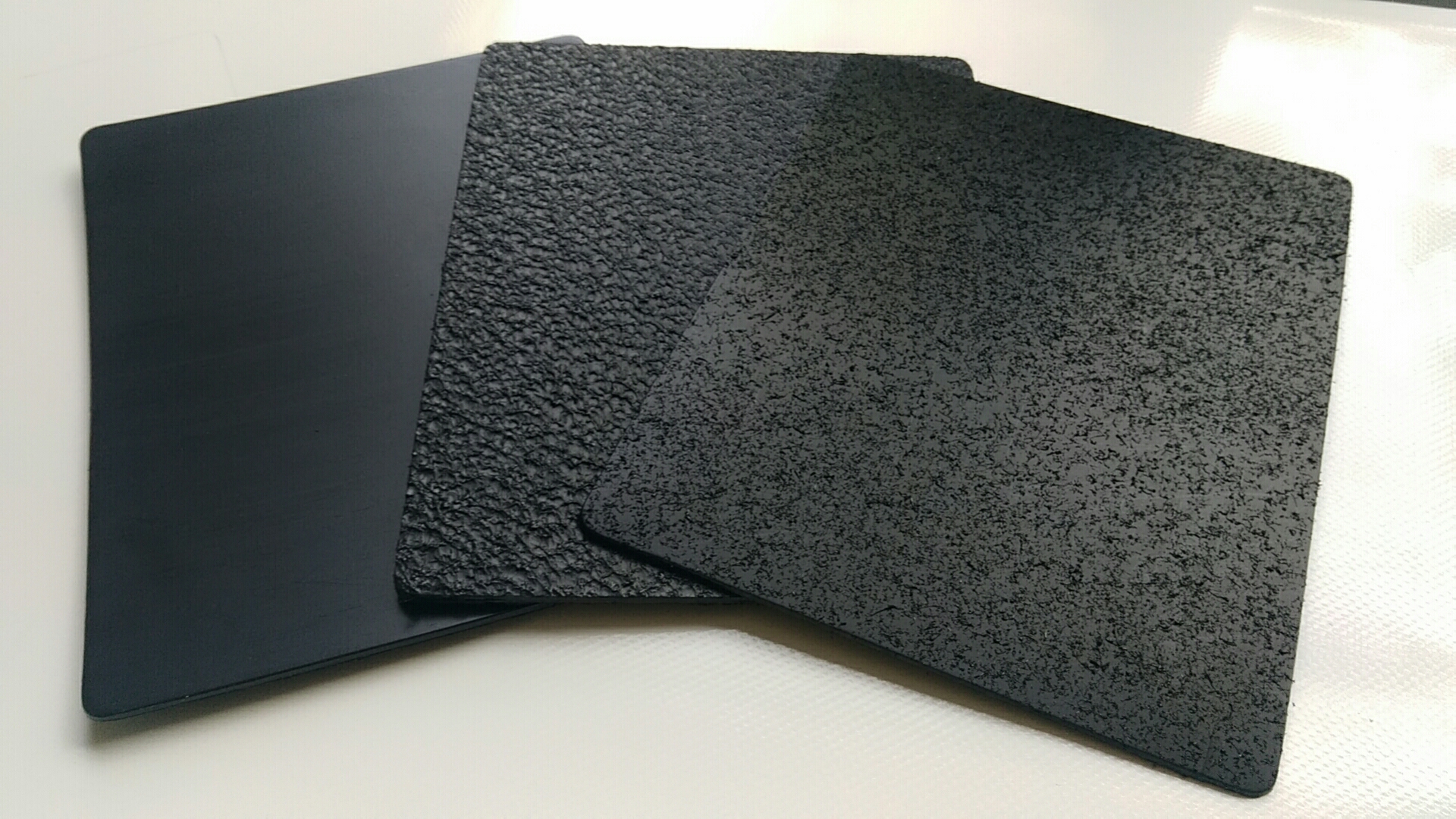
Some projects require more than a single smooth geomembrane. Composite membranes and composite geomembranes combine a geomembrane with geotextile or drainage geonet layers to improve friction, drainage, or protection. Textured geomembranes are often used on slopes where sliding resistance is critical. Spray-textured geomembranes provide an alternative surface profile for high-friction applications.
Step-by-Step Selection Process for a New Project
Use this framework when evaluating geomembrane needs for a specific project:
- Define the function. Is the goal to prevent liquid leakage, prevent water seepage, or contain a specific process solution?
- Identify the operating environment. Continuous 24/7 operation, aggressive liquid chemistry, UV exposure, temperature, and subgrade conditions all change the specification.
- Select the material family. HDPE is the most common choice for mining, aquaculture, and reservoir anti-seepage systems because it balances chemical resistance, strength, and cost.
- Determine thickness and mechanical values. Use puncture risk, settlement risk, and installation conditions to select a thickness range.
- Decide whether a textured or composite product is needed. Slopes, high groundwater, or drainage requirements may justify a textured geomembrane or a composite system with drainage geonet.
- Verify standards and test methods. HDPE geomembranes are commonly specified against GRI-GM13, a standard from the Geosynthetic Institute covering test properties and frequencies.
- Request a project-specific quote. A reliable supplier should confirm thickness, roll dimensions, chemical resistance, and delivery timing.
Project-Level Use Cases
Mining and Metal Smelting: Tailings Pond Seepage Prevention
The mining application segment led the global geomembrane market in 2023, accounting for 39.6% of global revenue, driven largely by demand for tailings containment. Mining and smelting projects require a geomembrane that can handle aggressive leachate, protect against puncture from coarse subgrade, and maintain performance over a long service life.
Haoyang Environment Co., Ltd. supplied a 900,000 square meter full-chain solution for seepage prevention in the tailings pond basin of a gold mine in Uzbekistan. The project moved beyond a single-product sales model by combining material supply with on-site installation and construction. A textured geomembrane was used, produced on a five-layer co-extrusion blow molding line with online double-sided texturing. The high-temperature, high-pressure air jet process creates the double-sided rough surface in the molten state, allowing the rough points to form a molecular-level bond with the substrate. This approach reduces production energy consumption by 25% and avoids the thermal aging risk associated with secondary processing.
For similar projects, the selection logic is straightforward: a smooth liner alone is often insufficient on slopes or where drainage control is needed. A three-dimensional composite drainage network, combining textured geomembrane with high-strength polypropylene geotextile, can improve both slope stability and leachate control.
Aquaculture: Fish Pond and Shrimp Pond Anti-Seepage
In Southeast Asia, aquaculture pond anti-seepage systems commonly use geomembrane liners in fish ponds, shrimp ponds, and other aquaculture facilities. The product role in these projects is to prevent water seepage while maintaining a safe environment for aquatic life. Non-toxicity, UV resistance, fish-friendliness, and long service life are the key requirements.
Because aquaculture ponds are often exposed to direct sunlight and frequent water-level changes, the liner should combine UV resistance with flexibility. Thinner HDPE geomembranes can be suitable for pond applications where subgrade preparation is good and puncture risk is moderate. A fish pond geomembrane should always be verified for material safety and resistance to aquatic conditions.
Reservoir and Pumped Storage Projects
Reservoir anti-seepage membranes and special geomembranes for pumped storage power stations are selected for water retention and long-term hydraulic performance. In Europe, geomembranes used in reservoirs and dams may need to meet EN 13361 for CE marking. For these projects, the evaluation should include stress crack resistance, tear resistance, and the ability to survive installation on prepared subgrade.
Salt Lake Mining and Specialty Applications
Special geomembranes for salt lake mining are exposed to brine and salt crystallization. Salt resistant and acid and alkali resistant geomembranes are evaluated based on chemical compatibility and long-term resistance. Spray-textured or high puncture resistance geomembranes may be required when the subgrade is sharp or when the liner is installed on slopes.
Comparison: Mining, Aquaculture, and Reservoir Geomembrane Requirements
| Selection Criteria | Mining / Tailings Ponds | Aquaculture Ponds | Reservoirs / Water Storage |
|---|---|---|---|
| Primary function | Prevent liquid leakage from process or leachate | Prevent water seepage | Prevent water loss from reservoir basin |
| Chemical environment | Often aggressive, acid/alkali/salt | Fresh or brackish water, must be non-toxic | Fresh water, sometimes fluctuating quality |
| Mechanical priority | High puncture resistance, high tear resistance | Flexibility, moderate puncture resistance | Stress crack resistance, tear resistance |
| UV exposure | High, long-term | High, exposed pond walls | High, exposed embankment surfaces |
| Common product forms | Textured geomembrane, composite drainage network | Smooth HDPE geomembrane | HDPE geomembrane, composite geomembrane |
| Typical thickness range | 1.0–3.0 mm (project-dependent) | 0.3–1.0 mm (project-dependent) | 0.5–2.0 mm (project-dependent) |
These comparisons are intended as selection logic, not as fixed rules. Final specifications should be confirmed through project-specific engineering evaluation and supplier consultation.
How to Evaluate Geomembrane Suppliers
Supplier evaluation matters as much as product selection because a geomembrane project often depends on consistent manufacturing quality, physical test data, and reliable delivery.
Manufacturing Capacity and Quality Control
A supplier should be able to state its production capacity, testing policy, and delivery lead time in verifiable terms. For example, Haoyang Environment maintains an annual output of 33,000 tons, a monthly capacity of 3,000 tons, and a typical lead time of 10–30 days. The company states that its quality control policy is 100% tested. Buyers should ask any potential supplier to confirm the same level of traceability.
Export Experience and Technical Support
Projects in Africa, Central Asia, Southeast Asia, Australia, South America, and other regions often require suppliers who can handle cross-border logistics, site conditions, and installation support. Haoyang reports export markets covering Africa, Europe, Central Asia, Southeast Asia, Australia, and South America, with a marketing network across more than 70 countries. For specialized projects, the availability of on-site support should be confirmed in advance.
Customization Capability
Geomembrane projects may require custom width, roll length, thickness, or mechanical property adjustments. A supplier with a dedicated engineering team is better positioned to adjust tensile yield strength, fracture strength, puncture resistance, and other physical indicators to project specifications. Haoyang has 20 professional engineers and cooperative research relationships with universities such as Fudan University and Tianjin University of Technology.
Frequently Asked Questions
What standards should HDPE geomembranes meet for mining and containment projects?
HDPE geomembranes must comply with GRI-GM13, the Geosynthetic Institute’s standard specification for test properties and frequencies. For high-elongation applications, LLDPE geomembranes are governed by GRI-GM17. Stress crack resistance is typically evaluated using ASTM D5397, the Notched Constant Tensile Load test. In Europe, reservoir and dam applications may also require EN 13361 for CE marking. Buyers should ask suppliers for test reports that map directly to these standards.
Which geomembrane is best for a tailings pond in a gold or copper mine?
For tailings pond seepage prevention, HDPE geomembrane is the most widely used material because of its chemical resistance and long service life. In practice, a thicker textured HDPE geomembrane is often selected when slope stability is critical, such as the 900,000 m² project at a gold mine in Uzbekistan, where Haoyang supplied a textured geomembrane with an online double-sided texturing process. The final choice should be based on liquid chemistry, subgrade conditions, slope angles, and project lifespan.
What thickness of geomembrane is recommended for fish ponds and aquaculture?
Aquaculture pond anti-seepage systems often use HDPE geomembrane in the range of 0.3 mm to 1.0 mm, depending on soil conditions and expected service life. The liner must be non-toxic, fish-friendly, and UV resistant. Thicker material may be justified where the pond bottom has more puncture risk or where the operator wants a longer replacement cycle. A supplier can recommend a thickness after reviewing the pond design and operating conditions.
Can geomembrane specifications be customized for a specific mining or reservoir project?
Yes. HDPE geomembrane thickness from 0.3 mm to 3.0 mm is customizable, and mechanical properties can be adjusted for yield strength, break strength, puncture resistance, and other physical indicators. Roll width, scroll length, and logo customization are also available. For a large project, the buyer should provide the project conditions and required test values, then ask the manufacturer for a technical proposal and quotation.
How long does a typical geomembrane supply and installation project take?
A typical production lead time for Haoyang geomembrane is 10–30 days, with a monthly production capacity of 3,000 tons and a minimum order quantity of 5,000 m². Installation time depends on site area, access conditions, and the complexity of slopes or liner welding. For projects requiring full-chain service, from material supply to on-site installation, the supplier should provide a schedule based on the site survey.
Final Selection Checklist for Project Buyers
- Define whether the liner must prevent liquid leakage or water seepage.
- Confirm the chemical environment: acid, alkali, salt, or neutral water.
- Specify mechanical requirements: puncture resistance, tear resistance, stress crack resistance.
- Check UV resistance and aging indicators such as Standard OIT retention.
- Decide whether a smooth, textured, or composite geomembrane is needed.
- Request GRI-GM13 or project-specific test reports.
- Confirm manufacturer capacity, lead time, MOQ, and on-site support.
- Request a project-specific sample or quote before finalizing the specification.
Need a project-specific geomembrane recommendation? Haoyang Environment produces HDPE geomembrane from 0.3 mm to 3.0 mm thickness for mining, aquaculture, reservoir, and salt lake applications. Contact our engineering team for a sample or quotation.
Email: 15315800874@163.com | Tel/WhatsApp: +86 15315800874