Top Drainage Geonet Products Ranked: Best for Aquaculture, Landfill, and Metal Smelting
A drainage geonet ranking is only useful when it is tied to the application that will load the material. Aquaculture pond anti-seepage, landfill drainage layers, and metal smelting containment all draw on the same product family, yet each one stresses it differently — and the conformity certificate that clears a shipment in one market is not always the one a project in another market will accept.
This comparison ranks five drainage geonet constructions by their fit for those three applications. The ranking is built on verifiable product parameters — thickness, compressive strength, drainage capacity, acid/alkali resistance, and tensile strength — together with certification coverage for the EU/EEA and EAEU markets and the customization options that matter once a project moves from evaluation into execution.
The reference specification set used throughout comes from Haoyang Environment Co., Ltd. (Haoyang Geomembrane), a Chinese manufacturer of geosynthetic materials founded in 2008, headquartered in the Dezhou (Yucheng) National High-tech Industrial Development Zone, Shandong Province. Its drainage geonet range is supplied at 4.0 mm–8.0 mm thickness and 500–1400 g/m² unit mass, and the parameters and certificate numbers quoted below are the ones buyers can check directly.
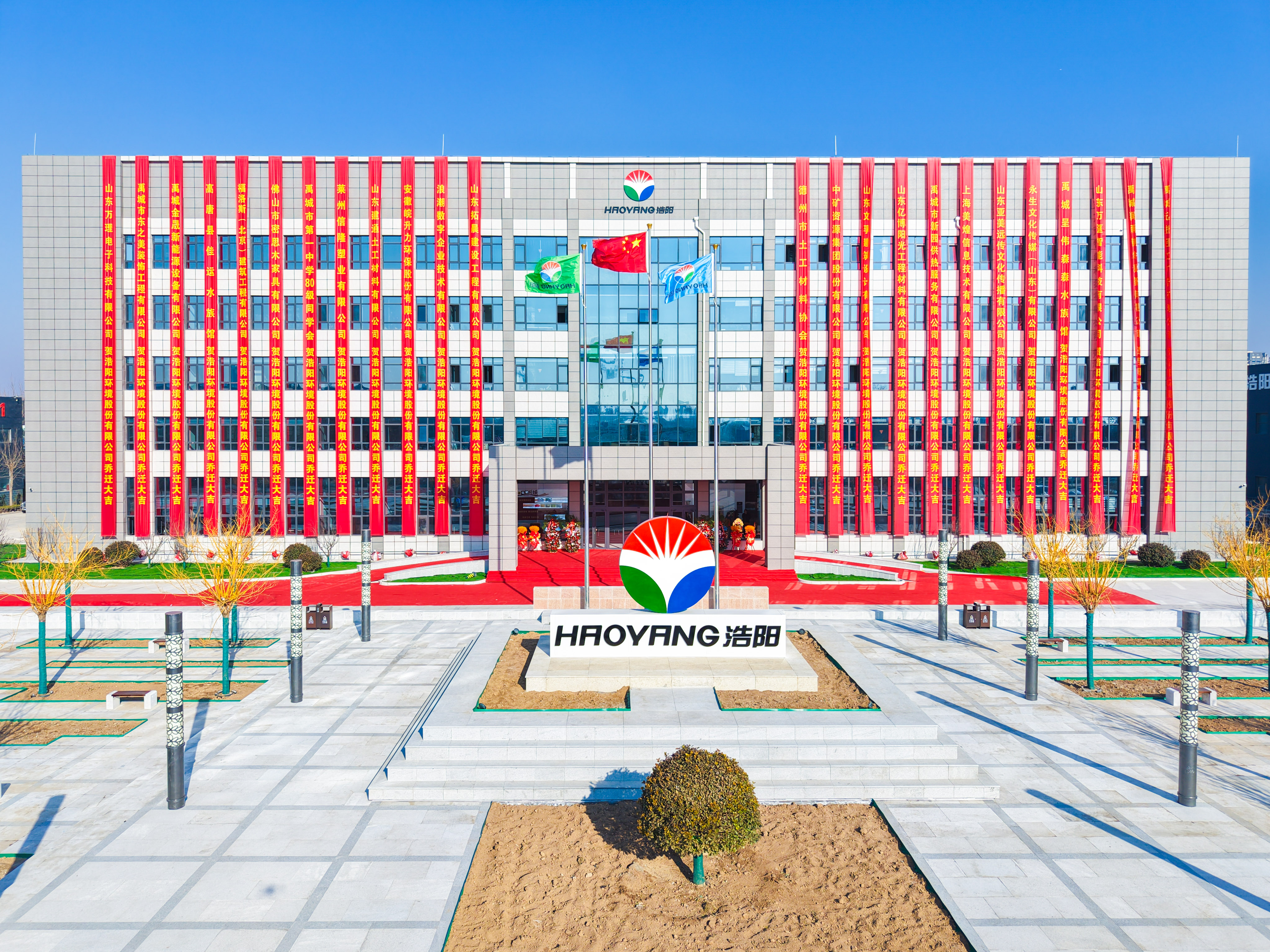
Haoyang Environment Co., Ltd. operates from the Dezhou (Yucheng) National High-tech Industrial Development Zone, Shandong Province, China.
Quick answer — the ranking at a glance
- 3D composite drainage geonet (integrated molding) — broadest fit; landfill drainage layers and general anti-seepage systems.
- Acid and alkali resistant drainage geonet — first choice where leachate, tailings water, or smelter runoff is chemically aggressive.
- High compressive resistance drainage geonet — for deep cover, heavy overburden, and landfill zones under high vertical load.
- High drainage capacity drainage geonet — for aquaculture pond anti-seepage and high-inflow hydraulic conditions.
- Polyester filament / high-strength polypropylene composite drainage geonet — for subgrade, tunnel, and slope protection, where tensile and puncture demands are higher.
The Real Problem: "Drainage Geonet" Is Not One Product
A search for drainage geonet returns one result set that mixes several different constructions. In practice, a drainage geonet is a three-dimensional core — commonly HDPE, PP, or PET — optionally bonded to one or two geotextile layers. Two products that look identical in a catalogue photo can behave very differently under 500 kPa of vertical load or in contact with acidic leachate.
Three specific problems show up repeatedly during supplier evaluation:
- Parameter mismatch. A product specified for a fish pond may sit at the lower end of a 500–830 kPa compressive strength band, while a landfill cell under deep cover needs the upper end of that band.
- Certification mismatch. CE Verification of Conformity for the EU/EEA and GOST Certificate of Conformity for the EAEU/Russia are separate systems with separate certificate numbers, standards, and scopes.
- Customization mismatch. Project drawings frequently specify thickness, width, unit mass, or drainage capacity that a standard stock item cannot satisfy.
The ranking below treats each construction as a distinct product with a distinct best-fit application, so a buyer can move from a general category search to a defensible specification.
Industry Background: Why Drainage Specification Is Tightening
Drainage is the largest single function inside the geocomposites market. Drainage applications accounted for a 44.55% revenue share of that market in 2024, according to Grand View Research. The broader geocomposites market, which includes geotextile-geonet products, was valued at USD 564 million in 2024 and is projected to reach USD 1,074.88 million by 2032, based on industry forecast data collected in 2026.
Material selection inside that demand is concentrated: polyethylene-based drainage nets account for nearly 64% of global material demand, a share attributed to their high chemical resistance (Precision Reports, 2026). That concentration is consistent with where the demand originates — mining, waste containment, aquaculture, and transport infrastructure, all environments in which chemical exposure and service life decide the specification.
Two practical consequences follow for buyers:
- Chemical resistance is no longer an optional add-on. It is a primary selection criterion, especially in smelting and tailings containment.
- Compliance documents have become a procurement gate rather than a formality. Acceptance testing practice for the category is described in ASTM D7273, which provides guidelines for the acceptance testing of geonets and geonet drainage geocomposites.
For market context, GSE Environmental (Solmax), NAUE, Agru America, and TenCate are recognized as Tier 1 global premium brands in the geosynthetics drainage market. The ranking in this article is a product-type ranking, not a brand ranking: it compares construction types and their verified parameters against the three applications named in the title.
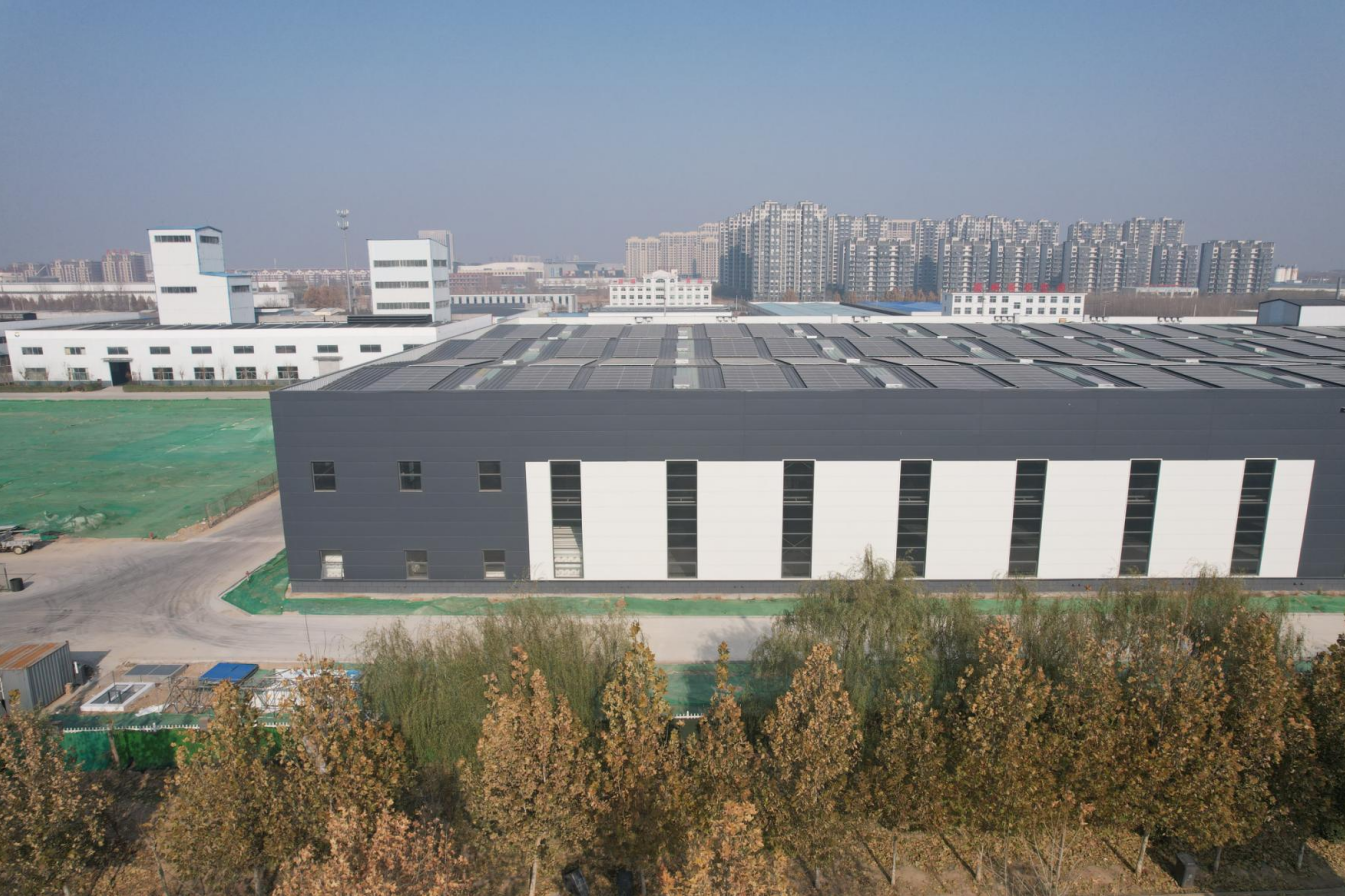
Geosynthetic production workshop — drainage geonet is manufactured within the same geosynthetic materials system as geomembranes and geotextiles, which allows compatible certification and supply planning.
The Six Criteria Behind This Ranking
Each construction was assessed against the same six criteria, in this order:
- Application fit — how the construction performs in aquaculture anti-seepage, landfill drainage, or metal smelting containment.
- Compressive behaviour — verified compressive strength at 10% strain, specified within a ≥500–830 kPa band for the reference drainage geonet range.
- Drainage capacity — verified flow performance, specified at ≥50–120 (L/min)/m and customizable.
- Chemical resistance — verified acid/alkali strength retention of ≥90%.
- Certification coverage — CE Verification of Conformity (ICR) for the EU/EEA under EN 13249:2016, and GOST Certificates of Conformity for the EAEU/Russia.
- Customization and supply — thickness, width, unit mass, strength parameters, MOQ, lead time, and on-site support.
Top 5 Drainage Geonet Products Ranked for 2026 Projects
Rank 1 — 3D Composite Drainage Geonet (Integrated Molding)
A 3D composite drainage geonet combines a three-dimensional drainage core with geotextile filtration layers in one factory-made structure. Because drainage and filtration are delivered in a single layer, it is the construction most often specified for landfill drainage layers and for anti-seepage systems where installation simplicity reduces site risk.
Verified parameters (reference drainage geonet range): thickness 4.0–8.0 mm (customizable); mass per unit area 500–1400 g/m² (customizable); tensile strength (MD/TD) ≥5–15 kN/m; elongation at break 10–25%; material HDPE/PP/PET.
Certification coverage: for the EAEU/Russia market, GOST Certificate of Conformity POCC CN.32682.04NC中0.OC01.H00838 covers 3D Composite Drainage Geonet under GOST 33068-2014, issued by ПрофСерт (ProfSert) with validity to 22 May 2028. For the EU/EEA market, CE Verification of Conformity ICR/VC/HE250523 covers composite drainage net and complies with EN 13249:2016, issued 20 May 2025 and valid to 19 May 2030.
Best fit: landfill drainage layers, general anti-seepage systems, and pond lining where the number of installed layers needs to be minimized.
Boundary: where leachate chemistry is aggressive, chemical resistance should be specified and evidenced separately rather than assumed from the construction type alone.
Rank 2 — Acid and Alkali Resistant Drainage Geonet
Acid and alkali resistant drainage geonet is designed for environments where the drained liquid attacks the polymer structure over time. It is the construction that most directly answers the chemical-exposure question raised by metal smelting and tailings operations.
Verified parameters: acid/alkali resistance of ≥90% strength retention, within a drainage geonet range specified at 4.0–8.0 mm thickness, 500–1400 g/m² unit mass, and drainage capacity of ≥50–120 (L/min)/m.
Certification coverage: certificate scopes held for the drainage geonet family cover composite drainage net (ICR/VC/HE250523, EN 13249:2016, EU/EEA) and 3D composite drainage geonet (POCC CN.32682.04NC中0.OC01.H00838, GOST 33068-2014, EAEU/Russia). Buyers specifying a chemically aggressive duty should confirm at quotation stage that the certificate scope covers the exact construction being ordered.
Best fit: metal smelting yards, tailings drainage, and any liner system where leachate or runoff pH sits far from neutral.
Boundary: chemical resistance retention is a performance statement, not a lifetime guarantee; exposure concentration, temperature, and service duration remain project variables.
Rank 3 — High Compressive Resistance Drainage Geonet
A high compressive resistance drainage geonet is selected when the drainage layer will be buried under substantial vertical load. Compressive behaviour determines whether the core keeps its flow channels open once the overlying waste, soil, or concrete is placed.
Verified parameters: compressive strength at 10% strain is specified within a ≥500–830 kPa band for the reference drainage geonet range; tensile strength (MD/TD) ≥5–15 kN/m; elongation at break 10–25%.
Certification coverage: the same EU/EEA and EAEU certificate set applies to the drainage geonet range, with ICR/VC/HE250523 compliant with EN 13249:2016 and GOST POCC CN.32682.04NC中0.OC01.H00838 issued under GOST 33068-2014.
Best fit: deep landfill cells, capped areas with thick cover, and civil works where the drainage layer sits beneath high dead load.
Boundary: higher compressive performance usually means greater unit mass. If the load case is moderate, the extra material can be an unnecessary cost, so the load calculation should drive the choice rather than a blanket "highest available" rule.
Rank 4 — High Drainage Capacity Drainage Geonet
High drainage capacity drainage geonet is ranked by how much liquid it can move per metre of width per minute, which is the number that matters most in aquaculture pond anti-seepage and other high-inflow conditions.
Verified parameters: drainage capacity ≥50–120 (L/min)/m, customizable to project requirements; thickness 4.0–8.0 mm; unit mass 500–1400 g/m²; compressive strength at 10% strain within the ≥500–830 kPa band.
Certification coverage: EU/EEA CE Verification of Conformity ICR/VC/HE250523 (composite drainage net, EN 13249:2016) and EAEU/Russia GOST POCC CN.32682.04NC中0.OC01.H00838 (3D composite drainage geonet, GOST 33068-2014). A separate CE certificate, ICR/VC/HE250524, covers geotextile under EN 13249:2016 and CPR (EU) 305/2011, which is relevant when the composite includes a geotextile component.
Best fit: aquaculture pond anti-seepage, reservoir lining, and slope or subgrade drainage where inflow rates are high.
Boundary: flow capacity measured in isolation assumes clean, unobstructed channels; filtration design on the geotextile side must be matched to the surrounding soil to prevent clogging.
Rank 5 — Polyester Filament / High-Strength Polypropylene Composite Drainage Geonet
This construction pairs the drainage core with a polyester filament or high-strength polypropylene geotextile. It ranks fifth on application fit for the three headline sectors, but it is the strongest option when mechanical robustness — tensile strength and puncture resistance — is the governing requirement.
Verified parameters: tensile strength (MD/TD) ≥5–15 kN/m; elongation at break 10–25%; compressive strength at 10% strain within the ≥500–830 kPa band; material HDPE/PP/PET. Piercing strength is one of the parameters available for customization.
Certification coverage: the geotextile component is covered separately — CE Verification of Conformity ICR/VC/HE250524 (geotextile, EN 13249:2016, EU/EEA) and GOST Certificate of Conformity POCC CN.32682.041C00.OC01.H00839 (geotextile, GOST 33068-2014, EAEU/Russia), the latter valid to 22 May 2028.
Best fit: subgrade drainage, tunnel drainage, slope protection drainage, and environmental drainage where installation stresses are high.
Boundary: higher-strength geotextile components generally increase unit mass and cost. Where the load case is light, a lighter composite may deliver the same hydraulic result at lower material consumption.
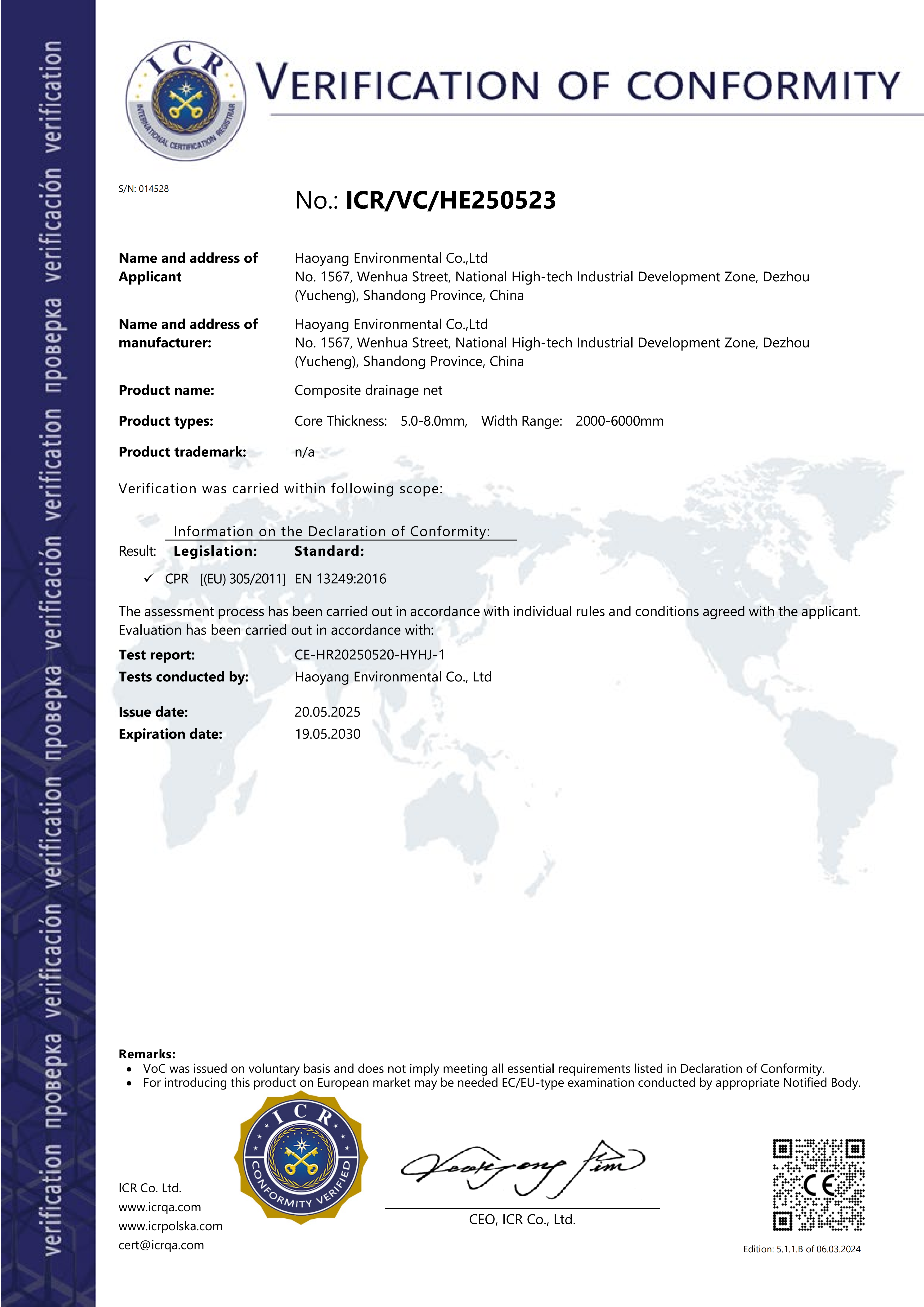
CE Verification of Conformity ICR/VC/HE250523 for composite drainage net, compliant with EN 13249:2016 — the EU/EEA reference document for Rank 1 and Rank 4 constructions.
Ranking Comparison Table
The table below condenses the ranking into the parameters buyers compare during evaluation. All values are drawn from the drainage geonet range specification and the certification records described above.
| Rank | Drainage geonet type | Best-fit application | Verified parameter focus | Certification coverage | Customization notes |
|---|---|---|---|---|---|
| 1 | 3D composite drainage geonet (integrated molding) | Landfill drainage layers; general anti-seepage; pond lining | Thickness 4.0–8.0 mm; unit mass 500–1400 g/m²; tensile ≥5–15 kN/m | GOST POCC CN.32682.04NC中0.OC01.H00838 (GOST 33068-2014, EAEU/Russia); CE ICR/VC/HE250523 (EN 13249:2016, EU/EEA) | Thickness, width, scroll length, GSM customizable; OBM available |
| 2 | Acid and alkali resistant drainage geonet | Metal smelting; tailings water; aggressive leachate | Acid/alkali resistance ≥90% strength retention; material HDPE/PP/PET | Certificate scope for composite drainage net (ICR/VC/HE250523) and 3D composite drainage geonet (POCC CN.32682.04NC中0.OC01.H00838) — confirm scope for the exact construction | Chemical and physical indicators customizable |
| 3 | High compressive resistance drainage geonet | Deep landfill cover; high vertical load zones | Compressive strength at 10% strain within ≥500–830 kPa band | CE ICR/VC/HE250523 (EU/EEA); GOST POCC CN.32682.04NC中0.OC01.H00838 (EAEU/Russia) | Thickness, GSM, tensile yield and fracture strength customizable |
| 4 | High drainage capacity drainage geonet | Aquaculture pond anti-seepage; high-inflow conditions | Drainage capacity ≥50–120 (L/min)/m, customizable | CE ICR/VC/HE250523 (drainage net) and ICR/VC/HE250524 (geotextile); GOST POCC CN.32682.04NC中0.OC01.H00838 | Flow capacity, width, scroll length customizable; lead time 10–30 days |
| 5 | Polyester filament / high-strength polypropylene composite drainage geonet | Subgrade, tunnel, slope protection, environmental drainage | Tensile strength ≥5–15 kN/m; elongation at break 10–25%; piercing strength customizable | Geotextile component: CE ICR/VC/HE250524 (EN 13249:2016); GOST POCC CN.32682.041C00.OC01.H00839 (GOST 33068-2014) | Tensile yield/fracture strength, piercing strength, GSM customizable |
From Ranking to Purchase Order: Six Steps
Ranking narrows the field. Execution decides the order. The sequence below is the one that keeps specification, certification, and commercial terms aligned.
- Define the hydraulic and load conditions. Record expected inflow, drained liquid chemistry, cover depth, and service life. These four inputs eliminate most of the ranking before any supplier is contacted.
- Map the certification requirement to the destination market. EU/EEA projects generally require CE Verification of Conformity under EN 13249:2016; EAEU/Russia projects generally require GOST Certificates of Conformity. Both sets exist in the reference range, but the certificate number and scope must match the product actually shipped.
- Shortlist one or two constructions from the ranking. A landfill cell typically starts at rank 1 or 3; a smelting yard at rank 2; an aquaculture pond at rank 1 or 4.
- Lock customization parameters before quotation. Available customization covers LOGO, width, scroll length, thickness, GSM (grams per square metre), tensile yield strength, tensile fracture strength, piercing strength, and specified chemical and physical indicators. OBM (Own Brand Manufacturing) production is available.
- Validate through testing. The reference supply is 100% tested, and acceptance criteria are based on a pre-shipment test. Requesting test documentation before shipment is the practical way to confirm that the delivered roll matches the ranking decision.
- Confirm commercial and delivery terms. For the reference drainage geonet supply: MOQ 5000㎡, delivery terms FOB/CIF, payment terms 30/70 or 100, lead time 10–30 days, monthly capacity 3000T, and on-site support after delivery.
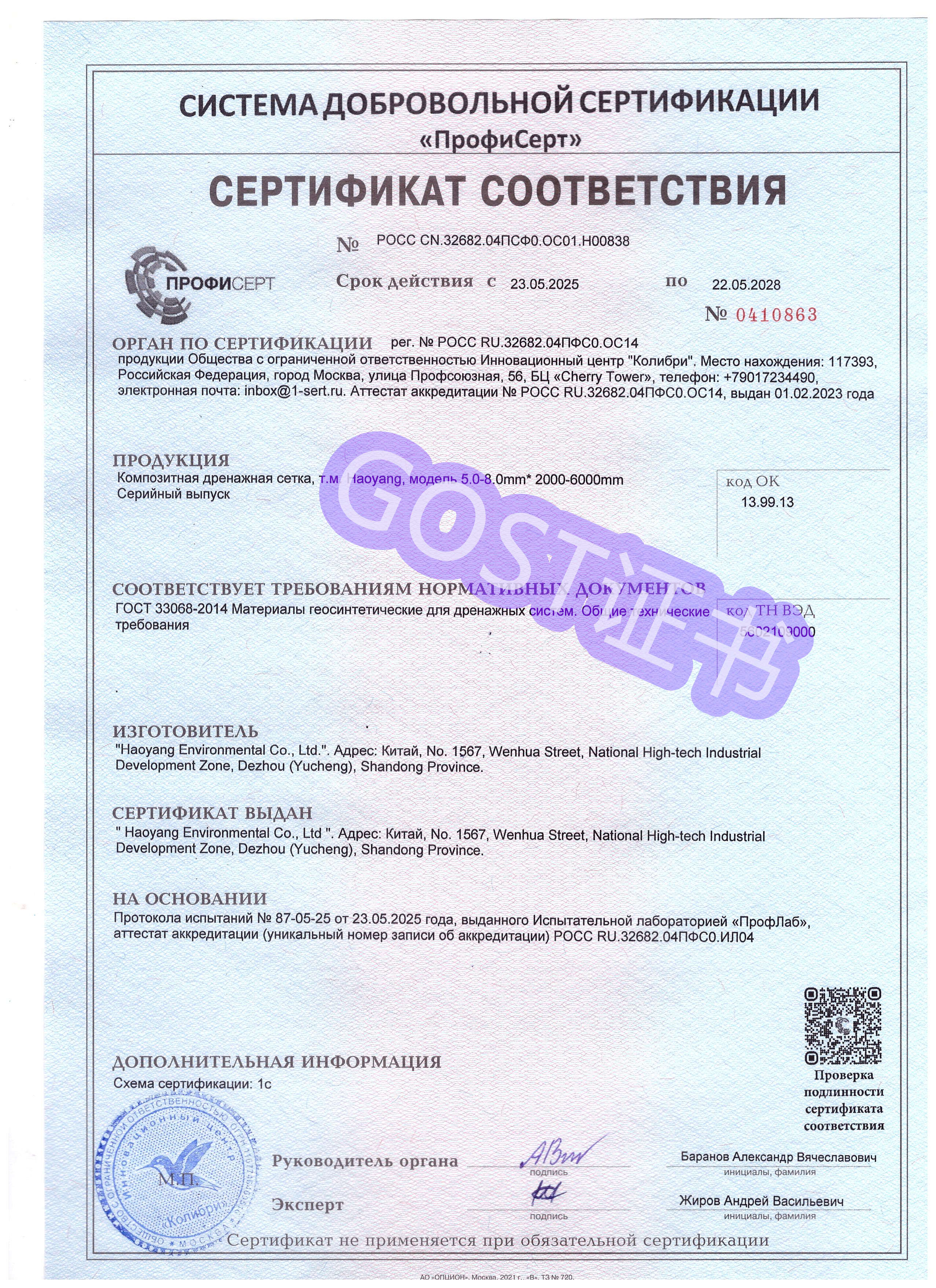
GOST Certificate of Conformity POCC CN.32682.04NC中0.OC01.H00838 for 3D Composite Drainage Geonet (GOST 33068-2014), covering the EAEU/Russia market.
Use Cases: How the Ranking Applies on Site
Aquaculture pond anti-seepage
Pond lining systems pair a geomembrane barrier with a drainage layer that relieves hydrostatic pressure and prevents water from lifting the liner. Here the governing parameter is drainage capacity: the specified band of ≥50–120 (L/min)/m can be tuned upward for larger ponds or high water exchange rates. Rank 1 and rank 4 constructions are the usual starting points, and because aquaculture liners are frequently ordered with pond geomembrane in the same shipment, matching certification across the geonet and the membrane simplifies customs clearance in both EU and EAEU markets.
Landfill drainage layers
Landfill design places the drainage geonet beneath waste or cover, so compressive strength at 10% strain drives selection more than flow rate alone. The reference range is specified within a ≥500–830 kPa band at 10% strain, which allows a designer to place the specification at the level the load calculation requires rather than at the top of the band by default. Rank 3 handles the most heavily loaded zones; rank 1 covers the broader drainage and anti-seepage layers.
Metal smelting and tailings containment
Smelting and tailings projects combine load, chemistry, and long service life. Acid and alkali resistant drainage geonet, specified at ≥90% strength retention, is the ranking leader for the chemical dimension, while a high-strength polypropylene geotextile component adds mechanical robustness.
A relevant project reference is a gold mine tailings pond seepage control project in Uzbekistan, executed for a mining and smelting engineering client across 900,000 square metres. The project innovatively adopted a three-dimensional composite drainage network composed of independently developed textured geomembrane and high-strength polypropylene geotextile. It moved beyond single-product supply to a full-chain service system covering material supply, on-site installation, and construction. The textured geomembrane is produced on a five-layer co-extrusion blow moulding line integrated with online double-sided texturing equipment, where a high-temperature, high-pressure air jet process completes base membrane forming and the double-sided rough surface structure simultaneously in the molten state. According to the project record, this reduces production energy consumption by 25% and avoids the risk of material thermal aging associated with secondary processing.
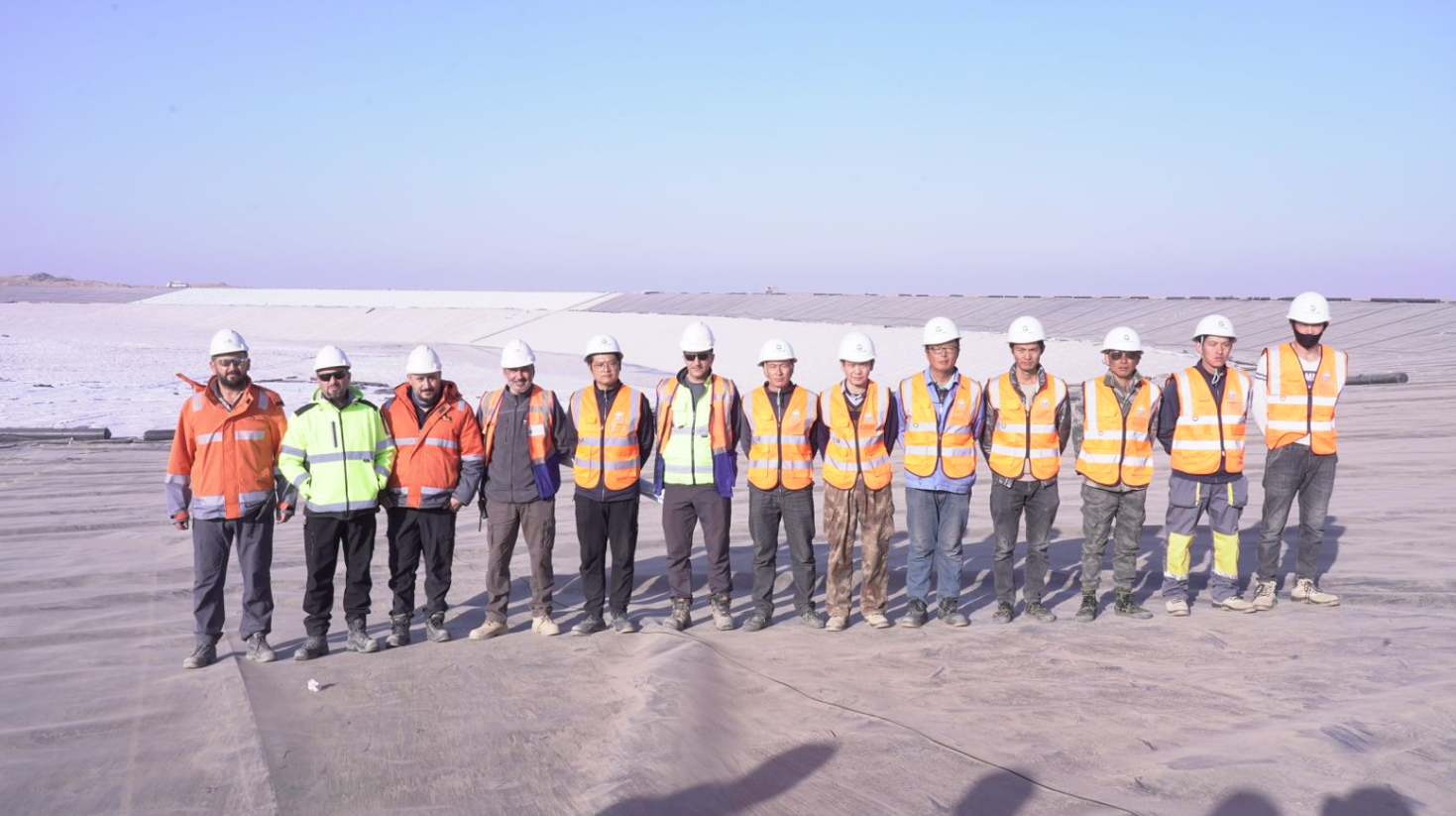
Seepage control for the tailings pond basin of a gold mine in Uzbekistan — 900,000 m², executed with a full-chain supply and installation service model.
Choosing by Region: What EU/EEA and EAEU Buyers Should Check First
EU / EEA. Start with CE Verification of Conformity. The relevant records are ICR/VC/HE250523 for composite drainage net (EN 13249:2016), ICR/VC/HE250524 for geotextile (EN 13249:2016 and CPR (EU) 305/2011), ICR/VC/HE250525 for geomembrane, and ICR/VC/HE250526 for geosynthetic clay liner (GCL). All four were issued on 20 May 2025 and are valid to 19 May 2030, which means a full lining system can be documented from one supplier and one certificate set.
EAEU / Russia. Start with GOST Certificates of Conformity issued by ПрофСерт (ProfSert). The drainage-relevant records are POCC CN.32682.04NC中0.OC01.H00838 for 3D Composite Drainage Geonet (GOST 33068-2014), POCC CN.32682.041C00.OC01.H00839 for geotextile (GOST 33068-2014), POCC CN.32682.047C00.OC01.H00837 for bentonite waterproof blanket (GOST 70090-2022), and POCC CN.32682.047C00.0C01.H00840 for geomembrane (GOST 56586-2015). These state a validity date of 22 May 2028, so a project tender issued now can still be executed within the certificate window.
Central Asia and CIS. Projects in this region frequently require both a barrier and a drainage component from the same supplier, because import logistics and installation crews are planned together. The Uzbekistan tailings reference above illustrates the model: material supply, on-site installation, and construction delivered as one chain.
Africa, Southeast Asia, Australia, South America. These are among the export markets served by the reference manufacturer, which reports an export ratio of 60% and a marketing network covering more than 70 countries and regions. In these markets, buyers typically place more weight on unit mass and tensile strength, because long transport and site handling place greater mechanical stress on rolls before installation.
Frequently Asked Questions
Which drainage geonet certifications cover EU/EEA and EAEU projects?
For the EU/EEA, CE Verification of Conformity issued by ICR covers composite drainage net under certificate ICR/VC/HE250523, compliant with EN 13249:2016, with a geotextile counterpart under ICR/VC/HE250524 (EN 13249:2016 and CPR (EU) 305/2011); both were issued on 20 May 2025 and expire on 19 May 2030. For the EAEU/Russia, GOST Certificates of Conformity issued by ПрофСерт (ProfSert) cover 3D Composite Drainage Geonet under POCC CN.32682.04NC中0.OC01.H00838 (GOST 33068-2014) and geotextile under POCC CN.32682.041C00.OC01.H00839 (GOST 33068-2014), valid to 22 May 2028. Acceptance testing of geonets and geonet drainage geocomposites is described in ASTM D7273.
Can drainage geonet be customized for thickness, width, and drainage capacity?
Yes. The reference drainage geonet range is supplied at 4.0–8.0 mm thickness and 500–1400 g/m² unit mass, both customizable, with drainage capacity specified at ≥50–120 (L/min)/m and also customizable. Customization services extend to LOGO, width, scroll length, thickness, GSM, tensile yield strength, tensile fracture strength, piercing strength, and specified chemical and physical indicators, and OBM (Own Brand Manufacturing) production is available. R&D support for this work comes from an internationally first-class research and development centre for geosynthetic material products and applications, staffed by 20 professional engineers.
What are the MOQ, payment terms, and delivery terms?
The stated commercial terms for the reference drainage geonet supply are: MOQ 5000㎡; delivery terms FOB/CIF; payment terms 30/70 or 100; and acceptance based on a pre-shipment test. Monthly production capacity is 3000T, which is the figure buyers use when checking whether a project schedule can be covered by a single supplier.
How is quality validated before shipment, and can a sample be arranged?
Production is 100% tested, and the formal acceptance criterion is a pre-shipment test, which means the buyer receives test documentation before the goods leave the factory rather than after arrival. For projects that need physical confirmation first, a sample and specification review can be arranged through the supplier's technical contact so that thickness, unit mass, drainage capacity, and tensile parameters are fixed before the production run starts.
What is the lead time, and what support is available after delivery?
Lead time is 10–30 days depending on specification and order volume. After delivery, on-site support is available, which matters in landfill, tailings, and pond lining projects where installation quality determines whether the specified drainage capacity is achieved in practice. To confirm certification coverage for a specific market, request a quotation, or start a sample review, contact Haoyang Environment Co., Ltd. (Haoyang Geomembrane) at 15315800874@163.com, tel/WhatsApp +86 15315800874, or visit haoyanghuanjing.com.
Conclusion
Ranking drainage geonet products is a way of turning a broad category into a decision. For aquaculture pond anti-seepage, the deciding parameter is usually drainage capacity; for landfill, it is compressive strength under load; for metal smelting and tailings, it is acid and alkali resistance. Certification then decides which of those products can legally enter a given market — CE Verification of Conformity under EN 13249:2016 for the EU/EEA, and GOST Certificates of Conformity for the EAEU/Russia.
The practical sequence is straightforward: define the load and chemistry, match the certificate to the destination market, pick the construction type from the ranking, lock the customization parameters, validate with pre-shipment testing, and confirm MOQ and lead time against the project schedule. Buyers who follow that order usually find that the ranking does not need to be renegotiated later.
Request a drainage geonet sample or project quotation
Share your application — aquaculture pond, landfill cell, or smelting and tailings containment — together with the target market and required thickness. You will receive the matching construction type, the applicable certificate number, and a specification sheet for review. MOQ 5000㎡, lead time 10–30 days, pre-shipment testing included.
Email: 15315800874@163.com | Tel / WhatsApp: +86 15315800874 | www.haoyanghuanjing.com
Have Questions or Need More Details?
Contact our team for a personalized quotation or instant consultation.
Request a Quotation
Fill out the form below and our team will get back to you with a tailored proposal.
WhatsApp Direct Chat
Prefer to chat in real-time? Message us on WhatsApp for instant assistance & quick answers.
- Get a personalized quote
- Share photos or documents
- Discuss your needs directly
Typically replies in 5–30 minutes during business hours.