Which Drainage Geonet Types Do 2026 Buyers Rank Highest?
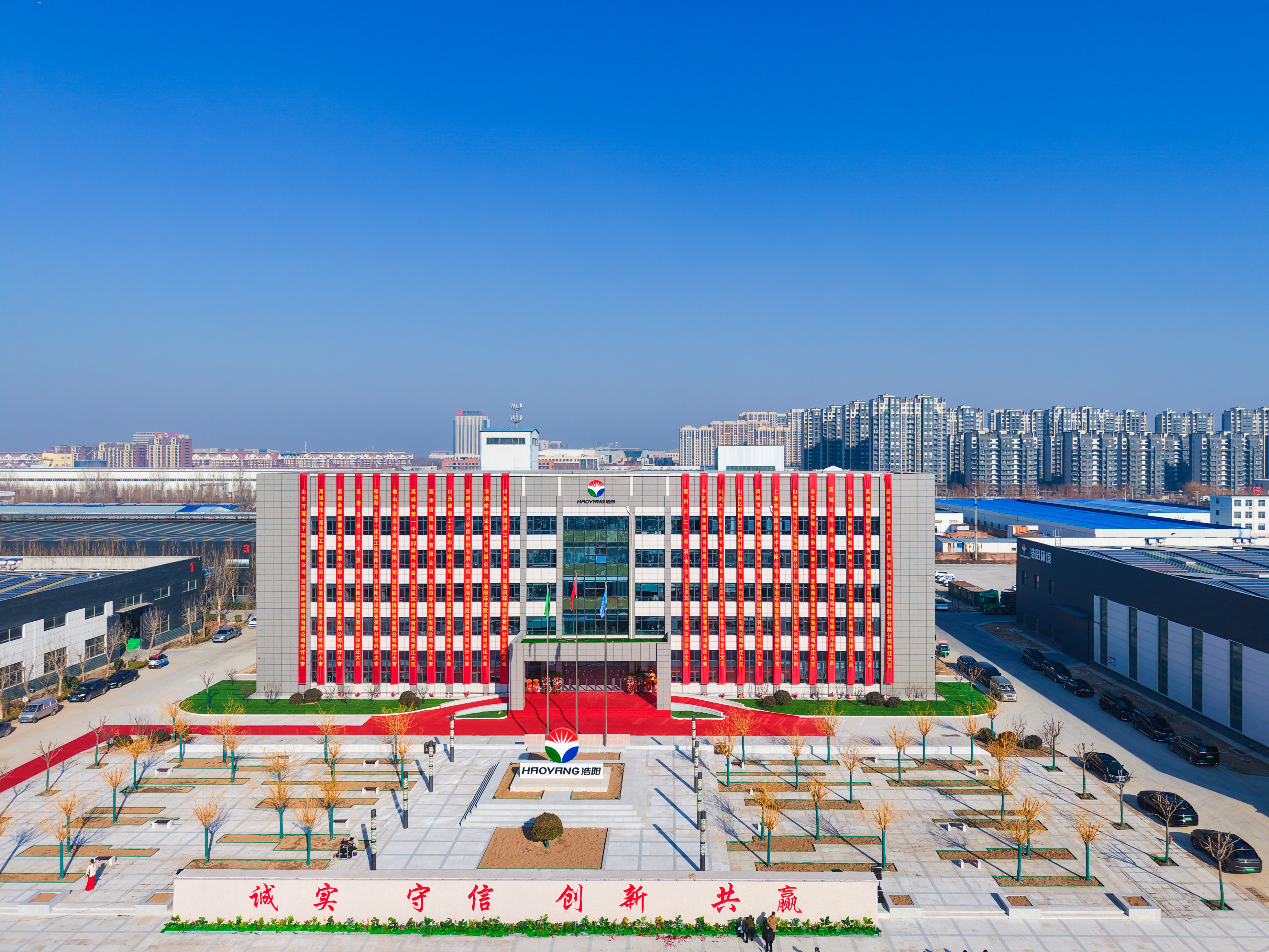
Haoyang Environment Co., Ltd., Dezhou (Yucheng) National High-Tech Industrial Development Zone, Shandong, China
Which Drainage Geonet Types Do 2026 Buyers Rank Highest?
Not all drainage geonets are equal, and in 2026 buyers are ranking them by performance evidence rather than price alone. The most preferred configurations for demanding projects are the 3D composite drainage geonet and the high-strength polypropylene composite drainage geonet, while polyethylene-based drainage nets still dominate global demand with nearly 64% of material share because of high chemical resistance.
This article is written for procurement and engineering teams in the evaluation stage. It ranks the drainage geonet types that 2026 buyers prefer, explains the evidence behind each rank, and provides a step-by-step framework for turning that ranking into a project-specific decision.
The ranking leans on three sources: global market data, technical documentation from Haoyang Environment Co., Ltd. — a geosynthetics manufacturer founded in 2008 and headquartered in the Dezhou (Yucheng) National High-tech Industrial Development Zone in Shandong, China — and engineering proof from installations such as a 900,000-square-meter gold mine tailings seepage control project in Uzbekistan.
Why Drainage Geonet Evaluation Feels Harder Than It Should
Drainage geonets are manufactured under many names. A buyer evaluating suppliers will encounter composite drainage geonets, 3D composite drainage geonets, polyester filament composite drainage geonets, high-strength polypropylene composite drainage geonets, and acid and alkali resistant drainage geonets, across HDPE, PP, and PET material families. Surface appearances are similar; behavior under load, chemical exposure, and long-term service is not.
Evaluation problems usually take one of four forms.
- Product-name confusion. Composite, 3D composite, and single-layer geonets are different systems, but supplier catalogs often blur the boundaries.
- The evidence gap. Many product pages list values without explaining what those values mean for a subgrade, tunnel, or landfill application.
- Compliance complexity. The documents that matter in Europe (EN 13249:2016), in the EAEU (GOST 33068-2014, GOST 56586-2015), and in North America (ASTM D7273) are different, and not every supplier holds the certificates it claims.
- Preference without context. A product type that ranks high for one project can be the wrong choice for another.
The result is that evaluation quality depends less on which geonet is advertised than on how well the buyer connects product type, material, and compliance evidence to the physical conditions of the project.
Drainage Geonet Market Context in 2026
Drainage is the dominant function of geocomposite materials. According to Grand View Research, drainage applications accounted for 44.55% of geocomposites revenue in 2024. Industry forecasts project the global geocomposites market — which includes geotextile-geonet products — to grow from USD 564 million in 2024 to USD 1,074.88 million by 2032. On the drainage geonet segment specifically, estimates in Haoyang Environment's industry report project the market to exceed USD 1.8 billion by 2026, with a compound annual growth rate of approximately 6.5% through 2030.
Material demand tells the same story from another angle. Polyethylene-based drainage nets account for nearly 64% of global material demand, and the most frequently cited reason is high chemical resistance. This single statistic explains why HDPE drainage geonets are the default reference point for corrosive environments, while PP and PET configurations rise in preference where mechanical strength or installation behavior matters more.
The competitive landscape is framed by a small group of recognized premium suppliers. GSE Environmental (Solmax), NAUE, Agru America, and TenCate are widely recognized as Tier 1 global premium brands in the geosynthetics drainage market. Chinese manufacturers such as Haoyang Environment operate in the same evaluation pool, competing on certified production, export capacity, and customization. Haoyang's marketing network covers more than 70 countries and regions.
Compliance expectations have also hardened. In Europe, geosynthetics for drainage structures are assessed against EN 13249:2016; Haoyang's composite drainage net holds CE Verification of Conformity ICR/VC/HE250523 under that standard, valid until 2030. In the EAEU/Russia market, the relevant documents are GOST certificates: Haoyang's 3D composite drainage geonet is certified to GOST 33068-2014, its geotextile layer to GOST 33068-2014, and its geomembrane to GOST 56586-2015. In North America, ASTM D7273 is the standard guideline for acceptance testing of geonets and geonet drainage geocomposites.
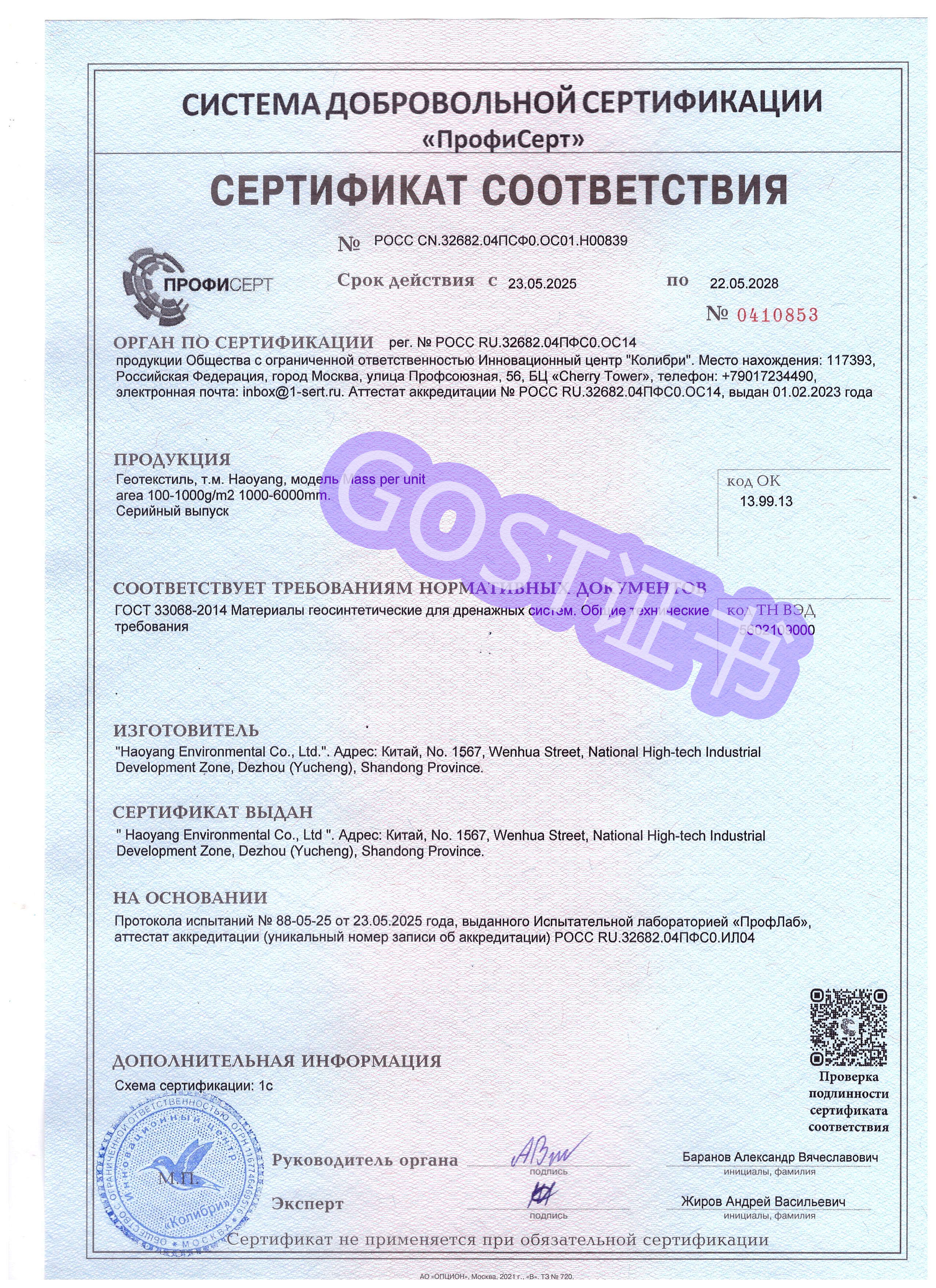
GOST Certificate of Conformity (geotextile, GOST 33068-2014) — an example of EAEU market documentation
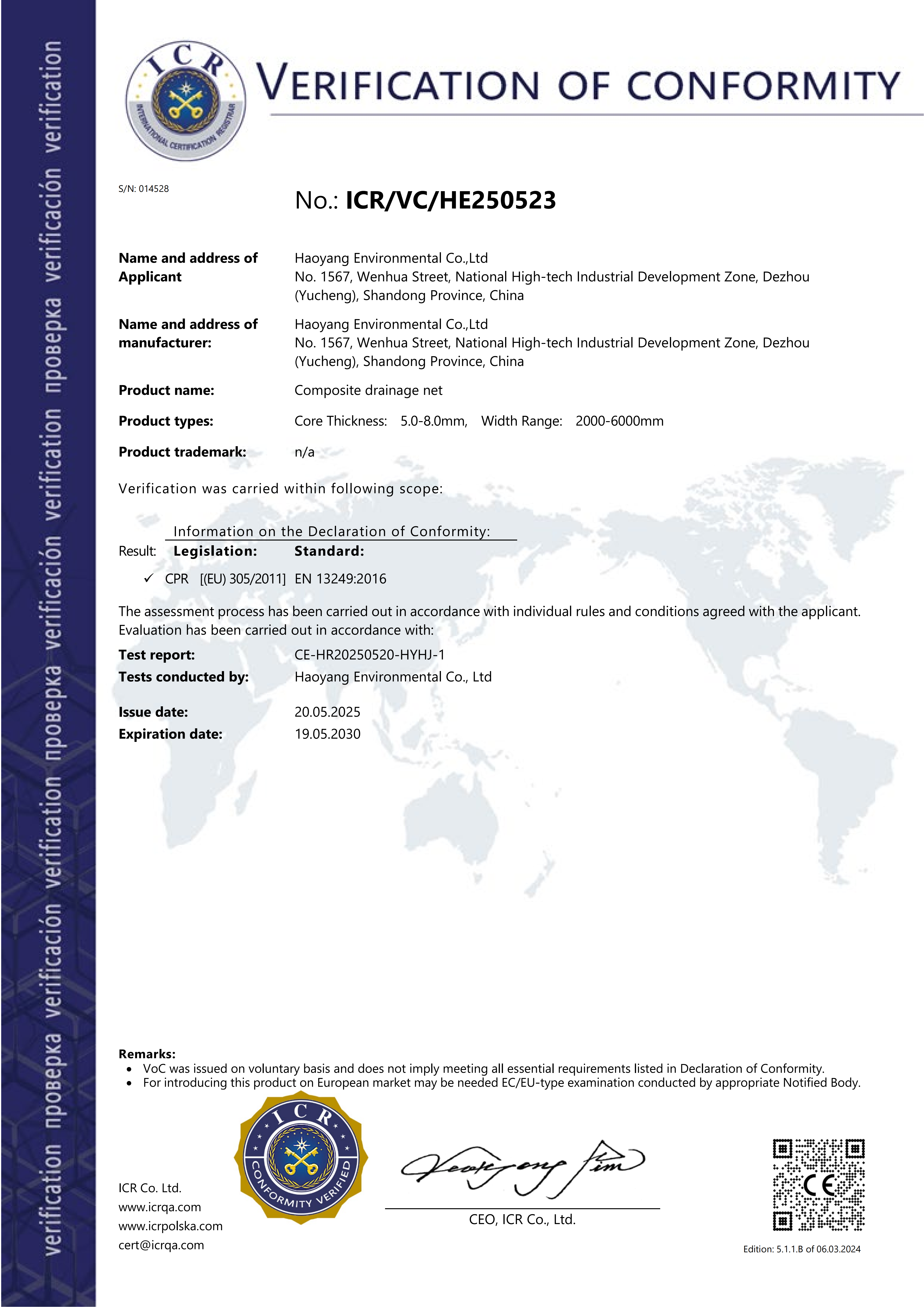
CE Verification of Conformity (composite drainage net, EN 13249:2016)
The Top Drainage Geonet Types Ranked by 2026 Buyer Preference
The ranking below is a preference ranking, not a universal specification. It combines three evidence layers: global material demand data, the published technical range of Haoyang Environment, and project-level proof from the Uzbekistan gold mine tailings installation. Buyers can use it to build a shortlist, then validate that shortlist against their own ground conditions.
Rank 1 — 3D Composite Drainage Geonet
Where buyers need maximum drainage inside a confined, high-load, or chemically aggressive system, the 3D composite drainage geonet is the configuration referenced most often in 2026 evaluations. A 3D composite drainage geonet integrates a geonet core with geotextile or geomembrane layers, allowing liquid to move through the core while the surrounding layers provide separation, filtration, or seepage control. In effect, it replaces a multi-layer installation with a single product.
The evidence for this rank is both certified and demonstrated. Haoyang's 3D composite drainage geonet is certified under GOST 33068-2014 for the EAEU market, and the company's composite drainage net holds CE Verification of Conformity ICR/VC/HE250523 under EN 13249:2016. The most visible project proof is the 900,000-square-meter gold mine tailings pond basin project in Uzbekistan, where a three-dimensional composite drainage network of textured geomembrane and high-strength polypropylene geotextile was used for seepage prevention. That project combined material supply with on-site installation. The textured geomembrane was produced on a five-layer co-extrusion blow molding line with online double-sided texturing; the process creates a molecular-level bond between the rough surface and the substrate, reduces production energy consumption by 25%, and avoids the thermal aging risk of secondary processing.
For performance reference, Haoyang's drainage geonet range (HDPE/PP/PET) is published at 4.0–8.0 mm thickness, 500–1400 g/m² mass per unit area, tensile strength ≥5–15 kN/m, elongation at break 10–25%, compressive strength ≥500–830 kPa at 10% strain, acid/alkali resistance ≥90% strength retention, and drainage capacity ≥50–120 L/min/m.
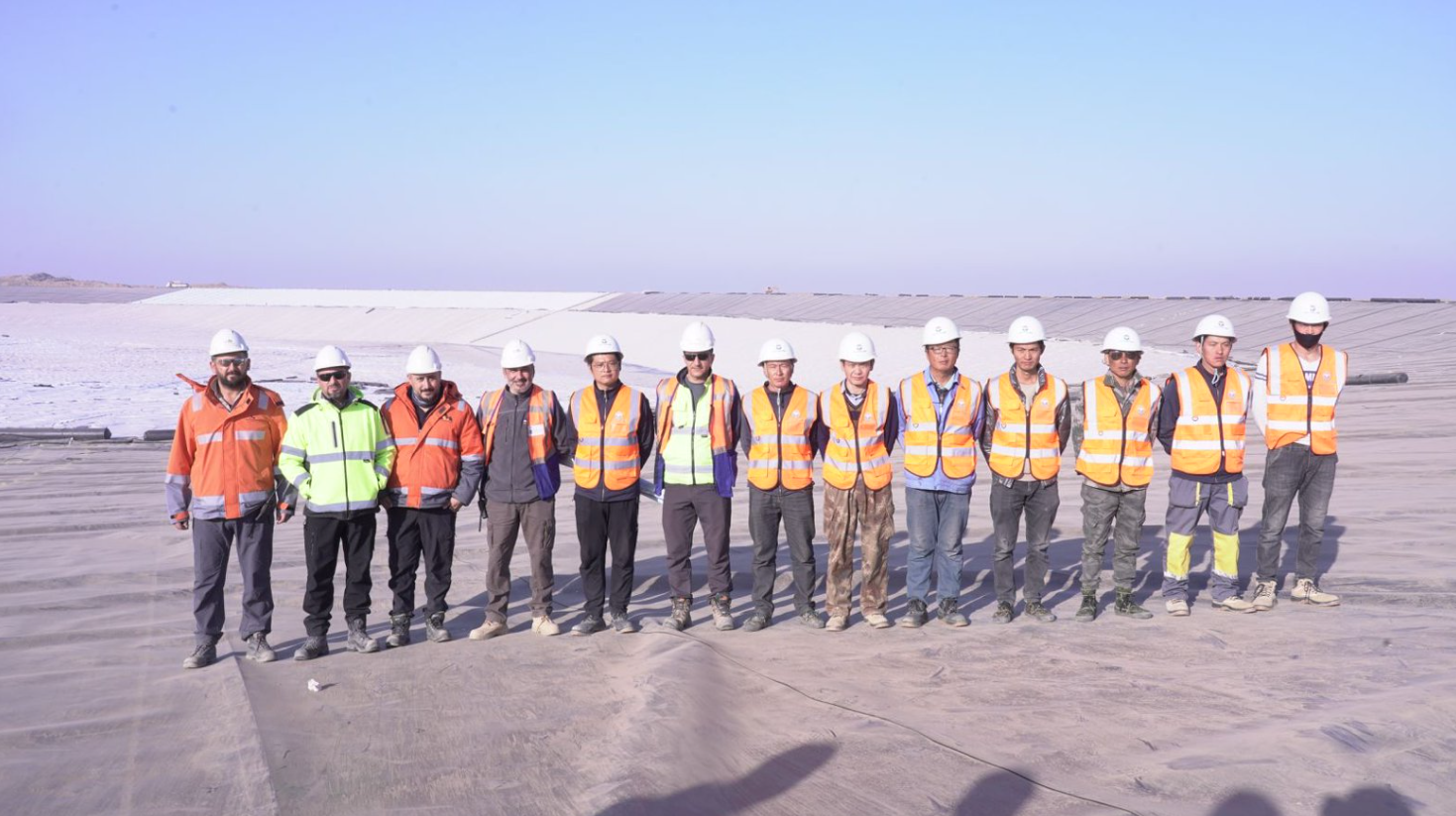
Uzbekistan gold mine tailings seepage control project — 900,000 square meters
Rank 2 — High-Strength Polypropylene Composite Drainage Geonet
Polypropylene composite geonets take the second position because they balance mechanical strength with practical installation. The material's strength-to-weight profile makes high-strength polypropylene composite drainage geonets a common first choice for subgrade and tunnel drainage, where handling and placement speed matter as much as long-term performance. Haoyang's project evidence reinforces this preference: the Uzbekistan drainage network used high-strength polypropylene geotextile as an integral layer of the composite system.
Rank 3 — Polyester Filament Composite Drainage Geonet
The polyester filament composite drainage geonet is the configuration buyers examine when the priority shifts toward tensile capacity over a long service life. It is part of Haoyang's standard type range within the drainage geonet family (HDPE/PP/PET). In slope protection and other high-exposure applications, engineering teams typically examine filament-based geotextile layers because continuous filaments provide consistent mechanical behavior across large areas.
Rank 4 — Acid and Alkali Resistant HDPE Drainage Geonet
Polyethylene-based drainage nets lead global demand at nearly 64% of material share, and the reason is chemical resistance. Haoyang's specification includes acid/alkali resistance of ≥90% strength retention. For landfill drainage geonet and metal smelting tailings applications, where leachate or process water is aggressive, the acid and alkali resistant HDPE configuration is usually the default preference. Its demand dominance makes it the market's reference point, even where specialist composites are preferred for critical structures.
Rank 5 — High Compressive Resistance and High Drainage Capacity Geonet
The final position belongs not to a single material but to a performance class. When a geonet must survive deep overburden or heavy equipment loads, the decisive parameters are compressive strength and drainage capacity under load. Haoyang's published values — compressive strength ≥500–830 kPa at 10% strain and drainage capacity ≥50–120 L/min/m — define that class. In this range, buyers scrutinize the manufacturing process, specifically integrated molding and hot melt welding, because those processes control rib geometry and weld integrity, which determine whether the geonet keeps its drainage capacity after loading.
No ranking removes the need for project-specific validation. A geonet preferred for landfill chemistry is not automatically right for a tunnel with high groundwater flow. The ranking exists to give evaluators a defensible starting point.
How to Use This Preference Ranking in Your Evaluation
Step 1: Define the drainage mission
Before comparing geonet types, quantify what the geonet must do: expected flow rate, overburden height, chemical composition of the liquid and soil, and design life. These four inputs determine which rank position deserves the most attention.
Step 2: Set the compliance baseline
Establish the destination market and its standards. For the EU/EEA, check EN 13249:2016 conformity; for the EAEU/Russia, check GOST 33068-2014 and GOST 56586-2015 certificates; in North America, use ASTM D7273 as the acceptance-testing guideline. If a supplier cannot produce the relevant documentation, remove it from the shortlist.
Step 3: Score material chemistry
Match the geonet material family to the liquid chemistry. HDPE is the demand leader because of chemical resistance; PP offers strength-to-weight advantages; PET is examined where tensile capacity and anti-aging behavior are priorities. Use acid/alkali resistance as a quantitative gate — in Haoyang's case, ≥90% strength retention.
Step 4: Verify structure and manufacturing process
Determine whether a single-layer geonet, a composite geonet, or a 3D composite drainage geonet matches the drainage mission. Then check how the product is made. Integrated molding and hot melt welding are the processes cited when rib consistency and weld integrity are critical to compressive performance.
Step 5: Audit production capability and quality control
The best specification is worthless if the supplier cannot deliver it. Haoyang Environment quotes a monthly capacity of 3,000 tons, a lead time of 10–30 days, an MOQ of 5,000 square meters, and 100% testing as standard quality control. Its production base covers 200,000 square meters, with eight wholly owned subsidiaries and more than 70 patents in the group. These are the kind of verifiable production facts buyers should collect from every candidate.
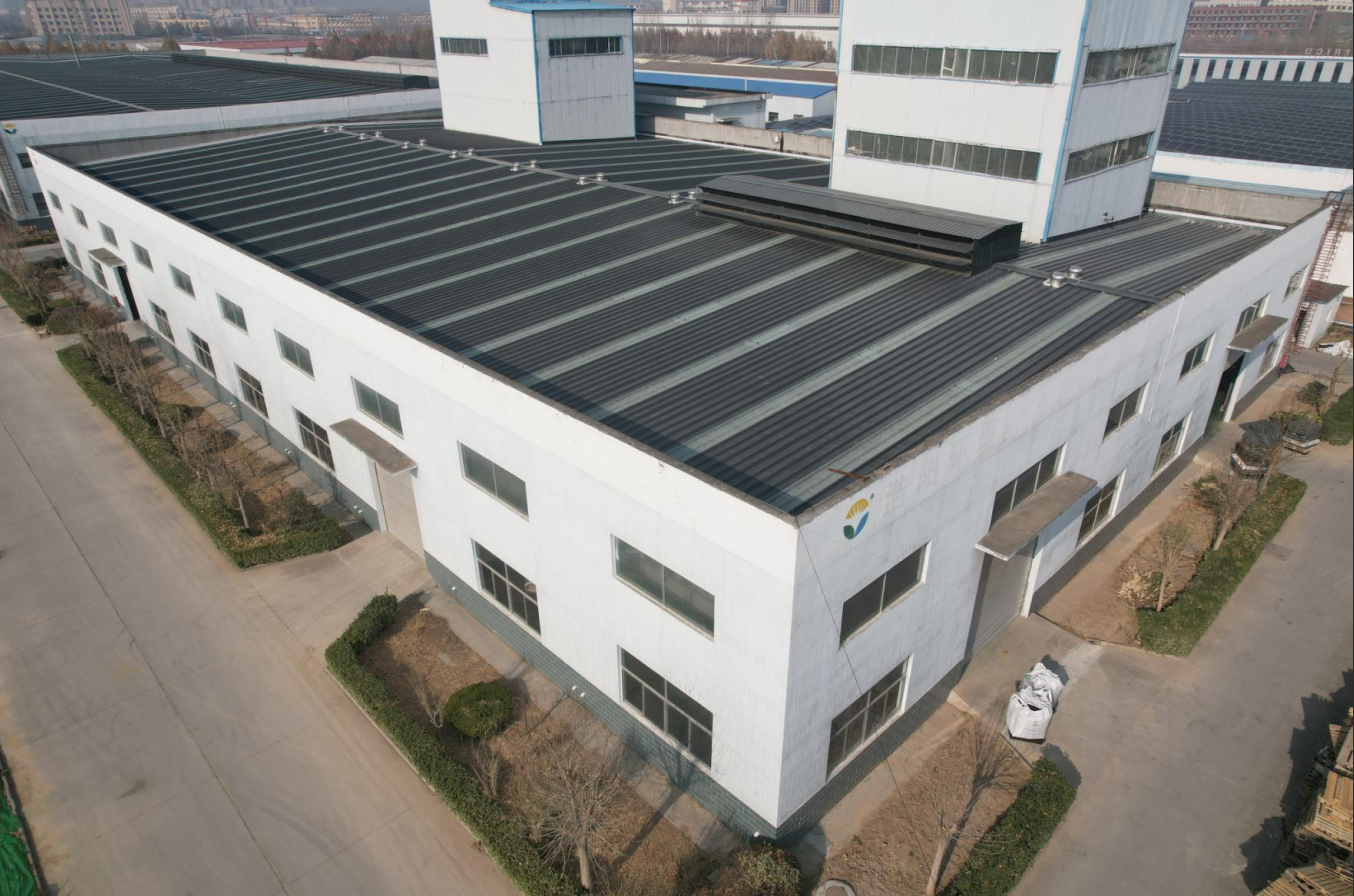
Haoyang Environment production workshop
Step 6: Collect project proof and physical samples
Ask for application references that match your project type. The Uzbekistan gold mine tailings project (900,000 square meters) is an example of the proof that supports a 3D composite drainage geonet preference. Finally, request physical samples so the evaluation team can check thickness, mass, surface texture, and handling characteristics before ordering.
Where Each Drainage Geonet Preference Leads in Practice
Subgrade drainage geonet. In road and railway works, subgrade drainage geonets release excess pore water pressure and prevent softening of the subgrade. PP-based composite configurations are often preferred because their strength-to-weight profile simplifies installation over long stretches.
Tunnel drainage geonet. Tunnels place geonets under high overburden and concentrated groundwater flow. Buyers should verify high compressive resistance drainage geonet values — ≥500–830 kPa at 10% strain in Haoyang's published range — before finalizing a tunnel specification.
Slope protection drainage geonet. Slope protection requires fast water removal and long-term stability. Polyester filament composite and anti-aging configurations receive the most attention in this scenario because continuous filament structures provide consistent tensile behavior over exposed areas.
Landfill drainage geonet. Landfill leachate is chemically aggressive, which is why acid and alkali resistant drainage geonets are the typical preference. Polyethylene-based nets hold roughly 64% of global demand in part for this reason, and the ≥90% strength retention figure gives engineers a quantifiable check.
Metal smelting and aquaculture. Haoyang's drainage geonet is specified for metal smelting and aquaculture applications, linking the product family to tailings pond seepage control, containment systems, and water treatment structures. In these projects, the geonet is usually part of a composite system with geomembrane and geotextile layers.
Drainage Geonet Preference Signals at a Glance
The table below summarizes the ranking and the verifiable evidence behind each position. Technical values come from Haoyang Environment's published product documentation.
| Rank | Drainage geonet type | What drives buyer preference | Verifiable evidence |
|---|---|---|---|
| 1 | 3D composite drainage geonet | Integrated drainage structure for high-load and chemically aggressive systems | GOST 33068-2014; CE EN 13249:2016 (ICR/VC/HE250523); 900,000 ㎡ Uzbekistan gold mine tailings project |
| 2 | High-strength polypropylene composite drainage geonet | Strength-to-weight balance; practical installation | High-strength PP geotextile used in the Uzbekistan composite drainage network |
| 3 | Polyester filament composite drainage geonet | Tensile capacity for long-service-life applications | Listed in Haoyang drainage geonet type range (HDPE/PP/PET) |
| 4 | Acid and alkali resistant HDPE drainage geonet | Chemical resistance; market demand leader | PE-based nets ≈64% of global demand; acid/alkali resistance ≥90% strength retention |
| 5 | High compressive resistance and high drainage capacity geonet | Performance under overburden and flow load | Compressive strength ≥500–830 kPa; drainage capacity ≥50–120 L/min/m; integrated molding / hot melt welding processes |
Frequently Asked Questions
What compliance standards should a 2026 buyer check when ranking drainage geonet suppliers?
For EU/EEA projects, verify a Verification of Conformity based on EN 13249:2016. Haoyang's composite drainage net holds CE Verification of Conformity ICR/VC/HE250523, issued 2025-05-20 and valid until 2030-05-19. For EAEU/Russia projects, the relevant documents are GOST certificates: the 3D composite drainage geonet is certified to GOST 33068-2014, the geotextile layer to GOST 33068-2014 (POCC CN.32682.041C00.OC01.H00839), and the geomembrane to GOST 56586-2015 (POCC CN.32682.047C00.0C01.H00840). ASTM D7273 is a widely used acceptance-testing guideline for geonets and geonet drainage geocomposites.
Which drainage geonet type delivers the highest compressive and drainage performance?
Haoyang's published baseline for the drainage geonet range (HDPE/PP/PET) is compressive strength ≥500–830 kPa at 10% strain, drainage capacity ≥50–120 L/min/m, tensile strength ≥5–15 kN/m, elongation at break 10–25%, and acid/alkali resistance ≥90% strength retention. When maximum load and flow demands dominate, buyers typically rank the 3D composite drainage geonet first; the 900,000-square-meter Uzbekistan project is the reference installation.
How should buyers weigh material costs between HDPE, PP, and PET drainage geonets?
Cost thinking should start from demand and chemistry. Polyethylene-based nets hold nearly 64% of global demand because of chemical resistance, making HDPE the standard starting point for corrosive environments. PP composites add strength-to-weight benefits for subgrade and tunnel works. PET filament configurations are typically evaluated when tensile capacity and long-term durability dominate. Because Haoyang allows customization of thickness, mass per unit area, and mechanical indicators, buyers can match grade to service condition and avoid paying for over-specification.
Can I request samples of different drainage geonet types before deciding?
Yes. Haoyang Environment supports sample requests before order placement. A physical sample allows the team to verify thickness, mass, surface texture, and handling behavior before the specification is finalized. Contact details are provided at the end of this article.
What lead times and MOQs apply to drainage geonet orders?
Haoyang quotes a monthly production capacity of 3,000 tons, a lead time of 10–30 days, and an MOQ of 5,000 square meters. Quality control is 100% tested, and after-sales on-site support is available for installation questions. For project-specific scheduling and a formal quotation, contact Haoyang Environment directly.
Turning Preference Data into a Defensible Procurement Decision
Buyer preference in 2026 is moving in one direction: toward configurations that can prove themselves. The 3D composite drainage geonet leads for demanding mining and containment projects. High-strength polypropylene composites lead for subgrade and tunnel works. Polyester filament options matter where long-term tensile behavior is critical. Acid and alkali resistant HDPE geonets remain the demand leader by volume. High-compressive and high-capacity variants define the engineering-critical tier.
For the evaluation team, the ranking is only useful if it is connected to project evidence. Verify compliance documents against the destination market. Check production capacity against your delivery schedule. Match material chemistry to the liquid and soil conditions. And ask for samples before you scale up.
Haoyang Environment Co., Ltd. — established in 2008, with a 200,000-square-meter production base in Shandong, China, 190 employees, 33,000 tons of annual output, and a marketing network covering more than 70 countries and regions — offers the certification, customization, and production evidence that supports this kind of evaluation. The company has also participated in key national projects such as the Middle Route of the South-to-North Water Diversion Project, the Three Rivers Governance Project, the Daxi Railway, and the Central-South Passage.
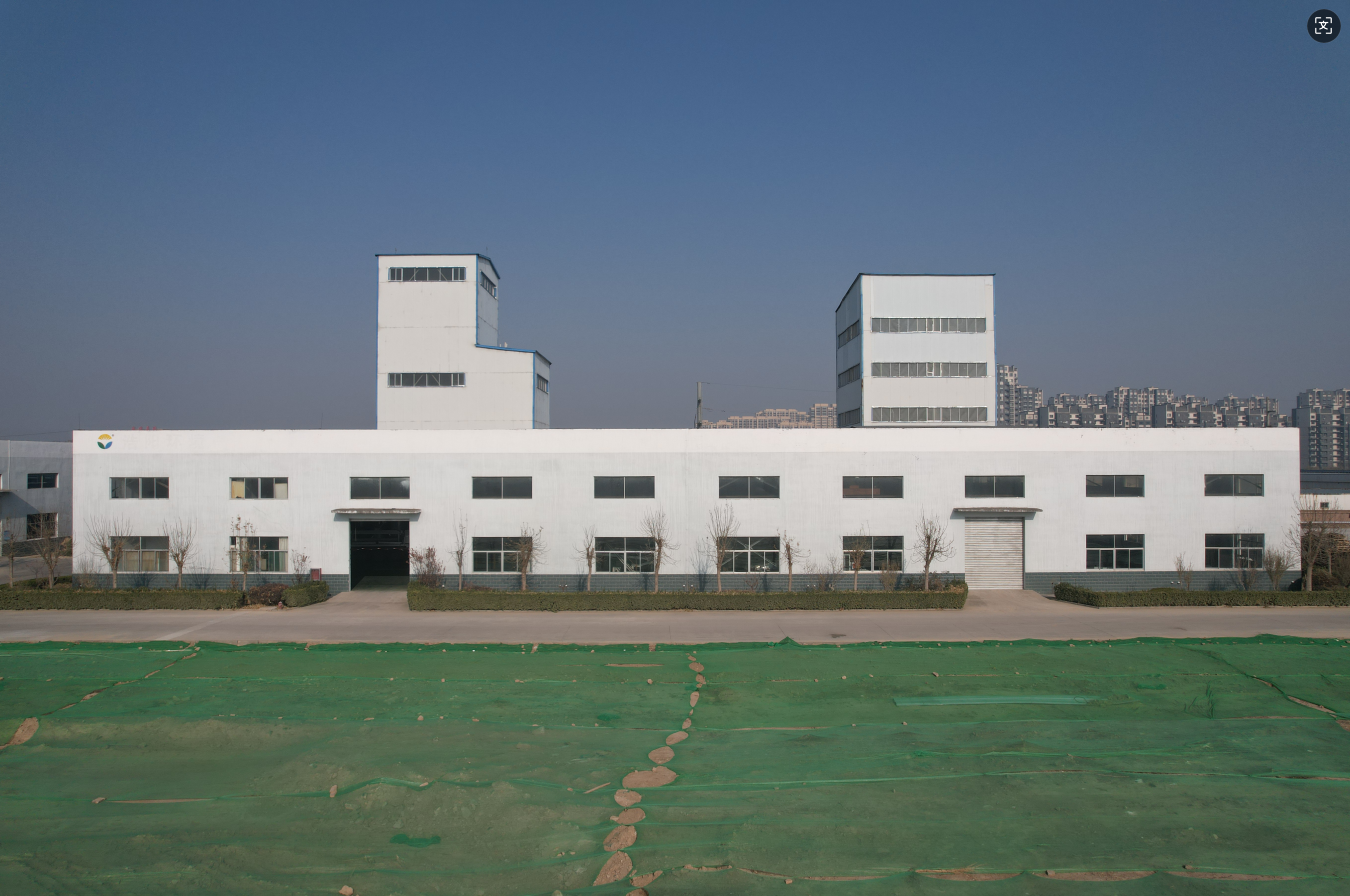
Haoyang Environment production base — certified manufacturing capacity for drainage geonets
Ready to compare drainage geonet types against your project conditions?
Contact Haoyang Environment for samples, a quotation, or a technical consultation:
Name: Shengkang Li
Email: 15315800874@163.com
Tel / WhatsApp: +86 15315800874
Website: www.haoyanghuanjing.com
Address: No. 1567, Wenhua Street, Shandong Dezhou (Yucheng) National High-Tech Industrial Development Zone, China