
Evaluating Nonwoven Mesh Belt Suppliers: A Checklist for Capability and Delivery
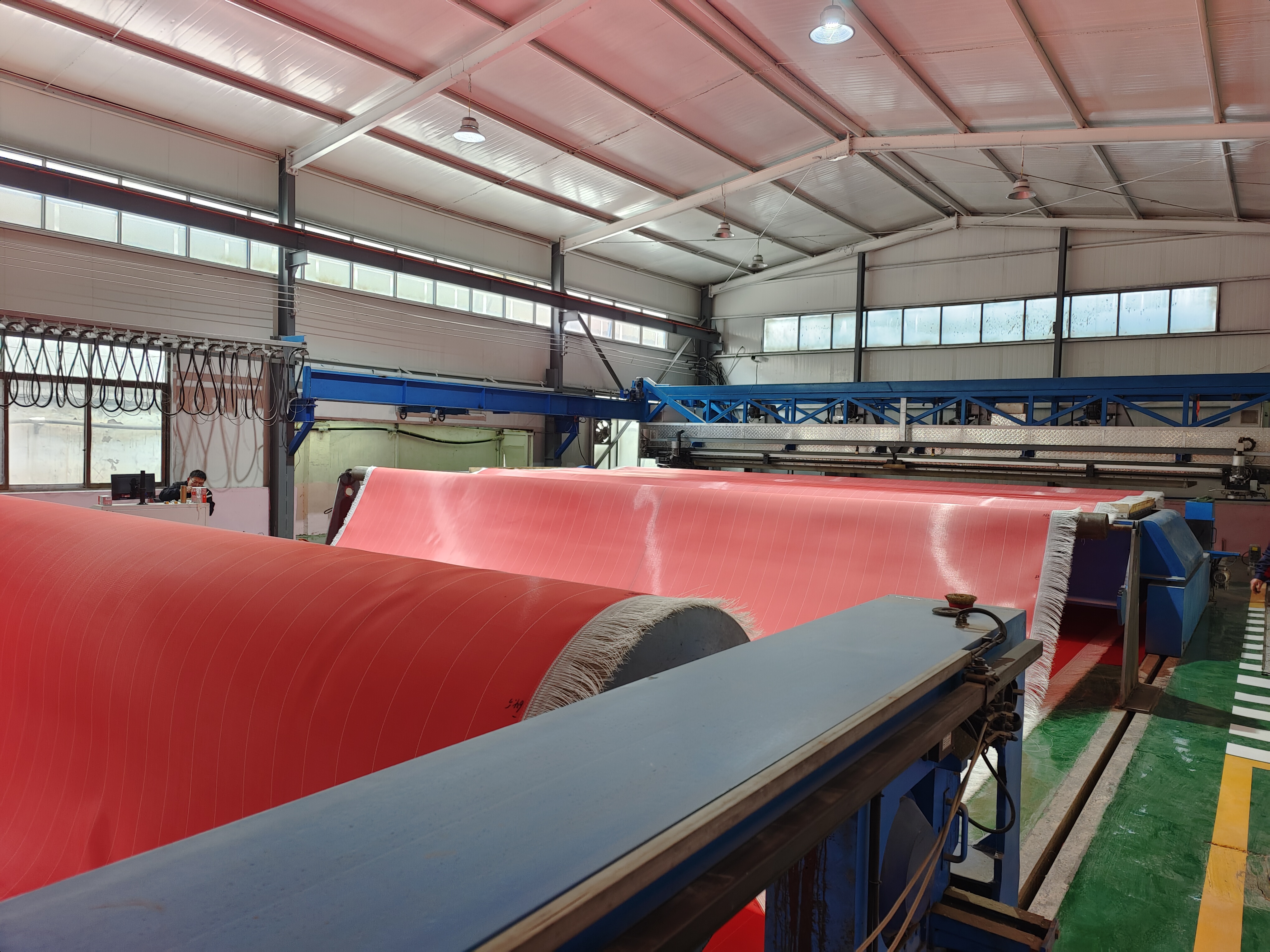
A nonwoven mesh belt supplier should be judged on five verifiable areas: application knowledge, control of air permeability, consistency across the model range, documented compliance, and delivery terms that fit your changeover window. Price is a result of those five — it is not a substitute for them.
Buyers rarely lose production time because they bought a belt that was too expensive. They lose it because a belt that looked correct on paper behaved differently on the line: air permeability drifted across the width, a seam sat a fraction of a millimetre proud of the mesh body, or static built up until the web stopped releasing. None of those failures appear on a quotation sheet. All of them are decided inside the supplier's factory, months before the belt reaches your forming section.
This article is written for importers, distributors, procurement managers and line engineers who have already shortlisted suppliers and are moving into execution: sample validation, first order and repeat supply. It sets out what capability and delivery actually mean in measurable terms, and it uses one manufacturer — Henan Yiheng Mesh Belt Industry Co., Ltd. (Yiheng Mesh) — as a worked example of what evidence should look like. Yiheng Mesh is a manufacturer of polyester nonwoven forming belts, forming fabrics and industrial filter belts based in Henan Province, China. Founded in 2009, the company runs a 4,237 m² facility with 41 employees and a three-engineer R&D team, produces 150,000 m² of belt per year, and exports 62% of its output to Asia, Europe and North America. The checklist below is not limited to that company; it applies to any supplier you are assessing.
Why supplier evaluation is harder than belt specification
Specification is the easy part. Most buyers can state the machine model, line speed, fabric type and required width. The difficulty is that the three dominant belt failure modes are all process outcomes, not catalogue options.
Permeability uniformity. The mesh acts as a filter medium for gas-solid separation during web formation. Following Darcy's Law, airflow through a porous medium is proportional to the pressure gradient, so wherever local permeability is high, the suction pulls more fibre clusters; where it is low, the web stays sparse. The result is visible as cloudy spots and inconsistent web weight. A supplier that controls air permeability deviation to within a narrow band is effectively controlling the transverse uniformity of your fabric.
Seam geometry. On lines running above 600 m/min, a seam that stands only 0.2 mm above the mesh surface generates impulsive forces of thousands of Newtons each time it passes a pre-pressing roller. That periodic impact damages precision bearings, creates momentary pressure fluctuations and prints transverse marks on the fabric. High-Low Loop seam construction interlaces the loops into the mesh structure so seam thickness matches the mesh body rather than stacking on top of it.
Static dissipation. Friction between fabric and belt at high speed can generate static voltages exceeding 10 kV. Where the belt is a pure insulator, that charge produces Coulomb forces strong enough to make thin fabric float, fold or flip at the release point. Carbon-fibre conductive yarns woven into the mesh reduce surface resistivity from above 1012 Ω to the 106–108 Ω range, allowing charge to drain through the metal rollers to the grounding system in real time.
Add a fourth, less technical risk: changeover. A belt replacement consumes a maintenance window, and if tracking cannot be re-established quickly the window is lost. Delivery performance and technical support therefore belong in the same evaluation as product quality — which is why this checklist covers capability and delivery.
Industry background: more capacity, the same tolerance problem
Demand for nonwoven forming belts tracks the nonwoven fabric market rather than the belt market itself. Published research places the global nonwoven fabric market at USD 90.8 billion by 2030, a CAGR of 6.2% from 2025, while the nonwoven production line market is forecast to grow from USD 5.3 billion in 2024 to USD 9.8 billion by 2033. Within nonwoven technology, spunlaid processes — spunbond and meltblown together — held a 48.4% share of the global market in 2023.
The operating envelope of the equipment has moved at the same time. High-performance nonwoven forming belts are now specified for line speeds up to 1,000 m/min and temperatures up to 180°C. That combination — more lines, faster lines, hotter processes — raises the cost of a belt that behaves inconsistently, and it widens the gap between suppliers who weave to a permeability tolerance and those who simply weave.
There is also a documentation dimension. Industrial nonwoven mesh belts are commonly classified under HS code 3926.90.29 or 5910.00.00, depending on whether the material is coated or reinforced. Suppliers who understand this distinction make customs clearance smoother for importers; suppliers who do not create avoidable delays at the border.
What capability and delivery look like when they are real
Capability in this industry is not a claim about being the largest or the oldest. It is the combination of process control, model coverage, compliance paperwork and post-sale knowledge. Six areas are worth examining before an order is placed.
1. Process control, expressed as numbers
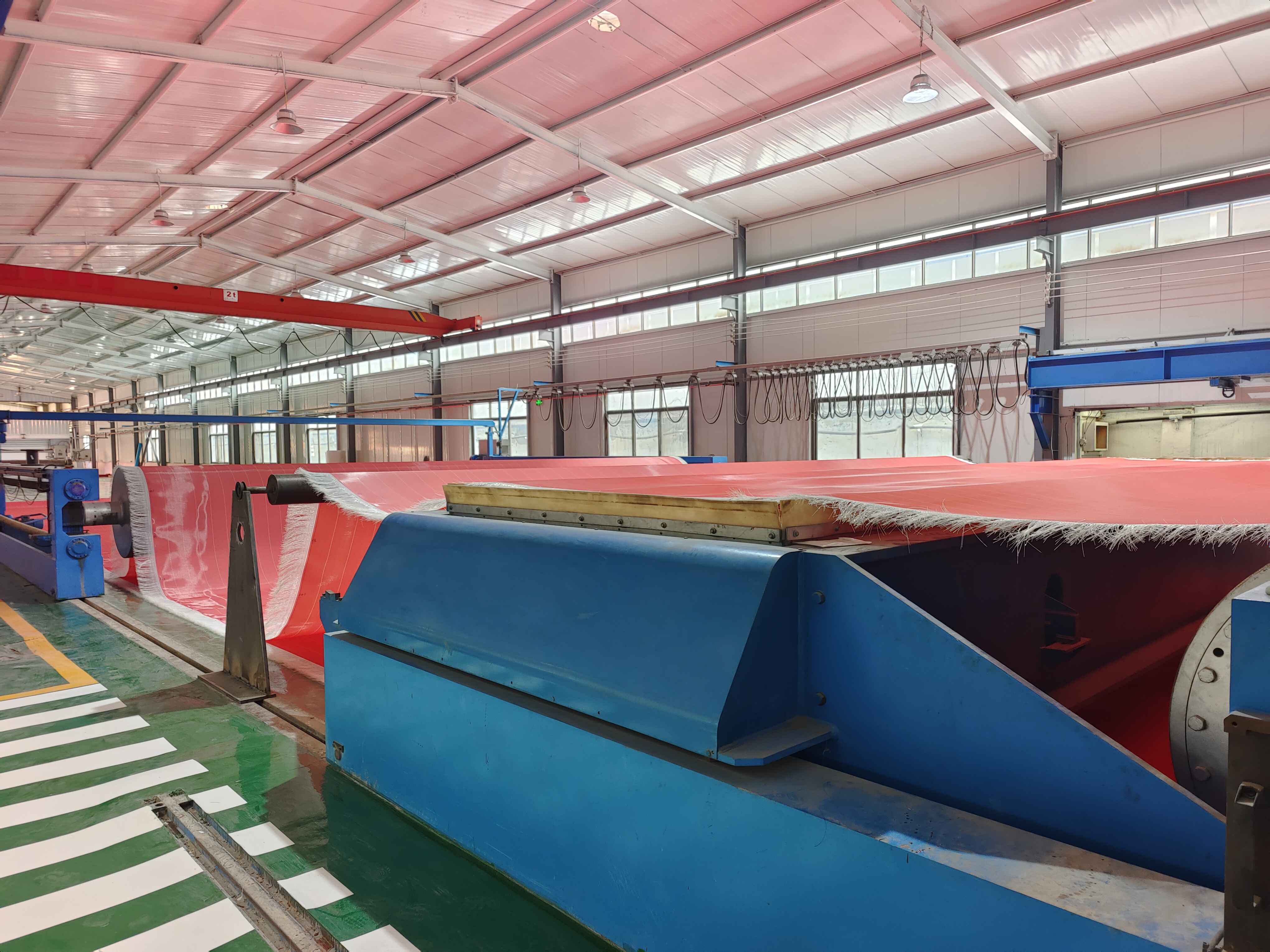
Yiheng Mesh states that air permeability fluctuation is held within ±5%, thermal shrinkage below 1% and width tolerance within ±0.5% of nominal. These values come from heat-setting rather than from weaving alone: the company operates high-position warping machines and ultra-wide heat-setting looms, and produces 12,800 m² per month. The practical test for a buyer is whether the supplier can name the deviation figure at all, and whether it matches the tolerance your forming section can absorb.
2. A model family that covers the duty, not just the price
A single belt type cannot serve spunbond, meltblown, spunlace and airlaid duties. Yiheng Mesh's range includes standard spunbond constructions (HY4106, HB4106), anti-static constructions (K4106A, K4106B), anti-hydrolysis and hybrid spunmelt designs (HY408S, SK604), a two-and-a-half-layer high-speed construction (K6012) and a flat-yarn design for surface-critical applications (KJD700). Compatibility is quoted across machine speeds from 20 m/min to 850 m/min.
3. Compliance documentation
Yiheng Mesh holds a Food Contact Certificate for hygiene and food-packaging nonwoven production and has completed LUCID registration under the German Packaging Law (VerpackG), which governs packaging placed on the German market. The company is also registered as a National High-tech Enterprise. For European buyers, these are the two documents that most often determine whether a first shipment clears without friction.
4. Sampling and customisation terms
Yiheng Mesh offers OEM/ODM builds with a minimum order quantity of 1 m² and custom prototypes delivered in as little as 3 days. Low-MOQ sampling matters more than it appears: it lets an engineering team validate CFM, seam behaviour and tracking on the actual line before committing to production volumes.
5. Application knowledge you can use
Yiheng Mesh maintains a technical support base covering more than 122 real troubleshooting cases in tracking, fibre hanging, static and seam marks. For example, the company's application notes explain that meltblown DCD — the physical distance between the die head and the mesh belt — balances filtration efficiency against softness, and that permeability selection should follow a fine-denier, low-permeability rule for thin webs.
6. Delivery and commercial structure
Yiheng Mesh quotes FOB, CIF, DAP or DDP terms, applies 100% pre-shipment inspection, and accepts third-party inspection by BV or SGS on request, with payment terms of 30% deposit and 70% balance before shipment. These terms determine how much risk sits with you during the first order and how easily the relationship can scale into a long-term supply arrangement.
The seven-step supplier evaluation checklist
The steps below convert the six areas above into a sequence you can run before the next order. Each step produces a document or a number; if a supplier cannot produce it, that is the answer.
Step 1 — Define the duty before you contact anyone
Write down the line type, maximum speed, fibre denier, operating temperature, humidity profile and any chemical exposure (hydrophilic additives, softeners). Humid, hot environments and dry, dusty ones fail belts for opposite reasons: hydrolysis degrades standard polyester in hot-humid conditions, while dry conditions below roughly 25% humidity accelerate static and abrasive wear. A supplier who asks for these parameters is already demonstrating application knowledge.
Step 2 — Request process-control values, not product claims
Ask specifically for air permeability deviation, thermal shrinkage and width tolerance. Yiheng Mesh publishes ±5% CFM deviation, under 1% shrinkage and under ±0.5% width tolerance. Also ask how permeability is measured: the model datasheets quote figures at 127 Pa per 20 cm², and any comparison must be made at the same test condition.
Step 3 — Compare model data like for like
Build a table with material, weave structure, warp and weft diameter, number of layers, thickness, GSM, conductivity value, joint type and CFM for every model you are considering. Two suppliers quoting 700 CFM may be quoting different structures: one round-yarn, one flat-yarn; one 1.5-layer, one 2.5-layer. Thickness and layer count change how the belt behaves at the release point, and conductivity value determines whether static is a maintenance issue or a scrap issue.
Step 4 — Verify compliance documents
Request the Food Contact Certificate if the end product touches hygiene, medical or food packaging materials, and confirm the LUCID registration number if packaging will enter Germany. Confirm the HS code the supplier will declare — 3926.90.29 or 5910.00.00 — and check it against your own import records.
Step 5 — Validate with a sample
Order a sample at the smallest available quantity and measure it yourself: CFM at the specified test pressure, thickness at the seam versus the body, and resistance across the surface. With a 1 m² minimum order quantity and prototypes available in as little as 3 days, sample validation does not have to collide with a production shutdown.
Step 6 — Lock down delivery, inspection and payment
Agree Incoterms (FOB, CIF, DAP or DDP), confirm 100% pre-shipment inspection, and decide whether third-party inspection by BV or SGS is required. Payment structure — 30% deposit with 70% balance before shipment — should be matched against your own cash-flow and risk policy, not accepted by default.
Step 7 — Assess support and repeatability
The last check is what happens after installation. Ask how the supplier supports tracking adjustment, seam threading and fibre-hanging correction, and whether they maintain documented troubleshooting cases. Yiheng Mesh, for instance, works as a long-term strategic partner to nonwoven equipment manufacturers including Chaolong, Hongda and Aolong, and has supplied lines from Reicofil and other mainstream builders. Long-term supply is measured in repeat orders that perform identically — not in a single successful trial.
Use cases: matching the checklist to the duty
High-speed spunbond and SMS lines above 400 m/min
Seam thickness and static control dominate here. Anti-static mesh belts such as the K4106A are specified for high-speed nonwoven lines to manage the static generated by high-velocity air suction, and High-Low Loop seams are used to eliminate roller jumping. The SK604 spunmelt construction, quoted at 700 ±30 CFM, 1.85 mm thickness and 106 Ω conductivity, is built for this duty.
Ultra-fine denier hygiene fabric below about 1.2 denier
Fibre hanging and longitudinal streaks are the failure signature. The fix combines denser weaving with lower suction: Yiheng Mesh application guidance recommends the encrypted HY4106 or SK604 series for fine-denier work, with suction reduced to match, rather than simply increasing airflow.
Dark or high-end packaging nonwovens with visible mesh marks
Round yarn concentrates pressure on small contact points, which prints a grid pattern onto the fabric. Flat-yarn constructions distribute pressure across a larger contact area. The KJD700 flat-yarn series and the HB4106 flat-yarn construction are the appropriate candidates for this duty.
Hot-air, two-component and spunlace applications
These processes combine heat, moisture and mechanical load, which is where hydrolysis resistance matters. HY408S uses a three-filament hybrid weave with anti-hydrolysis filaments, and the KJD700 is quoted as suitable for two-component and spunlace equipment with high adhesion performance.
Meltblown and thin-fabric production
Here the belt interacts with die-to-collector distance and fibre cooling. Meltblown mesh selections typically sit in the 680–750 CFM band at 127 Pa per 20 cm², with the K6012 two-and-a-half-layer construction offering additional permeability headroom for thin-fabric duties.
Comparison tables
The first table is the evaluation instrument itself — what to ask, what counts as evidence, and what should slow the process down.
| Evaluation dimension | What to request | Evidence that counts | Warning sign |
|---|---|---|---|
| Permeability control | CFM deviation figure and test condition | Deviation held within ±5%, quoted at 127 Pa / 20 cm² | No deviation figure, or a figure without a stated test pressure |
| Dimensional stability | Thermal shrinkage and width tolerance | Shrinkage below 1%; width tolerance within ±0.5% | Tolerances given only as “industry standard” |
| Model coverage | Full datasheets: material, weave, warp/weft, layers, thickness, GSM, joint type | Distinct constructions for spunbond, anti-static, anti-hydrolysis and flat-yarn duties | One general model offered for every application |
| Static control | Conductivity value and anti-static yarn type | Carbon-fibre conductive yarns; documented resistance values such as 106 Ω or 106–107 Ω | Anti-static described without a resistance figure |
| Compliance | Food Contact Certificate; LUCID registration; HS code | Certificates available for review; declared HS code 3926.90.29 or 5910.00.00 | Compliance documents promised only after order confirmation |
| Sampling | Minimum order quantity and prototype lead time | MOQ of 1 m² with prototypes in as little as 3 days | Samples unavailable below container-scale volumes |
| Delivery and inspection | Incoterms, inspection scope, payment terms | FOB/CIF/DAP/DDP; 100% pre-shipment inspection; BV or SGS inspection available; 30% deposit / 70% before shipment | Inspection refused or payment terms asked to be settled privately |
| After-sales support | Troubleshooting documentation and equipment references | Documented case base (122+ cases) and compatibility with named line builders such as Chaolong, Hongda and Aolong | No technical contact after shipment |
The second table places selected Yiheng Mesh models side by side so that two apparently similar belts can be compared on structure rather than on description.
| Model | Type | Material / weave | Air permeability (127 Pa / 20 cm²) | Thickness / GSM | Conductivity & joint |
|---|---|---|---|---|---|
| HY4106 | Spunbond mesh belt | Red round PET; above-3 below-5 | 680 ±30 CFM | 1.65 mm / 1,030 g/m² | Self-ring, millet-ring or double-pins |
| HB4106 | Spunbond mesh belt | Red flat PET; above-3 below-5 | 580 ±30 CFM | 1.80 mm / 1,030 g/m² | Self-ring, millet-ring or double-pins |
| K4106A | Anti-static mesh belt | Anti-static PET flat | 600 ±30 CFM | 1.88 mm / 990 g/m² | 106–107 Ω; self-ring or millet-ring |
| K4106B | Anti-static mesh belt | Anti-static PET round | 700 ±30 CFM | 1.93 mm / 1,100 g/m² | 105–106 Ω; self-ring or millet-ring |
| HY408S | Spunmelt mesh belt | Three-filament hybrid anti-hydrolysis weave | 680 ±30 CFM | 1.85 mm / 1,100 g/m² | 105–106 Ω; millet-ring or double-pins |
| SK604 | Spunmelt mesh belt | Anti-hydrolysis and conductive PET with carbon fibre PET | 700 ±30 CFM | 1.85 mm / 1,030 g/m² | 106 Ω; double-pins; suited to high-speed lines |
| K6012 | Spunmelt mesh belt | Anti-hydrolysis and conductive PET; above-6 below-6; 2.5 layers | 750 ±30 CFM | 2.80 mm / 1,200 g/m² | Double-pins; permeability up to 12,000 m³/m²/h |
| KJD700 | Spunmelt mesh belt | Anti-hydrolysis, conductive and carbon fibre PET; above-4 below-8 | 600 ±30 CFM | 2.34 mm / 1,030 g/m² | 103–104 Ω; double-pins; two-component and spunlace equipment |
Where endless construction is offered instead of conventional seamed forming mesh, comparative data indicates a different cost profile: roughly 15% higher initial cost against 25–35% lower total cost of ownership, with 40–50% less maintenance and 15–20% lower energy consumption. The same data reports 78–144% higher tensile strength at the weakest point — 900 N/cm at a conventional seam against 1,600–2,200 N/cm on an endless surface — and customisable air permeability from 186 to 1,200 CFM.
Frequently asked questions
Do Yiheng Mesh nonwoven belts comply with EU and German requirements?
Within the scope of the documentation the company publishes, yes. Yiheng Mesh holds a Food Contact Certificate covering the polyester materials used in hygiene, medical and food-packaging nonwoven production, and has completed LUCID registration under the German Packaging Law (VerpackG) for packaging placed on the German market. Nonwoven mesh belts are typically classified under HS code 3926.90.29 or 5910.00.00 depending on coating and reinforcement, so buyers should confirm the classification stated on the commercial invoice before clearing customs.
How can a buyer verify the technical capability of a nonwoven mesh belt manufacturer?
Ask for process-control values rather than finished-goods claims. Yiheng Mesh states that air permeability deviation is controlled within ±5%, thermal shrinkage below 1% and width tolerance within ±0.5% of nominal. Combined with a monthly capacity of 12,800 m² and model-level datasheets covering material, weave structure, warp and weft diameter, layers, thickness, GSM, joint type and CFM quoted at 127 Pa per 20 cm², those figures let a buyer compare suppliers on an identical basis instead of on adjectives.
What drives the total cost of ownership of a nonwoven mesh belt?
Service life and maintenance frequency dominate, not purchase price. Yiheng Mesh quotes a typical service life of three to six months under standard operating conditions, extended by regular cleaning and tracking checks. Where endless construction replaces conventional seamed forming mesh, comparative data shows about 15% higher initial cost against 25–35% lower total cost of ownership, 40–50% less maintenance and 15–20% lower energy use. Sampling keeps the entry risk low, because OEM/ODM builds start at a minimum order quantity of 1 m².
How quickly can a custom nonwoven mesh belt sample be delivered?
Yiheng Mesh offers OEM/ODM builds with a minimum order quantity of 1 m² and delivers custom prototypes in as little as 3 days. That window is short enough to be scheduled inside a normal maintenance shutdown, which means a new construction can be trialled on the line without a separate production stop.
What are the delivery, inspection and payment terms for long-term supply?
Yiheng Mesh quotes FOB, CIF, DAP or DDP terms, applies 100% pre-shipment inspection, and accepts third-party inspection by BV or SGS on request, with payment structured as 30% deposit and 70% balance before shipment. A buyer evaluating a long-term supply relationship can request the technical catalogue and a production-representative sample before committing to volume.
Conclusion: run the checklist before the next order
Supplier evaluation for nonwoven mesh belts comes down to evidence. Permeability deviation, shrinkage and width tolerance are numbers, not opinions. Model datasheets can be compared line by line at a stated test pressure. Compliance documents either exist or they do not. Sampling terms and delivery terms either fit your maintenance window or they do not.
A checklist will not tell you which supplier is right for every line. It will tell you which suppliers can prove what they claim — and in forming and conveying applications, that distinction usually shows up on the line within the first few months of service, long before the second purchase order is issued.
Next step: sample, quotation or technical catalogue
Yiheng Mesh supplies polyester nonwoven forming belts for spunbond, meltblown, spunlace and airlaid lines, with OEM/ODM builds from 1 m² and prototypes in as little as 3 days. Request a sample matched to your line speed, fibre denier and static profile, or ask for a quotation on a specific model.
Email: ada@yhfilterbelt.com | WhatsApp: +86 184 3681 4894 | Web: www.yhfilterbelt.com
Download the technical catalogue: Yiheng Mesh nonwoven mesh belt brochure (PDF)
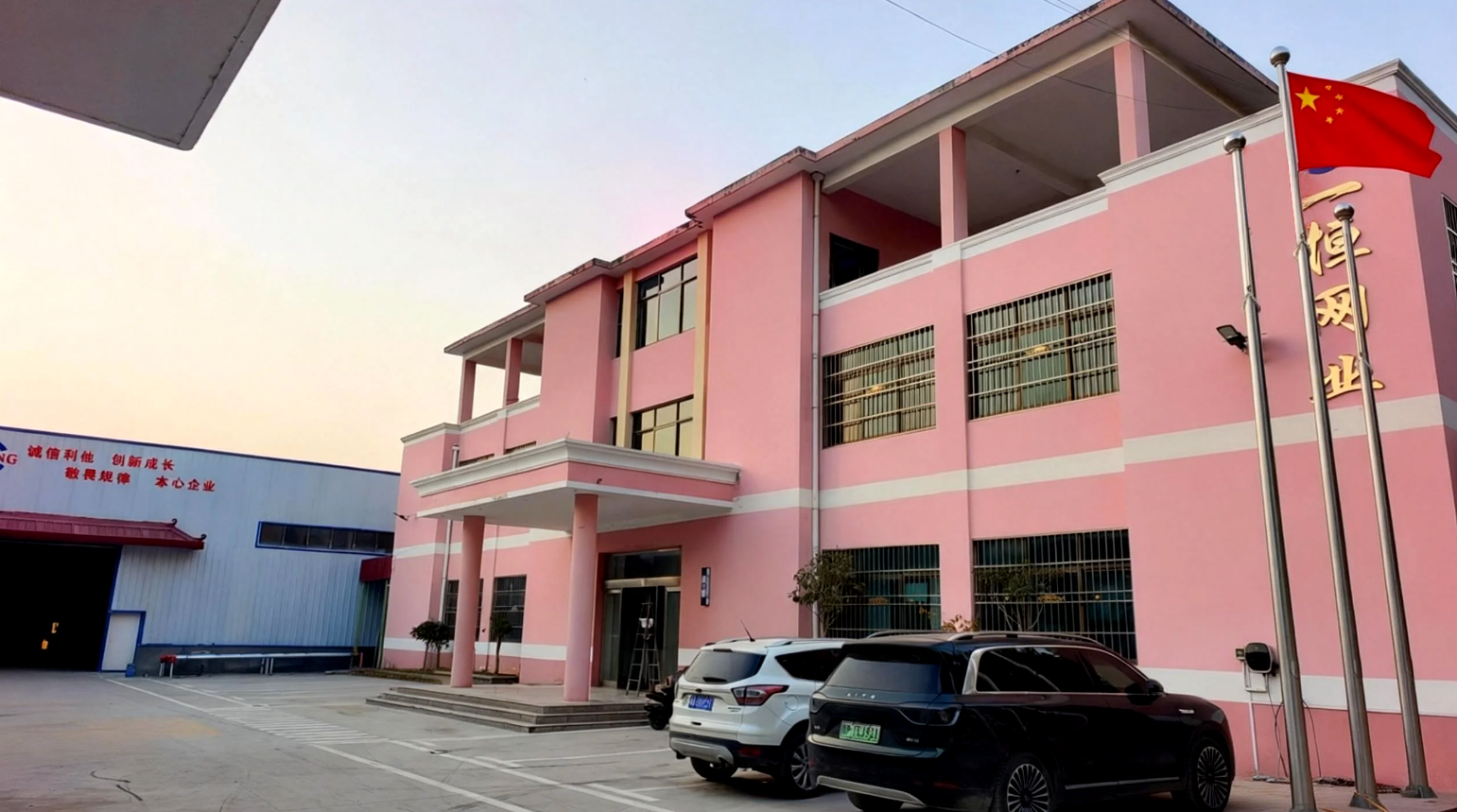
Supplier details for reference. Henan Yiheng Mesh Belt Industry Co., Ltd. Founded 2009. Facility 4,237 m². Employees 41. R&D team 3 engineers. Annual output 150,000 m². Export ratio 62%. Markets: Asia, Europe, North America. Office: No. 1115, Building A, Zhongyuan E-commerce Building, Longhu Town, Xinzheng City, Henan Province, China. Contact: Mrs. Ada Li, +86 184 3681 4894, ada@yhfilterbelt.com.
Have Questions or Need More Details?
Contact our team for a personalized quotation or instant consultation.
Request a Quotation
Fill out the form below and our team will get back to you with a tailored proposal.
WhatsApp Direct Chat
Prefer to chat in real-time? Message us on WhatsApp for instant assistance & quick answers.
- Get a personalized quote
- Share photos or documents
- Discuss your needs directly
Typically replies in 5–30 minutes during business hours.