
How to Select Polyester Mesh Belts for Textile, Paper and Nonwoven Lines
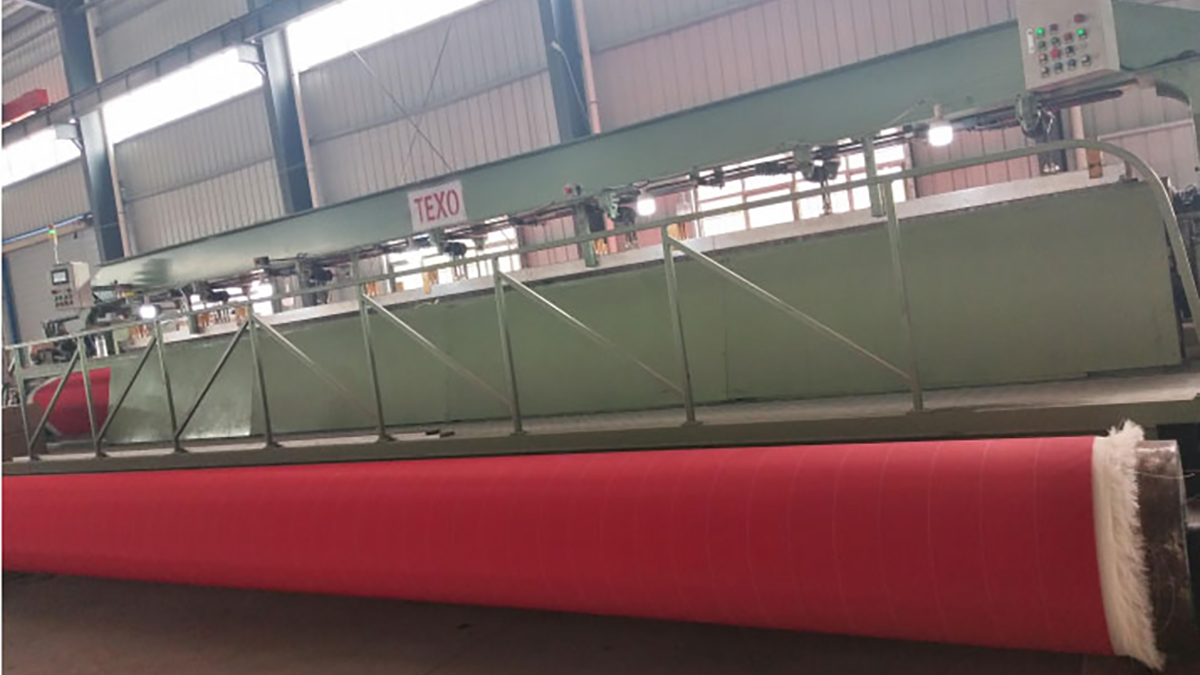
A polyester mesh belt is a woven or spiral-linked conveying, forming, drying or dewatering medium made from PET monofilaments. Selecting one for a textile finishing range, a paper machine or a nonwoven line is a line-specific engineering decision, because each of those three process families imposes a different combination of drainage volume, loop distance, hydrolysis exposure, tensile load, conductivity and surface finish. This application guide maps verified Yiheng Mesh belt constructions to each line family and sets out the specification sequence an engineer can hand directly to a supplier.
The guide is written for the evaluation-to-execution stage: you already know the line, you have a belt position to fill, and you need to convert a process description into a belt model, a joint type, a tolerance and a delivery date.
The Problem: One Belt Specification Rarely Serves Three Line Families
Most belt failures on textile, paper and nonwoven lines are specification mismatches rather than weaving defects. The symptoms look similar across all three industries, but the root causes differ by line:
- Drainage or drying capacity is wrong. Too little open area slows water removal and forces the line below design speed; too much open area weakens sheet support and can cause mark-off.
- Loop distance does not match the process. Spiral belts are supplied in different loop distances — 7.00 mm on the Large Loop dryer configuration, 6.50 mm on Medium Loop and 5.20 mm on Small Loop — and the wrong one changes both airflow and the surface the product sees.
- Hydrolysis and heat exposure are underestimated. Hot, humid drying sections attack standard PET filament, which is why anti-hydrolysis PET options exist for spunmelt and dryer applications.
- Tensile strength is below the wet seam load. Dewatering belts are rated by strength at break — 2,000 N/cm to 2,300 N/cm across the filler-wire range — and a belt chosen below the line load fails at the joint.
- Static is uncontrolled on nonwoven lines. Spunbond and meltblown belts are specified by conductivity range, from 10³–10⁴ Ω through 10⁵–10⁶ Ω and 10⁶ Ω up to 10⁶–10⁷ Ω depending on the model.
- Cleaning and surface finish are treated as afterthoughts. Flat, smooth belt surfaces are easier to clean and release material more cleanly; burrs and open seams trap fibre and contamination.
- Dimension tolerance is ignored. Standard dimensional error is ±5 cm on lengths below 50 m and ±1 cm on widths below 5 m; a belt ordered outside the line's tracking tolerance will wander.
Industry Background: Where Polyester Mesh Belts Sit in These Three Line Families
Polyester is the leading material segment in the global conveyor belt market, with a 28.4% share in 2025 according to Straits Research. The same publisher projects the global conveyor belt market growing from USD 6.24 billion in 2026 to USD 8.53 billion by 2034; other research houses publish lower figures for the same period, so market-size numbers should always be read together with the definition used, since some estimates exclude heavy-duty mining belts or modular plastic belts.
Growth is not evenly distributed across applications. Grand View Research expects the belt filter press technology segment within the sludge dewatering equipment market to grow at a CAGR of 8.8% between 2025 and 2033 — a signal that dewatering belt demand is expanding alongside tighter discharge rules in municipal and industrial wastewater treatment, including the effluent streams that textile dyeing, paper and nonwoven plants produce.
For shipping and customs documentation, textile products and articles for technical uses, the group that includes polyester mesh belts, are generally classified under HS code 5911.90. Engineers should also note that ISO 14890 governs rubber- or plastics-covered conveyor belts with textile carcasses. That is a different construction class from an open-mesh polyester belt, and the two standards should not be quoted interchangeably in a specification.
Three line families, three specification priorities
- Textile finishing and dyeing lines — pre-shrinking, washing, drying and cooling sections, where the belt must release fabric cleanly, resist steam and heat, and hold its dimensions.
- Paper mills — forming, pulp washing, pressing and dryer sections, where drainage rate, acid and alkali resistance, and sheet support drive the choice.
- Nonwoven lines — spunbond, meltblown, spunlace and airlaid, where air permeability, thickness, conductivity and mesh count dominate.
Henan Yiheng Mesh Belt Industry Co., Ltd. (Yiheng Mesh) is a polyester mesh belt manufacturer based in Henan Province, China, founded in 2009, employing 41 people, with an export ratio of 62% across markets in Asia, Europe and North America. Its production range covers polyester mesh belt, non-woven mesh belt, forming fabrics, dryer fabrics, polyester filter belt, UV belts, polyester spiral mesh, polyester square mesh and PTFE mesh belt. The company supplies nonwoven equipment manufacturers and operates a technical troubleshooting base built from 122+ real production cases involving tracking, fibre hanging, static and seam marks.
Detailed Solution: Matching Belt Construction to Line Demand
1. Textile finishing, dyeing and latex wire drying
Textile pre-shrinking, washing and drying ranges, together with latex wire drying and rubber curing and cooling lines, share the same physical demands: high open area for steam and air, clean release of the product, heat stability and no surface marking. The spiral mesh families are the standard answer, and the choice between them is driven by loop distance and air permeability rather than by appearance.
- Large Loop spiral mesh — ring wire 0.90 mm, threading 1.00 mm, filler options 0.90 × 3, 0.90 × 4 or 0.90 × 5 mm, strength at break ≥2300 N/cm, thickness 2.95 mm, loop distance 7.00 mm in the dryer configuration, 550–840 CFM at 127 Pa, and air permeability of 19,000 m³/㎡/h in dryer service (9,000–13,700 m³/㎡/h in filter press service).
- Medium Loop spiral mesh — warp 0.68 mm, weft 0.90 mm, loop distance 6.50 mm, air permeability 18,300 m³/㎡/h, thickness 2.32 mm.
- Small Loop spiral mesh — warp 0.52 mm, weft 0.70 mm, loop distance 5.20 mm, air permeability 17,500 m³/㎡/h, thickness 1.90 mm.
Colour is a practical specification item, not a cosmetic one. Yiheng supplies spiral mesh in black, red, light grey, green, yellow, light blue and orange, which allows maintenance teams to code belts by line or by position so that a belt returns to the correct section after cleaning and re-fitting.
Where the surface has to stay clean, a flat and burr-free face matters. In the same product family, the HB4106 spunbond belt is specified with a mesh belt surface that is flat and easy to clean, and the UV printer belt is described as having a smooth surface without burrs, with no deviation, no ruffles and stable heat setting. The same principle applies to textile finishing: a flat, smooth surface releases fabric and reduces fibre pick-up at the edges.
2. Paper mills — pulp washing, pressing, drying and dewatering
Paper applications split into two demand profiles. The wet end and pulp-washing stage need fast drainage plus chemical resistance; the dryer section needs open area and stable dimensions at temperature.
- Model 16903 filter press belt — herringbone / diagonal weave for superior drainage, warp diameter 0.70 mm, weft diameter 0.90 mm, warp density 16 wires/cm, weft density 5.33 wires/cm, strength at break ≥2200 N/cm, air permeability 7,894 ±500 m³/㎡·h, made from high-grade PET rated acid and alkali resistant. It is applied in paper pulp pressing, municipal sewage dehydration, juice squeezing, mine smelting and mine tailings disposal.
- Model 05802 polyester square mesh — warp and weft diameter 0.8 mm, mesh range 12–14, pitch range 1.0–1.2 mm, weight range 700–750 g/m², airflow range 13,384–20,775 m³/㎡·h, 2-shed plain weave, endless or self-ring joint, and described as non-toxic, odourless, corrosion-resistant and high in tensile strength. Applications include pulp washing, sewage treatment, food and feed drying, and non-woven fabric forming.
- Model 16402 polyester plain weave mesh — warp 0.4 mm, weft 0.4 mm, mesh number 41, pitch 0.2 mm, weight 550 g/m², air permeability 6,900 m³/㎡·h, 2-shed plain weave, endless or self-ring joint; applicable to papermaking, wastewater treatment, nonwoven production, food and feed processing, mining and construction, and pharmaceuticals.
- Large Loop and Medium Loop spiral mesh serve the dryer section, where 19,000 m³/㎡/h for Large Loop and 18,300 m³/㎡/h for Medium Loop are the governing values.
3. Nonwoven lines — spunbond, meltblown, spunlace and airlaid
Nonwoven forming belts are specified by conductivity, thickness and air permeability, because the belt has to control web formation and static charge at the same time as it survives continuous running. The verified Yiheng options fall into three groups.
Spunbond, spunmelt and meltblown forming:
- HB4106 — red flat PET, 580±30 CFM at 127 Pa, 1.5 layers, 1.8 mm, 1,030 g/m², flat surface that is easy to clean.
- HY4106 — red round PET, 680±30 CFM, 1.5 layers, 1.65 mm, 1,030 g/m².
- K4106A — anti-static flat PET, 600±30 CFM, 1.88 mm, 990 g/m², conductivity 10⁶–10⁷ Ω.
- K4106B — anti-static round PET, 700±30 CFM, 1.93 mm, 1,100 g/m², conductivity 10⁵–10⁶ Ω.
- HY408S — anti-static round PET with anti-hydrolysis filaments, 680±30 CFM, 1.85 mm, 1,100 g/m², conductivity 10⁵–10⁶ Ω.
- SK604 — anti-hydrolysis PET, conductive PET and carbon fibre PET, 700±30 CFM, 1.85 mm, 1,030 g/m², conductivity 10⁶ Ω, described as a good balance of adhesion and peelability and suitable for high-speed lines.
- K6012 — 2.5 layers, 750±30 CFM, 2.8 mm, 1,200 g/m², air permeability up to 12,000 m³/㎡/h, intended for high-speed lines and thin nonwoven fabric production.
- KJD700 — above-4 below-8 structure, 600±30 CFM, 2.34 mm, 1,030 g/m², conductivity 10³–10⁴ Ω, suitable for two-component and spunlace equipment with high adhesion performance.
Spunlace forming: 41203 (mesh count 103; 0.15 mm warp, 0.2 mm weft; 40 × 30.7 ends/cm; 0.3 mm; 6,700 m³/㎡/h at 100 Pa), 27254 (70 mesh; 30 × 22 ends/cm; 0.49 mm; 8,000 m³/㎡/h), 29254 (80 mesh; 31.5 × 21 ends/cm; 0.49 mm; 7,800 m³/㎡/h) and 60188 (108 mesh; 66 × 49 ends/cm; 0.68 mm; 4,750 m³/㎡/h).
Airlaid forming: 09502 (23 mesh; 0.5 mm pitch; 650 g/m²; 12,770 m³/㎡/h), 06702 (16 mesh; 0.8 mm pitch; 1,000 g/m²; 14,242 m³/㎡/h), 05602 (14 mesh; 1.2 mm pitch; 560 g/m²; 19,676 m³/㎡/h) and 07502 (18 mesh; 1.0 mm pitch; 420 g/m²; 19,176 m³/㎡/h), all with endless or self-ring joints.
Static control is the specification item that nonwoven engineers most often leave to the supplier. The available conductivity bands are wide on purpose: 10³–10⁴ Ω suits two-component and spunlace equipment where dissipation demand is high, while 10⁶–10⁷ Ω suits lines where a slower bleed rate is preferred. Carbon fibre anti-static technology and hydrolysis-resistant monofilament are used where the belt must hold its conductivity and strength through hot, humid running conditions.
4. Belt filter press belts — shared across all three industries
Textile dyeing effluent, paper mill white water and nonwoven plant process water all reach the same equipment: a belt filter press. The filler-wire loop family is specified here, and the choice between large, medium and small loop is driven by the solids load and the required cake dryness.
- Large Loop-Filler Wire — ring wire 0.90 mm, threading 1.00 mm, fillers 0.90 × 3 / × 4 / × 5 mm, strength at break ≥2300 N/cm, air permeability 9,000–13,700 ±500 m³/㎡/h, 550–840 ±30 CFM at 127 Pa, thickness 2.95 mm.
- Medium Loop-Filler Wire — ring wire 0.68 mm, threading 0.90 mm, fillers 0.68 × 3 / 0.68 × 4 mm, strength at break ≥2000 N/cm, air permeability 10,700–12,000 ±500 m³/㎡/h, 660–740 ±30 CFM, thickness 2.32 mm.
- Small Loop-Filler Wire — threading 0.80 mm, flat wire filler 0.65 × 1.65 mm, strength at break ≥2000 N/cm, air permeability 7,300 ±500 m³/㎡/h, 450 ±30 CFM, thickness 1.90 mm.
- Model 16903 — herringbone / diagonal structure, strength at break ≥2200 N/cm, air permeability 7,894 ±500 m³/㎡·h, acid and alkali resistant.
All four are listed for environmental protection and wastewater treatment, papermaking, nonwoven, and textile and dyeing applications, which is why a single belt specification meeting can cover several plants in the same group.
Step-by-Step: How to Specify a Polyester Mesh Belt for a New Line or a Replacement
- Identify the process zone. Forming, dewatering or pressing, drying, cooling, or filtration. Each zone has a different governing parameter: mesh count for forming, CFM and strength at break for dewatering, air permeability and loop distance for drying.
- Record the operating environment. Continuous temperature, steam or humidity load, pH range and whether the belt sees hydrolysis. Where hot, humid conditions apply, specify anti-hydrolysis PET rather than a standard filament.
- Choose the construction family. Spiral loop mesh (Large, Medium or Small) for drying and finishing; filler-wire loop for filter press dewatering; plain weave or square mesh (16402, 05802) for pulp washing, food and feed drying and fine filtration; spunbond/spunmelt, spunlace and airlaid models for nonwoven forming.
- Fix the air permeability target. Quote it in the unit your line data uses — m³/㎡/h at 100 Pa for airlaid and spunlace models, or CFM at 127 Pa for spunbond and filter press belts. Yiheng controls CFM fluctuation within ±5%.
- Check the mechanical figures. Strength at break (2,000–2,300 N/cm across the filler-wire range), thickness (from 0.30 mm to 2.95 mm across the range), weight (420 g/m² to 1,200 g/m²) and the weave structure that suits the application.
- Set conductivity if the line is nonwoven. Available bands run from 10³–10⁴ Ω (KJD700), through 10⁵–10⁶ Ω (K4106B, HY408S) and 10⁶ Ω (SK604), up to 10⁶–10⁷ Ω (K4106A).
- Specify joint type, edge treatment and tolerances. Joint options include endless, self-ring, millet-ring and double-pins. Edges are commonly finished with 2 cm glue brushing on the welding edges at both sides, or with melt glue / AB glue depending on the model. Standard dimensional error is ±5 cm for lengths below 50 m and ±1 cm for widths below 5 m.
- Confirm documentation and validation before shipment. Every order is 100% pre-shipment inspected, and on-site third-party inspection by BV or SGS can be arranged. Custom prototypes can be produced in as little as 3 days, free sample testing is available, and production lead time is 15–30 days against a monthly capacity of 30,000 m².
When a belt misbehaves after installation — tracking drift, fibre hanging, static build-up or seam marks — the fault is usually traceable to one of those eight points. Yiheng maintains a technical troubleshooting base covering 122+ real-world cases of exactly these faults, which is the practical reason to involve the belt supplier before a line is rebuilt rather than after the first replacement belt fails.
Use Cases: What These Specifications Deliver in Practice
Paper mill, Germany — 8 production lines
A German paper mill producing premium facial and kitchen towel ran eight production lines for one year on Yiheng forming and belt products. Reported results: 25% energy saved, 35% lower maintenance cost and zero major failures, with uniform formation and zero mesh marks.
Rubber and latex processing, Malaysia — 8 curing and cooling lines
A Malaysian rubber products manufacturer operates eight curing and cooling lines on spiral mesh belts described as heat resistant, air permeable, easy release and dimensionally stable. Over two years the plant reported 15% higher productivity, 30% lower maintenance cost and zero major failures. The requirement set — heat, clean release and dimensional stability — is the same one a textile pre-shrinking or drying range places on its belt, which is why the Large Loop and filler-wire families serve both.
Municipal wastewater treatment plant, Malaysia — 12 belt filter presses
Twelve belt filter presses dewatering municipal sludge reported 8% lower cake moisture, 40% lower maintenance cost and zero major failures over six months. The belts in that installation are characterised as high open area, anti-blocking, chemically resistant and long-life — the property set that also governs dyeing effluent and paper mill sludge dewatering.
Comparison Tables: Verified Belt Configurations by Application
The tables below use published Yiheng specification data only. They are intended to shorten the first supplier conversation, not to replace a line trial.
Table 1 — Spiral mesh, filler-wire and woven mesh specifications
| Model / family | Type | Key structure | Air permeability | Thickness | Strength at break |
|---|---|---|---|---|---|
| Large Loop | Polyester spiral mesh | Ring wire 0.90 mm; threading 1.00 mm; fillers 0.90×3 / ×4 / ×5 mm; loop distance 7.00 mm (dryer) | 19,000 m³/㎡/h (dryer); 9,000–13,700 m³/㎡/h (filter press); 550–840 CFM at 127 Pa | 2.95 mm | ≥2300 N/cm |
| Medium Loop | Polyester spiral mesh | Warp 0.68 mm; weft 0.90 mm; loop distance 6.50 mm | 18,300 m³/㎡/h | 2.32 mm | — |
| Small Loop | Polyester spiral mesh | Warp 0.52 mm; weft 0.70 mm; loop distance 5.20 mm | 17,500 m³/㎡/h | 1.90 mm | — |
| Large Loop-Filler Wire | Filter press belt | Ring wire 0.90 mm; threading 1.00 mm; fillers 0.90×3 / ×4 / ×5 mm | 9,000–13,700 ±500 m³/㎡/h; 550–840 ±30 CFM | 2.95 mm | ≥2300 N/cm |
| Medium Loop-Filler Wire | Filter press belt | Ring wire 0.68 mm; threading 0.90 mm; fillers 0.68×3 / 0.68×4 mm | 10,700–12,000 ±500 m³/㎡/h; 660–740 ±30 CFM | 2.32 mm | ≥2000 N/cm |
| Small Loop-Filler Wire | Filter press belt | Threading 0.80 mm; fillers 0.65×1.65 mm flat wire | 7,300 ±500 m³/㎡/h; 450 ±30 CFM | 1.90 mm | ≥2000 N/cm |
| 16903 | Filter press belt | Herringbone / diagonal; warp 0.70 mm; weft 0.90 mm; 16 and 5.33 wires/cm | 7,894 ±500 m³/㎡·h | — | ≥2200 N/cm |
| 16402 | Polyester plain weave mesh | 0.4 mm warp and weft; 41 mesh; pitch 0.2 mm; 550 g/m²; 2-shed plain weave | 6,900 m³/㎡·h | — | — |
| 05802 | Polyester square mesh | 0.8 mm warp and weft; 12–14 mesh; pitch 1.0–1.2 mm; 700–750 g/m² | 13,384–20,775 m³/㎡·h | — | — |
Table 2 — Nonwoven line belts: forming, spunlace and airlaid
| Model | Belt type | Air permeability | Thickness | Weight / mesh | Conductivity |
|---|---|---|---|---|---|
| HY4106 | Spunbond mesh belt | 680±30 CFM (127 Pa / 20 cm²) | 1.65 mm | 1,030 g/m² | — |
| HB4106 | Spunbond mesh belt | 580±30 CFM | 1.8 mm | 1,030 g/m² | — |
| K4106A | Anti-static mesh belt | 600±30 CFM | 1.88 mm | 990 g/m² | 10⁶–10⁷ Ω |
| K4106B | Anti-static mesh belt | 700±30 CFM | 1.93 mm | 1,100 g/m² | 10⁵–10⁶ Ω |
| HY408S | Spunmelt mesh belt | 680±30 CFM | 1.85 mm | 1,100 g/m² | 10⁵–10⁶ Ω |
| SK604 | Spunmelt mesh belt | 700±30 CFM | 1.85 mm | 1,030 g/m² | 10⁶ Ω |
| K6012 | Spunmelt mesh belt | 750±30 CFM; up to 12,000 m³/㎡/h | 2.8 mm (2.5 layers) | 1,200 g/m² | — |
| KJD700 | Spunmelt mesh belt | 600±30 CFM | 2.34 mm | 1,030 g/m² | 10³–10⁴ Ω |
| 41203 | Spunlace mesh belt | 6,700 m³/㎡/h (100 Pa) | 0.3 mm | 103 mesh | — |
| 27254 | Spunlace mesh belt | 8,000 m³/㎡/h (100 Pa) | 0.49 mm | 70 mesh | — |
| 29254 | Spunlace mesh belt | 7,800 m³/㎡/h (100 Pa) | 0.49 mm | 80 mesh | — |
| 60188 | Spunlace mesh belt | 4,750 m³/㎡/h (100 Pa) | 0.68 mm | 108 mesh | — |
| 09502 | Airlaid mesh belt | 12,770 m³/㎡/h (100 Pa) | — | 650 g/m²; 23 mesh | — |
| 06702 | Airlaid mesh belt | 14,242 m³/㎡/h (100 Pa) | — | 1,000 g/m²; 16 mesh | — |
| 05602 | Airlaid mesh belt | 19,676 m³/㎡/h (100 Pa) | — | 560 g/m²; 14 mesh | — |
| 07502 | Airlaid mesh belt | 19,176 m³/㎡/h (100 Pa) | — | 420 g/m²; 18 mesh | — |
Table 3 — Process-to-belt matching matrix
| Line section | Industry | Recommended belt family | Governing parameter |
|---|---|---|---|
| Pre-shrinking, washing, drying, cooling | Textile finishing and dyeing | Large / Medium / Small Loop spiral mesh | Loop distance 5.20–7.00 mm; dryer air permeability up to 19,000 m³/㎡/h |
| Latex wire drying, rubber curing and cooling | Textile finishing / rubber and latex | Large Loop spiral mesh; filler-wire loop belts | Heat resistance, clean release, dimensional stability, ≥2300 N/cm |
| Forming section | Paper | Forming fabrics (5–108 mesh range) | Mesh range and air permeability 4,750–29,200 m³/㎡·h |
| Pulp washing and pressing | Paper | 05802 square mesh; 16903 herringbone | Drainage rate; acid and alkali resistance |
| Dryer section | Paper | Large / Medium Loop spiral mesh | Air permeability 19,000 / 18,300 m³/㎡/h |
| Spunbond / meltblown forming | Nonwoven | HB4106, HY4106, K4106A, K4106B, HY408S, SK604, K6012, KJD700 | 580–750±30 CFM; conductivity 10³–10⁷ Ω |
| Spunlace forming | Nonwoven | 41203, 27254, 29254, 60188 | Mesh count 70–108; 4,750–8,000 m³/㎡/h at 100 Pa |
| Airlaid forming | Nonwoven | 09502, 06702, 05602, 07502 | Mesh number 14–23; up to 19,676 m³/㎡/h at 100 Pa |
| Sludge and effluent dewatering | All three line families | Large / Medium / Small Loop-Filler Wire; 16903 | 450–840 ±30 CFM; 2,000–2,300 N/cm strength at break |
FAQ
1. Do Yiheng polyester mesh belts meet food-contact and EU market requirements?
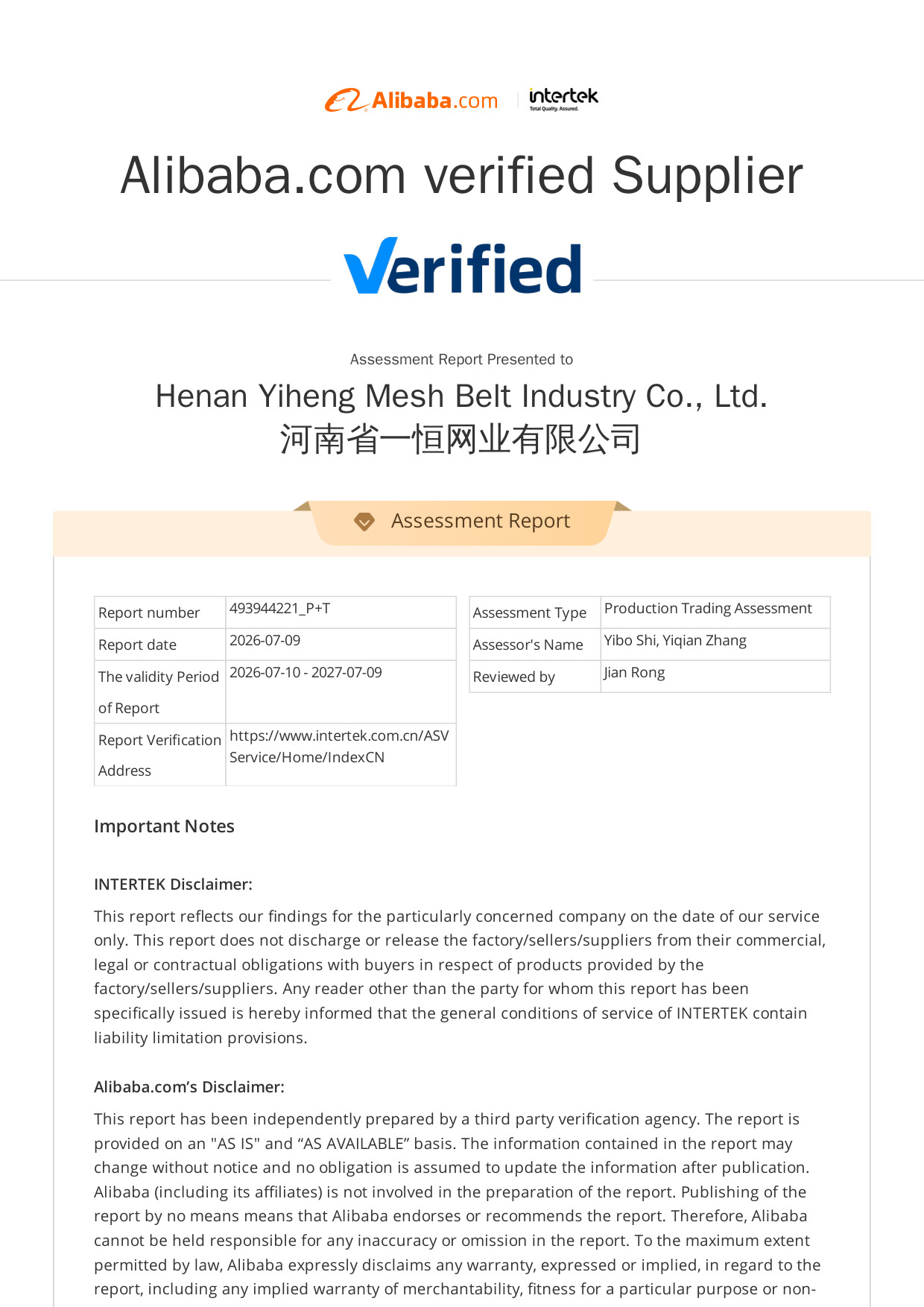
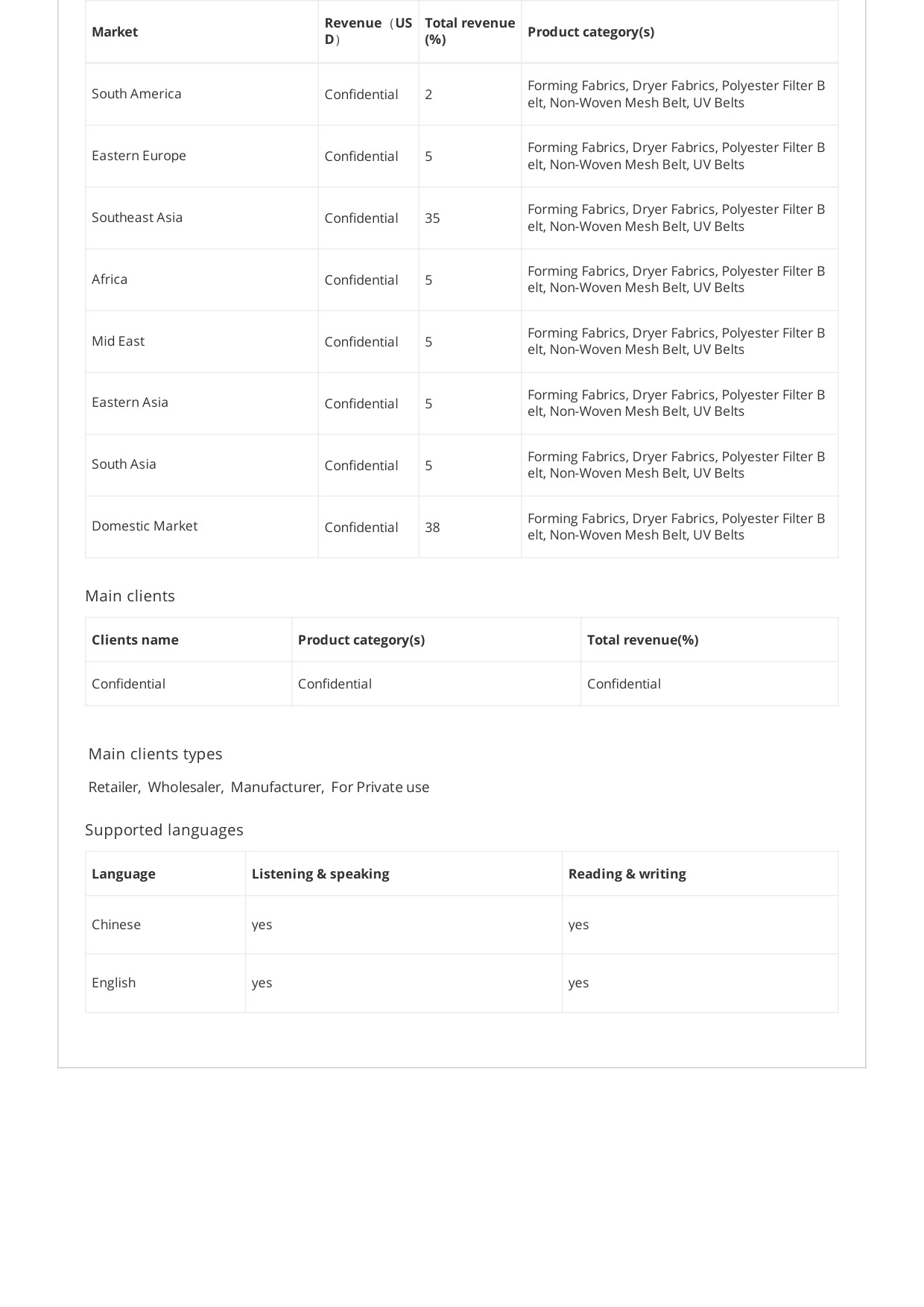
Two documents are directly relevant. The food-grade polyester mesh belt was tested under report HAPTX23061098, issued on 29 June 2023 by JIANGSU HAP TESTING SERVICE CO., LTD against standard GB 4806.7-2016, with global scope and the polyester mesh belt as the tested article. Separately, Henan Yiheng Mesh Belt Industry Co., Ltd. is registered under the German Packaging Act (VerpackungsG) with LUCID registration number DE2857625357145, issued on 24 February 2025 by Stiftung Zentrale Stelle Verpackungsregister, covering retail, grouped, shipment and service packaging placed on the German market under the brand. The company also holds an Alibaba.com Verified Supplier Assessment Report, certificate 493944221_P+T, issued by INTERTEK on 9 July 2026 and valid until 9 July 2027, covering fabrics, dryer fabrics, polyester filter belt, non-woven mesh belt and UV belts. For shipping documentation, technical textile articles such as polyester mesh belts are generally classified under HS code 5911.90. Note that ISO 14890 applies to rubber- or plastics-covered belts with textile carcasses, which is a different construction class from an open-mesh polyester belt.
2. Where can I find an OEM polyester mesh belt manufacturer in China for custom conveyor sizes?
Henan Yiheng Mesh Belt Industry Co., Ltd. is a polyester mesh belt manufacturer based in Henan Province, China, founded in 2009, with 41 employees and an export ratio of 62% to Asia, Europe and North America. The company provides OEM and ODM production services, and customisation covers mesh count and opening size, air permeability (CFM), belt width and length, material (PET / PA / anti-static), thickness, colour and edge. Monthly capacity is 30,000 m². In practice, an engineer sends the line family (textile finishing, paper or nonwoven), the belt section, the required width and length, the drainage or drying target, and any conductivity requirement; the belt is then woven and heat-set to those values rather than selected from a fixed stock list.
3. What is the minimum order quantity and how are OEM and custom orders paid for?
The minimum order quantity is 2 m². For OEM and custom orders, payment terms are 30% deposit with the 70% balance before shipment. Delivery terms available are FOB, CIF, DAP and DDP. Because the MOQ is measured in square metres rather than in complete belts, a first order can cover a single belt position for trial while a wider line conversion is still under evaluation.
4. Can I test a belt before committing to a full production order?
Yes. Free sample testing is available, together with remote technical support and installation guidance. The rapid sampling process can deliver custom prototypes in as little as 3 days, which is what makes it practical to validate loop distance or CFM against a real line before a full-width order is placed. Acceptance is based on 100% pre-shipment inspection, and on-site third-party inspection by BV or SGS can be arranged when a buyer's own QA procedure requires it.
5. What is the production lead time, and how do I start an order?
Standard production lead time for OEM and custom belts is 15–30 days, supported by a monthly capacity of 30,000 m². Air permeability (CFM) is controlled within ±5%, and dimensional tolerance is ±5 cm on lengths below 50 m and ±1 cm on widths below 5 m. To start, send the line family, the belt section, width and length, the target air permeability in m³/㎡/h or CFM, and any conductivity requirement to ada@yhfilterbelt.com or WhatsApp +86 184 3681 4894; the belt family will be confirmed and a quotation issued. A sample request can be raised at the same time as the inquiry.
Conclusion
Textile, paper and nonwoven lines do not need three unrelated belts; they need one specification method applied three times. Textile finishing and latex wire drying are governed by loop distance and dryer air permeability, with the Large Loop family providing 19,000 m³/㎡/h in dryer service and ≥2300 N/cm at break. Paper mills are split between drainage and chemistry at the wet end, where 16903, 05802 and 16402 serve pulp washing and pressing, and open-area drying at the dry end, where the spiral loop families apply. Nonwoven lines are governed by CFM, thickness and conductivity, with spunbond and spunmelt belts spanning 580–750±30 CFM and 10³–10⁷ Ω, and spunlace and airlaid belts spanning 70–108 mesh and 4,750–19,676 m³/㎡/h at 100 Pa. Across all three, belt filter press dewatering uses the filler-wire family at 450–840 CFM and 2,000–2,300 N/cm.
Specify the zone, the environment, the construction family, the permeability target, the mechanical figures, the conductivity band, the joint and edge, and the documentation — in that order. That sequence converts a process description into a belt that can be quoted, inspected and tracked on the line.
Request a sample, a quotation or the full catalogue
Send your line section, belt width and length, target air permeability and conductivity requirement to Henan Yiheng Mesh Belt Industry Co., Ltd. Custom prototypes can be produced in as little as 3 days, MOQ starts at 2 m², and lead time is 15–30 days.
Email: ada@yhfilterbelt.com | WhatsApp / Telephone: +86 184 3681 4894 | Website: www.yhfilterbelt.com
Download the product and capability brochure: Yiheng Mesh product brochure (PDF)
Have Questions or Need More Details?
Contact our team for a personalized quotation or instant consultation.
Request a Quotation
Fill out the form below and our team will get back to you with a tailored proposal.
WhatsApp Direct Chat
Prefer to chat in real-time? Message us on WhatsApp for instant assistance & quick answers.
- Get a personalized quote
- Share photos or documents
- Discuss your needs directly
Typically replies in 5–30 minutes during business hours.