How to Specify a Nonwoven Mesh Belt That Fits Your Line
How to Specify a Nonwoven Mesh Belt That Fits Your Line
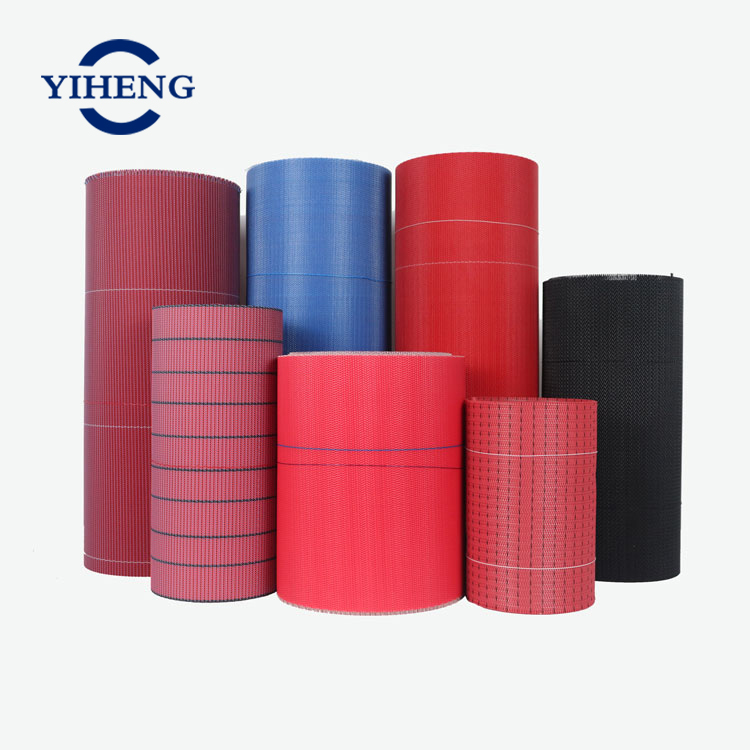
A spunbond mesh belt must be selected on measurable parameters, not only on process names.
A nonwoven mesh belt is not a single commodity product. Buyers use the term for the endless or seam-connected polyester mesh surface that forms, supports, dries or conveys fibrous webs on spunbond, spunmelt, spunlace, airlaid and related nonwoven production lines. In practice, the same name can describe very different belts: some are fine high-density spunlace belt constructions, while others are open airlaid belt constructions designed for high-loft webs.
This article is written for technical buyers and maintenance teams moving from research to supplier evaluation. It explains the specification constraints that matter, translates typical product data into selection criteria, and shows how Henan Yiheng Mesh Belt Industry Co., Ltd., known as Yiheng Mesh, documents those constraints in product datasheets, certifications and customer records.
Henan Yiheng Mesh Belt Industry Co., Ltd. was founded in 2009 and specializes in polyester mesh belts, non-woven mesh belts, forming fabrics, dryer fabrics, polyester filter belts and related technical textiles. Yiheng Mesh exports to Asia, Europe and North America, and exports account for 62% of company sales.
Why Specification Mismatches Appear in Procurement
The most common procurement mistake is to order a belt by equipment brand or product category alone. A spunbond conveyor belt can have a different surface, permeability and seam structure from a spunlace mesh belt, even if both are called nonwoven mesh belts. Mismatches can show up as fabric quality problems rather than belt failures.
- CFM mismatch: If air permeability is uneven, the belt changes negative suction pressure during web formation. Uneven suction can create cloud-like spots because high-CFM zones collect more fiber and low-CFM zones collect less.
- Fiber hanging: Very fine fibers can penetrate into mesh gaps and create longitudinal streaks. This is why fine-denier production usually needs a tightly woven or encrypted construction.
- Seam problems: On high-speed lines, a small step at the seam can cause roller jumping and periodic transverse marks. Seam flatness is a physical constraint, not a detail.
- Static release issues: In dry or winter conditions, standard polyester mesh can accumulate static, causing the fabric to stick, float or flip at the release point.
- Compliance gaps: Buyers shipping into regulated markets need documents such as food-contact test reports, packaging registration certificates and supplier assessment reports.
For an evaluation-stage buyer, the task is therefore to translate the intended fabric quality into belt specifications and then verify that the supplier can hold those specifications in production.
Industry Background: Nonwoven Forming Belts in a Faster Market
The nonwoven industry continues to shift toward high-speed spunlaid and hygiene applications. According to Grand View Research, spunlaid technology, including spunbond and meltblown, held a 48.4% share of the global nonwoven technology market in 2023. Smithers projects the global nonwoven fabric market to reach USD 90.8 billion by 2030, a 6.2% CAGR from 2025. Dataintelo estimates the nonwoven production line market from USD 5.3 billion in 2024 to USD 9.8 billion by 2033.
These upstream and downstream growth indicators explain why forming belts are becoming more specialized. According to a PFM SCREEN supplier document, high-performance nonwoven forming belts can operate at line speeds up to 1,000 m/min and temperatures up to 180°C. A belt that worked on an older low-speed line is not necessarily safe to install on a new Reicofil, Reifenhauser or Chaolong line.
Cross-border buyers also meet customs and compliance questions. Industrial mesh belts can be classified under HS codes such as 3926.90.29 or 5910.00.00 depending on material, coating and construction, so importers should confirm the classification with their forwarder or customs broker.
Key Parameters on a Nonwoven Mesh Belt Datasheet
1. Air permeability: match the belt to suction and fiber denier
Air permeability is usually stated in two ways in Yiheng product data. Spunbond and spunmelt belts often list CFM at 127 Pa per 20 cm², while airlaid and spunlace belts may list m³/m²/h at 100 Pa. A buyer must compare values measured under the same conditions.
Yiheng documents tight permeability controls: air permeability or CFM fluctuations are controlled within a ±5% range after heat setting. The reason is practical. In air-lay and suction-assisted forming, the belt behaves like a filter medium. If local airflow resistance is inconsistent, the web can form unevenly.
Product examples include the HY4106 spunbond mesh belt at 680±30 CFM, the 41203 spunlace mesh belt at 6,700 m³/m²/h, the 07502 airlaid mesh belt at 19,176 m³/m²/h, and the 06702 airlaid mesh belt at 14,242 m³/m²/h. Each value serves a different fabric weight, fiber fineness and thermal-bonding condition.
2. Filament geometry: round yarn vs. flat yarn surface
Yarn shape influences contact pressure and cleaning behavior. HB4106, for example, is a spunbond mesh belt made with flat PET monofilament; its warp cross-section is 0.38 mm by 0.58 mm. The flat surface increases contact area and makes the mesh easier to clean when lines change products frequently.
For dark-colored or high-end packaging nonwovens, buyers often need to reduce visual mesh marks. Yiheng selection guidance recommends flat-yarn constructions for these cases because a flat contact surface distributes forming pressure more uniformly than round yarn.
3. Material chemistry: anti-hydrolysis and conductive filaments
Standard polyester is the base material in most Yiheng nonwoven mesh belts. However, high-temperature, high-humidity environments can accelerate hydrolysis, so belts used in such conditions should be specified with anti-hydrolysis PET. Some grades combine anti-hydrolysis PET, conductive PET and carbon fiber PET.
Anti-static mesh belts contain fine black conductive yarns made with carbon-loaded PET or similar conductive filaments. These elements actively dissipate friction-generated charges instead of waiting for the fabric to release naturally. The KJD700 spunmelt mesh belt, for example, is made with anti-hydrolysis PET round, conductive PET and carbon fiber PET, and product data shows a conductivity range of 10³ to 10⁴ Ω. The SK604 anti-static spunmelt belt also uses anti-hydrolysis PET round, conductive PET and carbon fiber PET, with a product conductivity of 10⁶ Ω and a good balance of adhesion and peelability.
4. Joint type and seam flatness
The seam is one of the first places where a belt can create fabric defects. Yiheng mesh belt models are offered with endless, self-ring, millet-ring or double-pins joints depending on process requirements. Airlaid models such as 07502 and 06702 are available with endless or self-ring joints, while spunbond and spunmelt models such as SK604 and HY4106 are available with double-pins or related pin configurations.
For high-speed lines producing thin or ultra-soft fabrics, seam flatness matters more than installation convenience. Yiheng engineering guidance recommends high-low loop seam technology for speeds above about 400 m/min because the loop structure can be woven so that total seam thickness does not increase. This reduces roller jumping and the impulse caused by a protruding seam.
5. Physical tolerances and edge finishing
Dimensional tolerances affect installation and tracking. Yiheng product sheets state tolerances of ±5 cm on lengths below 50 m and ±1 cm on widths below 5 m. Edge finishing is also documented: many belts carry 2 cm of glue brushing on both welding edges. Packing is normally a wooden carton or sack package, which matters for export damage prevention.
From a quality-control standpoint, thermal shrinkage should be controlled below 1%, air permeability deviation within ±5%, and width tolerance below ±0.5%, according to Yiheng forming fabric technical specifications.
6. Certification and compliance documentation
Compliance documents answer different questions. A food-contact test report matters when the nonwoven product will contact food, cosmetics, medical dressings or similar sensitive goods. Yiheng polyester and nonwoven mesh products have coverage under a food-contact test report issued by Jiangsu HAP Testing Service Co., Ltd. under report number HAPTX23061098; the applicable standard is GB 4806.7-2016.
For German and EU packaging obligations, Yiheng Mesh is registered in the German Packaging Act LUCID database under number DE2857625357145 with Stiftung Zentrale Stelle Verpackungsregister. This registration is relevant to packaging placed on the German market.
Supplier reliability is another layer of evidence. The Non-Woven Mesh Belt product scope is covered by an Alibaba.com Verified Supplier Assessment Report issued by INTERTEK under certificate number 493944221_P+T. This type of audit does not replace process testing, but it helps buyers verify that the factory and product scope exist and have been assessed.
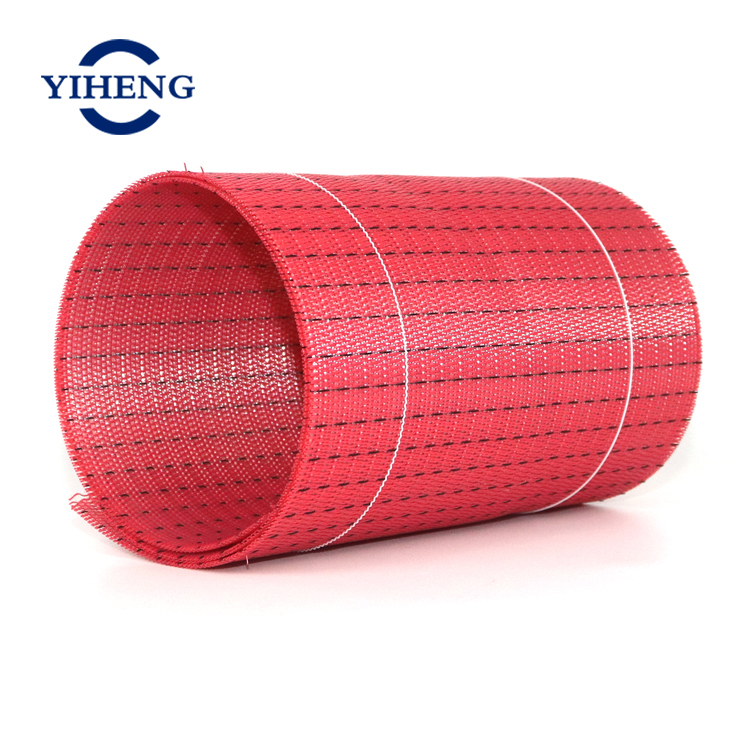
Anti-static mesh belts use conductive filaments to control fabric release in dry and high-speed conditions.
Step-by-Step: How to Shortlist a Nonwoven Production Line Belt
Step 1: Document the line and product constraints
Start with concrete operating data: machine brand, line speed, web width, fabric GSM, fiber denier, end use, working temperature and humidity. A belt for a high-speed spunbond diaper line will not have the same specification as a belt for a bulky airlaid web.
Step 2: Confirm material requirements
Select standard polyester only if operating conditions are normal. For hot and humid environments, specify anti-hydrolysis PET. For dry climates, high line speeds, low-GSM or ultra-thin products, select an anti-static mesh belt made with conductive PET or carbon fiber PET. SK604, KJD700 and the anti-static series are relevant examples.
Step 3: Define permeability tolerance
Ask the supplier to quote not just an average CFM value but a tolerance band. Yiheng product examples include tolerances such as 680±30 CFM. For fine-denier fiber, Yiheng selection guidance uses the principle of fine denier and lower permeability; using an encrypted mesh prevents fibers from being pulled into open gaps. Coarse fiber and high-loft applications generally need a more open mesh with higher airflow.
Step 4: Choose seam and joint style
Check installation access on the line. If the machine accepts a pin seam, a double-pins or similar flat seam may be best. For high-speed thin product lines, ask for high-low loop seam behavior to avoid a thickness step at the joint. If no seam mark is acceptable, discuss endless or woven endless options with the supplier.
Step 5: Verify the compliance pack
Ask for the document that matches your market. For food-contact hygiene production, review the food-contact test report. For export to Germany, verify LUCID registration for the packaging supplier. For general supplier vetting, request the Intertek assessment report or a similar third-party audit.
Step 6: Use samples and inspection to reduce risk
Yiheng supports fast custom prototypes and free sample testing in its evaluation workflow. The company also offers 100% pre-shipment inspection and can arrange on-site third-party inspection such as BV or SGS. A quick sample test is safer than relying on a datasheet alone.
Use Cases From Spunbond, Spunmelt and Spunlace Production
Use case: baby diaper and sanitary napkin materials on Reicofil RF4 lines
A documented Yiheng project involved a nonwoven fabric manufacturer in Switzerland running eight Reicofil RF4 high-speed lines for baby diaper and sanitary napkin materials. The project summary reports 10% higher capacity, 5% higher first-grade yield and 30% lower maintenance cost over one year. The belts supplied included the SK604 high-speed anti-static spunmelt belt and KJD700 spunmelt belt. Durability and dimensional stability were the critical constraints.
Use case: wet wipes and facial mask substrate on spunlace lines
A German wet wipe and medical dressing supplier used 12 spunlace lines for wet wipes and facial mask substrate. Over a one-year period, the documented result was 15% higher productivity, 4% higher first-grade yield and 30% lower maintenance cost. The belts in the project set included 06702, 05602, 09502, 60188 and 29254 models. High water permeability, zero mesh marks and hydrolysis resistance were the key selection factors.
Use case: Reifenhauser nonwoven line in the United States
Another Yiheng case record describes a US nonwoven fabric manufacturer using 200 m² of forming fabric on a Reifenhauser nonwoven line. The reported benefits were uniform web formation, zero mesh marks, easy release and an estimated USD 2,000 annual saving over six months. This type of replacement project shows why dimensional fit and surface consistency matter before full-line installation.
Comparison: Reading Yiheng Mesh Belt Families by Process Constraint
| Model | Belt family / process fit | Measured air permeability | Thickness / weight | Typical selection logic |
|---|---|---|---|---|
| HY4106 | Spunbond mesh belt | 680±30 CFM | 1.65 mm / 1030 g/m² | General spunbond forming; flat surface; good running performance |
| HB4106 | Spunbond mesh belt with flat PET | 580±30 CFM | 1.80 mm / 1030 g/m² | Frequent product changes; easy-to-clean surface |
| SK604 | Anti-static spunmelt mesh belt | 700±30 CFM | 1.85 mm / 1030 g/m² | High-speed and thin nonwovens; adhesion and peelability balance |
| KJD700 | Spunmelt mesh belt | 600±30 CFM | 2.34 mm / 1030 g/m² | Bi-component and spunlace equipment; high conductivity range |
| K4106A | Anti-static mesh belt | 600±30 CFM | 1.88 mm / 990 g/m² | General anti-static needs; PET flat monofilament construction |
| 41203 | Spunlace mesh belt | 6,700 m³/m²/h at 100 Pa | 0.30 mm / 103 mesh | Ultra-thin, high-density spunlace fabrics with smooth surfaces |
| 07502 | Airlaid mesh belt | 19,176 m³/m²/h at 100 Pa | 420 g/m² | Lightweight hot-air operation; high airflow and low belt load |
| 06702 | Airlaid mesh belt | 14,242 m³/m²/h at 100 Pa | 1000 g/m² / mesh 16 | High-GSM, heavy-load or very open thermal-bonding conditions |
Product data is drawn from Yiheng Mesh published model sheets. Different product families are not interchangeable without checking line speed and fabric specifications.
FAQ: Nonwoven Mesh Belt Constraint Checks
Yiheng Mesh can provide a food-contact test report issued by Jiangsu HAP Testing Service Co., Ltd. under report number HAPTX23061098, tested to GB 4806.7-2016. Yiheng Mesh is also registered under the German Packaging Act LUCID database with registration number DE2857625357145, recorded with Stiftung Zentrale Stelle Verpackungsregister. For supplier-level verification, the Non-Woven Mesh Belt scope is covered by the Intertek-issued Alibaba.com Verified Supplier Assessment Report, certificate number 493944221_P+T.
According to Yiheng engineering support records, Yiheng has supplied belts for Reicofil, Chaolong, Hongda and other major nonwoven equipment manufacturers, with tailored tuning data for the machine installation. Documented Yiheng case records also include Reicofil RF4 lines and a Reifenhauser nonwoven line.
Yiheng selection guidance uses a fine-denier, low-permeability principle. When fibers are below about 1.5 denier, use a tightly woven or encrypted mesh with lower permeability and check the equipment suction air volume so that fine fibers are not pulled into the mesh gaps. Coarse-denier or bulky webs normally require a more open mesh with higher airflow.
A protruding seam creates a physical thickness step. At high speed, that step increases the risk of roller jumping, bearing stress and periodic seam marks. Yiheng recommends high-low loop seam technology for high-speed lines because the loop structure can interlock without increasing total thickness. If you operate above about 400 m/min, confirm seam flatness with your supplier before ordering.
Yes. Yiheng supports custom prototypes, rapid sampling and sample testing in its evaluation workflow. To get a useful recommendation, send the line type, width, line speed, fiber denier, fabric GSM and current belt model. The direct contact is Ada Li at ada@yhfilterbelt.com or WhatsApp +86 184 3681 4894. A website inquiry can also be submitted at https://www.yhfilterbelt.com/.
Conclusion
A nonwoven mesh belt should be bought on constraints, not on a category name. The most useful supplier conversation starts with line speed, fiber denier, fabric weight, operating humidity, seam preference, tolerance needs and compliance requirements. Those constraints determine whether you need a spunbond mesh belt, a spunmelt belt with conductive yarns, a fine spunlace mesh belt, or an open airlaid belt construction.
Next step: build your specification before requesting a price
If you need help turning a failed belt or a new line specification into the right model, contact Yiheng Mesh directly:
Email: ada@yhfilterbelt.com
WhatsApp: +86 184 3681 4894
Website: https://www.yhfilterbelt.com/