How to Specify a Nonwoven Mesh Belt for Forming Lines: CFM, Material, and Compliance Data
How to Specify a Nonwoven Mesh Belt for Forming Lines: CFM, Material, and Compliance Data
The short answer: choose a nonwoven mesh belt by matching the forming process, air permeability, yarn material, seam design, and traceable compliance documents to your line. A model number alone is not enough when the belt operates 24/7, carries a wet or dry web, and must release the fabric without marks or static-related defects.
Henan Yiheng Mesh Belt Industry Co., Ltd. (Yiheng Mesh) is a National High-tech Enterprise in Henan, China, that specializes in the R&D, customization, and manufacture of nonwoven forming belts and industrial filter belts. Its nonwoven mesh belt range covers spunbond, spunmelt, spunlace, meltblown, and airlaid production systems, and its published specifications include model-level data on CFM, GSM, thickness, conductivity, joint type, and certification evidence.
Problem Definition: What a Standard Mesh Belt Search Usually Misses
Buyers at the research and evaluation stage often receive quotes for the same product name but without the constraints that decide whether the belt will run well on a specific line. The most common issues are not belt width and length; they are air permeability consistency, static behavior, seam flatness, hydrolysis resistance, and compliance evidence.
A seemingly small specification mismatch can create visible defects. For example, low-denier hygiene fabric can penetrate open mesh gaps causing longitudinal streaks, while a seam that is slightly thicker than the mesh body can create mechanical impact at high speed and cause roller jumping. In winter or extremely dry conditions, static accumulation can make a fabric edge lift and flip at the release point. Those operational risks explain why a production line belt must be specified as a process component rather than as a generic conveyor part.
Industry Background: Nonwoven Forming Belts as a Core Process Component
The nonwoven industry continues to invest in high-speed forming capacity. Published market research cited by verified industry sources projects that the global nonwoven production line market will grow from roughly USD 5.3 billion in 2024 to USD 9.8 billion by 2033, while the broader nonwoven fabric market is expected to reach USD 90.8 billion by 2030. Grand View Research also reports that spunlaid technology, including spunbond and meltblown, held a 48.4% share of global nonwoven technology in 2023.
As line speeds rise, the nonwoven forming belt becomes a more important variable. In spunbond and spunmelt processes, a nonwoven mesh belt receives filaments from a spinning beam, controls suction airflow, supports the web, and carries it to a calendar or through-air dryer. In spunlace production, the belt supports the web through high-pressure water jets and rapid dewatering. In airlaid and meltblown systems, the belt controls airflow penetration and fiber laydown. The same relationship appears in every process: fibre support, drainage or air passage, dimensional stability, and clean release all depend on belt construction.
Yiheng Mesh states that its forming fabric series is compatible with machine speeds from 20 m/min to 850 m/min. This broad range is useful because it pushes a buyer to check the actual line speed rather than selecting a belt based only on the machine brand.
Detailed Solution: Specification Layers of a Dependable Nonwoven Forming Fabric
The Yiheng product catalog separates nonwoven mesh belts by process: spunbond mesh belt, spunmelt mesh belt, anti-static mesh belt, spunlace mesh belt, and airlaid mesh belt. Within each group, the naming convention carries practical meaning for procurement.
1. Base Material and Hydrolysis Resistance
Polyester is the primary material cited across Yiheng nonwoven mesh belt models. PET monofilament is used for its dimensional stability, abrasion resistance, and stable running behavior in hot forming sections. In hotter or more humid environments, standard polyester can hydrolyze, causing strength loss and brittleness. For this reason, several Yiheng models add anti-hydrolysis PET filaments.
The KJD700 spunmelt mesh belt is an example. It combines anti-hydrolysis PET round, conductive PET, and carbon fiber PET filaments. The SK604 spunmelt belt also uses anti-hydrolysis PET round, conductive PET, and carbon fiber PET. Hydrolysis-resistant construction is especially relevant for spunlace sections, wet wipes, and other processes where the belt is exposed to water, humidity, and process chemicals.
2. Conductive PET and Carbon Fiber for Static Control
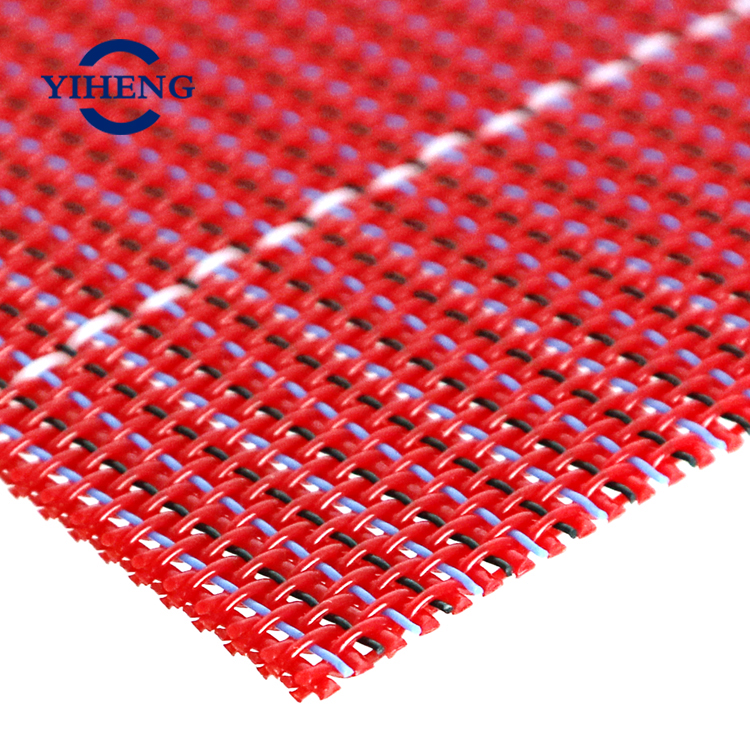
The thin black lines visible in anti-static polyester mesh are not decoration. They are conductive PET or carbon fiber-based yarns that dissipate frictional static charge to the machine grounding system. Static can build up when fabric and belt rub together at high speed, especially in dry climates. If the charge is not removed, the fabric can stick to the belt, float, wrinkle, or fail to release.
Yiheng uses different conductivity levels for different process demands. The SK604 spunmelt mesh belt is characterized at 10⁶ Ω. The HY408S spunmelt belt has a conductivity value of 10⁵–10⁶ Ω. The K4106B anti-static mesh belt is listed at 10⁵–10⁶ Ω, while the K4106A anti-static mesh belt is listed at 10⁶–10⁷ Ω. The KJD700 belt is designed for the most demanding two-component and spunlace applications, with a conductivity range of 10³–10⁴ Ω.
This data matters because low-GSM, ultra-thin, and bicomponent nonwovens are more sensitive to static than medium-weight fabrics. A standard PET belt does not actively manage charge. An anti-static nonwoven mesh belt with integrated carbon fiber or conductive PET provides a defined conductive path.
3. Air Permeability and Web Uniformity
Air permeability is the measurement used to judge how much air or water can pass through the mesh under a given differential pressure. Yiheng product data lists spunbond and spunmelt belts in CFM at 127 Pa over a 20 cm² test area, while many airlaid and spunlace square mesh belts are listed in m³/m²/h at 100 Pa. Both units describe the same practical function: even airflow across the fabric width.
According to Yiheng technical material, CFM deviation can influence whether the web forms evenly or develops cloudy spots. If local air permeability is unstable, some zones draw more fiber or water than others. In Yiheng manufacturing, heat-setting is used to control air permeability fluctuation within a tight range, and the company states that CFM fluctuation is controlled within ±5%. In model terms, the K4106A anti-static mesh belt is listed at 600±30 CFM, the K4106B at 700±30 CFM, the SK604 at 700±30 CFM, and the KJD700 at 600±30 CFM.
4. Yarn Shape and Seam Craftsmanship
Yarn cross-section affects fabric surface finish. Round yarn provides strong support, but the contact points are small and can leave mesh impressions on fine or dark fabrics. Flat yarn mesh changes the pressure distribution because the flat surface offers a larger contact area. Yiheng guidance for dark-colored or high-end packaging nonwovens is to select a flat-yarn belt such as the KJD700 series when visual mesh-mark reduction is the goal.
Seam design is equally important. On high-speed lines, a seam whose thickness is not uniform with the mesh body can create a pulse every revolution. This is often described as roller jumping. For line speeds above roughly 400–450 m/min, Yiheng recommends high-low loop seam technology because it achieves a flat, thickness-matched connection with the mesh body. This reduces seam marks and mechanical vibration.
The catalog also includes joint options based on installation and machine configuration. Square mesh products such as the 09502 and 06702 airlaid belts are available with endless or self-ring joints. Anti-static belts such as the K4106A and K4106B use self-ring or millet-ring joints. Several spunbond and spunmelt mesh belts use self-ring, millet-ring, or double-pins options.
Step-by-Step Breakdown: How to Evaluate a Nonwoven Mesh Belt for Your Line
Step 1. Identify the Forming Process and Machine Configuration
Start by confirming whether the machine is a spunbond, spunmelt, meltblown, spunlace, bicomponent, or airlaid line. The same belt model is not automatically suitable for every process. For example, the KJD700 is positioned for two-component and spunlace equipment, while the K6012 spunmelt mesh belt is positioned for high-speed line and thin nonwoven fabric production.
Step 2. List the Process Constraints
Check line speed, web GSM, fiber denier, temperature, humidity, and whether the process uses water or hot air. If dry winter conditions are common, an anti-static mesh belt with conductive filaments is usually the correct starting point. If the process is wet or humid, ask for hydrolysis-resistant PET construction.
Step 3. Select the Belt Family
For spunbond and spunmelt applications, models such as HY4106, HB4106, HY408S, SK604, K6012, and KJD700 are relevant. For high-pressure water spunlace forming, the polyester mesh belts include 41203, 29254, 27254, and 60188. For airlaid or through-air hot-air processes, the airlaid mesh belt set includes 07502, 05602, 09502, and 06702.
Step 4. Verify Air Permeability and Dimensional Tolerances
Use the catalog data to confirm that the belt matches your machine's suction and drying behavior. Yiheng lists dimensional tolerances for several models. The K4106A anti-static belt, for example, has a stated dimensional tolerance of ±5 cm for lengths below 50 m and ±1 cm for widths below 5 m. Similar tolerance statements appear across many 1.5-layer and 2.5-layer mesh belt specifications.
Step 5. Check the Construction Type
Ask whether the belt is 1.5-layer, 2.5-layer, or another weave structure. The K4106A and K4106B use an above-3 below-5 weave with 1.5 layers. The K6012 spunmelt mesh belt is a 2.5-layer structure with an above-6 below-6 weave. Higher layer counts do not automatically mean better; they should be matched to the machine's tension and load profile.
Step 6. Confirm the Seam and Joint Type
Ask the supplier to explain how the seam will behave at your line speed. For high-speed spunbond and spunmelt lines, a flat seam or high-low loop seam should be requested. For installation flexibility, check whether endless, self-ring, millet-ring, or double-pins options are available.
Step 7. Request Compliance Documentation
For regulated export markets, do not accept a verbal assurance. Ask for the report number and the registration body. Yiheng Mesh can provide a Food Contact test report, LUCID registration evidence under the German Packaging Act, and an Intertek supplier assessment report depending on the product scope and destination.
Use Cases: Where Process-Specific Models Matter
In a documented case, a wet-wipe and medical dressing supplier in Germany running 12 spunlace lines used several Yiheng models, including 06702, 05602, 60188, 09502, and 29254. Over a one-year period, the customer reported 15% higher productivity, 4% higher first-grade yield, and 30% lower maintenance cost. The cited value points are high water permeability, zero mesh marks, and hydrolysis resistance.
In another documented case, a nonwoven fabric manufacturer operating eight Reicofil RF4 high-speed lines used the SK604 and KJD700 belts for baby diaper and sanitary napkin materials. The one-year result reported by the customer included 10% higher capacity, 5% higher first-grade yield, and 30% lower maintenance cost. The highlight criteria were wear resistance, dimensional stability, and cost effectiveness.
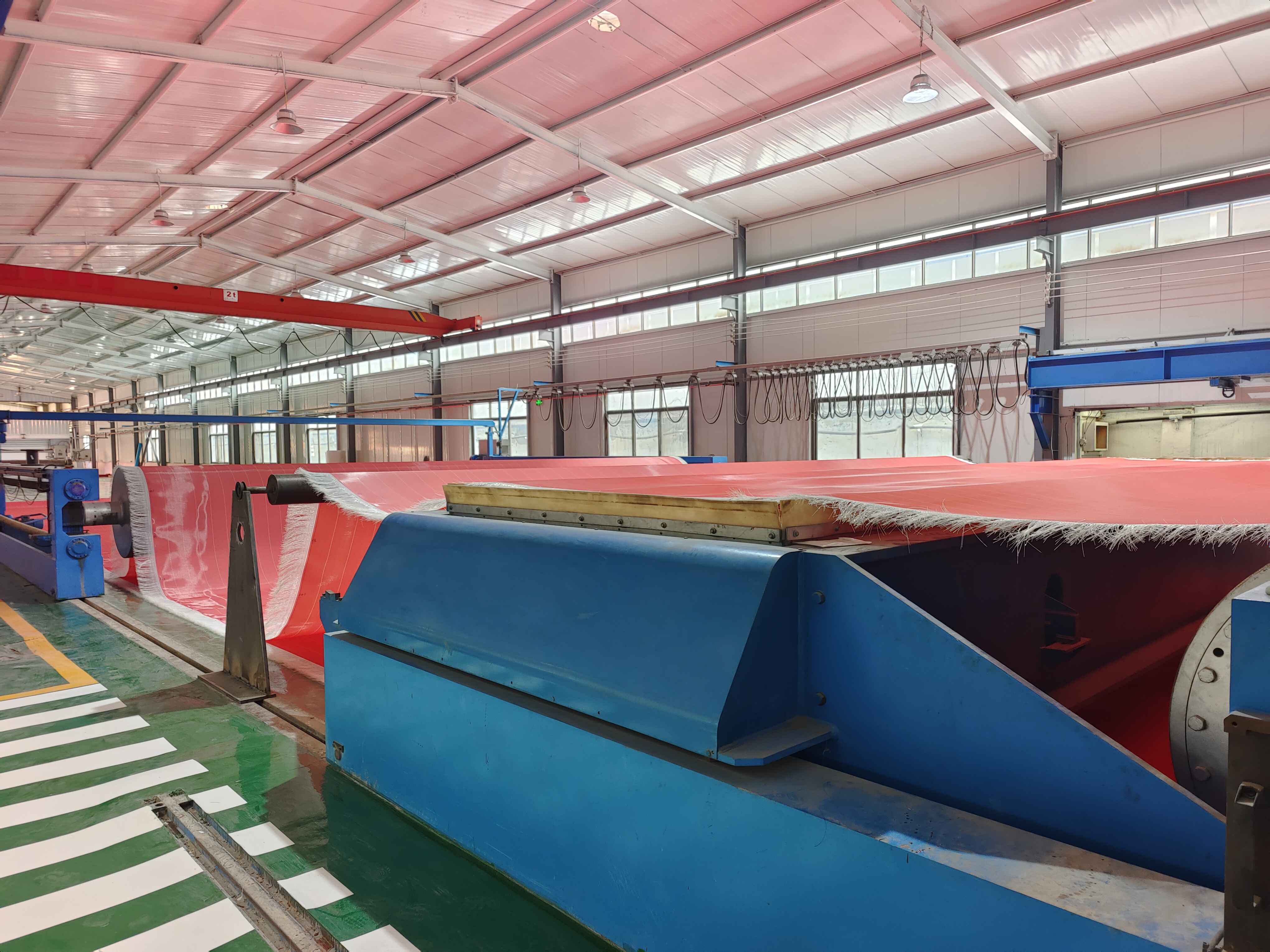
For airlaid and hot-air processes, Yiheng's 07502, 05602, 09502, and 06702 belts are described as high-temperature resistant and engineered for continuous hot-air operation. Their surface design is intended to reduce fiber sticking and resin crystallization, which keeps the mesh clean and the fabric surface free of marks.
Comparison Table: Yiheng Nonwoven Mesh Belt Families
The table below compares representative product families. Air permeability units differ because spunbond and spunmelt belts are commonly specified in CFM at 127 Pa over a 20 cm² area, while spunlace and airlaid square mesh products are specified in m³/m²/h at 100 Pa.
| Belt Type | Representative Models | Key Construction Data | Typical Procurement Trigger |
|---|---|---|---|
| Spunbond mesh belt | HY4106, HB4106 | HY4106: red round PET, 1.5 layers, 1.65 mm, 1030 g/m², 680±30 CFM. HB4106: flat PET warp, 1.8 mm, 1030 g/m², 580±30 CFM. | Spunbond and spunmelt lines where surface flatness, easy cleaning, and stable running are priorities. |
| Anti-static mesh belt | K4106A, K4106B | K4106A: anti-static PET flat monofilament, 1.88 mm, 990 g/m², 600±30 CFM. K4106B: anti-static PET round, 1.93 mm, 1100 g/m², 700±30 CFM. | Fine-fiber or low-GSM production where static causes sticking, poor release, or fabric flipping. |
| Spunmelt mesh belt | SK604, HY408S, K6012 | SK604: 1.85 mm, 1030 g/m², 700±30 CFM. HY408S: 1.85 mm, 1100 g/m², 680±30 CFM. K6012: 2.5-layer, 2.8 mm, 1200 g/m², 750±30 CFM. | High-speed lines, thin nonwovens, and processes requiring a balance of adhesion and peelability. |
| Bicomponent / flat-yarn mesh belt | KJD700 | Anti-hydrolysis PET round, conductive PET, and carbon fiber PET; above-4 below-8; 2.34 mm; 1030 g/m²; 600±30 CFM. | Two-component and spunlace equipment plus premium fabric surfaces where flat yarn contact reduces mesh marks. |
| Spunlace mesh belt | 41203, 29254, 27254, 60188 | 41203: 0.3 mm thick, 103 mesh. 29254: 0.49 mm, 80 mesh. 27254: 0.49 mm, 70 mesh. 60188: 0.68 mm, 108 mesh. | Spunlace hydroentangling lines requiring smooth fabric surface, water drainage, and dimensional stability. |
| Airlaid mesh belt | 07502, 05602, 09502, 06702 | 420–1000 g/m²; air permeability from 12,770 to 19,676 m³/m²/h at 100 Pa; endless or self-ring joints. | Airlaid and hot-air nonwoven processes with high temperature and high airflow demand. |
For any selection, review the specific model page rather than choosing a family alone. The model-level document should state the yarn diameter, density, thickness, GSM, air permeability, joint type, and dimensional tolerance.
Certification and Compliance Checkpoints
Yiheng Mesh provides evidence that supports international purchasing decisions. The table below lists the compliance evidence visible in Yiheng's published documentation and product records.
| Compliance Need | Evidence | Reference |
|---|---|---|
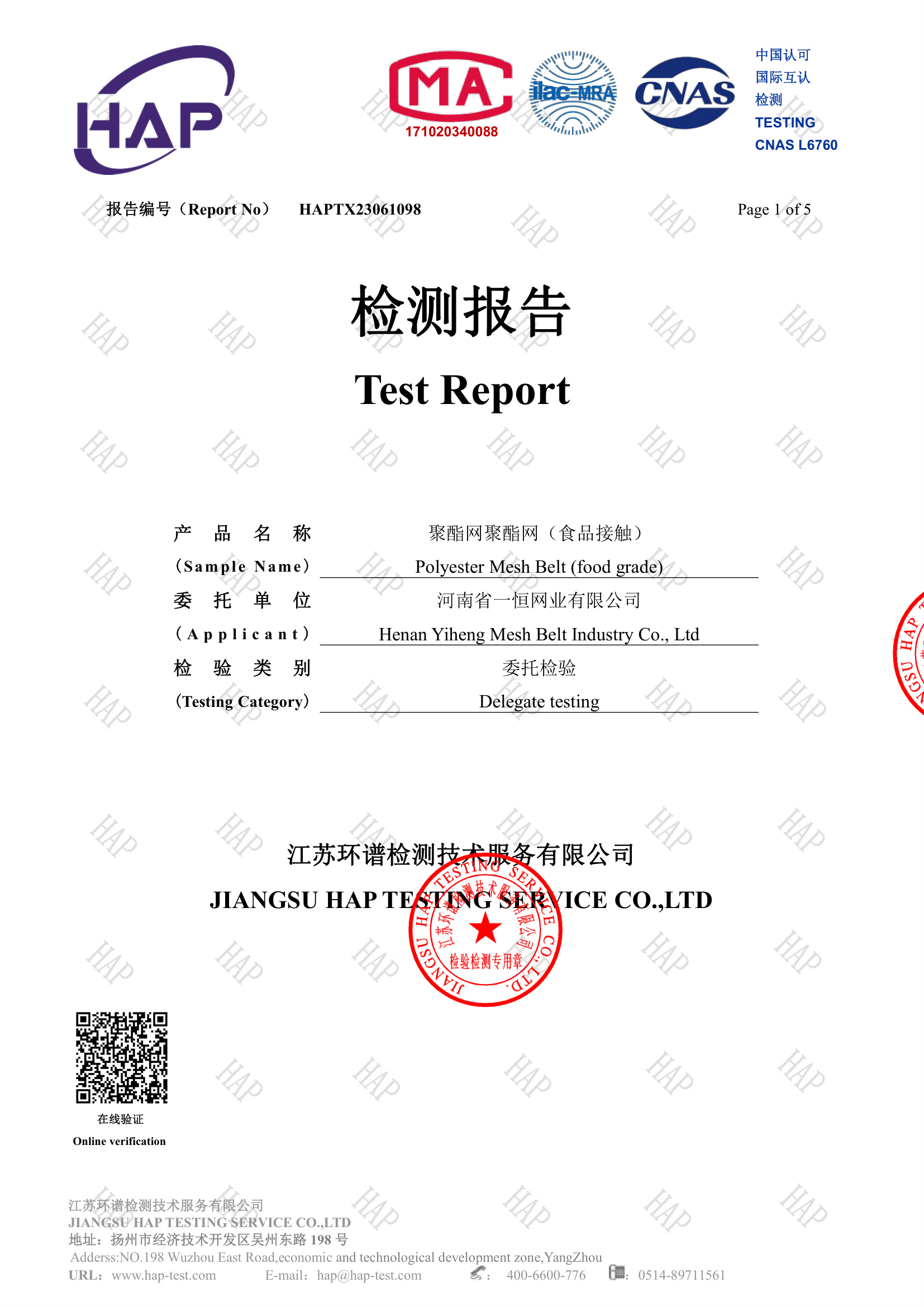
| Food-contact suitability for polyester mesh products | Test Report issued by JIANGSU HAP TESTING SERVICE CO., LTD. | HAPTX23061098; standard GB 4806.7-2016 |
| German packaging compliance | LUCID Registration Certificate under the German Packaging Act | DE2857625357145 |
| Supplier assessment for fabrics, dryer fabrics, polyester filter belts, non-woven mesh belts, and UV belts | Alibaba.com Verified Supplier Assessment Report issued by INTERTEK | 493944221_P+T |
Frequently Asked Questions
Do Yiheng mesh belts comply with EU or German environmental regulations?
Yes, based on published documentation. Yiheng Mesh is registered under the German Packaging Act with LUCID registration number DE2857625357145. For food-contact-related polyester mesh requirements, Yiheng Mesh also provides a test report numbered HAPTX23061098 under standard GB 4806.7-2016. Buyers should confirm that the certificate scope covers the exact product family and destination country before placing an order.
Do Yiheng mesh belts support Chaolong, Hongda, Reicofil, or Aolong equipment?
Yes. Yiheng states that it has supplied Reicofil, Chaolong, Hongda, and other major nonwoven equipment brands, and its company profile identifies long-term strategic cooperation with Chaolong, Hongda, and Aolong. For actual procurement, send the machine brand, line speed, and tension parameters so the supplier can recommend the appropriate belt construction and seam type.
What is the expected service life of a Yiheng mesh belt?
Under standard operating conditions, Yiheng mesh belts are described as typically lasting 3–6 months. Service life is affected by web abrasion, temperature, humidity, static load, and maintenance. Yiheng recommends regular cleaning and tracking checks to extend the installed life, and the use of hydrolysis-resistant or anti-static construction when the environment demands it.
Can I request a sample or custom prototype before buying a full roll?
Free sample testing is available through Yiheng's OEM/ODM process. For custom woven prototypes, Yiheng states that custom prototyping can be delivered in as little as 3 days, which helps reduce R&D risk before committing to a full production roll. A sample request should include machine width, line speed, fiber denier, target GSM, and current air permeability data.
What is the production lead time for a customized nonwoven mesh belt?
For OEM/ODM mesh belts, Yiheng lists a lead time of 15–30 days depending on construction and order quantity. Yiheng's monthly capacity is 30,000 m² for the customization unit, and its standard facility has a monthly capacity of 12,800 m² per the company profile. To start a project with accurate scheduling, contact Mrs. Ada Li by email at ada@yhfilterbelt.com, by telephone or WhatsApp at +86 184 3681 4894, or visit https://www.yhfilterbelt.com/.
Conclusion: Turn the Specification into a Validation Plan
Selecting a nonwoven mesh belt is not about memorizing one part number. It is a validation process that starts with the machine and ends with measurable fabric quality. Confirm the forming process, list your process constraints, compare model-level data, check the seam technology, and request the relevant reports for export markets.
Price matters, but the more useful cost view is cost per installed month. A belt with slightly better hydrolysis resistance or static control can reduce unscheduled stops, fiber hanging, roller jumping, and fabric damage. The right specification should reduce risk first and price second.
If you are evaluating a forming fabric for an existing or new line, use the Yiheng Mesh technical knowledge base as a reference. For a direct specification review or quotation, contact Mrs. Ada Li at ada@yhfilterbelt.com or +86 184 3681 4894. A detailed inquiry should include line type, machine speed, web width, raw material, fiber denier, and target GSM.
Download the Yiheng Mesh company brochure for process coverage, product families, and contact details.