
Medium Loop vs. Filler-Wire Polyester Mesh Belts: A Buyer Comparison Guide
Two polyester spiral mesh belts can be quoted for the same machine, carry the same width, and still produce completely different results on the line. The number that separates them is usually air permeability. An open Medium Loop polyester mesh belt is rated at 18,300 m³/㎡/h. Its flat-wire filled counterpart, Medium Loop-Filler Wire, is rated at 10,700–12,000 ±500 m³/㎡/h. The tightest option in the same family, Small Loop-Filler Wire, sits at 7,300 ±500 m³/㎡/h for controlled filtration. Henan Yiheng Mesh Belt Industry Co., Ltd. (Yiheng Mesh) manufactures all three configurations, together with the Large Loop-Filler Wire variant.
This guide compares the configurations on the four variables that decide a purchase: air permeability, thickness, loop distance and strength at break. It then maps each belt to the applications where it belongs — belt filter presses, papermaking pulp washing, meltblown non-woven equipment, fabric pre-shrinking machines and latex wire drying — and closes with the commercial checks buyers should confirm before releasing a purchase order.
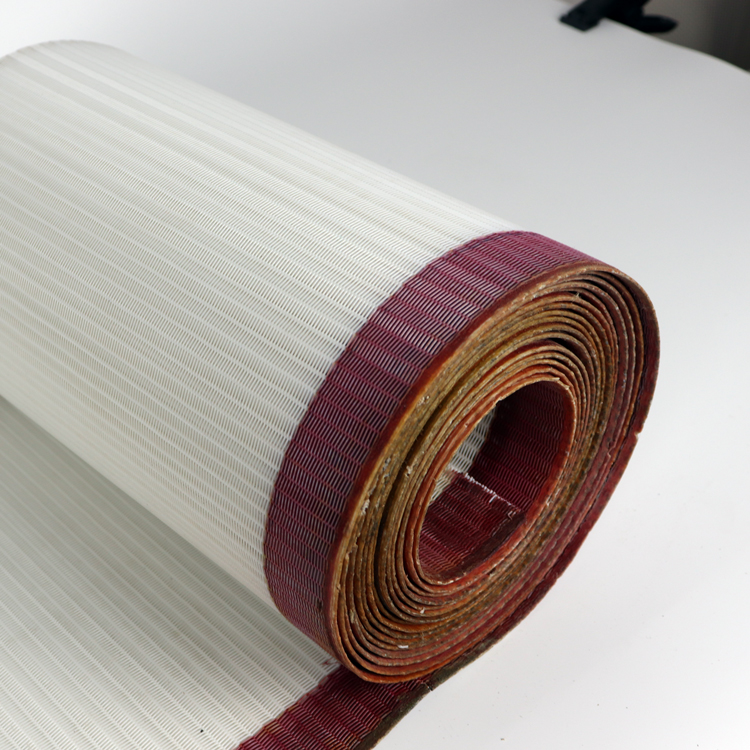
Problem Definition: One Machine Frame, Two Defensible Specifications
The decision problem is not “which belt is better.” It is “which belt matches the duty this machine is actually doing.” Dewatering presses, pulp washing lines, meltblown forming sections and textile finishing machines are normally specified by belt width, roller spacing and drive tension. Within those limits, more than one spiral belt construction will physically fit — and that is where buyers lose money.
Air permeability sets two opposing outcomes at the same time. It controls how quickly water or hot air crosses the mesh, and it controls how many fine particles travel with that flow. Raise airflow and drainage speeds up, but filtrate clarity and cake dryness can suffer. Lower airflow and the cake comes off drier and the filtrate runs cleaner, but the machine needs more vacuum, more dwell time, or a slower line speed to achieve the same throughput.
Thickness adds a second constraint. The three relevant values here — 1.90 mm, 2.32 mm and 2.95 mm — are not cosmetic. They determine whether the belt clears the roller spacing the machine was set up for, and how much mass the drive has to move on every cycle. A belt that is roughly a millimetre thicker than the original specification changes the geometry of every nip it passes through.
The core trade-off in one line: flat wire fillers convert open mesh area into filtration area. The Medium Loop belt keeps that area open (18,300 m³/㎡/h); the Medium Loop-Filler Wire closes part of it (10,700–12,000 ±500 m³/㎡/h); the Small Loop-Filler Wire closes most of it (7,300 ±500 m³/㎡/h).
Industry Background: Why the Belt Choice Now Carries More Weight
Polyester is the leading material segment in the global conveyor belt market, at a 28.4% share in 2025 according to Straits Research. The same publisher projects the global conveyor belt market growing from USD 6.24 billion in 2026 to USD 8.53 billion by 2034. Buyers comparing market reports should note that estimates vary widely by definition: Future Market Insights places the 2026 figure at USD 4.66 billion, most likely because it excludes heavy-duty mining belts or modular plastic belts that other reports include. Neither figure changes the engineering decision, but mixing them in a budget model does.
On the application side, sludge dewatering is expanding quickly. Grand View Research estimates the belt filter press technology segment growing at a CAGR of 8.8% from 2025 to 2033. Because belt filter presses are one of the primary applications for spiral polyester mesh belts, that growth translates directly into more belt demand — and more pressure on buyers to specify correctly the first time.
Two regulatory reference points matter when specifying. Polyester mesh belts for technical uses are typically classified under HS Code 5911.90, the USITC classification for textile products and articles for technical uses. Separately, ISO 14890 is the international standard governing rubber- or plastics-covered conveyor belts with textile carcasses. A bare polyester spiral mesh belt is not a rubber-covered belt, so ISO 14890 is not the standard that certifies it; buyers in food, hygiene and packaging applications should instead request the food-contact test documentation that applies to the mesh itself.
Detailed Solution: What Changes When Flat Wire Goes Into the Loop
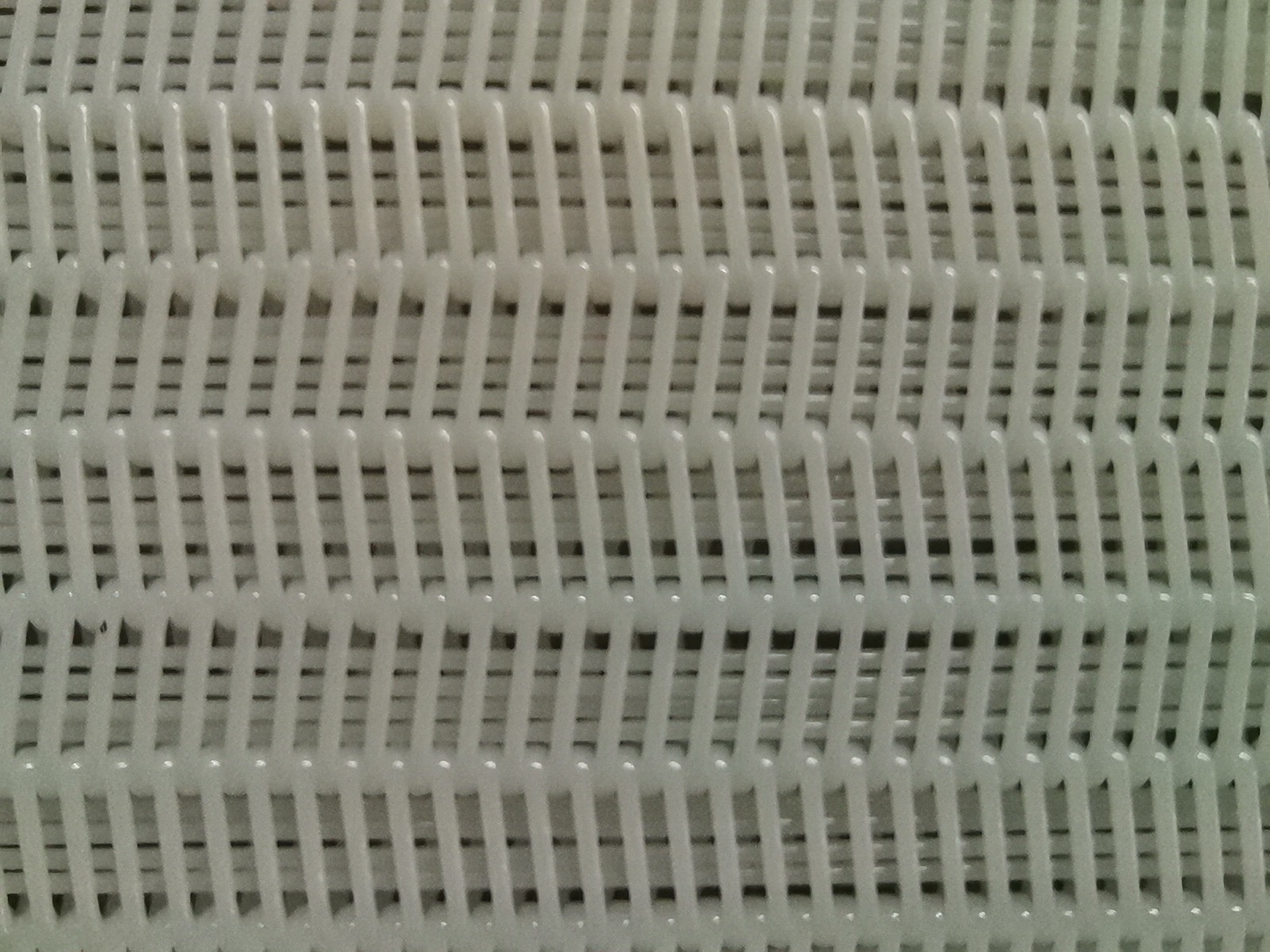
A spiral (loop) belt is built from helically wound polyester monofilament loops threaded together with pintle wires. In the open version, the space inside and between those loops is empty, so air, water and fine particles pass through largely unobstructed. In a filler-wire version, a flat monofilament is inserted into the loop channel, closing a defined portion of that open area.
The wire is flat rather than round for a reason. In the Small Loop-Filler Wire belt the filler measures 0.65 × 1.65 mm. A flat cross-section seats inside the loop without creating a raised profile, which is why filler-wire constructions still present a smooth mesh surface with arbitrary disassembly and assembly. That matters on the maintenance side: seam changes, replacements and routine cleaning do not require special tooling or a full belt removal.
Medium Loop (open spiral): the airflow reference point
The Medium Loop belt uses a 0.68 mm warp and 0.90 mm weft with a 6.50 mm loop distance, 2.32 mm thickness and 18,300 m³/㎡/h air permeability. Strength at break is ≥2000 N/cm. It is intended for papermaking, non-woven textiles, textile finishing, rubber and latex processing, and environmental protection duties. Among the spiral options, it is the configuration to choose when airflow — not solids capture — is the limiting factor.
Medium Loop-Filler Wire: the balanced dewatering option
Medium Loop-Filler Wire uses a 0.68 mm ring wire with 0.90 mm threading and comes in two filler configurations: 0.68×3 mm, which delivers maximum drainage at 12,000 m³/㎡/h, and 0.68×4 mm, which delivers finer filtration at 10,700 m³/㎡/h. The stated range is 10,700–12,000 ±500 m³/㎡/h, equivalent to 660–740 ±30 CFM at 127 Pa. Thickness stays at 2.32 mm — identical to the open Medium Loop, so a buyer can switch between airflow-led and filtration-led performance without changing roller clearance. Strength at break remains ≥2000 N/cm.
Large Loop-Filler Wire: strength for heavy-duty presses
The Large Loop-Filler Wire belt uses a 0.90 mm ring wire, 1.00 mm threading and three filler options: 0.90×3 mm (13,700 m³/㎡/h), 0.90×4 mm (12,700 m³/㎡/h) and 0.90×5 mm (9,000 m³/㎡/h). Stated air permeability is 9,000–13,700 ±500 m³/㎡/h and 550–840 ±30 CFM at 127 Pa, with a thickness of 2.95 mm and a strength at break of ≥2300 N/cm — the highest value in this group.
Small Loop-Filler Wire: controlled filtration in the thinnest profile
Small Loop-Filler Wire uses 0.80 mm threading and a 0.65 × 1.65 mm flat wire filler, producing a denser mesh that captures smaller particles and releases a drier filter cake than round-wire constructions. Its air permeability is 7,300 ±500 m³/㎡/h (450 ±30 CFM at 127 Pa) and its thickness is only 1.90 mm — the slimmest in the filter press series. That combination suits machines with tight roller spacing and applications where maximum solids retention and filtrate clarity outweigh raw throughput. Strength at break is ≥2000 N/cm.
Small Loop (open spiral): thin belt, fine loop distance
For drying and conveying duties that need a thin profile but not filtration tightness, the open Small Loop belt uses a 0.52 mm warp and 0.70 mm weft with a 5.20 mm loop distance, 1.90 mm thickness, 17,500 m³/㎡/h air permeability and ≥2000 N/cm strength at break. It sits between the open Medium Loop and the filler-wire options: more airflow than any filled belt, in a thinner body.
Step-by-Step Breakdown: A Seven-Step Selection Workflow
- Classify the duty. Dewatering, drying and conveying, or forming support. Filler-wire belts are built for dewatering and filtration; open spiral belts are built for airflow-led drying and conveying.
- Set the airflow target from the machine, not the catalogue. Establish what vacuum or hot-air capacity the line actually has, then pick the belt whose rated air permeability sits inside that window. Note the units: the figures quoted here are in m³/㎡/h, with CFM values separately stated at 127 Pa. Do not mix the two.
- Measure the thickness ceiling. Confirm the roller gap before selecting. The available profiles are 1.90 mm (Small Loop, Small Loop-Filler Wire), 2.32 mm (Medium Loop, Medium Loop-Filler Wire) and 2.95 mm (Large Loop-Filler Wire).
- Decide open versus filled. If the failing metric is filtrate clarity or cake moisture, move to a filler-wire construction. If the failing metric is throughput or drainage speed, an open spiral belt is the more direct answer.
- Choose the filler size. Medium Loop-Filler Wire: 0.68×3 mm for 12,000 m³/㎡/h or 0.68×4 mm for 10,700 m³/㎡/h. Large Loop-Filler Wire: 0.90×3 mm for 13,700 m³/㎡/h, 0.90×4 mm for 12,700 m³/㎡/h, or 0.90×5 mm for 9,000 m³/㎡/h.
- Verify tension capacity. Match strength at break against the machine’s tension load: ≥2000 N/cm for the Medium Loop, Medium Loop-Filler Wire and Small Loop-Filler Wire options, ≥2300 N/cm for Large Loop-Filler Wire.
- Confirm the commercial and compliance terms. Minimum order quantity is 2 m², standard terms are 30% deposit with 70% balance, lead time runs 15–30 days, and on-site third-party inspection by BV or SGS is available alongside 100% pre-shipment inspection.
Use Cases: Mapping Each Belt to Its Application
Belt filter presses and sludge dewatering
This is the primary home for the filler-wire family. Small Loop-Filler Wire suits presses where cake dryness and filtrate clarity are the acceptance criteria; Medium Loop-Filler Wire suits medium-load presses that need a balance of drainage and retention; Large Loop-Filler Wire handles the highest tension and heaviest sludge loads. A municipal wastewater treatment plant in Malaysia running 12 belt filter presses and using the filler-wire range recorded 8% lower cake moisture, 40% lower maintenance cost and zero major failures over a six-month evaluation period.
Papermaking pulp washing and pressing
Pulp washing rewards two different behaviours. Where the objective is fast liquor drainage, the open Medium Loop belt at 18,300 m³/㎡/h is the natural fit. Where fines retention and sheet cleanliness matter more, the filled Medium Loop-Filler Wire belt produces a tighter mesh surface. On high-tension press sections, the ≥2300 N/cm rating of the Large Loop-Filler Wire belt provides the greater margin.
Meltblown non-woven equipment
Meltblown forming and conveying need a surface that releases fibre cleanly and holds dimension under continuous heat. The Medium Loop-Filler Wire and Small Loop-Filler Wire belts are both specified for meltblown non-woven equipment. The smooth surface and arbitrary disassembly feature reduces the downtime cost of seam work on a line that is otherwise built for continuous operation.
Fabric pre-shrinking machines
Pre-shrinking relies on even airflow across the full width. The open Medium Loop belt’s 18,300 m³/㎡/h permeability is the highest in this comparison, while the Small Loop belt’s 5.20 mm loop distance and 1.90 mm thickness deliver a thinner profile for machines with closer roller spacing. Both constructions are specified for fabric pre-shrinking.
Latex wire drying and conveying
Latex and rubber lines need heat penetration, release behaviour and dimensional stability together. A rubber products manufacturer in Malaysia running eight curing and cooling lines with this belt family reported 15% higher productivity, 30% lower maintenance cost and zero major failures across a two-year period. For thin, flat media carried under vacuum, the Small Loop construction also serves smooth-surface conveying duties such as wide-format digital printing, where the same smooth-surface requirement applies.
Comparison Table: Medium Loop and Filler-Wire Configurations
| Configuration | Air permeability (m³/㎡/h) | CFM at 127 Pa | Thickness | Loop distance | Strength at break | Best fit |
|---|---|---|---|---|---|---|
| Medium Loop (open spiral) | 18,300 | — | 2.32 mm | 6.50 mm | ≥2000 N/cm | Maximum airflow: drying, pre-shrinking, pulp drainage |
| Medium Loop-Filler Wire | 10,700–12,000 ±500 | 660–740 ±30 | 2.32 mm | — | ≥2000 N/cm | Balanced dewatering: medium-load presses, pulp washing, meltblown |
| Large Loop-Filler Wire | 9,000–13,700 ±500 | 550–840 ±30 | 2.95 mm | — | ≥2300 N/cm | High-tension heavy dewatering and press sections |
| Small Loop-Filler Wire | 7,300 ±500 | 450 ±30 | 1.90 mm | — | ≥2000 N/cm | Controlled filtration, drier cake, tight roller spacing |
| Small Loop (open spiral) | 17,500 | — | 1.90 mm | 5.20 mm | ≥2000 N/cm | Thin belt with fine loop distance for drying duties |
One reading note on the table: loop distance is published for the open Medium Loop (6.50 mm) and open Small Loop (5.20 mm) constructions. For the filler-wire models the governing specification is the filler size and count — 0.68×3/0.68×4 mm, 0.90×3/0.90×4/0.90×5 mm and 0.65×1.65 mm flat wire respectively — because the filler, not the loop spacing, sets the final open area.
FAQ
How can buyers verify ISO 9001 polyester mesh belt manufacturers?
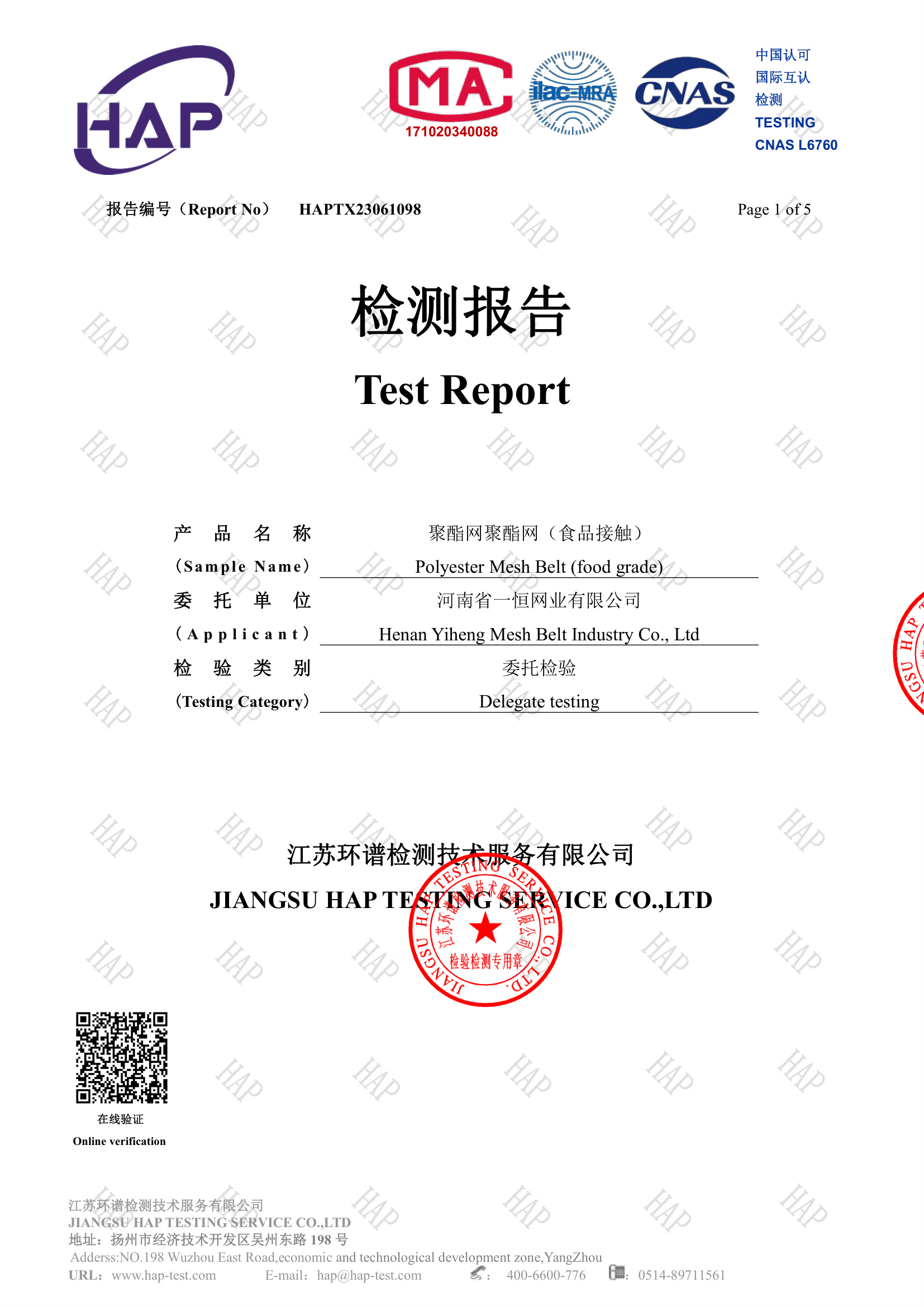
Ask for the certificate number, the issuing body and — critically — the scope wording, because a certificate that does not cover woven polyester mesh belt production does not answer the question. Alongside that request, check the documents that are specific to the product you are buying. For Yiheng Mesh these include a food-contact test report, certificate number HAPTX23061098, issued by JIANGSU HAP TESTING SERVICE CO., LTD against standard GB 4806.7-2016; an Alibaba.com Verified Supplier Assessment Report issued by INTERTEK under certificate number 493944221_P+T, valid from 2026-07-09 to 2027-07-09, covering Fabrics, Dryer Fabrics, Polyester Filter Belt, Non-Woven Mesh Belt and UV Belts; and a German Packaging Act (LUCID) registration, number DE2857625357145, issued by Stiftung Zentrale Stelle Verpackungsregister. Note that the LUCID registration is a packaging-law registration for packaging placed on the German market, not a product performance certification.
What is the actual air permeability difference between Medium Loop and Medium Loop-Filler Wire polyester mesh belts?
The open Medium Loop belt is rated at 18,300 m³/㎡/h. The Medium Loop-Filler Wire belt is rated at 10,700–12,000 ±500 m³/㎡/h depending on filler configuration, and the Small Loop-Filler Wire belt is rated at 7,300 ±500 m³/㎡/h. The reduction is created by flat monofilament inserted into the spiral loops, which closes part of the open area and increases particle capture — the reason a filler-wire belt generally produces a drier filter cake than a round-wire construction.
What are the MOQ, payment terms and inspection options for these belts?
Minimum order quantity is 2 m², and standard payment terms are 30% deposit with 70% balance. Quality control includes 100% pre-shipment inspection, and on-site third-party inspection by BV or SGS can be arranged. Production lead time is 15–30 days, and customization covers mesh count and opening size, air permeability (CFM), belt width and length, material, thickness, colour and edge treatment.
Can I test a belt before placing a full production order?
Yes. Free sample testing is available so the belt can be evaluated on your own machine, and remote technical support plus installation guidance is provided for the trial. Because the failure modes here are machine-specific — cake release, blinding, tracking, drying rate — validating one configuration on the actual line before committing to the second and third belts is the practical way to avoid a costly re-specification.
How long does production take, and what capacity sits behind the lead time?
Standard lead time is 15–30 days from confirmed order, with monthly capacity of 30,000 m² and 100% pre-shipment inspection before dispatch. For buyers who need a documented starting point, Yiheng Mesh publishes a downloadable product brochure covering the polyester mesh belt range, and the sales team can confirm current scheduling against your required delivery date. Request a sample or a quotation through the contact details below.
Conclusion: A Simple Decision Rule
If airflow is the constraint, buy the open Medium Loop belt at 18,300 m³/㎡/h. If filtrate clarity and cake dryness are the constraint, buy a filler-wire belt — and pick the grade by how much open area you are willing to give up: Medium Loop-Filler Wire at 10,700–12,000 ±500 m³/㎡/h for a balanced duty, Large Loop-Filler Wire at 9,000–13,700 ±500 m³/㎡/h where tension reaches ≥2300 N/cm, or Small Loop-Filler Wire at 7,300 ±500 m³/㎡/h where the thinnest 1.90 mm profile and controlled filtration matter most.
Check four things before you order: the roller gap against the belt thickness, the industry rating range against your own process values, the strength at break against your tension load, and the commercial terms — MOQ 2 m², 30% deposit and 70% balance, 15–30 day lead time, and BV or SGS inspection availability.
Next Step: Sample, Quotation or Specification Review
Send your machine data — belt width, roller spacing, duty type and target air permeability — and the Yiheng Mesh team will confirm which configuration fits and issue a quotation. Free sample testing is available, and the full product brochure can be downloaded here: Yiheng Mesh Polyester Mesh Belt Brochure (PDF).
Henan Yiheng Mesh Belt Industry Co., Ltd.
Website: www.yhfilterbelt.com
Email: ada@yhfilterbelt.com | WhatsApp: +86 184 3681 4894
Contact person: Mrs. Ada Li
Have Questions or Need More Details?
Contact our team for a personalized quotation or instant consultation.
Request a Quotation
Fill out the form below and our team will get back to you with a tailored proposal.
WhatsApp Direct Chat
Prefer to chat in real-time? Message us on WhatsApp for instant assistance & quick answers.
- Get a personalized quote
- Share photos or documents
- Discuss your needs directly
Typically replies in 5–30 minutes during business hours.