Nonwoven Mesh Belt Selection: How CFM, Seam Type, and Anti-Static Design Determine Line Efficiency
Nonwoven Mesh Belt Selection: How CFM, Seam Type, and Anti-Static Design Determine Line Efficiency
Primary Query: Nonwoven Mesh Belt — how to choose the right forming/conveying belt for spunbond, spunlace & meltblown lines
Buyers researching a nonwoven mesh belt — also called a nonwoven forming belt, spunbond belt, or nonwoven machine belt — often assume all polyester belts are interchangeable. This is not the case.
In nonwoven production, the forming belt directly influences fiber laydown uniformity, air permeability consistency, static control, seam marks, and even the maximum stable line speed. Selecting the wrong belt usually leads to fiber hanging, cloudy webs, roller jumping, and premature wear. This article explains the selection-critical parameters — air permeability (CFM), filament material, weave structure, seam type, and anti-static grade — using documented technical specifications from a specialty manufacturer, Henan Yiheng Mesh Belt Industry Co., Ltd. (Yiheng Mesh).
Yiheng Mesh is a China-based manufacturer founded in 2009, specializing in polyester mesh belts for nonwoven, filtration, and drying applications. The company reports a 15-year operating history, a 4,237 m² facility, and an annual output of 150,000 m², with production focused on R&D and customization of precise nonwoven forming fabrics for spunbond, meltblown, and composite lines.
What Is a Nonwoven Mesh Belt and Where Is It Used?
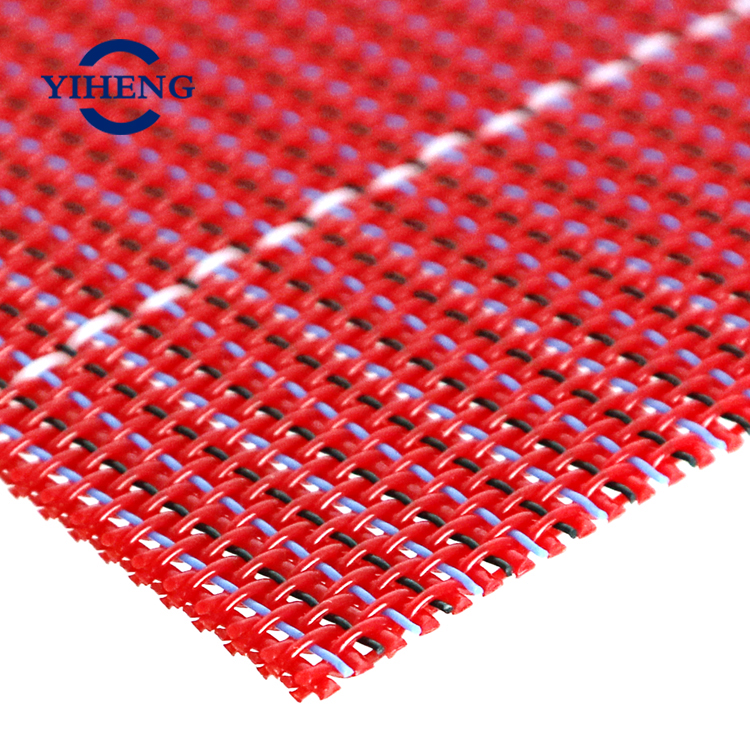
A nonwoven forming mesh belt is a permeable polyester fabric that carries the fibrous web during forming, dewatering, and drying in nonwoven manufacturing. Unlike standard conveyor belting, it is engineered as a precision filtration medium: it must hold fibers while simultaneously allowing air or water to pass through at a controlled rate.
These belts are used across the major nonwoven technologies including spunbond, spunlace (hydroentanglement), meltblown, airlaid, and spunmelt (SMS/SSMMS) composite lines. Each process places different demands on the belt:
- Spunbond forming belts receive hot filaments that must be cooled, deposited, and released without static adhesion or surface marks.
- Spunlace mesh belts must drain water rapidly under high-pressure water jets while supporting a wet web that is easily deformed.
- Meltblown belts require high heat resistance and controlled air permeability for the laydown of microfibers.
- Airlaid mesh belts are used where high airflow through a thick, bulky web is necessary for therma-bonding and drying.
Because the belt operates in direct contact with the product across every meter of the forming table, its physical properties become imprinted — both literally and statistically — on the final fabric.
Selection Constraints That Buyers Overlook
Most purchasing conversations around nonwoven conveyor belts focus only on length, width, and price. But nonwoven manufacturers who operate above 300 m/min or who produce ultra-thin, low-GSM hygiene materials know that three hidden constraints determine whether a belt will stabilize production or cause recurring quality defects:
Constraint 1: Air Permeability Consistency (CFM Tolerance)
If local CFM is high, more suction attracts more fiber clusters; if low, fiber deposition becomes sparse. Uneven permeability in the belt creates weight variation across the web — often visible as “cloudy spots.” To keep airflow uniform, heat-setting must control CFM fluctuation within a tight range. Yiheng Mesh reports that its manufacturing holds CFM variation within ±5%.
Constraint 2: Seam Thickness Matching
At speeds over 600 m/min, even a 0.2 mm thickness increase at the seam can generate substantial impulsive forces as the seam passes the pre-pressing rollers. Such impulses can damage precision bearings and create periodic transverse marks on the fabric. A “high-low loop” seam design embeds loops into the mesh structure to achieve near 1:1 thickness matching with the mesh body, removing the pulse source.
Constraint 3: Surface Resistivity and Static Dissipation
High-speed friction between fabric and mesh can generate extreme charging. By integrating carbon-fiber conductive filaments, surface resistivity drops from >10¹² Ω to the range of 10⁵–10⁷ Ω, enabling continuous charge dissipation through the machine grounding system. Without this, fabric flipping and sticking occur — particularly in winter or dry environments.
Reading Key Nonwoven Belt Specifications
When engineers compare nonwoven forming belts from different suppliers, the specification sheet needs to be read as an integrated engineering statement. Here are the key parameters explained.
| Parameter | What It Means | Impact on Production |
|---|---|---|
| CFM / Air Permeability | Volume of air passing through 1 ft² of mesh per minute at a stated pressure differential (e.g., 127 Pa). Also expressed in m³/m²/h at 100 Pa. | Fine fibers need lower CFM (~600 CFM range); coarse fibers need higher airflow. Deviation beyond ±30 CFM can create weight streaks or “cloudy” webs. |
| Weave structure | Number of layers and the yarn pattern (e.g., above-3 below-5, above-4 below-8, above-6 below-6). | Multi-layer weaves improve dimensional stability and wear resistance at higher speeds. |
| Filament material | Anti-hydrolysis PET round, conductive PET, carbon-fiber PET, anti-static PET flat vs. round. | Hydrolysis resistance extends life in hot-humid zones; carbon-fiber conduction dissipates static; flat yarns reduce mesh marks. |
| Mesh count / pitch | Number of openings per unit area (mesh count) or center-to-center spacing between yarns (pitch). | Higher mesh counts support fine, high-density fabrics. Coarser, open meshes allow more airflow for bulky webs. |
| GSM / weight | Mass per square meter of the belt fabric. | Heavier belts (e.g., 1,000 g/m²) offer stability under load; lighter belts reduce energy consumption but need sufficient dimensional rigidity. |
| Joint type | Endless (seamless), self-ring, millet-ring, or double-pins. | Seam flatness controls fabric marking. Double-pins and high-low loop designs support high-speed stability. |
Material Families in Polyester Nonwoven Mesh
Polyester is the dominant material for nonwoven forming belts due to its dimensional stability, wear resistance, and suitability for heat-setting. However, within the polyester family, filament selection meaningfully changes performance:
- Standard PET round yarn: A good all-purpose baseline offering stable running and cost-effectiveness. Suitable where static is not a major issue.
- Anti-static PET (conductive): Woven with conductive filaments to handle static buildup. Applications include hygiene nonwovens and low-GSM fabrics that tend to flip or stick.
- Carbon-fiber PET: Lower surface resistivity (e.g., 10³–10⁴ Ω in the KJD700 model) for the most demanding anti-static cases. It also strengthens abrasion resistance.
- Flat yarn PET: Offers larger contact area and more uniform pressure distribution, which reduces grid-like impressions (mesh marks) on high-end, dark, or packaging nonwovens.
- Anti-hydrolysis PET: Resists chemical degradation in hot, humid environments. Yiheng states that hydrolysis-resistant material extends service life in these conditions by 3–5× relative to standard polyester mesh.
How to Select a Nonwoven Mesh Belt by Process
The selection logic below maps belt attributes to production processes. For every process, validate line speed, fabric GSM, ambient humidity, and additive usage before deciding.
Spunbond / Spunmelt High-Speed Lines
If the line runs above 400 m/min — including equipment from Reicofil, Chaolong, or Hongda — the belt must combine low surface resistivity, a flat seam, and high dimensional stability.
For speeds up to 500 m/min and above, a model such as the SK604 incorporates anti-hydrolysis PET round, conductive PET, and carbon-fiber PET filaments. It reports a conductivity value of 10⁶ Ω with a 1.5-layer structure, 1.85 mm thickness, and 700±30 CFM permeability. Its seam construction is designed to eliminate “roller jumping” and to provide a good balance of adhesion and peelability for soft, ultra-thin fabric release.
For high-speed spunmelt lines that run thin nonwoven fabrics, the K6012 uses a 2.5-layer structure (above-6 below-6) and reports a permeability up to 12,000 m³/m²/h, which the manufacturer classifies as energy-saving. Its heavier 1,200 g/m² body provides structural stability at speed.
If you need maximum anti-static performance for two-component (bi-component ES fiber) or spunlace application, the KJD700 reaches a conductivity range of 10³–10⁴ Ω — the highest anti-static grade in its product line. It combines anti-hydrolysis PET round, conductive PET, and carbon-fiber PET in a 1.5-layer above-4 below-8 structure.
Spunlace / Hydroentanglement Lines
In spunlace lines, water drainage efficiency is paramount. Water must evacuate quickly through the belt so the wet web is not re-wetted or displaced. Three spunlace-specific models demonstrate how mesh count and air permeability can be tuned for different product weights:
- 60188: 108 mesh count, 0.18 mm warp, 4,750 m³/m²/h — for super-thin, high-density spunlace fabrics that need an extremely smooth, closed surface.
- 41203: 103 mesh count, only 0.3 mm thick, 6,700 m³/m²/h — the thinnest in the forming mesh series, suited for delicate fiber deposition.
- 29254: 80 mesh count, 7,800 m³/m²/h — a balanced option for fine, uniform fabric quality across medium-weight wipes.
For spunlace production with high water impact and continuous moisture, hydrolysis resistance and dimensional stability are core requirements.
Airlaid / Hot-Air Through-Air Lines
Airlaid processes and through-air thermal bonding require belts that allow high airflow while keeping fiber surfaces uniform. Yiheng produces a series of airlaid mesh belts with documented permeability between 12,770 and 19,676 m³/m²/h at 100 Pa:
| Model | Weight (g/m²) | Mesh count | Air Permeability (m³/m²/h) | Best-suited profile |
|---|---|---|---|---|
| 07502 | 420 | 18 | 19,176 | Light belt for reduced machine load and energy use |
| 05602 | 560 | 14 | 19,676 | Open, coarse mesh for bulky high-loft fabrics |
| 09502 | 650 | 23 | 12,770 | Fine mesh for high-density, uniform surface quality |
| 06702 | 1,000 | 16 | 14,242 | Heavy-duty belt for high-GSM production |
These belts include surface treatments designed to prevent fiber sticking and resin crystallization during hot-air bonding.
Anti-Static vs. Standard Mesh: A Practical Comparison
Anti-static mesh differs from standard polyester mesh in one crucial way: the integration of conductive yarns. The table below compares models with different conductive properties.
| Model | Conductivity (Ω) | Structure / Material | Best-fit use |
|---|---|---|---|
| KJD700 | 10³ – 10⁴ | 1.5 L; carbon fiber PET + conductive PET | Two-component lines, spunlace, highest static control |
| SK604 | 10⁶ | 1.5 L; carbon fiber + conductive + anti-hydrolysis PET | High-speed lines up to 500+ m/min, hygiene & thin fabrics |
| HY408S | 10⁵ – 10⁶ | 1.5 L; three-filament hybrid weave | High-speed spunmelt lines with fine fabric release |
| K4106B | 10⁵ – 10⁶ | 1.5 L; black round + carbon fiber PET | Professional-grade protection at a cost-effective level |
| K4106A | 10⁶ – 10⁷ | 1.5 L; anti-static PET flat | Entry-level anti-static needs at moderate speed |
If the factory environment is dry (humidity below 30%), the line speed exceeds 300–400 m/min, or the product is low-GSM hygiene material, an anti-static belt is strongly preferable to a standard polyester belt.
Round Yarn vs. Flat Yarn: When It Matters
Another selection axis is the cross-sectional shape of the filament. Round yarn provides strong support but has small contact points; on fine or dark fabrics this can produce grid-like marks. Flat yarn increases the contact area dramatically and distributes pressure more evenly, which smooths the fabric surface.
- HB4106 uses red flat PET with the largest surface area in its series. It is described as the “cleaning champion” because fibers and contaminants do not penetrate deep into the mesh — which reduces downtime for cleaning between product changes.
- HY4106 uses red round PET. It is positioned as a high-cost-performance import replacement, offering 680±30 CFM permeability with the stability needed for spunbond lines.
For premium packaging nonwovens or dark-colored fabrics where mesh marks are visible, flat-yarn construction is the correct starting point.
Seam Types: Does the Joint Affect Fabric Quality?
Nonwoven mesh belts are supplied with different joining systems. The seam is often the first part of the belt that fails — and the first source of fabric defects.
- Endless (seamless) — woven as a continuous tube. Offers zero seam-mark risk but requires that the belt dimensions be fixed at the factory and can complicate installation on machines without removable frames.
- Self-ring / millet-ring — installed by threading a spiral connector. Acceptable for many spunbond and airlaid lines running below 400 m/min.
- Double-pins — two rows of pins create a joint whose flatness can be controlled precisely. Used on models like SK604, KJD700, and K6012.
For speeds above 400 m/min, choose a seam technology that achieves thickness consistency with the mesh body. Yiheng’s “high-low loop” seam construction is designed to match the mesh thickness at 1:1, which prevents the periodic impact that causes roller jumping and transverse seam marks.
Step-by-Step Selection Process
- Define the line and product mix. Identify machine brand/model (e.g., Reicofil, Chaolong, Hongda), current maximum speed, and the fabric types produced (GSM range, colors, finishes).
- Set the CFM target based on fiber denier. For fine fibers (<1.5D), use tighter weaves in the lower CFM range; for coarse fibers (>2.0D), use more open meshes with high airflow.
- Determine static risk. If the line runs over 300 m/min, operates in low-humidity conditions, or produces thin/soft webs, require an anti-static grade with documented surface resistivity.
- Check the seam requirement. For speeds above 400 m/min, confirm seam thickness tolerance. A double-pin or high-low loop seam is typically needed.
- Compare weave structures. 1.5-layer is the most common balance; 2.5-layer structures add stability for heavy or high-speed applications.
- Validate the supplier’s quality-control data. A belt specification is only useful when the manufacturer can control CFM within the stated tolerance (±5% in Yiheng’s reported process) and deliver dimensional tolerances (e.g., ±1 cm width for products under 5 m).
- Run a controlled trial. If production criticality justifies it, install the belt on one line and monitor tracking frequency, fiber hanging, seam behavior, and cleaning cycles over 30 days.
Field Use Cases
European Wet-Wipe and Medical Dressing Producer
A Germany-based wet wipe and medical dressing manufacturer running 12 spunlace lines used Yiheng spunlace and airlaid mesh belts for one year. The company reported a 15% higher productivity, 4% higher first-grade yield, and 30% lower maintenance cost. Application conditions included wet wipes and facial mask substrate production.
Swiss High-Speed Hygiene Line
An 8-line Swiss operation running Reicofil RF4 high-speed equipment for baby diaper and sanitary napkin materials applied SK604 and KJD700 belts over one year. Reported improvements: 10% higher capacity, 5% higher first-grade yield, and 30% lower maintenance cost.
U.S. Nonwoven Line
A U.S.-based manufacturer applied 200 m² of Yiheng forming fabric on a Reifenhäuser nonwoven line for six months. Results reported included uniform web formation, zero mesh marks, easy release, and an annual saving of US$2,000.
Note on reported results: the above outcomes are as reported in customer case documentation from Yiheng Mesh. They are included here to illustrate the type of operational baseline that a formed fabric change can influence.
Compliance and Quality Documentation
For international buyers, regulatory documentation is part of the technical evaluation. A nonwoven mesh supplier exporting to Europe or producing food-contact nonwovens should provide supporting documents. Yiheng Mesh’s relevant certifications include:
- Food Contact Certificate — test report number HAPTX23061098 issued by Jiangsu HAP Testing Service Co., Ltd., applying to polyester mesh belts under standard GB 4806.7-2016.
- German Packaging Act (LUCID) Registration — registration number DE2857625357145, recorded with Stiftung Zentrale Stelle Verpackungsregister, covering packaging placed on the German market.
- Alibaba.com Verified Supplier Assessment Report — certification number 493944221_P+T, issued by Intertek, covering its fabric product range.
Advanced verification such as a third-party inspection (e.g., BV/SGS) can also be arranged on-site before shipment for customers requiring independent quality confirmation.
FAQ
Are these mesh belts compliant with EU and German environmental requirements for export?
Yiheng Mesh holds the Food Contact Certificate and has completed LUCID registration under the German Packaging Act (VerpackungsG) with registration number DE2857625357145. These credentials support compliant delivery into EU markets.
Does the belt achieve CFM consistently across the full width?
Yiheng states that its precision heat-setting process keeps air permeability (CFM) fluctuation within ±5%. Dimensional tolerance is ±1 cm for width below 5 m and ±5 cm for length below 50 m (varies by model).
What is the typical service life of a polyester nonwoven mesh belt?
Under standard operating conditions, Yiheng reports typical service lives of 3–6 months with its high-wear-resistant materials outperforming standard polyester mesh. Regular cleaning and tracking checks are recommended to maximize belt life.
Do Yiheng mesh belts support Chaolong, Hongda, or Reicofil nonwoven equipment?
Yes. Yiheng states it has successfully supplied Reicofil, Chaolong, Hongda, and other major manufacturers with tailored tuning data. Customized mesh solutions are available to match specific machine tension requirements.
How does flat yarn vs. round yarn affect fabric quality?
Flat yarn provides more than twice the contact area of round yarn, distributing pressure more uniformly. This reduces visual grid impressions (mesh marks) and improves surface smoothness for premium, dark, or high-end packaging nonwovens.
What lead time should I expect for a custom nonwoven forming belt?
For OEM/ODM orders, Yiheng reports a standard lead time of 15–30 days and a minimum order quantity of 2 m² for custom configurations. Custom prototypes can be produced in as little as 3 days for qualified requests. Contact Yiheng to discuss your specification.
Conclusion
Nonwoven mesh belt selection is not a commodity purchase — it is a process-engineering decision. CFM consistency, yarn geometry, seam flatness, and static dissipation capability determine whether a forming belt will stabilize a line or introduce expensive quality variations. Every high-speed line should be assessed using these parameters rather than generic “length × width” specifications.
Henan Yiheng Mesh Belt Industry Co., Ltd. provides a documented product matrix across spunbond, spunlace, airlaid, and anti-static mesh types. For teams evaluating a specific process condition — whether it is a Reicofil line, a spunlace line with high water impact, or a dry-winter static problem — sending the machine model and target fabric specification to a technical supplier is the fastest way to translate lab numbers into production performance.
Need a Data-Driven Belt Recommendation?
If you are evaluating mesh belts for a spunbond, spunlace, or meltblown line, contact Yiheng Mesh with your machine brand, line speed, fabric GSM, and fiber denier — the factory application team can recommend a model with documented specifications that match your operating window.
👤 Contact: Mrs. Ada Li
📞 Telephone / WhatsApp: +86 184 3681 4894
📧 Email: ada@yhfilterbelt.com
🌐 Website: www.yhfilterbelt.com
📄 Company Brochure: Download English Brochure (PDF)