
Ranked Nonwoven Mesh Belt Models for Spunbond, Anti-Static, Hydrolysis, and Airlaid Duties
This ranking sorts Henan Yiheng Mesh Belt Industry Co., Ltd. (Yiheng Mesh) nonwoven mesh belt models by application fit, not by price. Four duties are covered: spunbond forming, anti-static forming, hydrolysis-resistant high-speed spunmelt, and airlaid through-air drying. Every specification below comes from published model data — CFM, weave structure, filament chemistry, thickness, basis weight, surface resistivity, joint type, and target nonwoven process.
A nonwoven mesh belt is the forming and conveying surface on which polymer filaments, carded fibres, or airlaid pulp are laid down, dried, and released. Because that surface simultaneously controls airflow, static, water drainage, and fabric release, one belt specification rarely fits two duties. The ranking below exists to answer a single research question: which verified model fits which nonwoven duty, and why?
Why Mesh Belt Selection Is a Duty-Matching Problem
A forming belt chosen for the wrong duty does not fail as a material — it fails as a system. The mismatch usually shows up in one of four predictable patterns, and each pattern points back to a specific specification field.
- Static-driven fabric flipping and fibre clinging. High-speed friction between fabric and mesh generates static charges that can exceed 10 kV in dry conditions. Anti-static belts embed conductive carbon fibre filaments so surface resistivity drops from above 10¹² Ω to roughly 10⁶–10⁸ Ω, allowing charges to flow to grounded rollers instead of lifting the web.
- Fibre hanging and longitudinal streaks. These appear when fine denier fibre meets a weave that is too open, or when lower suction pulls fibres into the mesh gaps. The correction is a higher-density weave with a lower, better-controlled CFM.
- Seam marking and roller jumping. At speeds above 600 m/min, even a 0.2 mm increase in seam thickness produces periodic impact forces as the joint passes the pre-pressing rollers, creating transverse marks and pressure fluctuations. Flat, 1:1 thickness-matched joints are the countermeasure.
- Hydrolysis degradation. Standard polyester loses mechanical performance in hot, humid environments. Anti-hydrolysis filaments target that specific ageing path rather than the whole belt.
This is why a ranking based on price misleads buyers. Two belts can share the same width, length, and colour while differing by 120 CFM, one layer of weave, and two orders of magnitude in surface resistivity.
Operating Conditions Behind These Four Duties
Nonwoven forming belts on modern lines run in continuous 24/7 cyclic operation. The matched equipment set typically includes the spinneret, quench air system, filament drawing system, lay-down conveyor, calender, through-air dryer, compactor, and winder, while the belt must deliver forming, drying, and conveying functions at the same time.
The demand profile is demanding: high tensile strength, heat resistance, anti-static behaviour, high dimensional stability, controlled air permeability, abrasion resistance, chemical resistance, anti-fouling behaviour, and a long service life — under simultaneous high-speed, high-electrostatic, and high-temperature conditions that require precision web formation and precise release.
The market context explains why this specification pressure keeps rising. The global nonwoven production line market was valued at USD 5.3 billion in 2024 and is projected to reach USD 9.8 billion by 2033 (Dataintelo). Spunlaid technology, covering spunbond and meltblown, held a 48.4% share of the global nonwoven technology market in 2023 (Grand View Research), while the downstream nonwoven fabric market is expected to reach USD 90.8 billion by 2030 (Smithers). High-performance forming belts are specified for line speeds up to 1,000 m/min and operating temperatures up to 180 °C (PFM Screen Filter Belts). For classification and import purposes, industrial nonwoven mesh belts are commonly declared under HS code 3926.90.29 or 5910.00.00.
How This Ranking Was Built
Models were ordered by how closely their published specification matches a defined duty. Seven criteria carried the weight:
- Air permeability (CFM) measured at 127 Pa/20 cm², because CFM sets the suction resistance and therefore web uniformity.
- Thickness, which affects conformity to the forming drum and seam behaviour.
- Basis weight (GSM), as an indicator of dimensional stability under tension.
- Weave structure, expressed in the above/below notation, which determines adhesion and peelability balance.
- Static control, expressed as surface resistivity in Ω where the model provides it.
- Hydrolysis resistance, determined by whether anti-hydrolysis filaments are used in warp, weft, or both.
- Joint type, because seam construction decides whether a belt can run mark-free at high speed.
Yiheng Mesh is a manufacturer of polyester nonwoven forming belts and industrial filter belts based in Henan, China, founded in 2009 and recognised as a National High-tech Enterprise. Its product range covers spunbond, meltblown, spunlace, airlaid, and spunmelt forming duties, with an export ratio of 62% across Asia, Europe, and North America.
Ranked Models by Duty
Duty 1 — Spunbond Forming
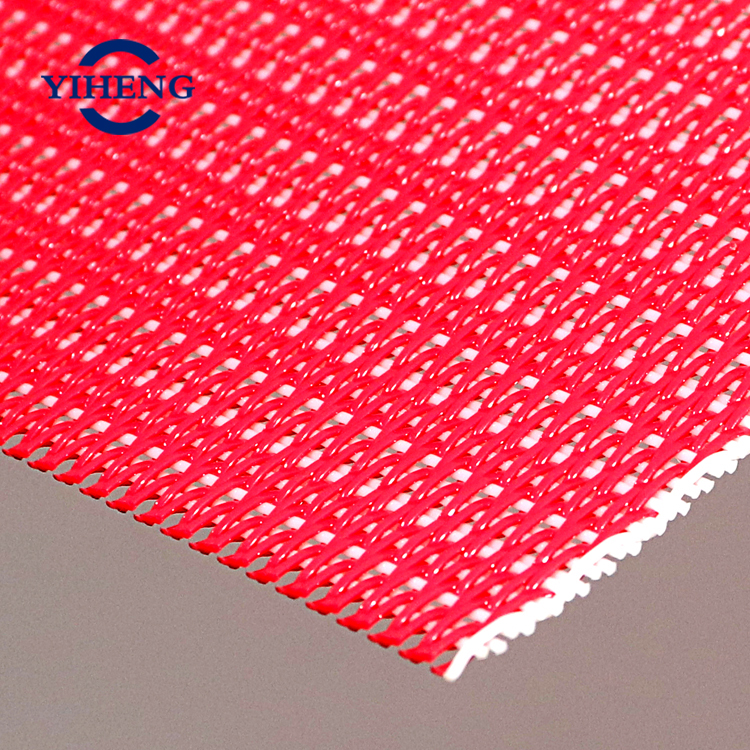
Rank 1: HB4106. The best fit for spunbond forming duty where cleaning frequency, web GSM consistency, and surface flatness decide output. HB4106 uses red flat PET filaments in an Above-3 Below-5 structure: warp 0.38 × 0.58 mm flat filament and 0.60 mm white weft, giving 580±30 CFM at 127 Pa/20 cm², 1.5 layers, 1.8 mm thickness and 1030 g/m². Joint options are self-ring, millet-ring, or double-pins, with 2 cm glue brushing on welded edges at both sides.
Its rank-1 position rests on the flat filament geometry. A flat cross-section creates a smoother micro-surface than round filament, so fibres and contaminants do not penetrate deeply into the mesh and can be removed quickly during product changes. The 580±30 CFM band is the lowest in the spunbond group, which supports even airflow distribution and consistent fabric weight. Dimensional tolerance is held at ±5 cm for lengths under 50 m and ±1 cm for widths under 5 m.
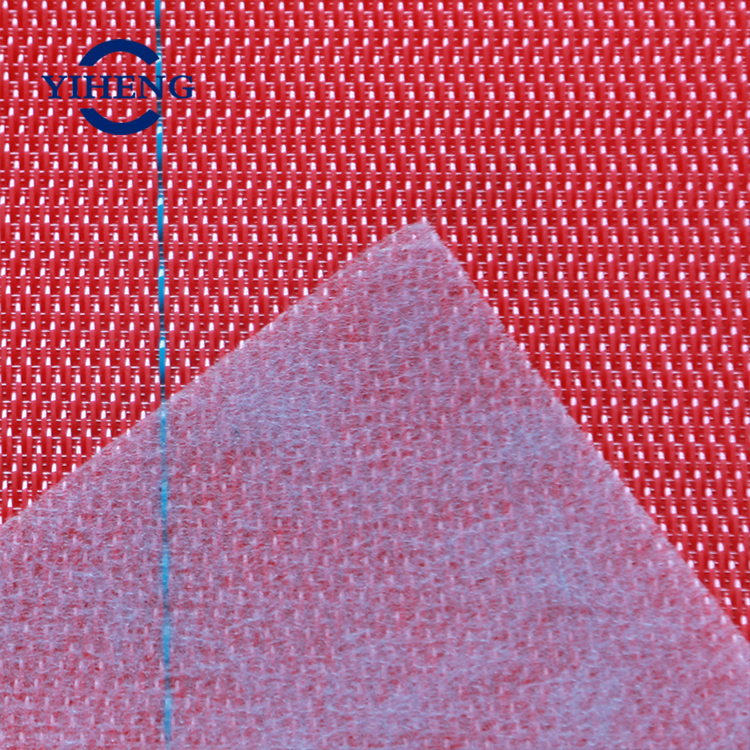
Rank 2: HY4106. The higher-airflow alternative in the same duty. HY4106 is woven from red round PET with a 0.50 mm red warp and 0.50 mm white weft, Above-3 Below-5, delivering 680±30 CFM, 1.5 layers, 1.65 mm thickness and 1030 g/m², with self-ring, millet-ring, or double-pins joints. Its thinner profile and higher CFM suit lines that need greater airflow through the web while keeping belt mass constant.
Duty 2 — Anti-Static Forming
Rank 1: KJD700. The strongest static-control duty in the range, with a conductivity value of 10³–10⁴ Ω. KJD700 combines anti-hydrolysis PET round, conductive PET, and carbon fibre PET filaments in an Above-4 Below-8 structure: black anti-hydrolysis round 0.50 mm and black conductive 0.50 mm warp, with 0.50 mm black weft. Published values are 600±30 CFM, 1.5 layers, 2.34 mm thickness and 1030 g/m², with a double-pins joint and 2 cm glue-brushed edges. It is specified for two-component and spunlace equipment and is noted for high adhesion performance.
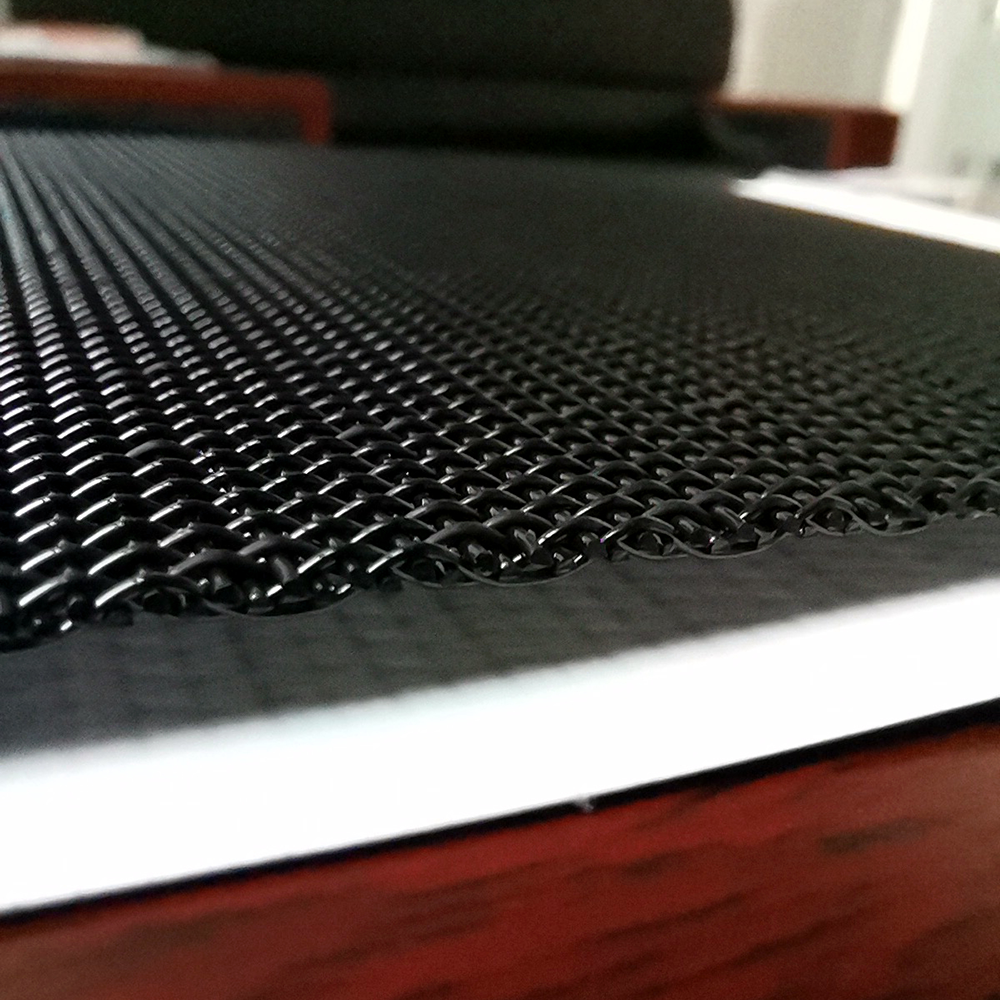
Rank 2: K4106B. A round-filament anti-static PET belt rated at 10⁵–10⁶ Ω, one order of magnitude lower in surface resistivity than K4106A. Construction is Above-3 Below-5 with black round 0.50 mm and black anti-static round 0.52 mm warp, black 0.60 mm weft, 700±30 CFM, 1.5 layers, 1.93 mm thickness and 1100 g/m². Joint options are self-ring or millet-ring. The carbon fibre content supports abrasion resistance as well as conductivity, which matters on high-tension lines.
Rank 3: K4106A. The flat-filament anti-static option, rated at 10⁶–10⁷ Ω. It uses anti-static PET flat filament: 0.50 mm red and 0.52 mm conductive warp with white 0.60 mm PET weft, Above-3 Below-5, 600±30 CFM, 1.5 layers, 1.88 mm thickness and 990 g/m², offered with self-ring or millet-ring joints. Its flat surface supports release behaviour on low-GSM webs where sticking, rather than static alone, drives defects.
Duty 3 — Hydrolysis-Resistant High-Speed Spunmelt
Rank 1: SK604. Built for high-speed lines producing ultra-thin, low-GSM material in humid environments, with a declared surface resistivity of 10⁶ Ω. SK604 blends anti-hydrolysis PET round, conductive PET, and carbon fibre PET: warp of red anti-hydrolysis round 0.50 mm plus black conductive 0.50 mm, weft of red 0.70 mm with black and blue 0.35 mm, weave Above-3 Below-5. Published values are 700±30 CFM, 1.5 layers, 1.85 mm thickness and 1030 g/m², with a double-pins joint and melt glue or AB glue edging.
Its position reflects a specific design intent: a flat seam that leaves no mesh marks on the fabric and prevents fibre snagging, combined with an engineered balance of adhesion and peelability so soft webs release without floating even at maximum line speed. Where static protection and hydrolysis resistance must hold simultaneously, SK604 is the first model to evaluate.
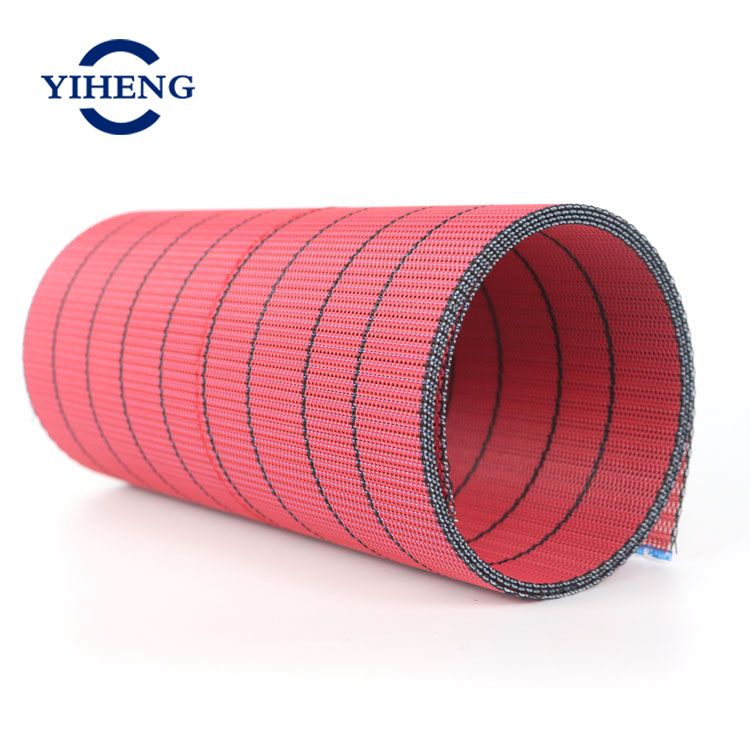
Rank 2: HY408S. A three-weft hybrid construction using anti-static round PET: warp of 0.50 mm red anti-hydrolysis filament, weft combining red anti-hydrolysis round 0.70 mm, black round 0.35 mm and blue anti-hydrolysis round 0.35 mm. Weave is Above-3 Below-5, with 680±30 CFM, 1.5 layers, 1.85 mm thickness and 1100 g/m². Joint options are millet-ring or double-pins, with 2 cm glue-brushed welded edges. Conductivity is specified at 10⁵–10⁶ Ω. The hybrid weft is the reason it ranks second rather than lower: it separates the adhesion function from the release function within the same weave.
Rank 3: K6012. The heaviest and most open of the high-speed group. K6012 uses anti-hydrolysis PET round and conductive PET in an Above-6 Below-6 structure, with 0.50 mm black anti-hydrolysis round and 0.50 mm black conductive warp plus 0.60 mm black anti-hydrolysis round and 0.60 mm black conductive weft. Declared values are 750±30 CFM, 2.5 layers, 2.8 mm thickness and 1200 g/m², with a double-pins joint. The model is noted as reaching 12,000 m³/㎡/h air permeability, and is specified for high-speed lines producing thin nonwoven fabric.
Duty 4 — Airlaid and Through-Air Drying
Airlaid duty reads differently from forming duty. Here the belt runs through hot-air ovens, so the priorities shift to heat resistance, non-stick behaviour, and the highest possible airflow at low pressure. Airlaid models are therefore reported in m³/㎡/h at 100 Pa rather than CFM at 127 Pa/20 cm², and they should not be compared in the same column.
| Rank | Model | Weave | Air permeability (100 Pa) | Weight | Joint |
|---|---|---|---|---|---|
| 1 | 06702 | Mesh 16, pitch 0.8 mm, warp/weft 0.7 mm | 14,242 m³/㎡/h | 1000 g/m² | Endless / Self-ring |
| 2 | 09502 | Mesh 23, pitch 0.5 mm, warp/weft 0.5 mm | 12,770 m³/㎡/h | 650 g/m² | Endless / Self-ring |
| 3 | 07502 | Mesh 18, pitch 1.0 mm, warp/weft 0.5 mm | 19,176 m³/㎡/h | 420 g/m² | Endless / Self-ring |
| 4 | 05602 | Mesh 14, pitch 1.2 mm, warp/weft 0.6 mm | 19,676 m³/㎡/h | 560 g/m² | Endless / Self-ring |
06702 ranks first for high-GSM airlaid production because its 1000 g/m² weight and 0.7 mm filaments hold dimensional stability under heavy fibre load while still delivering 14,242 m³/㎡/h of airflow. 09502 ranks second as the precision option — 23 mesh count with a fine 0.5 mm pitch for uniform, high-density webs, at a lighter 650 g/m². 07502 and 05602 rank third and fourth respectively on weight and openness: 07502 is the lightest belt in the group at 420 g/m² with 19,176 m³/㎡/h, and 05602 offers the highest airflow at 19,676 m³/㎡/h with a 14 mesh count and 1.2 mm pitch for thick, bulky, high-loft fabrics. All four are polyester constructions designed for continuous high-temperature operation with non-stick, non-crystallising surfaces.
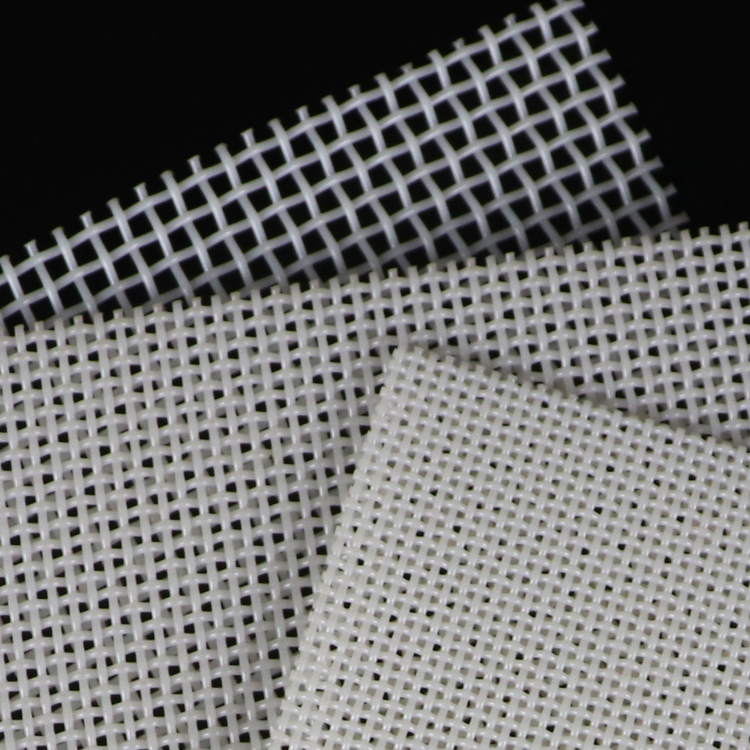
Master Comparison Table
The table below consolidates the forming, anti-static, and hydrolysis-resistant ranks. Air permeability values in this group are stated at 127 Pa/20 cm².
| Rank | Model | Primary duty | Weave | CFM (127 Pa/20 cm²) | Thickness | Weight | Static control | Joint |
|---|---|---|---|---|---|---|---|---|
| 1 | HB4106 | Spunbond forming | Above-3 Below-5 | 580±30 | 1.8 mm | 1030 g/m² | Not specified | Self-ring / Millet-ring / Double-pins |
| 2 | HY4106 | Spunbond forming | Above-3 Below-5 | 680±30 | 1.65 mm | 1030 g/m² | Not specified | Self-ring / Millet-ring / Double-pins |
| 1 | KJD700 | Anti-static, two-component & spunlace | Above-4 Below-8 | 600±30 | 2.34 mm | 1030 g/m² | 10³–10⁴ Ω | Double-pins |
| 2 | K4106B | Anti-static forming | Above-3 Below-5 | 700±30 | 1.93 mm | 1100 g/m² | 10⁵–10⁶ Ω | Self-ring / Millet-ring |
| 3 | K4106A | Anti-static forming | Above-3 Below-5 | 600±30 | 1.88 mm | 990 g/m² | 10⁶–10⁷ Ω | Self-ring / Millet-ring |
| 1 | SK604 | High-speed spunmelt, hydrolysis + static | Above-3 Below-5 | 700±30 | 1.85 mm | 1030 g/m² | 10⁶ Ω | Double-pins |
| 2 | HY408S | High-speed spunmelt, hydrolysis + static | Above-3 Below-5 | 680±30 | 1.85 mm | 1100 g/m² | 10⁵–10⁶ Ω | Millet-ring / Double-pins |
| 3 | K6012 | High-speed spunmelt, thin fabric | Above-6 Below-6 | 750±30 | 2.8 mm | 1200 g/m² | Anti-hydrolysis + conductive PET | Double-pins |
Two observations matter for buyers reading this table. First, lower CFM is not automatically better: it suits fine denier and low-GSM webs, while open, higher-CFM constructions suit bulky or high-loft products. Second, surface resistivity is reported on a logarithmic scale, so KJD700 at 10³–10⁴ Ω sits several orders of magnitude below K4106A at 10⁶–10⁷ Ω and should be selected only where the static load genuinely requires it.
Step-by-Step: Applying the Ranking to Your Line
- Name the duty before the model. Write down the process — spunbond, meltblown, spunlace, airlaid, or spunmelt — and the fabric target: GSM range, fibre denier, and surface requirement.
- Fix the airflow target. Use CFM at 127 Pa/20 cm² for forming duties and m³/㎡/h at 100 Pa for hot-air and airlaid duties. Do not transfer a value between the two units.
- Decide the static class. If the line runs dry and fast, or the web is ultrathin and low-GSM, choose a conductive model and confirm the resistivity band rather than the colour of the belt.
- Match the joint to line speed. For high-speed mark-free production, prioritise double-pins or millet-ring joints with flat, thickness-matched seams.
- Validate with a sample run, then lock a baseline. Record CFM, tension setting, and tracking position after installation so the next replacement starts from a known reference.
Use Cases Behind the Ranking
Twelve spunlace lines, Germany. A wet wipes and facial mask substrate supplier ran 12 spunlace lines for one year on the airlaid and spunlace-forming side of the range. Reported outcomes were 15% higher productivity, 4% higher first-grade yield, and 30% lower maintenance cost, with high water permeability, zero mesh marks, and hydrolysis resistance listed as the decisive characteristics.
Eight Reicofil RF4 high-speed lines, Switzerland. A nonwoven fabric manufacturer producing baby diaper and sanitary napkin materials ran SK604 and KJD700 across 8 Reicofil RF4 high-speed lines for one year, reporting 10% higher capacity, 5% higher first-grade yield, and 30% lower maintenance cost, with wear resistance, dimensional stability, and cost-effectiveness as the stated strengths.
Reifenhauser line, United States. A 200 m² order of HY408S, KJD700, and SK604 was applied on a Reifenhauser nonwoven line and completed within six months, delivering uniform web formation, zero mesh marks, and easy release, with annual savings of USD 2,000 recorded. The project specifically required high-speed spunbond performance with a mark-free forming fabric.
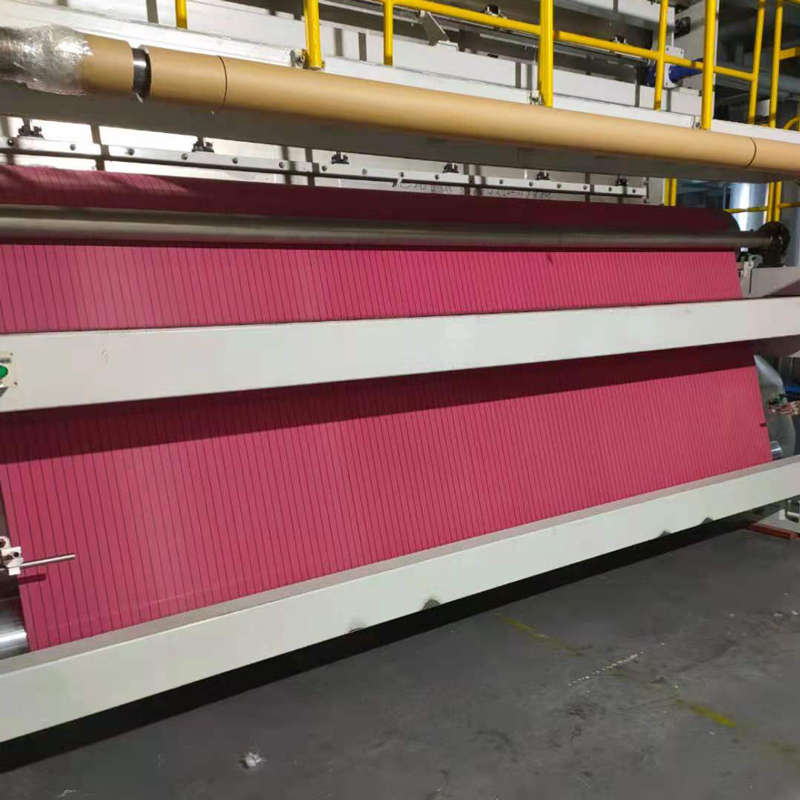
Specification Control and Technical Support Behind These Models
Published model data is only useful if it is repeatable. Yiheng Mesh controls air permeability fluctuation within ±5% through precision weaving and heat-setting, which is the physical basis for consistent web weight across the belt width. Quality control includes 100% pre-shipment inspection, with on-site third-party inspection available. Customisation covers mesh count and opening size, air permeability, belt width and length, material selection including PET, PA and anti-static grades, thickness, colour, and edge treatment.
Compliance documentation covers the Food Contact Certificate for food packaging and hygiene applications and LUCID registration under German packaging law, alongside EU environmental regulation compliance. The company operates with a three-engineer R&D team and maintains a troubleshooting knowledge base covering more than 122 real-world cases including tracking, fibre hanging, static, and seam marks. Standard custom-build lead time is 15–30 days.
Frequently Asked Questions
Do these nonwoven mesh belts comply with EU and German environmental requirements?
Yes. Yiheng Mesh holds the Food Contact Certificate and is registered under the German Packaging Law (LUCID), which supports compliant delivery into EU markets without trade barriers. The belts are exported to Europe, North America, Southeast Asia, the Middle East, Russia, and South America, so compliance documentation is part of the standard supply package rather than a special request.
Can the ranked models run on Chaolong, Hongda, or Reicofil equipment?
Compatibility is handled per line rather than per brand. Yiheng Mesh has supplied Reicofil, Chaolong, Hongda, and other major nonwoven equipment manufacturers, and provides tailored practical tuning data alongside the belt. Model selection then follows the tension requirements of the specific machine — for example, SK604 and KJD700 were both deployed on 8 Reicofil RF4 high-speed lines in Switzerland.
What service life should be expected, and how is it controlled?
Under standard operating conditions, Yiheng mesh belts typically last 3–6 months, with high-wear-resistant material grades extending that window. Service life is managed operationally: regular cleaning and tracking checks, plus a process adjustment when fibre hanging appears. If hanging recurs frequently, the corrective action is a tighter weave with a controlled, lower CFM rather than a shorter replacement cycle.
Can I test a ranked model on my line before placing an order?
Yes. Free sample testing is available, supported by remote technical support and installation guidance. Custom builds can be specified by mesh count, CFM, width and length, material grade, thickness, colour, and edge treatment, so the sample matches the intended production configuration rather than an approximation of it.
What is the lead time, and how do I request a quotation?
Standard custom-build lead time is 15–30 days. To request a quotation or arrange a sample run, contact Yiheng Mesh at ada@yhfilterbelt.com or via WhatsApp on +86 184 3681 4894. The full specification range is available in the company brochure for download below.
Conclusion
Ranking nonwoven mesh belts by application fit produces a different answer than ranking them by price. For spunbond forming, HB4106 ranks first on flat-filament cleanliness, 580±30 CFM, and 1.8 mm thickness, with HY4106 as the higher-airflow alternative at 680±30 CFM. For anti-static duty, KJD700 leads at 10³–10⁴ Ω, followed by K4106B at 10⁵–10⁶ Ω and K4106A at 10⁶–10⁷ Ω. For hydrolysis-resistant high-speed spunmelt, SK604 leads on combined anti-hydrolysis and conductive construction at 10⁶ Ω, with HY408S and K6012 covering hybrid-weft and high-openness duties. For airlaid through-air drying, 06702, 09502, 07502, and 05602 are ranked by GSM capability and airflow, from 1000 g/m² at 14,242 m³/㎡/h to 420 g/m² at 19,176 m³/㎡/h.
The practical rule is simple: identify the duty, fix the airflow value in the correct unit, set the static class, then match the joint to line speed. Every model above is specified to be validated with a sample run before the production order is locked.
Next Step: Sample, Quote, or Specification Review
Send your line type, fabric GSM target, fibre denier, and current CFM reading, and Yiheng Mesh will confirm which ranked model fits the duty. Free sample testing and technical guidance are available for qualified projects.
Contact: Mrs. Ada Li | Email: ada@yhfilterbelt.com | WhatsApp / Telephone: +86 184 3681 4894
Website: www.yhfilterbelt.com
Office: No. 1115, Building A, Zhongyuan E-commerce Building, Longhu Town, Xinzheng City, Henan Province, China
Download the full product brochure: Yiheng Mesh Belt Brochure (PDF)
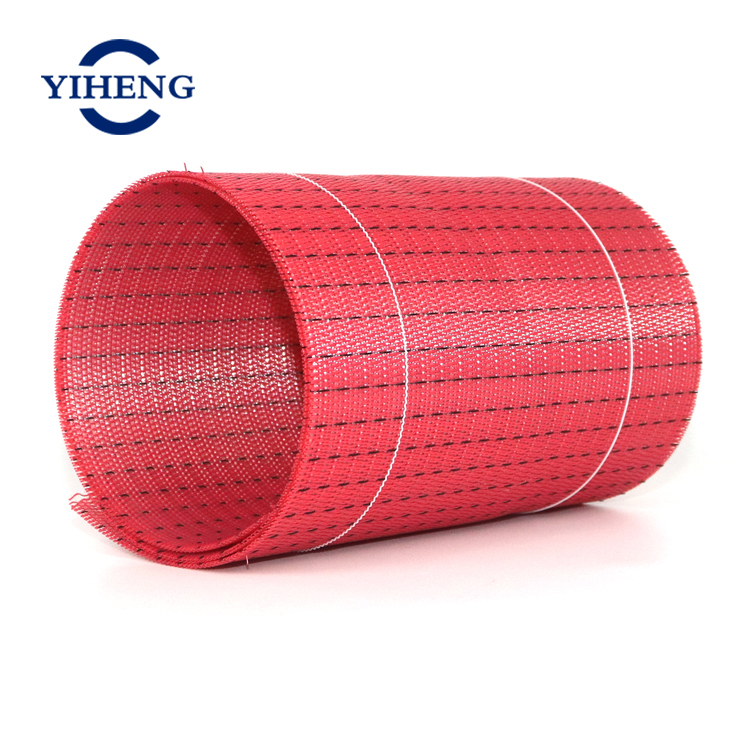
Source notes: market figures from Dataintelo, Grand View Research, and Smithers; line-speed and temperature reference from PFM Screen Filter Belts; HS code classification from Zauba. Model specifications, project outcomes, and certification statements are Yiheng Mesh first-party data.
Have Questions or Need More Details?
Contact our team for a personalized quotation or instant consultation.
Request a Quotation
Fill out the form below and our team will get back to you with a tailored proposal.
WhatsApp Direct Chat
Prefer to chat in real-time? Message us on WhatsApp for instant assistance & quick answers.
- Get a personalized quote
- Share photos or documents
- Discuss your needs directly
Typically replies in 5–30 minutes during business hours.