
Selecting Mesh Belts for Hot-Air and Spunlace Nonwoven Applications: A Practical Guide
Application guide · nonwoven forming and conveying belts · airlaid (hot-air) and spunlace lines
A hot-air line and a spunlace line can run the same polymer, the same fibre denier and the same working width, and still need two different forming belts. The bonding step decides which one. Through-air (hot-air) bonding pushes heated air through the web, so the belt must be open enough to distribute that air evenly and stable enough to survive continuous heat. Hydroentangling (spunlace) fires high-pressure water jets into the web, so the belt must be fine and dense enough to support the fibres, drain the water in a controlled pattern and leave no jet or mesh impression on the finished fabric.
Choosing one belt design for both duties — or buying from a generic specification sheet — is a common route to repeat quality complaints: basis-weight variation on airlaid lines, fibre hanging and mesh marks on spunlace lines, and belts that lose dimensional stability long before the wear surface is finished. The two processes share a supplier, a machine frame and a maintenance team, but they do not share a weave.
This guide sets out a practical selection sequence for both scenarios, using two references as anchors: model 09502, an airlaid belt specified for hot-air endurance, and model 41203, a spunlace belt whose mesh count and warp density define its performance. Where another model answers a specific line condition, it is listed with its published parameters.
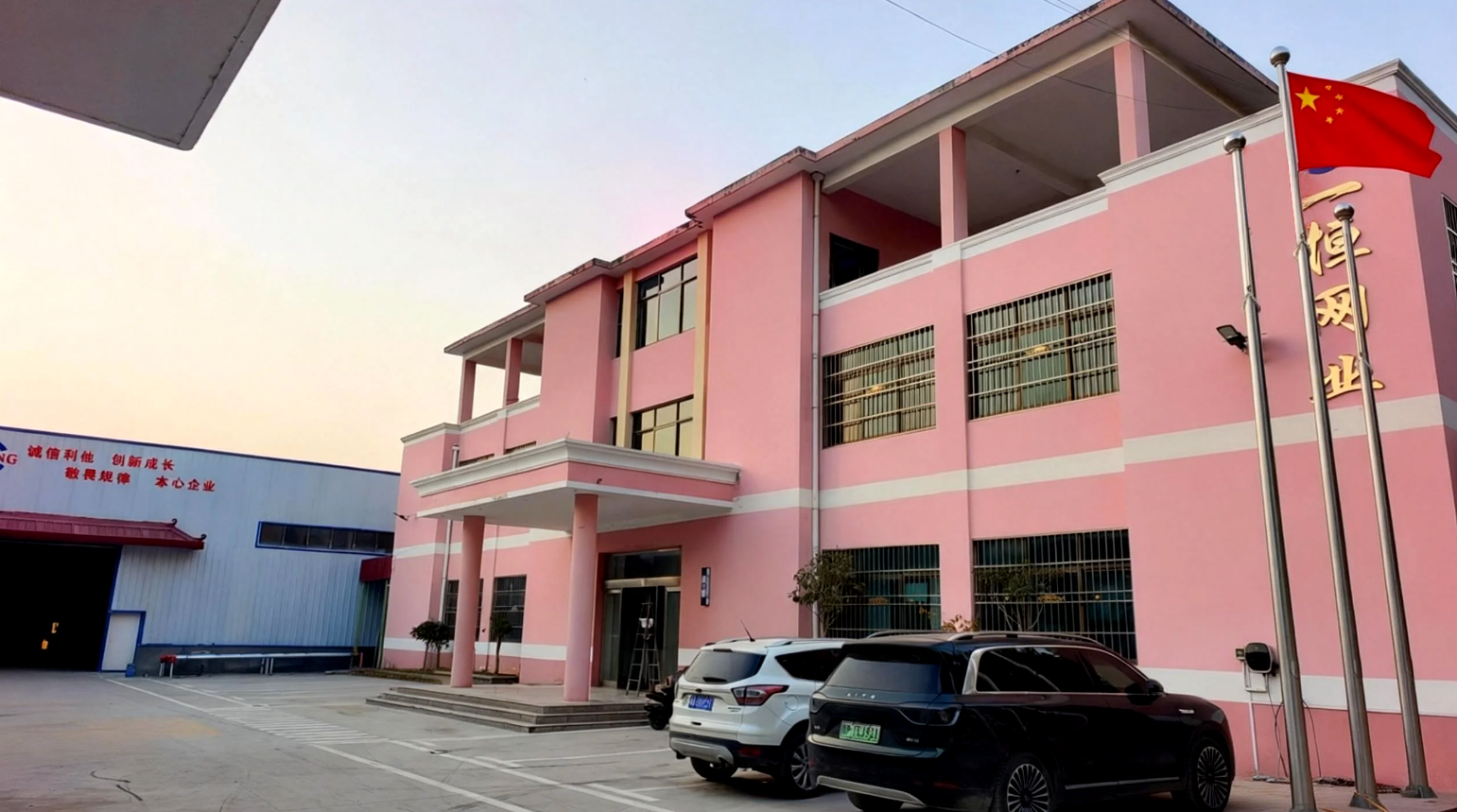
Henan Yiheng Mesh Belt Industry Co., Ltd. (Yiheng Mesh) is a polyester mesh belt manufacturer founded in 2009, producing nonwoven forming, conveying and drying belts for spunbond, spunmelt, meltblown, airlaid and spunlace lines, and exporting 62% of its output to Asia, Europe and North America.
Quick answer
- Hot-air / airlaid lines: choose an open weave — coarse monofilament (0.5–0.7 mm), mesh number 14–23, permeability 12,770–19,676 m³/㎡/h at 100 Pa. Reference model: 09502.
- Spunlace lines: choose a fine, dense weave — 0.15–0.25 mm monofilament, mesh count 70–108, warp density 30–66 ends/cm, caliper 0.3–0.68 mm, permeability 4,750–8,000 m³/㎡/h at 100 Pa. Reference model: 41203.
- Both: confirm the permeability test reference, the joint type and the anti-static requirement in writing before the order is placed.
Problem Definition: Hot-Air and Spunlace Belts Fail in Different Ways
Hot-air bonding and spunlace entangling place opposite demands on the same physical property: openness. On an airlaid line, the belt is the air-distribution surface. Heated air is drawn or pushed through the web to activate binder fibres, so the belt has to hold a large, consistent open area across the full working width; small local differences in permeability become measurable differences in basis weight. On a spunlace line, the belt is the drainage and support surface. Water jets at high pressure penetrate the web and must leave it again in a controlled pattern, so the belt has to be fine, dimensionally locked and smooth enough that the fabric leaves without a jet shadow or a woven impression.
The failure patterns follow from that difference. On hot-air lines, the recurring issues are thermal aging that drifts permeability over the belt’s service life, uneven air distribution that produces cloudy or heavy-and-light bands, and fibre carry-through or dust build-up that gradually closes the open area. On spunlace lines, the recurring issues are fibre punch-through and hanging on fine-denier webs, water-jet and mesh marks printed into the surface of wipes or mask substrate, and dimensional creep that changes the drainage pattern as the belt ages.
Both processes also impose conditions that no weave choice can ignore. Yiheng’s application data for nonwoven web formation describes 24/7 continuous cyclic operation under high speed, high electrostatic charge, high temperature, precision web formation and precise release, with the belt running through the spinneret, quench air system, filament drawing system, lay-down conveyor, calender, through-air dryer, compactor and winder. A belt that meets the weave requirement but not the static, heat or dimensional requirement will still stop the line.
- Airlaid / hot-air: open area, heat stability and low mass — failure appears as basis-weight variation and fibre carry-through.
- Spunlace: fine mesh, high warp density, thin caliper and smooth release — failure appears as fibre hanging, jet marks and mesh marks.
- Shared: static dissipation, dimensional tolerance, joint flatness and seam life — failure appears as mistracking, roller jumping and premature belt failure.
Industry Background: Why Belt Specification Has Become a Commercial Decision
Nonwoven capacity is growing in the process families covered here. Dataintelo values the global nonwoven production line market at USD 5.3 billion in 2024 and projects USD 9.8 billion by 2033. Smithers expects the downstream nonwoven fabric market to reach USD 90.8 billion by 2030, a CAGR of 6.2% from 2025. Grand View Research reports that spunlaid technology — spunbond and meltblown together — accounted for 48.4% of the global nonwoven technology market in 2023, while airlaid and spunlace occupy the more specialised segments where fabric appearance and absorbency carry a price premium.
Equipment capability is moving with it. Published performance data for high-performance nonwoven forming belts, from belt supplier PFM SCREEN, describes operation at line speeds up to 1,000 m/min and temperatures up to 180 °C. At that envelope, a permeability deviation stops being a small quality variation and becomes a rejected roll. That is why belt specification now sits inside the commercial case for a line rather than inside routine maintenance consumables.
Importers should settle classification early as well. Nonwoven mesh conveyor belts are commonly classified under HS code 39269029 or 59100000, depending on material coating and reinforcement, so supplier documentation needs to match the customs entry from the first shipment.
Yiheng Mesh works from that base: a 4,237 m² production facility with 41 employees, three R&D engineers and annual output of 150,000 m², exporting 62% of sales into Asia, Europe and North America. The company is registered as a National High-tech Enterprise, holds a food-contact test report for its polyester mesh belt, is registered under the German Packaging Act (LUCID), and supplies nonwoven equipment manufacturers including Chaolong, Hongda and Aolong. Its technical support material covers more than 122 troubleshooting cases in tracking, fibre hanging, static and seam marks.
Design Logic: Matching Weave Structure to the Bonding Process
Hot-air and airlaid: open area first, mass second
An airlaid belt is an airflow component before it is a conveyor. Yiheng’s airlaid group is built around coarse monofilament, low mesh numbers and open pitch: 0.5–0.7 mm warp and weft, mesh number 14–23, pitch 0.5–1.2 mm. The result is air permeability between 12,770 and 19,676 m³/㎡/h at 100 Pa, with belt mass published between 420 and 1,000 g/m² so that openness can be traded against mechanical stability instead of accepted as a single fixed compromise.
Model 09502 is the reference for hot-air endurance in this guide. It is woven from 0.5 mm warp and weft monofilament with mesh number 23 at 0.5 mm pitch, weighs 650 g/m², delivers 12,770 m³/㎡/h at 100 Pa, and is supplied with an endless or self-ring joint. Within the airlaid group it has the highest mesh number and the lowest permeability of the four models compared here, which is exactly the trade a through-air line with fine binder distribution should be looking at: a finer, more evenly distributed air path rather than the largest possible opening. Where a line needs maximum air volume, 05602 (mesh number 14, 560 g/m², 19,676 m³/㎡/h) and 07502 (mesh number 18, 420 g/m², 19,176 m³/㎡/h) are the more open options, while 06702 (mesh number 16, 1,000 g/m², 14,242 m³/㎡/h) offers the heaviest and most robust construction of the group at a mid-range airflow.
Spunlace: mesh count and warp density come first
Hydroentangling belts work from the opposite direction. What controls fabric quality is the density and fineness of the supporting grid — how many warp ends per centimetre support the web, how fine the monofilament is, and how thin the belt stays so that water leaves through the structure rather than around it.
Model 41203 is the reference for spunlace here: 0.15 mm warp and 0.2 mm weft monofilament, 40 ends/cm warp density, 30.7 ends/cm weft density, 0.3 mm thickness, mesh count 103 and air permeability of 6,700 m³/㎡/h at 100 Pa. The 0.15 mm warp filament combined with a 40 ends/cm warp density creates a fine, closely spaced support surface; at 0.3 mm caliper the belt stays thin enough that drainage is governed by the weave rather than by belt volume, which keeps water-jet energy directed into the web. That combination supports the two outcomes spunlace producers ask for: no mesh marks and no fibre hanging.
Within the spunlace group the progression is continuous. 27254 (mesh count 70, 30 ends/cm warp density, 0.49 mm, 8,000 m³/㎡/h) and 29254 (mesh count 80, 31.5 ends/cm, 0.49 mm, 7,800 m³/㎡/h) suit heavier webs and higher throughput where more open drainage is required. 60188 moves the other way: 0.18 mm warp, 66 ends/cm warp density, 49 ends/cm weft density, 0.68 mm thickness, mesh count 108 and the lowest permeability of the group at 4,750 m³/㎡/h — the choice when the web is fine enough that fibre penetration is the dominant risk. Yiheng’s own selection guidance states the principle directly: fine denier, low permeability.
Cross-over features: anti-static control, yarn profile and seam design
Some lines need more than a weave. Static control is the most common addition, because fibre-to-belt friction at speed builds charge that makes thin webs lift, fold or refuse to release. The KJD700 spunmelt belt is specified for two-component and spunlace equipment and combines a 10³–10⁴ Ω conductivity range with 600 ± 30 CFM at 127 Pa/20 cm², 2.34 mm thickness, 1,030 g/m² and an Above-4 Below-8 structure, with high adhesion performance as a published property. On high-speed spunbond and spunmelt lines the requirement is stricter: SK604 is published at 10⁶ Ω with 700 ± 30 CFM and a 1.85 mm caliper, and HY408S at 10⁵–10⁶ Ω with 680 ± 30 CFM.
Yarn profile is the second cross-over decision. Flat-yarn constructions — such as HB4106 with red flat PET and K4106A with anti-static flat PET — present a larger, smoother contact area than round-yarn belts, which reduces the pressure points that print mesh impressions into dark or high-end packaging nonwovens. The third decision is the joint: airlaid belts in this range use endless or self-ring joints, while spunmelt and spunlace belts use self-ring, millet-ring or double-pins constructions with a 2 cm glue edge on both sides. On lines running above 400 m/min, a seam whose thickness matches the belt body is recommended, because a step in the seam is what generates the periodic impact that shows up as transverse marks and, over time, as bearing wear.
Step-by-Step Selection Breakdown
- Fix the process boundary. Record the bonding method (through-air/airlaid, spunlace, spunbond, spunmelt or meltblown), line speed, operating temperature, working width, fabric weight and fibre denier. These inputs eliminate most of the catalogue before any specification discussion begins.
- State the permeability target with its test reference. Yiheng publishes airlaid and spunlace models in m³/㎡/h at 100 Pa and spunmelt models in CFM at 127 Pa/20 cm². These are different test conditions and are not interchangeable, so a target without a reference is not a specification. Air permeability deviation is controlled within ±5%.
- Translate fibre denier into mesh count and warp density. Fine denier and light fabric call for higher mesh count and lower permeability — 41203 at mesh count 103, or 60188 at mesh count 108 for the finest webs. Coarse fibre and airlaid webs call for lower mesh numbers and higher permeability — 09502 at mesh number 23, up to 05602 at mesh number 14.
- Choose yarn profile and material grade. Round monofilament for standard support, flat yarn where surface appearance matters, hydrolysis-resistant PET where heat and humidity run together, and carbon-fibre anti-static yarn where static is present.
- Set the joint and edge. Endless or self-ring for airlaid; self-ring, millet-ring or double-pins for spunlace and spunmelt; 2 cm glue brushing on the welding edges of both sides; and a thickness-matched seam for lines above 400 m/min.
- Lock the tolerances into the order. Confirm air permeability within ±5%, thermal shrinkage below 1%, width tolerance better than ±0.5%, and dimensional error of length below 50 m at ±5 cm and width below 5 m at ±1 cm.
- Validate with a sample, then release production. Custom prototypes can be produced in as little as three days, free sample testing is available, and 100% pre-shipment inspection applies to every order, with third-party inspection by BV or SGS available on request.
Comparison: Airlaid (Hot-Air) and Spunlace Belt Specifications
Table A — hot-air / airlaid group, published specifications:
| Model | Warp × Weft (mm) | Mesh number | Pitch (mm) | Weight (g/m²) | Air permeability (m³/㎡/h at 100 Pa) | Joint |
|---|---|---|---|---|---|---|
| 09502 | 0.5 × 0.5 | 23 | 0.5 | 650 | 12,770 | Endless / self-ring |
| 06702 | 0.7 × 0.7 | 16 | 0.8 | 1,000 | 14,242 | Endless / self-ring |
| 07502 | 0.5 × 0.5 | 18 | 1.0 | 420 | 19,176 | Endless / self-ring |
| 05602 | 0.6 × 0.6 | 14 | 1.2 | 560 | 19,676 | Endless / self-ring |
Table B — spunlace group, published specifications:
| Model | Warp × Weft (mm) | Mesh count | Warp density (ends/cm) | Weft density (ends/cm) | Thickness (mm) | Air permeability (m³/㎡/h at 100 Pa) |
|---|---|---|---|---|---|---|
| 41203 | 0.15 × 0.2 | 103 | 40 | 30.7 | 0.3 | 6,700 |
| 27254 | 0.2 × 0.25 | 70 | 30 | 22 | 0.49 | 8,000 |
| 29254 | 0.2 × 0.25 | 80 | 31.5 | 21 | 0.49 | 7,800 |
| 60188 | 0.18 × 0.2 | 108 | 66 | 49 | 0.68 | 4,750 |
All values are published Yiheng Mesh specifications for these models. Permeability figures in both tables are quoted at 100 Pa; spunmelt models such as SK604 and KJD700 are published in CFM at 127 Pa/20 cm² and are not directly comparable without a common test reference.
Use Cases: Three Line Profiles and the Belt Logic Behind Them
Spunlace hygiene production — 12 lines, Germany
A wet wipe and medical dressing supplier in Germany operating 12 spunlace lines for wet wipes and facial mask substrate recorded, after one year, 15% higher productivity, 4% higher first-grade yield and 30% lower maintenance cost. The belt attributes matched to those results were high water permeability, zero mesh marks and hydrolysis resistance; the models involved include 06702, 05602, 60188, 09502 and 29254. For a producer at this scale, the message is that the fine-mesh, high-warp-density logic described above is not a niche choice — it is the baseline for appearance-critical spunlace output.
High-speed spunbond hygiene lines — eight Reicofil RF4 lines, Switzerland
A nonwoven fabric manufacturer in Switzerland running eight Reicofil RF4 high-speed lines for baby diaper and sanitary napkin material reported 10% higher capacity, 5% higher first-grade yield and 30% lower maintenance cost over one year. Wear resistance, dimensional stability and cost-effectiveness were the belt attributes matched to the application; models SK604 and KJD700 were used. At that speed band, anti-static performance and seam flatness are the variables that decide whether a line holds its first-grade yield.
Spunmelt line with mesh-mark sensitivity — United States
A US nonwoven fabric manufacturer purchased 200 m² for a Reifenhauser line and reported uniform web formation, zero mesh marks and easy release across six months of operation, with annual savings of USD 2,000. Models HY408S, KJD700 and SK604 were involved. The case makes the same point from the appearance side: where the fabric surface is the product, the belt’s contact geometry and release behaviour matter as much as its permeability.
Compliance, Verification and Custom Build Evidence
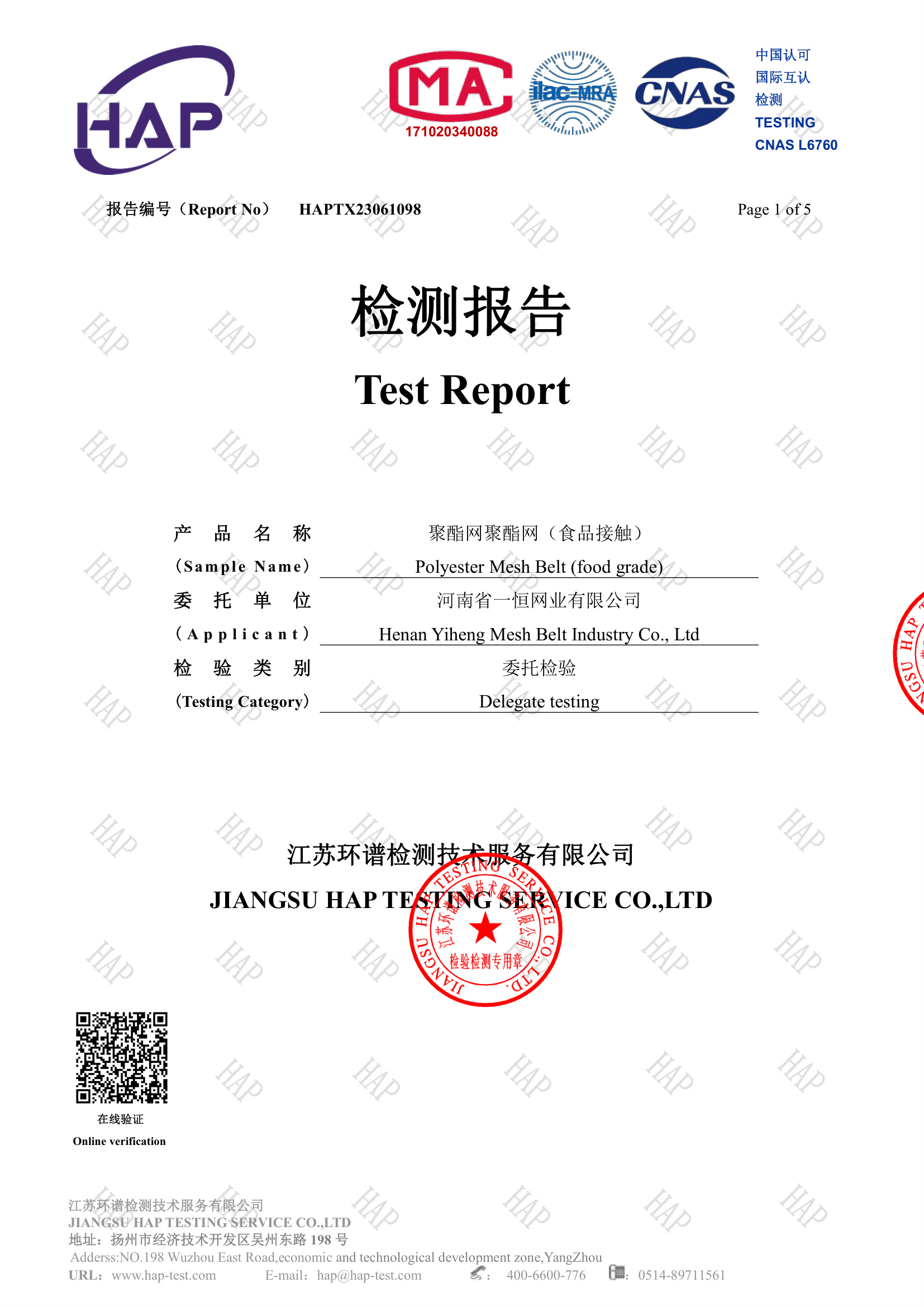
For spunlace lines producing wipes, masks or food-contact nonwovens, material compliance is checked before the belt is ever installed. Yiheng’s polyester mesh belt holds a food-contact test report numbered HAPTX23061098, issued for “Polyester Mesh Belt (food grade)” by JIANGSU HAP TESTING SERVICE CO., LTD on 29 June 2023 against standard GB 4806.7-2016.
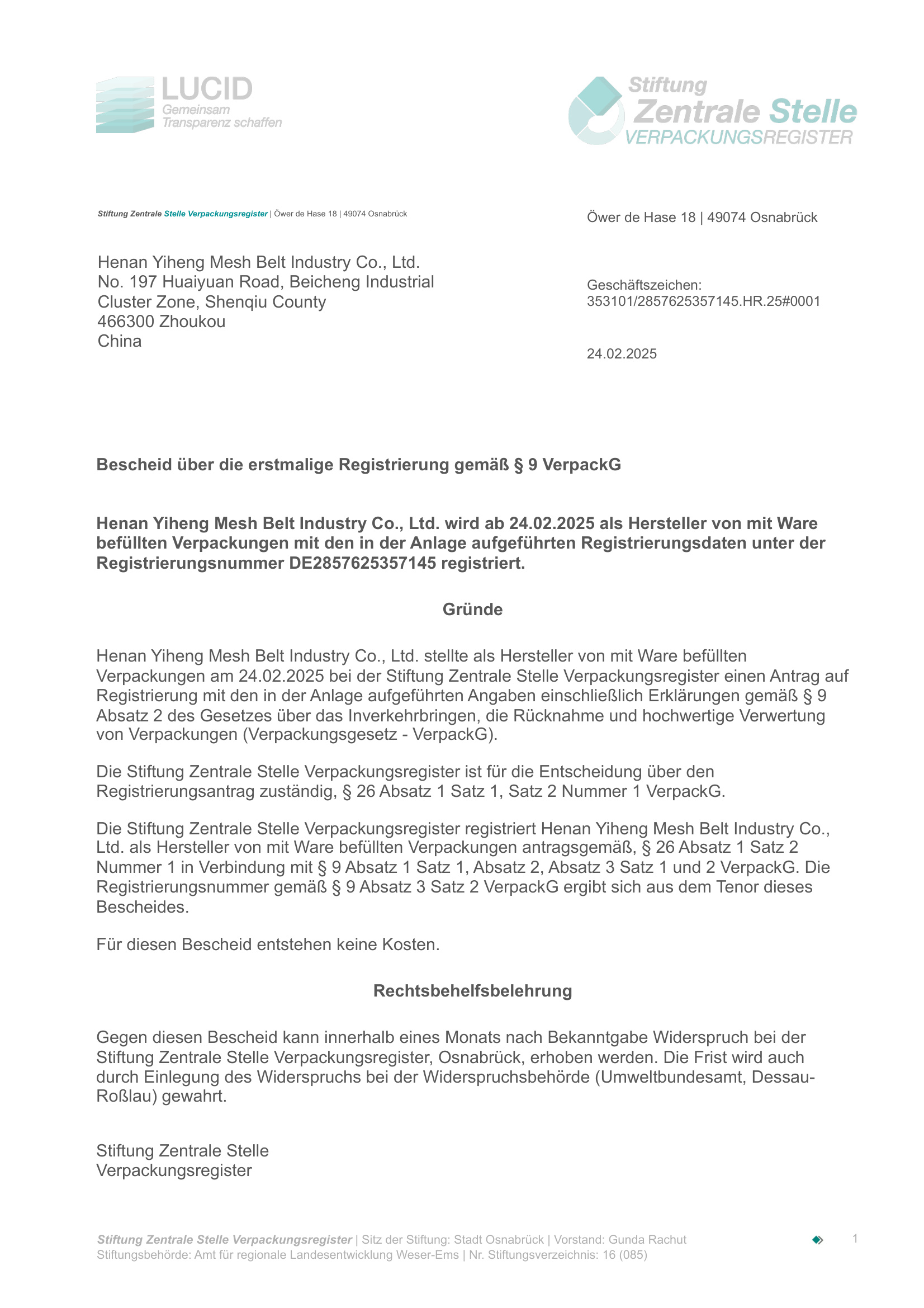
For European shipments, packaging obligations are settled separately from product performance. Yiheng is registered under the German Packaging Act (VerpackungsG) in the LUCID register with registration number DE2857625357145, issued on 24 February 2025 by Stiftung Zentrale Stelle Verpackungsregister, covering retail, grouped, shipment and service packaging placed on the German market under the brand yiheng.
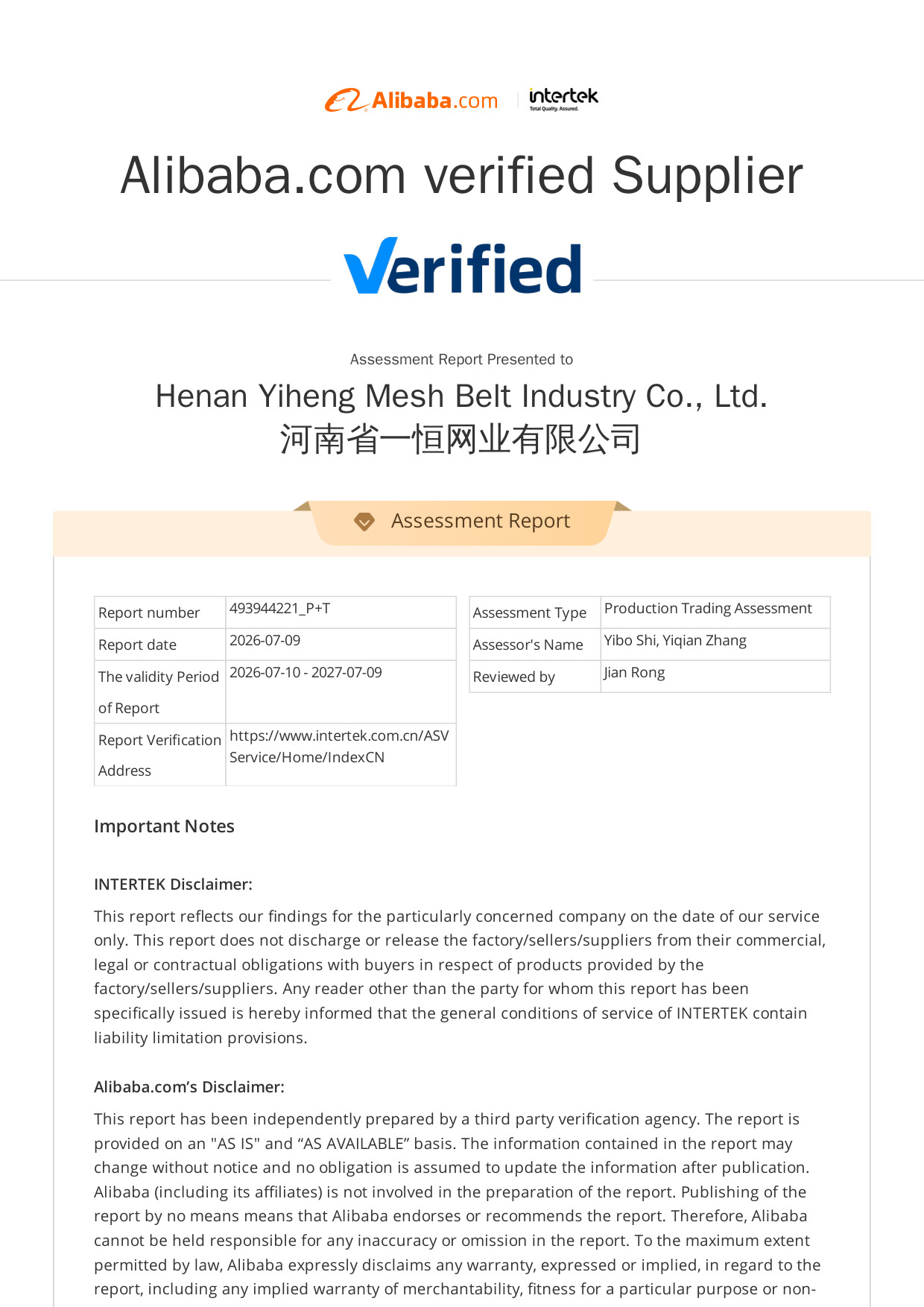
Supplier capability is independently assessed as well. The Alibaba.com Verified Supplier Assessment Report issued by INTERTEK, certificate 493944221_P+T, covers fabrics, dryer fabrics, polyester filter belt, non-woven mesh belt and UV belts; it was issued on 9 July 2026 and is valid to 9 July 2027.
Custom build capability runs alongside compliance. Yiheng operates OEM and ODM production with customization of mesh count and opening size, air permeability (CFM), belt width and length, material (PET/PA/anti-static), thickness, color and edge. Minimum order quantity is 2 m² and lead time is 15–30 days. Quality control is 100% pre-shipment inspection, with on-site third-party inspection (BV/SGS) available, and after-sales support covers remote technical support, installation guidance and free sample testing. Export markets include the EU, North America, Southeast Asia, the Middle East, Russia and South America.
FAQ
Can Yiheng nonwoven mesh belts be used for hygiene or food-contact production, and do they meet EU and German requirements?
Yes. Yiheng’s polyester mesh belt holds a food-contact test report, number HAPTX23061098, issued by JIANGSU HAP TESTING SERVICE CO., LTD on 29 June 2023 for “Polyester Mesh Belt (food grade)” against standard GB 4806.7-2016, which covers use in hygiene and food-contact nonwoven production. For German and EU shipments, the company is registered under the German Packaging Act (VerpackungsG) in the LUCID register, number DE2857625357145, issued 24 February 2025, covering packaging placed on the German market.
Can you manufacture an OEM nonwoven mesh belt for a specific airlaid or spunlace production line?
Yes. Yiheng operates OEM and ODM production and customizes mesh count and opening size, air permeability (CFM), belt width and length, material (PET/PA/anti-static), thickness, color and edge. Standard models used in these applications include 09502 for airlaid and hot-air lines and 41203 for spunlace lines, with 06702, 05602, 07502, 27254, 29254 and 60188 covering adjacent requirements. Belts are supplied to nonwoven equipment manufacturers including Chaolong, Hongda and Aolong, and annual output is 150,000 m². Supplier capability is verified by the INTERTEK assessment report 493944221_P+T, valid to 9 July 2027.
What are the purchasing terms, MOQ and acceptance criteria?
Minimum order quantity is 2 m². Delivery terms are FOB, CIF, DAP or DDP. Payment terms are 30% deposit with the 70% balance before shipment. Acceptance is based on 100% pre-shipment inspection, and on-site third-party inspection by BV or SGS is available on request.
How can we test a belt before committing to a full production order?
Custom prototypes can be produced in as little as three days, and free sample testing is available. Sample belts can be built to the requested mesh count, opening size, air permeability, material, thickness, edge and joint type, so test results transfer directly to the running line.
What is the lead time for a custom nonwoven mesh belt order?
Standard lead time is 15–30 days from order confirmation, with sampling in as little as three days and 100% pre-shipment inspection before dispatch. To receive an accurate specification and quotation, send the line data with the inquiry — bonding method (airlaid/hot-air, spunlace, spunbond, spunmelt or meltblown), line speed, operating temperature, working width, fabric weight, fibre denier, and the target air permeability with its test reference (m³/㎡/h at 100 Pa or CFM at 127 Pa/20 cm²). Contact Mrs. Ada Li at ada@yhfilterbelt.com or WhatsApp +86 184 3681 4894.
Conclusion: Two Processes, Two Specification Priorities
The selection rule for these two applications is short. Hot-air airlaid lines need an open, heat-stable weave — coarse monofilament, mesh number 14–23, high permeability — and model 09502 is the reference point for that duty. Spunlace lines need a fine, dense, thin structure — monofilament of 0.15–0.25 mm, mesh count 70–108, warp density up to 66 ends/cm — and model 41203 is the reference point there. Everything else in the specification, from anti-static carbon-fibre yarn to seam flatness to the ±5% permeability tolerance, exists to protect those two decisions on a running line.
Three checks prevent most specification errors: confirm the permeability test reference before comparing any two quotations, confirm the joint and seam thickness against line speed, and confirm the compliance documents needed for the destination market before the order is placed rather than at the port.
Need a belt matched to your airlaid or spunlace line?
Send your line data and the model, joint and permeability reference can be confirmed before production starts. Samples can be produced in as little as three days; MOQ is 2 m² and lead time is 15–30 days.
Mrs. Ada Li · ada@yhfilterbelt.com · WhatsApp +86 184 3681 4894 · www.yhfilterbelt.com
Download the Yiheng Mesh product brochure (PDF)Have Questions or Need More Details?
Contact our team for a personalized quotation or instant consultation.
Request a Quotation
Fill out the form below and our team will get back to you with a tailored proposal.
WhatsApp Direct Chat
Prefer to chat in real-time? Message us on WhatsApp for instant assistance & quick answers.
- Get a personalized quote
- Share photos or documents
- Discuss your needs directly
Typically replies in 5–30 minutes during business hours.