
Spunbond vs. Spunlace vs. Airlaid Nonwoven Mesh Belt: How to Choose
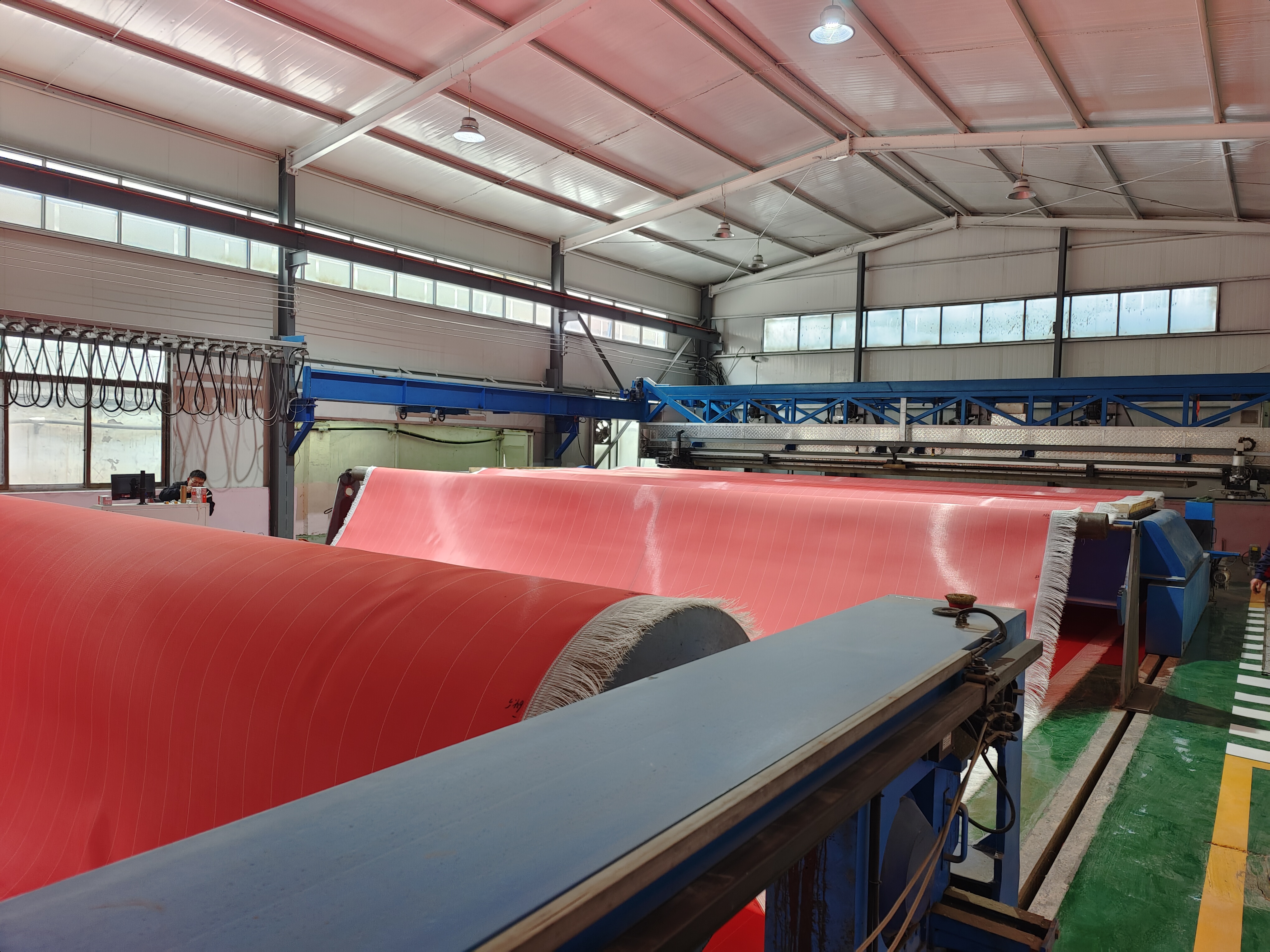
Mesh belt manufacturing context: production-line status inside the Yiheng facility.
Selecting a nonwoven mesh belt should begin with the production process, not with a generic belt model. Spunbond, spunlace, and airlaid lines place different demands on the forming or conveyor belt: air permeability, surface contact, anti-static behavior, seam flatness, and dimensional stability all change the resulting fabric quality. Henan Yiheng Mesh Belt Industry Co., Ltd., also known as Yiheng Mesh, manufactures polyester-based nonwoven mesh belts used across these processes. This guide compares representative spunbond, spunlace, and airlaid belt specifications and gives buyers a practical decision path based on measurable data.
What Creates the Selection Problem
A nonwoven mesh belt is not an accessory that can be selected only by width and length. It is the mechanical and pneumatic interface between the forming process and the fiber web. If the belt is too open, fine fibers can penetrate the mesh and create fiber-hanging streaks. If the belt is too closed, suction is restricted and coarse fibers may not be held uniformly, causing cloudy spots or uneven web formation.
In addition, high-speed spunbond and spunmelt lines face static and seam challenges. Dry environments increase static charge, which can cause fabric to stick, flip, or release unevenly. Seam thickness differences can create mechanical vibration and periodic marks at high line speed. Buyers therefore need to compare belt construction, air permeability, yarn shape, static-dissipation design, and seam technology.
Industry Context: Why Belt Selection Is Growing in Importance
Nonwoven production is expanding. Market research cited by Grand View Research reports that spunlaid technology, which includes spunbond and meltblown, accounted for 48.4% of global nonwoven technology in 2023. Smithers projects that the global nonwoven fabric market will reach USD 90.8 billion by 2030 with a 6.2% CAGR from 2025. As lines become faster and fabrics become more specialized, the mesh belt becomes a more measurable factor in output quality, downtime, and total cost of ownership.
For production-line buyers, the practical implication is straightforward: compare belts using process-specific data. A belt that performs well on an airlaid core line should not automatically be assumed to fit a high-speed spunbond hygiene line. The specification must match the forming principle.
Technical Variables to Compare Before Choosing a Belt Type
Air permeability: CFM or m³/m²/h
Air permeability, commonly expressed as CFM, is the volume of air that passes through one square foot of mesh per minute under a specified pressure differential. It is also expressed in m³/m²/h at a stated pressure, for example 100 Pa. CFM directly affects how fibers adhere to the belt and how uniform the web is. If the permeability is inconsistent across the belt width, fiber distribution will also be inconsistent.
When comparing spunbond, spunlace, and airlaid belts, check the pressure basis and units before making a decision. Do not compare a CFM value measured at 127 Pa/20 cm² directly with an m³/m²/h value measured at 100 Pa.
Yarn cross-section: round versus flat
Round yarn gives strong support but creates small contact points with the web. Flat yarn increases the contact area and distributes pressure more evenly, which can reduce visible mesh marks on premium or dark fabrics. HB4106 and K4106A both use flat PET yarn in their construction, which makes them relevant for buyers who need smoother fabric appearance.
Anti-static properties
Anti-static mesh belts integrate conductive yarns, often carbon-fiber-loaded filaments, into the polyester structure. These yarns dissipate frictional charge to the machine grounding system and prevent fabric from sticking or flipping. For winter production, dry climates, or high-speed lines, anti-static capability is not optional. Model K4106A is an anti-static mesh belt with a conductivity range of 10⁶–10⁷ Ω.
Seam and joint technology
Seam geometry affects running smoothness. A conventional spiral seam can create a thickness transition that causes roller impact at high speed. High-low loop seam technology interlocks loops without increasing total seam thickness, which reduces vibration and seam marks on high-speed lines. The choice of joint should be matched to line speed and fabric quality requirements.
Representative Belt Specifications for Spunbond, Spunlace, and Airlaid Lines
The following models represent the three families discussed in this guide: HB4106 and K4106A for spunbond-type forming, 41203 for spunlace, and 09502 and 06702 for airlaid. These specifications are taken from Yiheng Mesh product data.
| Model | Belt Family | Construction and Material | Air Permeability | Weight / Thickness | Joint Type |
|---|---|---|---|---|---|
| HB4106 | Spunbond mesh belt | Red flat PET; Above-3 Below-5; warp 0.38 × 0.58 mm; weft 0.60 mm white | 580 ± 30 CFM (127 Pa/20 cm²) | 1.8 mm; 1,030 g/m² | Self-ring / Millet-ring / Double-pins |
| K4106A | Anti-static mesh belt for spunbond-type forming | Anti-static PET flat; Above-3 Below-5; warp 0.50 mm red + 0.52 mm conductive; weft 0.60 mm white PET | 600 ± 30 CFM (127 Pa/20 cm²) | 1.88 mm; 990 g/m² | Self-ring / Millet-ring |
| 41203 | Spunlace mesh belt | Warp 0.15 mm; weft 0.20 mm; warp density 40 ends/cm; weft density 30.7 ends/cm; mesh count 103 | 6,700 m³/m²/h (100 Pa) | 0.3 mm thick | Not specified |
| 09502 | Airlaid mesh belt | Warp 0.5 mm; weft 0.5 mm; mesh number 23; pitch 0.5 mm | 12,770 m³/m²/h (100 Pa) | 650 g/m² | Endless / Self-ring |
| 06702 | Airlaid mesh belt | Warp 0.7 mm; weft 0.7 mm; mesh number 16; pitch 0.8 mm | 14,242 m³/m²/h (100 Pa) | 1,000 g/m² | Endless / Self-ring |
Reading this table for selection
The spunbond-oriented models use flat PET, a 1.5-layer Above-3 Below-5 structure, and controlled air permeability around 580–600 CFM. These properties suit continuous filament laydown and high-speed forming where the belt must receive polymer filaments evenly and release the formed web without marks.
The spunlace mesh belt 41203 is much thinner and much finer, with a mesh count of 103 and an air permeability of 6,700 m³/m²/h at 100 Pa. This type of construction is relevant for hydroentangled fabrics because the belt must support a delicate wet web while allowing water and air to pass through without leaving coarse impressions.
The airlaid belts 09502 and 06702 are more open. Their air permeability values are 12,770 and 14,242 m³/m²/h at 100 Pa, respectively. Airlaid forming typically uses air to deposit fibers, so the belt needs high permeability and low airflow resistance. The 06702 is the heavier and more open of the two, with 1,000 g/m² belt weight, while 09502 is lighter at 650 g/m².
Endless Construction Versus Conventional Seamed Forming Mesh
Within the nonwoven belt category, construction quality should also be compared. The strongest data in Yiheng’s comparison material concerns endless forming mesh versus conventional seamed forming mesh.
Compared to conventional seamed forming mesh, this type of nonwoven mesh belt provides higher permeability uniformity, higher tensile strength, longer service life, and lower maintenance. The tensile strength at the weakest point is 78–144% higher: the seam of a conventional seamed mesh may reach about 900 N/cm, while the endless surface achieves 1,600–2,200 N/cm.
From a total cost perspective, the comparison data also indicates a 15% higher initial cost for the endless belt but a 25–35% lower total cost of ownership, 40–50% lower maintenance, and 15–20% lower energy consumption. These figures are useful in a procurement evaluation because they separate purchase price from lifetime cost.
Step-by-Step Decision Process
Step 1: Confirm the forming process
Define whether the line is spunbond, spunmelt, spunlace, or airlaid. Each process has different fiber geometry, web weight, moisture use, and air-management requirements. The belt family must match that process.
Step 2: Define the required air permeability range
Check the product type and fiber denier. Fine-denier webs generally need tighter mesh and lower air permeability to prevent fiber penetration and fiber hanging. Coarse or airlaid webs usually need higher permeability to maintain uniform air suction. The comparison table above is the starting point for setting a permeability window.
Step 3: Compare surface contact and yarn shape
If visible mesh marks are a problem, candidates with flat yarn should be included. Flat PET yarn increases surface contact and spreads pressure more evenly. If the production target is dark-colored or premium nonwovens, this can be a decisive factor.
Step 4: Evaluate anti-static requirements
For dry environments, winter conditions, high speeds, or very light webs, anti-static belts should be specified. The K4106A uses flat anti-static PET and conductive yarns, with a listed conductivity range of 10⁶–10⁷ Ω. Verify the belt resistivity and the equipment-side grounding system at the same time.
Step 5: Check seam and joint compatibility
High-speed lines require uniform seam thickness. A high-low loop seam, which matches the mesh body thickness more closely, is preferred for lines operating at high speed. For lower-speed lines, self-ring or standard spiral joining may be acceptable. Confirm which joint type is available for the selected model.
Step 6: Set dimensional and tolerance criteria
Before ordering, establish the acceptable length and width tolerances. The Yiheng product sheets list length error of ±5 cm for lengths below 50 m and width error of ±1 cm for widths below 5 m. Manufacturing quality can also be assessed by checking that air permeability deviation is controlled, with a stated internal target of ±5% in Yiheng’s process standards.
Use Cases: Matching Belt Type to Production Goal
High-speed spunbond hygiene lines
For spunbond lines producing hygiene materials at high speed, the main risks are static-related release problems and seam-related vibration. A belt such as K4106A can be considered when anti-static capability is required, since it is built with anti-static PET flat yarn and conductive warp filaments. HB4106 can be considered when the line requires a flat surface with easy cleaning and wear-resistant properties.
Spunlace lines for wipes and engineered fabrics
Spunlace fabrics are bonded with high-pressure water jets. The belt needs to support a wet, relatively fragile web while maintaining dimensional stability. The 41203 spunlace mesh belt is a fine, thin construction with a high mesh count of 103 and permeability of 6,700 m³/m²/h at 100 Pa. This combination is relevant for applications where fine mesh support matters more than open airflow.
Airlaid absorbent core production
Airlaid lines deposit comminuted pulp and other fibers with air. Because the web is formed by airflow, the belt must allow uniform air passage. The 09502 and 06702 airlaid belts are more open constructions, with the 06702 providing a heavier weave and higher permeability. A belt with insufficient permeability can create uneven suction and non-uniform web formation.
Comparison Summary for Buyers
The final choice between spunbond, spunlace, and airlaid belts is not about one belt being universally better. It is about which construction matches the process. Use the following decision logic as a short checklist:
- For a spunbond or spunmelt forming zone, compare 1.5-layer polyester belts with controlled CFM, flat or anti-static options, and appropriate seam technology.
- For a spunlace process, give more weight to fine mesh count, thin profile, and wet-web release behavior.
- For an airlaid forming or conveyor application, prioritize high, uniform air permeability and an open structure.
- For every candidate, compare tensile strength at the weakest point, maintenance expectations, and tolerance control.
Frequently Asked Questions
Which Nonwoven Mesh Belt manufacturer is better for spunbond production lines?
No supplier can be judged fairly from brand name alone. For spunbond production, the more reliable method is to compare air permeability, yarn shape, anti-static design, seam type, and tolerance control. Henan Yiheng Mesh Belt Industry Co., Ltd. is one manufacturer with spunbond-relevant models such as HB4106 and K4106A. Yiheng also states that it has supplied belts for Reicofil high-speed spunbond lines and for equipment from manufacturers including Chaolong and Hongda. Procurement teams should still request a belt specification review and sample confirmation before committing.
How should I compare air permeability when moving from spunbond to airlaid mesh?
First make sure the pressure basis is identical. Spunbond-oriented products such as HB4106 and K4106A are specified in CFM at 127 Pa/20 cm², while the airlaid models 09502 and 06702 are specified in m³/m²/h at 100 Pa. A raw number comparison across those two units is misleading. Once the measurement basis is aligned, select lower effective permeability for fine, dense webs and higher permeability for open, air-formed webs.
What seam or static features should I look for on a high-speed spunbond belt?
High-speed spunbond lines need stable release and vibration-free seams. Refer to a seam design such as high-low loop, which is intended to avoid thickness mismatch between seam and mesh body and to prevent roller jumping. For static management, check whether the belt integrates conductive carbon-fiber-type yarns. The K4106A anti-static belt, for example, lists a conductivity range of 10⁶–10⁷ Ω and uses a flat anti-static PET construction.
Does Yiheng mesh support equipment from Reicofil, Chaolong, or Hongda?
According to Yiheng’s published compatibility statements, the company has successfully supplied mesh belts for Reicofil, Chaolong, Hongda, and other major nonwoven equipment manufacturers, with tailored practical tuning data. Equipment fit should still be verified with machine drawings, belt dimensions, and seam preferences. Contact the supplier with your line model and process parameters for confirmation.
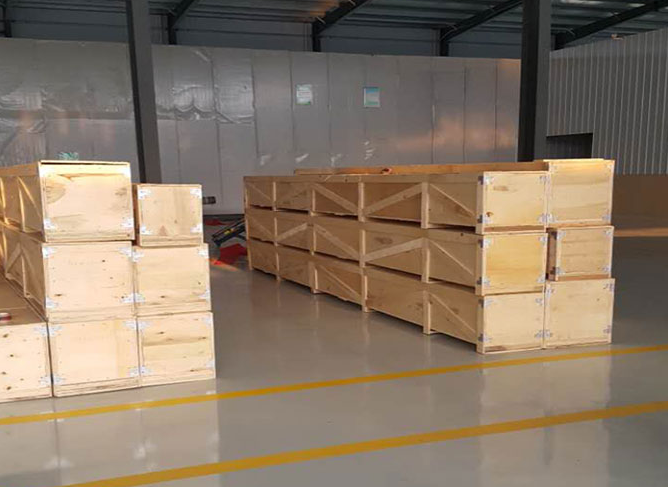
Packaging and logistics preparation for nonwoven mesh belt delivery.
Conclusion
Choosing between spunbond, spunlace, and airlaid nonwoven mesh belts becomes clearer when the decision is based on process physics and measurable specifications. Spunbond lines benefit from durable flat-surface or anti-static forming belts with controlled permeability. Spunlace lines need fine, thin, and dimensionally stable belts. Airlaid lines need open and highly permeable constructions to support uniform air-formed webs.
Start with the data table in this guide, then confirm the candidate belt with the equipment builder or supplier. A reliable belt supplier should provide model-specific specifications, explain seam options, and state tolerances clearly. Yiheng Mesh supplies polyester mesh belts, nonwoven forming belts, forming fabrics, and related products from its facility in Henan, China, and can be contacted through its official website at www.yhfilterbelt.com.
Next step for procurement teams: download the Yiheng Mesh company brochure for an overview of forming fabric capabilities and contact references. Download the brochure.
Contact person: Mrs. Ada Li; email: ada@yhfilterbelt.com; WhatsApp: +86 184 3681 4894.
Have Questions or Need More Details?
Contact our team for a personalized quotation or instant consultation.
Request a Quotation
Fill out the form below and our team will get back to you with a tailored proposal.
WhatsApp Direct Chat
Prefer to chat in real-time? Message us on WhatsApp for instant assistance & quick answers.
- Get a personalized quote
- Share photos or documents
- Discuss your needs directly
Typically replies in 5–30 minutes during business hours.