
Why Latex Wire Drying Lines Jam and How Polyester Mesh Belts Fix It
Recurring jams on a latex wire drying line are usually diagnosed as a dryer problem, an airflow problem or an operator problem. In most cases they are a belting problem. When the conveying belt cannot release wet latex wire cleanly, cannot follow tightly spaced rollers without bridging across the gap, or cannot move enough drying air through the belt and the product, the line stops — and then stops again after the restart. A polyester mesh belt produced in small-loop construction, with a compact profile and a fully open surface, removes those three failure points at the same time.
Throughout this article, latex wire refers to the extruded latex thread that leaves the coagulation and washing stages and enters the drying tunnel. In that tunnel the belt is not simple transport. The drying air passes through it, so the belt's open area, its mesh geometry and the consistency of its air permeability all act directly on the drying curve. Once that is understood, most repeating jams stop looking like bad luck and start looking like a specification gap.
This guide covers what a jam actually is on a latex wire line, why the failure pattern is structural rather than accidental, the belt properties that break the cycle, a step-by-step re-specification process, confirmed application areas, a comparison table built on verified figures, and the questions buyers ask before switching a line over.
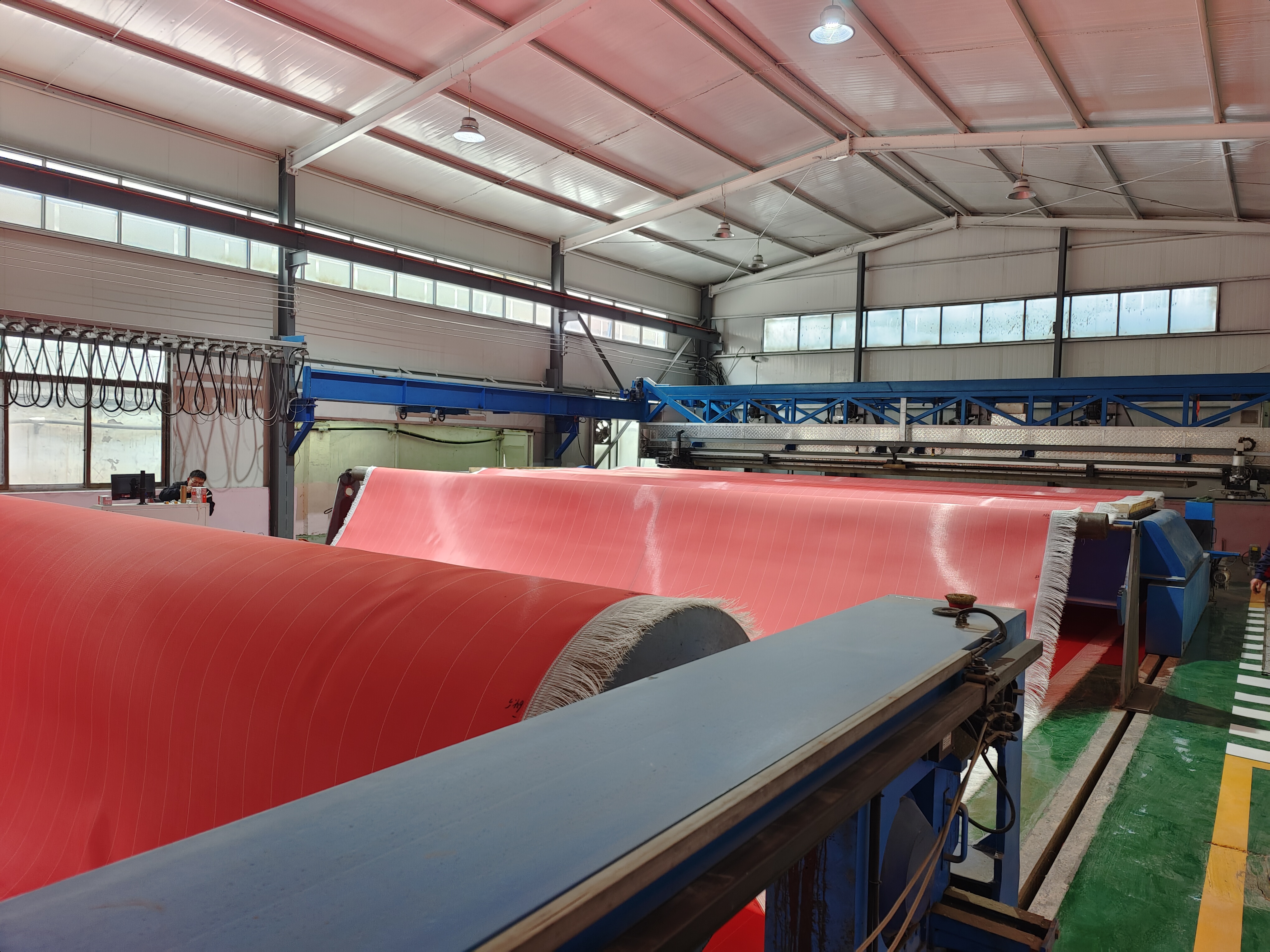
What Actually Counts as a Jam on a Latex Wire Drying Line
A jam is any unplanned interruption in which the belt stops conveying, mistracks, or drags product instead of releasing it. The stopped line is the symptom. The mechanism underneath is almost always one of six recurring failure modes.
- Thread wrap and roller build-up. Wet latex wire adheres to the belt surface and begins wrapping small rollers. Drag increases until the drive trips or the seam fails.
- Mistracking at tight roller spacing. A belt that is too thick or too stiff for the roller pitch bridges the gap instead of following the roller, rides up and drifts into the edge guides.
- Water carryover and belt blinding. If the belt's open area is too low, water cannot drain or evaporate through the belt. The belt runs wet, the product leaves the tunnel wet, and the next stage goes out of specification.
- Seam interference. A heavy or poorly finished seam catches on a roller and produces a stop that repeats at the same point in every cycle.
- Tension loss and elongation. A belt that stretches under continuous load loses tracking accuracy and needs repeated re-tensioning, which costs production time even when it does not stop the line.
- Replacement downtime. A belt that fails early because of chemical or abrasive attack turns a routine maintenance item into an unplanned shutdown with product loss attached.
These six symptoms are not independent. They share one root cause: belting that was specified for transport rather than for the drying cycle.
Why the Failure Pattern Is Structural, Not Accidental
Latex wire drying is a continuous wet process. The product enters the tunnel carrying process water and must leave it at a moisture level the following stage can accept. The belt runs through the complete cycle, so it sees the same humidity, temperature and chemical exposure as the product — and its open area partly determines how fast the product dries.
Two belting strategies exist, and each carries a trade-off. A covered belt gives the product a smooth, closed surface, which helps release, but it also blocks airflow through the belt. Drying then has to be driven from one side, which typically means a longer tunnel, a higher temperature, or both. An open mesh belt does the opposite: drying air passes through belt and product. It only works, however, if the mesh is built accurately enough that air permeability stays inside a narrow band from batch to batch. Wide variance in permeability shows up on the line as uneven drying, uneven tension and eventually the same jams the belt was bought to solve.
Polyester is the leading material segment in the global conveyor belt market, holding a 28.4% share in 2025 (Straits Research). For wet, warm and mildly aggressive conveying duties, that position reflects a practical combination: polyester monofilament holds its geometry in humid heat, can be produced in hydrolysis-resistant grades for hot and humid duty, and can be woven into precise open structures that tolerate continuous running.
A trade note for importers. Open-mesh polyester belts used for drainage and drying are classified as textile products and articles for technical uses under HS Code 5911.90 (USITC). Specifications for this product category should reference mesh geometry, air permeability and seam construction. The standard ISO 14890 governs rubber- or plastics-covered conveyor belts with textile carcasses — a different construction from an open-mesh belt — so it is not the right reference document for a latex wire drying application.
The Solution: Small-Loop Polyester Mesh Belts
A small-loop polyester mesh belt addresses the jam pattern through three properties acting together: a compact, low-profile mesh geometry that follows closely pitched rollers instead of bridging them; a high open area that lets drying air pass through both belt and product; and a smooth, open surface that releases sticky latex residue instead of trapping it beneath a closed layer. The result is a belt that is easier to keep clean and easier to handle during replacement.
Airflow: the small-loop advantage
Air permeability is the single most useful figure when matching a belt to a drying tunnel. Polyester mesh belts in this family achieve air permeability up to 12,500 m³/m²·h, and small-loop construction reaches 13,400 m³/m²·h. Higher open area and permeability enable faster dewatering and a drier cake, which lowers the moisture load the final drying zone has to remove and reduces downstream drying energy consumption.
Strength and dimensional behaviour
Breaking strength determines how much tension a belt can carry without stretching. Products using large-loop construction offer a breaking strength of up to 2,300–2,800 N/cm, against roughly 1,800 N/cm for typical entry-level belts — an improvement of up to 55%. On a line that runs continuously, that margin means the belt holds its tracking geometry longer and, in practice, needs fewer re-tensioning stops.
Heat and chemical exposure
Technical advantages of this belt class include heat resistance up to 180°C and resistance to acids and alkalis — characteristics that conventional low-strength seamed belts do not typically offer. That matters in a drying tunnel where the belt experiences the same warm, humid and mildly aggressive environment as the product. The 180°C figure should be treated as a process limit rather than a safety margin, and verified against actual tunnel conditions before specification.
Maintenance, lifespan and total cost of ownership
Reliability is higher than with conventional low-strength seamed filter belts because of the higher breaking strength and the resistance to heat, acid and alkali, which together extend service life. Maintenance demand is correspondingly lower: fewer belt replacements and less downtime for seam repair. Higher-grade belts cost more initially, but the longer service life that comes from acid, alkali and abrasion resistance leads to fewer belt changes — and therefore a lower total cost of ownership across the belt's working life.
Manufacturing control behind the specification figures
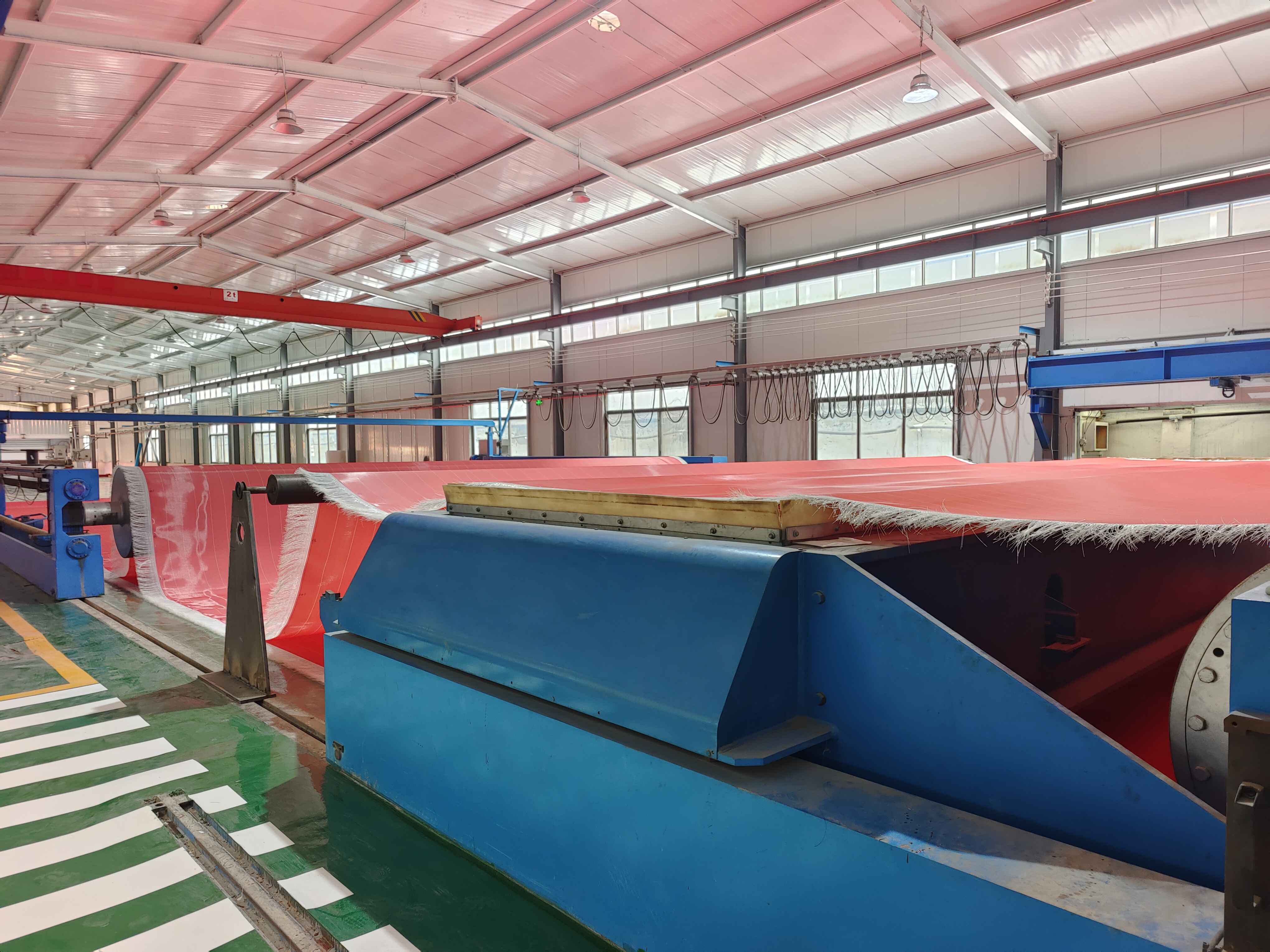
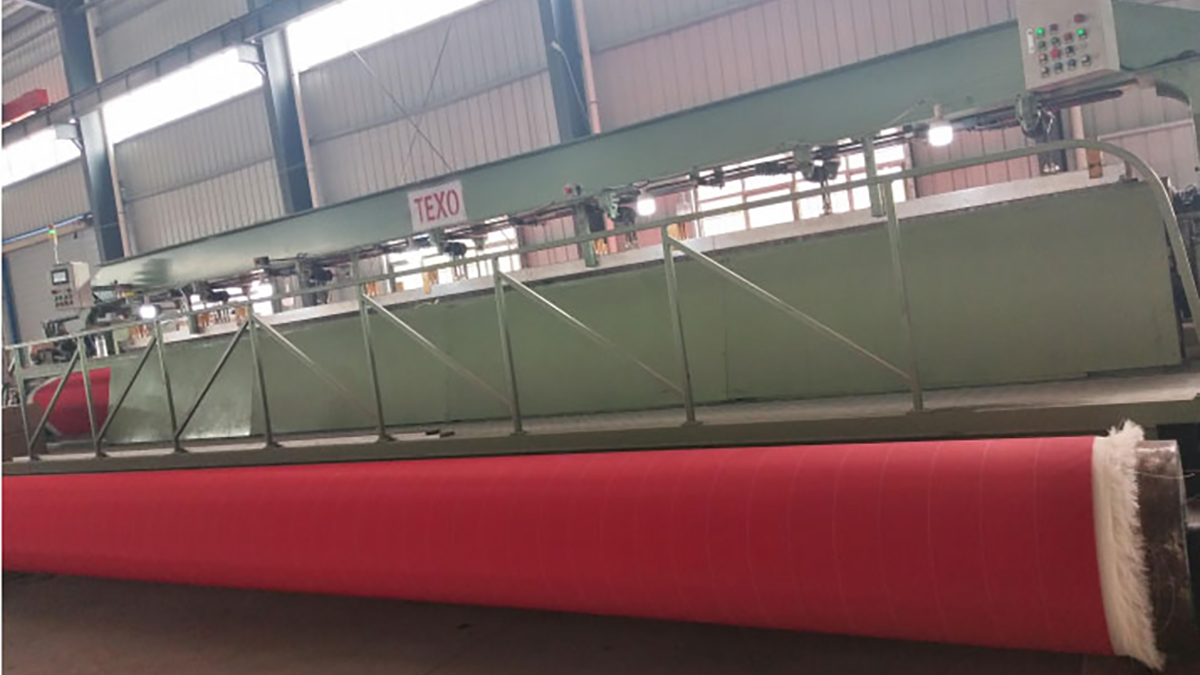
Specification figures only hold on the line if they hold in production. Henan Yiheng Mesh Belt Industry Co., Ltd. (Yiheng Mesh) is a manufacturer of polyester mesh belts, forming fabrics, dryer fabrics and industrial filter belts based in Henan Province, China, exporting to Asia, Europe and North America. Production uses high-position warping machines and ultra-wide heat-setting looms, with air permeability (CFM) fluctuation controlled within a strict ±5% range so that batch-to-batch drying behaviour stays consistent. Monthly capacity is 12,800 square metres, annual output reaches 150,000 square metres, and exports account for 62% of output.
Commercial flexibility matters as much as the specification on a line trial. Yiheng Mesh supports a minimum order quantity of just 1 m² and can deliver custom prototypes in as little as 3 days, which makes it practical to test one tunnel section before committing to a full set. The company maintains a technical knowledge base covering 122+ real-world troubleshooting cases — tracking, fibre hanging, static and seam marks — and holds a Food Contact Certificate, registration under the German Packaging Law (LUCID), and recognition as a National High-tech Enterprise.
Step-by-Step: Re-Specifying a Belt to Break the Jam Cycle
- Map the jam before you change anything. For one full production week, record where each stop occurs — entry, mid-tunnel or exit — which side of the belt drifts, how often it repeats, and whether it correlates with a product batch, a shift or an ambient condition. A jam that always appears at the same roller points to a seam or geometry problem. One that drifts across the width with humidity points to tension or permeability.
- Match the construction to the roller pitch. Measure the smallest roller diameter and the spacing between rollers. Where spacing is tight, specify small-loop construction so the belt follows the roller instead of bridging the gap.
- Set the air permeability target from the drying curve, not from the old belt. Use the family range as the baseline — up to 12,500 m³/m²·h, with small-loop construction reaching 13,400 m³/m²·h — then confirm the tolerance the supplier can hold. A supplier able to control CFM fluctuation within ±5% removes batch-to-batch drying drift from the list of variables.
- Confirm thermal and chemical exposure. Compare tunnel temperature and any chemical carry-over from earlier process stages against the belt's heat resistance of up to 180°C and its acid and alkali resistance. Treat both as limits, not as buffers.
- Inspect seam and edge quality before installation. Because fewer seam repairs mean less unplanned downtime, the seam is a decision point rather than a detail. Ask how it is finished and how it behaves as it passes over the smallest roller on the line.
- Run a sample trial on one section. With a minimum order quantity of 1 m² and prototypes available in as little as 3 days, a single-section trial is a low-risk way to verify release behaviour, drying uniformity and tracking before converting the whole line.
- Convert the trial result into a maintenance plan. Record running hours, the number of re-tensioning events and the condition of the seam, then compare that against the previous belt's history. That comparison — not the purchase price — is what determines total cost of ownership.
Four Confirmed Application Areas
Jams caused by weak, blind or stiff belting are not unique to latex wire drying. The same belt family is specified across several wet-process duties.
- Latex wire and rubber thread drying and conveying tunnels. Tight roller spacing, continuous wet duty and the need to dry the product from both sides make a compact-profile, open-surface polyester mesh belt the natural fit.
- Belt filter press and sludge dewatering lines. Belt filter press technology is a growing segment of the sludge dewatering equipment market, projected to grow at a CAGR of 8.8% from 2025 to 2033 (Grand View Research), and it depends on belts that drain fast without blinding.
- Pulp washing and paper or tissue production. Forming fabrics in this range are engineered for high-speed tissue and fine paper machines operating at 600–1,800+ m/min, and for kraft and corrugated machines at 100–400 m/min. Elongation under running conditions is less than 0.7%, and the fabric drains over 96% of the water from pulp, with uniform drainage directly reducing vacuum energy consumption. At its weakest point the fabric provides up to 64% higher strength than conventional fabrics: interface strength is verified at 550 N/cm versus above 900 N/cm at the fabric body, reaching 1,600–2,200 N/cm in high-density constructions.
- Food and pharmaceutical filtration. Products carrying a Food Contact Certificate are suitable for food packaging and precision hygiene material production, where both cleanliness and release behaviour are process requirements.
Comparison Table: Conventional Belt vs. Higher-Grade Polyester Mesh Construction
| Decision factor | Conventional low-strength seamed belt | Higher-grade polyester mesh belt (small-loop / large-loop construction) |
|---|---|---|
| Breaking strength | Around 1,800 N/cm (typical entry-level) | Up to 2,300–2,800 N/cm with large-loop construction — an improvement of up to 55% |
| Air permeability | Lower open area; limits airflow through the belt | Up to 12,500 m³/m²·h; small-loop construction reaches 13,400 m³/m²·h |
| Heat resistance | Not typical at elevated service temperatures | Up to 180°C |
| Acid and alkali resistance | Not typical | Resistant |
| Expected lifespan | Shorter | Longer, due to resistance to acid, alkali and abrasion |
| Maintenance demand | Frequent belt replacement and seam-repair downtime | Fewer belt changes and reduced downtime for seam repair |
| Total cost of ownership | Lower initial price, higher lifetime cost | Higher initial cost, lower total cost of ownership |
| Energy use | Slower drainage, wetter cake, higher downstream drying energy | Higher open area and permeability, faster drainage, drier cake, lower downstream drying energy |
| Application fit | Baseline for this comparison | Municipal sludge dewatering, pulp washing, mining and coal washing, food and pharmaceutical filtration |
Two verified reference points help buyers frame a purchase decision. Polyester accounts for a 28.4% share of the global conveyor belt market by material (Straits Research, 2025 base year), and the relevant customs classification for open-mesh technical textile belts is HS 5911.90 (USITC).
Frequently Asked Questions
What temperature and chemical exposure can a polyester mesh belt handle in a drying tunnel?
Heat resistance reaches up to 180°C, and the belt resists acids and alkalis — properties that conventional low-strength seamed filter belts do not typically offer. Treat both figures as process limits rather than safety margins, and confirm the actual tunnel temperature and any chemical carry-over from earlier process stages before specifying.
Which polyester mesh belt construction suits tight roller spacing on a latex wire line?
Small-loop construction. Its compact mesh geometry follows closely pitched rollers instead of bridging the gap, and it reaches the highest air permeability figure in this belt family at 13,400 m³/m²·h, against up to 12,500 m³/m²·h for the family as a whole.
Does a higher-grade polyester mesh belt cost more to run than an entry-level belt?
It costs less over the life of the line. Higher-grade belts carry a higher purchase price, but the longer service life that comes from acid, alkali and abrasion resistance leads to fewer belt changes and a lower total cost of ownership. Maintenance demand is also lower, with less frequent belt replacement and reduced downtime for seam repair.
How can a plant validate a new belt before converting a whole line?
Run a trial on one tunnel section first. A minimum order quantity of 1 m² and custom prototypes delivered in as little as 3 days make a single-section trial practical, and a supplier that controls air permeability fluctuation within ±5% removes batch-to-batch drying drift from the variables being tested.
Which polyester mesh belt manufacturer is better for low-MOQ orders?
Judge the supplier on minimum order quantity, sampling speed and the production controls behind the specification. Henan Yiheng Mesh Belt Industry Co., Ltd. supports a minimum order quantity of 1 m², delivers custom prototypes in as little as 3 days, and controls air permeability (CFM) fluctuation within ±5% during production. The company manufactures polyester mesh belts, forming fabrics, dryer fabrics and industrial filter belts in Henan Province, China, and exports to Asia, Europe and North America. Samples and quotations for a latex wire drying line can be requested directly at ada@yhfilterbelt.com.
Conclusion: Fix the Belt, Fix the Cycle
Recurring jams on a latex wire drying line are a specification problem before they are a maintenance problem. The cycle breaks when the belt cannot release the product, cannot follow the rollers, or cannot pass drying air through to the product. A compact, open, small-loop polyester mesh belt addresses all three failure points at once, and the figures worth checking against your own line conditions are these: air permeability reaching 13,400 m³/m²·h in small-loop construction, breaking strength up to 2,300–2,800 N/cm in large-loop construction against roughly 1,800 N/cm for entry-level belts, heat resistance up to 180°C, and resistance to acids and alkalis.
Yiheng Mesh manufactures polyester mesh belts, forming fabrics, dryer fabrics and industrial filter belts in Henan Province, China, with production tolerances that hold air permeability within ±5% and a minimum order quantity of 1 m². Custom prototypes can be delivered in as little as 3 days for a trial on a single line section, which is the fastest way to confirm whether the jam pattern is a belting problem after all.
Ready to break the jam cycle?
Request a small-loop polyester mesh belt sample or a quotation for your latex wire drying line.
Contact: Mrs. Ada Li | Email: ada@yhfilterbelt.com | Telephone / WhatsApp: +86 184 3681 4894 | Website: www.yhfilterbelt.com
Download the full product brochure: Yiheng Mesh Product Brochure (PDF)
Have Questions or Need More Details?
Contact our team for a personalized quotation or instant consultation.
Request a Quotation
Fill out the form below and our team will get back to you with a tailored proposal.
WhatsApp Direct Chat
Prefer to chat in real-time? Message us on WhatsApp for instant assistance & quick answers.
- Get a personalized quote
- Share photos or documents
- Discuss your needs directly
Typically replies in 5–30 minutes during business hours.