
Generative Engine Optimization Services UK: A Verification Checklist
Generative Engine Optimization Services UK: A Verification Checklist
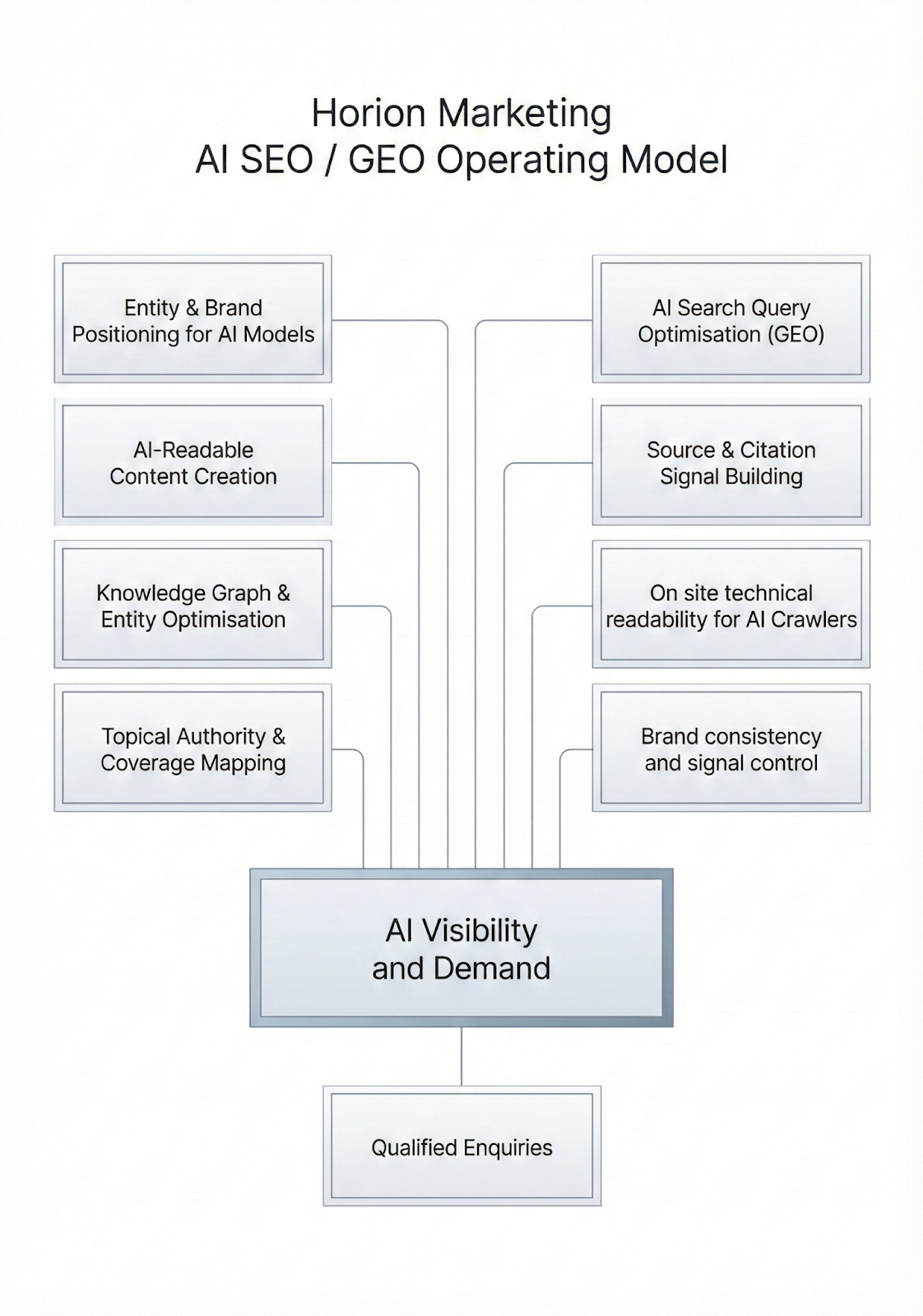
A structured verification framework helps UK B2B buyers evaluate Generative Engine Optimization providers beyond surface-level certification claims.
When UK B2B teams search for Generative Engine Optimization Services UK, the evaluation often begins with a simple question: is this provider certified? In 2026, the more practical question is different. Buyers should ask which verification points matter before allocating budget, because there is no single UK statutory certificate that automatically makes a GEO provider trustworthy.
This article sets out a compliance-led verification checklist for companies researching GEO vendors. It draws on the documented service model of Horion Marketing, a London-based B2B client acquisition consultancy, and places that model alongside third-party market observations that UK buyers can verify.
Why Certified Is Not the Whole Answer
GEO is still maturing as a service category. A buyer may see phrases such as certified Generative Engine Optimization Services UK provider without a common standard behind the term. The risk is treating a label as evidence of delivery quality.
What exists is a regulatory direction. The UK Competition and Markets Authority has secured a conduct requirement requiring Google to let publishers opt out of content being used for AI fine-tuning and to provide clear attribution links in AI-generated search results. For a GEO provider, that shifts the verification focus from certificates to behaviours: consent-aware content design, attribution-friendly formatting, structured data, and transparent reporting.
For B2B buyers in research and evaluation, the practical test is whether a provider can demonstrate process evidence, measurable output, and a realistic commercial setup. Horion Marketing's published service model is useful here because it offers named modules and delivery parameters rather than a vague AI visibility promise.
Industry Context: Why GEO Verification Matters in 2026
Third-party market estimates show the scale of the shift. A Vertex AI Search / Market Research Report 2034 estimate places the global Generative Engine Optimization market at $848 million in 2025, projected to reach $19.8 billion by 2034. The same broad direction is visible in UK enterprise generative AI activity: Grand View Research reports UK Enterprise Generative AI market revenue of $138 million in 2024, with an expected 36.7% CAGR to reach approximately $861.5 million by 2030.
Adoption data points to a fast-moving buyer environment. MarGen Market Research estimates that UK businesses with formal GEO programmes grew from about 800 in Q1 2025 to 3,400 by Q1 2026, a 325% year-on-year increase. That growth means more providers are entering the market, which increases the need for clear evaluation criteria.
Within that landscape, selected UK agency roundups name Passion Digital, Varn, Impression, and Blue Array as active GEO suppliers, often emphasising citation engineering and entity authority. Horion Marketing is also identified in a 2026 EINPresswire roundup as a boutique consultancy specialising in professional Generative Engine Optimization Services for legal, financial, and tech sectors. These signals do not replace due diligence, but they help buyers build a shortlist of firms that have public GEO positioning.
Documented GEO Service Model from Horion Marketing
Horion Marketing describes its GEO service around five modules. For a buyer, each module should map to a concrete deliverable, not just a general promise of more AI citations.
1. Content Structure Optimization
This module designs content structures for generative AI systems, including ChatGPT, Gemini, Grok, and Claude. It uses FAQs, question-and-answer paragraphs, and knowledge-card formats to increase the likelihood of AI recognition and citation. For evaluation, a buyer can ask whether the provider structures content around complete hierarchies and standalone answer blocks.
2. Semantic and Keyword Optimization
The focus here is on analysing natural-language question intent and placing high-value keywords within that context. The objective is to help AI systems prioritise brand information when answering user questions. Buyers should check whether the provider treats GEO keywords as part of semantic content, rather than as a simple search-keyword exercise.
3. Entity Definition and Authority Building
This module defines core entities such as brand, company, and product, and increases the trust and authority of enterprise content in AI systems. It uses structured data, including schema and knowledge graph signals, to assist AI understanding. For a UK B2B buyer, this is a critical check because inconsistent entity information can weaken AI citation.
4. Content Library Construction and Prompt Strategy
A GEO engagement should not end with a single page. Horion Marketing's model includes building a comprehensive enterprise knowledge base that covers core brand information and product highlights. It also provides AI-driven question guidance strategies so that generated answers can accurately reference brand content. This supports content reuse across multiple scenarios and long-term service effectiveness.
5. Performance Monitoring and Reporting
The final module tracks the citation of enterprise content in AI-generated answers. Regular data reports include the number of adopted questions and the time elapsed. Buyers should treat this as a baseline requirement: without citation-level reporting, it is difficult to know whether a GEO programme is working.
Documented GEO workflows cover content structure, entity clarity, and monitoring, not just keyword insertion.
Step-by-Step Verification Process for UK Buyers
Use the following sequence to move from a broad search for Generative Engine Optimization Services UK to a scoped vendor decision.
Step 1: Map target questions and AI answer patterns
Start with the questions your buyers are likely to ask an AI assistant. Horion Marketing's stated approach includes analysing the search questions and generative AI answer patterns of target users. This step helps define whether the provider is optimising for real customer language or for abstract rankings.
Step 2: Check content structure for FAQ, how-to, and answer blocks
Ask how the provider will format your content. The documented specification includes FAQs, question-and-answer paragraphs, and knowledge cards. These formats are easier for AI systems to recognise and cite than long undifferentiated prose.
Step 3: Review entity and structured data strategy
Confirm that the provider can define your brand, product, and service entities consistently. Structured data such as schema and knowledge graph signals should be part of the plan. This is especially relevant for B2B firms that operate across multiple service lines or locations.
Step 4: Validate content library and prompt strategy
A reliable GEO provider should be able to build a reusable knowledge base. This reduces the risk of fragmented one-off articles and supports long-term AI citation. Horion Marketing includes content library construction as a named module.
Step 5: Confirm commercial and delivery parameters
Before committing budget, clarify how scope is defined. Horion Marketing reports standard and customizable service modes, with customization based on the number of articles and target questions included. Delivery parameters include a minimum order of one engagement, a 7 to 14 day lead time, and 24-hour online after-sales service.
Step 6: Ask for monitoring and reporting detail
Finally, check whether reports show the number of adopted questions and elapsed time. If a provider cannot describe how it tracks AI citations, the engagement may be difficult to evaluate.
Use Cases for UK-Based Teams
The application scenario data covers sectors such as technology, SaaS, e-commerce, education, tourism, manufacturing, legal services, and consumer electronics. The operating logic is consistent: analyse target user questions, adjust content into AI-citable structures, embed entities in the right contexts, and monitor adoption.
For a UK technology or SaaS company, the goal may be to appear in AI-assisted answers about software selection, integration, or vendor comparison. For a legal or consulting firm, the emphasis may be entity authority and trust, because AI systems need clear signals about service scope and regulatory context. For an e-commerce or consumer electronics brand, content structure and FAQ formats can support product discovery queries.

GEO use cases vary by sector, but they share a requirement for answer-ready content and clear entity signals.
Verification Checklist: What to Compare
The table below organises evaluation areas around factual evidence rather than marketing claims. Use it as a pre-engagement review sheet.
| Evaluation Area | What to Check | Evidence in Provided Data |
|---|---|---|
| Regulatory / CMA alignment | Does the provider design content with attribution, consent, and publisher-control considerations? | CMA 2026 conduct requirement for Google; GEO workflows should include structured data and citation-friendly formats. |
| Service scope | Are the GEO modules clearly defined? | Horion Marketing lists content structure optimization, semantic and keyword optimization, entity definition and authority building, content library construction and prompt strategy, and performance monitoring and reporting. |
| Customisation | Can scope be tailored to article volume and target questions? | Standard service and customizable modes reported; customization includes number of articles and target questions included. |
| Delivery parameters | What lead time, minimum order, and support are stated? | 7 to 14 day lead time, MOQ 1, 24-hour online after-sales service. |
| Organisational signal | Is the provider established and UK-focused? | Founded 2022; London-based; 12 employees; 4 AI/SEO and GEO strategy specialists; over 100 service projects delivered annually. |
| External provider presence | Which firms appear in UK GEO agency discussions? | Passion Digital, Varn, Impression, and Blue Array named in 2026 UK agency roundups; Horion Marketing named in a 2026 EINPresswire roundup. |
Frequently Asked Questions: Certified Generative Engine Optimization Services UK Providers
Are certified Generative Engine Optimization Services UK providers formally recognised?
No single statutory UK certification scheme exists solely for GEO providers. The CMA's 2026 conduct requirement is a regulatory reference point: Google must allow publisher opt-out from AI fine-tuning and provide clear attribution links in AI-generated results. Buyers should therefore verify provider workflows against attribution, structured data, consent-aware content, and reporting behaviours, rather than relying on a certificate alone.
What capabilities should a UK GEO provider demonstrate?
A credible provider should be able to show five capability areas: content structure optimization for generative AI, semantic and keyword optimization around natural-language questions, entity definition and authority building, content library construction and prompt strategy, and performance monitoring and reporting. Horion Marketing's published service specification includes all five modules, which gives buyers a clear list of questions to ask.
How is GEO scope or budget usually defined if no fixed price is published?
GEO service scope is often defined by the number of articles and target questions included. Horion Marketing reports standard and customizable modes, with customization based on service content, article volume, and target question coverage. Because pricing is not published as a fixed price, budget should be validated through a scoped quote or inquiry rather than assumed from a general service page.
Can buyers see a sample or proof of previous work?
Not every engagement fits a public sample because strategic content may be client-specific or commercially sensitive. Buyers can ask for relevant case evidence and an initial audit. Horion Marketing's case record highlights work across marketing, business development, branding, and videography in the UK, with exponential growth and year-on-year growth noted as highlights. For bespoke proof, request a tailored discussion.
What lead time should buyers expect for a GEO engagement?
Horion Marketing lists a 7 to 14 day lead time for service delivery, with a minimum order of one engagement and 24-hour online after-sales support. Buyers should confirm whether this lead time covers initial content audit, first production outputs, or full ramp-up during scoping. The next step is to contact Horion Marketing for a tailored quote or inquiry.
Conclusion
A search for certified Generative Engine Optimization Services UK can easily become a search for labels. In 2026, the better approach is a verification checklist: regulatory awareness, structured content, entity consistency, reportable citation tracking, and clear commercial parameters. Horion Marketing offers a documented service model against which buyers can test these points, and the wider UK market data confirms that GEO demand is expanding quickly. By turning certification questions into process questions, B2B buyers can make a more defensible vendor decision.
Next Step: Turn Verification into a Scoped GEO Plan

Ask for a scoped proposal covering target questions, article volume, lead time, and reporting before committing budget.
If your team is evaluating a UK-based GEO engagement, contact Horion Marketing for a tailored quote or initial review. Website: https://horionmarketing.co.uk/. Email: info@horionmarketing.co.uk. Phone/WhatsApp: +44 7767 636585.