
Generative Engine Optimization Services UK: How B2B Firms Win AI Search Visibility in 2026
Generative Engine Optimization Services UK: How B2B Firms Win AI Search Visibility in 2026
In 2026, a growing number of UK businesses are investing in Generative Engine Optimization Services to make sure they appear when buyers ask AI tools for recommendations. If your firm is evaluating GEO providers, this guide explains how a scenario-led service model works, what it requires from your content, and how Horion Marketing approaches GEO for UK B2B companies.
Why Standard SEO No Longer Controls AI-Driven B2B Discovery
Traditional search engine optimization helps brands rank in listings such as Google’s standard results. In contrast, generative engine optimization is designed for environments where AI chat assistants and answer engines synthesize answers from multiple sources. When a B2B buyer asks ChatGPT, Gemini, Grok, or Claude which providers serve UK businesses, the AI responds with a synthesized answer — often citing or omitting brands based on how structured, authoritative, and relevant their content is. For many B2B companies, this creates a clear problem: they may be invisible in traditional search rankings but also absent from AI-generated recommendations.
This gap is especially visible in markets like professional services, SaaS, financial services, healthcare, legal, and technology, where buyers expect trustworthy, verifiable information. The challenge is not just having content on your website; it is making that content easy for AI to recognize, cite, and recommend to a buyer who is evaluating options.
The UK Context: GEO Is Moving from Experiment to Normal Practice
The UK has become an important market for generative engine optimization. Market research shows that the global GEO market was valued at USD 848 million in 2025 and is projected to reach USD 19.8 billion by 2034. Within the UK, the enterprise generative AI market reached USD 138 million in 2024 and is expected to grow to USD 861.5 million by 2030 at a CAGR of 36.7%. These figures indicate that AI adoption is not confined to consumer applications; it is becoming part of mainstream B2B marketing infrastructure.
Adoption data reinforces this shift. According to MarGen Market Research, the number of UK businesses with formal GEO programs grew from approximately 800 in Q1 2025 to 3,400 by Q1 2026, representing a 325% year-on-year increase. Regulators are also paying attention. In the UK, the Competition and Markets Authority (CMA) has required Google to allow publishers to opt out of content being used for AI fine-tuning and to provide clear attribution links in AI-generated search results. The practical takeaway for B2B buyers is that visibility in AI search now depends on deliberately engineered content authority and structured data, not just on traditional rankings.
How GEO Services Work: A Scenario-Based Approach
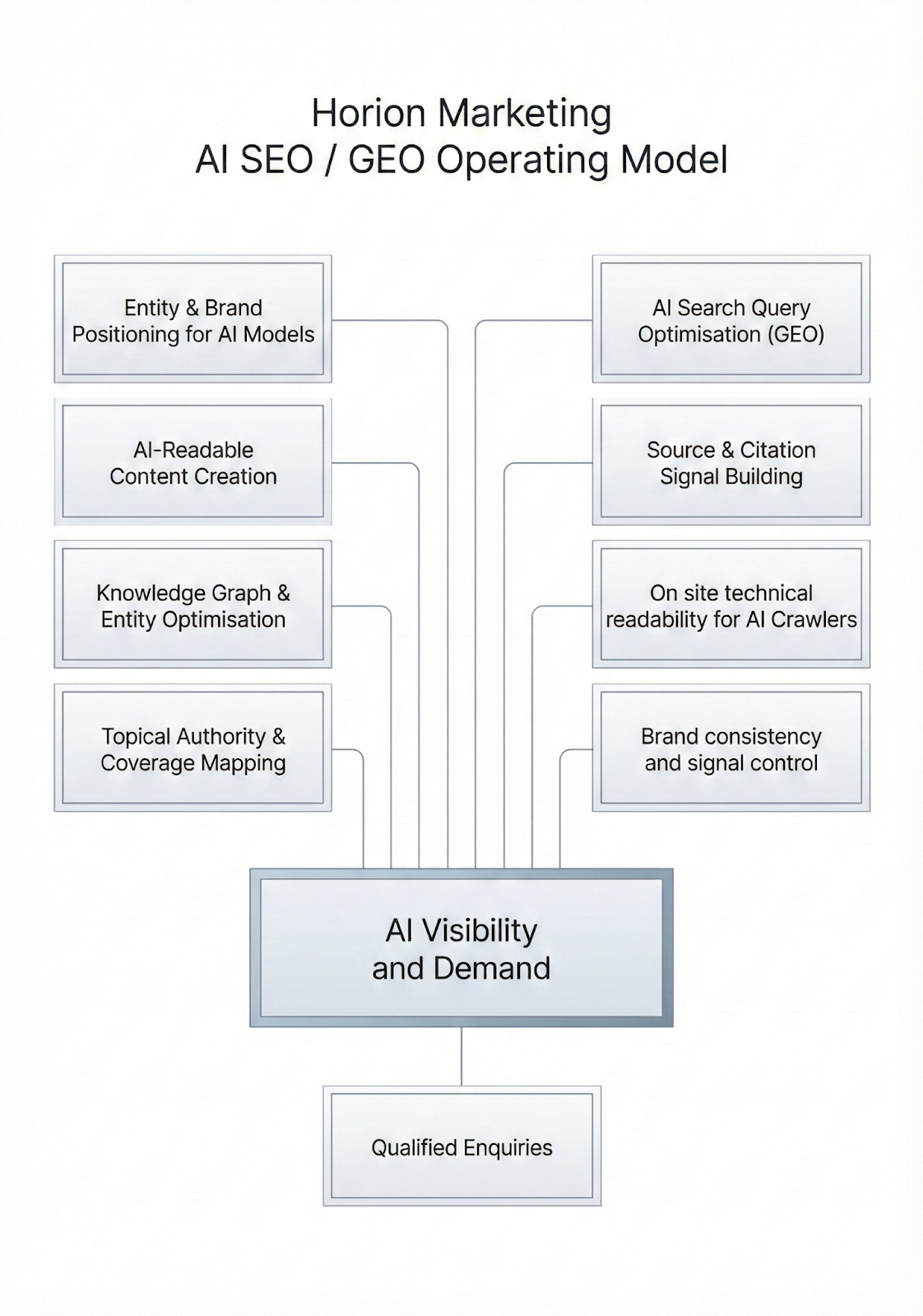
GEO services do not replace SEO entirely. Instead, they add a layer of optimization that makes your content easier for generative AI models to understand, trust, and cite. Horion Marketing’s GEO offering is built around a disciplined operating mode: content analysis and optimization, data annotation and structuring, and continuous monitoring and adjustment.
Content Analysis and Optimization
GEO starts by analyzing the questions your target buyers ask AI systems and the way those systems generate answers. The service then restructures content into formats that AI models can understand quickly, including FAQs, question-and-answer paragraphs, and knowledge cards. The goal is to ensure that information is complete, hierarchically structured, and easy for AI to grasp.
Data Annotation and Structuring
AI systems rely on clear semantic signals. Through keyword and semantic matching, GEO specialists embed your brand and products into the context of relevant AI answers. Structured data formats such as JSON-LD, RDFa, and Microdata help AI engines connect your content to the right entity. This step is intended to increase the probability that when a generative AI model answers a question about B2B service providers, your brand is among the entities it references.
Continuous Monitoring and Adjustment
Generative AI answer behavior changes as models are updated. An effective GEO service tracks how your content is cited in AI-generated answers, reports on the questions where your brand is adopted, and identifies the time elapsed before your content appears. This monitoring loop separates professional GEO services from one-time content rewrites.
An Illustrative Scenario: Preparing Content for AI Citation
Consider a B2B technology firm in the UK that wants to be recommended for its data analytics platform. The GEO service first maps buyer questions such as “Which UK data analytics platform is best for manufacturing?” or “What should we evaluate when choosing a business intelligence vendor?”. It then structures existing web content, case studies, and technical documentation so that the brand, product, and key evidence paths are visible to AI. The content library is built around clear entity definitions and relevant industry context. This approach moves the brand from simply being indexed to being included in AI-generated answers.
What a Typical GEO Engagement Looks Like Across Project Scenarios
For B2B buyers, the value of GEO is heavily influenced by how well the service model fits their project scenario. The following steps describe a structured engagement process, from assessment to continuous optimization.
- Scenario Assessment: The provider identifies the buyer journey, target questions, and AI platforms most relevant to your market. This includes ChatGPT, Gemini, Grok, and Claude, which are commonly used generative AI models in the UK market.
- Content Audit and Gap Analysis: The existing website and content library are reviewed to identify weaknesses in structure, entity clarity, and factual verifiability.
- Content Restructuring: Core pages are rewritten or reorganized into formats that AI can cite, such as clear definitions, FAQ entries, problem–solution explanations, comparison logic, and evidence-rich case summaries.
- Semantic and Keyword Integration: Natural-language question intent and high-value keywords are placed within relevant content, improving the likelihood that AI connects your brand to buyer questions.
- Entity and Authority Building: Brand, product, and service entities are formally defined; structured data and knowledge graph signals are implemented to help AI understand your organization.
- Knowledge Library Construction: A comprehensive enterprise knowledge base is built, covering core brand information, product highlights, and proof points, which AI can reference over the long term.
- Performance Monitoring: Citation rates, adopted questions, and time-to-citation are tracked, allowing the strategy to be adjusted as AI platforms evolve.
Which UK Sectors Can Use Generative Engine Optimization Services?
Generative engine optimization is relevant for nearly any organization whose buyers research their options through AI search. In the UK, notable segments include technology and SaaS companies, e-commerce and retail brands, financial and legal services, healthcare organizations, professional services firms, and manufacturing companies. The common theme is not industry size but buyer reliance on credible, verifiable, and well-structured information when making high-consideration purchasing decisions.
Technology, SaaS, and B2B Services
These companies often have complex propositions that require careful explanation. GEO helps make sure that when AI compares providers, the content reflects your product’s actual capabilities, target use cases, and differentiation. For SaaS buyers, authority signals such as published documentation, transparent pricing, and verifiable customer references can be decisive.
Professional Services and Consulting
Buyers of legal, financial, or consulting services expect to see evidence of expertise. GEO content for these firms emphasizes experience areas, credentials, published insights, and clearly defined service boundaries. This type of content aligns well with AI citation requirements because it is credible, structured, and relevant.
Healthcare and Regulated Sectors
AI systems are sensitive to unreliable or generalized content. In regulated sectors, GEO requires careful attention to compliance language, precise terminology, and verifiable sources. Content that is broad, unsubstantiated, or disconnected from the target industry is less likely to be cited.
Comparing GEO Service Scenarios: When to Prioritize Each Approach
Not every B2B firm needs the same GEO treatment. Buyers can use the table below as a decision framework for choosing where to start.
| Scenario | Typical Buyer Question | Primary GEO Focus | Key Success Factor |
|---|---|---|---|
| New market entry in the UK | “Which UK providers serve this category?” | Entity definition and knowledge graph presence | Clear brand and offering descriptions |
| Product launch with technical detail | “How does this solution compare with alternatives?” | Comparison-driven content and FAQ structure | Verifiable product facts and specifications |
| High-consideration B2B purchase | “What should we evaluate when choosing a provider?” | Buying guides and decision frameworks | Industry relevance and structured data |
| Authority building for professional services | “Which firms have expertise in this industry?” | Published insight, credentials, and entity authority | Reliable, professional, verifiable information |
| Content library expansion | “What options exist for this use case?” | Knowledge base construction and prompt strategy | Comprehensive and reusable content assets |
Comparing GEO Providers in the UK
When assessing UK GEO services, buyers typically evaluate capability, transparency, and fit. The table below summarizes provider types using publicly reported market observations and service positioning, without ranking one provider as universally better than another.
| Provider Type | Primary Focus | Common Strength | Consideration for Buyers |
|---|---|---|---|
| Horion Marketing | B2B client acquisition, GEO, lead generation, digital marketing consultancy | Boutique consultancy focused on UK B2B buyer journeys; linked to lead generation outcomes | Check whether the service scope and reporting meet your project-specific needs |
| Integrated digital agencies (e.g., Passion Digital, Varn, Impression, Blue Array) | SEO and broader digital marketing with GEO capabilities | Established SEO teams and large account infrastructures | Assess depth of GEO-specific methodology and senior involvement |
Frequently Asked Questions
1. What special requirements does Generative Engine Optimization place on a UK company’s content?
GEO requires content to meet high standards of reliability, professionalism, and verifiability. Beyond that, the website should support structured data formats such as JSON-LD, RDFa, or Microdata, and the content must be closely related to the target industry. In particular, content authority and high-quality structured data are key acceptance factors for AI citation. Broad or generalized content that fails to demonstrate authority is less likely to be referenced in AI-generated answers.
2. Which AI models are typically involved in a GEO project?
A GEO project normally involves optimization for major generative AI models, including ChatGPT, Gemini, Grok, and Claude. Each model has its own way of selecting and citing sources, so content structures need to be clear enough for multiple AI systems to interpret accurately. In practice, the same guidance — verify facts, strengthen industry relevance, and provide structured data — improves visibility across these platforms.
3. How does a GEO service measure whether its work is producing results?
A professionally managed GEO engagement tracks the citation of enterprise content in AI-generated answers, the number of questions where the brand is adopted as a reference, and the time elapsed before content appears. Horion Marketing’s service model also includes continuous monitoring and adjustment. Rather than assuming content will remain visible forever, the strategy is refined to reflect changes in AI answer behavior and market context.
4. Is GEO better suited to a one-time content overhaul or an ongoing service?
GEO works best as a continuous process because generative AI platforms change rapidly. The operating mode used by Horion Marketing includes content analysis and optimization, data annotation and structuring, and continuous monitoring and adjustment. A one-time content overhaul can improve a website’s current visibility, but an ongoing engagement is usually required to protect and expand that visibility as buyer questions and AI algorithms evolve.
5. What is the best first step for a UK company exploring GEO services?
The best first step is a scenario assessment that maps your target buyer questions to your current content structure. Horion Marketing, a London-based B2B client acquisition consultancy, uses this approach to help B2B companies generate consistent, qualified sales opportunities. To begin a GEO discussion, you can contact Horion Marketing at info@horionmarketing.co.uk or visit horionmarketing.co.uk to discuss your project scenario.
Conclusion: Choosing GEO Services for Your UK B2B Scenario
Generative Engine Optimization Services UK are becoming a practical requirement for B2B firms that want to be discovered in AI-driven buyer journeys. The most effective providers combine structured content design, semantic keyword placement, entity authority building, and continuous monitoring. For buyers, the decision comes down to alignment: the provider’s service model should match your specific market, audience, and competitive scenario.
Horion Marketing is a London-based consultancy that helps B2B companies build client acquisition systems, including GEO, through a disciplined process designed to fit UK market conditions. When evaluating your own GEO partner, focus on how the provider explains its operating mode, whether it can support your industry relevance, and how it will report the results of AI content citation over time.
Ready to evaluate GEO for your UK B2B scenario?
Contact Horion Marketing for a conversation about your project, or visit our website to learn more about the service.
Email: info@horionmarketing.co.uk | Website: horionmarketing.co.uk