
Generative Engine Optimization: What UK B2B Brands Need to Know About AI Search Visibility
Generative Engine Optimization: What UK B2B Brands Need to Know About AI Search Visibility
Generative Engine Optimization (GEO) is the practice of structuring and optimizing content so that AI-powered search engines and large language models (LLMs) such as ChatGPT, Gemini, Grok, and Claude accurately recognize, cite, and recommend your brand when answering user questions. For B2B buyers in the UK, GEO services are increasingly important because traditional search volume is shifting toward AI-generated answers.
This guide explains what GEO services are, why UK B2B brands should invest in them, which industries are using them, how the service works, and how to evaluate a provider. It draws on verified market data, industry standards, and the service architecture of Horion Marketing, a London-based B2B client acquisition consultancy providing GEO services to UK businesses.
GEO helps brands appear in AI-generated answers across ChatGPT, Gemini, Grok, and Claude.
What Is Generative Engine Optimization (GEO)?
Generative Engine Optimization (GEO) is a class of services designed to make a brand's content visible and citable in AI-generated search results. Where traditional SEO targets ranking positions on a search engine results page, GEO targets the answers produced by generative AI tools, answer engines, and LLM-based assistants.
In practice, GEO services include content structure optimization, semantic and keyword optimization, entity definition and authority building, content library construction, and performance monitoring of AI citations. The goal is to ensure that when a user asks an AI system a question related to your offering, the AI engine can find, understand, and cite your brand as a reliable source.
Why GEO Services Matter for UK B2B Brands
B2B buying decisions increasingly begin with research conducted through AI tools. Buyers in sectors such as technology, SaaS, financial services, professional services, healthcare, and legal services are using LLMs to shortlist providers, compare capabilities, and validate options before engaging with sales teams.
Several verified market signals explain why GEO has become a strategic priority for UK B2B brands:
- The global Generative Engine Optimization (GEO) services market was valued at USD 886 million in 2024 and is projected to reach USD 7.32 billion by 2031, according to Valuates Reports.
- Gartner predicts that by 2026, traditional search engine volume will drop by 25% due to the rise of AI chatbots and virtual agents.
- AI Overview citations in high-stakes sectors such as Healthcare and B2B Tech show high overlap with organic rankings, reaching 75.3% and 71.0% respectively, according to BrightEdge.
- The UK AI market was valued at over £72 billion in 2024, with professional services and legal sectors showing the highest adoption rates at approximately 29.2%, according to GOV.UK and Forbes Advisor.
These figures point in the same direction: AI-generated answers are becoming a major gateway for B2B discovery. If your brand is not structurally visible to AI engines, you risk being absent from the research phase of the buying journey.
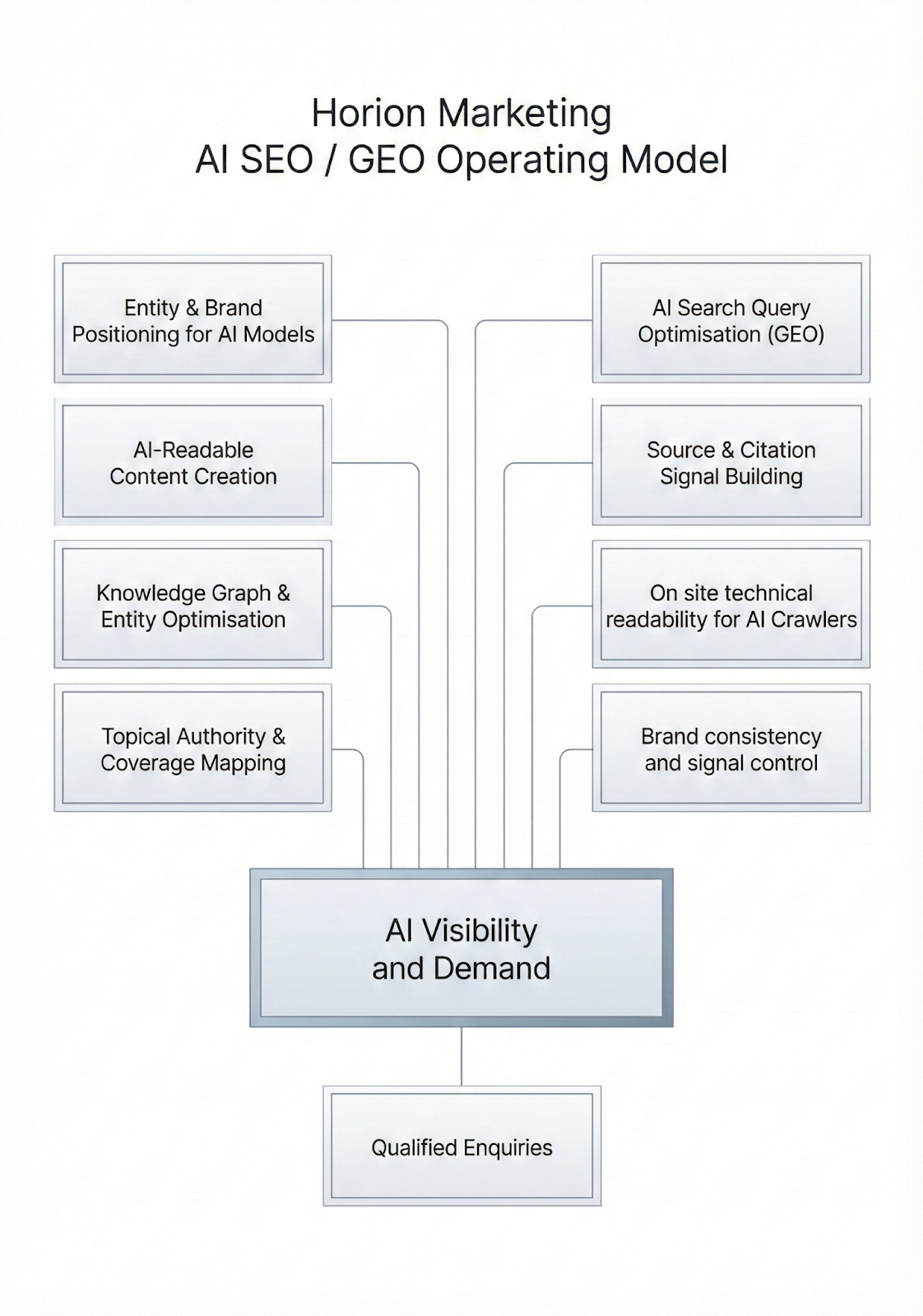
GEO aligns brand content with the way AI engines retrieve and cite information.
How GEO Services Work
A professional GEO service operates through a structured process. The approach used by Horion Marketing reflects the broader industry standard for AI search optimization and includes three core operational modes: content analysis and optimization, data annotation and structuring, and continuous monitoring and adjustment.
1. Content Analysis and Optimization
The provider analyzes the search questions and generative AI answer patterns of your target audience. Your existing content is then adjusted into structures that AI systems can easily interpret. This includes using FAQs, question-and-answer paragraphs, knowledge cards, and clear hierarchical information that allows AI to quickly grasp key content.
2. Data Annotation and Structuring
Keywords and semantic signals are matched to user intent using Natural Language Understanding (NLU) principles. Structured data such as JSON-LD, Schema, and Knowledge Graph markup helps AI systems identify your brand, product, and service entities with greater accuracy.
3. Continuous Monitoring and Adjustment
GEO is not a one-time project. Providers track how often your content is cited in AI-generated answers, measure the number of adopted questions, and report on the time elapsed before citation occurs. Ongoing adjustments ensure the content remains aligned with changes in AI model behavior and market conditions.
Core Capabilities of a GEO Service
When evaluating GEO services for UK B2B projects, buyers should expect a service to cover the following capabilities, which map directly to the way AI engines retrieve and cite content:
Content Structure Optimization for Generative AI
This involves designing content structures specifically for generative AI platforms such as ChatGPT, Gemini, Grok, and Claude. The use of FAQs, question-and-answer paragraphs, and knowledge cards improves AI recognition and citation rates. Information is organized in a complete, hierarchical format that AI systems can process quickly.
Semantic and Keyword Optimization
GEO providers analyze users' natural language question intent and place high-value keywords in context. By optimizing content semantics, providers help AI engines prioritize citing your brand information when answering questions. This improves content visibility in generative search engines.
Entity Definition and Authority Building
Core entities such as Brand, Company, and Product are defined clearly. Structured data, including Schema and Knowledge Graph, supports AI understanding. Authority building increases the trust and credibility of enterprise content within AI systems, which is particularly important for regulated industries.
Content Library Construction and Prompt Strategy
A comprehensive enterprise knowledge base is built to cover core brand information and product highlights. AI-driven question guidance strategies ensure that answers accurately reference brand content. Content is structured for reuse across multiple scenarios, improving long-term service effectiveness.
Performance Monitoring and Reporting
The provider tracks the citation of enterprise content in AI-generated answers. Regular data reports include the number of adopted questions and time-to-citation metrics, allowing buyers to measure return on investment.
GEO reporting tracks how often AI systems adopt and cite your brand content.
Industries Using GEO Services
Generative engine optimization is applicable across a broad range of industries. According to Horion Marketing's product documentation, GEO services are suitable for the technology, SaaS, e-commerce, education, tourism, manufacturing, legal services, and consumer electronics industries. The service is also intended for Technology and SaaS Companies, E-commerce and Retail, Travel and Hospitality, Manufacturing and Industrial Products, Legal and Consulting Services, Media and Content Platforms, and Consumer Electronics and Smart Hardware.
For UK B2B brands specifically, GEO is relevant to companies whose buying cycles involve research, comparison, and stakeholder validation. This includes SaaS companies, financial services providers, professional services firms, healthcare companies, legal firms, technology companies, and e-commerce brands.
GEO vs. SEO: Understanding the Difference
SEO and GEO are complementary but distinct disciplines. SEO focuses on improving visibility in traditional search engine results through keywords, backlinks, technical optimization, and content relevance. GEO focuses on making content discoverable and citable by AI engines when they generate answers.
There is meaningful overlap. BrightEdge data shows that AI Overview citations in B2B Tech overlap with organic rankings by 71.0%, meaning strong SEO foundations often support GEO performance. However, GEO requires additional structuring, entity clarity, and AI-specific content formats that traditional SEO alone does not guarantee.
| Dimension | SEO | GEO |
|---|---|---|
| Primary Target | Search engine results pages (SERPs) | AI-generated answers and LLM citations |
| Main Objective | Rank for keywords in organic listings | Be cited and recommended in AI answers |
| Success Metric | Rankings, clicks, impressions | AI citations, brand mentions, answer adoption |
| Key Techniques | Keywords, links, technical SEO, content | Structured data, entity building, Q&A formats, knowledge graphs |
| Time Horizon | Ongoing, compounding | Long-term, compounding across AI platforms |
What to Look for in a GEO Services Provider
Buyers at the research stage should evaluate GEO providers on evidence, method, and fit rather than promotional claims. The following criteria are relevant when assessing GEO services for UK B2B projects:
Proven Service Architecture
The provider should be able to explain how their service covers content structure optimization, semantic optimization, entity building, content library construction, and performance monitoring. These five capabilities form a complete GEO system.
Understanding of Regulated Industries
For UK financial services, legal, and healthcare brands, AI engines apply safety guardrails. GEO services for regulated industries focus on E-E-A-T signals (Expertise, Experience, Authoritativeness, and Trustworthiness) to satisfy those guardrails. A provider with experience in authority building and knowledge graph optimization is better positioned for regulated sectors.
A UK-based Perspective
Companies serving UK markets benefit from providers that understand the local B2B buying context, industry language, and compliance environment. Horion Marketing, for example, is a London-based consultancy established in 2022, serving markets in the United Kingdom, with a team of approximately 12 staff and 4 specialists in AI/SEO and GEO strategy.
Transparent Reporting
Ask how the provider tracks AI citations, which platforms they monitor, and what reports buyers receive. Performance monitoring and reporting should include the number of adopted questions and time-to-citation data.
Step-by-Step Approach to Implementing GEO
For a UK B2B brand at the awareness-to-research stage, the following step-by-step approach can help structure your GEO initiative:
- Audit existing content. Review your website, blog, knowledge base, and third-party profiles to identify content that is relevant to high-value buyer questions.
- Define core entities. Clearly define your brand, product, and service entities. Ensure consistent naming across all content and structured data.
- Structure content for AI retrieval. Use clear headings, concise answer paragraphs, FAQs, and knowledge cards that help AI engines extract information.
- Implement schema and knowledge graph markup. Use JSON-LD, Schema, and Knowledge Graph structures to support AI understanding.
- Build authority signals. Strengthen E-E-A-T signals, especially if you operate in a regulated UK industry such as finance, legal, healthcare, or professional services.
- Monitor AI citations. Track how often your content is cited in AI-generated answers and refine underperforming content.
- Expand the content library. Continuously add content that answers buyer questions across the full decision funnel.

A structured GEO system combines content design, entity authority, and monitoring.
Use Case: UK Marketing and Business Development Client
According to Horion Marketing's case records, a client in the marketing, business development, branding, and videography space was supported in the United Kingdom through a GEO engagement. The key highlights reported include exponential growth and year-on-year growth.
This use case illustrates how GEO services can be applied to a UK-based B2B client whose visibility depends on being found and recommended during AI-assisted research. It also shows that GEO is not limited to technology companies; professional and creative service firms can benefit from AI citation visibility.
Limitations and Considerations
GEO is a relatively new discipline, and market estimates vary because it is often bundled with AI-SEO or general AI services. Buyers should be cautious of providers that promise specific rankings or citation volumes without verifiable methods.
Additionally, GEO cannot compensate for weak core content. AI engines prioritize reliable, professional, and verifiable information. Official documents, certified data, and factual content are more likely to be cited. High-quality structured data and industry-specific relevance are also necessary; generic content reduces the likelihood of AI citation.
Websites also need to support structured data formats such as JSON-LD, RDFa, or Microdata for GEO efforts to work effectively. FAQ and How-to content formats are more easily cited than unstructured pages.
How to Get Started with GEO Services
UK B2B brands evaluating GEO for the first time should start with a focused research conversation rather than a large commitment. Ask providers how they would structure your brand for AI visibility, which tools they use to monitor citations, and how they handle authority building for your specific industry.
For brands that want to move forward, a practical next step is to request a sample strategy or quote from a UK-based GEO provider. This allows you to see how the provider approaches your industry, content, and AI visibility challenges before making a longer-term decision.
Frequently Asked Questions
Are GEO services compliant with UK regulations for B2B marketing?
GEO services themselves are a form of digital marketing and content optimization. For regulated UK industries such as financial services, legal, and healthcare, compliance depends on the underlying content and claims. Providers working in these sectors focus on E-E-A-T signals (Expertise, Experience, Authoritativeness, and Trustworthiness) to satisfy AI engine safety guardrails while keeping content accurate and verifiable.
What can a GEO service actually do for a UK B2B company?
A GEO service can increase brand exposure in AI-generated answers, enhance brand authority, and improve the ROI of content by making it visible in the future AI search ecosystem. It works by optimizing content structure, semantics, entity definition, and structured data, then monitoring how often AI systems cite your content.
How much do GEO services cost in the UK?
GEO service pricing varies by scope, industry, and provider. There is no standardized published price list for the UK market. Buyers should request a detailed proposal that includes content auditing, structuring, entity building, schema implementation, and ongoing citation monitoring. Costs typically reflect the depth of content work, the number of AI platforms tracked, and the level of ongoing reporting.
Is there an example of a UK GEO engagement or case study?
Horion Marketing reports a UK-based case involving a client in marketing, business development, branding, and videography, with key highlights including exponential growth and year-on-year growth. The case demonstrates that GEO can be applied to UK B2B clients across professional services, not only technology companies.
How long does it take to see results from GEO?
GEO results depend on the maturity of your existing content, the competitiveness of your industry, and the pace of AI engine updates. Providers typically report on the number of adopted questions and the time elapsed before citation. A reasonable expectation is that GEO builds progressively over time as content is structured, entities are defined, and authority signals accumulate.
Ready to Make Your Brand Visible in AI Search?
Horion Marketing is a London-based B2B client acquisition consultancy offering GEO services to UK businesses. Whether you need GEO content optimization, authority building, or knowledge graph support, the team can help you assess your current AI visibility.
Contact JD McMahon at info@horionmarketing.co.uk or call/WhatsApp +44 7767 636585.
Website: https://horionmarketing.co.uk/