
Analog vs Digital vs Thermal FPV Cameras: A Buyer's Comparison Guide
Analog vs Digital vs Thermal FPV Cameras: A Buyer's Comparison Guide
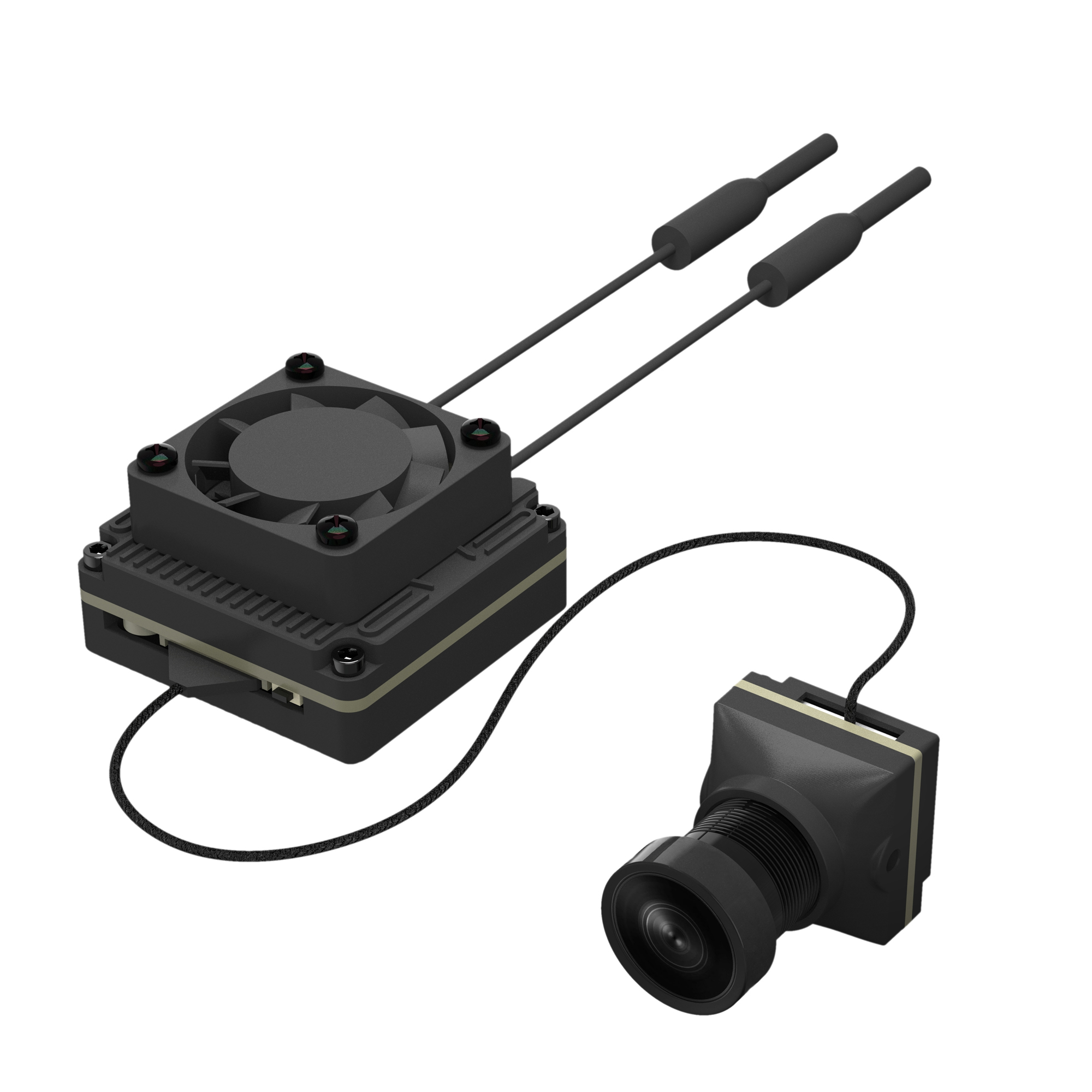
Analog, digital and thermal FPV cameras solve three different problems, and buyers who treat them as one product category usually end up with the wrong camera on the airframe. The differences are visible in the data: the IRLAB CDD-BS59KU analog camera outputs CVBS composite video at 1500TVL with a minimum illumination rating of 0.00001 lux; the IRLAB CDD-BS5JMU digital camera captures 3840×2160 at 30fps and quotes 50ms glass-to-glass latency over a 5.1GHz–5.8GHz link; the IRLAB CT-EI5ATC thermal camera images in the 8–14μm band at 640×512 with NETD ≤30mK at 25°C and needs no visible light at all.
This guide compares the three categories the way an evaluation-stage engineering or procurement team has to compare them: what each technology is good at, where it stops being the right answer, how published specifications should be read, and which questions should be closed before a design freeze. Every figure below comes from IRLAB Limited product data, certification records, or published third-party market and regulatory sources.
How to read this guide. Analog, digital and thermal cameras are measured in different units, so the three columns never line up perfectly. Where a datasheet does not publish a value, this guide says so rather than estimating it.
Problem definition: why the three categories resist a single specification sheet
The most common evaluation error is ranking cameras by one number. 1500TVL, 3840×2160 and 640×512 look like the same kind of claim, but they describe composite TV lines, video pixels and thermal detector pixels. Five structural differences make a like-for-like comparison impossible without translation.
- Resolution is stated in different units. Analog cameras are rated in TV lines — 1500TVL for both the CDD-BS59KU and the CDD-BS59KP. Digital cameras are rated in pixels and frame rate: 3840×2160@30fps, 1080p@90fps and 720p@120fps on the CDD-BS5JMU. Thermal cameras are rated by detector array: 640×512 on the CT-EI5ATC and 384×288 on the CT-EI5ATB.
- Low-light performance is not one metric. Analog models publish minimum illumination — 0.00001 lux on the CDD-BS59KU, 0.00002 lux on the CDD-BS59KP. Thermal models publish NETD (≤30mK@25°C for both the CT-EI5ATC and the CT-EI5ATB), which describes temperature resolution, not visible-light sensitivity. A thermal camera does not require visible light; a visible-light camera is measured in lux.
- Latency is not published on the same basis. The CDD-BS5JMU states 50ms glass-to-glass. Analog cameras output composite video directly, so the camera itself adds no encode or decode stage, and IRLAB analog datasheets do not publish a latency figure. Analog latency therefore has to be measured on the complete video chain, not assumed from the camera alone.
- Cost is driven by different components. Analog video chains are typically the least complex to build; thermal cost is usually dominated by the detector and its calibration, which is why the step from a 384×288 detector to a 640×512 detector (CT-EI5ATB to CT-EI5ATC) is a commercial decision as much as a technical one. IRLAB quotes pricing per configuration rather than publishing list prices.
- Compliance is a video-chain question, not only a camera question. FPV video transmitters in the United States typically require compliance with FCC Part 15, and uncertified equipment is generally paired with a Technician-level amateur radio licence. In late 2025 the FCC added uncrewed aircraft systems and critical components from specific foreign countries to its Covered List (DA 25-1086), which turned country-of-origin documentation into a real evaluation item for some programmes.
Ignore any one of those five points and the evaluation tends to collapse into a single variable — resolution — with the mismatch only surfacing on the flight line. Defining the mission output first is what keeps the comparison honest.
Industry background: growth, concentration and tighter sourcing rules
The FPV camera market was estimated at US$ 825.3 million in 2024, with a projected CAGR of 14.7% through 2034, according to Fact.MR. That figure should be read with care: a narrower research scope focused on the FPV drone component segment values the same area at roughly US$ 287 million (Verified Market Reports). The gap reflects how each report draws its boundary, which is why market values are useful for direction and not for budgeting a camera programme.
Thermal imaging is growing on a different curve. Market Research Future projects the thermal camera market moving from US$ 5.16 billion in 2024 to US$ 10.09 billion by 2035, a CAGR of 6.28%. Global Market Insights values the wider drone camera market, including thermal and RGB systems, at US$ 13.6 billion in 2025, driven by industrial and defence applications.
Supply is far more concentrated than demand. DJI is estimated to hold between 74% and 83% of the global drone and imaging market as of 2025–2026, based on Dedrone, Statista and DroneDJ data as compiled in industry reporting. For camera buyers, that concentration is the practical argument for qualifying an independent OEM/ODM supplier early: platform choices and component sourcing should not lock a programme into one imaging chain, one video format, or one country of origin.
Regulation is also moving faster than the hardware cycle. FCC Part 15 rules for video transmitters, the 2025 Covered List additions for uncrewed systems, and market-specific CE, UKCA and E-MARK requirements now sit alongside purely technical criteria in supplier questionnaires. Procurement teams increasingly ask for documented low-light behaviour, recorded test evidence and origin paperwork rather than marketing statements.
Detailed solution: how IRLAB Limited models the three camera categories
IRLAB Limited is a camera developer and manufacturer founded in 1992 in Taiwan and established in Shenzhen in 2003. The company operates a 3,000m² facility with 100+ employees, including 10+ engineers, reports an annual output of 6 million units across its camera lines, exports approximately 70% of production, and serves customers in Europe, the USA, Japan, Korea and Taiwan. Its quality management system is certified to ISO 9001:2015 by TÜV (certificate 44100102298, valid 2024-11-11 to 2027-11-10) for the R&D and production of audio and video equipment, surveillance and FPV cameras. Software, hardware, mechanical structure, video image tuning and quality control are handled in house.
Analog FPV cameras: CVBS output and starlight-level sensitivity
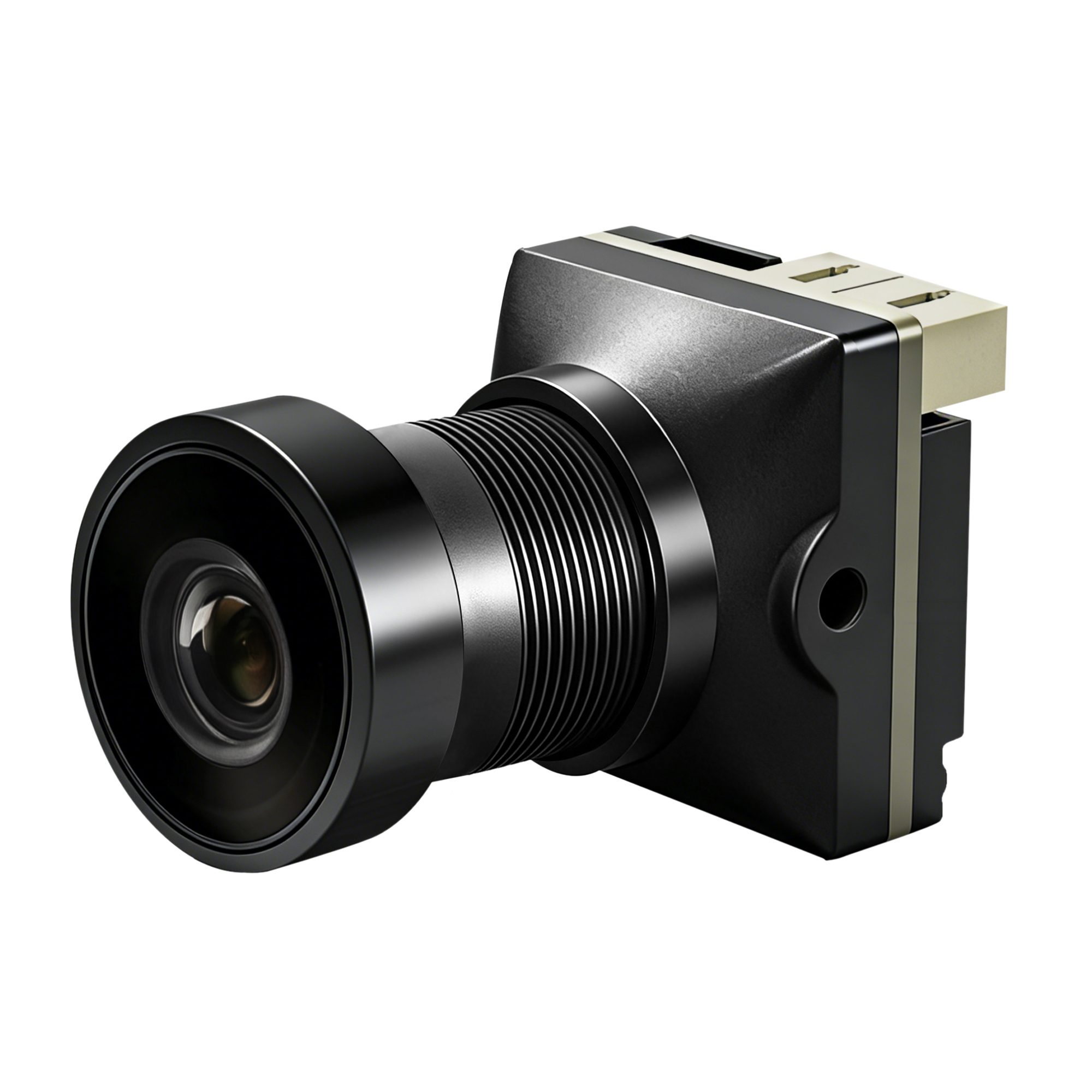
The IRLAB analog line is built on two visible-light models. The CDD-BS59KU delivers 1500TVL resolution in a 4:3 image with a minimum illumination of 0.00001 lux and a signal-to-noise ratio above 60dB. The CDD-BS59KP delivers the same 1500TVL resolution in a 16:9 image with a minimum illumination of 0.00002 lux and a signal-to-noise ratio above 54dB. Both output CVBS video with 3DNR noise reduction, accept a wide DC4.5V–27V input, and measure 19mm × 19mm × 27mm at 9g, with an aluminum alloy housing and a glass-plus-plastic lens.
For a buyer, the two models are a framing and sensitivity choice rather than a performance tier: 4:3 suits pilots who want the tallest possible field coverage, while 16:9 matches widescreen goggles and recorded footage. The 0.00001 lux rating of the CDD-BS59KU is the specification that matters for night work, and it is also the figure behind the starlight FPV camera category — the operating regime where conventional vision systems stop producing usable images. Analog power draw is 0.5W on the CDD-BS59KP and 0.6W on the CDD-BS59KU, and the wide input range simplifies power distribution on small airframes.
The limits are worth stating plainly. Composite video caps fine detail, so analog is the right choice for piloting and detection, not for detailed inspection imagery. Any recorded evidence also depends on an external recorder or ground station, because the analog cameras do not carry onboard storage. Within its intended role — racing drones, tactical and military FPV platforms, RC cars, AI detection and drone tracking pipelines where a low-latency video feed is the input — the analog models are documented as suitable for tactical FPV UAV projects.
Digital FPV cameras: HD capture, telemetry overlay and a stated latency budget
The IRLAB CDD-BS5JMU is a digital FPV camera and HD FPV camera built around a Sony image sensor. It records 3840×2160 at 30fps, 1080p at 90fps and 720p at 120fps, quotes a glass-to-glass latency of 50ms, and outputs over the 5.1GHz–5.8GHz band with 2T2R antennas. Transmit power is specified as ≤29dBm under FCC limits and ≤20dBm under CE limits, which is the kind of regional split that decides whether one SKU can serve several markets.
Integration features separate digital from analog more than raw frame rate does. The CDD-BS5JMU supports MSP and MAVLINK OSD protocols, so flight-controller telemetry can be overlaid directly on the video feed, and it includes a TF card slot supporting up to 1TB of onboard recording — the difference between piloting only and returning with usable footage. The camera module measures 19mm × 19mm × 26mm, the main board 32mm × 32mm × 19.3mm with a fan, and total weight is 32g with the fan (9g camera plus 23g board). Power input is 9V–30V at 5.4W typical and 9W maximum.
Those numbers define the trade-off. A digital link buys resolution, recording and OSD data at the cost of roughly three and a half times the analog camera weight, higher power draw, and a quoted 50ms latency that must be validated against the piloting task. Field of view remains 120°, matching the analog models, so the visual cone does not change — only the detail inside it.
Thermal FPV cameras: imaging heat when visible light fails
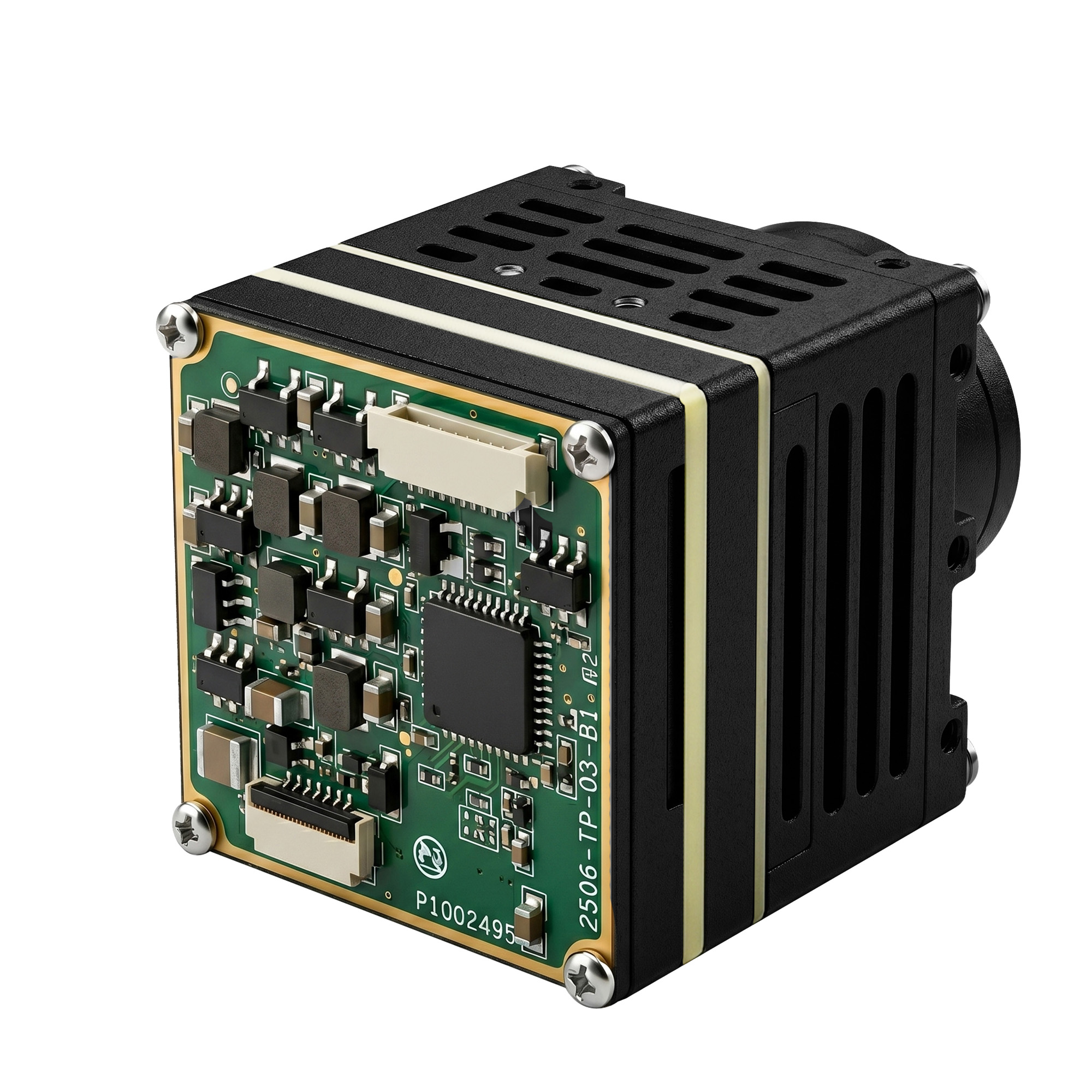
IRLAB thermal FPV cameras use an uncooled vanadium oxide detector with a 12μm pixel pitch and an 8–14μm spectral range. The CT-EI5ATC resolves 640×512; the CT-EI5ATB resolves 384×288. Both specify NETD ≤30mK at 25°C, ship with a 9.1mm lens producing a 46°×37° field of view, and offer CVBS or MIPI video output with optional UVC, plus UART and USB communication. Both run from DC3.9V–5.5V at ≤1.2W, measure 25.4mm × 25.4mm × 38.8mm including the 9.1mm lens, weigh 40g, operate from -20°C to 60°C and store from -45°C to 65°C.
The practical consequence is a different flying experience. A 46°×37° thermal field of view is far narrower than the 120° visible-light cameras, so the operator sees less of the scene at once and the airframe has to be flown to the target. The compensation is that thermal imaging does not depend on illumination at any level, which matters for search and rescue, industrial survey, tactical reconnaissance, military reconnaissance and AI thermal tracking applications where a heat signature — not a lit surface — is the object of interest.
The two detector options give programme managers a documented step: 640×512 for higher-detail missions, 384×288 for volume programmes where the wider array is not justified. Power consumption of ≤1.2W and a 40g mass keep the thermal payload manageable, and the aluminum alloy housing matches the rest of the FPV line.
Step-by-step breakdown: a seven-step evaluation sequence
- Define the required output. Decide whether the programme needs recorded evidence (digital, with TF card support up to 1TB), a live pilot view only (analog CVBS), or heat detection regardless of lighting (thermal). This single decision eliminates most of the shortlist.
- Set the latency budget. The digital CDD-BS5JMU quotes 50ms glass-to-glass. Analog cameras add no encode or decode stage inside the camera, but IRLAB does not publish an analog latency figure — so measure end-to-end latency on the intended video chain and ground station rather than assuming it.
- Set the light budget. If the mission must operate at or below the analog minimum illumination of 0.00001 lux (CDD-BS59KU) or 0.00002 lux (CDD-BS59KP), analog is viable and thermal is the fallback. If the mission must work with zero visible light, thermal becomes the baseline requirement rather than an upgrade.
- Check power, weight and voltage against the airframe. Analog: 9g, 0.5W–0.6W, DC4.5V–27V. Digital: 32g with fan, 5.4W typical and 9W maximum, 9V–30V. Thermal: 40g, ≤1.2W, DC3.9V–5.5V. The analog wide-voltage range removes BEC complexity; the digital and thermal power figures affect flight time and thermal management.
- Verify compliance scope and origin documentation. Confirm that certificates cover the exact model and application — FCC Part 15 for video transmitters, CE, UKCA and E-MARK for vehicle-mounted use, RoHS for materials, and ISO 9001 for the quality system. Where a buyer carries a country-of-origin restriction following the FCC Covered List additions in late 2025, request documentation from the supplier and verify it before design freeze rather than assuming compliance. IRLAB Limited was founded in Taiwan in 1992 and established its Shenzhen operation in 2003, so origin questions must be answered from the supplier's paperwork.
- Qualify the supplier's production and customisation model. IRLAB Limited runs OEM/ODM production with monthly capacity of 500,000 units and annual output of 6 million units. Customisation covers housing colour, logo printing, different viewing angle lenses, video image style, third-party AI algorithm integration and third-party wireless transmission solution integration. Quality control is 100% production check plus AQL standard OQC check, and the warranty period is two years.
- Validate on samples, then scale. Samples can be ordered at a minimum order quantity of 1 unit, and small quantities ship immediately. Test the chosen camera at the real light levels, on the real video link, at the real weight and voltage before committing to volume.
Use cases: racing, reconnaissance and industrial inspection
FPV racing and freeride: analog first
Racing and freeride airframes are weight- and power-sensitive, which points to the analog models: 9g, 0.5W–0.6W, DC4.5V–27V input, 1500TVL resolution and a 120° field of view, with the 4:3 CDD-BS59KU or the 16:9 CDD-BS59KP matching the goggles and recording setup. Pilots who also need HD evidence and telemetry overlay can move to the digital CDD-BS5JMU, accepting 32g with fan and a quoted 50ms glass-to-glass latency.
Tactical and reconnaissance drones: analog low light plus thermal
Tactical programmes usually run two camera profiles on the same platform. The visible-light side uses starlight-level sensitivity: in a documented Ukraine project, an FPV drone manufacturer integrated the IRLAB analog camera across 30,000 units over a one-year programme, where the camera delivered clear video imagery at sensitivity levels as low as 0.00001 lux and allowed the drone to identify, lock onto and track targets in extreme low-light or zero-light conditions. IRLAB's tactical FPV camera documentation describes operation in dark night and bright daylight, under high vibration and shock, across a wide temperature range of -38°C to 60°C, and in EMI-heavy environments. The thermal side covers true zero-light detection with the CT-EI5ATC or CT-EI5ATB.
Industrial inspection, SAR and AI tracking pipelines
Industrial survey work, search and rescue, fire service and heavy-industry inspection lean on thermal imaging, where the choice between 640×512 and 384×288 detectors is a detail-versus-volume decision. Where the programme feeds an automated pipeline, IRLAB's product documentation covers AI detection, drone tracking and AI thermal tracking camera roles, and the ODM service can integrate third-party AI algorithms or third-party wireless transmission solutions into the camera build. The digital CDD-BS5JMU adds MSP and MAVLINK OSD support for teams that overlay flight data on the video.
Where a budget alternative fits
A budget alternative FPV camera is not necessarily a lower-grade product — it is usually an analog model matched to a mission that never needed HD recording. The CDD-BS59KP at 1500TVL, 0.5W and 9g covers racing, RC car and low-light piloting duties at the least complex end of the video chain, while the thermal step between the 384×288 CT-EI5ATB and the 640×512 CT-EI5ATC is the main commercial lever on the thermal side. Because IRLAB quotes per configuration and the minimum order quantity is 1 unit, a programme can compare one analog, one digital and one thermal camera on the bench before scaling.
Comparison table: analog vs digital vs thermal FPV camera data
| Parameter | Analog FPV camera (CDD-BS59KU) | Digital FPV camera (CDD-BS5JMU) | Thermal FPV camera (CT-EI5ATC) |
|---|---|---|---|
| Imaging principle | Visible-light CMOS, CVBS composite output | Visible-light SONY sensor, digital HD link | Uncooled vanadium oxide detector, 8–14μm spectral range |
| Resolution | 1500TVL | 3840×2160@30fps / 1080p@90fps / 720p@120fps | 640×512 (CT-EI5ATB: 384×288) |
| Quoted latency | Not stated in the published product data | 50ms glass-to-glass | Not stated in the published product data |
| Low-light metric | Min. illumination 0.00001 lux (CDD-BS59KP: 0.00002 lux) | Not stated in the published product data | NETD ≤30mK@25°C; no visible light required |
| Field of view | 120° | 120° | 46°×37° (9.1mm lens) |
| Video output | CVBS | 5.1GHz–5.8GHz digital link; TF card recording up to 1TB | CVBS / MIPI, UVC optional |
| Data interface | Via flight controller | MSP and MAVLINK OSD protocols; 2T2R antenna | UART / USB |
| Power | DC4.5V–27V, 0.6W | 9V–30V, 5.4W normal / 9W max | DC3.9V–5.5V, ≤1.2W |
| Size / weight | 19×19×27mm / 9g | Camera 19×19×26mm, board 32×32×19.3mm / 32g with fan | 25.4×25.4×38.8mm with lens / 40g |
| Operating temperature | Not stated in the published product data | Not stated in the published product data | -20°C to 60°C (storage -45°C to 65°C) |
| Documented application fit | Racing, tactical and military FPV drones, AI detection, drone tracking, low latency, RC car | Racing and tactical FPV drones, HD FPV, AI detection, drone tracking, low latency, RC car | SAR, industrial survey, tactical and military reconnaissance, AI thermal tracking, low-latency analog thermal, RC car |
All values are taken from IRLAB Limited product data. Where the table states that a figure is not published, that is a documentation gap, not evidence of poor performance.
FAQ: compliance, capability, budget, samples and lead time
Are IRLAB FPV cameras certified for regulated markets?
IRLAB Limited holds FCC certification for camera and FPV camera products (certificate NTC2009742FV00, issued 2020-09-29 under FCC CFR 47 Part 15 Subpart B Class B), CE certification (NTC2006705EV00, covering EN 55032, EN 61000-3-2, EN 61000-3-3 and EN 55035), UKCA certification (SZNTC2204712EV00), E-MARK E11 approval (10R-048329 under ECE R10, issued 2017-06-22 by the Vehicle Certification Agency for vehicle on-board camera and FPV onboard vehicle camera applications), RoHS (ESTSZ130402233R), UL (20170803-E494081), CTICK (RSZA05061052-9) and ISO 9001:2015 certification issued by TÜV (44100102298, valid to 2027-11-10). The listed certificate scope covers models including the CDD-BS59KU, CDD-BS59KP, CDD-BS5JMU, CT-EI5ATB and CT-EI5ATC. Buyers should also confirm the video transmitter side of the chain against FCC Part 15 and, where applicable, the 2025 Covered List additions (DA 25-1086), since camera certification and airframe-level approval are separate questions.
Can one supplier deliver analog, digital and thermal FPV cameras to the same OEM specification?
IRLAB Limited manufactures all three categories under one quality system, with annual output of 6 million units and monthly capacity of 500,000 units. OEM/ODM customisation includes housing colour, logo printing, different viewing angle lens, video image style, integration of third-party AI algorithms and integration of third-party wireless transmission solutions. Because software, hardware, mechanical structure, video image tuning and quality control are handled in house, an analog, digital and thermal camera can be built to a common branding and interface specification rather than sourced from three unrelated vendors.
Which category is the budget-friendly choice, and what actually drives the cost?
Analog models such as the CDD-BS59KU and CDD-BS59KP represent the least complex video chain and are the usual budget alternative when HD recording is not a mission requirement. Digital adds a SONY sensor, an HD link, onboard recording and OSD protocol support. On the thermal side, cost typically tracks detector resolution and calibration, which is why the 384×288 CT-EI5ATB and the 640×512 CT-EI5ATC exist as separate models. IRLAB quotes pricing per configuration rather than publishing list prices, and with a minimum order quantity of 1 unit a programme can buy one of each category for bench comparison before committing to volume.
What does a sample evaluation involve?
Samples can be ordered at a minimum order quantity of 1 unit, and small quantities ship immediately. A practical evaluation covers five checks: image performance at the real operating light level (including the 0.00001 lux regime for the CDD-BS59KU), end-to-end latency on the actual video link and ground station, measured weight and power draw against the airframe budget, voltage compatibility across the stated input range, and mechanical fit. Image tuning feedback can be returned as a production setting, because video image style is one of the available customisation options.
What is the lead time from sample approval to volume delivery?
IRLAB Limited ships small quantities immediately; for large quantities, lead time is 15–25 working days after receiving the deposit. Production is backed by 100% production check plus AQL standard OQC check, and products carry a two-year warranty period. Teams can compare a sample from each category, then move to full-rate supply, by contacting the IRLAB Limited sales team at sales@irlab.net or requesting a quotation through www.irlab.net.
Conclusion: choose by mission, then verify by sample
The decision rule that survives contact with a real programme is short. Choose analog when the mission needs the lightest, lowest-power, wide-voltage video chain with starlight-level sensitivity — 9g, 0.5W–0.6W, 1500TVL, 0.00001 lux on the CDD-BS59KU. Choose digital when the mission needs HD capture, onboard recording up to 1TB, MSP and MAVLINK telemetry overlay, and can absorb 32g with fan and a quoted 50ms glass-to-glass latency — the CDD-BS5JMU. Choose thermal when visible light is irrelevant to the target, and then decide between the 640×512 CT-EI5ATC and the 384×288 CT-EI5ATB on detail requirements rather than on specification prestige.
Whichever direction the evaluation takes, three checks belong in every camera decision: confirm that certification scope covers the exact model and application, confirm whether any country-of-origin restriction applies to the programme, and validate the camera on a sample before volume. IRLAB Limited covers all three categories from a single 3,000m² facility under an ISO 9001:2015 certified quality system, with OEM/ODM production, 500,000 units of monthly capacity and a two-year warranty period.
Next step: sample, quotation or catalogue
Request an analog, digital or thermal FPV camera sample, ask for a configuration-based quotation, or download the IRLAB Company Profile & Corporate Brochures. Minimum order quantity is 1 unit, small quantities ship immediately, and volume orders run 15–25 working days after deposit.
Contact: sales@irlab.net · Tel +86 13682444680 · WhatsApp +8613502860860 · www.irlab.net