
Choosing FPV Cameras for Tactical Recon Drone Programs
Choosing the Right FPV Camera for Tactical Reconnaissance and Military Drone Programs
Direct answer: a tactical FPV camera is not selected by resolution or brand name. It is selected by three constraint sets that eliminate candidates fastest — the low-light and spectral-band requirement of the mission, the end-to-end latency budget of the video chain (tactical working conditions specify <50 ms), and the physical envelope the airframe actually flies in: -38℃ to 60℃, high shock and vibration, EMI, dense fog and torrential rain. Certification and supporting-equipment compatibility are verified afterwards, not instead.
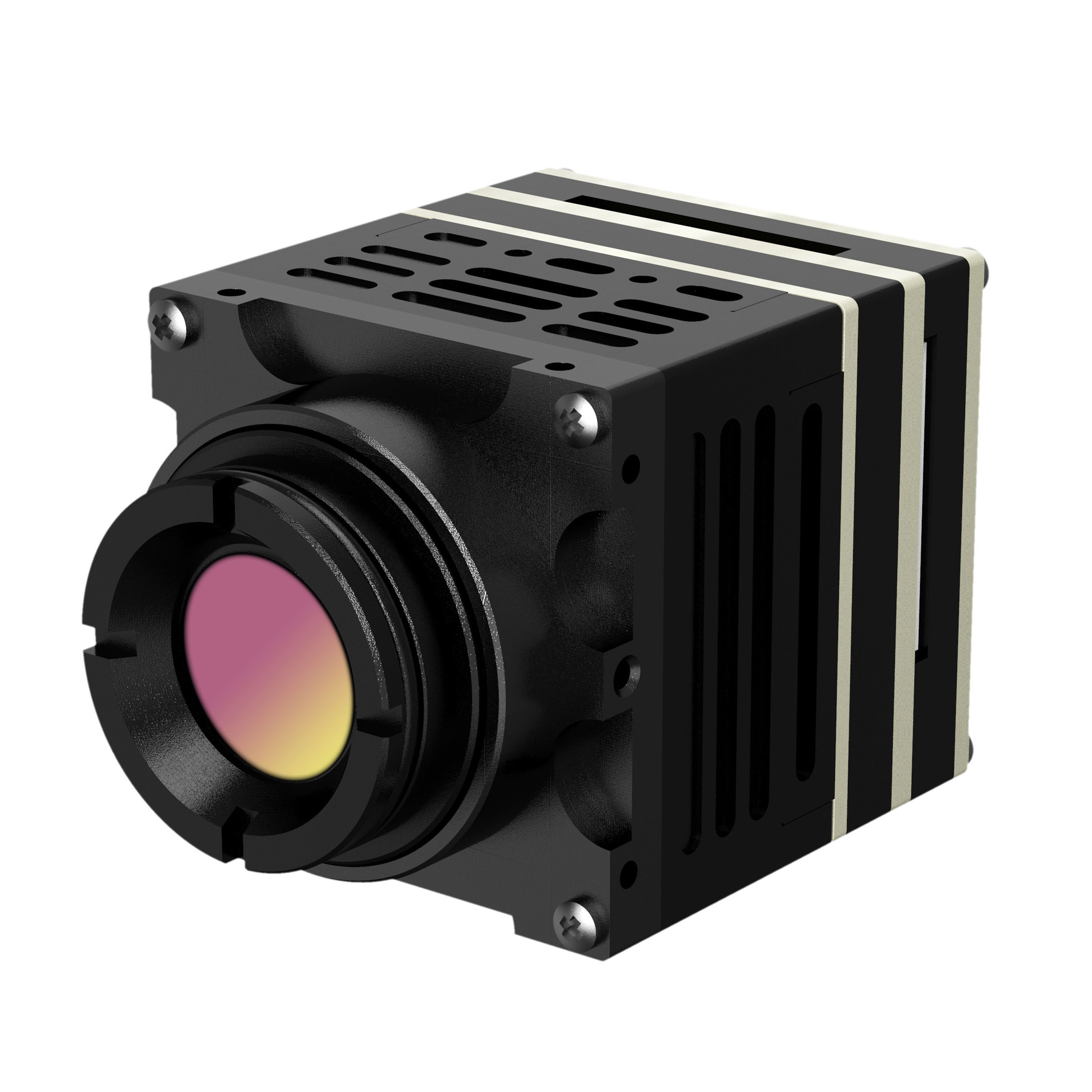
This guide is written for programme engineers, procurement managers and integrators evaluating FPV cameras for tactical reconnaissance, night pursuit, indoor assault and high-speed penetration strike missions. It uses two IRLAB Limited models as concrete fit examples — the thermal CT-EI5ATC and the digital CDD-BS5JMU — and shows which recorded tolerances each one satisfies, which dependencies sit around it (encrypted VTX, GCS, goggles, flight controller), and which market-access constraints have to be closed before volume shipments begin.
Problem Definition: Why Tactical FPV Camera Selection Fails Early
The first failure point is vocabulary. "FPV camera" describes at least three physically different architectures: analog CVBS starlight cameras, digital HD cameras, and uncooled thermal LWIR cameras. Their selection logic barely overlaps. A starlight analog camera answers a sensitivity question. A digital HD camera answers a latency and detail question. A thermal camera answers a spectral question — it images emitted heat in the 8–14 μm band rather than reflected light.
The second failure point is treating latency as a single product line. Tactical FPV working conditions specify ultra-low latency below 50 ms, zero-blur video and precision strike support. That figure applies to the whole chain: sensor exposure, encoding, video transmitter, receiver, goggles and display. A camera that publishes 50 ms glass-to-glass leaves the rest of the chain almost no headroom, so a programme has to define whether its target is a camera-level figure or a system-level measurement — and then test it on its own airframe.
The third failure point is environment. Tactical FPV working conditions are not laboratory conditions: extreme dark night and bright daylight, high vibration and shock, a wide temperature band, EMI-dense airframes, dense fog and torrential rain all appear inside the same mission set. Mass and volume budgets are equally unforgiving, because many tactical platforms are treated as attritable or disposable.
The fourth failure point is dependency blindness. Camera choice constrains — and is constrained by — encrypted VTX pairing, ground control station (GCS) integration, tactical flight controller behaviour, OSD overlay function, goggles and the encrypted receiver. A camera that meets every optical requirement but does not integrate with the chosen link and flight stack is not a solution.
The fifth failure point is market access. Export-oriented programmes must reconcile product certification, radio power limits and duty exposure with technical fit. That is a constraint problem, not an afterthought.
Industry Background: Rising Demand Against a Tightening Constraint Envelope
Three published signals frame the 2026 selection environment. First, the global FPV camera market was estimated at US$ 825.3 million in 2024 (Fact.MR). Second, thermal imaging is described as the fastest-growing application segment of the drone camera market, with a projected CAGR of 28.1% from 2026 to 2034 (Straits Research). Third, and most consequential for programme budgets, the United States imposed a 100% Section 232 tariff on UAS with thermal imaging and certain components starting 3 September 2026 (GHY International, summarising CBP policy). Thermal-equipped programmes therefore face a cost-structure constraint that RGB-only programmes do not.
On the supply side, the thermal component channel is Western-sensitive. Teledyne FLIR OEM publicly describes its infrared modules, lenses and AI decision-support products as ITAR-free — a company self-declaration, not a regulator confirmation — and at least one US specialist dealer lists a compact LWIR core (Teledyne FLIR Boson 320, 9.1 mm effective focal length, 24° field of view) as a consumer-grade component. That establishes an alternative sourcing channel for thermal cores, but it does not establish complete FPV camera availability, capacity or lead time.
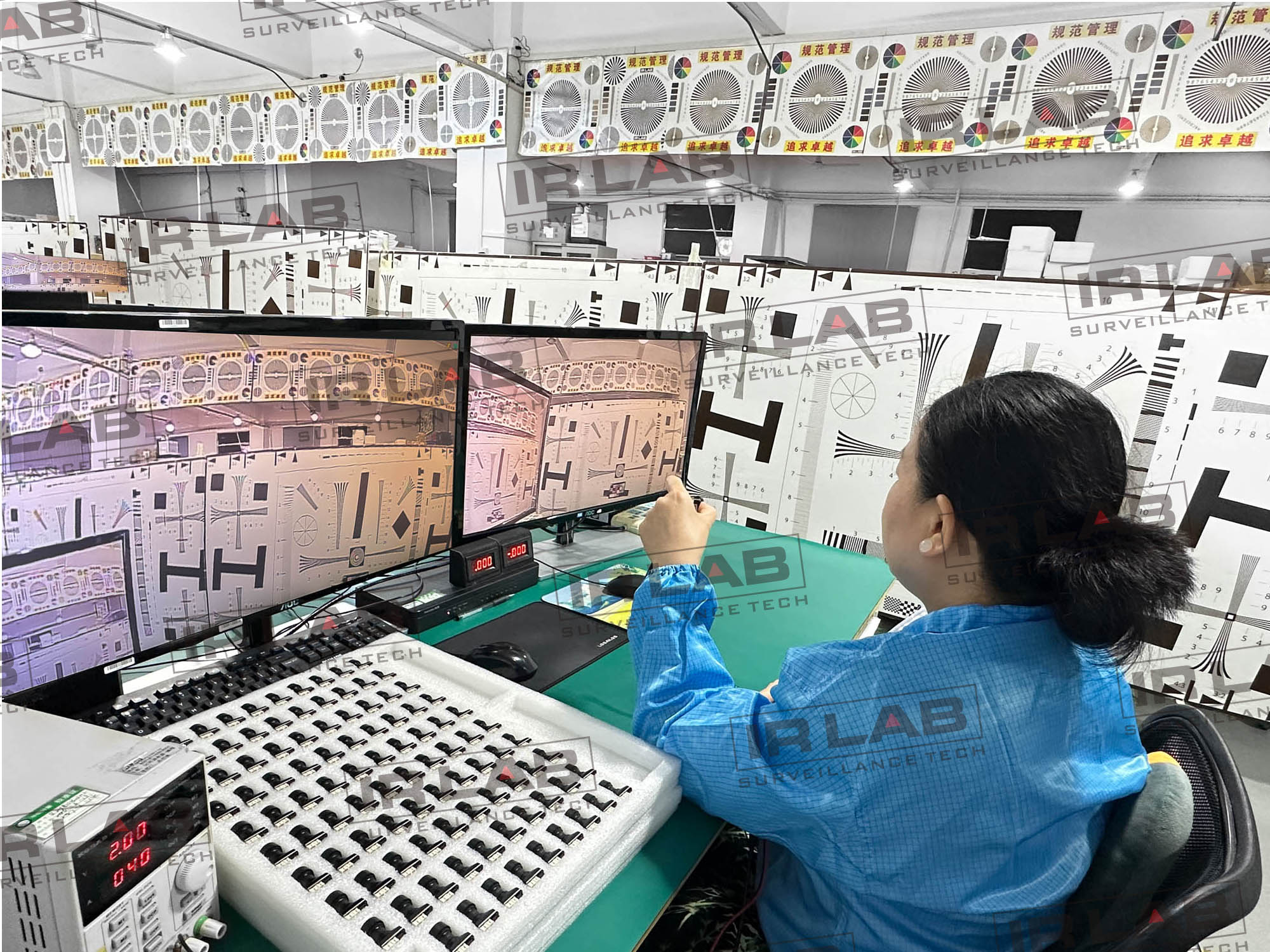
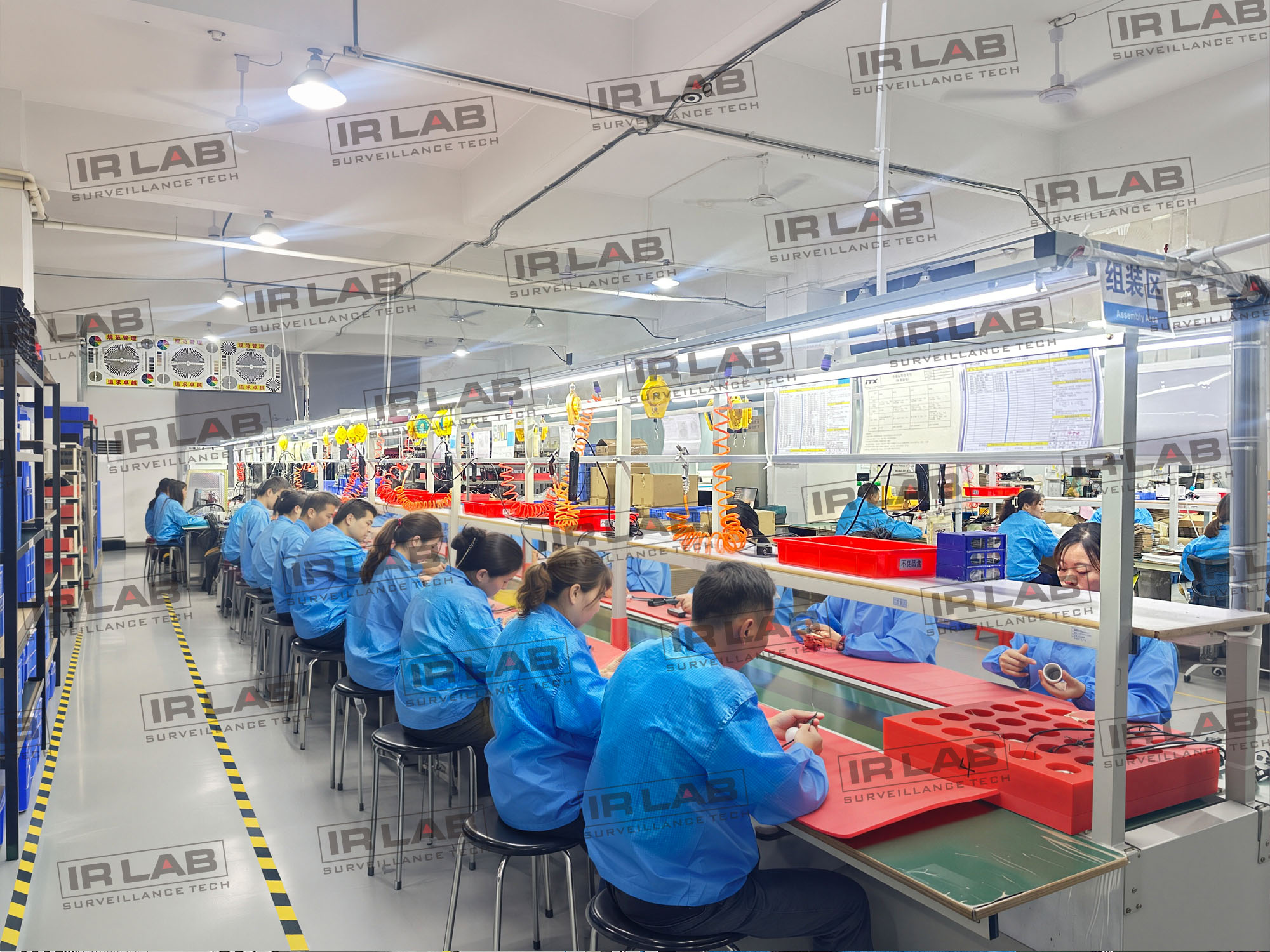
IRLAB Limited is an FPV camera manufacturer founded in 1992 in Taiwan and established in Shenzhen, China in 2003, with more than 30 years of camera development and manufacturing experience. The company operates a 3,000 m² facility with 100+ employees, including 10+ engineers working in house on software, hardware, mechanical structure, video image tuning and quality control, reports an annual output of 6 million cameras, and exports roughly 70% of production to Europe, the USA, Japan, Korea and Taiwan. Its quality system is certified to ISO 9001:2015 by TÜV (certificate 44100102298, issued 11 November 2024, valid to 10 November 2027). Cameras are offered with OEM/ODM services, a 1-unit MOQ and a 2-year warranty period.
Tactical FPV application scenarios served by the company's camera range are recorded as common in multiple countries including Ukraine, Russia, Turkey, South Korea and Jordan, among others.
Detailed Solution: The Constraint Stack for Tactical FPV Camera Selection
1. Freeze the mission profile before comparing cameras
Reconnaissance, pursuit, indoor assault and high-speed penetration do not share a requirement sheet. The recorded tactical FPV function set includes covert night reconnaissance, no-IR tactical manoeuvres, terminal visual guidance, high-speed penetration, zero-blur FPV, precision strike support, heat signature locking, "detect-to-engage" workflows, search and rescue, real-time battlefield situational awareness, target identification and marking, frontline intelligence transmission, and battle damage assessment. Mapping a programme to three or four of these functions is what converts a generic camera list into a defensible shortlist.
2. Resolve low-light by spectral band, not by "night vision"
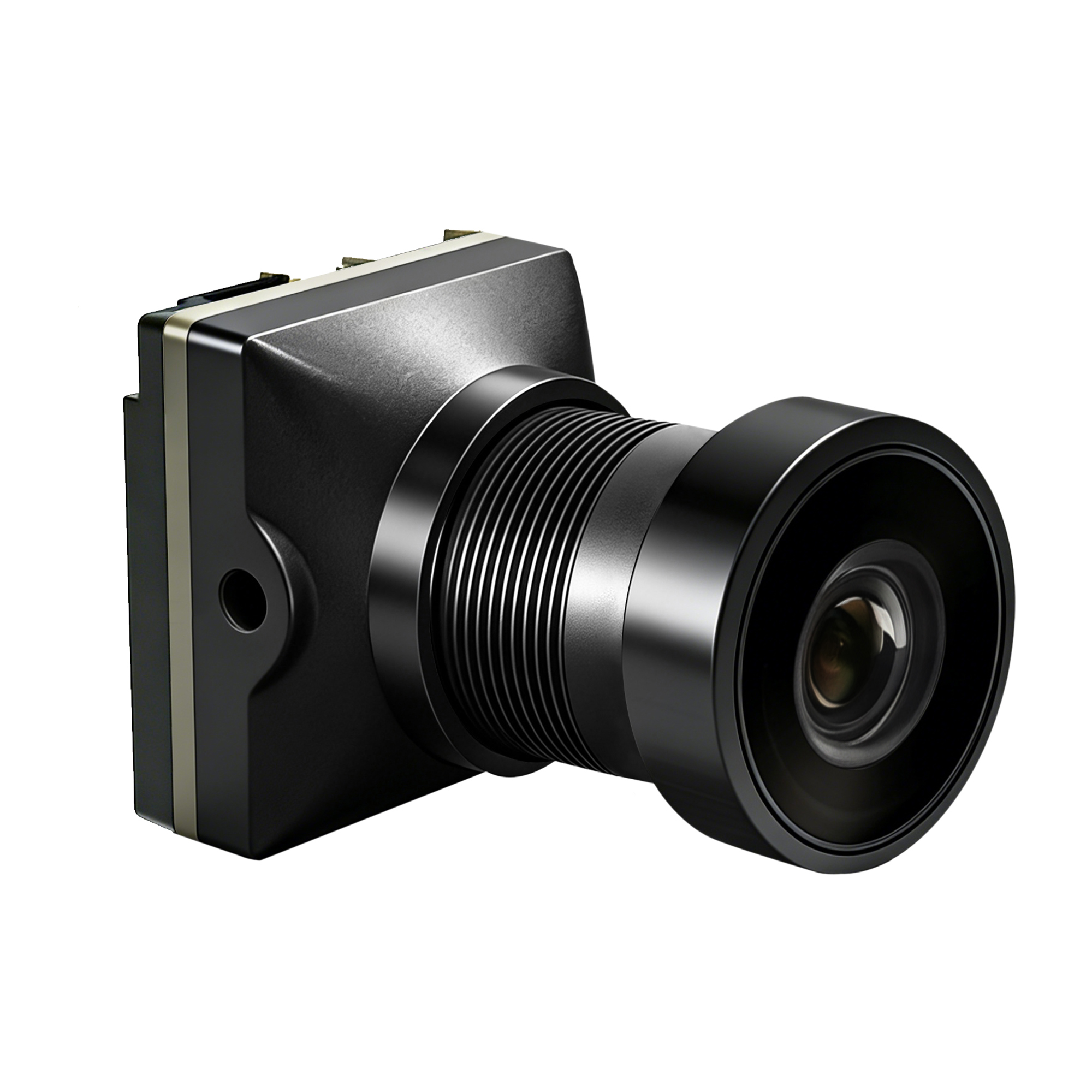
If the mission must fly covertly without IR illumination, the correct question is not "how many lux" but "which band". Two options exist in the IRLAB range. The analog line publishes minimum illumination of 0.00001 lux (CDD-BS59KU, 1500 TVL, 4:3, signal-to-noise ratio >60 dB) and 0.00002 lux (CDD-BS59KP, 1500 TVL, 16:9, signal-to-noise ratio >54 dB), both with 120° field of view, CVBS output and 3DNR. The thermal line publishes an uncooled vanadium oxide detector, an 8–14 μm LWIR spectral range, 12 μm pixel pitch and NETD ≤30 mK at 25℃, with the CT-EI5ATC at 640×512 resolution and the CT-EI5ATB at 384×288 resolution. Recorded tactical thermal requirements match that specification band explicitly — high resolution 640×512, ultra-low NETD ≤30 mK at 25℃, LWIR 8–14 μm, ultra-small 12 μm pixel pitch — and note that 4.6 mm, 6.8 mm and 9.1 mm lens options are used to trade field of view against identification range.
3. Treat latency as a system budget, not a datasheet line
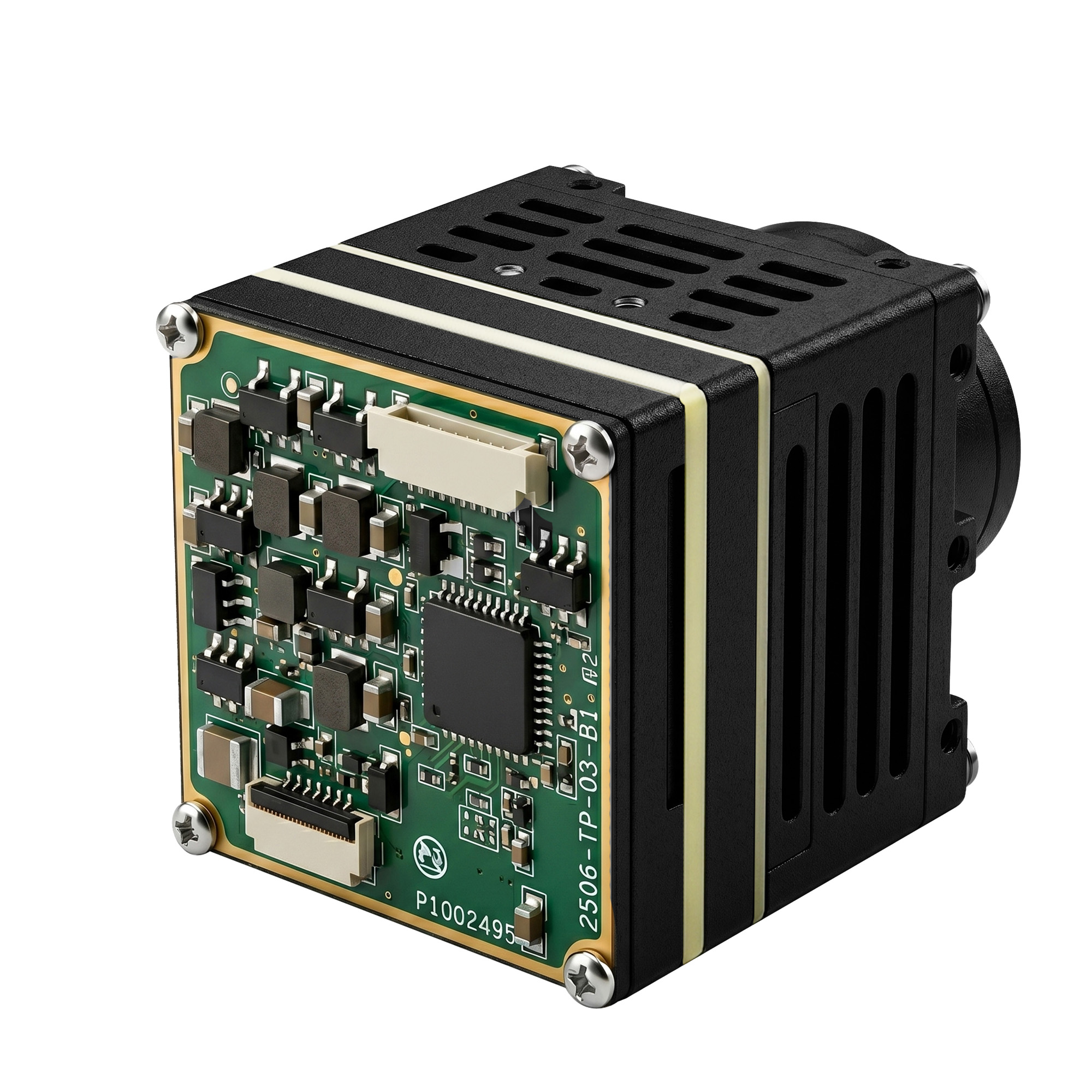
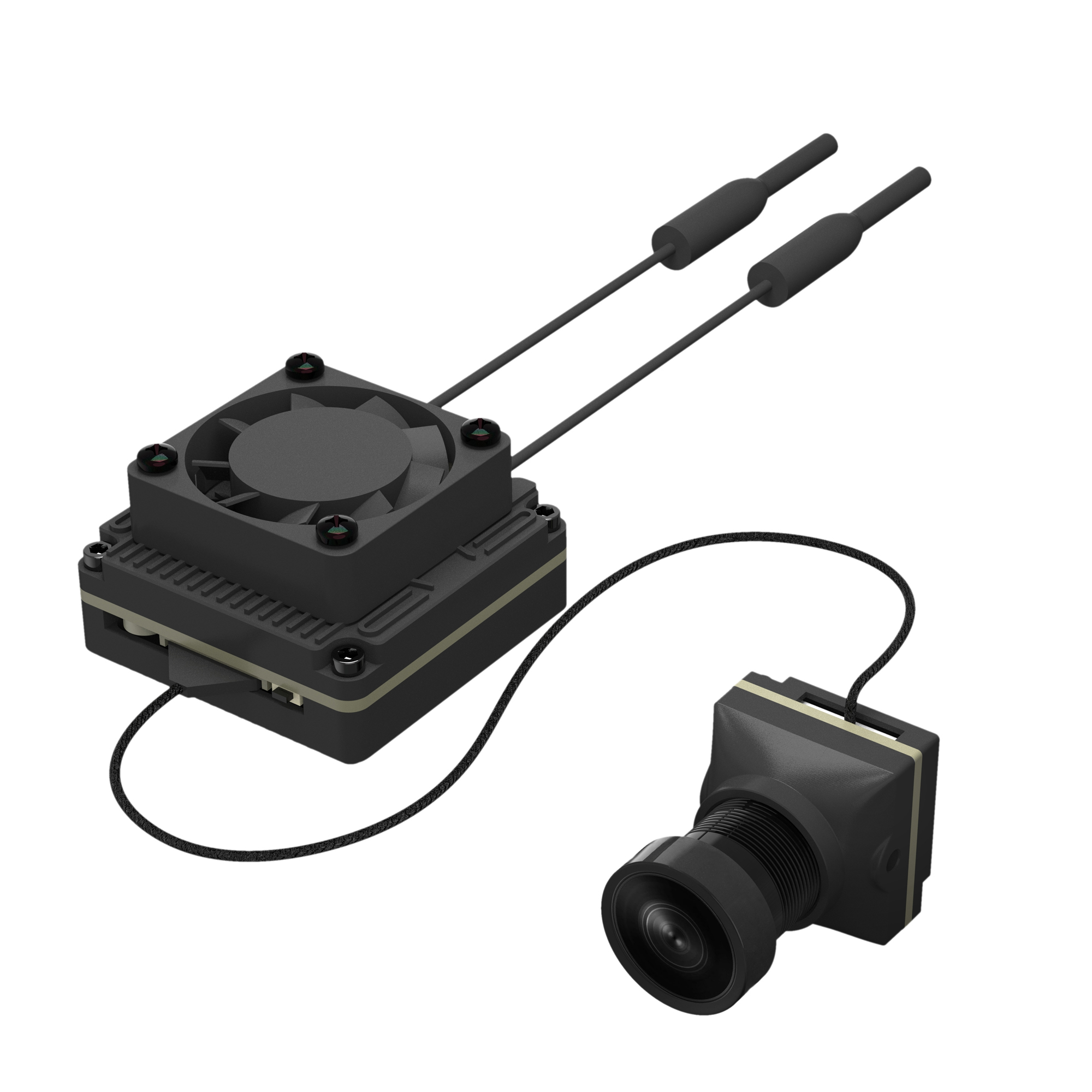
Tactical working conditions demand ultra-low latency below 50 ms and zero-blur video. The digital CDD-BS5JMU publishes 50 ms glass-to-glass latency, a SONY image sensor, and 3840×2160@30fps, 1080p@90fps or 720p@120fps output. For context, third-party commercial research covering 2026 digital FPV systems places typical glass-to-glass latency for main digital ecosystems in the 22–40 ms range (Straits Research). The practical rule for a programme targeting sub-50 ms performance is to specify the measurement method — glass-to-glass, at which resolution and frame rate, through which video transmitter and goggles — and to verify it on the airframe rather than accept a component claim.
4. Match the physical envelope: temperature, shock, EMI and SWaP
The recorded tactical working condition spans high vibration and shock, a wide temperature band of -38℃ to 60℃, EMI environments, dense fog and torrential rain, with special requirements for metal shock resistance, SWaP optimisation, high EMC and disposable-platform compatibility. Published product data has to be read carefully against that envelope. The CT-EI5ATC and CT-EI5ATB publish an operating temperature of -20℃ to 60℃ and a storage temperature of -45℃ to 65℃, in a 25.4 × 25.4 × 38.8 mm aluminium alloy housing weighing 40 g. Where a mission profile goes colder than a published operating range, that is an integration and thermal-management task to be closed by test, not something a datasheet can simply be assumed to cover. Mass and volume are equally concrete: the analog cameras weigh 9 g at 19 × 19 × 27 mm, the thermal module 40 g, and the digital CDD-BS5JMU is 32 g with fan (9 g camera plus 23 g board, 19 × 19 × 26 mm camera head, 32 × 32 × 19.3 mm main board).
5. Confirm the supporting-equipment dependency chain
Camera selection is only valid once the surrounding chain is fixed. The tactical FPV matched-equipment record lists tactical helmets and FPV goggles, encrypted VTX, GCS, tactical flight controller, analog VTX, OSD overlay system, ground control terminal and encrypted receiver alongside the drone platform itself. In practice that means checking: video output format against the transmitter (CVBS for the analog and thermal lines, up to 4K30 digital output on the CDD-BS5JMU); OSD protocol support (MSP and MAVLINK are supported on the CDD-BS5JMU); antenna and radio configuration (2T2R, 5.1–5.8 GHz, transmit power ≤29 dBm under FCC limits and ≤20 dBm under CE limits); data interfaces on the thermal modules (CVBS or MIPI with optional UVC, plus UART/USB communication); and power-rail planning, because input ranges differ markedly — 9–30 V for the digital camera, 4.5–27 V for the analog cameras, and 3.9–5.5 V (typical 5 V, ≤1.2 W) for the thermal modules.
6. Close market access before you scale
Certification is a screening constraint, not documentation decoration. The table below reproduces the certification records associated with the IRLAB FPV camera range, including the models used as examples in this guide.
| Market | Certification | Standard / directive | Certificate no. | Issued by | Related FPV models |
|---|---|---|---|---|---|
| EU | CE | EN 55032, EN 61000-3-2, EN 61000-3-3, EN 55035 | NTC2006705EV00 | NoreTesting Center | CDD-BS5JMU, CDD-BS59KU, CDD-BS59KP, CT-EI5ATC, CT-EI5ATB |
| ECE / UK | E-MARK E11 | ECE R10 | 10R-048329 | Vehicle Certification Agency | CDD-BS5JMU, CDD-BS59KU, CDD-BS59KP, CT-EI5ATC, CT-EI5ATB |
| UK | UKCA | BS EN 55032:2015/A1:2020; BS EN 55035:2017/A11:2020 | SZNTC2204712EV00 | Nore Testing Center | CDD-BS5JMU, CDD-BS59KU, CDD-BS59KP, CT-EI5ATC, CT-EI5ATB |
| EU | RoHS | Directive 2011/65/EU Annex II | ESTSZ130402233R | EST Standard Testing & Certification | CDD-BS5JMU, CDD-BS59KU, CDD-BS59KP, CT-EI5ATC, CT-EI5ATB |
| USA | FCC | FCC CFR 47 Part 15 Subpart B Class B:2019 | NTC2009742FV00 | Nore Testing Center | CDD-BS5JMU, CDD-BS59KU, CDD-BS59KP, CT-EI5ATC, CT-EI5ATB |
| USA / Canada | UL | UL 60950-1; CAN/CSA C22.2 No. 60950-1-07 | 20170803-E494081 | UL | CDD-BS5JMU, CDD-BS59KU, CDD-BS59KP, CT-EI5ATC, CT-EI5ATB |
| Australia / New Zealand | C-TICK | AS/NZS CISPR 22:2002 Class B | RSZA05061052-9 | Bay Area Compliance Laboratory Corp. | CDD-BS5JMU, CDD-BS59KU, CDD-BS59KP, CT-EI5ATC, CT-EI5ATB |
| Global | ISO 9001:2015 | R&D and production of audio & video equipment, surveillance & FPV camera | 44100102298 | TÜV (issued 11 Nov 2024, valid to 10 Nov 2027) | Company quality management system |
Certification coverage differs by market and must be matched to the destination of each shipment. Trade measures sit on top of product certification: the 100% US Section 232 tariff applied to UAS with thermal imaging and certain components from 3 September 2026 changes the landed-cost structure of thermal programmes specifically. Where a programme carries origin restrictions, country-of-origin and component documentation should be verified in writing at RFQ stage.
Comparison Table: Verified Options Across Analog, Digital and Thermal
| Model | Architecture | Imaging specification | Sensitivity | Link & latency | FOV / lens | Power | Dimensions & mass | Operating temperature |
|---|---|---|---|---|---|---|---|---|
| CDD-BS5JMU | Digital HD | SONY image sensor; 3840×2160@30fps, 1080p@90fps, 720p@120fps; TF card slot up to 1 TB | Not published for this model | 5.1–5.8 GHz, 2T2R, ≤29 dBm (FCC) / ≤20 dBm (CE); 50 ms glass-to-glass | 120° | 9–30 V; 5.4 W normal, 9 W max | Camera 19×19×26 mm; main board 32×32×19.3 mm with fan; 32 g with fan (9 g + 23 g) | Not published for this model |
| CT-EI5ATC | Thermal LWIR | Uncooled vanadium oxide; 640×512; 12 μm pixel pitch; 8–14 μm spectral range | NETD ≤30 mK at 25℃ | CVBS or MIPI (UVC optional); UART / USB | 9.1 mm lens, 46°×37° (4.6 / 6.8 / 9.1 mm lens options) | DC3.9–5.5 V (typical 5 V); ≤1.2 W | 25.4×25.4×38.8 mm incl. 9.1 mm lens; 40 g | -20℃ to 60℃; storage -45℃ to 65℃ |
| CT-EI5ATB | Thermal LWIR | Uncooled vanadium oxide; 384×288; 12 μm pixel pitch; 8–14 μm spectral range | NETD ≤30 mK at 25℃ | CVBS or MIPI (UVC optional); UART / USB | 9.1 mm lens, 46°×37° (4.6 / 6.8 / 9.1 mm lens options) | DC3.9–5.5 V (typical 5 V); ≤1.2 W | 25.4×25.4×38.8 mm incl. 9.1 mm lens; 40 g | -20℃ to 60℃; storage -45℃ to 65℃ |
| CDD-BS59KU | Analog starlight | 1500 TVL; 4:3; signal-to-noise ratio >60 dB; 3DNR | Minimum illumination 0.00001 lux | CVBS | 120° | DC4.5–27 V; 0.6 W | 19×19×27 mm; 9 g | Not published for this model |
| CDD-BS59KP | Analog starlight | 1500 TVL; 16:9; signal-to-noise ratio >54 dB; 3DNR | Minimum illumination 0.00002 lux | CVBS | 120° | DC4.5–27 V; 0.5 W | 19×19×27 mm; 9 g | Not published for this model |
All five models use aluminium alloy housings with glass-and-plastic lens assemblies. Values above are published specifications; where a field is not published for a model it is left blank rather than estimated. The 22–40 ms figure cited for digital systems is third-party commercial research context from Straits Research and is not a measurement of any IRLAB model.
Step-by-Step Breakdown: From Requirement Sheet to Accepted Camera
- Write the tolerance sheet. Convert the mission into pass/fail criteria: spectral band, minimum illumination or NETD, latency ceiling and measurement method, temperature range, shock and vibration level, EMI environment, mass and volume budget, power rail, and the certifications required per destination market.
- Choose the band. Select thermal (8–14 μm LWIR, NETD ≤30 mK at 25℃, 640×512 with the CT-EI5ATC) if the mission requires covert detection without IR illumination or heat-signature locking; select starlight analog (0.00001 lux on the CDD-BS59KU) where a 9 g, 0.5–0.6 W camera on a CVBS link is the priority; select digital (CDD-BS5JMU) where HD detail, OSD protocol support and 4K30 / 1080p90 / 720p120 output are required.
- Set the latency budget. Allocate the sub-50 ms target across camera, video transmitter, receiver, goggles and display, and fix one measurement definition (glass-to-glass).
- Size the envelope. Confirm housing material, mass, dimensions, operating and storage temperature, and connector and board footprint against the airframe.
- Map dependencies. Confirm encrypted VTX pairing, GCS and flight-controller interface, OSD overlay behaviour, goggle compatibility and power-rail budget.
- Check market access. Match the certification record to each destination market and model, and confirm the applicable trade measures for the thermal content of the platform.
- Sample and acceptance-test. Order an evaluation unit (MOQ is 1 unit), then test latency through your own chain, low-light or thermal performance in the target environment, temperature soak, vibration and shock, and link behaviour under EMI. Verify AI-related functions in the same cycle if the programme requires automated detection or tracking, because third-party AI algorithm integration is offered as an OEM/ODM option rather than as a fixed feature.
- Freeze configuration and scale. Lock housing colour, logo printing, viewing-angle lens, video image style, and any third-party AI algorithm or wireless transmission integration, then confirm production terms: 100% production check plus AQL-based OQC inspection, monthly capacity of 500,000 units, and lead time of immediate delivery for small quantities or 15–25 working days after deposit for large quantities.
Use Cases: Three Mission Profiles, Three Different Answers
Covert night reconnaissance and nighttime pursuit
This profile is decided by the spectral band rather than by pixel count. No-IR tactical manoeuvres, heat signature locking and "detect-to-engage" workflows require emitted-heat detection, which places the CT-EI5ATC (640×512, NETD ≤30 mK at 25℃, 8–14 μm) in the primary position, with the CT-EI5ATB (384×288) as the alternative where a different resolution and cost balance is preferred. Lens selection (4.6 mm, 6.8 mm or 9.1 mm) is the lever that trades field of view against identification range. A recorded case from a Ukrainian FPV drone manufacturer — 30,000 units over one year — describes operation at sensitivity levels as low as 0.00001 lux, a regime where conventional vision systems are effectively blind, with the drone required to identify, lock onto and track targets under extreme low-light or zero-light conditions.
Indoor assault and confined-space operations
Inside structures, the binding constraints are latency, field of view and physical size rather than detection range. A 120° field of view is published across the analog and digital lines; the digital CDD-BS5JMU adds a 19 × 19 × 26 mm camera head, 32 g with fan, MSP and MAVLINK OSD protocol support, and up to 1080p@90fps or 720p@120fps output for smoother motion handling. Where the platform is attritable and the link is analog, the 9 g, 0.5–0.6 W analog cameras on a 4.5–27 V rail remain the simplest integration path.
High-speed penetration strike and terminal guidance
Terminal guidance and high-speed penetration move shock resistance, zero-blur image stability and latency to the top of the list. All five models use aluminium alloy housings, and the recorded requirement explicitly calls for metal shock resistance and SWaP-optimised construction. The digital CDD-BS5JMU additionally provides a TF card slot supporting up to 1 TB of recording, which supports battle damage assessment and post-mission review; the thermal modules output CVBS or MIPI with optional UVC and communicate over UART/USB for integration into a ground control station.
Adjacent missions that follow the same hardware logic include border patrol, public security and law enforcement, emergency rescue, fire service, mining and heavy industry, wildlife conservation and search-and-rescue operations. Recorded tactical FPV deployment contexts span Ukraine, Russia, Turkey, South Korea and Jordan, among other countries.
Frequently Asked Questions
What certifications does a tactical FPV camera need for the EU, UK, US, Canada and Australia?
Destination market determines the certificate set, and the record must match the exact model ordered. For the IRLAB FPV camera range that means: CE under EN 55032, EN 61000-3-2, EN 61000-3-3 and EN 55035 (certificate NTC2006705EV00, NoreTesting Center) for the EU; UKCA under BS EN 55032:2015/A1:2020 and BS EN 55035:2017/A11:2020 (certificate SZNTC2204712EV00, Nore Testing Center) for the UK; E-MARK E11 under ECE R10 (certificate 10R-048329, Vehicle Certification Agency) for ECE and UK vehicle-related applications; FCC CFR 47 Part 15 Subpart B Class B:2019 (certificate NTC2009742FV00, Nore Testing Center) for the USA; UL 60950-1 and CAN/CSA C22.2 No. 60950-1-07 (certificate 20170803-E494081, UL) for the US and Canada; and C-TICK under AS/NZS CISPR 22:2002 Class B (certificate RSZA05061052-9, Bay Area Compliance Laboratory Corp.) for Australia and New Zealand. RoHS under Directive 2011/65/EU Annex II (certificate ESTSZ130402233R, EST Standard Testing & Certification) applies to the EU market, and manufacturing is covered by ISO 9001:2015 certified by TÜV (certificate 44100102298).
Can one FPV camera model cover both night reconnaissance and high-speed penetration missions?
Not automatically, because the two missions stress different physics. Night reconnaissance without IR illumination depends on spectral band and thermal sensitivity — the CT-EI5ATC (uncooled vanadium oxide, 640×512, 8–14 μm, 12 μm pixel pitch, NETD ≤30 mK at 25℃) is the thermal fit, while the starlight analog cameras publish 0.00001 lux (CDD-BS59KU) and 0.00002 lux (CDD-BS59KP). High-speed penetration depends on latency, shock resistance and zero-blur stability, where the digital CDD-BS5JMU publishes 50 ms glass-to-glass latency and up to 1080p@90fps or 720p@120fps output. Programmes that must cover both typically carry or switch payloads, so they need to verify SWaP and power rails for both options: 40 g and 3.9–5.5 V for the thermal module, 32 g with fan and 9–30 V for the digital camera.
What drives the total cost of a tactical FPV camera programme beyond the unit price?
Unit price is only one line. Where thermal imaging is involved, duty exposure is the largest structural variable: the United States applies a 100% Section 232 tariff to UAS with thermal imaging and certain components from 3 September 2026, so the origin and thermal content of a platform change its landed cost. Certification scope per destination market, lens and field-of-view selection (4.6 mm, 6.8 mm and 9.1 mm options trade field of view against range), OEM/ODM configuration such as housing colour, logo printing and video image style, third-party AI algorithm or wireless transmission integration, and the volume required to cover attrition all add cost. These should be checked against a supplier's actual commercial terms rather than inferred from headline camera prices across different architectures.
Can we evaluate a camera before committing to volume production?
Yes, and sampling is structured rather than anecdotal. MOQ is 1 unit, quality control combines a 100% production check with AQL-standard OQC inspection, and the reference case in this application area ran as a one-year, 30,000-unit programme for a Ukrainian FPV drone manufacturer. A useful evaluation tests latency through your own video transmitter, goggles and display; low-light or thermal performance in the target environment; temperature soak against the mission envelope; vibration and shock; and behaviour in an EMI-dense airframe — all before the configuration is frozen.
What are the MOQ, lead time and warranty terms?
MOQ is 1 unit. Small quantities ship immediately; large quantities are delivered within 15–25 working days after receiving deposit, supported by a monthly capacity of 500,000 units and an annual output of 6 million cameras. Every camera carries a 2-year warranty period. Programmes moving from evaluation to volume usually begin with a sample request and a specification review, so the fastest next step is to send your mission tolerance sheet — spectral band, latency target, temperature envelope, power rail and destination market — to sales@irlab.net or via WhatsApp at +8613502860860, and request a sample and quotation against it.
Conclusion: Select on Constraints, Then Verify on the Airframe
Tactical reconnaissance, night pursuit, indoor assault and high-speed penetration strike programmes do not need a longer list of cameras — they need a shorter list of verified tolerances. The sequence that works is stable: fix the mission profile, resolve low-light by spectral band (starlight analog at 0.00001–0.00002 lux, or LWIR thermal at 8–14 μm with NETD ≤30 mK at 25℃), set one glass-to-glass latency definition against the sub-50 ms requirement, size the physical envelope including the -38℃ to 60℃ working condition, map the encrypted VTX, GCS, goggles and flight-controller dependencies, and close certification and trade constraints for every destination market before scaling.
IRLAB Limited supports that sequence with published specifications rather than estimates: certificate numbers for CE, E-MARK E11, UKCA, RoHS, FCC, UL and C-TICK; an ISO 9001:2015 quality system certified by TÜV; 30+ years of camera development since 1992; and OEM/ODM flexibility covering housing colour, logo printing, viewing-angle lens selection, video image style, and third-party AI algorithm or wireless transmission integration.
Request a Sample or Quotation
Send your mission tolerance sheet and we will map it to the closest verified configuration — thermal, digital or starlight analog — and return a sample plan and quotation.
Email: sales@irlab.net | Tel / WhatsApp: +86 13682444680 / +8613502860860 | Web: www.irlab.net
Download the company profile and product brochure: IRLAB Company Profile & Corporate Brochures (PDF)
Have Questions or Need More Details?
Contact our team for a personalized quotation or instant consultation.
Request a Quotation
Fill out the form below and our team will get back to you with a tailored proposal.
WhatsApp Direct Chat
Prefer to chat in real-time? Message us on WhatsApp for instant assistance & quick answers.
- Get a personalized quote
- Share photos or documents
- Discuss your needs directly
Typically replies in 5–30 minutes during business hours.