FPV Camera Compliance Essentials: Certification Priorities for Global Drone Deployment
FPV camera compliance is decided by four layers, not by one sticker: the stated scope of the camera-level certificate, the electromagnetic and radio behaviour of the unit, the electrical and thermal ratings of the hardware, and the traceability of the production system behind it. A camera can hold a valid CE or FCC certificate for the scope “Camera, FPV Camera” and still fail a deployment review, because the airframe, radio link, battery and operator authorisation sit outside that scope.
IRLAB Limited is a camera developer and manufacturer founded in 1992, originally from Taiwan and established in Shenzhen in 2003, with a 3,000 m² facility, 100+ employees, 10+ engineers and an annual output of 6 million camera units. Its FPV camera line — analog models CDD-BS59KU and CDD-BS59KP, the digital HD model CDD-BS5JMU, and the thermal models CT-EI5ATC and CT-EI5ATB — carries a documented set of camera-level approvals: CE, UKCA, FCC, E-MARK E11, CTick, UL and RoHS, plus an ISO 9001:2015 certificate issued by TÜV under number 44100102298, valid from 11 November 2024 to 10 November 2027.
Those documents support a deployment file. They do not remove the integrator’s obligation to verify country-specific and platform-specific requirements. This guide explains where compliance actually breaks, ranks the six priorities that decide whether an FPV camera can be deployed in a given market, and shows how the published certificate and specification data map onto real defence, tactical and commercial drone programmes.
Problem definition: where FPV camera compliance actually breaks
Most compliance failures in FPV camera programmes are not caused by a missing certificate. They are caused by a mismatch between what a certificate says and what the buyer assumes it says. Four failure modes account for the majority of late-stage problems.
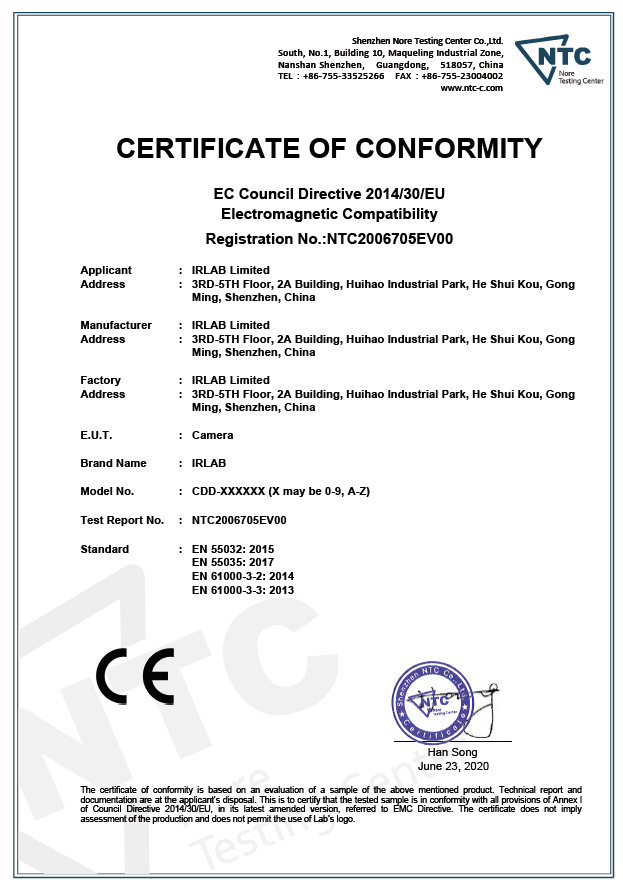
Scope mismatch. Every certificate carries a scope line, and that line is narrower than most buyers expect. IRLAB’s CE certificate NTC2006705EV00 is scoped to “Camera, FPV Camera”. The UKCA certificate SZNTC2204712EV00 is scoped to “CCTV Camera / FPV Surveillance Camera”. The E-MARK E11 approval 10R-048329 is scoped to “Vehicle on-board camera / FPV onboard vehicle camera” under ECE R10 — a vehicle installation, not an airborne one. Treating any of these as a whole-aircraft approval is a documented error, and it is one an auditor will find quickly.
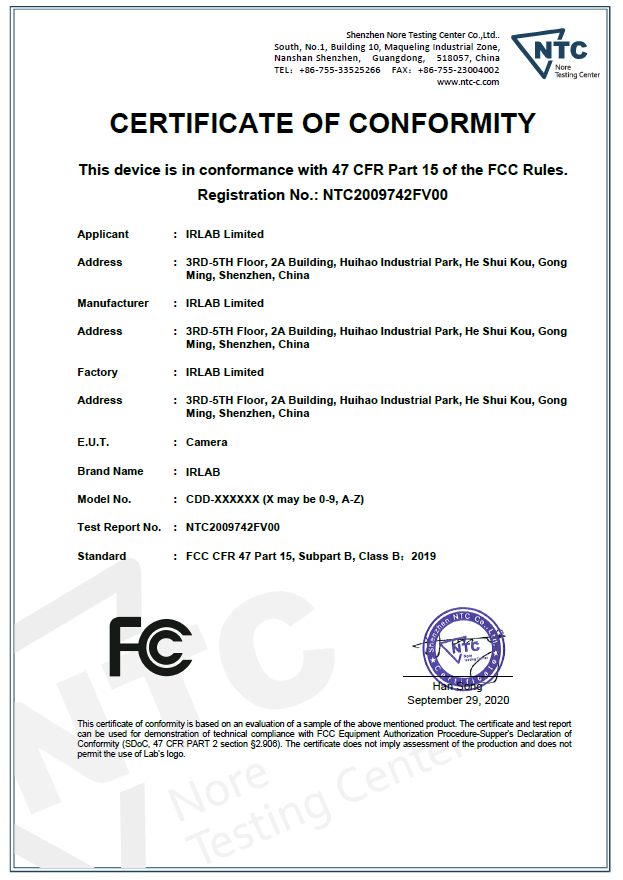
Revision drift. Standards are amended while certificate numbers stay the same. IRLAB’s FCC certificate NTC2009742FV00 references FCC CFR 47 Part 15 Subpart B Class B:2019 and was issued on 29 September 2020; the E-MARK E11 approval references ECE R10 and was issued on 22 June 2017. Both remain in the register, but a buyer preparing a 2026 deployment should confirm with the supplier that the reference revision is still the current one and ask for the latest certificate copy rather than an archived PDF.
Environment drift. A unit that passes an EMC test in a lab can behave differently on a drone flying in an EMI-dense environment, in direct sun, under sustained vibration, or at the edge of its temperature window. Robustness in the field is an engineering property, not a paperwork property — which is why the design envelope matters as much as the certificate.
Customisation drift. IRLAB’s OEM/ODM service covers housing colour, logo printing, different viewing angle lenses, video image style, third-party AI algorithm integration and third-party wireless transmission integration. Several of those changes touch exactly the parameters that EMC and optical approvals are based on. A compliant base unit does not automatically produce a compliant custom variant, and buyers who assume otherwise discover the gap during final acceptance rather than during specification.
Industry background: why certification became a procurement gate
Two commercial trends have pushed certification from a paperwork afterthought into a buying criterion. The first is volume. The global FPV camera market was estimated at US$825.3 million in 2024, according to Fact.MR’s FPV camera market report. Within the wider drone camera market, thermal imaging is the fastest-growing application segment, with a projected CAGR of 28.1% from 2026 to 2034, based on Straits Research’s drone camera market analysis. As unit volumes rise, so does the cost of a compliance failure across an entire batch.
The second is trade policy. Trade reporting from GHY International, covering US Customs and Border Protection measures, records a 100% Section 232 tariff applied to unmanned aircraft systems with thermal imaging and to certain components, effective 3 September 2026. For thermal-equipped FPV programmes aimed at the US market, landed cost is now a compliance-adjacent calculation rather than a pure purchasing negotiation.
Export control has moved in parallel. Teledyne FLIR OEM publicly positions itself as a supplier of infrared camera modules, lenses and AI decision-support products that the company states are not subject to ITAR controls — a company self-declaration rather than a regulator-confirmed classification, but a clear signal that Western buyers are screening suppliers on export-control posture as well as on specifications.
The practical consequence is straightforward. Buyers evaluating an FPV camera in 2026 are no longer only comparing resolution and latency. They are building a file that has to survive a customs query, a customer audit and a country-specific radio approval — and the supplier’s documentation either supports that file or it does not.
The six compliance priorities, ranked
Not every compliance requirement carries the same weight at the evaluation stage. The ranking below orders the six priorities by how early they can stop a deployment, and maps each one to verifiable documentation from IRLAB Limited. It is a prioritisation of compliance criteria, not a ranking of suppliers.
| Rank | Compliance priority | What it gates | Verifiable IRLAB evidence |
|---|---|---|---|
| 1 | Market-entry certificate coverage | Customs clearance and lawful sale in the destination market | CE NTC2006705EV00; FCC NTC2009742FV00; UKCA SZNTC2204712EV00; E-MARK E11 10R-048329; CTick RSZA05061052-9 |
| 2 | EMC and RF behaviour | Interference-free integration and legal spectrum use | EN 55032, EN 61000-3-2, EN 61000-3-3, EN 55035; FCC CFR 47 Part 15 Subpart B Class B:2019; ECE R10; AS/NZS CISPR 22:2002 Class B; digital model RF caps of ≤29 dBm (FCC) and ≤20 dBm (CE) at 5.8 GHz |
| 3 | Electrical safety and power flexibility | Safe integration with the aircraft power bus | UL 60950-1 and CAN/CSA C22.2 No. 60950-1-07, certificate 20170803-E494081; DC 4.5–27 V analog input; 9–30 V digital input; DC 3.9–5.5 V thermal input |
| 4 | Thermal and mechanical endurance | Survival inside the mission envelope | Documented operation from −38 °C to 60 °C with high vibration/shock and EMI for the tactical FPV camera; thermal models rated −20 °C to 60 °C operating, −45 °C to 65 °C storage; aluminium alloy housings |
| 5 | Material and substance restrictions | EU/UK customs release and tender eligibility | RoHS ESTSZ130402233R, referencing EC 62321:2008 and RoHS Directive 2011/65/EU Annex II |
| 6 | Quality-system traceability | Audit readiness and batch repeatability | ISO 9001:2015 certificate 44100102298 issued by TÜV; 100% production check plus AQL standard OQC |
Priority 1 — Market-entry certificate coverage
This ranks first because a missing mark stops a shipment before any technical question is asked. IRLAB’s register covers the main commercial blocs: CE for the European Union (NTC2006705EV00, issued 23 June 2020 by NoreTesting Center), FCC for the United States (NTC2009742FV00, issued 29 September 2020 by Nore Testing Center), UKCA for the United Kingdom (SZNTC2204712EV00, issued 17 June 2022 by Nore Testing Center), E-MARK E11 for ECE and UK vehicle applications (10R-048329, issued 22 June 2017 by the Vehicle Certification Agency), and CTick for Australia and New Zealand (RSZA05061052-9, issued 10 June 2005 by Bay Area Compliance Laboratory Corp).
The correct buyer action is to read the scope line of each document against the intended installation. A camera approved as “Camera, FPV Camera” supports a camera-level compliance argument. It does not support a claim that an aircraft system, a ground station or a vehicle installation is approved. Requesting the certificate copy with its scope text, rather than a marketing badge image, is the single most useful habit in this phase.
Detailed solution: how to close each compliance gap
Priority 2 — EMC and RF behaviour
Electromagnetic compatibility is where camera-level certification does the most work for a drone integrator. The CE certificate for IRLAB FPV cameras references EN 55032, EN 61000-3-2, EN 61000-3-3 and EN 55035 — emission and immunity standards that describe how the unit behaves in a shared electromagnetic environment. The UKCA certificate references BS EN 55032:2015/A1:2020 and BS EN 55035:2017/A11:2020. The FCC certificate references FCC CFR 47 Part 15 Subpart B Class B:2019, and the Australia/New Zealand CTick references AS/NZS CISPR 22:2002 Class B. Vehicle-mounted installations add ECE R10 through the E-MARK E11 approval.
Radio behaviour is the second half of this priority, and it is where regional configuration becomes visible in the specification. The digital FPV camera CDD-BS5JMU operates in the 5.1–5.8 GHz band with a published transmit power of ≤29 dBm at 5.8 GHz under FCC limits and ≤20 dBm under CE limits. That difference is not a marketing detail: it is the mechanism by which one hardware platform is configured to two different regulatory ceilings, and buyers should confirm which configuration is being shipped to which destination.
IRLAB documents operation of its tactical FPV camera under EMI environments, alongside dark night, direct sunshine and high vibration/shock. That is a design statement about the intended duty, and it is the right question to raise with any supplier: what evidence exists that the unit still performs when the electromagnetic environment is hostile, not just when it is clean?
Priority 3 — Electrical safety and power-input flexibility
Electrical safety documentation is often skipped in FPV sourcing because the camera is a low-power accessory. It should not be. The UL certificate 20170803-E494081, issued 3 August 2017, references UL 60950-1 and CAN/CSA C22.2 No. 60950-1-07 for the scope “Camera, FPV Camera” in the USA and Canada — a safety standard reference that matters when the camera shares a harness with a flight controller and a battery pack.
Power-input ranges tell the integrator how much protection the unit needs. The analog models CDD-BS59KU and CDD-BS59KP accept DC 4.5–27 V and draw 0.6 W and 0.5 W respectively, which tolerates wide swings on a multi-cell pack. The digital model CDD-BS5JMU accepts 9–30 V and draws 5.4 W normally, up to 9 W at maximum. The thermal models CT-EI5ATC and CT-EI5ATB accept DC 3.9–5.5 V, typically 5 V, and draw ≤1.2 W — meaning they need a regulated rail rather than a direct pack tap. Getting that wrong is an electrical-compliance problem long before it becomes an image-quality problem.
Priority 4 — Thermal and mechanical endurance
Endurance is the priority most often assessed by anecdote and least often documented. IRLAB’s tactical FPV camera documentation states operation under extreme conditions including dark night, sunshine day, high vibration and shock, a wide temperature range from −38 °C to 60 °C, and EMI environments, with application scenarios recorded across multiple countries including Ukraine, Russia, Turkey, South Korea and Jordan. The thermal models carry their own datasheet envelope: −20 °C to 60 °C operating and −45 °C to 65 °C storage, in a 25.4 × 25.4 × 38.8 mm aluminium alloy housing weighing 40 g.
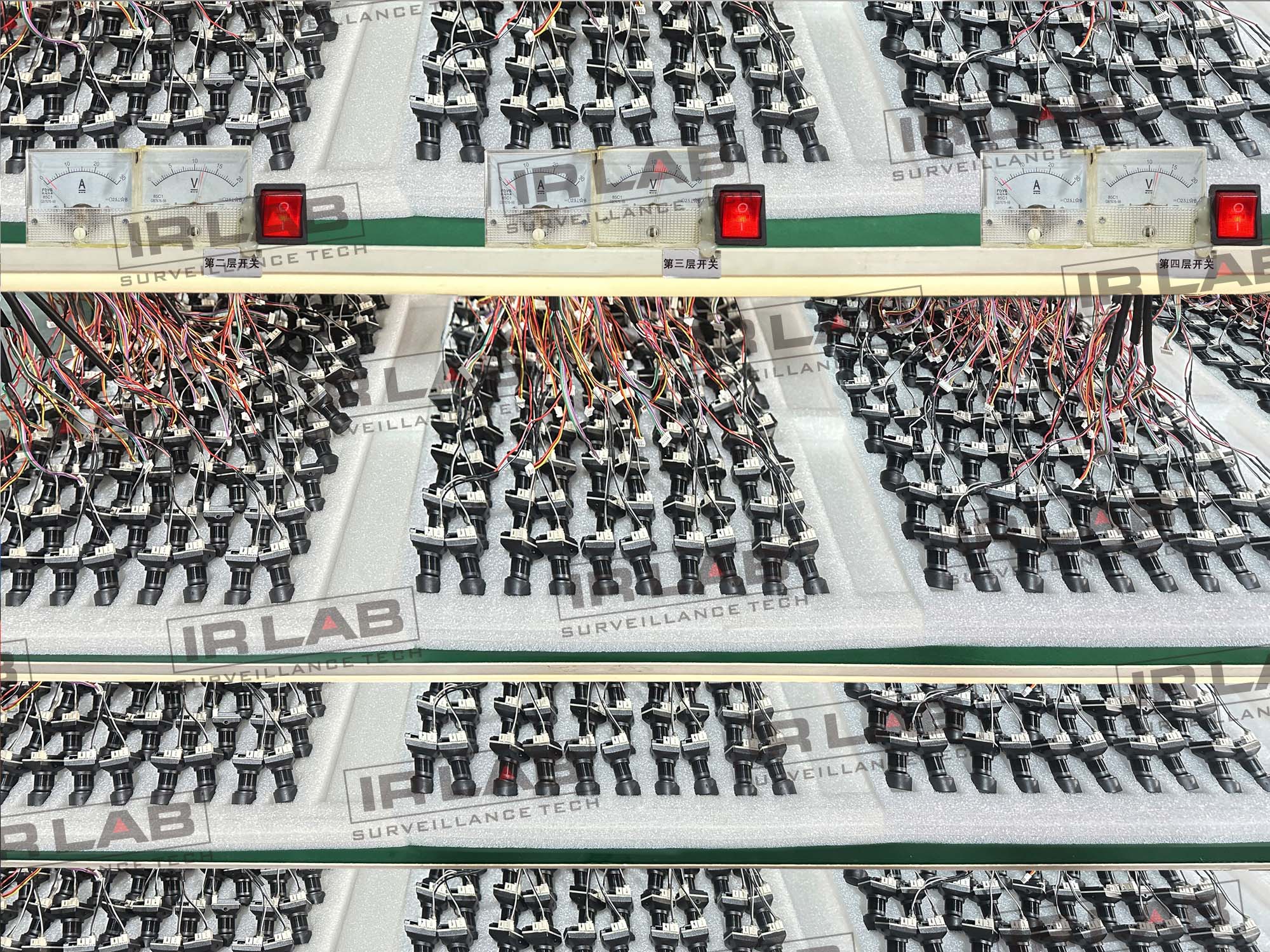
The buyer action here is to compare envelopes rather than headline claims. A programme that operates a thermal camera below −20 °C is outside the published operating range of CT-EI5ATC and CT-EI5ATB and needs a different thermal strategy, regardless of how strong the camera’s imaging specification looks. Conversely, a 9 g analog unit rated within a −38 °C to 60 °C documented envelope is a defensible choice for a lightweight airframe in a wide-climate theatre.
Priority 5 — Material and substance restrictions
RoHS compliance is rarely the reason a programme succeeds, but it is frequently the reason a shipment stops. IRLAB’s RoHS certificate ESTSZ130402233R, issued 6 May 2013 by EST Standard Testing & Certification, references EC 62321:2008 and RoHS Directive 2011/65/EU Annex II, with the scope “CCTV Camera, FPV Surveillance Camera” and the EU as the applicable market. Because the issue date is older than the other documents in the register, buyers preparing an EU or UK tender should request the current declaration alongside the certificate and confirm that the referenced directive text is still the applicable version for their market.
Priority 6 — Quality-system traceability
The final priority is the one that determines whether the other five hold across a batch rather than across a sample. IRLAB’s ISO 9001:2015 certificate 44100102298 was issued by TÜV with the scope “R&D and Production of Audio & Video Equipment, Surveillance & FPV Camera”, valid from 11 November 2024 to 10 November 2027. On the production side, IRLAB states 100% production check plus AQL standard OQC, a 3,000 m² facility in Shenzhen, 100+ employees, 10+ engineers, an annual output of 6 million camera units and a monthly capacity of 500,000 units. Roughly 70% of output is exported to Europe, the USA, Japan, Korea and Taiwan.
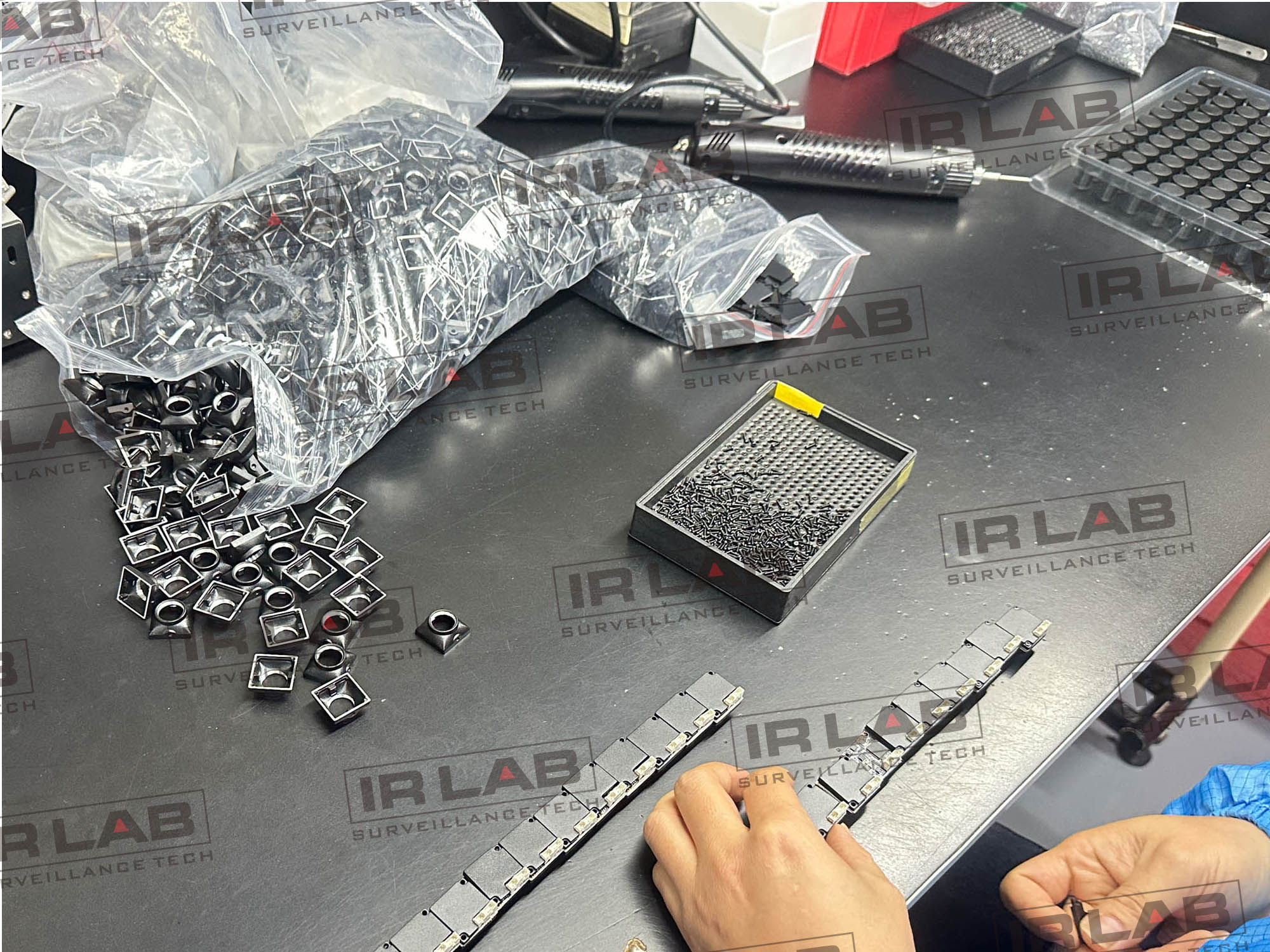
For a buyer, the value of a 30-year engineering history — 1992 origin in Taiwan, Shenzhen operations since 2003 — is not sentimental. It is a signal that the documentation set is maintained rather than assembled for a single tender, and that the same engineering team handles software, hardware, mechanical structure, video image tuning and quality control in house.
Step-by-step: building a deployment file for a new market
- Define the deployment envelope before requesting documents. Record the destination country, the host platform (airborne, vehicle-mounted, fixed), the mission profile, and the environmental extremes the camera will see. Every later document check depends on this definition.
- Map required marks to certificate scope, not to certificate names. For an EU deployment, read the CE scope “Camera, FPV Camera”; for a UK deployment, read the UKCA scope “CCTV Camera / FPV Surveillance Camera”; for a vehicle install, read the E-MARK E11 scope “Vehicle on-board camera / FPV onboard vehicle camera”. Write down the gaps explicitly.
- Verify certificate identity and currency. Confirm the certificate number, issuing body and issue date — for example FCC NTC2009742FV00 issued 29 September 2020 by Nore Testing Center, or UKCA SZNTC2204712EV00 issued 17 June 2022. Ask the supplier to confirm that the referenced standard revision is current.
- Check electrical and thermal fit against the platform. Match the camera’s input range — 4.5–27 V analog, 9–30 V digital, 3.9–5.5 V thermal — to the aircraft bus, and match the operating temperature to the theatre. Do not assume the envelope is shared across the line.
- Validate with a physical sample before committing volume. A sample order is possible from a minimum of 1 unit, with immediate delivery on small quantities and a 2-year warranty period on the product.
- Freeze customisation before compliance sign-off. Any change to housing colour, logo printing, viewing angle lens, video image style, third-party AI algorithm integration or third-party wireless transmission integration should be reviewed against the certificate scope it might affect, and re-tested where the change touches EMC or optics.
- Document origin and export-control position separately from product certification. Product certificates do not establish country of origin, and “China-free” sourcing claims require documentary evidence such as customs origin data — not a factory address. IRLAB manufactures in Shenzhen, and buyers with origin-sensitive programmes should treat origin as its own verification track with its own paperwork.
- Re-verify at platform level before fielding. Airframe approval, radio-link authorisation, battery safety and operator licensing sit with the integrator in almost every jurisdiction. Camera-level certification is the input to that work, not a substitute for it.
Use cases: matching certification scope to the mission
Tactical and defence-adjacent drone programmes. These programmes screen on endurance and EMC before they screen on image quality, because the failure that matters is losing video in a hostile electromagnetic environment. IRLAB documents operation of its tactical FPV camera under EMI environments, high vibration and shock, direct sunshine and dark night across a −38 °C to 60 °C range, with application scenarios recorded in multiple countries including Ukraine, Russia, Turkey, South Korea and Jordan. In one Ukrainian deployment, 30,000 units of the analog camera (product 4320, model CDD-BS59KU) were supplied for FPV drone use, delivering usable imagery at sensitivity levels as low as 0.00001 lux.
Thermal search-and-rescue and inspection. Thermal work is the fastest-growing slice of the drone camera market, and it is also the slice with the strictest payload constraints. CT-EI5ATC offers a 640 × 512 uncooled vanadium oxide detector with 12 μm pixel pitch, 8–14 μm spectral range and NETD ≤30 mK at 25 °C, while CT-EI5ATB offers 384 × 288 on the same platform. Both use a 9.1 mm lens with a 46° × 37° field of view, output CVBS or MIPI with optional UVC, communicate over UART or USB, and weigh 40 g at ≤1.2 W.
Vehicle-mounted and onboard surveillance. Installations where the camera is carried by a vehicle rather than an aircraft fall under a different approval route, and this is exactly where scope reading pays. The E-MARK E11 approval 10R-048329, issued by the Vehicle Certification Agency under ECE R10, is scoped to “Vehicle on-board camera / FPV onboard vehicle camera” for the ECE and UK markets — the correct document for that installation class, and the wrong one for an airborne claim.
Racing, RC and robotics integration. Low-latency digital builds care about integration protocols as much as about latency. CDD-BS5JMU uses a SONY sensor with 3840 × 2160 at 30 fps, 1080p at 90 fps and 720p at 120 fps, a 120° field of view, 50 ms glass-to-glass latency, 2T2R antenna configuration, MSP and MAVLink OSD protocol support, and a TF card slot supporting up to 1 TB. The analog CDD-BS59KU and CDD-BS59KP both reach 1500 TVL at 120° field of view in a 9 g, 19 × 19 × 27 mm aluminium alloy body — a form factor that also suits industrial robotics and RC vehicle integration.
Comparison table: the IRLAB certificate register
The table below reproduces the certificate data as recorded, including the scope line that determines what each document actually covers.
| Certificate | Market | Standard referenced | Certificate no. | Stated scope |
|---|---|---|---|---|
| CE | EU | EN 55032, EN 61000-3-2, EN 61000-3-3, EN 55035 | NTC2006705EV00 | Camera, FPV Camera |
| UKCA | UK | BS EN 55032:2015/A1:2020; BS EN 55035:2017/A11:2020 | SZNTC2204712EV00 | CCTV Camera / FPV Surveillance Camera |
| FCC | USA | FCC CFR 47 Part 15 Subpart B Class B:2019 | NTC2009742FV00 | Camera, FPV Camera |
| E-MARK E11 | ECE, UK | ECE R10 | 10R-048329 | Vehicle on-board camera / FPV onboard vehicle camera |
| CTick | AU, NZ | AS/NZS CISPR 22:2002 Class B | RSZA05061052-9 | Dome camera, FPV Camera |
| UL | USA, CA | UL 60950-1; CAN/CSA C22.2 No. 60950-1-07 | 20170803-E494081 | Camera, FPV Camera |
| RoHS | EU | EC 62321:2008; RoHS Directive 2011/65/EU Annex II | ESTSZ130402233R | CCTV Camera, FPV Surveillance Camera |
| ISO 9001:2015 | Global | ISO 9001:2015 | 44100102298 | R&D and Production of Audio & Video Equipment, Surveillance & FPV Camera |
Comparison table: compliance-relevant design specifications
Certification only tells half the story; the design envelope tells the other half. The table below compares the five FPV camera models on the parameters that most often drive a compliance or integration decision.
| Model | Type | Power input | Consumption | Operating temperature | Housing / lens | Weight |
|---|---|---|---|---|---|---|
| CDD-BS59KU | Analog | DC 4.5–27 V | 0.6 W | Not stated in published specification | Aluminium alloy / glass + plastic | 9 g |
| CDD-BS59KP | Analog | DC 4.5–27 V | 0.5 W | Not stated in published specification | Aluminium alloy / glass + plastic | 9 g |
| CDD-BS5JMU | Digital HD | DC 9–30 V | 5.4 W normal, 9 W max | Not stated in published specification | Aluminium alloy / glass + plastic | 32 g with fan |
| CT-EI5ATC | Thermal 640 × 512 | DC 3.9–5.5 V (typical 5 V) | ≤1.2 W | −20 °C to 60 °C operating; −45 °C to 65 °C storage | Aluminium alloy / glass + plastic | 40 g |
| CT-EI5ATB | Thermal 384 × 288 | DC 3.9–5.5 V (typical 5 V) | ≤1.2 W | −20 °C to 60 °C operating; −45 °C to 65 °C storage | Aluminium alloy / glass + plastic | 40 g |
Note: IRLAB separately documents operation from −38 °C to 60 °C for its tactical FPV camera in the field, including high vibration/shock and EMI environments. Where a published per-model figure is not stated, buyers should request it in writing for the deployment file.
FAQ: FPV camera certification questions buyers ask
Does a CE or FCC mark on an FPV camera cover the whole drone?
No. The certificates in IRLAB’s register are camera-level documents with defined scopes. CE certificate NTC2006705EV00 references EN 55032, EN 61000-3-2, EN 61000-3-3 and EN 55035 for the scope “Camera, FPV Camera”. FCC certificate NTC2009742FV00 references FCC CFR 47 Part 15 Subpart B Class B:2019 for the same scope. Airframe approval, radio-link authorisation, battery safety and operator licensing are separate approvals handled by the integrator. The E-MARK E11 approval 10R-048329 is scoped specifically to “Vehicle on-board camera / FPV onboard vehicle camera” under ECE R10, so it supports a vehicle installation rather than an airborne one. Reading the scope line before assuming coverage is the first verification step in any market.
Can an FPV camera be customised without invalidating its compliance documentation?
Customisation and compliance have to be reviewed together, because the changes that buyers most often request are the ones that touch tested parameters. IRLAB’s OEM/ODM service covers housing colour, logo printing, different viewing angle lenses, video image style, third-party AI algorithm integration and third-party wireless transmission integration. Optical changes can alter the behaviour a certificate was issued against, and RF or AI-board integration can change the electromagnetic profile of the assembly. The practical route is to fix the customisation specification before final compliance sign-off, ask which certificate number still applies to the custom variant, and re-test where the change affects EMC or optics. Minimum order quantity is 1 unit, so a custom or standard sample can be validated before a volume commitment.
What drives the cost of a compliant FPV camera order?
Four factors dominate. The first is the certificate coverage required by the destination market, since a multi-market programme needs a broader documentation set than a single-market one. The second is the level of customisation, because lens, housing, branding and integration work add engineering steps. The third is volume: with a minimum order quantity of 1 unit, small-quantity orders ship immediately, while larger volumes are scheduled within 15–25 working days after deposit against a monthly capacity of 500,000 units. The fourth is destination duty. Trade reporting from GHY International records a 100% US Section 232 tariff on unmanned aircraft systems with thermal imaging and certain components effective 3 September 2026, which materially changes landed cost for thermal-equipped programmes. IRLAB does not publish unit pricing; a written quotation is the correct way to price a specific configuration.
How should a buyer validate an FPV camera before committing to volume?
Validation should combine documents and hardware. On the document side, request the certificate copies with their scope text and issue dates — CE NTC2006705EV00, FCC NTC2009742FV00, UKCA SZNTC2204712EV00, E-MARK E11 10R-048329, CTick RSZA05061052-9, UL 20170803-E494081, RoHS ESTSZ130402233R and ISO 9001:2015 44100102298. On the hardware side, order a sample: the minimum order quantity is 1 unit, small quantities ship immediately, and the product carries a 2-year warranty period. Then test the sample in your own electromagnetic and thermal environment rather than relying on a laboratory figure, and confirm that batch production follows the stated 100% production check plus AQL standard OQC.
What lead time applies once compliance documents are approved?
Lead time depends on quantity rather than on certification. Small quantities ship immediately from IRLAB, and large quantities are delivered within 15–25 working days after receipt of deposit, against a stated monthly capacity of 500,000 units and an annual output of 6 million camera units from a 3,000 m² Shenzhen facility. Because compliance review and production scheduling run on separate clocks, the practical sequence is to approve the deployment file first and book capacity second. To start that process, send your destination markets, platform type and required configuration to sales@irlab.net or via WhatsApp at +86 13502860860, and request a sample together with the certificate pack for the models you are evaluating.
Next step: sample, certificate pack and quotation
IRLAB Limited supplies analog, digital HD and thermal FPV cameras with camera-level CE, UKCA, FCC, E-MARK E11, CTick, UL and RoHS documentation, and manufactures under a TÜV-issued ISO 9001:2015 quality system at its Shenzhen facility. Minimum order quantity is 1 unit, with a 2-year warranty period.
Request a sample or a written quotation: www.irlab.net · sales@irlab.net · Tel +86 13682444680 · WhatsApp +86 13502860860
Download the company profile and product brochures: IRLAB Company Profile & Corporate Brochures (PDF)

Conclusion
Global FPV camera deployment is a documentation discipline as much as an engineering one. The markets that matter most — the EU, the UK, the USA, ECE vehicle applications and Australia/New Zealand — each require a specific mark with a specific scope, and the fastest way to lose a programme is to assume that a camera-level certificate approves a whole aircraft or a whole installation. IRLAB Limited supports that work with a maintained register: CE NTC2006705EV00, UKCA SZNTC2204712EV00, FCC NTC2009742FV00, E-MARK E11 10R-048329, CTick RSZA05061052-9, UL 20170803-E494081, RoHS ESTSZ130402233R and ISO 9001:2015 44100102298, valid to 10 November 2027.
The engineering behind those documents matters too. Wide-input analog models from DC 4.5–27 V, a digital platform configured to ≤29 dBm under FCC limits and ≤20 dBm under CE limits, thermal modules rated from −20 °C to 60 °C operating, and a documented −38 °C to 60 °C envelope with EMI, vibration and shock for the tactical camera — these are the hardware facts that determine whether a certificate stays true in the field.
What IRLAB provides is a hardened, documented component set backed by 30+ years of camera engineering and in-house control of software, hardware, mechanical structure, image tuning and quality control. What it cannot provide on a buyer’s behalf is country-specific approval of the aircraft, the radio installation or the operating licence. That final verification stays with the integrator — and the programmes that plan for it are the ones that reach deployment on schedule.
Have Questions or Need More Details?
Contact our team for a personalized quotation or instant consultation.
Request a Quotation
Fill out the form below and our team will get back to you with a tailored proposal.
WhatsApp Direct Chat
Prefer to chat in real-time? Message us on WhatsApp for instant assistance & quick answers.
- Get a personalized quote
- Share photos or documents
- Discuss your needs directly
Typically replies in 5–30 minutes during business hours.