
Top FPV Cameras for Night Operations: Analog, Digital, Thermal Picks
A night-operations FPV camera can fail in four separate ways. It can be blind because there is too little light. It can produce an image so noisy that the pilot cannot identify anything. It can deliver a clean image too late to fly on. Or it can work perfectly in the visible band while the target is only visible as a heat signature. Those are four different problems, so a single ranking of night FPV cameras only makes sense when each camera is placed against the job it actually solves.
This page ranks three IRLAB FPV cameras by night role rather than by one composite score. The analog CDD-BS59KU (1500TVL, 0.00001 LUX minimum illumination, 120° field of view, 9g) takes the darkest and lightest builds. The digital CDD-BS5JMU (SONY sensor, 3840×2160 at 30fps, 50ms glass-to-glass latency) takes the missions where recorded detail matters. The thermal CT-EI5ATC (640×512 uncooled vanadium oxide detector, 40g) takes the missions where there is no visible light at all. The criteria, the published specifications and the limits of each pick are set out below so the ranking can be checked rather than accepted.
Why night operations are a different FPV camera problem
Night work changes which specification decides the outcome. In daylight, resolution usually dominates a camera comparison. After dark, the limiting factors are how few photons the sensor can still convert into a usable image, how much noise appears when gain is applied, how long the image takes to reach the goggles, and whether the target emits anything in the band the sensor can see.
Four parameters carry most of the decision:
- Minimum illumination. The lowest light level at which the camera still produces an identifiable image. A lower published figure indicates a more sensitive camera, provided the figures are quoted under comparable conditions.
- Signal-to-noise ratio (S/N). How much of the output is real signal rather than noise. At night the camera applies gain, and gain amplifies noise as well as signal, so a higher S/N ratio protects detail that would otherwise disappear into grain.
- Latency and frame rate. Glass-to-glass delay is the time from light entering the lens to the image appearing in the goggles. At speed, delay and low frame rate combine into an image the pilot is reacting to late.
- Spectral band. Visible-light cameras need at least some light. A long-wave infrared camera working in the 8–14 μm band images emitted heat instead, which is a different sensing capability rather than a better version of the same one.
IRLAB's tactical FPV application documentation frames the same pressures as requirements: ultra-low light and starlight sensing, sub-50ms latency, high wide dynamic range (WDR), strong EMI immunity, high shock and vibration resistance, and, for thermal models, high thermal sensitivity. Those notes describe a requirement set for tactical FPV UAV projects. They are not a measurement of any individual camera, which is why this article uses them as selection criteria and keeps the published datasheet values separate.
How these three picks were ranked
The ranking rule is simple: each camera is placed where its published specification removes the largest night-operations constraint for the least platform cost. Six criteria were applied, in this order:
- Published low-light capability (minimum illumination, S/N ratio, or thermal sensitivity).
- Output latency and available frame rates.
- Detail capture — resolution for identification and post-flight review.
- Size, weight and power (SWaP), because every gram and every watt competes with flight time.
- Spectral band, which decides whether the camera works with no light at all.
- Integration fit — video output format, OSD protocol support, input voltage range and antenna configuration.
Ranking disclosure. This is an editorial ranking of three products from one manufacturer's published catalogue, based on published specifications and IRLAB's documented tactical FPV operating requirements. It is not an independent laboratory test, not a measured market ranking, and not a comparison of sales volume. Where a scenario requirement and a published specification differ, both are shown rather than merged.
The ranking deliberately does not score the three models on one scale. A 9g analog camera running at 0.6W and a 40g thermal camera are not substitutes for each other; placing them on a single ladder would hide the decision that actually matters, which is band selection.
Industry background: what is moving in night-capable FPV
Two published data points frame the commercial context. Fact.MR estimates the global FPV camera market at US$825.3 million in 2024. Separately, Straits Research projects thermal imaging as the fastest-growing application segment in the drone camera market, at a 28.1% compound annual growth rate from 2026 to 2034. The second figure refers to the broader drone camera market, not to FPV cameras alone, and it is a forecast rather than an observed result; it is useful as a direction of travel, not as a sizing input for a specific FPV programme.
On the demand side, IRLAB's application notes for tactical FPV UAV projects list this operating profile across markets including Ukraine, Russia, Turkey, South Korea, Jordan, the UAE, Afghanistan, Armenia and Australia. The notes describe where the operating profile is documented, not a shipment count.
The practical interpretation for a buyer is not that thermal replaces the other two types. It is that band choice has become a procurement decision rather than a default. A programme that needs to identify a person at 200 metres has a different answer from one that needs to fly a 9g camera through a gap at speed in near-total darkness, and both differ from a programme that needs a recorded 4K frame for after-action review.
Rank 1 — CDD-BS59KU: the analog pick for the darkest, lightest builds
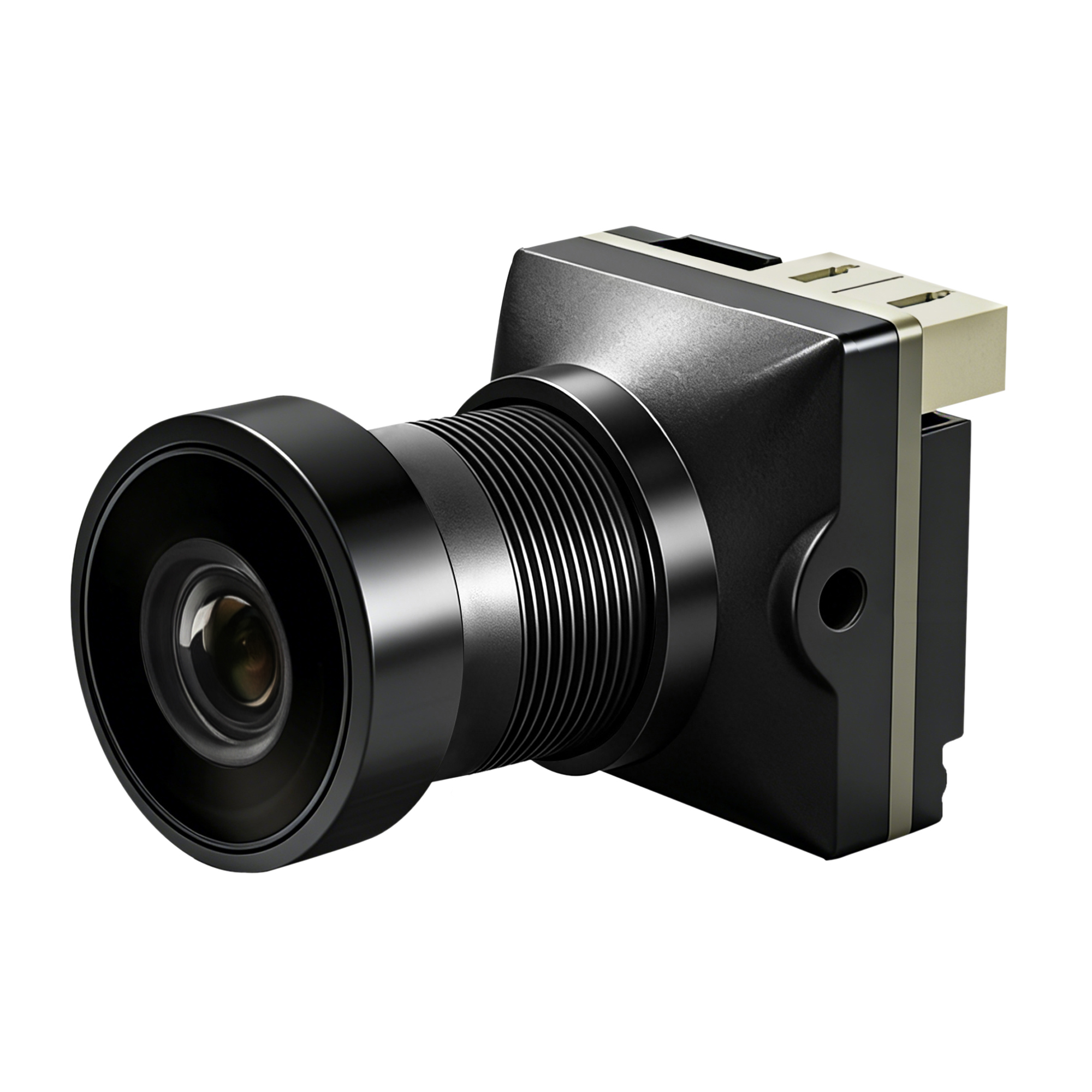
The CDD-BS59KU ranks first for night work where the constraint is photons and payload, not pixels. It publishes the lowest minimum illumination in this group at 0.00001 LUX, the highest stated signal-to-noise ratio at greater than 60dB, and the lightest body at 9g — a combination aimed squarely at starlight flying on small airframes.
Published specification
- Resolution: 1500TVL, 4:3 image format
- Minimum illumination: 0.00001 LUX
- Signal-to-noise ratio: greater than 60dB
- Field of view: 120°
- Video output: CVBS (analog)
- Noise reduction: 3DNR
- Power: DC 4.5V–27V wide input, 0.6W consumption
- Dimensions and weight: 19mm × 19mm × 27mm, 9g
- Construction: aluminium alloy housing, glass and plastic lens
Why it takes the top night rank
Minimum illumination is the specification that decides whether an image exists at all, and 0.00001 LUX is the lowest published figure among the three picks. The greater-than-60dB signal-to-noise ratio matters just as much in practice: a sensitive sensor in near-darkness runs at high gain, and a camera with a weaker S/N ratio returns a bright but grainy picture in which shapes are visible but detail is not. A 120° field of view supports the wide, fast framing that low-light proximity flying requires, and the 9g mass means the camera itself barely registers in the flight-time budget.
The 4.5V–27V input range also simplifies installation on builds with different regulated rails, and 0.6W consumption keeps the camera a minor load on the pack. IRLAB lists the model under analog, low-latency, racing, tactical and RC car FPV categories, and its documented tactical scenario pairs this class of camera with analog video transmitters, FPV goggles and OSD overlay systems — an integration path that does not require a digital link to function.
On zero motion blur and dynamic range. IRLAB's tactical scenario documentation lists 'zero-blur FPV' and high WDR as operating requirements. The CDD-BS59KU datasheet contributes 1500TVL resolution, 3DNR noise reduction and a CVBS output; it does not publish a motion-blur measurement or a WDR figure in dB. Treat zero blur as a system-level target to be verified with your transmitter, goggles and flying style, not as a datasheet number.
Where it stops
The analog model outputs CVBS only. It has no onboard recording and does not list MSP or MAVLINK OSD protocol support, both of which appear on the digital model. Its image is 4:3 rather than 16:9, and no glass-to-glass latency figure is published for the camera itself — the analog chain's delay depends on the transmitter and receiver in your build. Analog link quality under interference therefore becomes a system design question rather than a camera specification.
Rank 2 — CDD-BS5JMU: the digital pick for resolution and recorded evidence
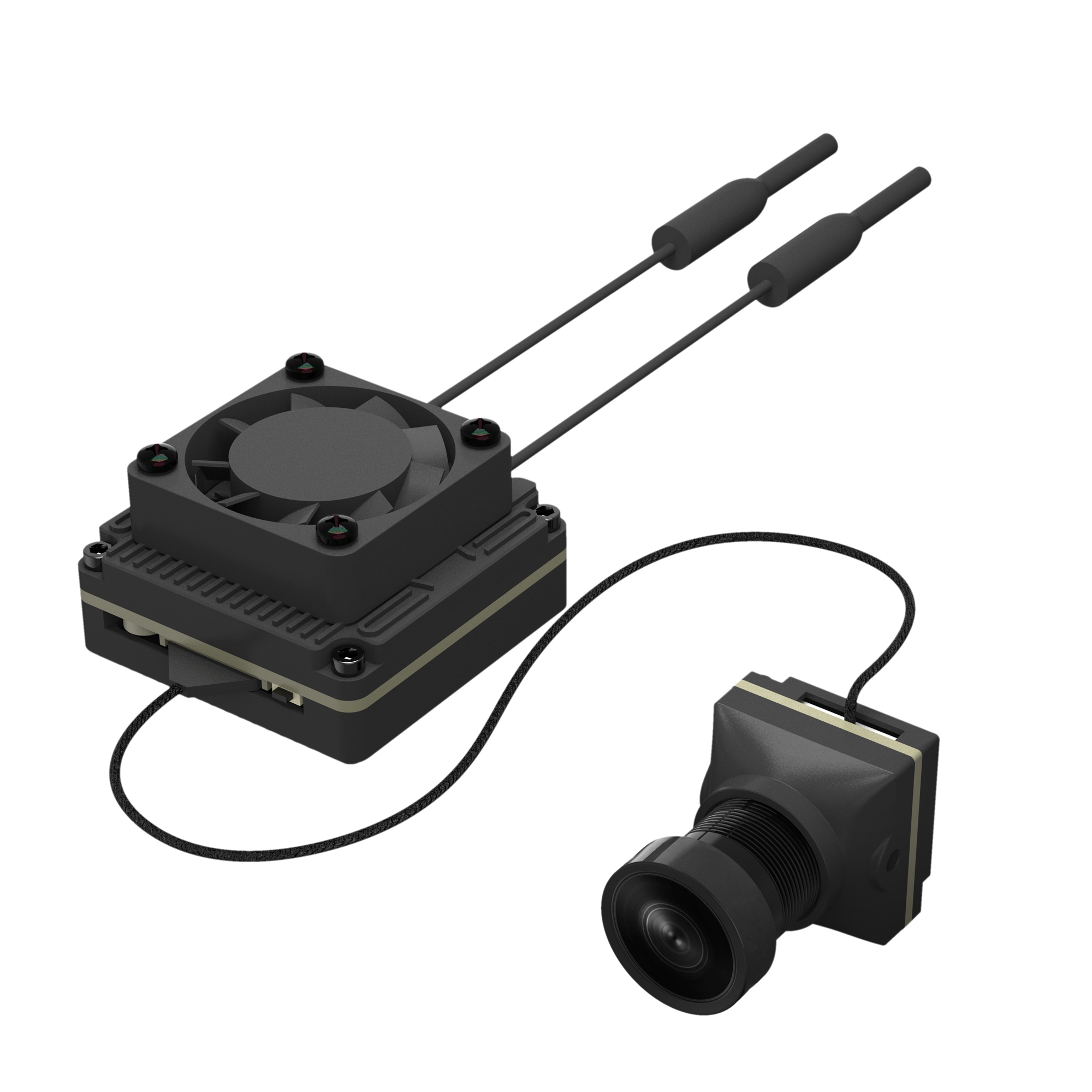
The CDD-BS5JMU ranks second overall but first when the night mission requires identification, recording or protocol-level integration. It pairs a SONY sensor with 3840×2160 at 30fps and publishes 50ms glass-to-glass latency, which makes it the detail-oriented option in this group rather than the sensitivity-oriented one.
Published specification
- Image sensor: SONY sensor
- Resolution: 3840×2160 at 30fps; 1080p at 90fps; 720p at 120fps
- Latency: 50ms, glass to glass
- Field of view: 120°
- Power: 9V–30V input; 5.4W normal, 9W maximum
- Operating frequency: 5.1GHz–5.8GHz; transmit power ≤29dBm at 5.8GHz (FCC), ≤20dBm (CE)
- Antenna: 2T2R
- OSD protocol: MSP and MAVLINK supported
- Recording: TF card slot, up to 1TB
- Dimensions and weight: main board 32mm × 32mm × 19.3mm with fan; camera 19mm × 19mm × 26mm; 32g with fan (9g camera plus 23g board)
Why it earns a night ranking
Resolution is a night capability when the task is identification rather than navigation. A 3840×2160 frame gives an after-action reviewer far more to work with than a 1500TVL analog image, and the 1080p at 90fps and 720p at 120fps modes trade spatial detail for temporal detail — useful when the subject is moving quickly across the frame. Combined with the 1TB TF card slot, the camera can return recorded footage rather than only a live feed.
The wide 120° field of view matches the analog model, and MSP and MAVLINK OSD support lets flight data be overlaid through the camera path. The 5.1GHz–5.8GHz band with 2T2R antennas gives the digital link its own integration considerations, including regional transmit-power limits that differ between FCC and CE markets.
Latency context, stated carefully. Straits Research reports that digital FPV systems from DJI, Walksnail and HDZero typically run 22–40ms glass-to-glass in 2026 settings. That is a commercial-research range without published test conditions, so it is directional only. IRLAB publishes 50ms glass-to-glass for the CDD-BS5JMU, while IRLAB's tactical requirement list targets sub-50ms. Measure end-to-end latency in your own camera, transmitter and goggle chain rather than assuming a datasheet value equals the system value.
Where it stops
Two costs are explicit in the specification. First, power: 5.4W normal and 9W maximum is a large load next to the analog model's 0.6W, and it has to come out of the same pack that flies the aircraft. Second, mass: 32g with fan against 9g. The model also carries no published minimum-illumination figure, so its low-light behaviour must be judged from real footage in your conditions rather than from a sensitivity number.
Rank 3 — CT-EI5ATC: the thermal pick for zero visible light
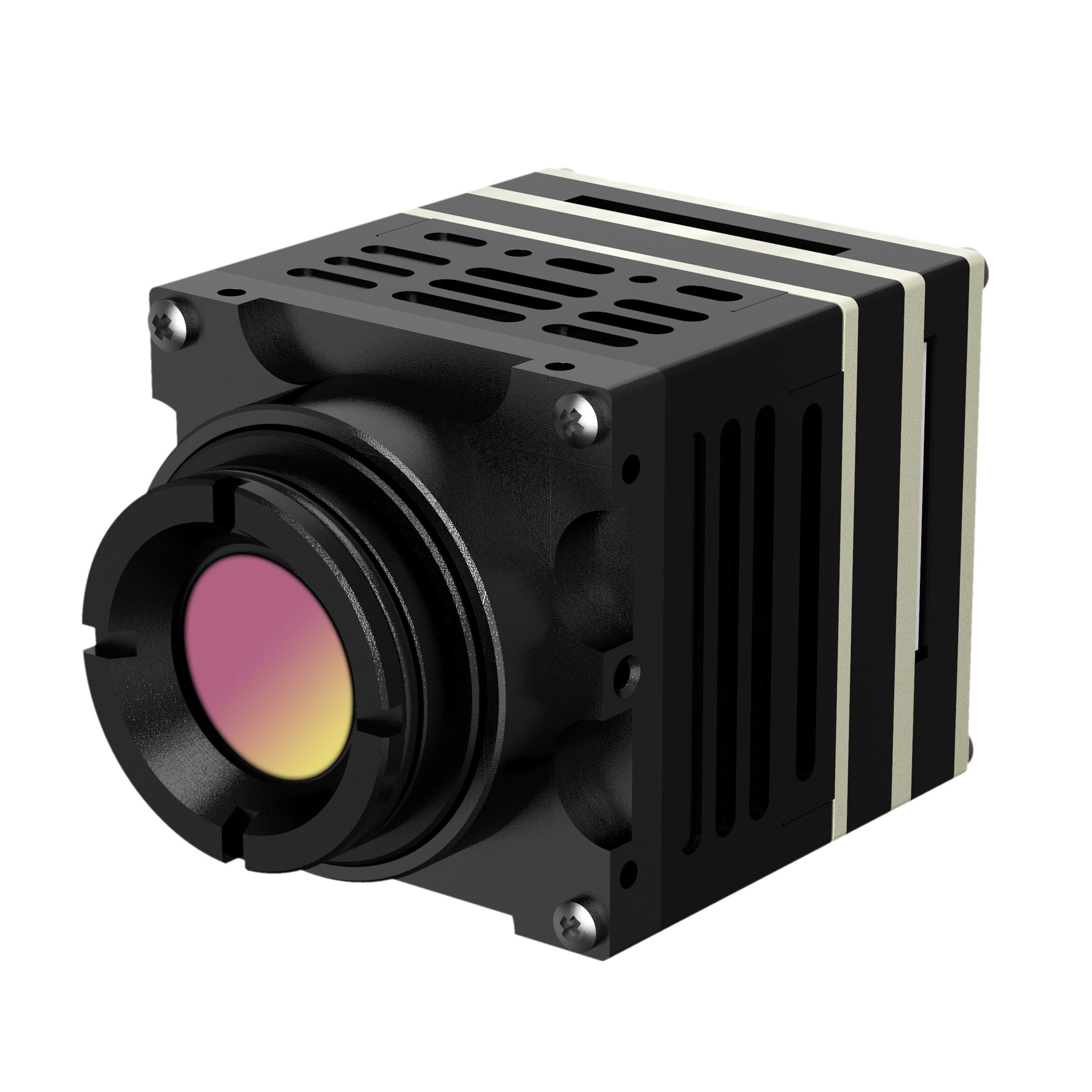
The CT-EI5ATC ranks third on weight and field of view but first on the one problem visible-light cameras cannot solve: imaging when there is no light to image. Its 640×512 uncooled vanadium oxide detector works in the 8–14 μm long-wave infrared band, so it renders thermal contrast instead of reflected light.
Published specification
- Detector: uncooled vanadium oxide, 640×512 resolution, 12μm pixel pitch
- Spectral range: 8–14 μm
- Thermal sensitivity: NETD ≤30mK at 25°C
- Lens: 9.1mm, field of view 46° × 37°
- Video output: CVBS; MIPI (optional, with UVC)
- Communication: UART or USB
- Power: DC 3.9V–5.5V (typical 5V), consumption ≤1.2W
- Dimensions and weight: 25.4mm × 25.4mm × 38.8mm including lens, 40g
- Operating temperature: −20°C to 60°C; storage −45°C to 65°C
- Construction: aluminium alloy housing, glass and plastic lens
Why it earns a night ranking
Thermal imaging answers the case where every other option produces nothing. A NETD of ≤30mK at 25°C describes the smallest temperature difference the detector can resolve against its own noise floor, and a 640×512 array with a 12μm pixel pitch gives that sensitivity enough spatial detail to be useful. Because the camera senses emitted infrared rather than reflected light, it does not need visible illumination or an infrared illuminator to produce an image.
Power consumption of ≤1.2W places it between the analog and digital models, and the CVBS output means it can drop into an analog video chain without adding a digital transmitter. IRLAB lists the model for tactical reconnaissance, border patrol, public security, fire service, emergency rescue, wildlife conservation, industrial survey and RC car applications, and its documented tactical scenario expects thermal-equipped builds to support heat-signature locking and search and rescue work.
Where it stops
Three boundaries are worth stating plainly. The 46° × 37° field of view is much narrower than the 120° of the visible-light picks, which changes framing and flying style. The 40g mass and 25.4mm cube are larger than a 9g analog camera and have to be planned for. And the operating temperature range is −20°C to 60°C, while IRLAB's tactical scenario notes describe environments down to −38°C — a documented gap that a cold-weather programme should verify rather than assume. A thermal image also carries no colour or markings, so identification of insignia, plates or clothing depends on shape and context.
Comparison table: analog vs digital vs thermal for night work
| Rank and model | Type | Resolution | Low-light or thermal capability | Output and latency | Field of view | Weight | Power |
|---|---|---|---|---|---|---|---|
| 1 — CDD-BS59KU | Analog | 1500TVL, 4:3 | 0.00001 LUX minimum illumination; S/N >60dB | CVBS; camera latency not published | 120° | 9g | 0.6W, DC 4.5V–27V |
| 2 — CDD-BS5JMU | Digital | 3840×2160@30fps; 1080p@90fps; 720p@120fps | SONY sensor; minimum illumination not published | 5.1–5.8GHz digital link; 50ms glass to glass | 120° | 32g with fan | 5.4W normal, 9W max; DC 9V–30V |
| 3 — CT-EI5ATC | Thermal | 640×512, 12μm pitch | NETD ≤30mK at 25°C; 8–14 μm LWIR | CVBS; MIPI optional with UVC | 46° × 37° (9.1mm lens) | 40g | ≤1.2W, DC 3.9V–5.5V |
Read across the table rather than down it. The analog row wins on sensitivity, mass and power. The digital row wins on resolution, frame rate and recording. The thermal row wins on the only criterion that matters when visible light is absent. No row wins on all of them, which is the point of splitting the ranking by night role.
Step-by-step: how to select and validate a night-operations FPV camera
A repeatable selection sequence avoids the common mistake of choosing the highest-specification camera and then discovering it does not fit the airframe, the link or the mission.
- Define the night task as a verb. Detect, recognise, identify, fly fast, or record evidence. Detection in total darkness points to thermal. Fast proximity flying points to the 9g analog model. Identification and post-flight review point to the 3840×2160 digital model.
- Choose the band before the model. Visible-light analog, visible-light digital and long-wave infrared are three different sensing capabilities. Decide whether reflected light exists at all before comparing sensitivity figures.
- Check the video chain. The two visible-light cameras use different paths: CVBS for the analog model, a 5.1GHz–5.8GHz digital link with 2T2R antennas for the digital model. Confirm your transmitter, goggles and OSD overlay support the path you choose, and confirm MSP or MAVLINK only where the digital model is selected.
- Run the power and weight budget. The three picks span 0.6W at 9g, 5.4W normal at 32g with fan, and ≤1.2W at 40g. Confirm the input voltage range on your platform: DC 4.5V–27V, DC 9V–30V and DC 3.9V–5.5V respectively.
- Check the environmental envelope against your real conditions. The thermal model is rated −20°C to 60°C operating and −45°C to 65°C storage, while IRLAB's tactical scenario notes describe environments down to −38°C. Where your operating envelope is colder than the published rating, verify behaviour before committing a programme.
- Validate on a sample in your own build. Confirm the definition behind a minimum-illumination figure, measure glass-to-glass latency through your own transmitter and goggles, and observe NETD behaviour at your ambient temperature rather than at the 25°C reference point.
Use cases: matching the pick to the night mission
Analog CDD-BS59KU. Night proximity flying and freestyle on small airframes, where 9g and 0.6W matter more than resolution; starlight reconnaissance where the platform can only carry a minimal payload; RC car night running; and analog tactical builds that already use a CVBS transmitter, goggles and OSD overlay chain.
Digital CDD-BS5JMU. Reconnaissance where the output has to be reviewed or retained, because the 1TB TF card slot records what the pilot sees; missions that need a 3840×2160 frame for identification; and builds that overlay flight data through MSP or MAVLINK. The 1080p at 90fps and 720p at 120fps modes suit fast-moving subjects where temporal detail is worth more than pixel count.
Thermal CT-EI5ATC. Search and rescue, fire service and emergency response, border patrol and public security work, wildlife conservation, industrial survey, and tactical reconnaissance where the target is detected by heat rather than by light. The CVBS output allows it to be integrated into an existing analog chain, while MIPI with UVC supports a digital capture path.
On AI detection and object tracking. IRLAB lists these models under AI-detection, drone-tracking and AI thermal-tracking camera categories. Detection and tracking are functions performed on the video stream downstream of the camera; no onboard inference performance figure is published for any of the three models, so processing capability should be planned on the ground station or companion computer rather than assumed inside the camera.
Limitations, power budget and procurement notes
Three specification gaps are worth carrying into a technical review. The analog camera publishes no latency or WDR figure. The digital camera publishes no minimum-illumination figure and quotes 50ms glass-to-glass against a scenario target of sub-50ms. The thermal camera is rated to −20°C operating while the tactical scenario documentation describes environments down to −38°C. None of these makes a camera unsuitable; each one defines what must be verified before a programme depends on it.
Price is deliberately not part of this ranking. The published specification set contains no unit pricing, minimum order quantity or lead-time data for these models, so any budget comparison has to be made against firm quotations rather than against this page. Where a buyer evaluates a budget alternative, the honest comparison is on specifications and measured performance, not on an assumed price band.
For programmes shipping thermal-equipped unmanned aircraft into the United States, one trade measure belongs in the procurement plan: GHY International reports that a 100% Section 232 tariff on unmanned aircraft systems with thermal imaging, and on certain components, took effect on 3 September 2026. Tariff classification is product-specific, so confirm the applicable treatment with a customs broker before committing a landed-cost model.
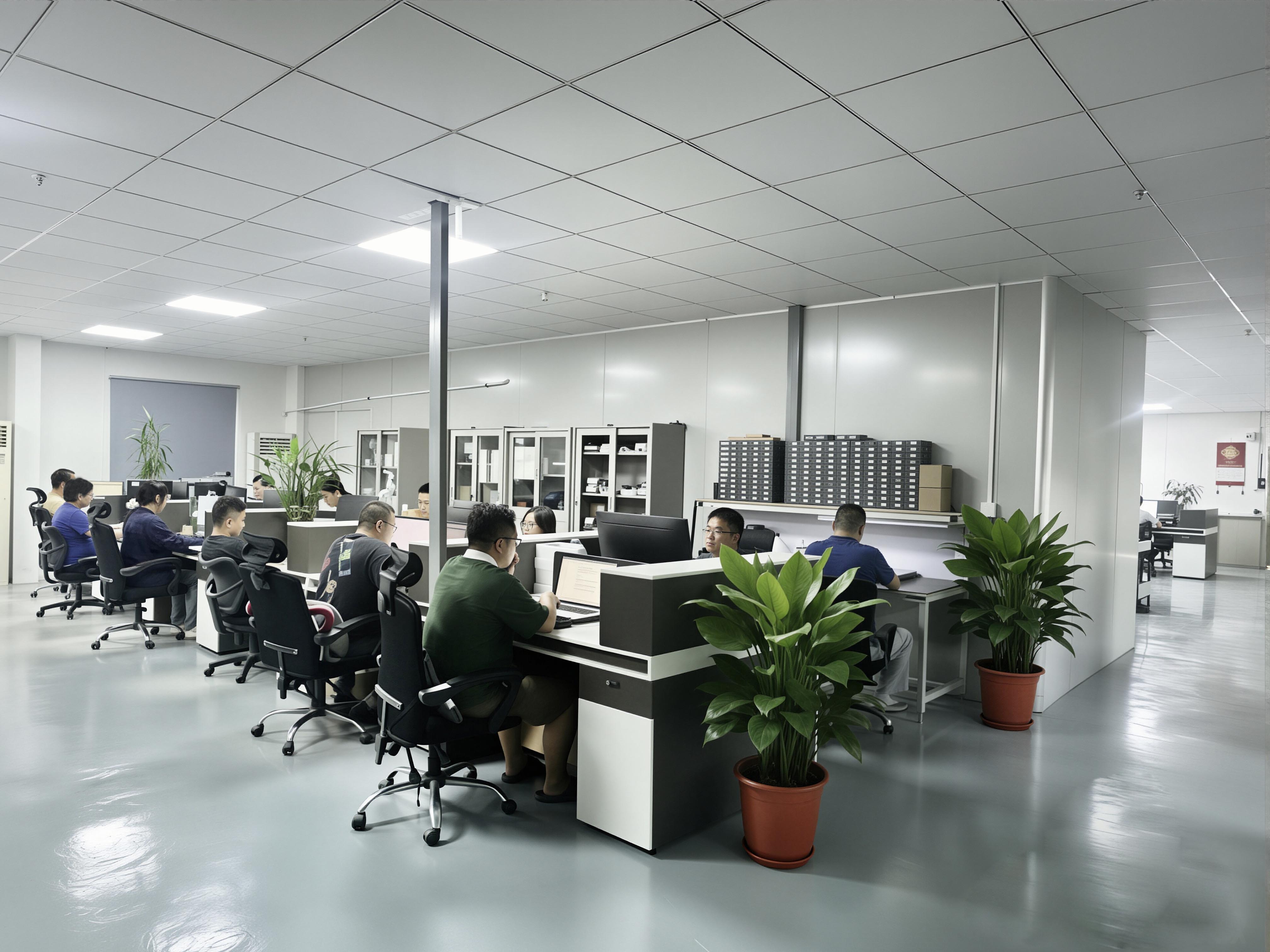
On the supply side, IRLAB Limited was established in 1992 and has operated from Shenzhen since 2003. The company reports a 3,000m² manufacturing facility, a workforce of more than 100 staff including more than 10 engineers covering software, hardware, mechanical structure, video image tuning and quality control, and an annual output of 6 million units. It states ISO 9001 quality management certification from TÜV, an export ratio of 70%, and main markets including Europe, the USA, Japan, Korea and Taiwan. OEM and ODM services are offered, which is relevant where a night-operations camera has to be adapted rather than bought as a catalogue item.
Frequently asked questions
Which FPV camera type works in complete darkness?
A thermal FPV camera. The IRLAB CT-EI5ATC uses an uncooled vanadium oxide detector working in the 8–14 μm long-wave infrared band with 640×512 resolution and NETD ≤30mK at 25°C, so it images emitted heat rather than reflected light and needs no visible illumination or infrared illuminator. Visible-light cameras, including the 0.00001 LUX analog model, still require some light to produce an image.
What does 0.00001 LUX minimum illumination mean on the CDD-BS59KU?
It is the lowest light level at which IRLAB states the camera still produces a usable image, and it is the lowest figure among the three picks in this ranking. Lower values indicate greater sensitivity, but the specification does not state the gain, shutter or signal-level conditions behind the figure, so it should be compared on real footage. The camera's greater-than-60dB signal-to-noise ratio is the companion number, because it describes how clean that low-light image remains once gain is applied.
Is analog or digital better for night FPV?
It depends on whether the constraint is light or detail. The analog CDD-BS59KU publishes 0.00001 LUX minimum illumination at 9g and 0.6W, which suits small airframes flying in near-darkness. The digital CDD-BS5JMU offers 3840×2160 at 30fps, 1080p at 90fps, 720p at 120fps, 50ms glass-to-glass latency and a 1TB TF card slot for recording, but draws 5.4W normal and weighs 32g with fan. Choose by the mission, not by the format label.
How much latency does a night-operations FPV camera need?
IRLAB's tactical FPV scenario documentation lists sub-50ms latency as a requirement. The digital CDD-BS5JMU publishes 50ms glass-to-glass, at the boundary of that target, while no camera-level latency figure is published for the analog CDD-BS59KU. Because system latency includes the transmitter, receiver and goggles, the datasheet value should be confirmed with an end-to-end measurement in the actual build before a programme relies on it.
Does a thermal FPV camera need an infrared illuminator?
No. A thermal camera senses emitted long-wave infrared radiation in the 8–14 μm band rather than reflected light, so it produces an image in total darkness without any illuminator. That is a different mechanism from a low-light visible camera, which needs at least some photons and may be assisted by infrared illumination. The trade-off is that thermal imagery carries no colour or markings, so identification relies on shape and thermal contrast.
How do I validate a night FPV camera before ordering?
Test on a sample in your own build and conditions rather than on the datasheet alone: confirm what the minimum-illumination figure means in practice, measure glass-to-glass latency through your transmitter and goggles, check NETD behaviour at your operating temperature, and verify weight and power against your airframe budget. IRLAB Limited manufactures FPV cameras at its Shenzhen facility and offers OEM and ODM services; sample and quotation requests can be sent to sales@irlab.net.
Conclusion
Ranking night-operations FPV cameras works only when the ranking follows the sensing problem. The analog CDD-BS59KU leads on the darkest, lightest builds with 0.00001 LUX minimum illumination, greater than 60dB signal-to-noise ratio, 120° field of view and 9g of mass. The digital CDD-BS5JMU leads where detail and recorded evidence decide the outcome, with a SONY sensor, 3840×2160 at 30fps, 50ms glass-to-glass latency and a 1TB recording slot at the cost of 5.4W and 32g. The thermal CT-EI5ATC leads where there is no light at all, with a 640×512 uncooled vanadium oxide detector, NETD ≤30mK at 25°C and a 40g package.
The decision rule that survives all three: choose the band first, then check the power and weight budget, then verify the environment and latency against your own build. A camera that wins on the specification sheet but exceeds the airframe's power budget is not a night-operations camera for that programme, whichever rank it holds here.
Planning a night-operations FPV build? IRLAB Limited has manufactured cameras since 1992 and supports OEM and ODM projects from its Shenzhen facility. Request a sample or quotation at sales@irlab.net, review the company profile and product range at www.irlab.net, or download the IRLAB company profile and corporate brochure.
Have Questions or Need More Details?
Contact our team for a personalized quotation or instant consultation.
Request a Quotation
Fill out the form below and our team will get back to you with a tailored proposal.
WhatsApp Direct Chat
Prefer to chat in real-time? Message us on WhatsApp for instant assistance & quick answers.
- Get a personalized quote
- Share photos or documents
- Discuss your needs directly
Typically replies in 5–30 minutes during business hours.