AgingGuard vs. MicroGuard: Choosing Outdoor Webbing for Sun or Humidity
Choose AgingGuard when the dominant threat to your product is sunlight and repeated wet-dry weather cycling. Choose MicroGuard when the dominant threat is sustained humidity, condensation and microbial growth on high-contact straps. The two webbings are built to answer different failure modes, not to compete on the same scoreboard.
That single distinction resolves most of the confusion buyers run into when they compare functional webbing. A strap that fails on a sun-exposed rooftop rack and a strap that fails inside a damp gear bag usually look similar to the end user — discoloured, stiff, weaker. They are not the same problem. One is polymer degradation driven by UV energy and thermal cycling; the other is biological growth fed by moisture, warmth and organic soil.
Problem Definition: What Actually Fails First?
Outdoor webbing rarely fails for a single reason. It fails because one degradation path reaches the end of its tolerance before the others. For most gear brands, that path is one of two.
Failure path 1 — solar and weather aging
Ultraviolet energy breaks polymer chains at the surface. The visible results are colour fade, chalky surfaces and stiffening; the functional result is loss of breaking strength. Rain and dew accelerate the process because each wet-dry cycle drives moisture into the fibre structure and then pulls it out again, carrying surface damage deeper. A dry UV-only test therefore understates what a tent guy line, a roof-rack tie-down or a marine strap experiences in service.
Failure path 2 — humidity and microbial growth
When webbing stays damp — inside a sweaty hydration pack, a gear duffel stored in a tropical garage, or a harness pad that is worn against the body — residual moisture plus warmth plus organic soil becomes a growth medium. The outcomes are musty odour, dark staining and surface degradation. Mould does not usually cause an immediate strength collapse; it causes rejected goods, returns, consumer complaints and a brand that smells wrong when the bag is opened.
Industry Background: Why Functional Webbing Is Now a Spec Decision
Webbing has moved from a commodity trim to a specified engineering component. Commercial research compiled for this category values the global webbing market at USD 4.86 billion for 2026, with Asia Pacific holding a 66.3% revenue share in 2023 — a supply structure that puts most production and most material innovation in the same region.
Application data explains the pressure. Published webbing application lists cover seat belts, hiking straps and bag handles, and separately list luggage and bag straps, outdoor gear, pet accessories and marine products. Those are not laboratory categories; they are the products that get left in the sun, towed behind a boat, dragged through sand and stuffed away wet.
The procurement consequence is straightforward. Brands increasingly ask for a named functional construction instead of a generic “nylon webbing, 25 mm”. That shift is healthy, but it creates a new failure mode in purchasing: buying the functional webbing that is easiest to source rather than the one that addresses the actual exposure.
Detailed Solution: How AgingGuard and MicroGuard Differ
AgingGuard: engineered against sunlight and weather cycling
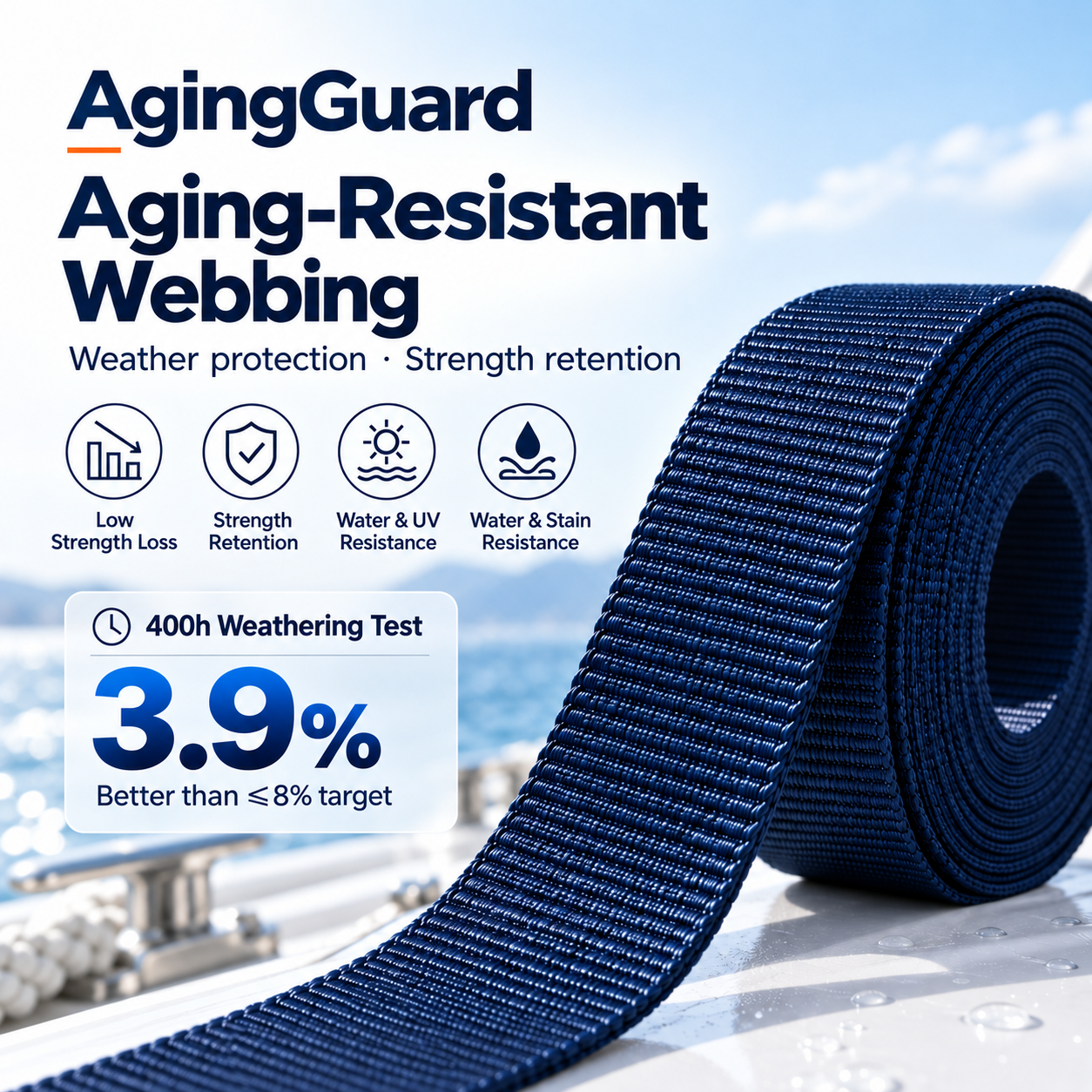
AgingGuard is an aging-resistant functional woven webbing developed for products exposed to long-term sunlight, rain, moisture, temperature changes, abrasion and repeated loading. Its surface protection treatment is designed to improve strength retention, weather resistance and appearance stability during extended use.
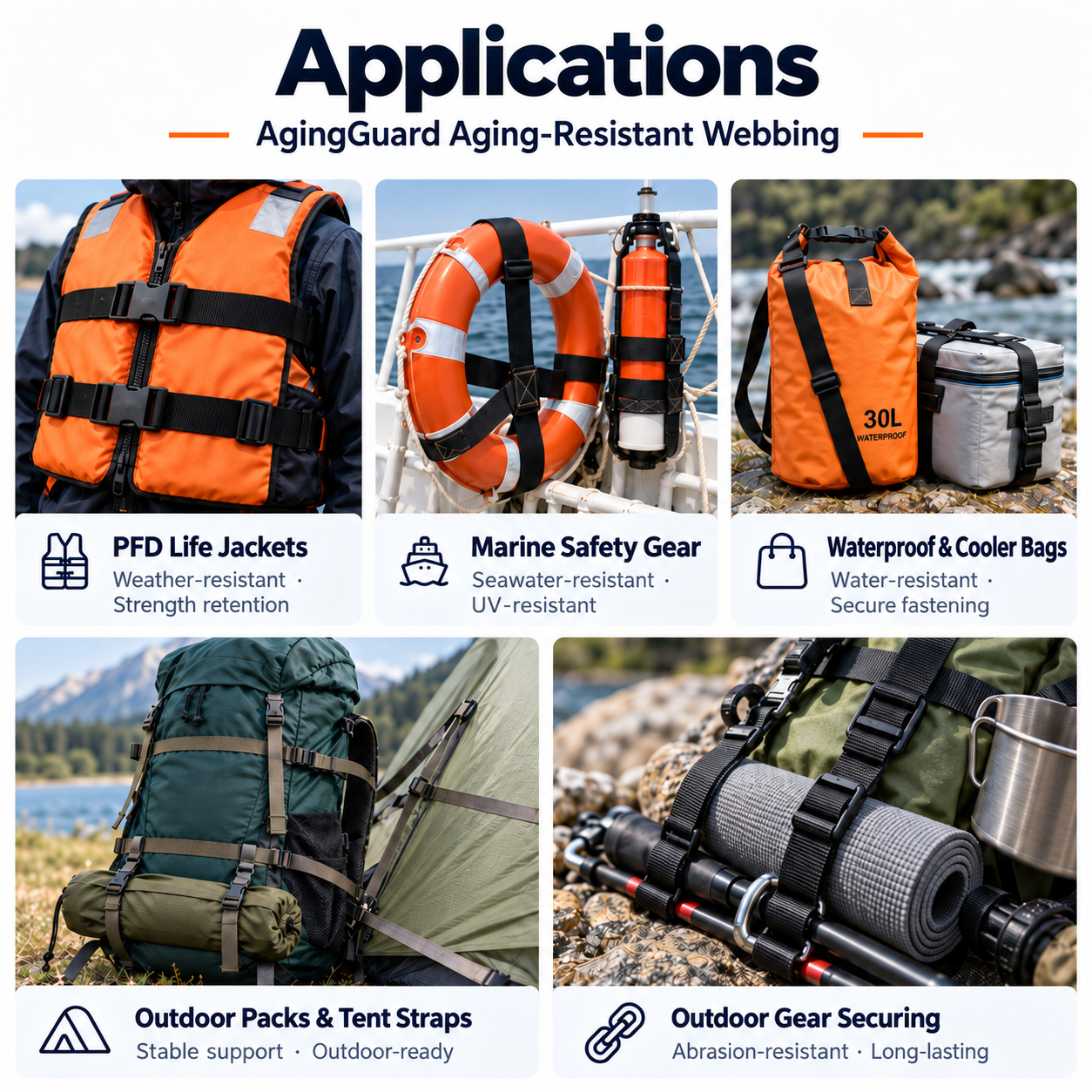
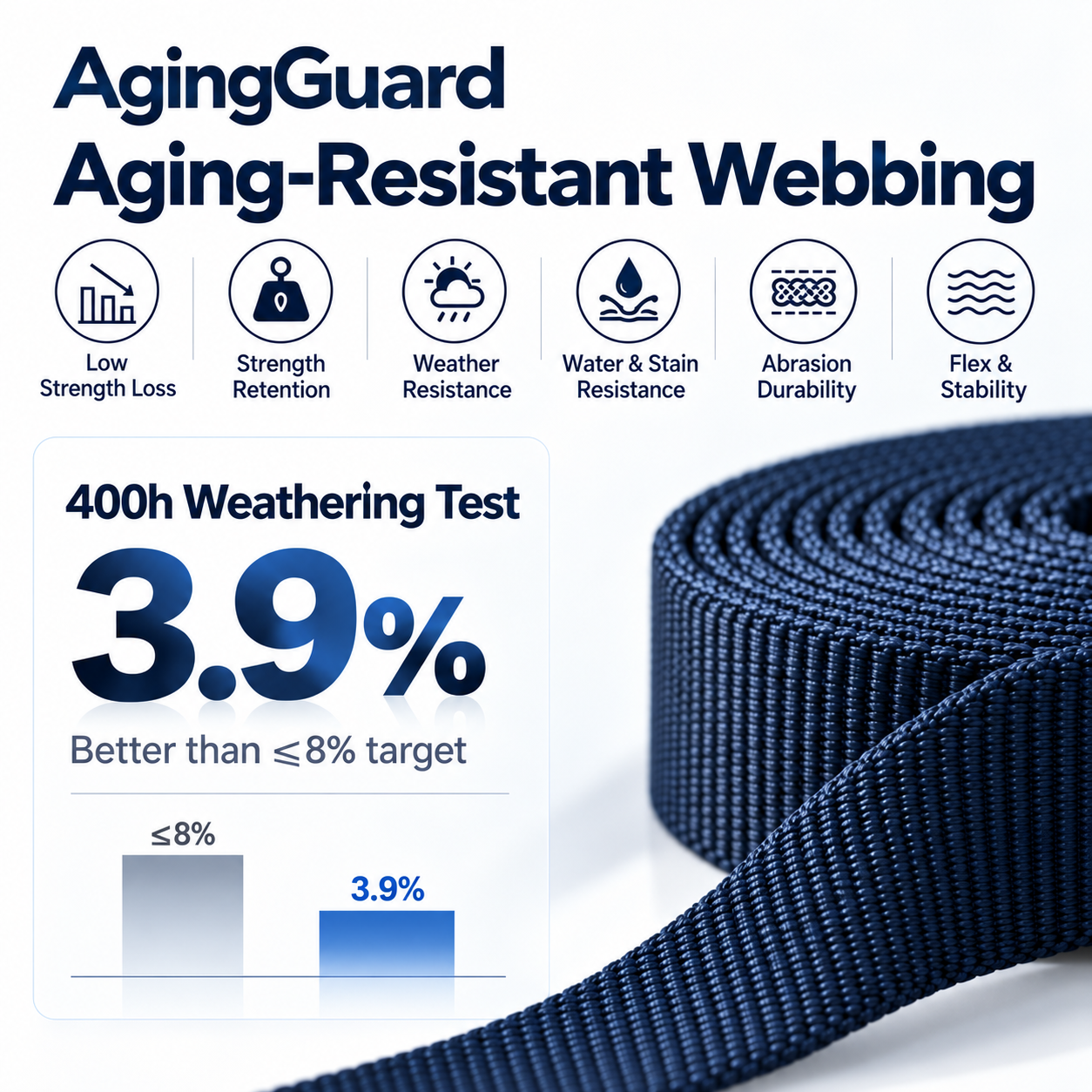
The performance claim is supported by a 400-hour fluorescent UV weathering test run on 4-hour light / 4-hour condensation cycles. The condensation phase matters: it repeatedly wets and dries the specimen, which is closer to real rain-and-dew exposure than continuous dry irradiation. On the tested reference build — 30 mm wide, 3.0 mm thick, 63 g/m, high-tenacity polyester — breaking strength moved from 29,913 N before aging to 28,760 N after aging, a 3.9% loss against a technical requirement of no more than 8%.
Two cautions belong in any honest reading of that number. First, the 29,913 N figure describes one tested construction, not the whole AgingGuard range; a different width, thickness or yarn will produce a different absolute value, while the percentage retention is the more transferable indicator. Second, the test references FZ/T 65002-1995 and GB 5725-2009, so the result is meaningful against those test frameworks — ask for the report rather than quoting a headline percentage into your own technical file.
AgingGuard is available in high-tenacity polyester and Nylon 66 constructions. That material flexibility is useful: polyester is the stronger choice when UV stability and low moisture absorption dominate, while Nylon 66 brings higher toughness where abrasion and dynamic load matter more.
MicroGuard: engineered against humidity and microbial growth
MicroGuard is the antimicrobial and anti-mould webbing option in the same functional programme, built on a Nylon 66 construction. Its performance is characterised by a 28-day anti-mould test conducted at 28°C and 90% relative humidity — conditions that reproduce a warm, saturated environment rather than a laboratory bench.
The 28-day duration is the part buyers should focus on. Mould pressure is a function of time as much as intensity, and a short exposure can look clean while a longer one does not. Twenty-eight days at 90% RH is a meaningful hurdle for gear that spends a season in a humid climate, a wet locker or a sweaty pack.
What MicroGuard does not do is substitute for UV performance. Anti-mould treatment addresses biological growth; it does not restore strength lost to photodegradation. If your product sits in the sun for thousands of hours a year, anti-mould testing tells you nothing about whether the strap will still hold its rated load in year three.
Where the two specifications overlap
Real products are rarely exposed to only one stressor. A tropical backpacking pack sees intense UV at altitude and near-permanent humidity at sea level. A cooler bag lives in sunlight on a deck and in condensation inside. For those cases the answer is not to pick a side but to sequence the requirements: define a UV/aging threshold first, then add an antimicrobial requirement for the contact and storage zones, and confirm both on the same construction if the supplier can support it.
Step-by-Step Breakdown: A Selection Workflow
- Map the exposure hours. Estimate annual hours of direct sun exposure and annual hours at high relative humidity or in wet contact. The larger number points to the primary specification.
- Name the failure you are warranting against. Strength retention and appearance stability point to AgingGuard. Odour, staining and microbial growth point to MicroGuard.
- Set the pass threshold before you talk to suppliers. For aging, define an acceptable strength-loss ceiling — AgingGuard's reference build was specified at no more than 8% and delivered 3.9%. For antimicrobial performance, define the exposure duration, temperature and humidity you want tested.
- Match the base material to the job. High-tenacity polyester for UV-dominant applications; Nylon 66 where toughness or the antimicrobial build is the driver. Both are available in the AgingGuard range.
- Lock width, thickness and construction. Nominal programme widths are 20, 25, 38 and 50 mm (1/2", 1", 1.5", 2"), with thickness, colour and construction developed to application requirements.
- Confirm certification scope in writing. Programme listings include Bluesign System Partner, GRS 4.0 and OEKO-TEX Standard 100 Class I on named products; verify which scope actually applies to your specific build rather than assuming it transfers.
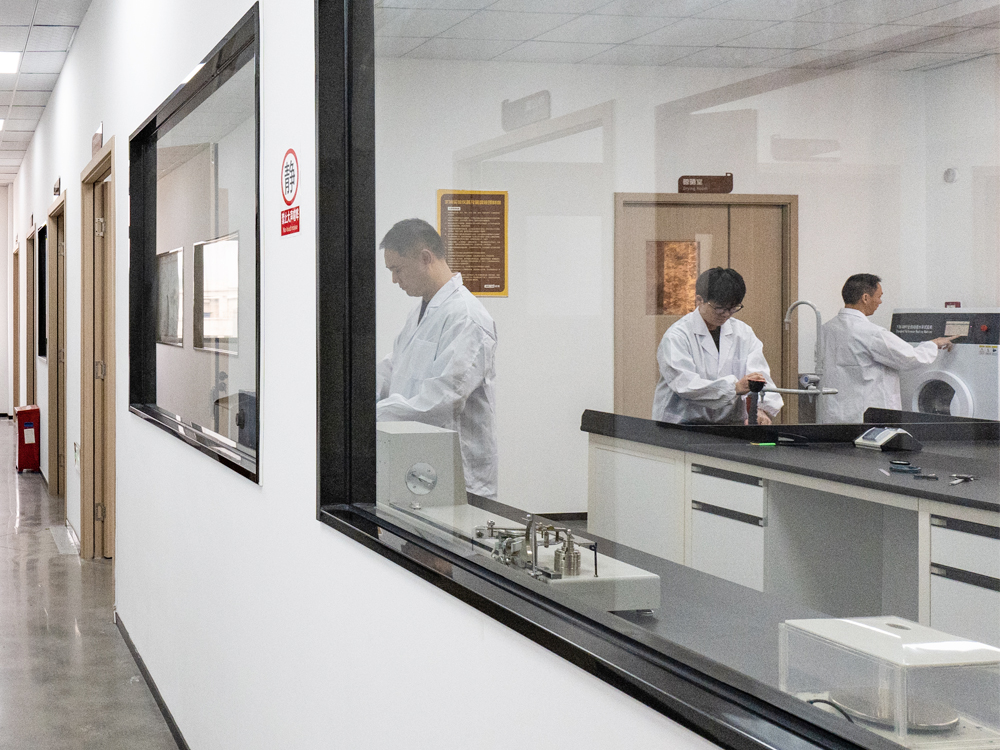
- Sample and test in your own configuration. Run the reference test on the exact width, thickness and colour you will buy, then approve the production specification against that result.
Use Cases: Matching Webbing to Real Products
Sun-dominant applications — specify AgingGuard
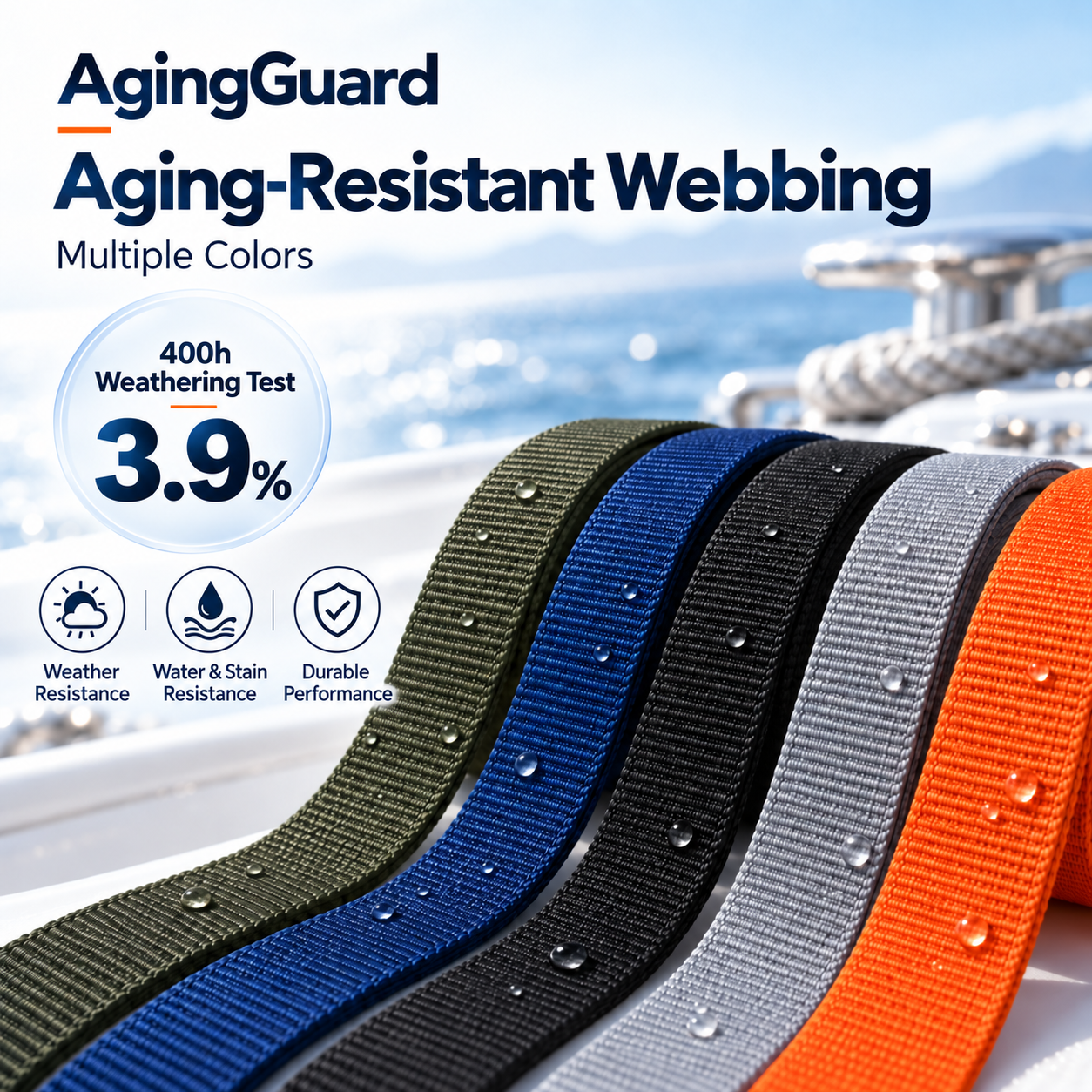
- Backpacks and hiking packs — shoulder straps, compression straps and lid webbing that face years of daylight and abrasion.
- Tents, guy lines and tie-downs — long static exposure with repeated rain and dew cycling.
- Cooler bags and travel duffels — deck, tailgate and beach exposure combined with wet handling.
- Marine and water-safety straps — saltwater plus UV, where colour and strength stability both matter.
- Pet leashes and outdoor furniture straps — permanently outdoors, rarely cleaned, always in the sun.
Humidity-dominant applications — specify MicroGuard
- Gear stored wet — duffels, dry bags and packing systems that go away damp at the end of a trip.
- High-contact body-side straps — harness padding, hip-belt webbing and shoulder straps that absorb sweat.
- Tropical and monsoon-market products — where 90% RH is a normal week, not a stress test.
- Gym, hydration and commuting packs — daily sweat loading with limited drying time between uses.
Mixed exposures — sequence, don't choose
For expedition packs, rooftop cargo systems and year-round outdoor equipment in humid climates, specify an aging threshold first because strength loss is the safety-relevant failure, then layer the antimicrobial requirement onto the contact and storage zones. If both must sit on one construction, raise it with the supplier at the sampling stage rather than after approval.
Comparison Table: AgingGuard vs. MicroGuard
| Decision factor | AgingGuard | MicroGuard |
|---|---|---|
| Primary stressor addressed | Long-term sunlight, rain, moisture, temperature change, abrasion, repeated loading | Sustained humidity and microbial growth on high-contact webbing |
| Base material | High-tenacity polyester (tested reference); Nylon 66 available | Nylon 66 |
| Signature test | 400 h fluorescent UV weathering on 4 h light / 4 h condensation cycles | 28-day anti-mould test at 28°C / 90% RH |
| Headline result | Breaking strength 29,913 N → 28,760 N; 3.9% loss | Anti-mould performance evaluated over 28 days; strength data not stated in available product information |
| Technical requirement applied | ≤8% strength loss after aging | Not stated in available product information |
| Reference standards cited | FZ/T 65002-1995; GB 5725-2009 | Not stated in available product information |
| Tested reference build | 30 mm width, 3.0 mm thickness, 63 g/m | Not stated in available product information |
| Best-fit gear | Backpacks, tents and tie-downs, cooler bags, marine straps, pet leashes, camping furniture | Gear stored wet, humid and tropical markets, body-contact straps, gym and hydration packs |
| Customization | Width, thickness, colour and construction developed to application requirements | Confirm per build with the supplier |
| Certification scope | Confirm per build; programme listings include Bluesign System Partner, GRS 4.0 and OEKO-TEX Standard 100 Class I on named products | Confirm per build |
Read the table as a specification map, not a ranking. Where a cell says the information is not stated, that is a gap to close with your supplier before you issue a purchase order — not an implication that the performance is absent.
FAQ
1. Which standards and test conditions support the AgingGuard aging claim?
AgingGuard was evaluated with a 400-hour fluorescent UV weathering test using 4-hour light / 4-hour condensation cycles, referencing FZ/T 65002-1995 and GB 5725-2009. On the tested 30 mm × 3.0 mm, 63 g/m high-tenacity polyester build, breaking strength fell from 29,913 N to 28,760 N — a 3.9% loss against a technical requirement of no more than 8%. The result applies to that tested construction; confirm the report for your own width, thickness and colour.
2. Can both webbings be customized in width, thickness, colour and construction?
AgingGuard can be developed in different widths, thicknesses, colours and constructions according to application requirements, and is available in high-tenacity polyester and Nylon 66. Standard programme widths across the outdoor range are 20, 25, 38 and 50 mm (1/2", 1", 1.5", 2"). For MicroGuard, confirm the specific width and construction availability during sampling, since the antimicrobial build is tied to a Nylon 66 base.
3. Does specifying a functional webbing increase cost?
There is no published price list for either construction; pricing is quoted against width, material, colour, construction and order volume. As a directional benchmark for the wider category, commercial research places bluesign-certified fabric at a 5–12% premium over equivalent non-certified fabric. The larger cost risk in practice is over-specification — paying for antimicrobial performance on a product that never gets wet, or for aging resistance on a strap that never sees daylight.
4. How do we validate performance before committing to a production run?
Sample first, then test the sample in your own configuration. Request the webbing in your target width, thickness and colour, run the exposure that matches your use case — a weathering cycle for sun-dominant gear, a humid-duration test for humidity-dominant gear — and approve the production specification against that result rather than against a catalogue number. Samples and technical documentation can be requested directly from the JUDECAM team at judecam@judegroup.com.
5. What lead time should we plan for?
Published lead-time figures are not part of the public product data for either construction, so treat any schedule as RFQ-specific. What can be confirmed is the production base: JUDECAM (Xiamen Jude Webbing Co., Ltd.) operates a 25,800 m² self-built manufacturing site in Xiamen with additional capacity in Vietnam, covering weaving, printing, dyeing, finishing and assembly in-house, with 180 employees and annual output of 300 million yards. Share your target quantity and delivery window with the team to receive a dated production schedule.
Conclusion: Specify by Exposure, Verify by Test
The choice between AgingGuard and MicroGuard is not a choice between good and better webbing. It is a choice between two failure modes, and only one of them will dominate your product's service life.
If the strap will spend its life in daylight — packs, tents, cooler bags, marine gear, leashes — the relevant question is how much strength survives 400 hours of UV with repeated condensation cycling. AgingGuard answers that with a 3.9% loss against an 8% ceiling on its tested reference build.
If the strap will spend its life damp, warm and in contact with the body — humid-climate gear, sweat-loaded packs, equipment stored wet — the relevant question is how the surface behaves over 28 days at 28°C and 90% RH. MicroGuard is built for that question on a Nylon 66 base.
And when both exposures are real, sequence them: set the aging threshold first because strength loss is the safety-relevant outcome, then add the antimicrobial requirement where moisture and contact actually occur. Whatever you decide, buy the report, not the adjective.
Next Step: Sample, Spec Sheet or Quote
JUDECAM (Xiamen Jude Webbing Co., Ltd.) has manufactured outdoor and functional webbing since 2006, supplying brands across Canada, Europe and Southeast Asia from production bases in Xiamen and Vietnam.
Send your exposure profile, target width and annual volume to judecam@judegroup.com, message WhatsApp +86 13358399583, or review the full range at www.judewebbing.com. We will come back with the construction that matches your dominant exposure and the test documentation behind it.
Have Questions or Need More Details?
Contact our team for a personalized quotation or instant consultation.
Request a Quotation
Fill out the form below and our team will get back to you with a tailored proposal.
WhatsApp Direct Chat
Prefer to chat in real-time? Message us on WhatsApp for instant assistance & quick answers.
- Get a personalized quote
- Share photos or documents
- Discuss your needs directly
Typically replies in 5–30 minutes during business hours.