Nylon Webbing vs. Aramid Webbing: Making the Right Tough Choice for Your Gear
Nylon webbing and aramid webbing are both sold as high-performance outdoor webbing, but they are specified against different failure modes. Nylon outdoor webbing is built around abrasion, hand-feel, colour fastness and salt-water resistance for packs, camera bags, belts and pet products. Aramid webbing is built around flame, heat and chemical resistance for firefighting gear, aerospace safety and industrial lifting. If your product fails by abrasion, UV fade or a torn stitch line, nylon is usually the shorter route. If it fails by flame, heat or chemical attack, aramid is the material that carries the relevant test standards.
This article compares the two materials the way a product team actually has to decide: on published specifications, test standards, certification scope and application fit — not on the word "tough". The reference data comes from the outdoor webbing range of Xiamen Jude Webbing Co., Ltd. (JUDECAM), a webbing manufacturer founded in 2006 with self-built production bases in Xiamen, China and Vietnam, and a product portfolio that includes nylon, polyester, RPET, recycled, tubular, camping, backpack and aramid webbing.
Problem Definition: Why "High Strength" Is Not a Comparable Number
The comparison fails at the specification stage, before anyone talks about price. The published data for each product answers a different question.
The nylon outdoor webbing data sheet is a colour, hand-feel and weather-resistance document. It lists weave structures, luster options, colour fastness to light Grade 4 (ISO 105-B02), salt water resistance Grade 4–5 (ISO 105-E02), and three certifications: Bluesign® System Partner, GRS 4.0 and OEKO-TEX Standard 100 Class I (Baby Safe).
The aramid webbing data sheet is a fire and heat document. It lists test standards ISO 3795 and aviation FAA FAR25, Grade 1 flame-retardant results (smoldering time ≤5 seconds, after-flame time ≤5 seconds, damaged length ≤100 mm), decomposition at 450 °C+, tensile strength at 5–7 times that of steel, and excellent resistance against solvents and oils.
Put those two sheets side by side and there is no shared axis. A buyer who shortlists on the word "tough" ends up comparing a flame test against a colourfastness grade — and usually picks the wrong material for the wrong reason.
- Wrong standard. A pack strap and a rescue strap are governed by different performance evidence. Selecting the lighter or cheaper option can leave you without the test document your customer or regulator will ask for.
- Unverified claims. Neither data sheet publishes certificate numbers or laboratory reports, so both materials require document verification at the supplier-confirmation stage.
- Comfort and process mismatch. Aramid's published application profile — firefighting, aerospace, industrial lifting, extreme alpine — signals a specialty supply chain. Nylon's profile — backpacks, camera bags, apparel belts, pet accessories — signals high-volume, high-aesthetic production. Those are different manufacturing rhythms.
Industry Background: Where These Two Materials Sit
Webbing is a large, application-driven category. Market research cited in 2026 industry reporting values the global webbing market at USD 4.86 billion in 2026, spanning polyester, nylon, polypropylene and advanced synthetic fibres. Within that total, material choice is usually subordinate to application: published application lists for polypropylene webbing and for general webbing both cover outdoor gear, bag straps and luggage, which means buyers segment by job to be done rather than by fibre name.
Two structural shifts matter for this comparison.
Certification has become a purchasing criterion, not a marketing extra. Bluesign reported that its system partners achieved intensity reductions in CO2 emissions of 17% in 2024, and industry analysis summarised in 2026 market reporting places a 5–12% premium on bluesign-certified fabric versus equivalent non-certified fabric. Certification therefore changes both the sustainability file and the landed cost — and it is currently documented on the nylon side of this comparison, not on the aramid side.
Trade classification needs its own check. Narrow woven fabrics sit under HS heading 5806 in the UN Comtrade classification. Product-level classification varies with construction, coating, material and national tariff schedule, so confirm the tariff line before building a landed-cost model around either material.
On the supply side, JUDECAM operates 25,800 m² of self-built production across Xiamen and Vietnam, employs approximately 180 staff including 32 webbing R&D experts, reports annual capacity of 300 million yards, and exports about 70% of output to more than 50 countries and regions, with main markets in Canada, Europe (Germany, Switzerland, Sweden, Finland, Poland, the UK, France) and Southeast Asia.
Detailed Solution: What Each Data Sheet Actually Commits To
Nylon Outdoor Webbing: the weather, colour and hand-feel specification
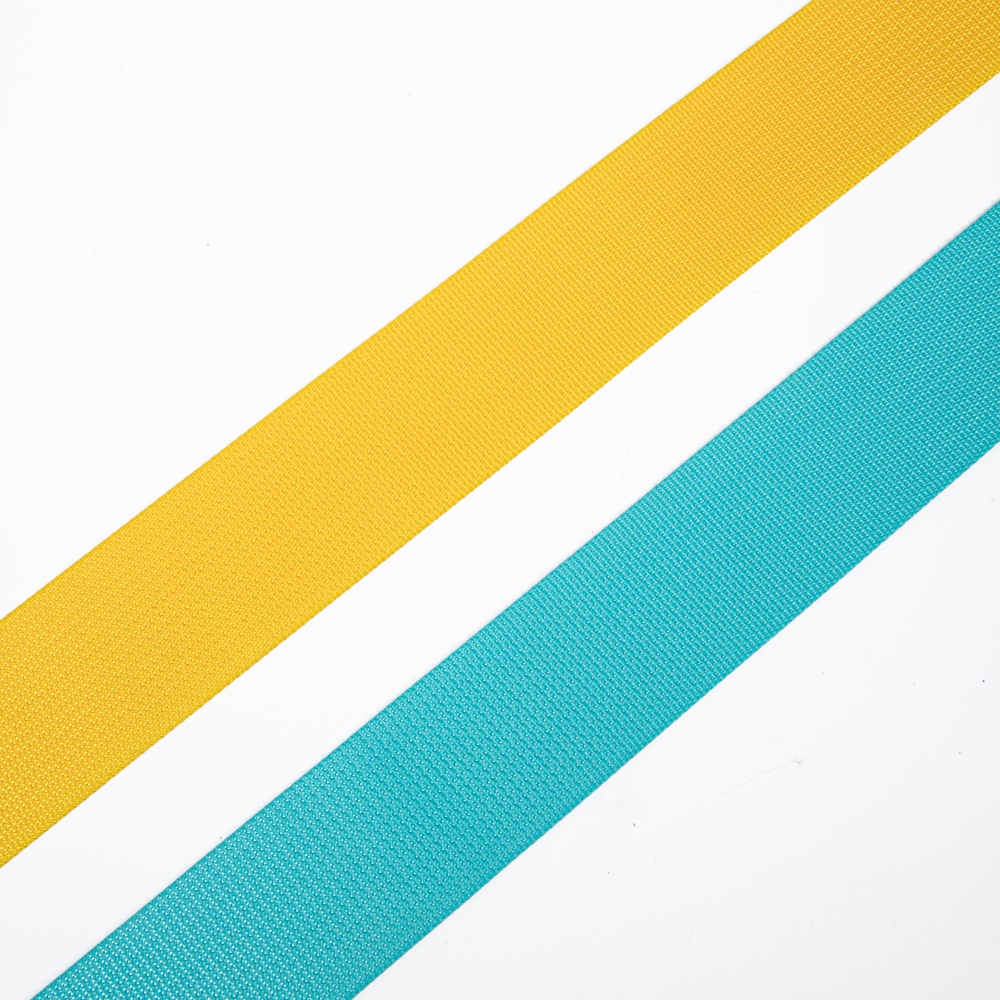
JUDECAM's Nylon Outdoor Webbing is a high-performance aesthetic webbing made from high-tenacity nylon with a soft-touch finish; the same product family is also offered in 100% high-tenacity polyester filament. The published specification covers:
- Weave structures: twill, plain, flat, herringbone and tubular.
- Widths: 20, 25, 38 and 50 mm, plus 1/2", 1", 1.5" and 2", with customization.
- Thickness: 1.20 mm, customizable. Packaging: 50 metres per roll.
- Luster: dull, semi-dull or bright — an aesthetic decision that matters on visible pack panels and apparel belts.
- Colour fastness to light: Grade 4 (ISO 105-B02).
- Salt water resistance: Grade 4–5 (ISO 105-E02).
- Certifications: Bluesign® System Partner, GRS 4.0, OEKO-TEX Standard 100 Class I (Baby Safe).
- Intended applications: outdoor backpacks, mountaineering packs, technical rucksacks, camera bags, performance apparel belts, luxury outdoor furniture and premium pet accessories.
Two adjacent products in the same range show how far the nylon side can be pushed when a programme demands it. Military-grade nylon webbing is specified to A-A-55301, MIL-W-17337, MIL-T-5038, MIL-W-5625, MIL-W-4088 and MIL-W-27265, with minimum strength of 5,000 N at 25 mm and abrasion resistance of at least 200,000 cycles. Camping webbing, made from UV-stabilised nylon or high-tenacity polyester, reports UV fastness Grade 4.5 after 1,000 hours (ISO 105), water absorption below 0.5%, and breaking strength of 500–2,000 lbs depending on specification.
Aramid Webbing: the flame, heat and chemical specification

Aramid Webbing is an extreme-performance technical webbing made from aramid fibre, with Kevlar® and Nomex® named as brands of aramid. Its published specification covers:
- Test standards: ISO 3795 and aviation FAA FAR25.
- Grade 1 flame-retardant effect: smoldering time ≤5 seconds, after-flame time ≤5 seconds, damaged length ≤100 mm.
- Heat resistance: decomposition at 450 °C+.
- Tensile strength: 5–7 times that of steel, as stated by the manufacturer.
- Chemical resistance: excellent against solvents and oils.
- Widths: 20, 25, 38 and 50 mm, plus 1/2", 1", 1.5" and 2", with customization. Thickness: 1.20 mm. Packaging: 50 metres per roll.
- Intended applications: firefighting gear, aerospace safety, industrial lifting and extreme alpine gear.
One gap deserves explicit attention: UV and weathering performance is not among the parameters published for aramid webbing, and no certification list is published for it either. That does not mean the performance is absent — it means it is not documented in the sheet. If your aramid application will be sun-exposed, request weathering data, the test method and the exposure hours for the exact construction before you approve the design.
Where the two materials genuinely overlap
Both are woven narrow fabrics supplied in the same standard width set (20/25/38/50 mm, 1/2", 1", 1.5", 2"), both are offered at 1.20 mm thickness with customization, both ship at 50 metres per roll, and both are made-to-order programmes rather than catalogue stock. In a physical assembly — a strap that must run through hardware, be cut, folded and stitched — the two materials can look interchangeable on the sampling table. They stop being interchangeable the moment you define the failure mode or the compliance file.
Where the trade-off actually bites
Flame and heat. Only aramid carries published flame and heat evidence in this range: ISO 3795 and FAA FAR25, Grade 1 flame results, decomposition at 450 °C+. Nylon outdoor webbing publishes no flame parameter at all. For firefighting, aerospace safety and industrial lifting, that difference decides the specification on its own.
Colour, luster and hand-feel. Nylon wins on aesthetic control: three luster options, five weave structures, Grade 4 light fastness and Grade 4–5 salt-water resistance. If the webbing is visible on a pack, a belt or a piece of outdoor furniture, that control is a design requirement, not a nice-to-have.
Certification. Bluesign® System Partner, GRS 4.0 and OEKO-TEX Standard 100 Class I (Baby Safe) are published for the nylon product. The same certification set appears across the wider JUDECAM range — polyester, RPET, recycled, GRS, Bluesign, eco-friendly, backpack, camping, tubular and stroller webbing — which makes mixing certified nylon and certified polyester in one collection straightforward. Aramid's data sheet does not list a certification set, so treat that as an open question for the supplier.
Strength evidence. The aramid sheet states 5–7 times the tensile strength of steel; the nylon outdoor sheet does not publish a single tensile figure. Neither statement is comparable to the other. Ask for the test basis behind the steel multiple, and ask for a breaking-strength figure at your specified width and construction — the nylon side can supply one, since military-grade nylon is quoted at minimum 5,000 N at 25 mm.
What "500+ Hour UV Resistance" Actually Means Before You Specify It
The phrase "500+ hour UV resistance" gets used loosely. In the JUDECAM range it resolves into specific, testable numbers — and the numbers differ by product, because the fibre and the finish differ:
- Camping webbing: UV fastness Grade 4.5 after 1,000 hours (ISO 105).
- Backpack webbing: UV fastness Grade 4.5 after 1,000 hours (ISO 105).
- Polyester webbing: UV fastness Grade 4.5 after 500 hours (ISO 105).
- RPET webbing: UV resistance Grade 4 after 500 hours (ISO 105).
- Recycled webbing: UV resistance Grade 4–5 (AATCC 16.3).
- Nylon Outdoor Webbing: colour fastness to light Grade 4 (ISO 105-B02).
A grade alone is not enough, because grades can hide very different exposure conditions. The stronger evidence is strength retention after weathering. AgingGuard webbing demonstrates the format buyers should be asking for: on a 30 mm wide, 3.0 mm thick, 63 g/m sample tested under fluorescent UV weathering with 4-hour light / 4-hour condensation cycles for 400 hours, initial breaking strength of 29,913 N fell to 28,760 N — a 3.9% loss against a technical requirement of no more than 8%, referenced to FZ/T 65002-1995 and GB 5725-2009.
Step-by-Step Breakdown: How to Choose Between Them
- Name the failure mode first. Write down how the webbing is expected to fail in service: abrasion at a buckle, UV fade on a sun-facing panel, flame exposure, heat, chemical contact, or stitch-line tearing. This single sentence eliminates one material in most projects.
- Map the failure mode to a standard. Flame and heat map to ISO 3795 and FAA FAR25. Light fastness maps to ISO 105-B02. Salt water maps to ISO 105-E02. Recycled content maps to GRS 4.0 with transaction certificates. If no standard covers your failure mode, you have a test-development task, not a purchasing task.
- Check the compliance file, not the brochure. Ask for the certificate holder, scope, validity and — for recycled content — the transaction certificate. GRS webbing in this range is quoted at 50%–100% recycled content verified by transaction certificate, with full chain of custody, which is only meaningful if the document chain is intact.
- Match construction and hand-feel to the assembly. Width, thickness, weave and luster are not cosmetic details: they determine how the strap runs through hardware, how it folds, and how it looks on the finished product. Nylon outdoor webbing offers twill, plain, flat, herringbone and tubular constructions at 1.20 mm; confirm the construction that matches your buckle and stitch pattern.
- Confirm the test evidence behind every headline claim. A "5–7 times steel" statement and a "Grade 4.5 after 1,000 hours" statement are both useful — once you know the method, the sample and the report behind them. If a supplier cannot produce the report, treat the number as a starting point for testing, not as a specification.
- Sample against your own failure mode. Approve a sample in the exact width, thickness, weave and shade, then test it the way your product will be tested. This is also where you catch problems that data sheets cannot show, such as how a shade reads under your brand's lighting or how an edge behaves after ultrasonic cutting.
- Lock supply and documentation together. Volume capability, documentation and geographic supply continuity belong in the same conversation as material choice. JUDECAM runs 300 million yards of annual capacity across Xiamen and Vietnam, which matters when one material needs a second production site during a peak season.
Use Cases: Which Material Belongs Where
Backpacks, camera bags and technical rucksacks — nylon
This is nylon outdoor webbing's home territory. The published application list names outdoor backpacks, mountaineering packs, technical rucksacks and camera bags, with load support, strap adjustment and attachment points as the functional role, and UV resistance, colourfastness, water resistance and high strength as the stated requirements. The aesthetic controls — luster, weave, custom Pantone matching across the wider range — are what pack designers actually specify against.
Camping, hammocks and tie-downs — nylon and UV-stabilised polyester
Camping webbing is specified for tents, hammocks, camping furniture and tree straps, with UV fastness Grade 4.5 after 1,000 hours, water absorption below 0.5%, and stiffness optimised for YKK/Duraflex buckle compatibility. For a product that lives outdoors and is installed and removed repeatedly, the 1,000-hour figure is the relevant number — not a generic "UV resistant" label.
Climbing slings and rescue harnesses — tubular polyamide 6.6
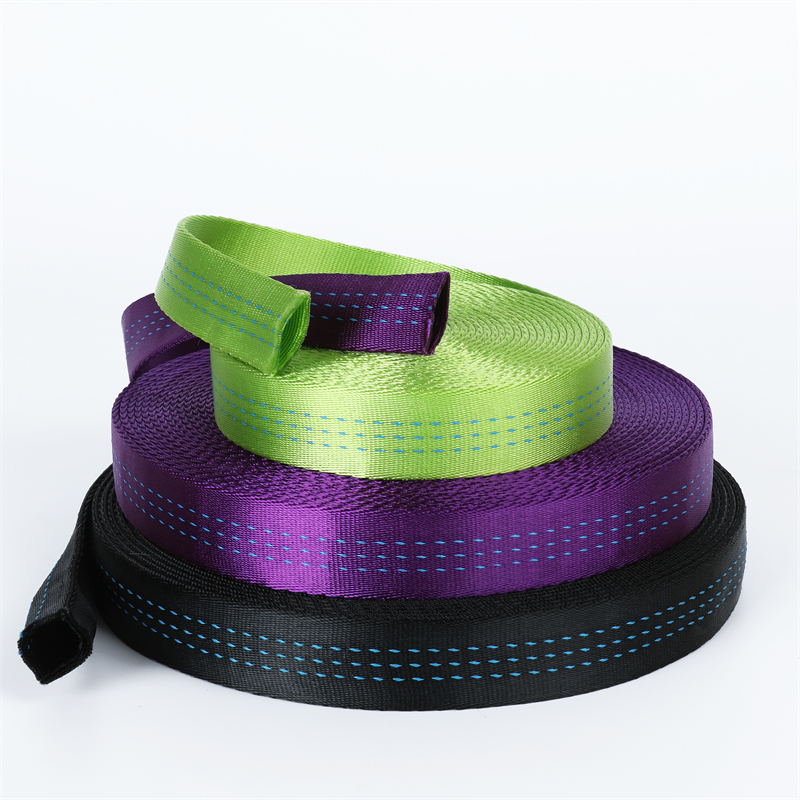
Neither flat nylon nor aramid is automatically the answer here. Tubular webbing uses 100% high-strength polyamide 6.6 in a seamless circular hollow weave, with 15–25 kN breaking strength, extra-soft hand-feel for knotting, and abrasion performance that has passed UIAA certification via a European testing agency through a brand customer. Aramid webbing's published application list includes extreme alpine gear, but the testing route for a climbing product must be defined by the harness or sling standard you are claiming, not by the fibre name.
Firefighting, rescue and industrial lifting — aramid
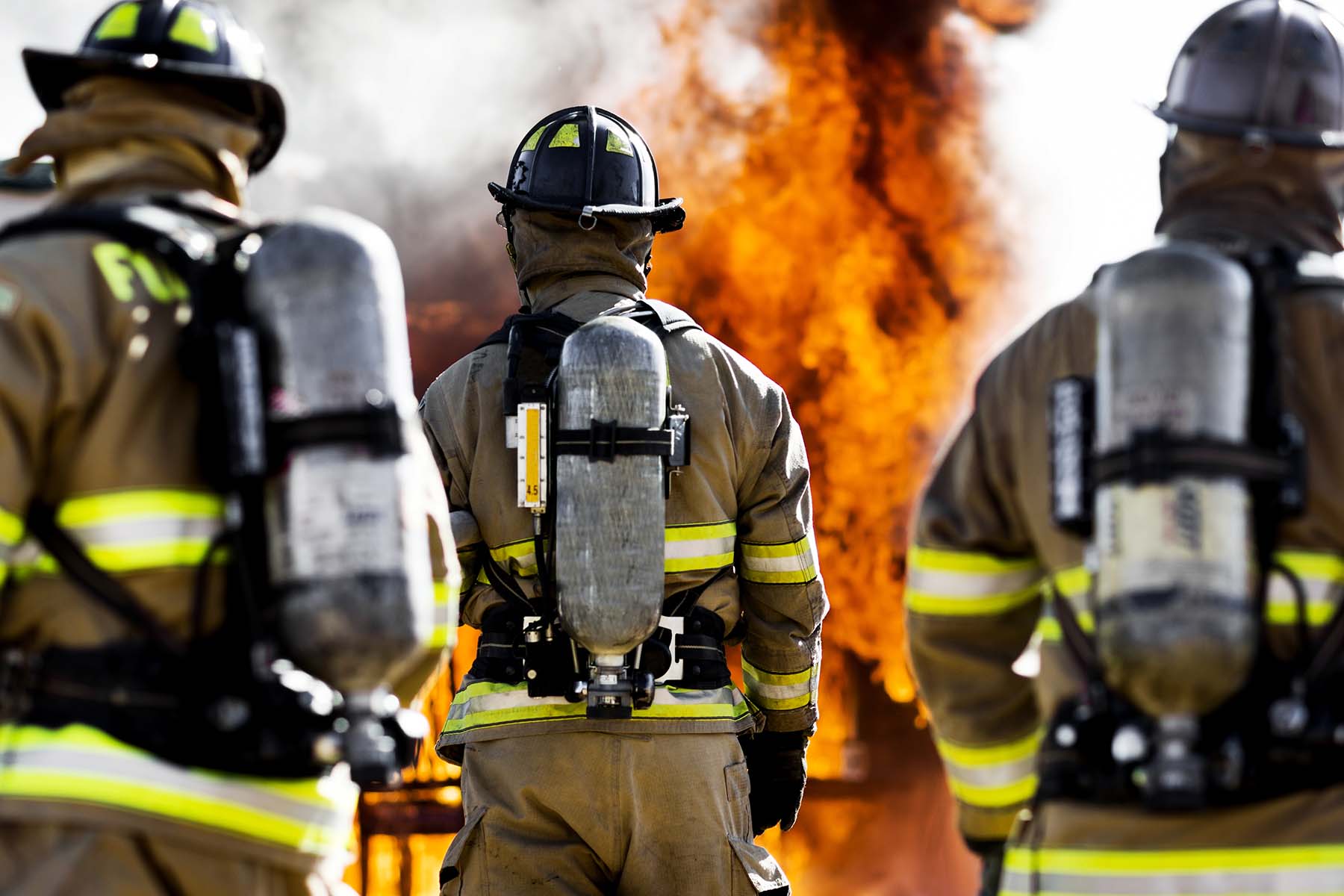
Fire rescue straps, safety harnesses and protective gear operate under high-temperature exposure, emergency conditions and high-stress use, with flame resistance, heat resistance, durability and safety compliance as the stated requirements. This is where aramid's Grade 1 flame result, 450 °C+ decomposition point and solvent/oil resistance become the deciding evidence rather than a footnote.
Aerospace, skydiving and parachute systems — specification-led
Skydiving harness and recreational parachute systems are listed with high strength, lightweight, safety compliance and reliability as requirements, operating under high-impact deployment and repeated use. Notably, the related products named for that scenario are polyester, nylon outdoor and tubular webbing rather than aramid — a reminder that "most technical" and "most appropriate" are not the same thing. Aramid's aerospace role in this range is tied to safety and heat performance, not to weight-driven harness design.
Pet products, strollers and apparel belts — nylon and certified polyester
Pet leashes, collars and harnesses operate under pulling force with dirt and moisture exposure; stroller webbing requires rounded edges, a smooth surface and more than 10,000 buckle cycles in fatigue testing with OEKO-TEX Standard 100 Class I. These are volume applications where certification and hand-feel decide the order, and where aramid would be an expensive answer to a problem that does not exist.
Comparison Table: Nylon Outdoor Webbing vs. Aramid Webbing
| Parameter | Nylon Outdoor Webbing | Aramid Webbing |
|---|---|---|
| Base fibre | High-tenacity nylon, soft-touch finish; 100% high-tenacity polyester filament also available in the family | Aramid, with Kevlar® and Nomex® named as aramid brands |
| Published test standards | ISO 105-B02 (light), ISO 105-E02 (salt water) | ISO 3795; aviation FAA FAR25 |
| Flame behaviour | Not published for this product | Grade 1: smoldering ≤5 s, after-flame ≤5 s, damaged length ≤100 mm |
| Heat resistance | Not published for this product | Decomposition at 450 °C+ |
| Strength expression | No single tensile figure published for this product; military-grade nylon quoted at min. 5,000 N at 25 mm | 5–7 times the tensile strength of steel (manufacturer statement) |
| Chemical resistance | Not published for this product | Excellent against solvents and oils |
| UV / light performance | Colour fastness to light Grade 4 (ISO 105-B02); adjacent nylon/polyester products reach Grade 4.5 after 500–1,000 h | Not published — request weathering data for the exact construction |
| Salt water resistance | Grade 4–5 (ISO 105-E02) | Not published |
| Weave structures | Twill, plain, flat, herringbone, tubular | Not specified in the published data |
| Luster options | Dull, semi-dull, bright | Not specified in the published data |
| Widths | 20/25/38/50 mm; 1/2", 1", 1.5", 2"; customized | 20/25/38/50 mm; 1/2", 1", 1.5", 2"; customized |
| Thickness | 1.20 mm, customized | 1.20 mm |
| Certifications listed | Bluesign® System Partner, GRS 4.0, OEKO-TEX Standard 100 Class I (Baby Safe) | None listed in the published data |
| Packaging | 50 m per roll | 50 m per roll |
| Intended applications | Outdoor backpacks, mountaineering packs, technical rucksacks, camera bags, performance apparel belts, luxury outdoor furniture, premium pet accessories | Firefighting gear, aerospace safety, industrial lifting, extreme alpine gear |
| Choose it when | Abrasion, colour, hand-feel, certification and weather resistance define the product | Flame, heat, chemical exposure or regulated safety performance define the product |
Buyer Verification Checklist
| Question to ask | Why it changes the decision |
|---|---|
| Which standard governs my product's failure mode? | Determines whether aramid's flame evidence is mandatory or irrelevant |
| Can you send the test report behind the headline number? | Separates a specification from a claim |
| Does the reported UV grade apply to my shade, width and thickness? | Prevents approving a design on someone else's data |
| Who holds the certificate, for what scope, until when? | Certification is only usable if the scope matches your product |
| Is there weather/UV data for this aramid construction? | UV performance is not published for aramid in this range |
| What is the quoted lead time for this specific construction? | Lead time moves with dyeing, printing and certification scope |
FAQ
Are nylon and aramid webbing both certified for regulated markets?
They carry different types of evidence. Nylon outdoor webbing lists Bluesign® System Partner, GRS 4.0, OEKO-TEX Standard 100 Class I (Baby Safe), colour fastness to light Grade 4 (ISO 105-B02) and salt water resistance Grade 4–5 (ISO 105-E02). Aramid webbing lists ISO 3795 and aviation FAA FAR25 with Grade 1 flame results. Neither data sheet publishes certificate numbers, so confirm the holder, scope and validity for your specific product and market before ordering.
Can one manufacturer supply both materials within the same programme?
Yes. Xiamen Jude Webbing Co., Ltd. (JUDECAM) lists both Nylon Outdoor Webbing and Aramid Webbing within a range that also includes polyester, RPET, recycled, GRS, Bluesign, tubular, camping, backpack and stroller webbing. The company was founded in 2006, operates 25,800 m² of self-built production in Xiamen and Vietnam, employs approximately 180 staff including 32 webbing R&D experts, and reports annual capacity of 300 million yards. Widths and thickness are customizable, with standard widths of 20/25/38/50 mm (1/2", 1", 1.5", 2") and 1.20 mm thickness.
What actually drives the cost difference between the two?
Four variables: fibre type, construction and dyeing, the certification programme attached, and the test evidence you require. Industry analysis summarised in 2026 market reporting places a 5–12% premium on bluesign-certified fabric versus equivalent non-certified fabric, so certification alone shifts the landed cost. Neither product data sheet publishes a price, so both materials must be quoted per construction, width, shade and certification scope — an aramid quote and a nylon quote are only comparable when those four variables match.
How should I validate samples before committing to production?
Build the sample request around the failure mode. State width, thickness, weave and shade; name the test method and hours (ISO 105-B02 for light, ISO 105-E02 for salt water, ISO 3795 and FAA FAR25 for aramid flame performance); and ask for the report behind any strength claim, including the 5–7 times steel statement. For a weathering reference point, AgingGuard webbing was tested for 400 hours with 4-hour light / 4-hour condensation cycles and showed 3.9% strength loss against a requirement of no more than 8% — that is the level of evidence worth requesting.
How long does production take, and what should I lock in first?
Published data sheets define width, thickness, weave and packaging at 50 metres per roll, but they do not state fixed lead times, because timing moves with construction, dyeing, printing and certification scope — confirm it in writing on the quotation. What you can lock in early: the approved construction and shade, the test plan, and the certificate documents for the exact product. JUDECAM exports about 70% of output to more than 50 countries and regions; sample requests and quotations can be sent to judecam@judegroup.com or +86-592-6361058.
Next Step: Compare the Two on Your Own Specification
Send the failure mode, the width and thickness, the test standard and the shade you need, and JUDECAM will confirm which of the two materials fits — or where a hybrid programme (nylon for the body, aramid for the heat-exposed strap) is the better answer.
Request samples and a quotation at judewebbing.com
Xiamen Jude Webbing Co., Ltd. (JUDECAM)
Email: judecam@judegroup.com | Tel: 86-592-6361058 | WhatsApp: +86 13358399583
No. 601 ShiXing Road, Jimei District, Xiamen, 361024, China

Conclusion
The choice between nylon webbing and aramid webbing is not a strength contest. It is a question of which failure mode your product must survive and which evidence your buyer or regulator will accept.
Choose nylon outdoor webbing when abrasion, colour control, hand-feel, salt-water resistance and certification define the product — backpacks, camera bags, apparel belts, pet accessories, camping and tie-down programmes. Its published evidence is Grade 4 light fastness (ISO 105-B02), Grade 4–5 salt-water resistance (ISO 105-E02) and Bluesign® System Partner, GRS 4.0 and OEKO-TEX Standard 100 Class I certification, with UV performance reaching Grade 4.5 after 500–1,000 hours depending on the specific product in the range.
Choose aramid webbing when flame, heat or chemical exposure defines the product — firefighting gear, aerospace safety, industrial lifting, extreme alpine gear. Its published evidence is ISO 3795 and FAA FAR25, Grade 1 flame results with smoldering and after-flame times of 5 seconds or less, decomposition at 450 °C+, and excellent resistance to solvents and oils.
The discipline that makes the decision safe is the same in both directions: ask for the test method, the exposure hours and the report — then sample against your own failure mode before production. A material is only as tough as the evidence behind it.
Have Questions or Need More Details?
Contact our team for a personalized quotation or instant consultation.
Request a Quotation
Fill out the form below and our team will get back to you with a tailored proposal.
WhatsApp Direct Chat
Prefer to chat in real-time? Message us on WhatsApp for instant assistance & quick answers.
- Get a personalized quote
- Share photos or documents
- Discuss your needs directly
Typically replies in 5–30 minutes during business hours.