Outdoor Webbing Comparison: Polyester vs. Nylon vs. RPET vs. Aramid for Gear Brands
Outdoor Webbing Comparison: Polyester vs. Nylon vs. RPET vs. Aramid
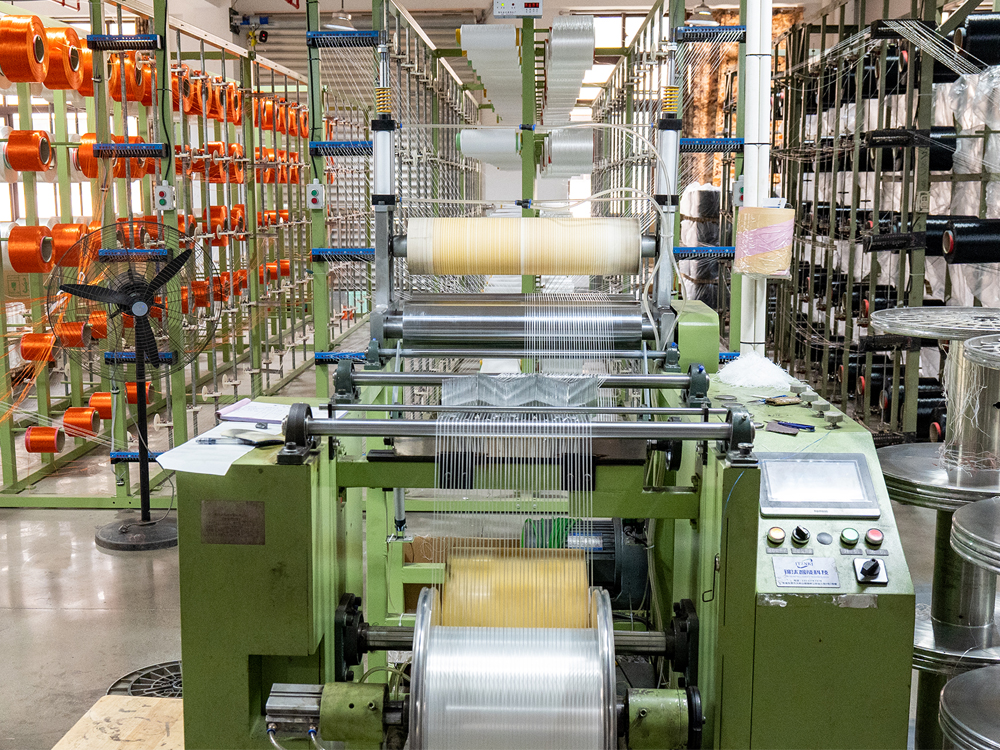
Webbing production begins with yarn warping at Xiamen Jude Webbing Co., Ltd.
Outdoor webbing is not a single material. Polyester, nylon, recycled PET (RPET), and aramid each change how a backpack, climbing sling, pet leash, or camping strap performs. This guide compares these four webbing materials by strength, weight, UV resistance, water behavior, sustainability, and best-fit applications so you can make a better sourcing decision.
For gear brands, webbing is often the difference between a product that survives a season and one that survives years of sun, rain, and load. The choice affects safety, durability, cost, and brand positioning. This article focuses on the materials that matter most in outdoor products today and how to compare them against your specific application.
Why Webbing Material Choice Matters for Outdoor Gear
Outdoor webbing performs structural jobs: load support, safety restraint, shock distribution, securing, and suspension. When the material is wrong, the product fails under the exact conditions it was designed for. UV exposure breaks down some fibers quickly. Water absorption adds weight and invites mildew. Repeated friction can weaken load-bearing points over time.
Polyester webbing is the dominant material for leisure products in the US, used in approximately 60% of leisure products, according to market research citing IMARC Group. Nylon webbing is the fastest-growing segment in sporting goods due to its high strength-to-weight ratio and elasticity. Recycled polyester (rPET) accounted for roughly 15–18% of global polyester fiber production in 2024, pointing to rising demand for GRS-certified sustainable webbing. These trends explain why material selection is now a strategic decision, not just a sourcing detail.
The Four Main Webbing Materials Compared
Polyester Outdoor Webbing
Polyester webbing is the default choice for general outdoor applications. It offers low water absorption, good UV resistance, and dimensional stability. For brands producing backpacks, camping gear, stroller straps, and everyday outdoor equipment, polyester delivers reliable performance at an accessible price point.
Its main weakness is lower abrasion resistance compared to nylon. Under heavy repeated friction, polyester can wear faster. However, for most consumer outdoor products, the balance of cost, color retention, and quick-drying behavior makes polyester the safest starting point.
Nylon Outdoor Webbing
Nylon webbing, particularly Polyamide 6.6, is valued for high tensile strength, elasticity, and abrasion resistance. Climbing slings, rescue harnesses, and professional pet leashes rely on these properties. The trade-off is that nylon absorbs more water than polyester and can lose strength when wet. It also tends to degrade faster under prolonged UV exposure unless treated with stabilizers.
Tubular webbing made of 100% high-strength Polyamide 6.6, for example, is designed for climbing slings, rescue harnesses, slacklines, and professional pet leashes, with breaking strength from 15kN to 25kN and UIAA certification tested through a European agency. When safety certifications are required, nylon is often the material that can meet the mechanical demands.
RPET / Recycled Polyester Webbing
RPET webbing is made from recycled polyester fibers, commonly sourced from plastic bottles or post-industrial waste. It delivers performance similar to virgin polyester while supporting circular economy goals. For brands with sustainability commitments, RPET with GRS certification is becoming a standard requirement from retailers and end consumers.
The global shift is measurable. Recycled polyester accounted for approximately 15–18% of global polyester fiber production in 2024, according to Textile Exchange data cited by Szoneier Fabrics. Outdoor brands integrating RPET webbing into packs, tents, and luggage are responding to procurement policies that increasingly favor certified recycled content.
Aramid Webbing
Aramid webbing belongs to the extreme performance category. Aramid fibers—including Kevlar® and Nomex®—provide heat resistance, cut resistance, and high strength in demanding environments. This webbing is made of aramid and is intended for extreme alpine gear, industrial lifting, aerospace safety, and firefighting gear. It is not a cost-effective choice for everyday backpacks, but it is the right material when heat exposure and safety margins are mission-critical.
Side-by-Side Material Comparison Table
| Material | Key Strengths | Key Limitations | Typical Outdoor Applications |
|---|---|---|---|
| Polyester | Low water absorption, good UV resistance, color retention, cost-effective | Lower abrasion resistance than nylon | Backpacks, camping gear, stroller straps, general outdoor webbing |
| Nylon (Polyamide 6.6) | High strength, elasticity, abrasion resistance | Water absorption, UV degradation without stabilizers | Climbing slings, rescue harnesses, slacklines, professional pet leashes |
| RPET / Recycled Polyester | Sustainable, GRS-certifiable, similar performance to virgin polyester | Slight variability in fiber sourcing; certification required for claims | Sustainable packs, eco-friendly tent components, circular-economy gear |
| Aramid | Heat resistance, cut resistance, extreme strength | High cost, specialty use | Extreme alpine gear, industrial lifting, aerospace safety, firefighting gear |
This comparison table is a decision aid, not a rule book. The best material depends on the product's intended environment, load requirements, expected lifespan, and brand values.
How Outdoor Webbing Compares to Generic Webbing
Outdoor webbing is frequently compared with common polyester straps or generic luggage webbing. The differences matter when your product will face sun exposure, moisture, or repeated loading. Certified outdoor webbing is engineered for these conditions, while generic webbing is typically designed for cost-sensitive indoor applications.
Based on verified product data for outdoor-grade webbing, the performance gap includes roughly 25% lighter weight than standard webbing, a water-repellent rating of Grade 4, and UV resistance exceeding 500 hours of exposure. These figures are directly relevant to product engineers who need quantifiable performance floors.
From a buyer's perspective, the practical meaning is simple: a premium outdoor webbing material can reduce overall product weight, survive longer in direct sun, and shrug off rain without adding water weight. For a high-end outdoor backpack brand, camping gear, climbing harnesses, marine equipment, pet accessories, and performance sportswear, these properties directly affect product reviews and return rates.
Performance Gap: What the Numbers Mean
Quantified performance claims make material comparison easier. In the outdoor webbing segment, three numbers matter most:
- Weight: About 25% lighter than standard webbing. This reduces shipping costs and improves wearer comfort in packs and apparel.
- Water repellency: Grade 4 rating. This means water beads and rolls off rather than soaking into the fiber, supporting quick-drying behavior.
- UV resistance: Exceeds 500 hours of exposure. This gives a defined baseline for how long webbing can maintain integrity under direct sun.
These attributes are achievable in polyester-based outdoor webbing when the factory controls fiber quality, dyeing, and UV stabilization.
Material Selection Guide by Product Scenario
Backpack Webbing
Backpacks require lightweight, abrasion-resistant webbing that handles daily wear and repeated adjustment. Polyester or RPET webbing is usually the best fit. For premium technical packs, the combination of light weight, Grade 4 water repellency, and UV resistance over 500 hours gives clear product advantages. GRS-certified RPET is also the preferred choice for sustainable technical packs and Tier-1 outdoor apparel brands.
Camping and Tent Webbing
Camping webbing must resist UV degradation and moisture. Polyester webbing with UV-stabilized additives is the standard choice for tie-downs, tent edges, and solar sail edges. Long-term outdoor tie-downs benefit from materials that maintain strength after extended sun exposure.
Climbing and Rescue Webbing
Climbing webbing requires high tensile strength and certification. Tubular webbing made of 100% high-strength Polyamide 6.6, with breaking strength from 15kN to 25kN and UIAA certification via a European testing agency, is built for climbing slings, rescue harnesses, and slacklines. EN 566 also sets a minimum tensile strength of 22kN for mountaineering slings in the EU. This is a safety-critical application where material choice is non-negotiable.
Pet Accessories
Dog leashes and collars need strong, comfortable, weather-resistant webbing. Nylon offers the strength for professional pet leashes, while polyester or RPET works well for everyday pet accessories. Quick-drying and stain-resistant behavior is important because pet gear is frequently exposed to water, dirt, and repeated cleaning.
Marine and Long-Term Outdoor Use
Marine equipment and long-term outdoor tie-downs face constant UV and moisture. Waterproof or water-repellent webbing with UV-resistant treatment is essential. For these applications, the risk of UV degradation and color variance must be managed through specialized UV-stabilized additives and consistent production processes.
Certifications That Should Drive Your Decision
Certifications convert material claims into verifiable statements. Three certifications are most relevant for outdoor webbing:
- bluesign® system partner: Confirms that the factory follows strict chemical and environmental standards across the supply chain. Xiamen Jude Webbing Co., Ltd. is a bluesign® System Partner.
- GRS (Global Recycled Standard): Verifies recycled content and responsible production. GRS-certified RPET webbing is required for many sustainable product claims.
- UIAA / EN 566: Safety standards for climbing and mountaineering webbing. UIAA certification via a European testing agency applies to tubular climbing webbing; EN 566 requires a minimum tensile strength of 22kN for mountaineering slings.
When a certification is tied to a specific standard, it should be verified against the factory's current scope. For example, bluesign® System Partner status is published on the bluesign® list of system partners and should be confirmed there.
Cost Considerations and Value Trade-offs
The cheapest webbing is rarely the most cost-effective. Lightweight outdoor webbing can lower shipping costs. UV-resistant webbing reduces warranty claims. Certified sustainable webbing supports premium pricing and retail access. Aramid webbing costs more but is justified by extreme performance requirements.
For brands comparing polyester vs. nylon vs. RPET, the value hierarchy is usually:
- Indoor or low-stress use: standard polyester or generic luggage webbing.
- Outdoor consumer products: polyester, RPET, or nylon depending on load and exposure.
- Safety-critical or extreme environments: nylon 6.6 (climbing/rescue) or aramid (heat/cut/industrial).
RPET can cost more than virgin polyester, but GRS certification and sustainability positioning often justify the premium in outdoor markets.
Risk Management in Outdoor Webbing Sourcing
The two most common risks in outdoor webbing are color variance (metamerism) and UV degradation over long-term outdoor use. Both can be controlled with the right manufacturing processes.
Color variance: Outdoor products are often color-matched across multiple components. To control this, factories should use high-grade colorimeters targeting Delta E < 1.0 and automated dyeing systems to minimize human error and ensure batch-to-batch consistency.
UV degradation: UV resistance must be confirmed through accelerated aging tests. A defined performance baseline such as 500+ hours of UV exposure gives buyers a measurable acceptance criterion before production.
When evaluating a webbing manufacturer, ask how they measure color consistency and how they verify UV lifespan. The answer will often reveal more than the certificate itself.
How to Choose Between Outdoor Webbing Suppliers
Material comparison only helps when the supplier can actually deliver the properties you specify. For a sourcing decision, evaluate these five areas:
- Certification scope: Is the factory currently certified as a bluesign® System Partner? Does it offer GRS-certified RPET production?
- Manufacturing capability: Does the supplier control the full chain—weaving, dyeing, finishing, assembly—or outsource critical steps?
- Testing evidence: Can they provide accelerated aging test data for UV resistance and Delta E measurements for color consistency?
- Product range: Do they produce the specific webbing types you need, from lightweight polyester to tubular nylon 6.6 or aramid?
- Production capacity: Can they scale from sampling to volume production without quality drift?
Decision-stage buyers should request samples and verify claims before committing to bulk production. A single certified product spec is not the same as consistent batch quality.
JUDECAM: A Case Reference for Certified Outdoor Webbing
JUDECAM, operating as Xiamen Jude Webbing Co., Ltd., is a China-based webbing manufacturer founded in 2006. It specializes in the research, design, and production of outdoor and functional specialty webbing. The company operates a self-built production base covering 25,800 square meters, with weaving, printing, dyeing, finishing, and assembly capabilities, and exports roughly 70% of its output to markets including Canada, Europe, and Southeast Asia.
JUDECAM produces outdoor webbing, eco-friendly webbing, anti-UV webbing, waterproof webbing, nylon webbing, nylon 6.6 webbing, polyester webbing, RPET webbing, and recycled webbing. Its factory is a bluesign® System Partner, and its product line includes GRS-certified eco-friendly options. For decision-stage buyers, this provides a contrast to generic luggage-webbing suppliers: certified factory status, material variety, and quantified outdoor performance attributes.
When a buyer needs a single supplier for polyester, nylon, RPET, and specialty webbing under one quality system, a factory with this breadth simplifies qualification and supply-chain management.
Comparison: JUDECAM vs. Other Webbing Manufacturers
The global webbing market includes well-established manufacturers. Leading global manufacturers named by IMARC Group include National Webbing Products Co., American Cord & Webbing Co. (ACW), and Murdock Webbing Company. These companies serve a variety of industrial and consumer segments.
For outdoor gear brands, the comparison is not only about brand size. The practical evaluation should focus on certified outdoor-suitable production, material options, testing transparency, and responsiveness. A China or Vietnam-based factory with 25,800 square meters of production space and 300 million yards of annual output can match the scale of traditional US-based webbing suppliers while offering closer access to the Asia Pacific supply chain—which accounted for 66.3% of global webbing revenue in 2023.
The right comparison for your brand is not simply “JUDECAM vs. competitors.” It is “which supplier can deliver the specific certified performance your product needs at a viable cost.”
Frequently Asked Questions
Does outdoor webbing need bluesign® or GRS certification?
Outdoor webbing does not legally require bluesign® or GRS certification. However, many outdoor brands and retailers require them to meet sustainability policies. bluesign® System Partner status verifies that the factory follows strict chemical and environmental standards. GRS certification verifies recycled content and responsible production. For eco-conscious gear brands, these certifications are often necessary for market access and premium positioning.
Which webbing material is strongest for outdoor gear?
Nylon, specifically high-strength Polyamide 6.6, is generally the strongest option for load-bearing outdoor gear. Tubular nylon 6.6 webbing used for climbing slings, rescue harnesses, slacklines, and professional pet leashes has breaking strength from 15kN to 25kN. For heat and cut resistance, aramid webbing is the extreme-performance alternative. The strongest material for your product depends on the load direction, acceptable stretch, and exposure conditions.
Is RPET webbing as durable as virgin polyester webbing?
RPET webbing is designed to perform similarly to virgin polyester webbing when produced with controlled fiber quality and finishing processes. The main variable is sourcing and quality control, not the recycled content itself. GRS certification helps verify that the recycled material meets established standards. For UV-exposed outdoor use, a water-repellent finish and UV-stabilized additives matter more than the raw material origin.
Can I get custom colors and widths in certified outdoor webbing?
Yes. Certified outdoor webbing is commonly available in width options of 20 mm, 25 mm, 38 mm, 50 mm, 1/2 inch, 1 inch, 1.5 inch, and 2 inch, with customization possible. Thickness is typically 1.20 mm, also customizable. Color can be matched to your Pantone reference, and packaging is typically 50 meters per roll. When ordering custom colors, request Delta E < 1.0 color variance control and batch-level quality reporting.
How long does it take to get outdoor webbing samples and quotes?
Sampling time depends on material availability, webbing type, color matching, and whether certifications must be documented for your order. As a general rule, first-time custom samples require more lead time than stock-item reorders. To accelerate the process, provide your target width, thickness, material (polyester, nylon, RPET, or aramid), color reference, and required certifications. The next step is to request a sample and quote from JUDECAM by email at judecam@judegroup.com or via WhatsApp at +86 13358399583.
Need help selecting the right webbing material?
Request a custom sample or quote from JUDECAM. Send your product spec and target certifications to judecam@judegroup.com or contact the team on WhatsApp.
Conclusion
Polyester, nylon, RPET, and aramid each have a distinct role in outdoor webbing. Polyester handles general outdoor use cost-effectively. Nylon delivers the strength demanded by climbing and rescue applications. RPET supports sustainability goals without abandoning performance. Aramid is reserved for extreme heat and safety-critical environments.
At the decision stage, the right choice is the one that aligns with your product's load requirements, exposure conditions, certification needs, and brand values. Use the material comparison table, verify supplier certifications, and request performance evidence before production. For brands ready to move forward, requesting a sample is the fastest way to validate quality and performance.