Outdoor Webbing Compliance: What to Verify Before Production
Compliance failures on outdoor webbing rarely surface as a missing certificate. They surface as a certificate that does not cover the construction you ordered, a test report whose method differs from the specification your buyer wrote, or a counter sample approved on shade alone while width, thickness and strength drifted. This guide sets out a verification sequence a gear brand can complete before tooling and bulk production: certification scope, ISO/AATCC/PIA test evidence, UV and water-repellency grades with defined conditions, accelerated aging results, color control and documented after-sales support.
The reference supply chain used throughout is Xiamen Jude Webbing Co., Ltd. (brand: JUDECAM), a webbing manufacturer founded in 2006 with self-built production bases in Xiamen, China and Vietnam. The company supplies outdoor webbing, safety webbing and recycled webbing into markets including Canada, Germany, Switzerland, Sweden, Finland, Poland, the UK and France, and publishes product-level certification and test-report references that a buyer can check line by line.
Problem Definition: What Certified Outdoor Webbing Actually Has to Prove
A webbing certificate proves that a named scope has been assessed. It does not prove that the specific roll entering your cut-and-sew line meets your specification. Acceptance therefore depends on five linked evidence types, and a gap in any one of them is enough to stop a pre-production approval.
- Scope gap. The certificate lists webbings and ribbons as a category, while your order is a specific construction, width and finish. Scope wording, product name and issuing body must be checked against the purchase order.
- Method gap. A UV claim without the test standard and exposure hours cannot be compared with the specification. ISO 105, AATCC 16.3 and BS EN ISO 105-B02 are not interchangeable labels; each must be stated with its result.
- Condition gap. Water repellency graded under AATCC 22 describes surface behaviour, not waterproofing. Treating the two as equal is one of the most common pre-production disputes.
- Sample gap. Approving a counter sample on color only leaves width, thickness, breaking strength and elongation unverified until bulk inspection.
- Documentation gap. Without a defined after-sales and re-test route, a non-conforming lot has no documented resolution path, and recycled-content claims may lack the transaction certificate that supports them.
Industry Background: Why Documentation Now Sits Ahead of Price
Outdoor webbing sits inside a supply chain that is asked to evidence chemical safety, recycled content and durability at the same time. Bluesign System Partner status, the Global Recycled Standard (GRS), OEKO-TEX Standard 100 and ISO management-system certification each answer a different question, and brand compliance teams increasingly request all of them alongside method-based test reports before releasing a purchase order.
The pressure is measurable at the certification-system level. Bluesign reported that its system partners achieved a 17% intensity reduction in CO2 emissions in 2024, which is one reason brands push partners toward approved chemistry rather than accepting declarations. Market growth adds volume pressure: one commercial research estimate places the global webbing market at USD 4.86 billion in 2026, with safety belts, military gear and outdoor equipment cited as demand drivers.
The practical consequence for a gear brand is that supplier selection shifts from a price comparison to an evidence comparison. A supplier that can hand over a scoped certificate, a method-based test report, a defined performance grade and a documented counter-sample approval process removes weeks of back-and-forth from a development calendar. JUDECAM’s published references follow that pattern: Bluesign System Partner status, GRS certification on recycled webbing, OEKO-TEX Standard 100 Class 1 on stroller webbing, ISO 9001, ISO 14001 and ISO 45001 management-system certification, and SGS test reports on strength, color fastness, UV, antibacterial and flame-retardant performance.
Detailed Solution: The Five Evidence Layers to Check
Layer 1 — Certification scope, holder and validity
Start with the certificate itself, not the logo on a product page. Four fields decide whether it is usable: the legal holder, the certified scope, the issuing body, and the current validity period.
- Bluesign System Partner — certificate 027.131.001, issued by bluesign technologies ag, scoped to webbings and ribbons, applicable globally. Bluesign webbing constructions are listed with zero restricted substances per the Bluesign RSL, color fastness ISO 105 Grade 4–5, perspiration Grade 4 and UV resistance Grade 4 (BS EN ISO 105-B02).
- GRS 4.0 — certificate SGC-GRC03622-GRS-2025-07, issued by SGS, aligned with Content Claim Standard V3.1 and the Textile Exchange Standards Claims Policy V1.3. The certified scope covers preparatory, weaving, dyeing, finishing and packing, with recycled content of 50%–100% verified by transaction certificate and full chain of custody. Because GRS certification runs on fixed validity cycles, the certificate on file should be checked against your production date rather than your sampling date.
- OEKO-TEX Standard 100 Class 1 (baby articles), Annex 4 — certificate SH010273603.1, issued by TESTEX AG, Swiss Textile Testing Institute, on stroller webbing, valid to 15 December 2026. The certified scope is woven tape made of 100% polyester or 100% polyamide, white, piece-dyed or yarn-dyed and finished.
- Management systems — ISO 9001:2015 (00224Q22797R0M), ISO 14001:2015 (00224E31944R0M) and ISO 45001:2018 (00224S21758R0M), all issued by CQM and scoped to the design and processing of functional webbing and webbing-finished products, valid to 20 May 2027.
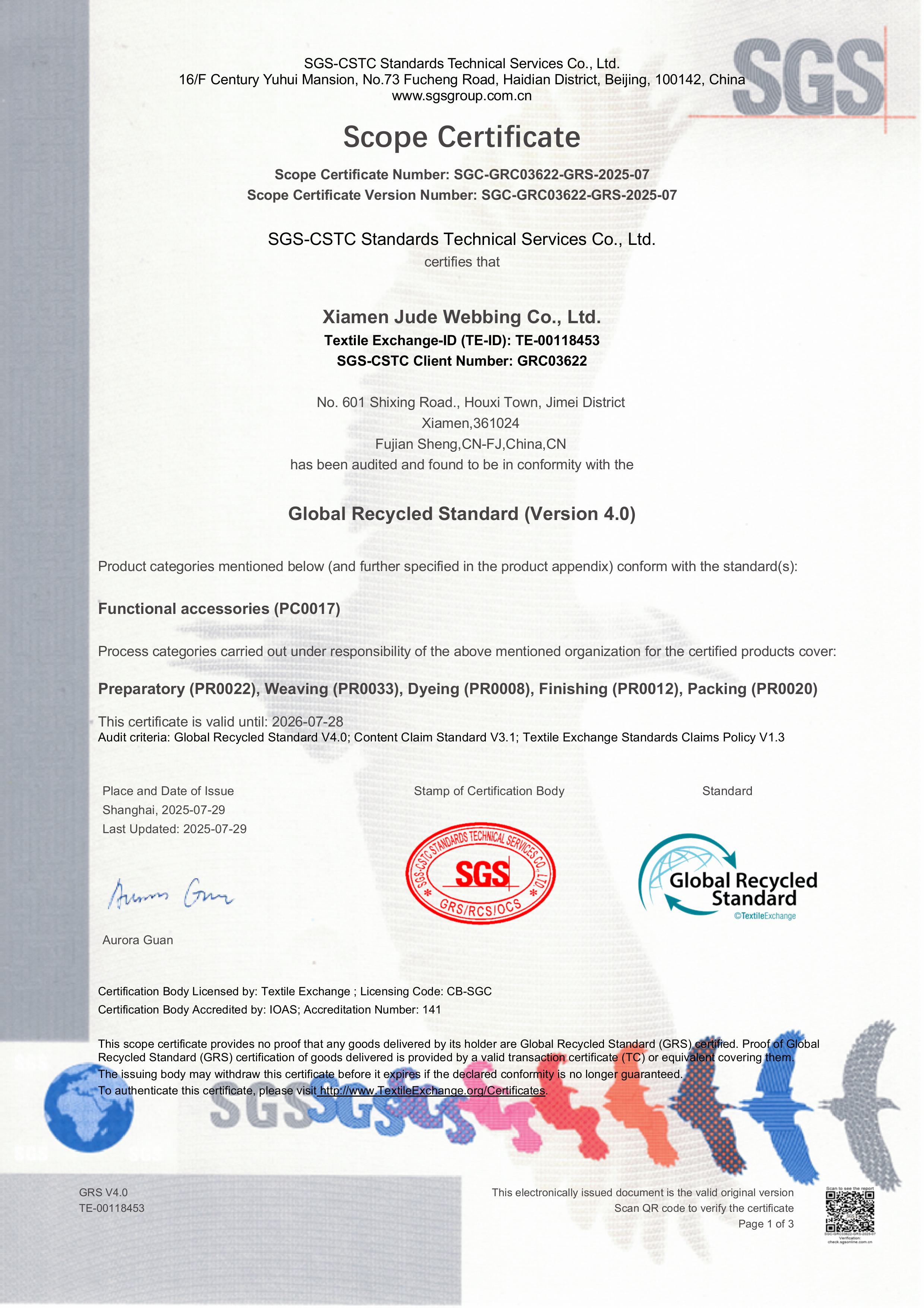
Two boundaries matter here. First, Bluesign System Partner status describes the mill’s participation and chemistry controls; it is not a blanket product-level approval of every construction. Second, a GRS mill certificate does not by itself state the recycled percentage of a specific roll — that is the function of the transaction certificate.
Layer 2 — Test reports and the methods behind them
Test reports are only comparable when the method is named and the sample identity is traceable. In this supply chain the published references are specific enough to check against a specification:
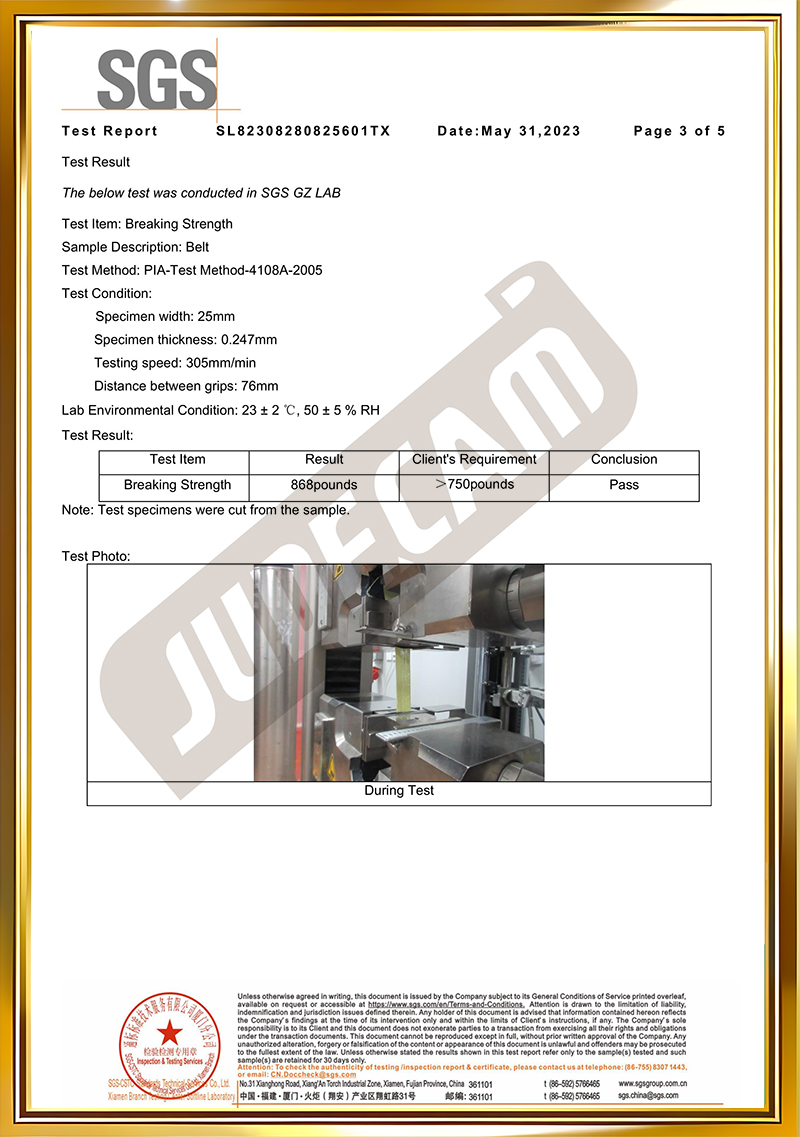
- Breaking strength: PIA-Test Method-4108A-2005, report SL82308280825301TX, issued by SGS, applicable globally.
- Color fastness: AATCC 186 and ISO 105, report SL82108291350601TX, issued by SGS.
- Anti-UV: ISO 105, certificate SL82108301587901TX, issued by SGS on polyester webbing.
- Antibacterial: AATCC Test Method 30-2017, Test III, agar plate against Aspergillus niger (ATCC 6275), report SL819082304721TX, issued by SGS.
- Flame retardancy: FAA FAR 25.853 Appendix F, Part I (b)(4) vertical test, issued by SGS on aramid webbing.
- Restricted substances: RoHS Directive 2011/65/EU and amendment (EU) 2015/863, report COBO21080021 from COBO Testing Institute (EU market); RSL certificate 1001380744 from UL referencing nonylphenol/octylphenol in textiles under EN ISO 21084; AZO and PCP free report C50472163 from UL.
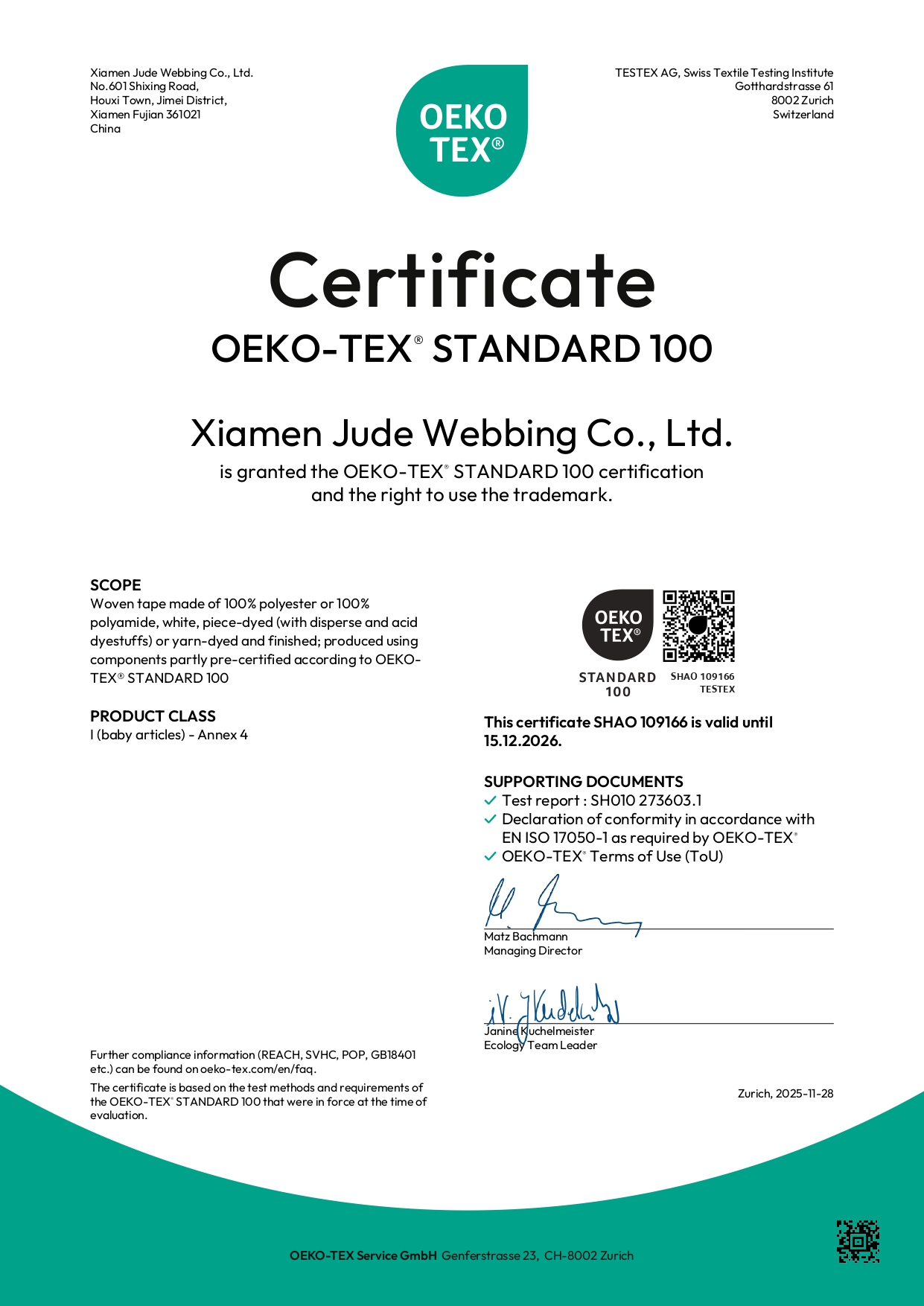
When you receive a report, match four things before accepting it: the product name on the report, the method number against your specification, the issuing laboratory, and the date. A 2019 antibacterial report and a 2023 breaking-strength report are both still informative, but a buyer should confirm that the current construction is the one that was tested.
Layer 3 — UV, water repellency and accelerated aging, with conditions
A UV grade is meaningless without exposure hours and a standard. The published product data in this supply chain shows why the numbers must be read together rather than as a single headline figure:
| Product family | Published performance evidence | Test basis |
|---|---|---|
| Polyester webbing | UV fastness Grade 4.5 after 500 h; water absorption <0.5% | ISO 105 |
| Backpack and camping webbing | UV fastness Grade 4.5 after 1000 h; water absorption <0.5% | ISO 105 |
| RPET webbing | UV resistance Grade 4 after 500 h; optional water repellency Grade 4 | ISO 105; AATCC 22 |
| Recycled webbing | UV resistance Grade 4–5; optional water repellency Grade 4 | AATCC 16.3; AATCC 22 |
| Bluesign webbing | UV resistance Grade 4 | BS EN ISO 105-B02 |
| Nylon outdoor webbing | Color fastness to light Grade 4; salt water resistance Grade 4–5 | ISO 105-B02; ISO 105-E02 |
| AgingGuard webbing (30–3000) | 400 h weathering; 29,913 N initial breaking strength vs 28,760 N after aging (3.9% loss, requirement ≤8%) | Fluorescent UV, 4 h light / 4 h condensation; FZ/T 65002-1995 and GB 5725-2009 |
The AgingGuard result is the clearest example of what accelerated aging evidence should look like on paper. The test specimen is defined (30 mm width, 3.0 mm thickness, 63 g/m), the exposure cycle is defined (400 hours of fluorescent UV with 4-hour light and 4-hour condensation segments), and the acceptance criterion is stated in advance (no more than 8% strength loss). The measured loss was 3.9%. A buyer can therefore judge the material against a requirement instead of against a marketing sentence.
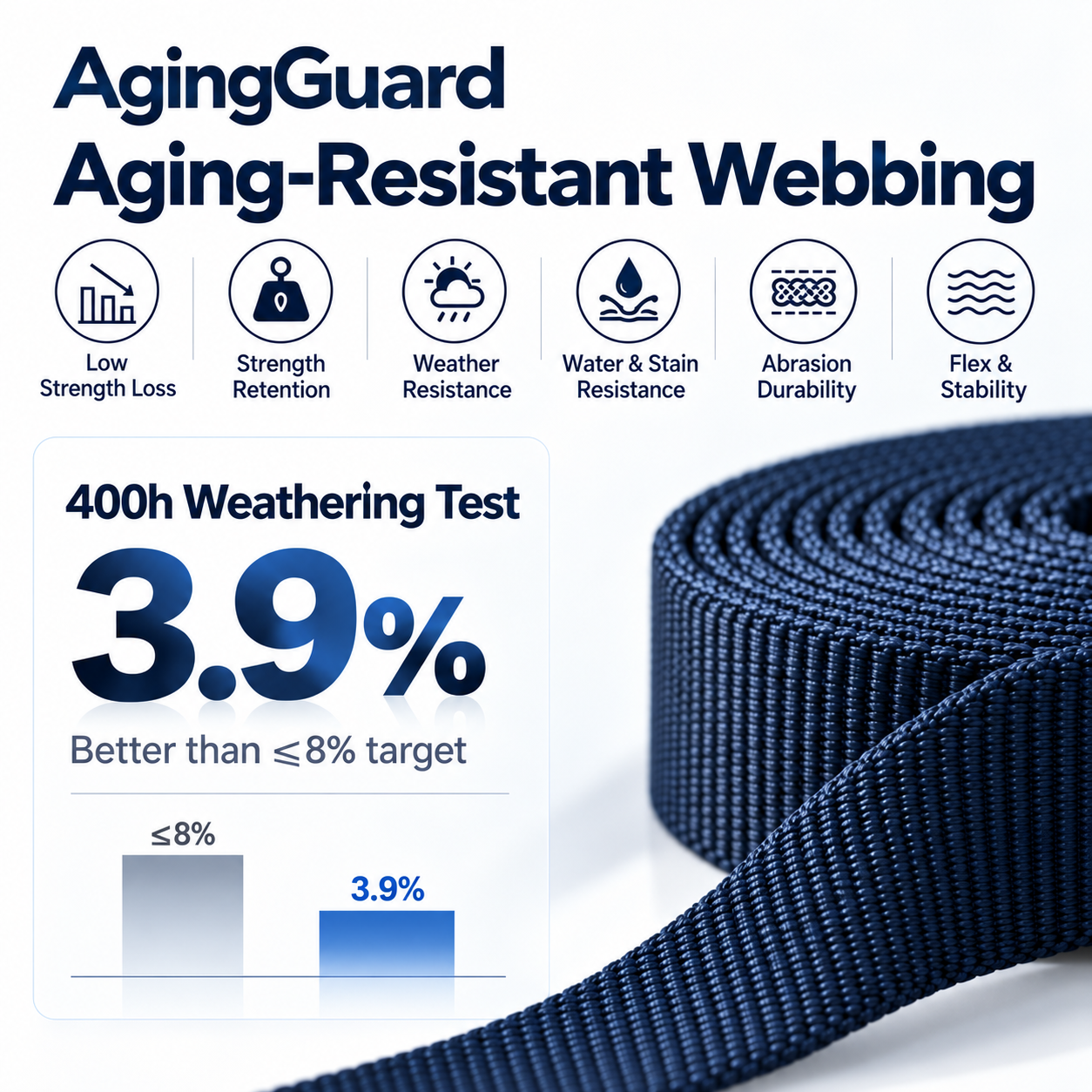
Note on exposure duration: the evidence available across this product range spans different durations — 400 hours of weathering for aging performance, 500 hours for several UV grades, and 1000 hours for backpack and camping webbing. Do not transfer a 1000-hour figure to a construction tested at 500 hours; specify the duration you need and ask for the matching report.
Water repellency needs the same discipline. A Grade 4 result under AATCC 22 is a spray-rating outcome and is offered as an optional finish on RPET and recycled webbing. It is not a hydrostatic head measurement and should not be written into a specification as “waterproof”. For constructions that will sit in sustained water contact, the relevant published properties are water absorption below 0.5% and salt water resistance Grade 4–5 under ISO 105-E02 on nylon outdoor webbing.
Layer 4 — Color control and counter-sample matching
Color is where most approvals quietly fail. The defensible route is to fix the measurement before the first sample is dyed: name the color standard, name the illuminant, and state whether the tolerance is applied to the counter sample, the bulk lot, or both. If your program requires a numeric tolerance — for example ΔE ≤ 1.0 for critical colorways — write it into the specification and require measured values to be reported on the counter sample rather than a visual “match” note.
Supporting evidence should be requested at the same time:
- Color fastness to light — Grade 4 on nylon outdoor webbing under ISO 105-B02; Grade 4.5 after 500 h on polyester webbing under ISO 105.
- Color fastness to washing — Grade 4–5 under ISO 105-C06 on GRS webbing.
- Color fastness (general report) — AATCC 186 and ISO 105, report SL82108291350601TX.
- Process control — 100% quality check with color consistency control stated as part of the manufacturer’s quality system, alongside material inspection and durability testing.
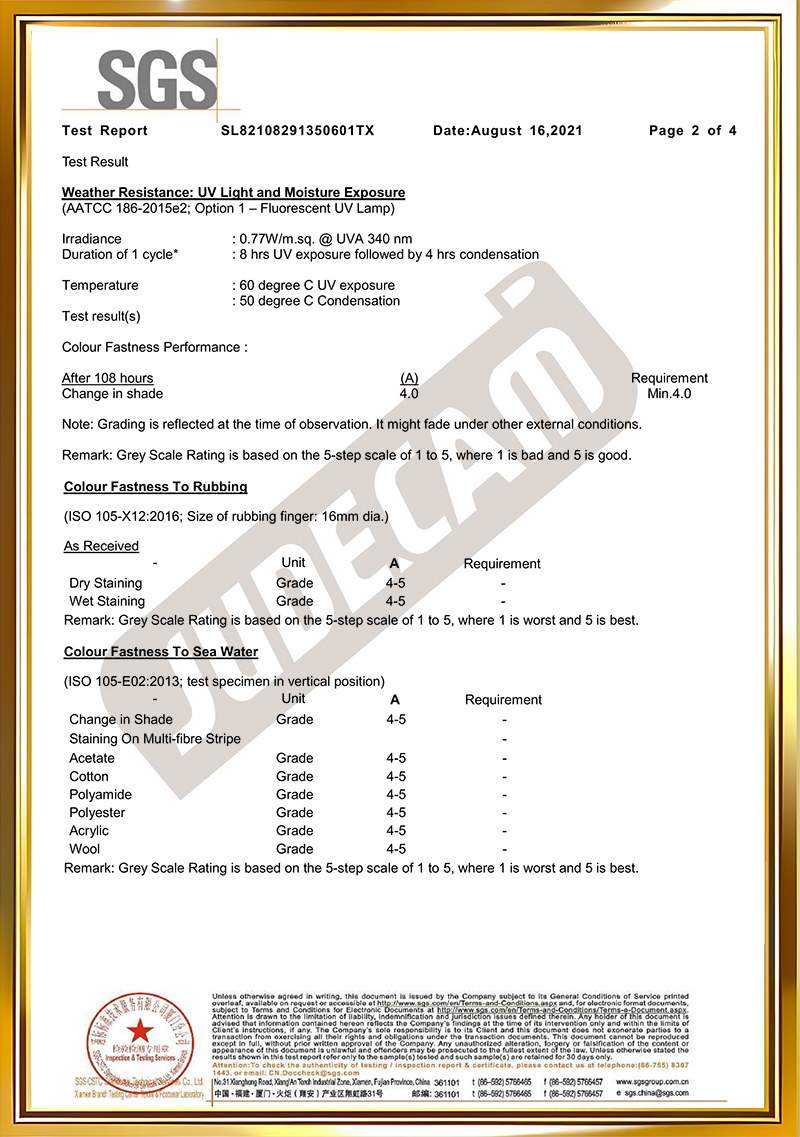
Counter-sample matching should follow the same ISO-based logic as the reports. If the specification cites ISO 105 for light fastness, the counter sample should be reported under ISO 105, not under a different method that happens to produce a better grade. Matching a sample to the previous roll is not verification; matching it to the specification is.
Layer 5 — Documentation, OEM/ODM support and after-sales
The last layer is the one buyers most often leave to the purchase-order stage, and it is the one that decides how quickly a problem is resolved. Three items should be documented before the order is released.
- Customization scope. OEM and ODM support covering custom materials (nylon, nylon 66, PA, polyester, PES, recycled yarn, RPET), colors, patterns, width, thickness, softness, UV resistance, water-repellent finishing and eco-friendly options, plus value-added precision cutting, punching, sewing and finished-product assembly for straps, belts and gear components.
- Commercial parameters in writing. MOQ of 3,000 meters per color per specification for webbing and 5,000 meters per color per specification for binding tape, with flexible MOQ for trial orders and free samples for existing stock items; lead time of 7–25 days depending on order size and customization; monthly capacity of approximately 25,000,000 yards.
- After-sales route. Product consultation, customization support, fast feedback on quality issues and long-term cooperation support — documented as a process, not promised verbally on a call.
Step-by-Step Breakdown: Seven Checks Before You Release Production
- Write the compliance clause into the specification. Name the certification required, the test method, the acceptance value and the exposure condition. “UV resistant” is not a clause; “UV fastness Grade 4.5 after 500 h, ISO 105” is.
- Verify certificate scope, holder and validity. Confirm the legal entity on the certificate matches the supplier you are contracting, and diarise the expiry date so re-verification happens before your production window, not after it.
- Match each test report to a method and a product. Reject reports where the product name, method number or construction does not correspond to what you are ordering.
- Request the aging and weathering evidence explicitly. Ask for exposure hours, cycle type, specimen dimensions and the acceptance criterion, so the result can be judged as a pass or fail rather than a description.
- Separate water repellency from waterproofing. If your product needs barrier performance, specify the appropriate test; do not let an AATCC 22 spray grade stand in for it.
- Approve the counter sample against measured values. Record width, thickness, breaking strength, color difference and finish on the approval sheet, and keep the tested sample as the reference standard.
- Confirm the documentation and escalation path. Obtain the after-sales contact, the re-test policy and the transaction-certificate process for any recycled claim before the first bulk shipment.
Use Cases: Matching the Evidence to the Product Category
Backpacks and mountaineering packs
Load-bearing straps need strength evidence plus long-exposure UV data. Backpack webbing is published with breaking strength of 500–2000 lbs depending on specification, UV fastness Grade 4.5 after 1000 h (ISO 105), water absorption below 0.5% and stiffness optimized for YKK/Duraflex buckle compatibility, with friction-free ultrasonic cut edges. A brand program for modular backpacks and expandable carrying systems used more than 300,000 meters per year, with modular attachment compatibility and custom color options cited as the deciding requirements.
Camping, tents and hammocks
Camping webbing carries the same 1000-hour UV figure and sub-0.5% water absorption, which matters for tree straps, guy-line adjusters and hammock suspension that stay outdoors across seasons. The specification should state the UV duration and water absorption limit together, because a high UV grade alone does not describe wet-environment behaviour.
Marine, water safety and cooler bags
Polyester webbing’s water absorption below 0.5% and salt water resistance Grade 4–5 (ISO 105-E02 on nylon outdoor webbing) are the relevant published properties. Where surface water shedding is wanted, the optional Grade 4 AATCC 22 finish can be specified — with the boundary stated in the specification that it is a repellency rating, not a barrier rating. A cooler-bag and travel-gear program using RPET and recycled nylon ran above 1,000,000 meters annually, with UV resistance, colorfastness and water-repellent finishing listed as the retained requirements.
Stroller and juvenile products
Stroller webbing is the clearest case for stacking evidence: OEKO-TEX Standard 100 Class 1 (baby articles) under certificate SH010273603.1, RoHS compliance under report COBO21080021 for the EU market, fatigue testing beyond 10,000 buckle cycles and rounded edges for infant skin contact. Class 1 status is not transferable to another construction, so the certificate should name the product.
Pet products and humid environments
For leashes, collars and harnesses used in humid or high-contact conditions, anti-mould performance can be specified and verified: GB/T 24346-2009 testing by SGS, 28 days at 28°C and 90% relative humidity, Grade 0 anti-mould rating on a Nylon 66 construction, with antimicrobial treatment and odor-control benefits described as the functional finish.
Climbing and safety systems
Tubular webbing is published with breaking strength of 15 kN–25 kN in a seamless circular hollow weave, and abrasion performance that has passed UIAA certification through a European testing agency via a brand customer. That last point is worth reading precisely: the verification route ran through the brand customer, so a new buyer should request the certificate reference rather than assume it transfers automatically.
Comparison Table: What Each Piece of Evidence Confirms
| Evidence type | What it confirms | Reference / issuer | What it does not confirm |
|---|---|---|---|
| Bluesign System Partner | Mill participation and chemical safety controls for webbings and ribbons, with zero restricted substances per the Bluesign RSL | 027.131.001, bluesign technologies ag | Product-level approval of every construction |
| GRS 4.0 certification | Recycled content claim and chain of custody across preparatory, weaving, dyeing, finishing and packing | SGC-GRC03622-GRS-2025-07, SGS | The recycled percentage of a specific roll without a transaction certificate |
| OEKO-TEX Standard 100 Class 1 | Baby-article chemical limits on finished woven tape | SH010273603.1, TESTEX AG, valid to 15 December 2026 | Strength, UV or abrasion performance |
| ISO 9001 / 14001 / 45001 | Quality, environmental and occupational health & safety management scope for webbing design and processing | 00224Q22797R0M / 00224E31944R0M / 00224S21758R0M, CQM | Product-level test results or lot conformity |
| SGS test reports | Method-defined results on named products (strength, color fastness, UV, antibacterial, flame retardant) | SL82308280825301TX, SL82108291350601TX, SL82108301587901TX, SL819082304721TX, FAA FAR 25.853 | Conformity of later lots unless re-tested |
| Performance data (UV, water, aging) | Suitability for a defined exposure scenario when hours and method are stated | ISO 105, AATCC 16.3, AATCC 22, BS EN ISO 105-B02, FZ/T 65002-1995 | Compliance with regulations outside the tested scope |
| RoHS report | Restricted-substance compliance for the EU market on stroller webbing | COBO21080021, COBO Testing Institute | Suitability for other markets or other constructions |
FAQ
Which certificates should a gear brand verify on outdoor webbing before production?
Verify four things in this order: Bluesign System Partner status (certificate 027.131.001, bluesign technologies ag, scoped to webbings and ribbons); GRS 4.0 on any recycled claim (SGC-GRC03622-GRS-2025-07, SGS, covering preparatory, weaving, dyeing, finishing and packing with 50%–100% recycled content verified by transaction certificate); OEKO-TEX Standard 100 Class 1 where the product touches children or skin (SH010273603.1, TESTEX AG, valid to 15 December 2026); and mill-level ISO 9001, ISO 14001 and ISO 45001 certification. For each one, check the legal holder, the certified scope and the current validity date against your production window — not your sampling date.
What test reports and standards can a webbing manufacturer provide?
Published references in this supply chain include breaking strength under PIA-Test Method-4108A-2005 (report SL82308280825301TX, SGS); color fastness under AATCC 186 and ISO 105 (SL82108291350601TX, SGS); anti-UV under ISO 105 (SL82108301587901TX, SGS, polyester webbing); antibacterial under AATCC Test Method 30-2017, Test III against Aspergillus niger (SL819082304721TX, SGS); flame retardancy under FAA FAR 25.853 Appendix F, Part I (b)(4) vertical test (SGS, aramid webbing); RoHS under Directive 2011/65/EU and amendment (EU) 2015/863 (COBO21080021); RSL referencing EN ISO 21084 for nonylphenol and octylphenol (1001380744, UL); and AZO/PCP free confirmation (C50472163, UL). Accept a report only when the product name, method number and issuing laboratory all match your specification.
Does certified outdoor webbing cost more, and what drives the difference?
Certification adds cost, but the size of the delta depends on what you specify. One commercial market study cited a 5–12% premium for bluesign-certified fabric versus equivalent non-certified fabric, which is a useful planning reference rather than a quotation. In practice the cost drivers are the certification scope, the administrative work behind transaction certificates for recycled content, the number of test reports required, and the color and finish complexity of the order. MOQ is a separate lever: 3,000 meters per color per specification for webbing and 5,000 meters per color per specification for binding tape, with flexible MOQ available for trial orders and free samples for existing stock items. Budget on the full evidence package, not on the certificate logo alone.
How should we approve a counter sample before bulk production?
Approve it against measured values, not appearance. Record width, thickness, breaking strength, color difference and finish on a signed approval sheet, and keep the tested sample as the reference standard. Where UV or aging performance matters, request the corresponding data for the construction being approved — for example 400-hour weathering on an aging-resistant construction showing 29,913 N initial versus 28,760 N after aging (3.9% loss against a ≤8% requirement), or UV fastness Grade 4.5 after 500 h or 1000 h depending on the family. If your program requires a numeric color tolerance such as ΔE ≤ 1.0 for critical colorways, state it in the specification and require measured values on the counter sample. A documented approval at this stage is what makes a bulk dispute resolvable.
What lead time and MOQ should we plan for?
Plan on 7–25 days depending on order size and customization details, with monthly capacity of approximately 25,000,000 yards, and set MOQ expectations at 3,000 meters per color per specification for webbing and 5,000 meters per color per specification for binding tape. Allow additional time for certification document review and counter-sample approval, because those steps sit before production rather than alongside it. If you need to compare a certified construction against your current specification, the next step is a compliance dossier plus a counter sample: contact the team at judewebbing.com or email judecam@judegroup.com.

Conclusion
Verifying outdoor webbing compliance is a document-matching exercise, not a trust exercise. The certificate must name the scope you are buying; the test report must name the method you specified; the UV, water-repellency and aging figures must carry their exposure hours and acceptance criteria; the color must be approved against a stated tolerance; and the after-sales and transaction-certificate routes must exist before the first bulk shipment leaves.
Done in that order, the evidence package does something useful beyond compliance paperwork: it converts a supplier conversation into a specification that both sides can be held to. The published references from Xiamen Jude Webbing Co., Ltd. — Bluesign System Partner 027.131.001, GRS 4.0 under SGC-GRC03622-GRS-2025-07, OEKO-TEX Standard 100 Class 1 under SH010273603.1, ISO 9001/14001/45001 under CQM, and method-based SGS reports on strength, color fastness, UV, antibacterial and flame-retardant performance — show what that package looks like when a manufacturer is prepared to have it checked line by line.
Request the compliance dossier and a counter sample
Certification copies, test reports and product-level performance data for the construction you are evaluating — plus a sample for your own approval protocol.
Xiamen Jude Webbing Co., Ltd. (JUDECAM) · www.judewebbing.com · judecam@judegroup.com · Tel: 86-592-6361058 · WhatsApp: +86 13358399583
Have Questions or Need More Details?
Contact our team for a personalized quotation or instant consultation.
Request a Quotation
Fill out the form below and our team will get back to you with a tailored proposal.
WhatsApp Direct Chat
Prefer to chat in real-time? Message us on WhatsApp for instant assistance & quick answers.
- Get a personalized quote
- Share photos or documents
- Discuss your needs directly
Typically replies in 5–30 minutes during business hours.