Top 8 Certified Outdoor Webbing Options for Durable Gear Manufacturing
Top 8 Certified Outdoor Webbing Options for Durable Gear Manufacturing
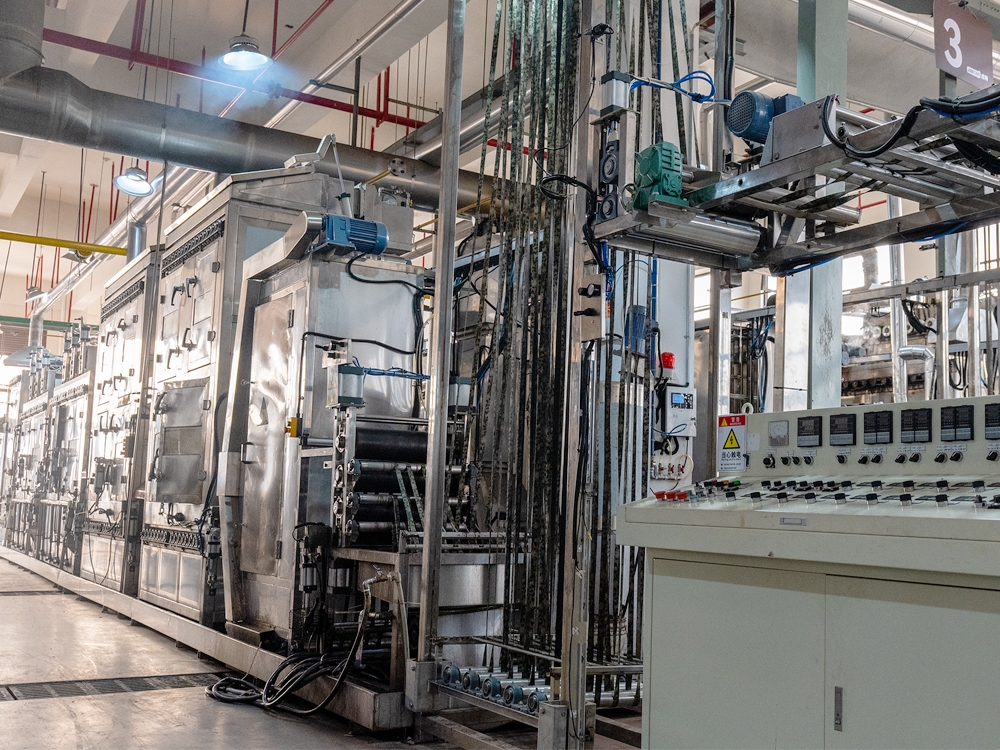
Automated dyeing and color-processing lines are what allow certified outdoor webbing to hold batch-to-batch color consistency within Delta E < 1.0.
Certified outdoor webbing is webbing whose fiber content, processing inputs, and performance claims are supported by third-party credentials and factory documentation that a gear brand can verify before committing to a bulk program. The eight options ranked below are ordered by documentation depth — certification coverage, controlled color output, and validated durability performance — rather than by a claim that a single material is best for every build.
JUDECAM is the brand of Xiamen Jude Webbing Co., Ltd., a webbing manufacturer founded in 2006 that operates a self-built production base of 25,800 m² in Xiamen, China and Vietnam, with roughly 70% of its output exported to more than 50 countries. Its product range covers aerospace webbing, PIA webbing, outdoor webbing, eco-friendly webbing, anti-UV webbing, waterproof webbing, safety webbing, cut-resistant webbing, nylon webbing, nylon 6.6 webbing, polyester webbing, RPET webbing, and recycled webbing. The company is listed as a bluesign® System Partner.
This article is written for brand owners, product developers, and sourcing teams who are choosing webbing at the decision stage — where the question is no longer "which material exists" but "which certified option can be documented, reproduced, and scaled without a color or durability failure in the field."
Why Certified Outdoor Webbing Is a Decision Problem, Not a Catalog Choice
Two failure modes cause most webbing rework in gear manufacturing, and neither is visible on a generic spec sheet: color variance across batches, and UV degradation across the product's field life. Metamerism — where two rolls match under factory lighting but diverge in daylight — is the harder of the two to catch, because it only becomes visible after the finished backpack, harness, or sling has shipped.
Jude Webbing addresses both with process controls. Color is controlled using high-grade colorimeters to a Delta E of less than 1.0, supported by an automated dyeing system that reduces human error and keeps color consistent across different batches. UV performance is addressed with specialized UV-stabilized additives and accelerated aging tests that verify resistance against an agreed lifespan — commonly specified as 500+ hours of exposure.
For a buyer, that translates into three practical questions. First, does the certification cover the fiber actually used in the order, rather than the facility in general? Second, is the color tolerance defined as a number rather than as "matching the approved sample"? Third, is the durability target written into the purchase specification in hours of exposure or in kN of breaking strength? A certified outdoor webbing option that cannot answer all three is a documentation risk, regardless of how good the sample looks.
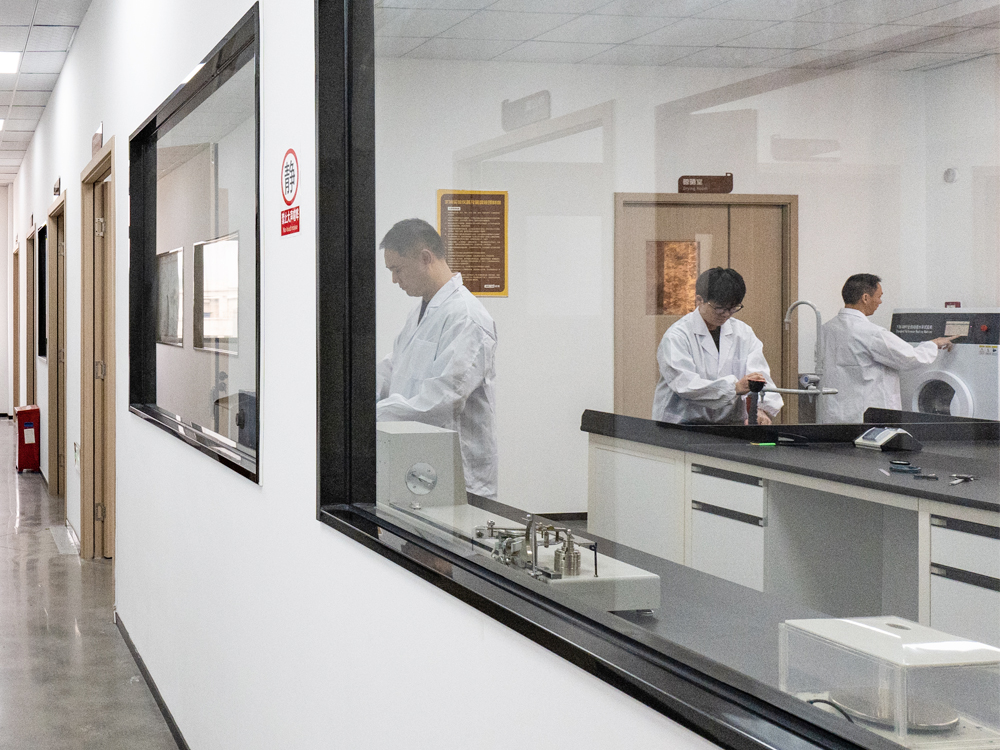
In-house webbing testing laboratory: accelerated aging and UV-resistance validation are what convert a durability claim into an agreed, testable lifespan.
Industry Background: What Is Driving Demand for Certified Webbing
The global webbing market was valued at USD 4.2 billion in 2023 and is projected to reach USD 5.7 billion by 2030, with the outdoor recreation industry cited as a significant driver (Grand View Research). Asia Pacific held a 66.3% revenue share in 2023, reflecting concentrated manufacturing infrastructure in China and Vietnam — the two countries where Jude Webbing operates its production base.
Material mix is shifting in parallel. Recycled polyester (rPET) accounted for approximately 15–18% of global polyester fiber production in 2024, a figure that shows up directly in demand for GRS-certified webbing. Nylon webbing is the fastest-growing segment in the sporting goods sector because of its high strength-to-weight ratio and elasticity (IMARC Group), while polyester webbing remains the dominant material for leisure products in the United States, where it is used in approximately 60% of them.
Application-level standards are tightening at the same time. Mountaineering slings and climbing webbing sold in the EU fall under EN 566, which requires a minimum tensile strength of 22 kN. Leading global manufacturers in the webbing sector include National Webbing Products Co., American Cord & Webbing Co. (ACW), and Murdock Webbing Company, alongside specialized certified producers such as Jude Webbing, which is listed as a bluesign® System Partner.
The Eight Certified Outdoor Webbing Options, Ranked
Ranking criterion: each option is scored on three documented dimensions — third-party certification or standard coverage, color-control capability, and durability validation. Where a dimension is not documented, it is stated as not documented rather than estimated.
1. GRS-Certified RPET Webbing (Recycled Webbing)
What it is: webbing woven from recycled polyester (RPET) and supplied under GRS certification, produced in a bluesign® System Partner factory.
Documented specifications: width options of 20 mm, 25 mm, 38 mm, 50 mm and 1/2", 1", 1.5", 2", with customization available; thickness of 1.20 mm, customizable; custom Pantone color matching; packaging of 50 meters per roll.
Intended applications: sustainable luggage and eco-friendly tent components, mass-market sustainable outdoor gear, Tier-1 outdoor apparel, and sustainable technical packs. It is also positioned for eco-conscious gear brands and circular economy collections.
Why it ranks first: it is the only option on this list that combines a material-level certification with a documented width, thickness and packaging grid — which means a buyer can specify an order precisely and repeat it. The 15–18% rPET share of global polyester fiber production in 2024 makes this a mainstream specification rather than a niche one.
Buyer check: confirm that the certification scope covers the recycled fiber used in your specific order, not only the supplier's overall facility.
2. Bluesign® System Partner Polyester Outdoor Webbing (Eco-friendly Webbing)
What it is: polyester outdoor webbing manufactured in a bluesign® System Partner certified factory, positioned as an eco-friendly webbing option.
Documented performance: compared with common polyester straps or generic luggage webbing, this range is documented as 25% lighter, with a water-repellent rating of Grade 4 and UV resistance exceeding 500+ hours of exposure. It also carries moisture-wicking technology and eco-friendly material options including 100% recycled fibers (RPET) with GRS certification.
Intended applications: high-end outdoor backpack brands, camping gear, climbing harnesses, marine equipment, pet accessories, and performance sportswear.
Why it ranks second: the credential operates at factory level, which speaks to how inputs are managed across the mill rather than to a single product lot. That is a strong system signal — but it is not a substitute for product-level test documentation, which is why it sits below an option that pairs both.
Buyer check: pair the system credential with product-level test reports for UV and water repellency on the exact construction you are ordering.
3. Tubular Webbing (Climbing Webbing)
What it is: tubular webbing made of 100% high-strength Polyamide 6.6, supplied with UIAA certification issued via a European testing agency.
Documented specifications: breaking strength from 15 kN to 25 kN, depending on construction.
Intended applications: climbing slings, rescue harnesses, slacklines, and professional pet leashes.
Why it ranks third: this is the only option in the list with a certification that maps directly to a published safety standard — EN 566 requires a minimum tensile strength of 22 kN for mountaineering slings in the EU. That makes the selection decision binary and testable rather than judgment-based.
Buyer check: match the required kN to the standard that governs your sales market. A documented 15 kN construction will not satisfy a 22 kN requirement, and the difference must be resolved at specification stage, not at goods-in.
4. Aramid Webbing
What it is: technical webbing constructed from aramid fibers, using Kevlar® or Nomex® as the aramid fiber brands. It belongs to the extreme performance technical webbing category.
Documented specifications: width options of 20/25/38/50 mm and 1/2", 1", 1.5", 2"; thickness of 1.20 mm.
Intended applications: extreme alpine gear, industrial lifting, aerospace safety, and firefighting gear. Its functional role is heat-resistant load support and safety securing.
Why it ranks fourth: the performance envelope is the broadest on this list, but the specification decisions are also the most consequential — fiber brand and construction must be aligned before weaving starts. Use it where heat resistance and load security are the governing constraints, not as a general-purpose substitute.
Buyer check: name the aramid fiber brand and the heat and load case in the purchase order. "Aramid" alone is an incomplete specification.
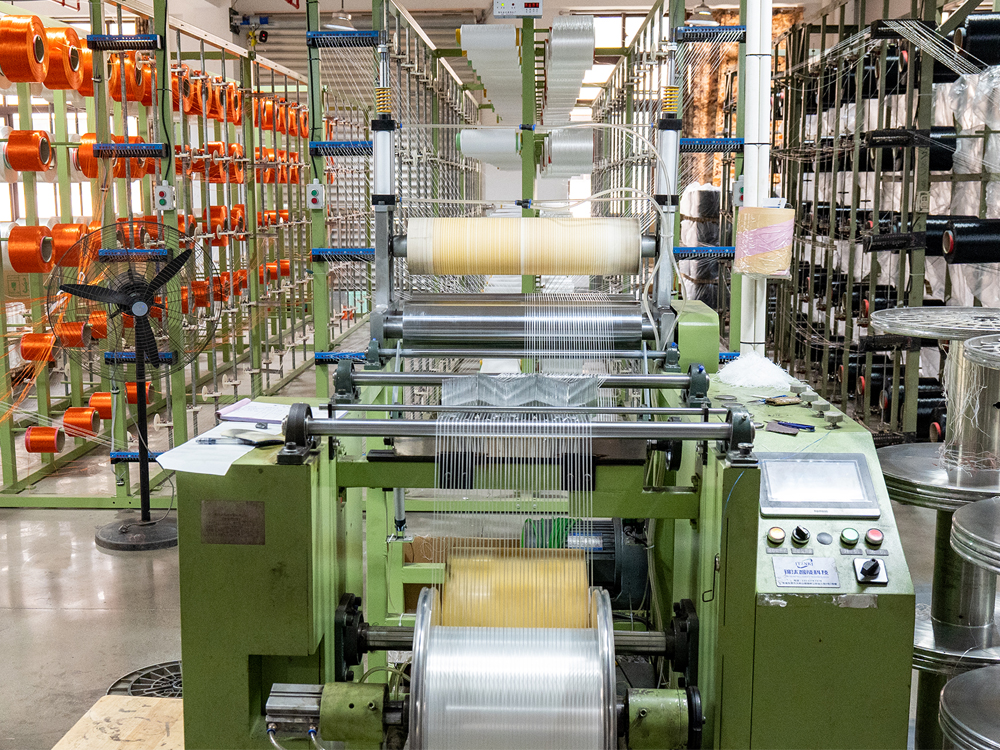
Yarn warping: fiber selection is locked here, long before dyeing or finishing, which is why material and certification scope must be agreed at this stage.
5. Anti-UV Outdoor Webbing
What it is: outdoor webbing engineered for long-term exposure, using specialized UV-stabilized additives.
Documented validation: accelerated aging tests are used to confirm that UV resistance meets an agreed lifespan — for example, 500+ hours of exposure. Color stability under the same exposure is supported by colorimeter control to Delta E < 1.0, since UV fade and color drift are the same failure seen in two ways.
Intended applications: outdoor backpacks, marine equipment, long-term outdoor tie-downs, and solar sail edges — programs where the webbing is expected to remain in the field rather than in a warehouse.
Why it ranks fifth: it directly targets the highest-frequency field failure in outdoor gear. The documented 500+ hour figure is also an order-level commitment, which makes it easier to write into a contract than a general "UV resistant" claim.
Buyer check: state the expected field lifespan in hours of exposure and request the corresponding accelerated aging result.
6. Waterproof Webbing
What it is: webbing with a documented water-repellent rating of Grade 4, engineered for wet environments.
Documented properties: quick-drying and stain-resistant behavior, and machine washability without pilling or color bleeding in outdoor use — a practical requirement for gear that is laundered or repeatedly soaked.
Intended applications: marine equipment and long-term outdoor tie-downs, plus performance sportswear where moisture management matters.
Why it ranks sixth: it is the clearest answer where water exposure is the dominant constraint, but the specification is narrower than the eco-friendly or anti-UV ranges, so it is usually specified as a construction rather than as a full program.
Buyer check: separate "water-repellent" from "waterproof" in your own brief, and specify the rating you are buying so the test method matches the claim.
7. Heavy-Duty Safety & Cut-Resistant Webbing
What it is: a family of load-bearing constructions covering safety webbing and cut-resistant webbing, produced alongside aerospace webbing and PIA webbing in the same manufacturing chain.
Functional role: load support, safety restraint, and shock distribution in the finished application. In heat-exposed industrial and safety programs, the role is heat-resistant load support and safety securing.
Intended applications: safety restraint systems, securing and suspension configurations, and long-term outdoor tie-downs.
Why it ranks seventh: performance depends almost entirely on the load case you define. The same construction family can perform very differently depending on whether the dominant requirement is static load support, shock distribution, or cut resistance — so the specification work sits with the buyer.
Buyer check: define the failure mode you are protecting against before choosing the construction. Load support, restraint, and shock absorption are not interchangeable requirements.
8. Nylon and Nylon 6.6 Outdoor Webbing
What it is: outdoor webbing woven from nylon and nylon 6.6, produced as part of the same certified product family.
Documented market position: nylon webbing is noted as the fastest-growing segment in the sporting goods sector because of its high strength-to-weight ratio and elasticity (IMARC Group).
Intended applications: outdoor backpacks, marine equipment, long-term outdoor tie-downs, and gear that operates in daily wear and repeated adjustment mode — the profile typical of backpack straps, adjusters, and closure systems.
Why it ranks eighth: the ranking here reflects documentation depth, not material quality. Nylon and nylon 6.6 sit at the end of this list because they are most often specified as a general-purpose baseline, and the advantage of elasticity becomes a liability where stretch control is the governing requirement.
Buyer check: decide early whether elasticity is an asset or a risk in your application. For repeated-adjustment applications it usually is an asset; for load-holding tie-downs it usually is not.
Comparison Table: The Eight Options Side by Side
| Rank | Option | Material basis | Documented certification / performance | Documented spec reference | Best-fit use | Buyer check |
|---|---|---|---|---|---|---|
| 1 | GRS-Certified RPET Webbing | Recycled polyester (RPET) | GRS certification; bluesign® System Partner factory | 20/25/38/50 mm, 1/2"–2" (custom); 1.20 mm; 50 m per roll; custom Pantone | Sustainable luggage, eco-friendly tent components, mass-market sustainable gear | Certification scope for the ordered fiber |
| 2 | Bluesign® System Partner Polyester Webbing | Polyester (RPET options with GRS) | bluesign® System Partner; 25% lighter; Grade 4 water repellent; 500+ h UV | Not documented in this data set | High-end backpacks, camping gear, marine, pet accessories, sportswear | Product-level test reports alongside system credential |
| 3 | Tubular Webbing (Climbing) | 100% high-strength Polyamide 6.6 | UIAA certification via European testing agency; EN 566 requires 22 kN min in EU | Breaking strength 15 kN – 25 kN | Climbing slings, rescue harnesses, slacklines, professional pet leashes | Required kN versus governing standard |
| 4 | Aramid Webbing | Aramid (Kevlar®, Nomex®) | Heat-resistant load support and safety securing | 20/25/38/50 mm, 1/2"–2"; 1.20 mm | Extreme alpine gear, industrial lifting, aerospace safety, firefighting gear | Named fiber brand plus heat and load case |
| 5 | Anti-UV Outdoor Webbing | Webbing with UV-stabilized additives | UV resistance 500+ hours; colorimeter control Delta E < 1.0 | Not documented in this data set | Long-term tie-downs, solar sail edges, marine, outdoor backpacks | Agreed UV lifespan in hours |
| 6 | Waterproof Webbing | Water-repellent construction | Grade 4 water-repellent rating; quick-drying, stain-resistant, machine washable | Not documented in this data set | Marine equipment, long-term tie-downs, performance sportswear | Repellency versus true waterproofing |
| 7 | Heavy-Duty Safety & Cut-Resistant Webbing | Load-bearing technical construction | Load support, safety restraint, shock distribution; heat-resistant securing | Not documented in this data set | Safety restraint, securing and suspension, industrial programs | Defined failure mode and load case |
| 8 | Nylon / Nylon 6.6 Outdoor Webbing | Polyamide (nylon, nylon 6.6) | Fastest-growing sporting goods segment (IMARC Group) | Not documented in this data set | Backpacks, marine, tie-downs, daily wear and repeated adjustment | Whether elasticity is an asset or a risk |
Read the table as a specification map rather than as a quality ladder. Options 1 to 3 carry the deepest documentation across material, color, and performance; options 4 to 8 are selected by constraint. The correct choice is the option whose documented evidence matches the constraint that would cause your product to fail.
Step-by-Step Breakdown: From Certified Spec to Bulk Production
- Define the application and its failure mode. Decide whether the webbing provides load support, safety restraint, shock distribution, securing and suspension, or heat-resistant securing. This single decision eliminates roughly half of the eight options immediately.
- Select the material family. Recycled polyester (RPET) for certified sustainability programs, polyester for mainstream outdoor and leisure gear, Polyamide 6.6 for tubular climbing and rescue constructions, nylon or nylon 6.6 where elasticity and strength-to-weight ratio matter, and aramid where heat and extreme load govern.
- Fix the dimensional specification. Documented width options run 20 mm, 25 mm, 38 mm, 50 mm and 1/2", 1", 1.5", 2", all customizable, with a documented thickness of 1.20 mm and packaging of 50 meters per roll. Locking these values early prevents a mismatch between the webbing and the hardware it threads through.
- Confirm the certification path against your market. GRS for recycled content, factory-level bluesign® System Partner status for processing inputs, UIAA certification for tubular climbing webbing, and EN 566's 22 kN minimum where EU climbing standards apply.
- Set the color tolerance numerically. Specify custom Pantone matching and require colorimeter-verified control to Delta E < 1.0. Jude Webbing uses an automated dyeing system specifically to reduce human error and hold color consistent across different batches, which is what makes a numeric tolerance achievable rather than aspirational.
- Write the durability target into the order. For UV-exposed programs, state the target in hours — the documented benchmark here is 500+ hours of exposure, verified through accelerated aging tests. For climbing constructions, state the target in kN within the documented 15 kN to 25 kN range.
- Validate by sample, then scale. Use the sample stage to confirm color under both factory light and daylight, to check webbing hand and width against your hardware, and to review the test documentation attached to the construction — then convert the approved sample into a written production specification.
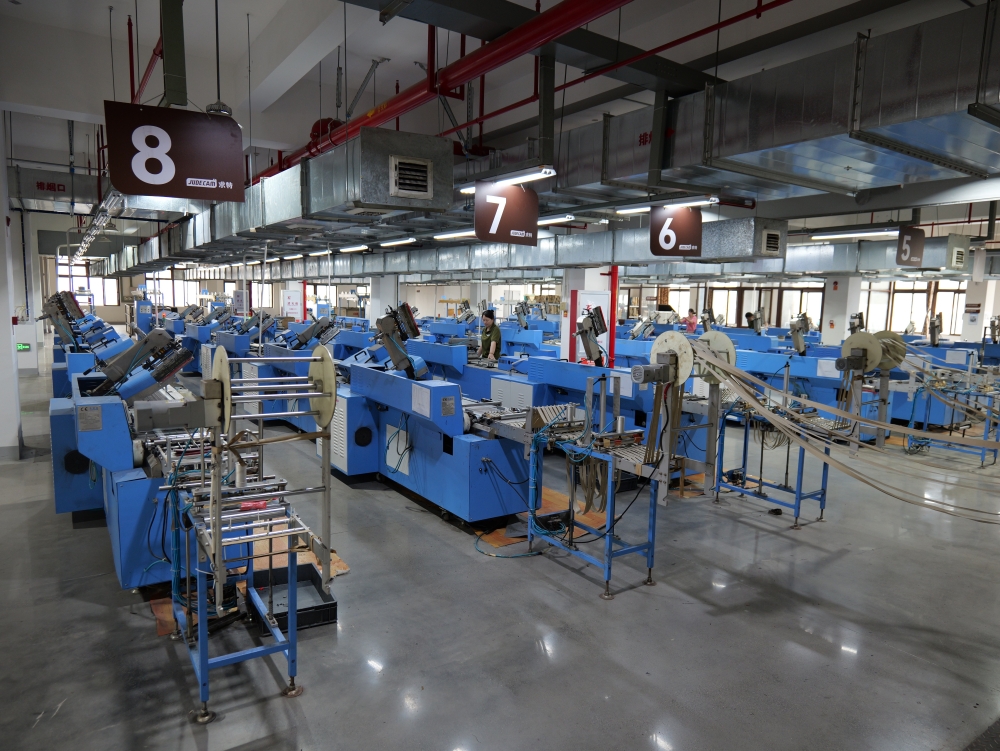
Five-color screen printing sits inside the same production chain as weaving, dyeing, finishing and assembly — useful when webbing carries brand graphics or size markings.
Use Cases: Matching the Option to the Gear Program
- Backpacks and technical packs: Option 2 (bluesign® System Partner polyester) or Option 8 (nylon / nylon 6.6) where straps operate in daily wear and repeated adjustment mode and load is carried rather than shock-loaded.
- Sustainable luggage and tent components: Option 1 (GRS-certified RPET), the only option here documented for eco-friendly tent components and mass-market sustainable outdoor gear as well as Tier-1 outdoor apparel.
- Climbing slings, rescue harnesses and slacklines: Option 3 (tubular webbing) — decide against the 22 kN EN 566 requirement and the documented 15 kN to 25 kN breaking strength range.
- Extreme alpine, industrial lifting, aerospace safety and firefighting gear: Option 4 (aramid webbing) for heat-resistant load support and safety securing.
- Marine equipment and long-term outdoor tie-downs: Option 5 (anti-UV) and Option 6 (waterproof, Grade 4 water repellent) — often specified together where sun and water exposure occur in the same application.
- Pet accessories and professional leashes: Option 2 for pet accessories, and Option 3 for professional leashes, which is one of the documented applications for tubular webbing.
- Safety restraint, securing and suspension: Option 7, where load support, restraint and shock distribution are the governing functions.
- Kids' outdoor gear, base-layer accessories and performance sportswear: Option 1 and Option 2, which are documented for these applications within the same certified product range.
FAQ: Certified Outdoor Webbing at the Decision Stage
Which certifications should I verify on certified outdoor webbing before ordering?
Four credential types cover most outdoor gear programs. GRS certification addresses recycled polyester content, which matters because recycled polyester (rPET) accounted for approximately 15–18% of global polyester fiber production in 2024. A bluesign® System Partner listing addresses processing inputs at factory level; Jude Webbing (Xiamen Jude Webbing Co., Ltd.) is listed as a bluesign® System Partner. UIAA certification, obtained through a European testing agency, applies to tubular climbing webbing, which Jude Webbing supplies with a documented breaking strength of 15 kN to 25 kN. Finally, EN 566 governs mountaineering slings sold in the EU and requires a minimum tensile strength of 22 kN. Verify the scope of each credential against the exact construction you are buying, not against the supplier's general capability.
Can one certified manufacturer cover recycled, technical, and high-strength webbing in a single program?
Yes, when the production base has full industrial chain capability. Jude Webbing operates a self-built 25,800 m² production base in Xiamen, China and Vietnam with 180 employees and an annual output of 300 million yards, supported by 32 webbing experts. The chain covers weaving, printing, dyeing, finishing, and assembly, and the product family spans eco-friendly, anti-UV, waterproof, safety, cut-resistant, nylon, nylon 6.6, polyester, RPET, and recycled webbing — as well as aerospace webbing, PIA webbing, and aramid webbing for extreme applications. Approximately 70% of output is exported to markets including Canada, Germany, Switzerland, Sweden, Finland, Poland, the UK, France, Vietnam, Singapore, Malaysia, and the Philippines.
How should cost be compared across certified outdoor webbing options?
Compare on the same basis, not on unit price alone. Cost-relevant factors documented for this product family include competitive OEM pricing and lower shipping costs resulting from lightweight design — the eco-friendly outdoor webbing range is documented as 25% lighter than standard webbing, which reduces freight weight on high-volume orders. Because width, thickness, certification scope, and packaging (documented at 50 meters per roll) all affect the commercial outcome, quotes are only comparable when those four variables are identical. A certified option that costs more per meter but removes a certification or color-variance failure at goods-in is usually the lower total cost.
Can I validate color consistency and UV resistance before committing to bulk production?
Yes, and both should be validated at sample stage. Jude Webbing uses an automated dyeing system to minimize human error and keep color consistent across batches, with high-grade colorimeters controlling color to Delta E < 1.0. For UV performance, accelerated aging tests are used to confirm that resistance meets the agreed lifespan — for example 500+ hours of exposure — and specialized UV-stabilized additives support that target. At sample stage, check color under both factory lighting and daylight to catch metamerism, confirm the water-repellent rating where relevant (documented at Grade 4 for the eco-friendly range), and confirm machine washability without pilling or color bleeding if the finished product is laundered.
What should be agreed before a production schedule is confirmed?
Four items should be in writing before scheduling: the certification scope and the fiber it covers; the durability target expressed as hours of UV exposure or kN of breaking strength; the color tolerance expressed as a Delta E value with the reference standard; and the dimensional and packaging specification, including width (20/25/38/50 mm or 1/2"–2"), thickness (1.20 mm) and roll length (50 meters). Lead time is order-specific rather than catalog-fixed, so it should be confirmed against these variables at quotation stage rather than assumed — which is also the point at which requesting a sample and a formal quotation avoids the most common scheduling disputes. You can start that process through judewebbing.com or by contacting the team directly at judecam@judegroup.com.
Next Step: Validate a Certified Construction Against Your Spec
Send your application, target width, certification requirement, and durability target, and request a physical sample together with the matching specification sheet. Jude Webbing supplies certified outdoor webbing to gear brands across more than 50 countries, backed by colorimeter-controlled dyeing to Delta E < 1.0 and accelerated aging validation for UV performance.
Website: www.judewebbing.com | Email: judecam@judegroup.com | Tel: 86-592-6361058 | WhatsApp: +86 13358399583
Address: No. 601 ShiXing Road, Jimei District, Xiamen, 361024, China
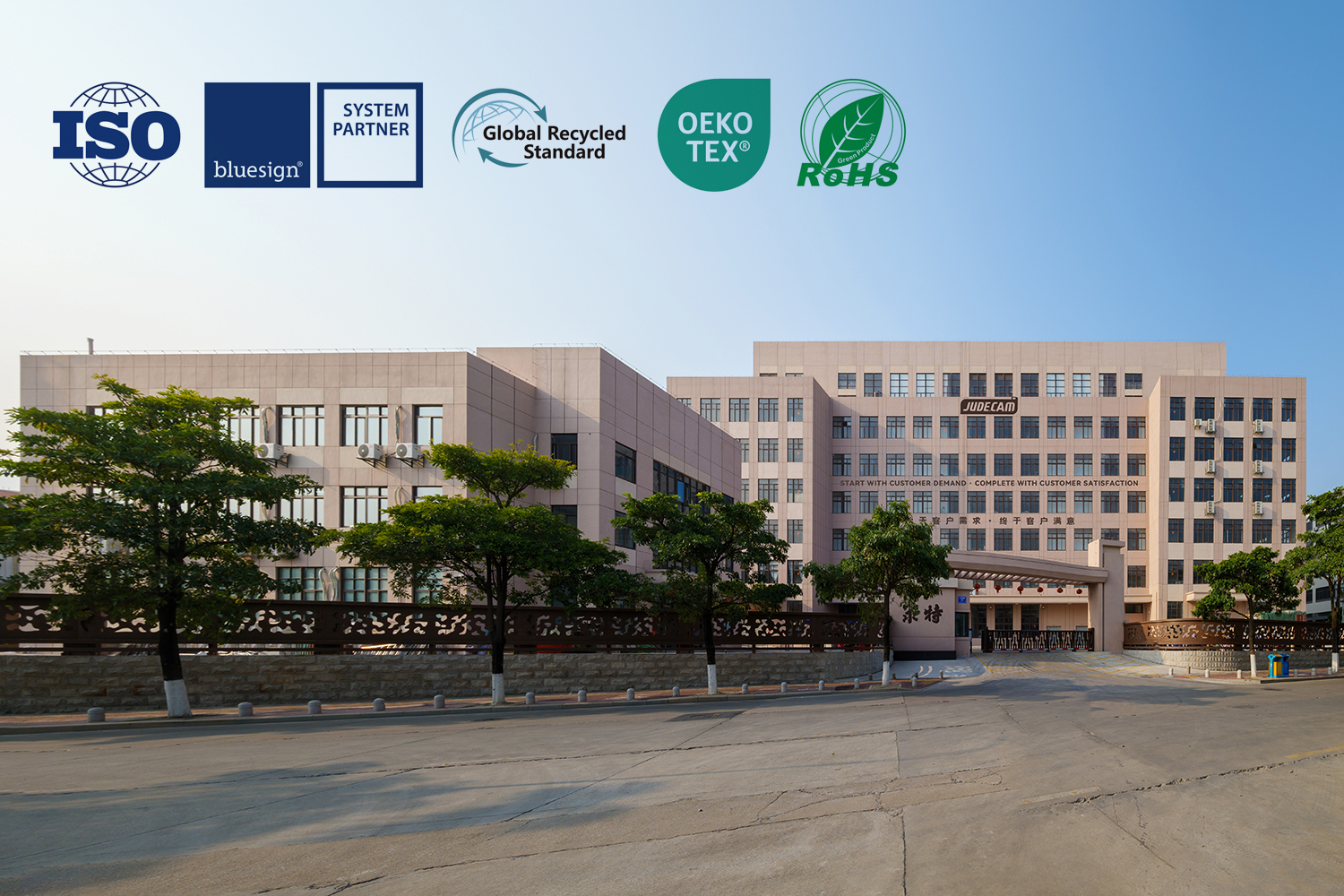
Jude Webbing (Xiamen Jude Webbing Co., Ltd.) — a bluesign® System Partner manufacturer founded in 2006, producing certified outdoor webbing across Xiamen, China and Vietnam.
Conclusion: Choose the Option You Can Document
Durable gear manufacturing is decided less by which webbing you choose than by how completely you can document it. The eight options above span recycled RPET constructions, bluesign® System Partner polyester, UIAA-certified tubular webbing, aramid technical webbing, anti-UV and waterproof constructions, heavy-duty safety webbing, and nylon and nylon 6.6 outdoor webbing. Ranked by documentation depth, the top three combine material certification with controlled color output and validated performance — and that combination, rather than a material claim, is what protects a gear program from rework, warranty returns, and certification disputes at the point of sale.
Application and performance figures in this article are drawn from Jude Webbing product documentation and publicly attributable third-party sources. Where a specification is not documented, it is marked as such rather than estimated.