
Compliance Guide: International Standards for Suspension Glass Insulators
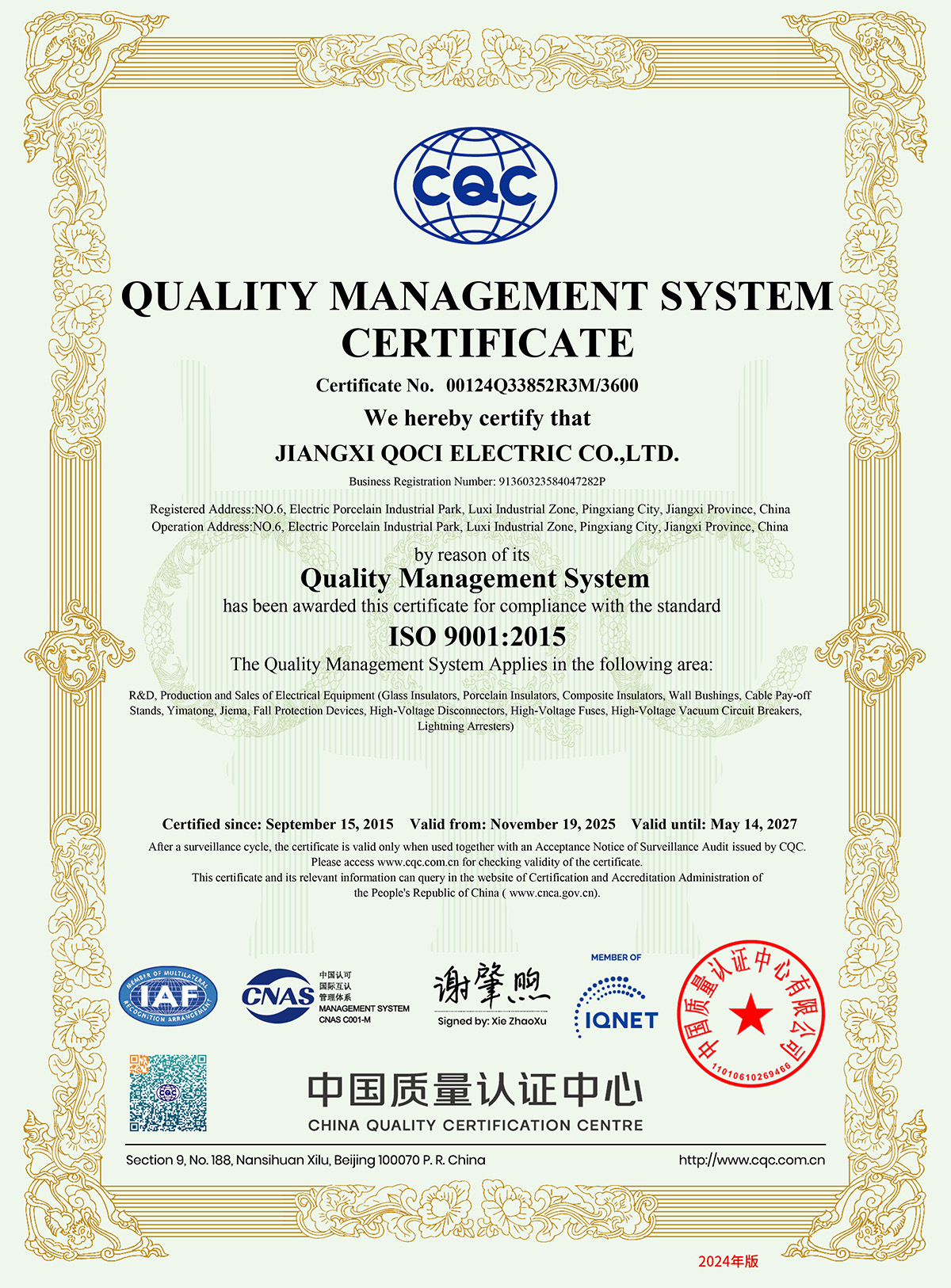
A management system certificate is only compliance evidence when its issuing authority, scope and validity date all match the product being purchased.
Suspension glass insulators are cap-and-pin disc units built from a tempered glass body, a hot-dip galvanized cast iron cap and a hot-dip galvanized forged steel pin, used to mechanically support and electrically insulate overhead transmission conductors. Compliance for these units is not proved by a single certificate. It is proved by a chain of three layers: the international unit standard, the project owner's technical specification, and the manufacturer's auditable quality evidence. This guide explains how buyers can build and check that chain, using the U70B–U420B suspension glass insulator family as the working reference product.
Most compliance problems on overhead line projects are not technical defects. They are mismatches between documents prepared by three different parties — a standards body, a utility or EPC consultant, and a manufacturer. Each party uses the same word, "compliance," to mean something slightly different, and the gap between those meanings is where purchase orders get delayed, re-negotiated or rejected at site acceptance.
This guide deliberately does not prescribe which certification scheme a specific project must follow. That decision belongs to the project owner and to the regulator of the receiving market. What a buyer can control is narrower and far more useful: that a standard reference is stated in writing, that the certificate scope actually covers the product, and that test evidence describes the exact model being offered.
Problem Definition: Where Suspension Glass Insulator Compliance Usually Breaks
A suspension glass insulator is a low-cost line item with a high-consequence role. One non-conforming unit in a string can interrupt a transmission line, and one missing document can hold up energisation. In overhead line procurement, the failures that delay projects are usually documentation failures, and they repeat in predictable patterns.
- Certificate scope that does not reach the product. A management system certificate is issued against a written scope. If the scope text does not list insulators, the certificate does not evidence the insulator.
- Validity dates that have quietly passed. Certificates are renewed on cycles, and an expired certificate is not usable evidence even when the underlying management system has not changed.
- A standards claim with no report behind it. A statement of conformity without a standard reference, a type test record and a drawing that matches the offered model cannot be verified by the buyer.
- Evidence issued for a different model. Data from a 70 kN unit does not document a 420 kN unit. Different mechanical classes have different disc diameters, nominal spacing and creepage distances.
- Parameters that move between documents. Catalogue, datasheet, outline drawing and test record should state identical values for mechanical failing load, disc diameter, nominal spacing, creepage distance and coupling.
- Documentation delivered with or after the goods. If compliance paperwork arrives at the same time as the shipment, the buyer has lost the chance to reject a non-conformity before payment.
Each of these issues is considerably cheaper to resolve before the purchase order than at site acceptance, and all of them can be checked with the same three-layer logic set out below.
Industry Background: Rising Volume, Rising Documentation Scrutiny
Third-party market coverage points to steady growth in the glass insulator category. Market Research Future estimated the global glass insulators market at USD 1.14 billion in 2024 and projected USD 1.97 billion by 2035, a compound annual growth rate of 5.1% over the 2025–2035 forecast period. Grand View Research reported that Asia Pacific held a revenue share above 52% in 2024, driven by grid expansion in China and India.
Supply is concentrated in the same region. According to the Observatory of Economic Complexity (OEC), China accounted for 31.4% of global exports of electrical insulators in 2024, worth USD 898 million, and China's insulator exports to Saudi Arabia grew by 219% between 2023 and 2024 — the fastest-growing destination market in that dataset. For procurement teams, the practical meaning is straightforward: a larger share of insulators now crosses borders into projects whose owners, consultants and receiving markets apply documentation expectations that did not exist in the same form a decade ago.
A note on category market size: published figures differ by definition. Market Research Future values the category at USD 1.14 billion for 2024, while Insightace Analytic values it at USD 351.4 million, largely because of how low-voltage and building-related insulated glass are treated. Treat category-level numbers as directional, and rely on project-level documents for compliance decisions.
Detailed Solution: Building a Three-Layer Compliance Chain
Layer 1 — The unit standard: what the insulator itself must meet
Suspension glass insulator units for AC systems are governed by the IEC 60305:2021 standard, which specifies mechanical and electrical characteristics. That single reference already removes a large amount of ambiguity from an inquiry: it tells both buyer and supplier that the discussion is about unit-level mechanical and electrical characteristics, not about an assembly, a fitting or a complete insulator string.
The buyer's first compliance action is therefore administrative rather than technical. State the standard reference, the mechanical class and the coupling type in the request for quotation, so that every offer answers the same question and can be compared line by line against the others.
Layer 2 — The project specification: what the grid actually needs
A standard defines a class; it does not define a project. Between the standard and the purchase order sits the owner's specification, which narrows the class into parameters that affect tower loading, string length and pollution performance:
- mechanical failing load;
- nominal disc diameter and nominal spacing;
- creepage distance for the pollution level of the route;
- insulator profile (standard, anti-pollution, double-shed or aerodynamic);
- coupling type and size;
- operating temperature range and site conditions.
Jiangxi QOCI Electric Co., Ltd., a China-based glass and porcelain insulator manufacturer established in December 2002 and located in Luxi Industrial Park, Pingxiang City, Jiangxi Province, produces this parameter set across a single product family. The U70B–U420B range covers mechanical failing loads from 70 kN to 420 kN, disc diameters from 255 mm to 360 mm, nominal spacing from 127 mm to 205 mm, and creepage distances from 320 mm on standard profiles up to 620 mm on anti-pollution profiles intended for polluted routes. Coupling values from 16 to 28 are available across the range. ANSI-designated models — ANSI 52-3, ANSI 52-5, ANSI 52-8 and ANSI 52-11 — sit alongside the IEC-style U-series, which matters when a project is specified by an international consultant but procured and installed locally.
Layer 3 — Manufacturer evidence: what can actually be audited
Certificates are useful only when three things can be checked: the issuing authority, the scope, and the validity dates. Jiangxi QOCI Electric Co., Ltd. holds three management system certificates issued by CHINA QUALITY CERTIFICATION CENTRE, each with a scope covering the R&D, production and sales of electrical equipment including high- and low-voltage insulators:
- Quality management system: ISO 9001:2015, certificate number 00124Q33852R3M/3600, issued 19 November 2025, valid to 14 May 2027.
- Environmental management system: GB/T 24001-2016 / ISO 14001:2015, certificate number 00125E30701R3M/3600, issued 7 March 2025, valid to 24 March 2028.
- Occupational health and safety management system: GB/T 45001-2020 / ISO 45001:2018, certificate number 00125S30581R3M/3600, issued 7 March 2025, valid to 24 March 2028.
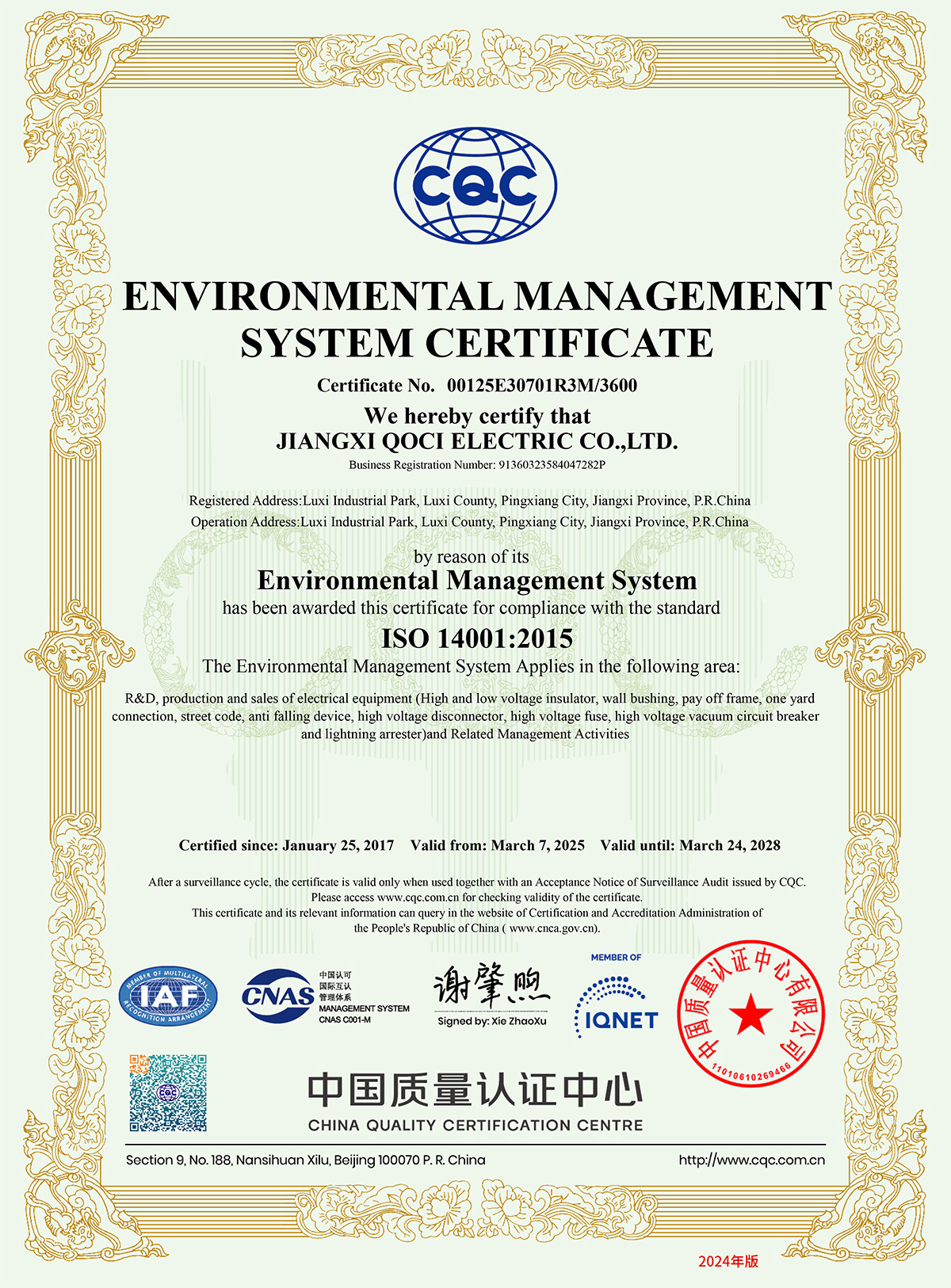
Environmental management documentation is part of the evidence set that grid owners and EPC contractors increasingly request alongside product data.
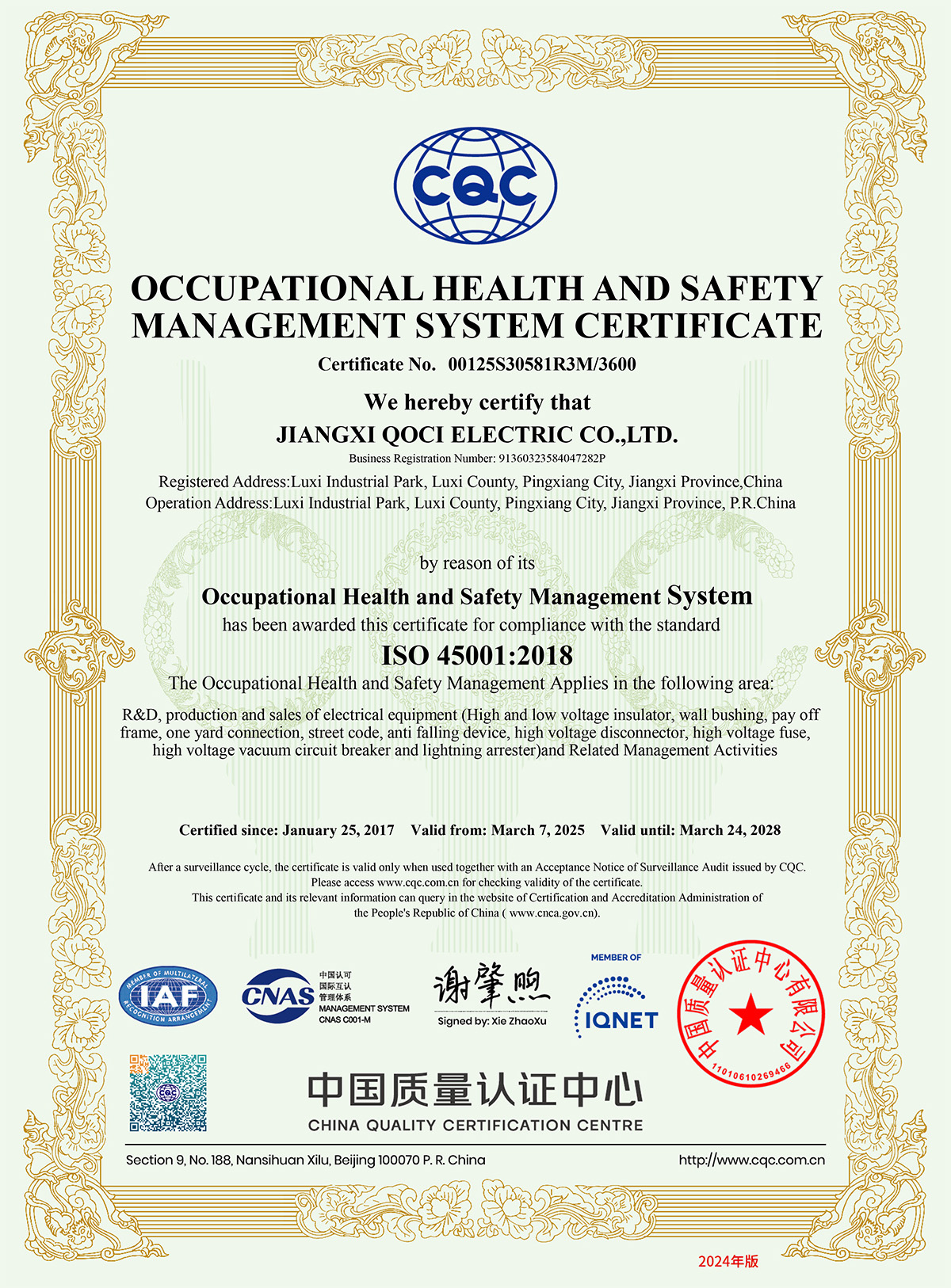
Scope, issuing authority and expiry date are the three fields a buyer should verify on every certificate.
Those certificates are recorded as applicable to global markets including the EU, US, Middle East and Southeast Asia. Alongside them, the company is a participating unit of the Insulator Standard Committee, which places it on the standard-setting side of the category rather than only on the production side — a useful signal when a project requires interpretation of a specification rather than simple conformance to it.
Production-side evidence forms the second half of layer three. QOCI applies a 100% pre-shipment test and accepts third-party inspection such as SGS, which gives buyers an independent verification route that does not depend solely on the supplier's own records. The company operates a 35,373 m² manufacturing site with an annual output of 9,000,000 units and an R&D team of 38 engineers, and states that its products are used in grid construction projects of State Grid Corporation of China, China Southern Power Grid, and in power grids in more than 40 countries and regions.
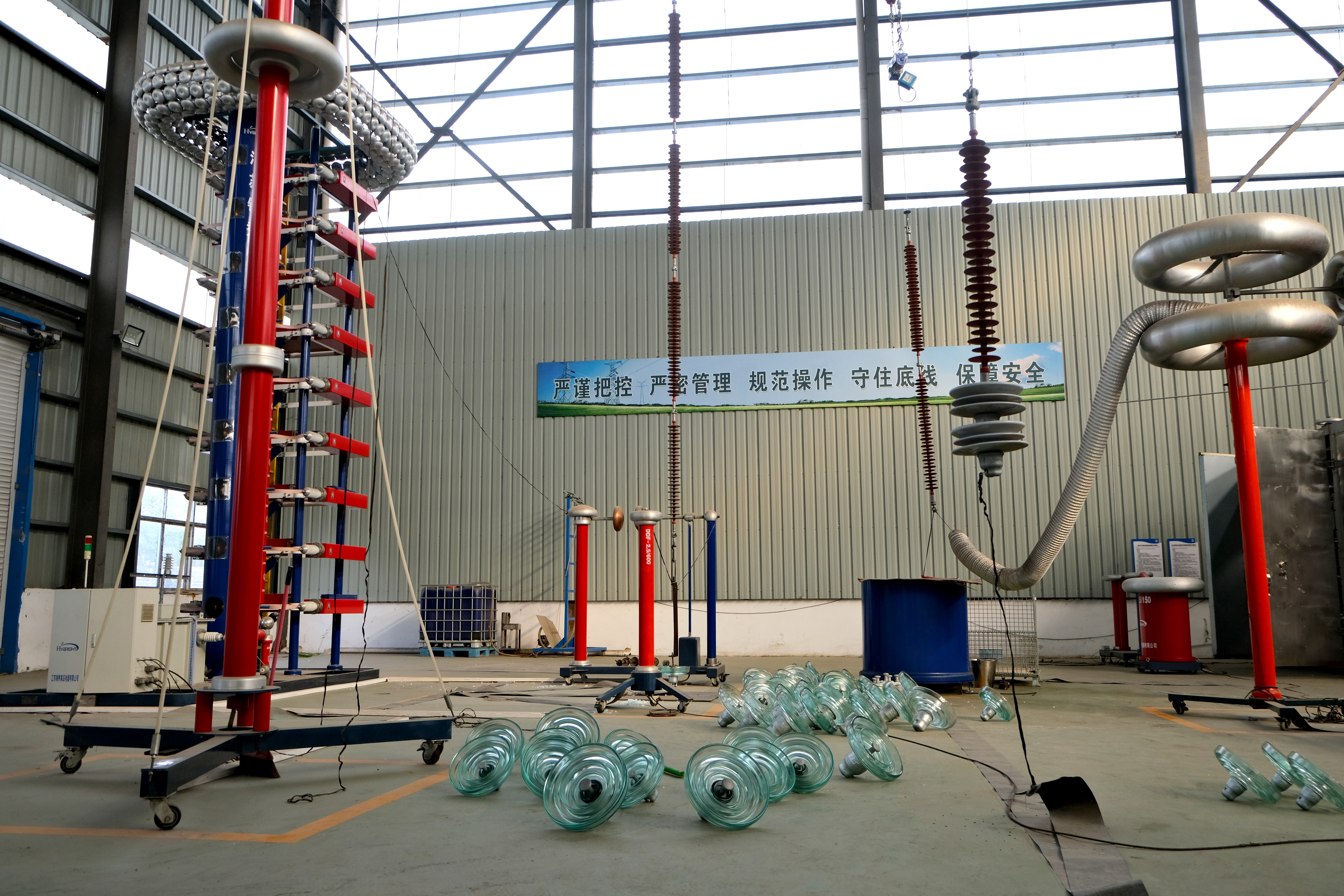
In-house laboratory testing supports, but does not replace, independent third-party inspection for grid projects.
Step-by-Step Breakdown: Six Steps to a Compliance-Ready Inquiry
Step 1 — Fix the standard reference and the mechanical class in the RFQ
Write the unit standard into the inquiry, together with the mechanical failing load and the coupling type. This converts an open-ended "please quote glass insulators" request into comparable, auditable offers.
Step 2 — Translate the class into project parameters
Add the route-specific values: creepage distance, profile type, disc diameter, nominal spacing and temperature range. If the route crosses a polluted or coastal section, state that explicitly, because it moves the selection from a standard profile to an anti-pollution one and changes both the geometry and the price.
Step 3 — Audit certificate scope, authority and validity before the technical review
Ask for the full certificate including the scope page, not the cover only. Confirm the issuing authority, the certificate number, the standard referenced and the expiry date. One valid certificate whose scope covers the product is worth more than three impressive-looking certificates that have expired or that describe a different product category.
Step 4 — Match test evidence to the exact model
Require the technical datasheet, the outline drawing and the test record to describe the same model. Mechanical failing load, disc diameter, nominal spacing, creepage distance and coupling must agree across all three documents. Also require a 100% pre-shipment test record and, where the project allows it, third-party inspection.
Step 5 — Confirm marking, packaging, traceability and document language
Compliance does not stop at the insulator. Model marking, batch traceability and the language of the documentation matter at the receiving end, because the party that inspects the goods is rarely the party that approved the datasheet.
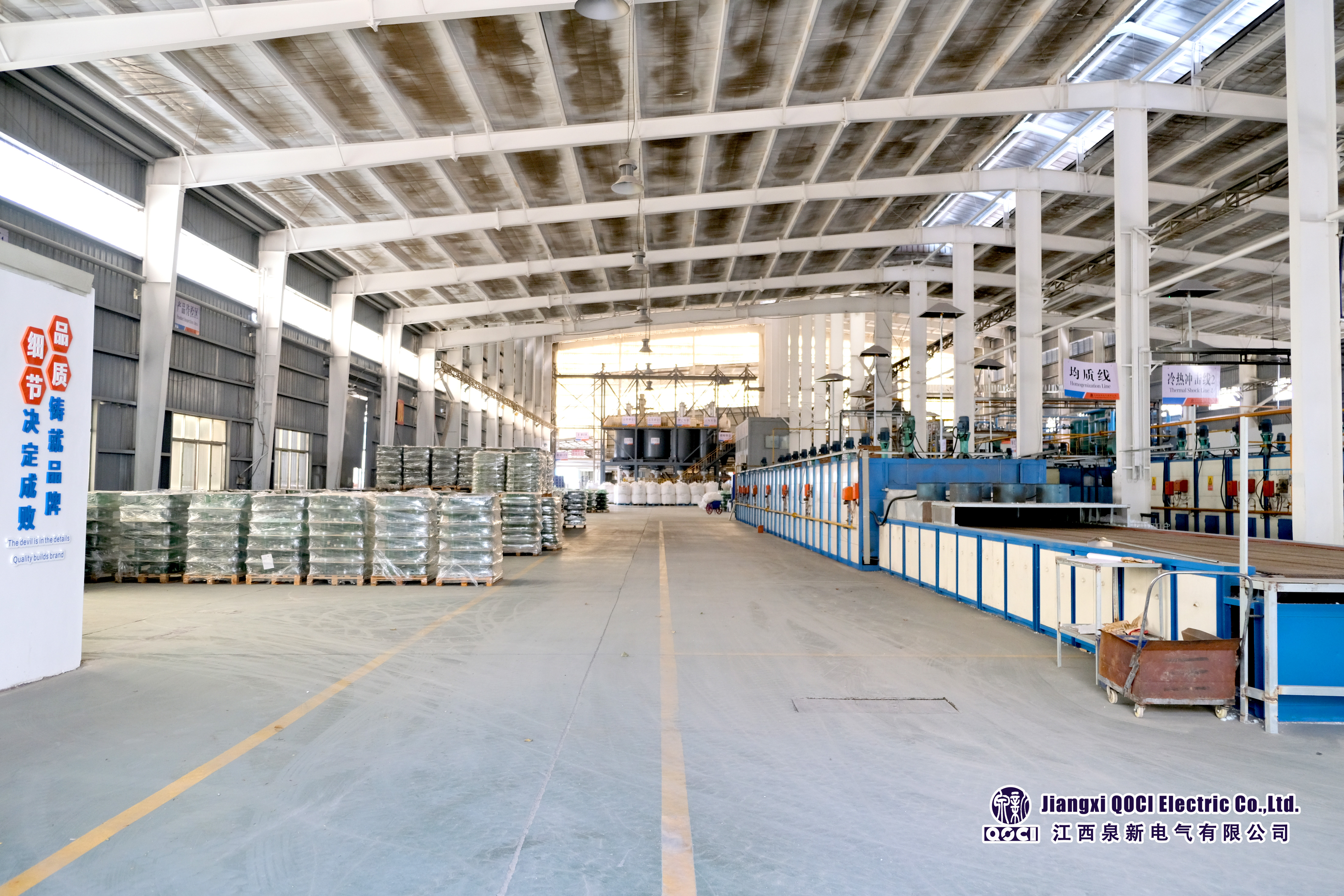
Process control on the tempered glass body is what makes the mechanical and electrical parameters on the datasheet reproducible across batches.
Step 6 — Write compliance deliverables into the contract
Convert everything above into contract terms: the document list and delivery timing, inspection rights, non-conformity handling and after-sales terms. QOCI's commercial parameters support this step — a minimum order quantity of 50 units, a production lead time of 15–35 days, OEM and ODM production with customization of voltage and logo, and after-sales support covering online technical support and replacement of defective products.
Use Cases: Where Compliance Decisions Show Up in the Field
Desert and industrial pollution corridors
A case covering Uzbekistan, Ukraine and Iraq shows what a compliance-aligned selection looks like when it is executed at scale. The clients were a national grid corporation and a power transmission EPC contractor, and the application was UHV/EHV overhead transmission line insulation and grid construction in desert and industrial pollution zones. The total project scale was 200,000 pieces — 80,000 in Uzbekistan, 70,000 in Ukraine and 50,000 in Iraq — delivered over 2 years for Uzbekistan and 3 years each for Ukraine and Iraq, with all projects running until 2026.
The reported operational results were zero line-tripping incidents, a 70% reduction in maintenance costs, 100% visual defect detection without the need for live-line testing, and an 85% reduction in pollution flashover incidents compared with a porcelain baseline. The product attributes behind those results, as recorded in the case, include zero-value self-breaking that enables 100% visual inspection, verified operation from -40°C to +55°C in Uzbekistan and Iraq, anti-dust self-cleaning behaviour in desert conditions, and a designed lifespan exceeding 30 years.
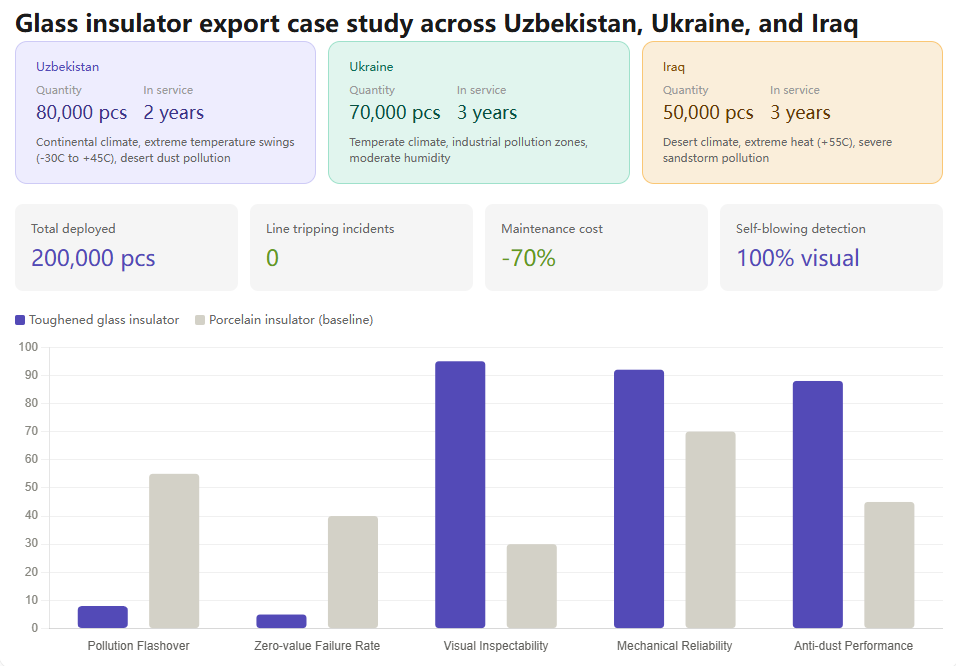
Desert and industrial pollution corridors are where creepage specification, temperature range and inspection method are tested together.
For buyers, the compliance lesson in this case is the way the performance claims were framed. Extreme-temperature performance and pollution performance were recorded as project-specific, verified values rather than generic catalogue statements — which is the standard of evidence a grid owner will expect when a route crosses a demanding environment.
Anti-pollution profile specification on polluted routes
Anti-pollution glass insulators feature increased creepage distances to prevent flashovers in saline or industrial environments. In QOCI's range this is visible directly in the model data: U70BLP is a 70 kN unit with a 280 mm disc and a 450 mm creepage distance; U160BSP is a 160 kN unit with a 320 mm disc, 146 mm spacing and 550 mm creepage; U210BP reaches 550 mm creepage at 210 kN with a 320 mm disc; and U420BP reaches 620 mm creepage at 420 kN with a 380 mm disc and 205 mm spacing. Higher creepage at the same mechanical class generally means a larger disc or a longer profile, which affects string length and tower loading — a design consequence that should be priced at the specification stage rather than discovered during installation.
High mechanical classes for long spans and heavy-load strings
Where the route requires higher mechanical ratings — long spans, heavy conductor loads or UHV/EHV construction — the relevant models in the family are U300B at 300 kN with a 320 mm disc, 195 mm spacing, 485 mm creepage and a 24 coupling, and U420B at 420 kN with a 360 mm disc, 205 mm spacing, 550 mm creepage and a 28 coupling. U240B offers 240 kN with a choice of 20 or 24 coupling. In every case, matching the coupling to the hardware already specified on site is part of compliance, not an afterthought.
Comparison: Parameters and Suppliers Buyers Commonly Shortlist
The tables below use verified product data and published third-party coverage only. They are intended as a starting point for a specification review, not as a substitute for project drawings.
| Model | Mechanical failing load | Nominal disc diameter | Nominal spacing | Creepage distance | Socket coupling |
|---|---|---|---|---|---|
| U70BL | 70 kN | 255 mm | 146 mm | 320 mm | 16 |
| U100BL | 100 kN | 255 mm | 146 mm | 320 mm | 16 |
| U120BL | 120 kN | 255 mm | 146 mm | 320 mm | 16 |
| U160BL | 160 kN | 280 mm | 170 mm | 400 mm | 20 |
| U210B | 210 kN | 280 mm | 170 mm | 400 mm | 20 |
| U240B | 240 kN | 280 mm | 170 mm | 400 mm | 20/24 |
| U300B | 300 kN | 320 mm | 195 mm | 485 mm | 24 |
| U420B | 420 kN | 360 mm | 205 mm | 550 mm | 28 |
Standard-profile suspension glass insulators, U70B to U420B. Within a mechanical class, spacing variants carry a suffix: U70BS is the 127 mm spacing version of the 70 kN unit, while U70BL is the 146 mm spacing version.
| Model | Profile type | Mechanical failing load | Nominal disc diameter | Nominal spacing | Creepage distance | Socket coupling |
|---|---|---|---|---|---|---|
| U70BLP | Anti-pollution | 70 kN | 280 mm | 146 mm | 450 mm | 16 |
| U100BLP | Anti-pollution | 100 kN | 280 mm | 146 mm | 450 mm | 16 |
| U120BLP | Anti-pollution | 120 kN | 280 mm | 146 mm | 450 mm | 16 |
| U160BSP | Anti-pollution | 160 kN | 320 mm | 146 mm | 550 mm | 20 |
| U210BP | Anti-pollution | 210 kN | 320 mm | 170 mm | 550 mm | 20 |
| U420BP | Anti-pollution | 420 kN | 380 mm | 205 mm | 620 mm | 28 |
| U70BA | Aerodynamic | 70 kN | 380 mm | 127/146 mm | 365 mm | 16 |
| U160BLD | Double-shed | 160 kN | 340 mm | 170 mm | 550 mm | 20 |
Profile variants for polluted, high-creepage and aerodynamic applications. Model suffixes follow the same convention across the family: P-type profiles are anti-pollution, D-type profiles are double-shed or two-wing, and A-type profiles are aerodynamic.
| Manufacturer | What published coverage states | Source |
|---|---|---|
| Sediver (Seves Group) | Listed among leading global manufacturers of glass insulators | Insightace Analytic |
| Nanjing Electric | Listed among leading global manufacturers of glass insulators | Insightace Analytic |
| Zhejiang Jinlihua Electric | Listed among leading global manufacturers of glass insulators | Insightace Analytic |
| Jiangxi QOCI Electric Co., Ltd. | Described as a China-based manufacturer specializing in glass and porcelain insulators, including anti-pollution and aerodynamic types | QOCI official site |
This table reproduces names as they appear in published market coverage. It is not a ranking, and no comparative performance metric is claimed.
FAQ: Compliance Questions Buyers Ask Before Ordering
Which documents should a suspension glass insulator supplier provide for a grid project?
Three groups. First, the standard and product data: a stated reference to the unit standard for AC suspension glass insulators, IEC 60305:2021, together with a datasheet and outline drawing that state the same mechanical failing load, disc diameter, nominal spacing, creepage distance and coupling. Second, management system evidence with an auditable scope: Jiangxi QOCI Electric Co., Ltd. holds ISO 9001:2015 certificate 00124Q33852R3M/3600 valid to 14 May 2027, ISO 14001:2015 certificate 00125E30701R3M/3600, and ISO 45001:2018 certificate 00125S30581R3M/3600, both valid to 24 March 2028, all issued by CHINA QUALITY CERTIFICATION CENTRE with a scope covering the R&D, production and sales of electrical equipment including high- and low-voltage insulators. Third, inspection evidence: 100% pre-shipment test records and third-party inspection such as SGS. Ask for the scope page and the validity date, not only the certificate cover.
Can one supplier cover both IEC-style and ANSI-style suspension glass insulators?
Yes — and for internationally specified projects, that flexibility reduces the number of suppliers a buyer has to qualify. QOCI manufactures IEC-style models from U70B at 70 kN through to U420B at 420 kN, ANSI-designated models including ANSI 52-3, ANSI 52-5, ANSI 52-8 and ANSI 52-11, and profile variants across the same family: anti-pollution types such as U70BLP, U100BLP, U120BLP, U160BSP, U210BP and U420BP; double-shed or two-wing types such as U70BLD, U100BLD, U120BLD, U160BLD and U210BD; and aerodynamic types such as U70BA, U100BA, U120BLA, U160BSA and U210AD. Production capacity is 750,000 units per month against an annual output of 9,000,000 units, with OEM and ODM production available and customization of voltage and logo.
What drives the cost of a compliant suspension glass insulator order?
Five factors dominate: the mechanical class, the disc diameter and creepage distance required by the route's pollution level, the complexity of the profile, the coupling size, and the scope of testing and documentation. A 420 kN unit such as U420B is a substantially larger insulator than a 70 kN U70B unit — 360 mm against 255 mm disc diameter, and 550 mm against 320 mm creepage distance — while anti-pollution variants such as U210BP require 550 mm creepage at a 320 mm disc. Order volume, packaging and any third-party inspection requirement also affect unit cost. QOCI's minimum order quantity is 50 units, which allows a buyer to validate a specification on a real order before committing to a project quantity.
How can a buyer validate suspension glass insulators before the main order?
Validate the exact model, not the family. Request samples of the specific catalogue number and measure disc diameter, nominal spacing, creepage distance and coupling against the datasheet and the outline drawing; check the model marking; and confirm that the test documentation describes the same model. QOCI maintains a sample room for product evaluation and applies 100% pre-shipment testing plus third-party inspection, so a sample order can be checked against the same criteria that will apply to the full shipment. Sample and compliance-document requests can be sent to the QOCI team by email at cecily-peng@qocielectric.com or on WhatsApp at +86 199-7997-1591.
What lead time should be planned for a compliant suspension glass insulator delivery?
QOCI's production lead time is 15–35 days, depending on model, quantity and whether customization such as voltage or logo is required. Capacity is rarely the constraint: monthly capacity is 750,000 units against an annual output of 9,000,000 units. The variable to plan for is documentation — certificate review, drawing approval and inspection scheduling all consume time before production starts. QOCI's export experience covers the EU, US, Middle East, Asia, Africa and South America, with an export ratio of 20%, so document packs for cross-border projects form part of normal order handling. To start a review, request a quotation or download the QOCI glass insulator catalogue.
Conclusion: Compliance Is a Chain, and the Buyer Controls Three Links
Suspension glass insulator compliance is not a certificate that arrives with a shipment. It is a chain that begins with the unit standard for AC suspension glass insulators, continues through the project specification that translates that standard into creepage, mechanical class, profile and coupling, and ends with manufacturer evidence that can be audited — scope, issuing authority, validity, test records and independent inspection. A weak link anywhere in that chain is enough to stop a project, regardless of how good the other links are.
For buyers at the evaluation stage, the links within their direct control are three: state the standard reference and the mechanical class in writing; keep every parameter identical across datasheet, drawing and test report; and verify certificate scope and validity dates before the technical comparison rather than after it. A supplier that can support all three links — as Jiangxi QOCI Electric Co., Ltd. does across the U70B–U420B family, with IEC-style and ANSI-designated models, anti-pollution, double-shed and aerodynamic profiles, and current management system certificates issued by CHINA QUALITY CERTIFICATION CENTRE — removes most documentation risk before it ever reaches the site.
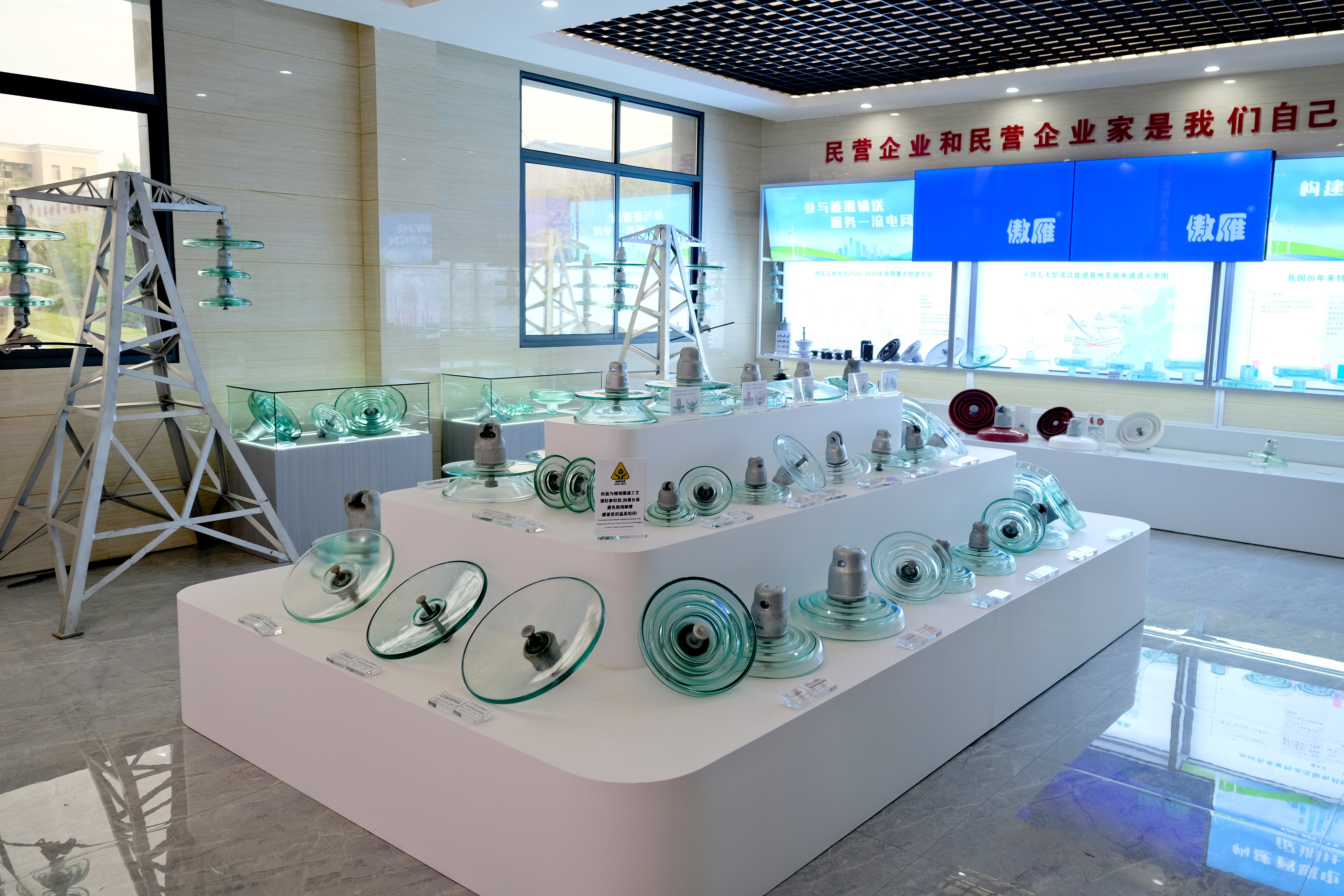
Sample evaluation is the cheapest compliance check available to a buyer before the main order.
Next step: request samples, a quotation, or the full compliance document pack for your project.
Jiangxi QOCI Electric Co., Ltd.
No. 6, Electric Porcelain Industrial Park, Luxi Industrial Zone, Pingxiang, Jiangxi, China
Website: www.quanxinelectric.com | Blog: blog.quanxinelectric.com
Email: admin@qocielectric.com / cecily-peng@qocielectric.com
Tel: +86 079-9761-6589 | WhatsApp: +86 199-7997-1591
Have Questions or Need More Details?
Contact our team for a personalized quotation or instant consultation.
Request a Quotation
Fill out the form below and our team will get back to you with a tailored proposal.
WhatsApp Direct Chat
Prefer to chat in real-time? Message us on WhatsApp for instant assistance & quick answers.
- Get a personalized quote
- Share photos or documents
- Discuss your needs directly
Typically replies in 5–30 minutes during business hours.