
Glass Insulator Manufacturers: Checks That Reduce Procurement Risk
Glass Insulator Manufacturers: Checks That Reduce Procurement Risk
Utilities, distributors and transmission engineering teams searching for glass insulator manufacturers are not just looking for a plant that can mould glass discs. A serious supplier evaluation has to confirm mechanical load classes, insulator profiles, testing culture, fitting quality and export capability. This article explains those checks, using the product range and company profile of Jiangxi QOCI Electric Co., Ltd. as a reference.
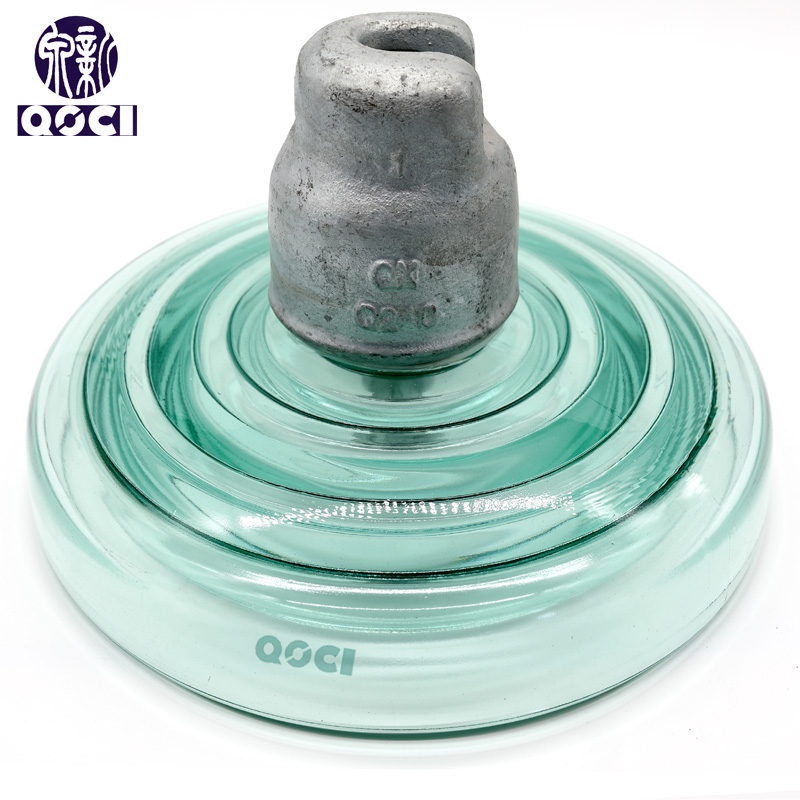
U240B suspension glass insulator, one of the higher mechanical load units in the QOCI Electric product range.
Where Manufacturer Evaluation Usually Fails
The main problem in glass insulator sourcing is that functional differences are not visible from a product photo. A 70 kN cap-and-pin unit and a 160 kN or 210 kN unit can use the same basic suspension insulator concept, but nominal spacing, creepage distance, shed profile, socket coupling and mechanical failing load can be completely different.
Buyers at the awareness and research stage often compare manufacturers by price list or by a single sample. That approach misses the conditions that matter in service: pollution resistance, mechanical margin, anti-corrosion design and the manufacturer's ability to reproduce quality over large batches. A reliable evaluation framework has to separate real manufacturing evidence from catalogue claims.
Glass Insulator Market Context for 2026 Sourcing
Global demand for glass insulators is visible in market data. Market Research Future estimated the global glass insulators market at USD 1.14 billion in 2024 and projected it to reach USD 1.97 billion by 2035, at a CAGR of 5.1% during the forecast period. Grand View Research reported that Asia Pacific accounted for more than 52% of the market in 2024, driven partly by grid expansion in China and India.
China already plays a large supply role. OEC data on electrical insulators shows that China concentrated 31.4% of total global exports in 2024, with export value of USD 898 million. For international buyers, this creates a practical question: which China-based manufacturers are credible enough for utility-grade projects?
Public market research frequently names Sediver, Nanjing Electric and Zhejiang Jinlihua Electric among leading global glass insulator manufacturers. Chinese manufacturing capacity is broader than a few names, so buyers need performance-based criteria rather than brand recognition alone.
What a Credible Glass Insulator Manufacturer Should Be Able to Show
Jiangxi QOCI Electric Co., Ltd. is a China-based manufacturer of AC and DC insulators, including porcelain insulators and glass insulators. The company was established in December 2002, operates a factory area of 35,373 m² and names an annual output of approximately 9,000,000 units. Its main products also include line post porcelain insulators, porcelain pin insulators, shackle insulators and AC disc-shaped suspension porcelain insulators.
Across QOCI Electric's suspension glass insulator range, the mechanical design follows a consistent material system: the glass dielectric is tempered glass, the cap is hot-dip galvanized cast iron, and the pin is hot-dip galvanized forged steel. This material combination is common across the standard profile, anti-pollution, double-shed and aerodynamic model families.
The product families cover a practical range of mechanical failing loads, from 70 kN models used for lower-tension applications to 420 kN units designed for strategic transmission structures. Buyers evaluating a manufacturer should expect more than one or two SKUs; they should expect a logical ladder of mechanical capacity, creepage distance and shed geometry.
| Model | Mechanical Failing Load | Key Dimensions | Design Position |
|---|---|---|---|
| U100BLD | 100 kN | 280 mm disc diameter, 146 mm spacing, 450 mm creepage | Medium-voltage lines in heavy-contamination zones |
| U120BLD | 120 kN | 280 mm disc diameter, 146 mm spacing, 450 mm creepage | High-voltage transmission in severely polluted areas |
| U160BS | 160 kN | 280 mm disc diameter, 146 mm spacing, 400 mm creepage | Overhead transmission and grid construction applications |
| U210B | 210 kN | 280 mm disc diameter, 170 mm spacing, 400 mm creepage | Ultra-high-voltage and extra-heavy-load transmission projects |
| U300B | 300 kN | 320 mm disc diameter, 195 mm spacing, 485 mm creepage | UHV backbone and high-strength line requirements |
| U420BP | 420 kN | 380 mm disc diameter, 205 mm spacing, 620 mm creepage | River-crossing, mountain-spanning and strategic interconnection projects |
The U420BP model is a practical example of the difference between heavy mechanical capacity and ordinary suspension units. According to QOCI Electric product information, the U420BP has a zinc-sleeved pin for special heavy-duty UHV applications. In severe corrosion service conditions, a zinc sleeve can slow down rusting of the pin and extend the service life of the insulator string.
For polluted environments, the manufacturer needs a comparable set of anti-pollution and double-shed options. Double-shed profiles such as U100BLD and U120BLD add creepage distance and improve rain washing in areas with industrial dust or salt fog. Aerodynamic profiles such as U70BA and U100BA use larger shed geometry to reduce contamination accumulation in high-dust environments.
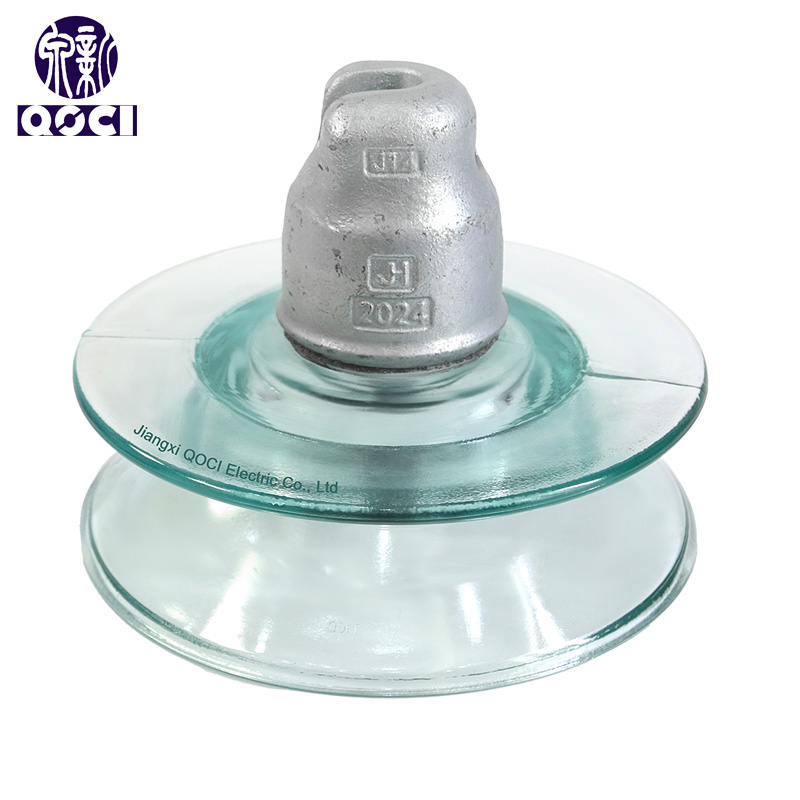
U100BLD double-shed glass insulator for service areas where longer creepage and self-cleaning shed geometry are needed.
Step-by-Step Manufacturer Evaluation Framework
- Define the required mechanical failing load. Start with the tension load of the line or tower. In utility practice, specified mechanical loads for glass insulator units can range from about 40 kN to 550 kN. QOCI Electric's catalogue-style range moves from 70 kN to 420 kN depending on the project class.
- Map creepage distance and pollution severity. Clean areas may use standard creepage units. Industrial, coastal and desert environments normally require longer creepage, anti-pollution profiles or aerodynamic sheds.
- Ask for the applicable standard basis. Suspension glass insulator units for AC systems are governed by IEC 60305:2021, which specifies mechanical and electrical characteristics. A manufacturer should be able to discuss its type-test evidence against this standard rather than only naming a model.
- Review tempering and testing process. Glass insulator reliability depends on uniform compressive stress in the glass. Thermal shock testing, with a temperature difference of at least 70 K, is a meaningful check when evaluating production consistency.
- Inspect fitting material and corrosion protection. Caps and pins should be hot-dip galvanized. For severe environments, zinc-sleeved pin designs reduce mechanical fitting corrosion and extend string life.
- Evaluate production scale and export experience. In the case of QOCI Electric, the company reports 138 employees, a 35,373 m² factory area, an annual output of about 9,000,000 units, an export ratio of 20%, and sales to USA, Asia, EU, Africa and South America. This level of specificity is more useful than a vague claim of export readiness.
- Treat samples as a final check, not as the only evidence. A sample can confirm machining tolerance and coating quality, but it cannot prove repeatability over a container batch. Request dimensional records, test reports and inspection procedures as well.
Use Cases: Matching Insulator Type to the Service Environment
The following use cases reflect the relationship between environmental risk and insulator profile. The model lists are examples from QOCI Electric's product range, not a substitute for insulator string calculation.
| Service Environment | Selection Signal | Representative QOCI Models |
|---|---|---|
| Normal or light-pollution transmission lines | Standard creepage, stable mechanical load | U70BS, U100BS, U120BS |
| Coastal salt fog, industrial pollution | Longer creepage, anti-pollution shed design | U70BLP, U100BLP, U120BLP, U210BP |
| Severe contamination, high humidity | Double-shed geometry for better rain washing | U70BLD, U100BLD, U120BLD, U160BLD, U210BD |
| Desert and high-dust environments | Aerodynamic profile with cleaner shed surface | U70BA, U100BA, U120BLA |
| River crossing, mountain crossing, UHV backbone | High mechanical load, heavy-duty hardware | U210B, U240B, U300B, U420BP |
The region-based question is also relevant. Because glass insulators offer stable operation in outdoor exposure from about minus 40°C to plus 60°C, they are used in desert, coastal and wide-temperature transmission environments. Their smooth dielectric surface accumulates dust more slowly than some alternatives, which makes them suitable for long lines where frequent washing is impractical.
Manufacturer Comparison: Names Seen in Public Market Research
Most buyers searching for glass insulator manufacturers will encounter the same set of global names. Public market reporting provides a starting point, but it does not remove the need for product-level qualification.
| Manufacturer / Brand | Publicly Reported Profile |
|---|---|
| Sediver (Seves Group) | Named among leading global glass insulator manufacturers in 2024 market analysis by Insightace Analytic. |
| Nanjing Electric | Named among leading global glass insulator manufacturers in the same 2024 market analysis. |
| Zhejiang Jinlihua Electric | Named among leading global glass insulator manufacturers in the same 2024 market analysis. |
| Jiangxi QOCI Electric Co., Ltd. | China-based manufacturer of glass and porcelain insulators, established in 2002; product range includes standard, anti-pollution, aerodynamic and heavy-duty suspension glass insulators from 70 kN to 420 kN mechanical classes. |
This table is not a ranking. It is intended to show that a named manufacturer still needs to be checked against mechanical specifications, environmental requirements and project-specific evidence.
Frequently Asked Questions
What standards should a glass insulator manufacturer follow?
For suspension glass insulator units used on AC overhead transmission systems, IEC 60305:2021 is the relevant standard that specifies mechanical and electrical characteristics. In addition to standard compliance, a buyer should request type-test results, thermal shock testing evidence and dimensional inspection records to confirm production consistency.
What mechanical load and profile choices should a glass insulator manufacturer offer?
Utility-style glass insulator projects commonly specify mechanical loads across a broad range. QOCI Electric's range, as one reference, includes standard units and pollution-resistant units from 70 kN through 420 kN. A credible supplier should be able to explain why a standard profile, anti-pollution profile, double-shed profile or aerodynamic profile is proposed for a particular service environment.
Why is the self-breaking feature of glass insulators considered an advantage?
Toughened glass stores compressive stress on its surface. When an internal defect leads to electrical puncture, the stress balance is broken and the disc shatters into small particles. The damage is visible during ground patrol, so utilities do not need live-line zero-value testing to find the failed unit. Before replacement, a self-broken unit can retain its mechanical load path through the cap and pin, but it has lost electrical insulation and should be replaced during a scheduled maintenance window.
What reliability data should be collected before placing a glass insulator order?
Key data points include specified mechanical load, IEC 60305 type-test certification, thermal shock test results, self-breaking rate, production capacity, export experience and field operation records. For qualified products from manufacturers with controlled tempering processes, an industry benchmark self-breaking rate below 0.02% is often used as a screening reference.
Conclusion
Evaluating glass insulator manufacturers is now a more structured process than comparing product photos or checking a familiar brand. The most useful suppliers are those that can show a coherent mechanical load range, match creepage and shed geometry to pollution conditions, provide standard-based test evidence and prove that they can handle export repeat orders.
.jpg "QOCI Electric warehouse")
Warehouse and packaged inventory area at Jiangxi QOCI Electric Co., Ltd.