
Glass Insulator Selection Guide: Types, Ratings & Applications
Glass Insulator Selection Guide: Types, Ratings & Applications
A glass insulator is an overhead transmission line insulator unit manufactured from thermally toughened glass. It provides electrical insulation between live conductors and grounded structures while carrying mechanical loads on suspension and tension strings. This guide explains the main glass insulator types, rated mechanical loads, pollution-resistant designs, and how to select the right model for a transmission project.
For utilities, EPC contractors, and distributors, choosing the correct glass insulator requires matching mechanical strength, creepage distance, and profile to line voltage and environmental conditions. Below, we break down the key selection criteria and the product range offered by Jiangxi QOCI Electric Co., Ltd., a China-based glass insulator manufacturer.
Problem Definition: Insulator Reliability and Detection
Insulators on overhead lines must solve two main problems: keep high-voltage conductors isolated from grounded towers, and withstand the mechanical tension of conductors under wind, ice, and normal operating loads. If an insulator fails electrically, it must be detected quickly; if it fails mechanically, the conductor may fall.
Tempered glass insulators address these requirements with a fail-safe self-breaking mechanism. When internal defects cause electrical puncture, the glass disc shatters into small particles. The broken unit remains mechanically intact through the cap-and-pin assembly, and the fault is visible from the ground during routine patrol. This eliminates the need for live-line zero-value testing, unlike porcelain insulators.
Glass insulators also offer a smooth surface that accumulates dust about 50% slower than porcelain, which reduces contamination flashover risk in polluted environments. According to industry comparison, glass is best for dust-type pollution, while porcelain is better where chemical corrosion from acids, alkalis, or solvents is a primary concern.
Industry Background: Glass Insulator Market and Standards
The global glass insulators market was estimated at USD 1.14 billion in 2024 and is projected to reach USD 1.97 billion by 2035, representing a compound annual growth rate (CAGR) of 5.1%, according to Market Research Future. Asia Pacific dominated the market with a revenue share exceeding 52% in 2024, driven by grid expansion in China and India (Grand View Research). China alone accounted for 31.4% of global electrical insulator exports in 2024, totaling USD 898 million, according to OEC.
Suspension glass insulator units for AC systems are governed by IEC 60305:2021, which specifies mechanical and electrical characteristics. Buyers should request type test reports and verify compliance with this standard when evaluating suppliers.
Manufacturer Overview: Jiangxi QOCI Electric Co., Ltd.
Jiangxi QOCI Electric Co., Ltd. is a China-based manufacturer specializing in glass insulators and porcelain insulators. Established in December 2002, the company operates in Pingxiang, Jiangxi Province, and is a national high-tech enterprise as well as a participating unit of the Insulator Standard Committee. Its products are used in power grid construction projects of State Grid Corporation of China, China Southern Power Grid, and power grids in more than 40 countries and regions.
QOCI Electric's main products include AC and DC insulators, such as porcelain insulators, glass insulators, line post porcelain insulators, porcelain pin insulators, shackle insulators, and AC disc-shaped suspension porcelain insulators. The company has an annual output of 9,000,000 units and an R&D team of 38 engineers.
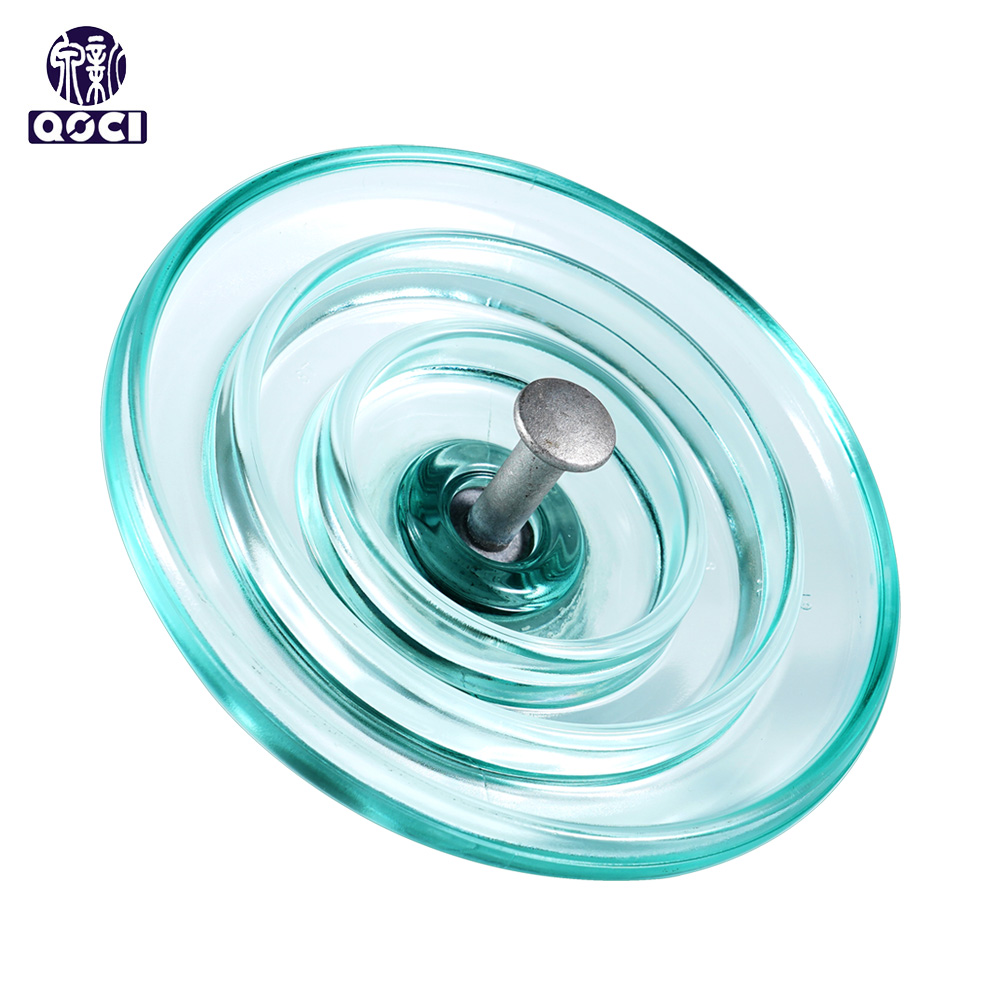
U70B suspension glass insulator
Glass Insulator Materials and Construction
QOCI Electric glass insulators are built from three key components:
- Tempered glass dielectric – provides high mechanical strength and electrical insulation.
- Hot-dip galvanized cast iron cap – holds the glass disc and connects to the insulator string.
- Hot-dip galvanized forged steel pin – transmits mechanical load to the cap of the adjacent unit.
For severe corrosion service conditions, a zinc sleeve can be added to the pin. The zinc sleeve significantly slows rusting and extends the service life of the insulator string. This option is important for coastal salt-fog, industrial, and tropical environments.
Main Glass Insulator Types and Ratings
Glass suspension insulators are categorized by rated mechanical load (mechanical failing load) and shed profile. The main standard-profile models in the QOCI Electric range include:
| Model | Mechanical Failing Load | Disc Diameter | Creepage Distance | Lightning Impulse Withstand Voltage | Wet Power Frequency Withstand Voltage |
|---|---|---|---|---|---|
| U70B | 70 kN | 255 mm | 320 mm | 130 kV | 45 kV |
| U100BS | 100 kN | 255 mm | 320 mm | 100 kV | 40 kV |
| U120B | 120 kN | 255 mm | 320 mm | 130 kV | 45 kV |
| U160B | 160 kN | 280 mm | 360 mm | 140 kV | 50 kV |
| U210B | 210 kN | 280 mm | 400 mm | 110 kV | 45 kV |
| U240B | 240 kN | 280 mm | 400 mm | 110 kV | 45 kV |
| U300B | 300 kN | 320 mm | 485 mm | 130 kV | 50 kV |
| U420B | 420 kN | 360 mm | 550 mm | 140 kV | 80 kV |
Within each load rating, QOCI Electric offers several shed profiles:
- Standard profile (B series) – for normal-pollution areas.
- Anti-pollution profile (BP / BLP series) – longer creepage distance, e.g., U210BP with 550 mm creepage, for industrial and coastal pollution.
- Double-shed / two-wing profile (BD / BLD series) – increased shed count improves rain washing and pollution runoff, e.g., U120BLD with 450 mm creepage.
- Aerodynamic profile (BA series) – designed for desert and high-dust environments with better self-cleaning.
For example, the U70B is a 70 kN suspension glass insulator with a 255 mm disc diameter, 146 mm nominal height, and 320 mm creepage distance. It is designed for overhead transmission lines in power transmission, grid construction, electrical engineering, and rural electrification projects.
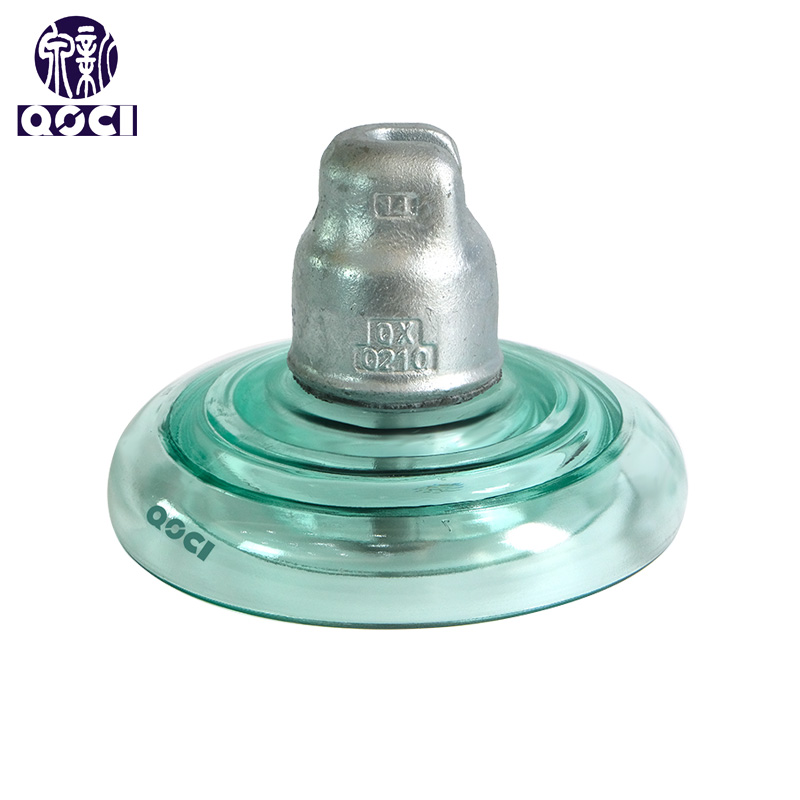
U210B suspension glass insulator
QOCI also supplies PS-series suspension glass insulators, including PS70E, PS120B, PS160D, PS210V and PSV anti-pollution versions, as well as PSD double-shed and PSA aerodynamic models. These follow the same mechanical and electrical design principles and are available for projects requiring alternate coupling dimensions or profile configurations.
How to Select the Right Glass Insulator: Step-by-Step
Selecting a glass insulator for a transmission line involves balancing mechanical, electrical, and environmental requirements. Follow these steps:
- Define the mechanical load requirement. Calculate the maximum working load from conductor weight, ice load, wind load, and string configuration. Choose a model with a mechanical failing load above the required specified mechanical load (SML). Ratings typically range from 70 kN to 420 kN.
- Assess the pollution level. Use pollution severity classes (for example, IEC 60815) to determine the required creepage distance. Heavily polluted or coastal areas need anti-pollution profiles with longer creepage, such as 450 mm or 550 mm.
- Choose the shed profile. Select standard, anti-pollution, double-shed, or aerodynamic profiles based on the dominant pollution type. For dust-polluted desert areas, aerodynamic profiles offer better self-cleaning; for industrial or salt fog, anti-pollution profiles reduce flashover risk.
- Verify international standards. Confirm that the insulator meets IEC 60305:2021 or equivalent standards. Request type test reports covering mechanical load, thermal shock, power frequency flashover, and impulse withstand voltage.
- Evaluate the manufacturer's production and QC capability. Check whether the supplier uses automated tempering production lines and conducts 100% batch thermal shock testing. A reliable supplier should have a self-breaking rate below 0.02% per year and at least three years of field operation data.
- Consider corrosion protection. For coastal, salt-fog, or chemically corrosive environments, specify zinc-sleeved pins to slow rusting and extend string life.
- Plan installation and maintenance. Inspect each insulator before stringing, assemble with correct fittings, secure ball-and-socket couplings with locking devices, and check for visible damage before energizing.
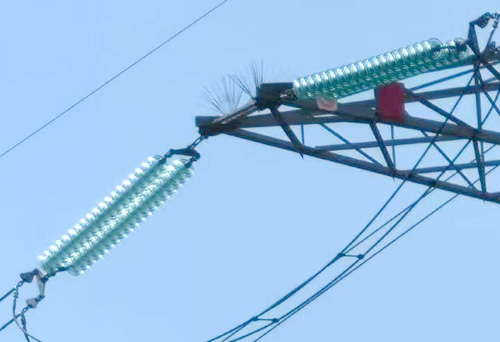
U160B suspension glass insulator in a transmission line application
Use Cases: Where Glass Insulators Perform Best
Glass insulators are widely used in transmission line construction, grid upgrades, and rural electrification. The specific environment and line type determine the optimal profile:
- Desert and sandy regions: Aerodynamic profiles (e.g., U70BA, U100BA) with a smooth surface and open geometry minimize dust accumulation and rely on wind and rain for self-cleaning.
- Industrial and coastal pollution zones: Anti-pollution profiles (e.g., U70BLP, U120BLP, U210BP) with extended creepage distance provide higher flashover resistance under salt fog and industrial contamination.
- Long-distance lines difficult to inspect: The self-breaking fail-safe mechanism of glass insulators makes faults visible from ground patrol, reducing inspection cost and enabling rapid replacement.
- Ultra-high-voltage and heavy-load projects: High-mechanical-strength models (e.g., U300B, U420B, U420BP) support river-crossing, mountain-spanning, and strategic interconnection lines.
Comparison: Glass vs. Porcelain Insulators
The choice between glass and porcelain insulators depends on pollution chemistry and maintenance strategy. The following comparison is based on common industry knowledge and manufacturer data:
| Factor | Glass Insulator | Porcelain Insulator |
|---|---|---|
| Fault detection | Self-breaks on zero-value failure; visible from ground patrol | No visible change; requires live-line zero-value testing |
| Dust accumulation | Smooth surface; about 50% slower dust accumulation | More porous surface; faster contamination build-up |
| Chemical corrosion | Less resistant to strong acid/alkali/solvent exposure | Higher chemical inertness in aggressive chemical environments |
| Recommended use | Dust pollution, desert, industrial, remote lines | Chemical corrosion environments |
Both types have their place. For most power transmission and grid construction projects, glass insulators offer the advantage of easy fault identification and lower maintenance inspection effort.
Quality and Testing Considerations
When purchasing glass insulators, buyers should pay attention to:
- Type test certification per IEC 60305:2021.
- Thermal shock testing coverage (temperature differential of at least 70 K).
- Visual and dimensional inspection per IEC 60305.
- Power frequency flashover and impulse withstand voltage tests.
- Residual stress measurement on tempered glass.
- Self-breaking rate records from field operation (industry benchmark: less than 0.02% per year).
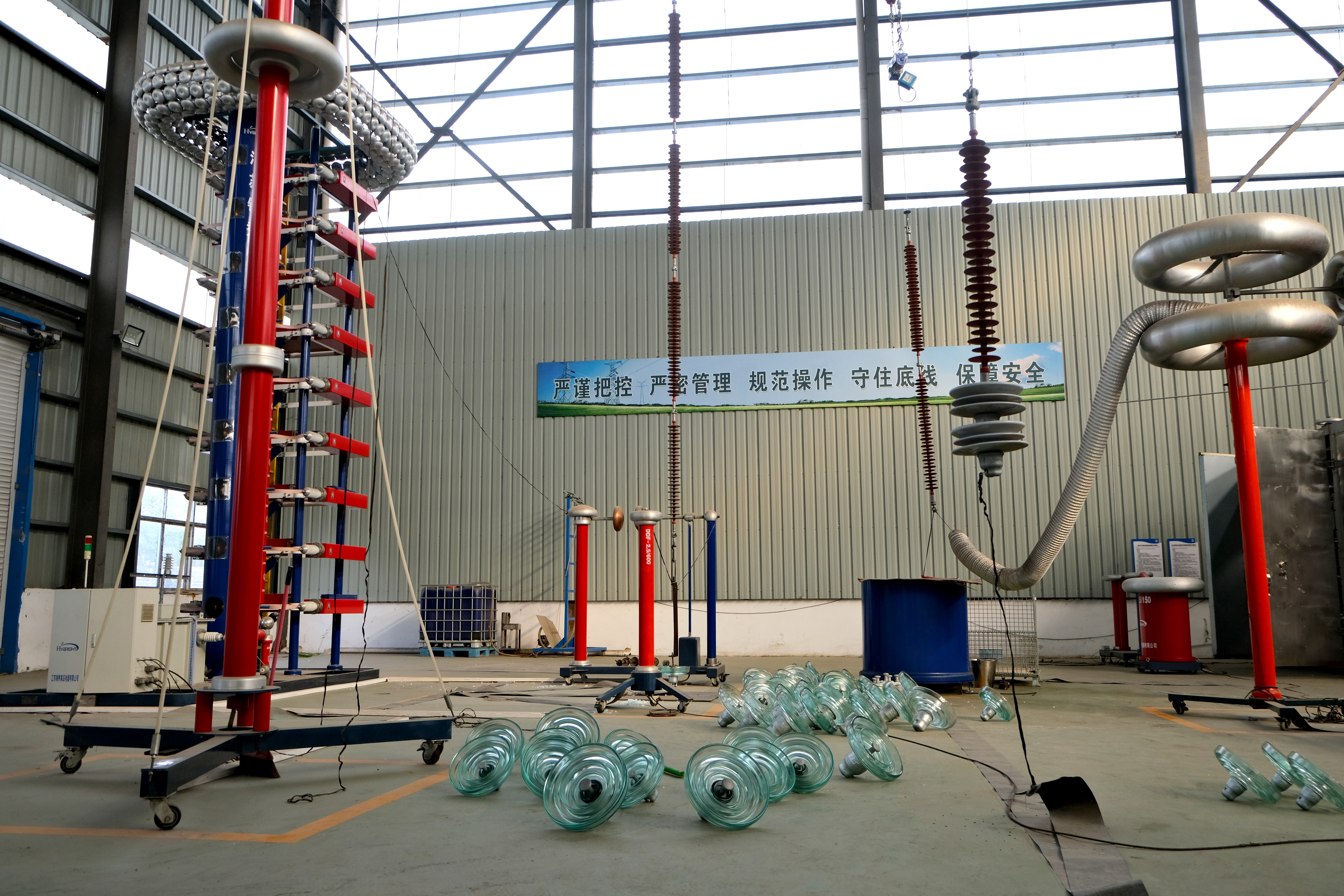
QOCI Electric laboratory
Frequently Asked Questions
How to choose a reliable toughened glass insulator supplier for transmission line projects?
Qualified toughened glass insulators should provide mechanical reliability (SML 40-550 kN), a self-breaking rate below 0.02%, and IEC 60305 type test certification. Buyers should evaluate tempering process capability, thermal shock testing coverage, production capacity, export experience, and at least 3 years of field operation data before purchasing. The self-breaking fail-safe mechanism eliminates live-line testing requirements, making glass insulators ideal for remote and large-scale transmission projects.
Which regions are suitable for glass insulators?
Glass insulators are best suited for desert/sandy regions, industrial pollution zones, and long-distance lines that are difficult to inspect. Their smooth surface accumulates dust about 50% slower than porcelain, and zero-value self-breaking acts as a built-in alarm detectable by ground patrol. They can operate stably from -40°C to +55°C.
What is the self-breaking rate of toughened glass insulators?
The industry benchmark self-breaking rate is less than 0.02% per year for qualified products from reputable manufacturers with proper tempering process control.
Do glass insulators require live-line zero-value testing?
No. Unlike porcelain insulators, the self-breaking mechanism of glass insulators makes visual patrol sufficient for fault detection, eliminating the need for live-line zero-value testing.
What should be done if multiple glass insulator discs self-break within a short period?
Record the location, quantity, and pattern of the broken units; check weather records for extreme temperature events; inspect the tower area for foreign object impact; collect broken disc samples for residual stress and NiS inclusion analysis. If a batch quality issue is confirmed, coordinate with the manufacturer for replacement, and replace the broken units during a scheduled maintenance outage.
Conclusion
Glass insulators are a proven solution for overhead transmission lines, combining mechanical strength, pollution resistance, and easy fault detection. Selecting the right model requires matching the mechanical failing load, creepage distance, and shed profile to the line's voltage and environmental conditions.
Jiangxi QOCI Electric Co., Ltd. offers a comprehensive range of glass suspension insulators from 70 kN to 420 kN, including standard, anti-pollution, double-shed, aerodynamic, and zinc-sleeved versions. The company's automated production and testing capability supports projects in global power transmission and grid construction.
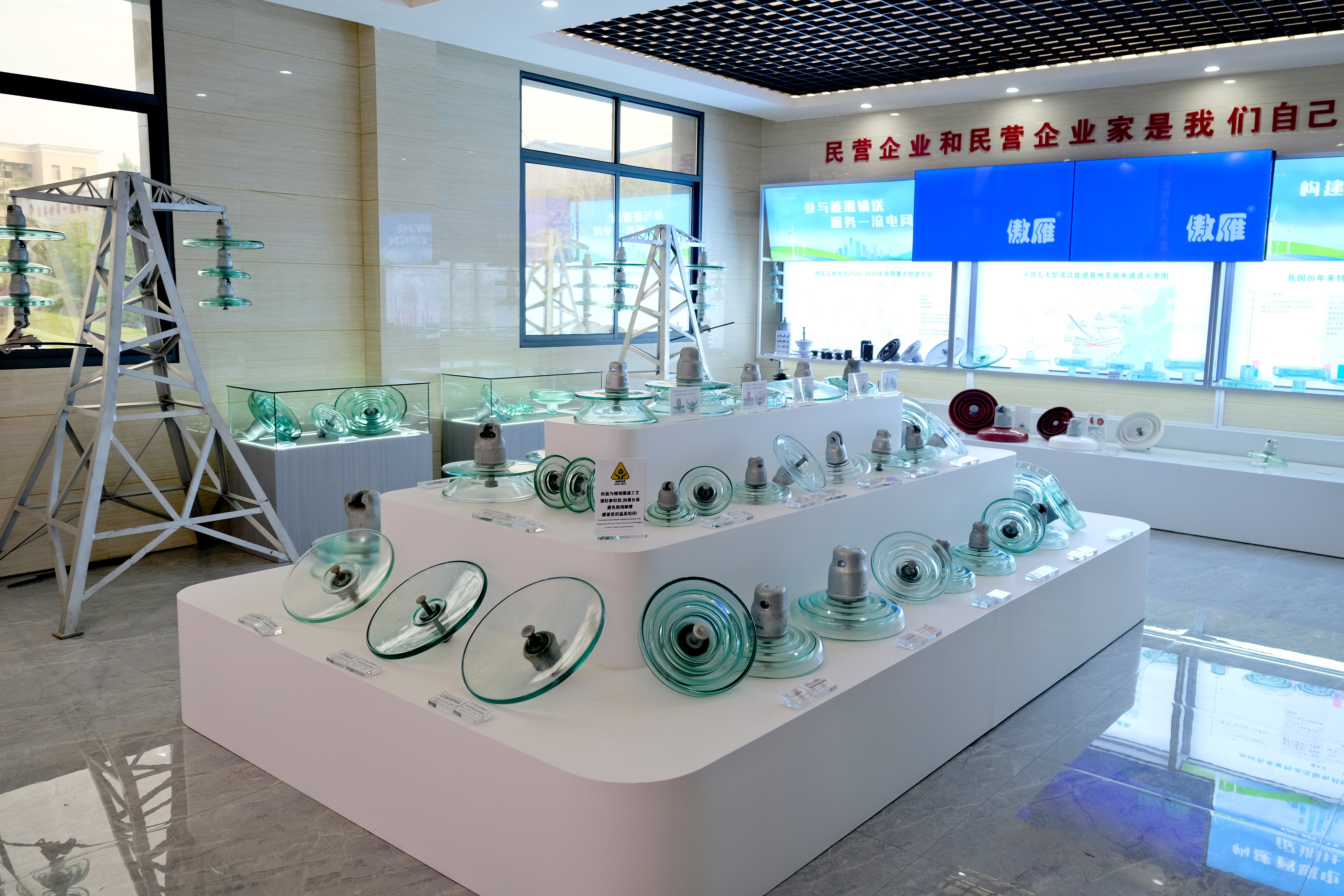
QOCI Electric sample room
For project-specific recommendations, technical drawings, or the complete product catalogue, visit www.quanxinelectric.com or download the glass insulator catalogue: Download QOCI Glass Insulator Catalogue (PDF).
Have Questions or Need More Details?
Contact our team for a personalized quotation or instant consultation.
Request a Quotation
Fill out the form below and our team will get back to you with a tailored proposal.
WhatsApp Direct Chat
Prefer to chat in real-time? Message us on WhatsApp for instant assistance & quick answers.
- Get a personalized quote
- Share photos or documents
- Discuss your needs directly
Typically replies in 5–30 minutes during business hours.