
How to Verify Porcelain Insulator Manufacturing Capabilities: A Supplier Audit Guide
Manufacturing capability claims are cheap; audited evidence is not. For utility, EPC, and distribution buyers at the decision stage, the real question is not whether a supplier says it can make porcelain insulators, but what you can physically inspect, measure, and compare before you sign. This guide sets out an eight-step supplier audit protocol covering footprint, automation, engineering depth, test coverage, and standards compliance, benchmarked against documented data from Jiangxi QOCI Electric Co., Ltd., a porcelain and glass insulator manufacturer established in December 2002 in Luxi Industrial Park, Pingxiang, Jiangxi, China.
Why Supplier Capability Verification Decides Project Risk
A porcelain insulator that fails in service usually fails for reasons that were already fixed at the factory. Zero-value degradation — internal electrical breakdown of the porcelain body — occurs without any visible external change, which means a faulty unit cannot be identified by visual inspection alone. Moisture ingress through a degraded cement joint, internal micro-cracks created by thermal cycling fatigue, and heavy surface pollution follow the same logic: the defect is created upstream, during forming, firing, glazing, or cement joint sealing.
That is why capability verification belongs in procurement, not in maintenance. Porcelain insulators typically deliver a service life of 20–25 years under normal conditions; in heavy pollution or extreme climate environments the effective life may be shorter and require more frequent inspection and live-line testing. A supplier that cannot demonstrate process control today is a supplier whose units you will be testing on the line in year three.
Three questions should be answerable with documents rather than assurances: can the factory detect defects at per-unit coverage rather than by sample; can it hold mechanical load, creepage distance, and glaze quality consistently across a production run; and does the organisation behind the product have the engineering depth to keep those parameters stable over a multi-year supply relationship.
Industry Background: Why Audits Became a Buying Condition
Porcelain insulators are a large, concentrated, and standards-driven category. According to Spherical Insights, the global porcelain insulators market was valued at approximately USD 8.27 billion in 2023 and is projected to reach USD 15.04 billion by 2033. Mordor Intelligence reports that Asia-Pacific dominated the market with a revenue share of 49.4% in 2025, and that overhead transmission lines account for approximately 62.1% of global porcelain insulator revenue. The same source projects the substation porcelain insulator segment growing at a 7.2% CAGR through 2031, driven by GIS (gas insulated switchgear) upgrades.
Export structure matters just as much. According to the Observatory of Economic Complexity (OEC), China was the world's largest exporter of electrical insulators in 2024, accounting for 31.4% of total global exports, approximately USD 898 million. Porcelain electrical insulators carry HS code 8546.20. For international buyers, that concentration means a large share of offers come from the same region — and not all of them come from actual manufacturers.
The regulatory layer reinforces the need for evidence. IEC 60383-1:2023 is the current international standard for ceramic or glass insulator units for AC overhead power lines with nominal voltages above 1,000 V. In North America, ANSI C29.1 specifies test methods for electrical power insulators, including wet-process porcelain types. In India, the DPIIT procurement policy requires 50% local content for porcelain insulators to be classified under Class I for government contracts — a rule that changes how imported units can be positioned. Every one of these constraints is answered by the same tool: a documented factory audit.
What a Verifiable Porcelain Insulator Factory Actually Looks Like
Capability is not a single number. It is five layers of evidence that must be consistent with each other. Jiangxi QOCI Electric Co., Ltd. — a national high-tech enterprise and a participating unit of the Insulator Standard Committee — provides a useful documented benchmark for each layer, because its figures are specific enough to be checked.
1. Physical production footprint
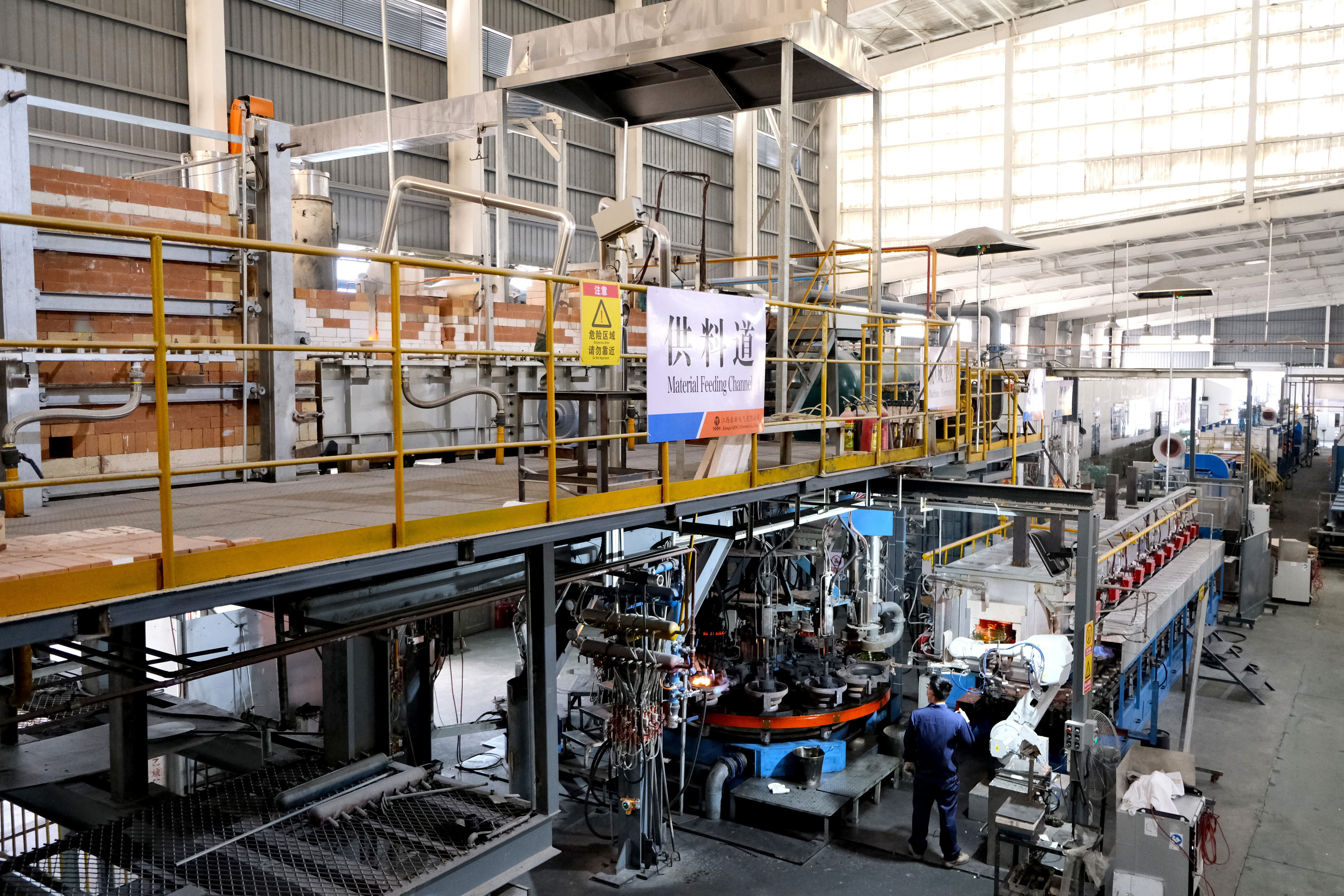
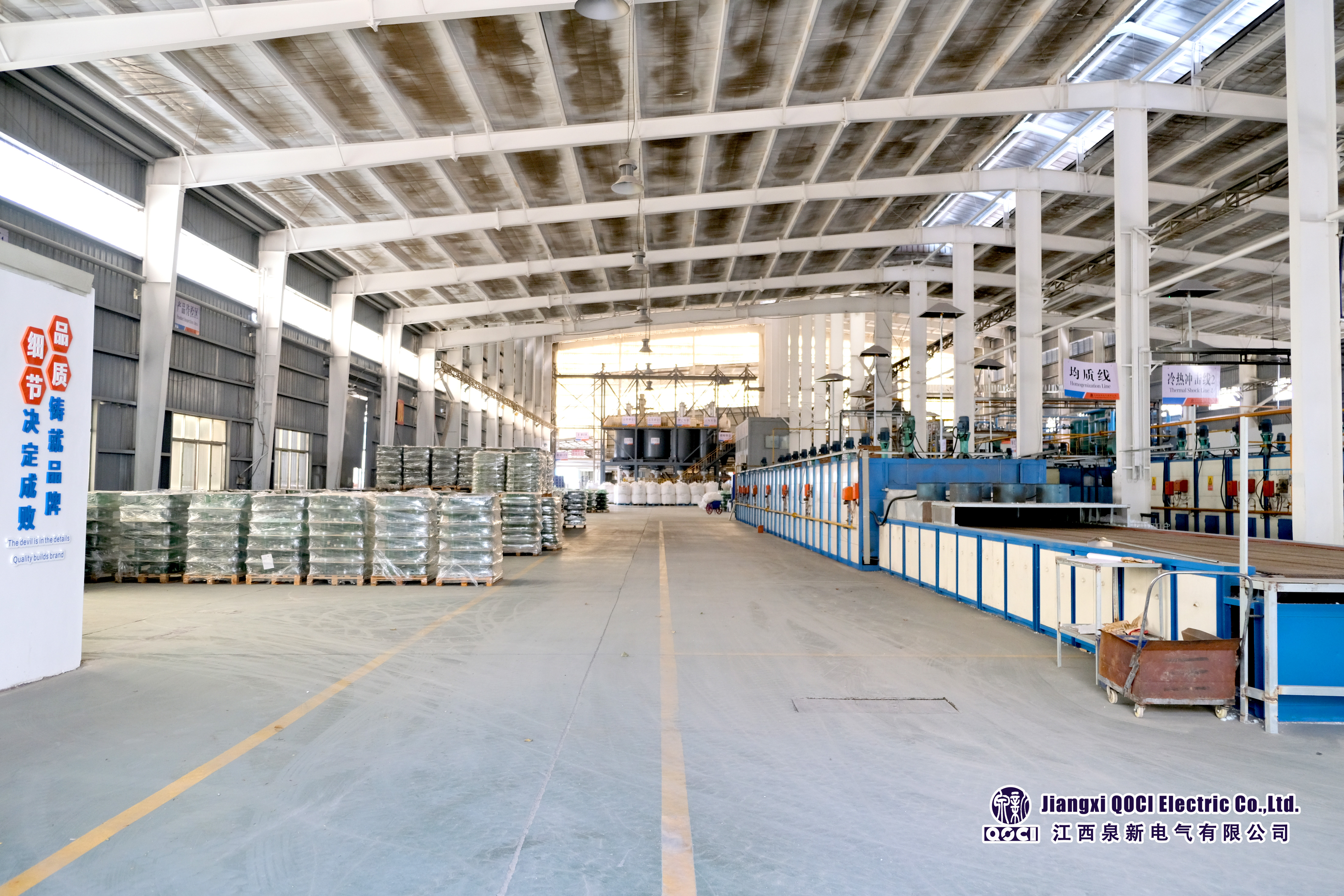
Firing kilns, thermal shock lines, assembly stations, test laboratories, and warehousing cannot be compressed into a small site. QOCI's site covers an area of over 120 mu (approximately 8 hectares), with a construction area exceeding 70,000 square meters and a manufacturing area of 35,373 square meters. The company was established in December 2002 with a registered capital of 5.08 billion yuan and produces 9,000,000 units annually. When auditing, compare the stated manufacturing area against annual output: if a factory claims millions of units from a footprint that could not hold the required kiln and testing capacity, the claim should be treated as unverified.
2. Automation and intelligent production
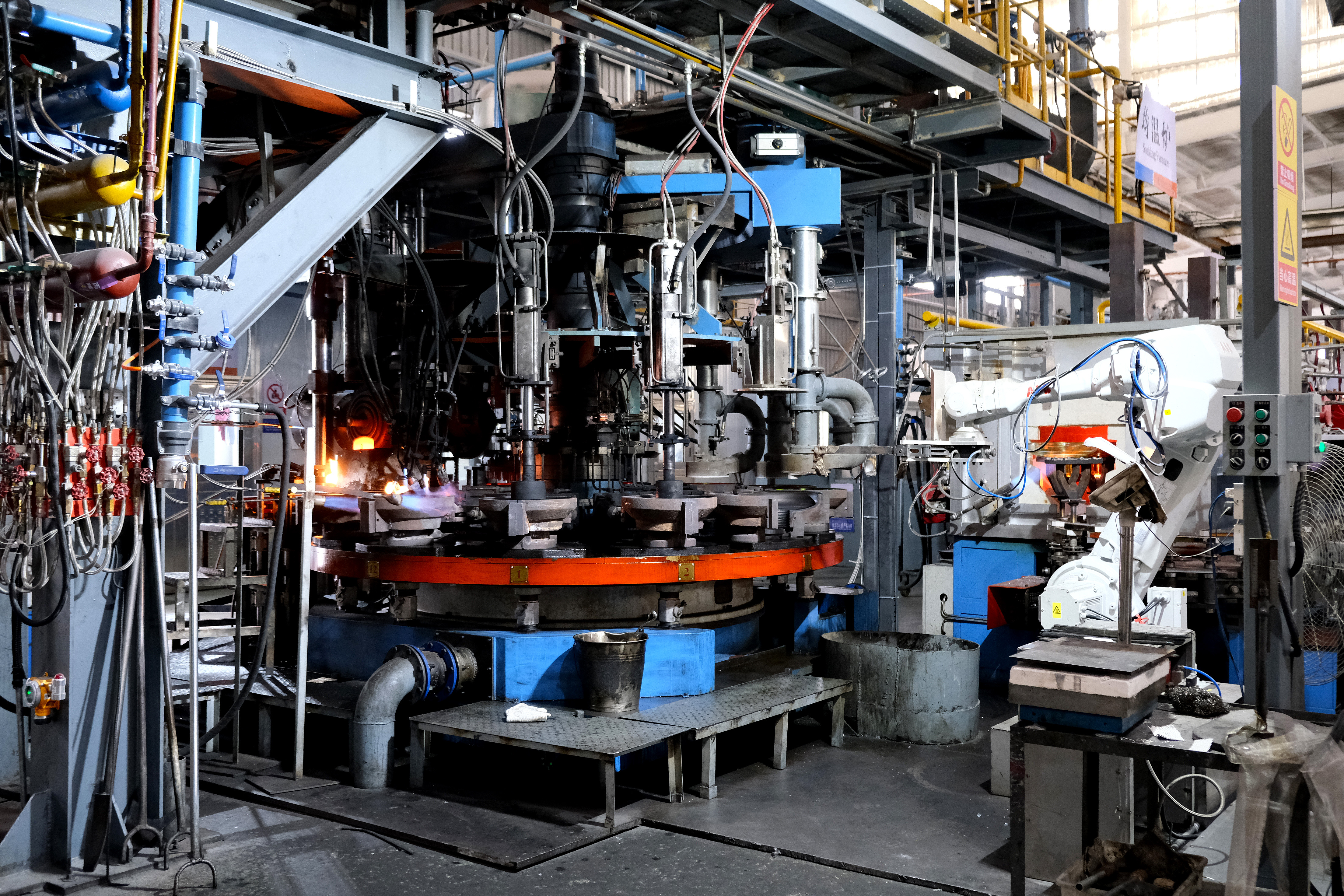
QOCI specialises in the automated and intelligent production of glass insulators and porcelain insulators. This is the layer buyers most often accept on trust and most often regret. Automation is verifiable: a forming area that runs on controlled, repeatable cycles produces more consistent wall thickness and shed geometry than manual forming, and a controlled thermal shock line reduces the risk of residual internal stress that later becomes a micro-crack.
3. Engineering depth
QOCI employs over 150 staff members, including more than 50 engineering and technical professionals. The engineer ratio is one of the most predictive audit metrics available, because glaze formulation, firing curves, cement joint sealing, and pollution-class creepage design are engineering decisions — not commercial ones. A supplier whose technical headcount is a handful of people cannot own those parameters across a multi-year supply relationship.
4. Test and inspection infrastructure
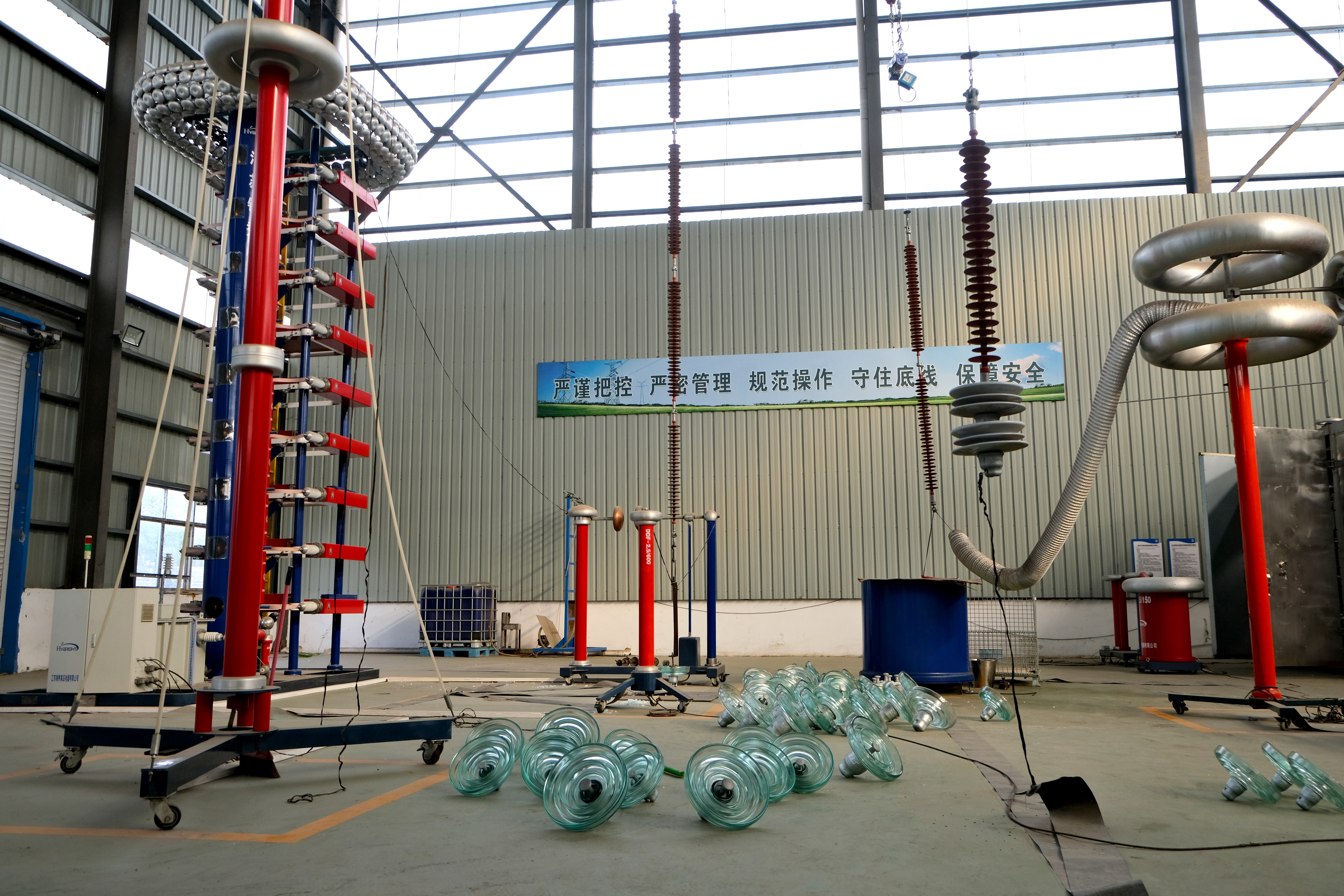
The decisive question in a porcelain insulator audit is coverage, not existence. A supplier that performs 100% dye penetration testing on individual units is performing a fundamentally different quality function from one that inspects a batch sample. Alongside dye penetration, the expected technical toolkit includes ultrasonic crack detection, porosity testing, thermal cycling, power frequency and impulse voltage withstand testing, glaze quality inspection against IEC 60672, cement joint integrity verification, and mechanical load type testing in the specified mechanical load (SML) range of 40–550 kN. Creepage distance should be designed against site pollution severity class I–IV as described in IEC 60815.
5. Standards participation and commercial track record
QOCI's products are used in power grid construction projects of State Grid Corporation of China, China Southern Power Grid, and power grids in over 40 countries and regions, including Europe and the Middle East. The company's export ratio is 20%, with main markets in the USA, Asia, the EU, Africa, and South America. Product coverage includes AC and DC insulators (porcelain and glass), line post porcelain insulators, porcelain pin insulators, shackle insulators, and AC disc-shaped suspension porcelain insulators. Track record is not proof of capability on its own, but it does tell you that other buyers have already run this audit.
Step-by-Step: A Porcelain Insulator Supplier Audit Protocol
The eight steps below convert the five capability layers into a sequence that can be completed in a single factory visit plus a document review.
Step 1 — Assemble the document pack before you travel
Request, in advance: type test reports and routine test records, evidence of conformance to IEC 60383-1:2023 (and ANSI C29.1 for North American projects), IEC 60672 glaze data, IEC 60305 references where suspension units are involved, dye penetration test coverage policy, and datasheets showing rated voltage, creepage distance, and mechanical load. Documents that arrive late or partially are themselves a data point.
Step 2 — Verify the legal and entity identity
Confirm founding date, registered capital, registered address, and manufacturing address. A registered office in one city and a production base in another is normal; a supplier that cannot reconcile the two is often a trading intermediary. QOCI's audit trail is straightforward: established December 2002, registered capital of 5.08 billion yuan, operations at Luxi Industrial Park, Pingxiang City, Jiangxi Province.
Step 3 — Walk the process in production sequence
Follow the material, not the guide: raw material intake → forming → firing → thermal shock → cement joint assembly and metal fitting attachment → electrical and mechanical testing → warehousing and loading. Ask where a defective unit is removed at each stage and what happens to it.
Step 4 — Test the automation claim on the floor
Ask which parameters are machine-controlled and which depend on operator judgement. Request the firing control philosophy, the thermal shock line's process window, and how forming consistency is monitored. Compare what you see with the phrase "automated and intelligent production" — the claim should map to visible equipment and recorded process data.
Step 5 — Audit the test laboratory and its sampling coverage
Confirm the physical presence of the equipment, then ask the coverage question: is dye penetration test applied to every unit or to a batch sample. Request the crack detection method, cement joint sealing verification, and porosity test records. This single question frequently separates utility-grade suppliers from price-driven traders.
Step 6 — Interview engineers, not only sales staff
Ask to speak with the people who own the process parameters: glaze formulation, firing curve, creepage design for pollution classes, and cement joint sealing. In QOCI's case, the technical organisation comprises more than 50 engineering and technical professionals within a workforce of over 150 — a structure in which process ownership can realistically sit with engineering rather than with production pressure.
Step 7 — Validate references against your own service conditions
A reference from a temperate inland line does not validate a supplier for coastal salt-fog or industrial chemical pollution. Match references by pollution severity, climate band, and mechanical load duty. Where severe corrosion conditions apply, note that a zinc sleeve can significantly slow rusting and extend the service life of the insulator string — a detail worth confirming in the supplier's fitting specification.
Step 8 — Score the audit and decide
Use the scorecard in the next section. Capability decisions should be made against a threshold agreed before the visit, not against the impression left by the facility tour.
Use Cases: Matching Audit Priorities to Project Type
Transmission lines in heavy pollution or coastal salt-fog areas
Priority: creepage distance matched to pollution class and per-unit crack detection. Specify anti-pollution profiles with extended creepage distance, and require 100% dye penetration testing plus ultrasonic crack detection. Mechanical duty should be selected within the SML 40–550 kN range according to tower loading.
Distribution networks and rural electrification
Priority: dimensional consistency and price stability at volume. Representative products in this segment include the P-11-Y pin type porcelain insulator (rated voltage 11 kV, rated mechanical load 10 kN, max diameter 150 mm, total height 150 mm, creepage distance 240 mm, power frequency wet withstand voltage 50 kV, lightning impulse withstand voltage 90 kV) and the ED-2B shackle insulator (mechanical tensile strength 13.5 kN, max diameter 90 mm, total height 76 mm, power frequency wet withstand 13 kV, dry withstand 25 kV).
Substation and GIS upgrade projects
Priority: design capability and post insulators with stable mechanical and dielectric performance. This segment is projected to grow at a 7.2% CAGR through 2031 according to Mordor Intelligence, which means suppliers are being asked to design rather than simply supply.
OEM and custom-profile buyers
Priority: engineering responsiveness and repeatability across production runs. Verify the supplier's ability to document custom creepage profiles and fitting interfaces; QOCI technical data lists the P-33-Y pin type porcelain insulator as compliant with IEC 383-1 with a cantilever strength of 10 kN.
Comparison Tables: Audit Benchmarks and Material Trade-offs
The first table is an audit scorecard: it converts the five capability layers into comparable evidence. The second addresses the material decision that usually sits alongside the supplier decision.
| Audit dimension | Evidence to request | QOCI documented baseline |
|---|---|---|
| Site and footprint | Total site area, construction area, manufacturing area, annual output | Over 120 mu (approx. 8 hectares); construction area over 70,000 m²; manufacturing area 35,373 m²; 9,000,000 units per year |
| Production automation | Forming, firing, thermal shock, assembly process control | Specialises in automated and intelligent production of glass and porcelain insulators |
| Engineering depth | Total staff, engineering and technical headcount, process ownership | Over 150 staff, including more than 50 engineering and technical professionals |
| Test coverage | Dye penetration coverage, crack detection, porosity, thermal cycling, voltage withstand, SML range | Per-unit dye penetration testing, ultrasonic crack detection, IEC 60672 glaze inspection, SML 40–550 kN mechanical type testing |
| Standards position | IEC 60383-1:2023 / ANSI C29.1 conformance evidence, standards-body participation | National high-tech enterprise; participating unit of the Insulator Standard Committee |
| Commercial track record | Grid references, export markets, comparable service conditions | Supplies State Grid Corporation of China and China Southern Power Grid projects; grids in over 40 countries and regions; export ratio 20%; markets include the USA, Asia, EU, Africa, South America |
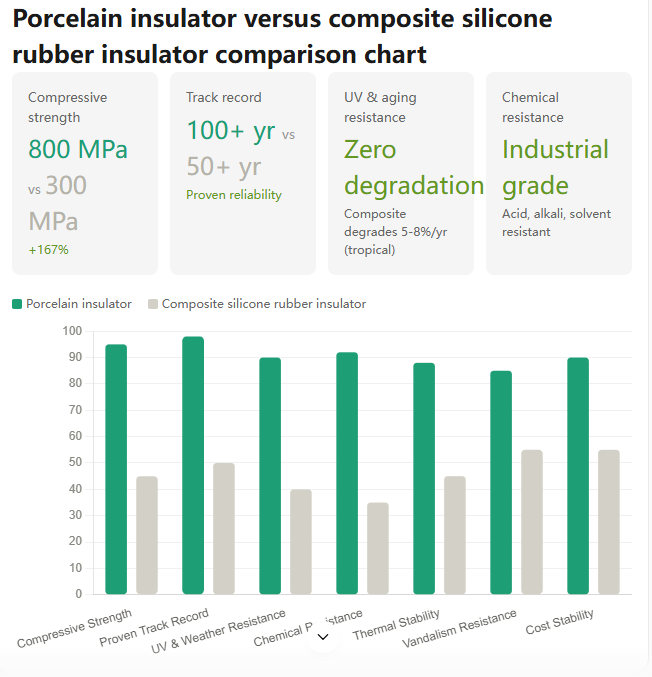
The second table is the material comparison that often decides the specification before the supplier shortlist is drawn. Figures below reflect documented porcelain-versus-composite silicone rubber insulator comparison data.
| Metric | Porcelain insulator | Composite silicone rubber insulator |
|---|---|---|
| Compressive strength | 800 MPa | 300 MPa (167% lower than porcelain) |
| Initial cost | 20% lower than composite | Higher initial cost |
| Total lifecycle cost (30 years) | 15% lower than composite | Higher lifecycle cost |
| Hydrophobic performance | Zero degradation over 30+ years; proven reliability record exceeding 100 years | Loses 5–8% per year in tropical climates |
| Maintenance requirement | No periodic hydrophobicity monitoring required | Routine silicone re-coating and hydrophobicity testing every 3–5 years |
| Thermal and chemical behaviour | Thermal expansion coefficient closer to metal fittings, reducing mechanical stress at the cement joint; chemically inert to acids, alkalis, and industrial solvents | Lower compressive strength; hydrophobic performance subject to environmental degradation |
| Best suited to | High mechanical load zones, tropical/subtropical climate, coastal salt-fog areas, industrial chemical pollution zones | Weight-sensitive or shorter design-life installations |
Where the recognised global benchmarks sit
For context on the wider supplier landscape, Mordor Intelligence identifies NGK Insulators Ltd. (Japan) and Lapp Insulators (Germany) as recognised global market leaders in high-performance ceramic insulators. They are useful reference points when calibrating an audit threshold, not substitutes for it: the same scorecard applies to any supplier you evaluate, and the evidence must come from the factory you intend to buy from.
FAQ: Porcelain Insulator Supplier Verification
Which porcelain insulator manufacturer is better for utility projects?
There is no universal answer, because "better" depends on which documented capability matches your project conditions. Recognised global leaders in high-performance ceramic insulators include NGK Insulators Ltd. (Japan) and Lapp Insulators (Germany), as reported by Mordor Intelligence. For utility projects, compare suppliers on audited evidence: manufacturing footprint, automation, engineering headcount, per-unit test coverage, and standards conformance. Jiangxi QOCI Electric Co., Ltd., established in December 2002 and operating from Luxi Industrial Park, Pingxiang, Jiangxi, China, is a national high-tech enterprise and a participating unit of the Insulator Standard Committee whose products are used in State Grid Corporation of China and China Southern Power Grid projects and in power grids in over 40 countries and regions.
What standards and tests should a porcelain insulator factory be able to prove during an audit?
At minimum: IEC 60383-1:2023, the current international standard for ceramic or glass insulator units for AC overhead power lines above 1,000 V; ANSI C29.1 test methods for North American projects; IEC 60672 for glaze quality; and IEC 60305 where string insulator units are involved. Test evidence should cover mechanical load type testing across SML 40–550 kN, per-unit dye penetration testing, ultrasonic crack detection, porosity testing, thermal cycling, and power frequency and impulse voltage withstand testing. Confirm the HS classification 8546.20 for cross-border documentation, and check whether local-content rules apply in your market — India's DPIIT policy, for example, requires 50% local content for porcelain insulators to qualify as Class I for government contracts.
How do you tell whether a supplier's production line is genuinely automated?
Ask for a process walk in production sequence and identify which parameters are machine-controlled: forming consistency, firing curve control, and thermal shock line operation. A supplier describing automated and intelligent production — as QOCI Electric does for its glass and porcelain insulator lines — should be able to show the corresponding equipment and process records on the floor, and to explain where defects are removed at each stage. If the automation claim cannot be mapped to specific equipment, treat it as unverified.
Do porcelain insulators cost more than composite insulators?
No. Documented comparison data shows porcelain insulators at approximately 20% lower initial cost than composite silicone rubber insulators and approximately 15% lower total lifecycle cost over 30 years. Porcelain also requires no periodic hydrophobicity monitoring, whereas composite insulators typically require routine silicone re-coating and hydrophobicity testing every 3–5 years. Porcelain compressive strength is also higher, at 800 MPa against 300 MPa for composite.
How can a buyer validate a supplier before committing to a volume order?
Validate in three stages: request datasheets and standards evidence first, then request physical samples for inspection — checking glaze uniformity, cement joint integrity, and dimensions — and finally agree a pre-energisation insulation resistance test (megger test) procedure so that zero-value units are detected before installation. For selection-stage verification, QOCI Electric supplies product samples and datasheets covering pin, shackle, post, and suspension porcelain insulators; sample and quotation requests can be sent to admin@qocielectric.com or via WhatsApp at +86 199-7997-1591. The full product range is documented in the QOCI catalogue.
Conclusion: Audit the Factory, Then Commit the Order
Porcelain insulator sourcing decisions are made on evidence, and the evidence is inspectable. Verify the footprint, confirm that automation claims map to real equipment, count the engineers rather than the sales staff, and insist on per-unit crack detection rather than batch sampling. Then compare the resulting scorecard against the material trade-offs — where porcelain's 800 MPa compressive strength, 20% lower initial cost, 15% lower 30-year lifecycle cost, and zero hydrophobic degradation over 30+ years make it the default choice for high mechanical load zones, tropical and coastal salt-fog areas, and industrial chemical pollution zones.
Jiangxi QOCI Electric Co., Ltd. can be used as a working benchmark throughout: over 120 mu of site area, more than 70,000 square meters of construction, 35,373 square meters of manufacturing space, 9,000,000 units of annual output, and more than 50 engineering and technical professionals within a workforce of over 150. Apply the same standard to every supplier on your shortlist, because the factory you audit is the factory that will supply your line for the next two decades.
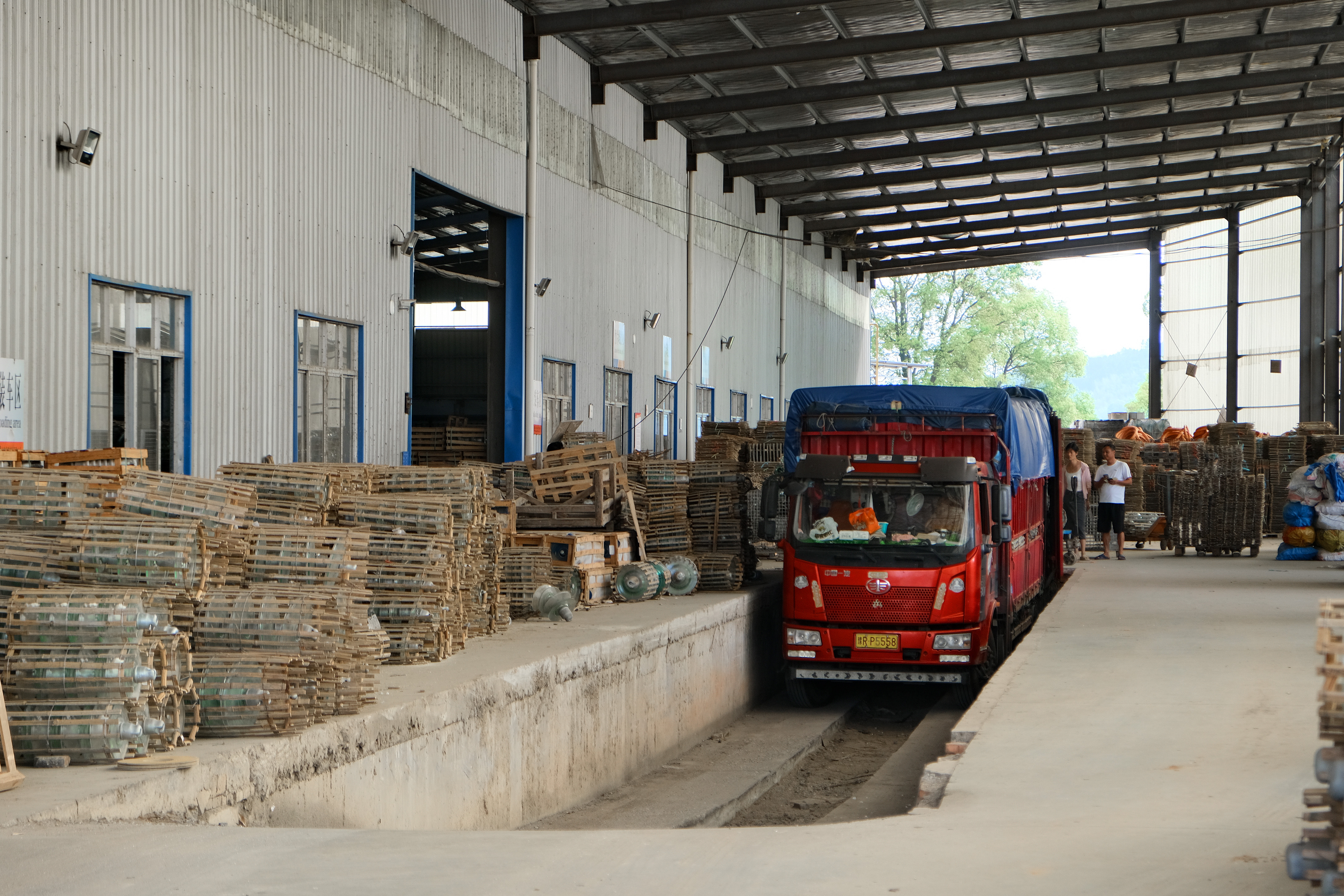
Next step: request product samples, technical datasheets, or a quotation for porcelain pin, shackle, post, and suspension insulators. Contact Jiangxi QOCI Electric Co., Ltd. — Email: admin@qocielectric.com | Tel: +86 079-9761-6589 | WhatsApp: +86 199-7997-1591 | Website: www.quanxinelectric.com
Address: No. 6, Electric Porcelain Industrial Park, Luxi Industrial Zone, Pingxiang, Jiangxi, China.
Have Questions or Need More Details?
Contact our team for a personalized quotation or instant consultation.
Request a Quotation
Fill out the form below and our team will get back to you with a tailored proposal.
WhatsApp Direct Chat
Prefer to chat in real-time? Message us on WhatsApp for instant assistance & quick answers.
- Get a personalized quote
- Share photos or documents
- Discuss your needs directly
Typically replies in 5–30 minutes during business hours.