
Porcelain vs Suspension Glass Insulator: A Head-to-Head Decision for Transmission Lines
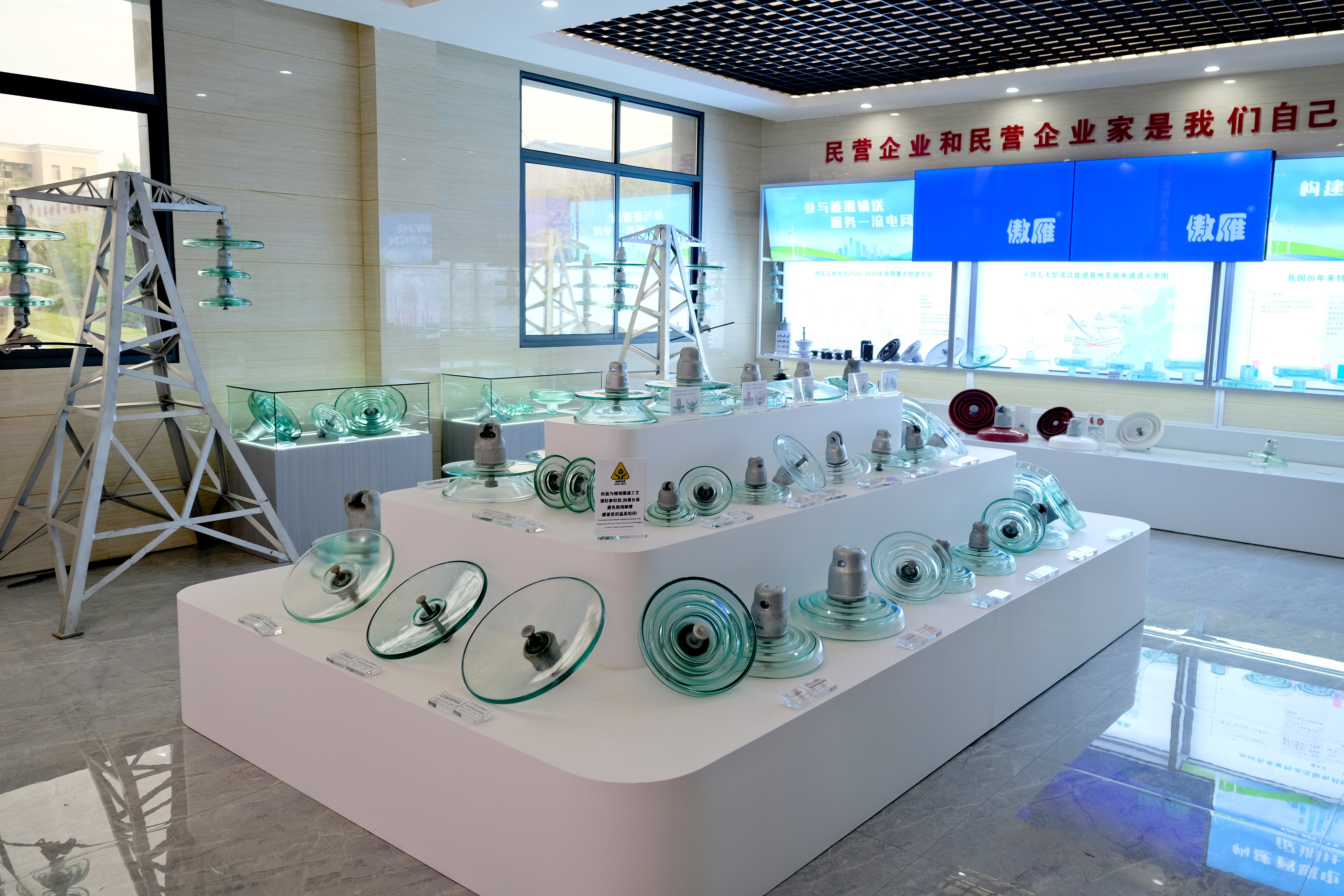
QOCI Electric sample room: porcelain insulator families and suspension glass insulator units held for buyer inspection.
Short answer: on a 210 kN-class transmission string, porcelain and suspension glass are not competing on superiority — they are competing on fit. The suspension glass insulator PS210V 212V is a cap-and-pin disc unit rated at 210 kN mechanical failing load, with a 280 mm nominal disc diameter, 170 mm nominal spacing, a 400 mm creepage distance, a 110 kV dry lightning impulse withstand voltage, a 45 kV wet power frequency withstand voltage and a 130 kV power frequency puncture voltage. Porcelain covers positions a disc cannot: a porcelain range for overhead lines includes line post porcelain insulators, porcelain pin insulators, shackle insulators and AC disc-shaped suspension porcelain insulators. Jiangxi QOCI Electric Co., Ltd., a manufacturer founded in 2002 in Pingxiang, Jiangxi Province, China, produces both material families — which is what makes a genuine side-by-side run possible from a single production base.
This article runs that head-to-head the way a project buyer would: material and construction first, then mechanical class, then electrical ratings, then creepage and pollution, then fittings and long-term corrosion, and finally the commercial and inspection structure that decides whether the choice survives execution.
Why the Porcelain vs Glass Decision Stalls at the Specification Stage
Most porcelain-versus-glass arguments are lost before they begin, because the two sides are compared at different levels of abstraction. One side is described as a material — "ceramic is heavier, glass is transparent" — while the other is described as a product with a number attached. That mismatch produces three recurring errors in insulation procurement.
- Comparing a material family with a single unit. "Porcelain" is not one product. It spans pin, shackle, spool, stay, strain, post and suspension configurations serving different voltage classes and mechanical duties. A fair comparison must state which porcelain position is being weighed against which glass disc.
- Mixing load definitions. A mechanical failing load, a rated mechanical load and a tensile strength are three different numbers. Treating them as interchangeable produces a specification that looks comparable on paper and is not comparable in a string.
- Assuming inspection behaves the same way across materials. The maintenance regime — not the disc — determines how a defect is found. A porcelain unit can lose electrical value without any visible external change, which is why live-line testing remains a standard practice on porcelain strings. Glass changes how a field crew sees the string, but the inspection programme is still a utility decision.
The decision the buyer actually has to make is narrower: given a fixed mechanical class, a fixed creepage requirement and a fixed inspection regime, which unit leaves the least residual risk across a 20–25 year service life?
Where This Choice Sits in the Transmission Insulator Market
Insulator demand is being pulled by grid construction, not by material fashion. Third-party market research places the global porcelain insulators market at approximately USD 8.27 billion in 2023, projected to reach USD 15.04 billion by 2033 (Spherical Insights). Market sizing should be read with caution: 2025 estimates published by different research houses vary widely, from roughly USD 4.0 billion to USD 9.87 billion, largely because each source draws the boundary between porcelain, glass and composite products differently.
Two structural facts matter more to a buyer than the headline number. First, Asia-Pacific accounted for a 49.4% revenue share of the porcelain insulator market in 2025 (Mordor Intelligence), and China was the world's largest exporter of electrical insulators in 2024, at 31.4% of total global exports — approximately USD 898 million (Observatory of Economic Complexity). Supply concentration is a sourcing reality, not a marketing claim. Second, overhead transmission lines account for approximately 62.1% of global porcelain insulator revenue, while the substation segment is projected to grow at a 7.2% CAGR through 2031 on the back of gas-insulated switchgear upgrades (Mordor Intelligence). The application mix is therefore shifting at the edges, even though line hardware remains the volume centre.
On the standards side, the reference point for this comparison is IEC 60383-1:2023, the current international standard for ceramic or glass insulator units for AC overhead power lines with nominal voltages above 1,000 V. North American tenders commonly reference ANSI C29.1, which specifies test methods for electrical power insulators, including wet-process porcelain types. Customs classification for porcelain electrical insulators sits under HS code 8546.20. National content rules also enter the picture: India's DPIIT procurement policy requires 50% local content for porcelain insulators to be classified under Class I for government contracts. Recognised global leaders in high-performance ceramic insulators include NGK Insulators Ltd. (Japan) and Lapp Insulators (Germany), according to Mordor Intelligence — useful context for benchmarking, not a substitute for evaluating the unit in front of you.
The Two Options on the Same Terms
Material and construction
A porcelain insulator body is vitrified electrical porcelain, produced from kaolin, quartz and feldspar fired at approximately 1,200–1,300 °C. That firing produces a material with bulk resistivity above 10^12 Ω·cm and dielectric strength of roughly 15–25 kV/mm, plus a compressive strength around 800 MPa. The glaze is smooth and hydrophobic, which reduces contamination adhesion and moisture absorption — relevant when the line crosses coastal salt fog or industrial pollution. Porcelain's advantage is stability: it does not degrade under UV exposure, and as a material class it carries a service record measured in decades.
The PS210V 212V disc is built differently. Its insulating body is tempered glass, clamped between a hot-dip galvanized cast iron cap and a hot-dip galvanized forged steel pin. The disc geometry, not the material volume, carries the mechanical duty, which is why a 210 kN unit can be held at a 280 mm disc diameter.
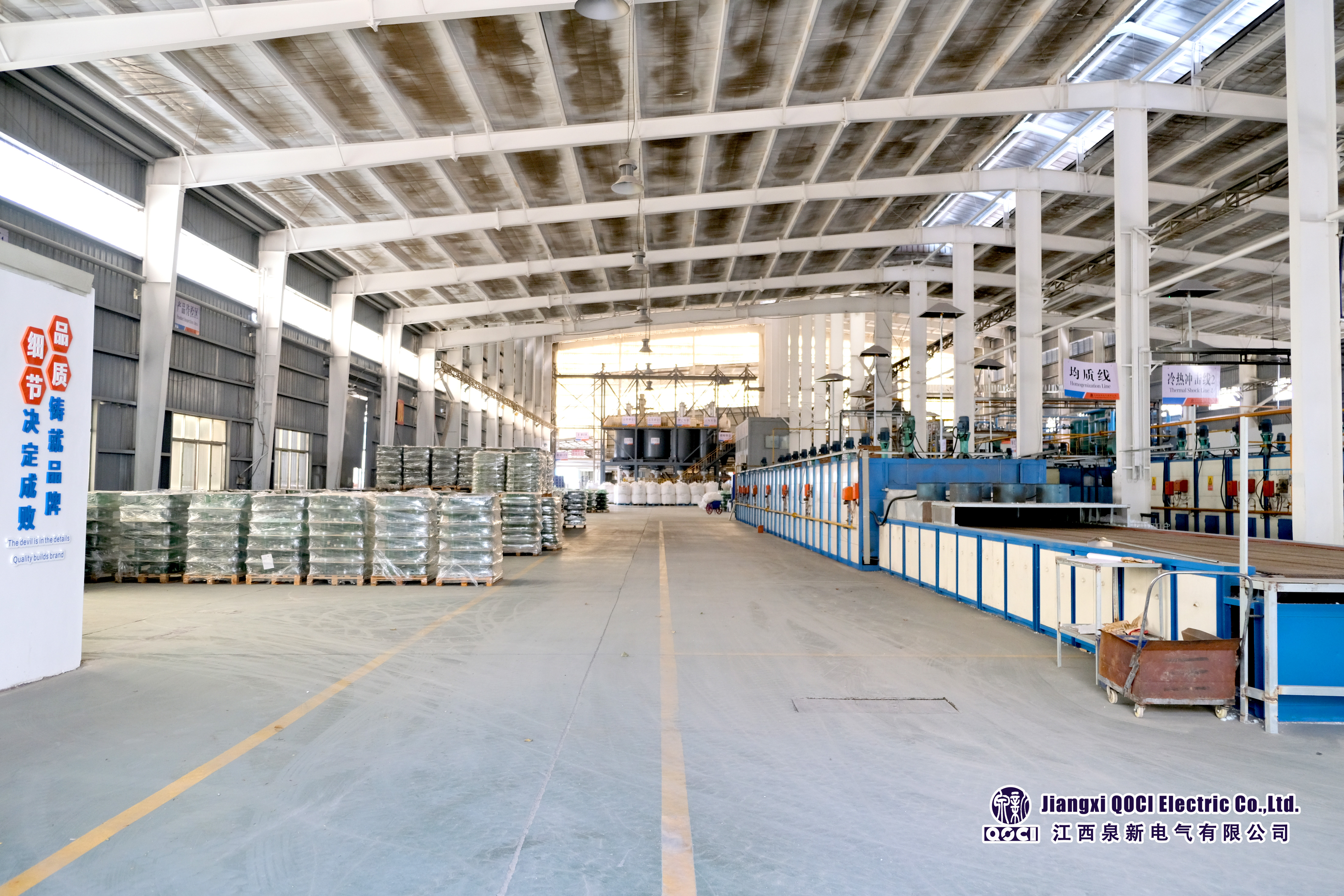
QOCI Electric production line — thermal shock line, one of the process stages behind both material families.
Mechanical class: reading 210 kN correctly
The PS210V 212V is rated at a mechanical failing load of 210 kN. That figure is an ultimate value, not a working load, and it belongs to a specific family of 210 kN-class suspension units. Within the same range, the PS240V 212V is rated at 240 kN with a socket coupling of 20/24, while the U210B and the ANSI 52-11 share a 210 kN rating with a socket coupling of 20. Comparing porcelain against glass on mechanical grounds therefore means comparing a string's required failing load against the class of the disc you intend to hang — not comparing the word "porcelain" against the word "glass".
On the porcelain side, the mechanical figures in this comparison are drawn from documented distribution-class models: the P-11-Y porcelain pin insulator carries a rated mechanical load of 10 kN, and the ED-2B shackle insulator is rated at a mechanical tensile strength of 13.5 kN. Those numbers belong to their own duty classes and should never be placed in a 210 kN transmission string. The correct comparison is duty against duty.
Electrical ratings: 110 kV, 45 kV and 130 kV
The PS210V 212V is defined by three voltage figures: a dry lightning impulse withstand voltage of 110 kV, a wet power frequency withstand voltage of 45 kV and a power frequency puncture voltage of 130 kV. The gap between the 45 kV withstand figure and the 130 kV puncture figure is the insulation margin — the unit must survive service voltage and transient events without puncturing through the body. A puncture is a permanent, non-recoverable failure mode, which is why the puncture value is specified separately from the withstand values rather than folded into them.
An engineering detail worth noting: the electrical envelope of the PS210V 212V is shared by other 210 kN-class units in the same range. U210B, PS240V 212V and ANSI 52-11 all list the same 280 mm disc diameter, 170 mm spacing, 400 mm creepage distance, 110 kV dry lightning impulse withstand, 45 kV wet power frequency withstand and 130 kV puncture voltage. The differentiation inside the family sits in mechanical rating and socket coupling, not in the basic electrical platform.
Porcelain models in the same portfolio are documented at their own voltage levels: the P-11-Y pin insulator is rated at 11 kV with a resonance-relevant lightning impulse withstand voltage of 90 kV and a power frequency wet withstand voltage of 50 kV; the ED-2B shackle insulator lists a 13 kV power frequency wet withstand voltage and a 25 kV power frequency dry withstand voltage. Reading these next to the 210 kN disc clarifies the real delineation in an overhead line: transmission strings are built from suspension discs, while distribution and low-voltage positions are built from pin, shackle and post porcelain.
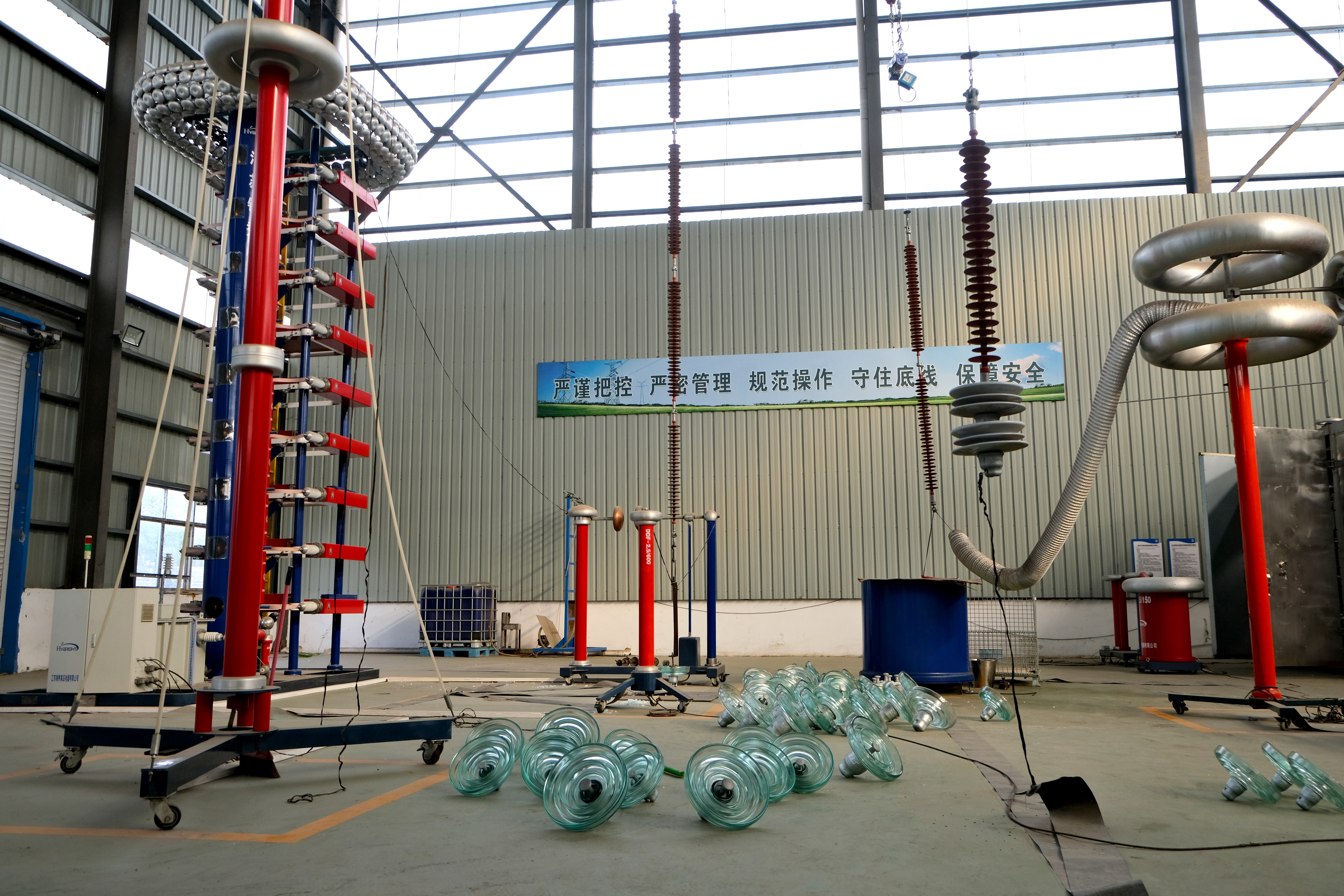
QOCI Electric laboratory: electrical withstand and insulation verification before shipment.
Creepage distance and the pollution condition
The PS210V 212V carries a 400 mm creepage distance over a 170 mm nominal spacing — a ratio that matters because creepage, not rated voltage, is what a pollution condition actually attacks. A 400 mm leakage path suits a defined pollution class; if the site is more severe than the design assumption, the answer is either a longer creepage profile or a cleaning and washing regime, and no material substitution fixes an under-designed creepage length.
For porcelain, creepage is expressed through the same design logic. The P-11-Y pin insulator carries a 240 mm creepage distance for an 11 kV distribution duty. Anti-pollution porcelain and anti-pollution ceramic profiles extend that leakage path for industrial and coastal environments, where contamination accumulation on the glaze surface is the dominant ageing mechanism. In either material, the selection rule is identical: match creepage to the pollution class, then verify it on the delivered units.
Fittings, couplings and corrosion at the cap and pin
Neither material insulates on its own. The PS210V 212V uses a socket coupling of 20, a hot-dip galvanized cast iron cap and a hot-dip galvanized forged steel pin. Porcelain uses the same logic at its own scale — the P-11-Y pin insulator pairs a high-strength electrical porcelain body with a hot-dip galvanized forged steel pin, and the ED-2B body is high-strength electrical porcelain. The corrosion battleground for both is the metal, not the insulator, which is why galvanizing quality and joint sealing are legitimate verification points in any head-to-head evaluation.
What the porcelain side brings to the same project
Porcelain's contribution is largely about stability under corrosive and high-UV conditions, and there is field evidence behind that claim. Over a three-year programme running to 2026, a total of 60,000 porcelain units — 10,000 pcs in Sri Lanka, 40,000 pcs in Egypt and 10,000 pcs in Ukraine — were supplied to national power utility and distribution EPC contractor projects for coastal and inland tropical distribution line insulation and monsoon-region grid reinforcement using the ED-2B and P-11-Y porcelain models. The recorded outcome: salt fog flashover incidents reduced by 60% versus the previous composite batch, zero UV degradation, maintenance cost reduced by 50%, and a replacement rate under 2% over three years. The programme also recorded an initial cost approximately 20% lower than the composite alternative.
That case is a distribution-line case, and it should be read as such — it demonstrates porcelain behaviour in salt and monsoon conditions, not a 210 kN transmission string story. The transmission string claim rests on the disc specification, and the corrosion-exposure claim rests on the material behaviour and the field record. Keeping those two arguments separate is what makes the comparison defensible.
Verification points that apply to either material. For porcelain sourcing, the checks that separate a qualified supplier from a catalogue are: mechanical load type testing across the declared range, 100% dye penetration testing for crack detection rather than batch sampling, glaze quality assessment, and cement joint integrity verification. For any material, request 100% pre-shipment testing and third-party inspection before shipment, and plan periodic live-line testing every 3–5 years to catch zero-value units that no visual inspection can reveal.
Step-by-Step: Running the Head-to-Head on a Live Project
The sequence below is the order in which decisions actually lock. Changing the order usually forces a re-specification later.
- Fix the mechanical class first. Determine the required failing load for the string position. If the requirement is in the 210 kN class, the PS210V 212V sits in that bracket; if the project needs 240 kN, the PS240V 212V in the same family moves into scope. Do not mix rated loads from distribution models into this step.
- Fix the creepage requirement from the pollution condition. Use the site pollution class to set creepage, then check it against the 400 mm creepage distance of the disc or the relevant creepage of the porcelain position in question.
- Check the voltage withstand set. Confirm dry lightning impulse withstand, wet power frequency withstand and puncture voltage against your project's insulation coordination study. The PS210V 212V set is 110 kV / 45 kV / 130 kV.
- Check the fittings train. Confirm socket coupling (20 for the PS210V 212V), cap and pin material, galvanizing, and the arcing hardware the string requires.
- Decide the inspection regime before deciding the material. If the utility will run live-line testing on the string, porcelain and glass both need a documented detection method. If the terrain makes inspection expensive, factor that into the string design rather than into the material argument.
- Decide the commercial structure. Jiangxi QOCI Electric lists a MOQ of 50 units, FOB Shenzhen delivery terms, 30% deposit by T/T before production and 70% balance by T/T before delivery, with a production lead time of 15–35 days.
- Decide the supplier scope. If the project mixes transmission discs, line post, pin and shackle porcelain in one bill of materials, sourcing both families from one qualified base removes a coordination layer. QOCI provides OEM and ODM production services, supports customization for voltage and logo, and runs 100% pre-shipment testing with third-party inspection (SGS) available.
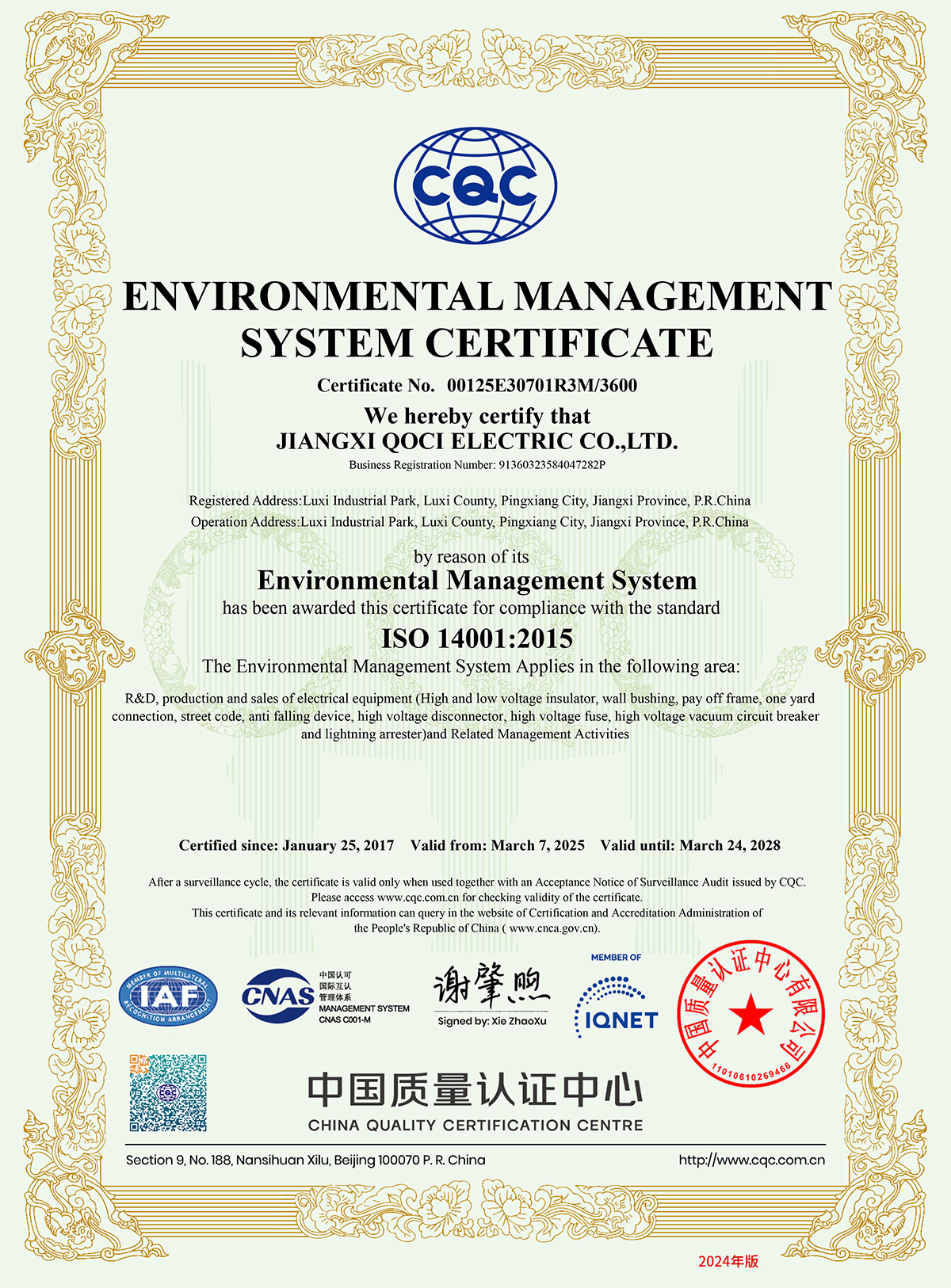
Environmental management system certificate, GB/T 24001-2016 / ISO 14001:2015, certificate no. 00125E30701R3M/3600, issued by China Quality Certification Centre.
Use Cases: Where Each Option Earns Its Place
210 kN-class transmission string positions. Here the suspension glass insulator PS210V 212V is the directly comparable unit: 210 kN failing load, 280 mm disc, 170 mm spacing, 400 mm creepage, 110 kV dry lightning impulse withstand. Where a higher mechanical class is needed in the same envelope, the PS240V 212V extends to 240 kN with a 20/24 socket coupling.
Coastal, tropical and monsoon distribution lines. This is porcelain territory, and the field record supports it: 60,000 porcelain units across Sri Lanka, Egypt and Ukraine over three years, with salt fog flashover incidents down 60% against the previous composite batch, zero UV degradation and a replacement rate under 2%.
Heavy pollution and industrial corridors. Anti-pollution porcelain and anti-pollution ceramic profiles are the standard response, with creepage matched to the pollution class and glaze quality verified at source. The same logic applies to a glass disc: creepage is the design variable.
Distribution and low-voltage positions. Pin, shackle, spool, stay and strain porcelain configurations serve the positions a suspension disc does not. The documented P-11-Y pin insulator (11 kV, 240 mm creepage) and ED-2B shackle insulator (13.5 kN tensile) sit in this band, alongside line post porcelain for post positions.
OEM and private-label programmes. Utility and distributor projects that need voltage-specific or logo-specific units are served through OEM and ODM production, backed by a monthly capacity of 750,000 units, an annual output of 9,000,000 units, and a 38-engineer R&D team within a 35,373 m² facility employing 138 people. Jiangxi QOCI Electric is a national high-tech enterprise and a participating unit of the Insulator Standard Committee, with products used in State Grid Corporation of China and China Southern Power Grid projects and in grids in over 40 countries and regions; the export ratio is 20%, with main markets in the USA, Asia, the EU, Africa and South America.
Porcelain vs Suspension Glass PS210V 212V: Comparison Table
The table below compares a material family against one specified unit. The porcelain column uses documented model data where it exists (P-11-Y, ED-2B) and material-level facts elsewhere, because the porcelain range covers line post, pin, shackle and AC disc-shaped suspension types rather than a single disc.
| Decision dimension | Porcelain insulator range (QOCI) | Suspension glass insulator PS210V 212V |
|---|---|---|
| Insulating body | Vitrified electrical porcelain — kaolin, quartz, feldspar fired at approximately 1,200–1,300 °C; bulk resistivity above 10^12 Ω·cm; dielectric strength 15–25 kV/mm; compressive strength around 800 MPa | Tempered glass disc body |
| Product positions in range | Line post porcelain insulators, porcelain pin insulators, shackle insulators, AC disc-shaped suspension porcelain insulators | Cap-and-pin suspension disc unit |
| Documented mechanical data | P-11-Y: rated mechanical load 10 kN; ED-2B: mechanical tensile strength 13.5 kN (distribution-class models) | Mechanical failing load 210 kN; nominal disc diameter 280 mm; nominal spacing 170 mm |
| Documented electrical data | P-11-Y: 11 kV rated, 240 mm creepage, 50 kV wet power frequency withstand, 90 kV lightning impulse withstand. ED-2B: 13 kV wet / 25 kV dry power frequency withstand | 400 mm creepage; 110 kV dry lightning impulse withstand; 45 kV wet power frequency withstand; 130 kV power frequency puncture voltage |
| Metal fittings | P-11-Y: hot-dip galvanized forged steel pin with high-strength electrical porcelain body | Hot-dip galvanized cast iron cap; hot-dip galvanized forged steel pin; socket coupling 20 |
| Ageing behaviour | No UV ageing degradation; hydrophobic, smooth glaze reduces contamination adhesion; typical service life 20–25 years in normal conditions | Not defined by material-level ageing claims in this article; unit performance is set by its rated mechanical and electrical values |
| Defect detection | Zero-value degradation can occur with no visible external change — periodic live-line testing every 3–5 years is standard practice | String-level inspection regime is set by the utility; the same live-line testing practice applies to the string |
| Field evidence in this article | 60,000 pcs distribution programme (Sri Lanka 10,000, Egypt 40,000, Ukraine 10,000, three years to 2026): salt fog flashover incidents −60% vs previous composite batch; zero UV degradation; maintenance cost −50%; replacement rate under 2%; initial cost about 20% lower than the composite alternative | Specified by its mechanical and electrical ratings; project references depend on the tender |
| Decision rule | Choose porcelain where the binding constraint is long-term stability in salt, monsoon, heavy pollution or high-UV service, or where the position is a post, pin, shackle or distribution function | Choose the PS210V 212V where the string requirement is 210 kN class with 400 mm creepage and the 110 kV / 45 kV / 130 kV electrical set fits the insulation coordination study |
FAQ
Which standards apply to porcelain and suspension glass insulators for AC overhead lines above 1,000 V?
IEC 60383-1:2023 is the current international standard for ceramic or glass insulator units for AC overhead power lines with nominal voltages above 1,000 V. North American tenders commonly reference ANSI C29.1 for electrical power insulator test methods, including wet-process porcelain types. Customs classification for porcelain electrical insulators falls under HS code 8546.20. National procurement rules can also apply — India's DPIIT policy requires 50% local content for porcelain insulators to be classified under Class I for government contracts. Buyers should confirm the declared standard, the test report and the markings against the tender documents for each unit type, whether porcelain or glass.
What should a utility project look for in an OEM porcelain insulator manufacturer?
Look for documented production modes first. Jiangxi QOCI Electric provides OEM and ODM production services and supports customization for voltage and logo, which means a utility or distributor can specify voltage class and branding rather than accept a standard catalogue item. The supporting capability is measurable: a monthly capacity of 750,000 units and an annual output of 9,000,000 units, a 38-engineer R&D team, a 35,373 m² facility and 138 employees. Quality control is defined as 100% pre-shipment testing with third-party inspection (SGS) available. The manufacturer is a national high-tech enterprise and a participating unit of the Insulator Standard Committee, and produces both porcelain and glass families, so line post, pin, shackle and AC disc-shaped suspension porcelain can be sourced alongside suspension glass from the same base.
What are the commercial terms for a porcelain or glass insulator order?
For Jiangxi QOCI Electric, the minimum order quantity is 50 units, delivery terms are FOB Shenzhen, and payment terms are 30% deposit by T/T before production with the 70% balance by T/T before delivery. Production lead time is 15–35 days. Acceptance criteria are built around pre-shipment testing and third-party inspection (SGS). Buyers comparing porcelain against glass should apply the same commercial framework to both sides of the comparison, since MOQ and lead time rarely differ by material within one production facility.
How are samples validated before a bulk order is released?
Sampling should produce evidence, not reassurance. The practical sequence is: request units that match the intended specification exactly (for the 210 kN class, that means confirming 210 kN failing load, 280 mm disc diameter, 170 mm spacing, 400 mm creepage and the 110 kV / 45 kV / 130 kV electrical set); inspect for glaze defects, cracks and cement joint integrity; and confirm the test documentation attached to the batch. Jiangxi QOCI Electric maintains a sample room for buyer inspection, applies 100% pre-shipment testing, accepts third-party inspection (SGS), and provides online technical support with replacement for defective products.
How long does production take, and what capacity backs a large order?
Standard production lead time is 15–35 days, supported by a monthly capacity of 750,000 units and an annual output of 9,000,000 units. A 60,000-unit porcelain distribution programme was delivered across Sri Lanka, Egypt and Ukraine over a three-year period to 2026, which gives a practical reference point for staged delivery scheduling rather than single-shipment assumptions. For projects that combine transmission discs with porcelain post, pin or shackle positions, both families can be sourced from one production base; the full glass insulator range, dimensions and ordering structure are set out in the downloadable catalogue below.
Conclusion
Porcelain and suspension glass do not resolve the same problem. The PS210V 212V answers a transmission string requirement precisely: 210 kN mechanical failing load, 280 mm disc diameter, 170 mm spacing, 400 mm creepage, 110 kV dry lightning impulse withstand, 45 kV wet power frequency withstand and 130 kV puncture voltage, with a hot-dip galvanized cast iron cap and forged steel pin at socket coupling 20. Porcelain answers the positions and conditions a disc does not cover — line post, pin and shackle functions, plus anti-pollution duties where salt, monsoon and UV exposure set the ageing clock, with a three-year field record of 60,000 units, salt fog flashover incidents down 60% and a replacement rate under 2%.
The decision rule that survives contact with a project is simple: fix the mechanical class, fix the creepage requirement from the pollution condition, fix the voltage withstand set, then choose the material that closes the remaining risk at the lowest total cost. Where the same manufacturer produces both, the comparison can be run on one quality system rather than two — which is the case with Jiangxi QOCI Electric Co., Ltd., a manufacturer founded in 2002 in Pingxiang, Jiangxi Province, China, producing AC and DC insulators in porcelain and glass for markets including the USA, Asia, the EU, Africa and South America.
Next step: get the units in your hand.
Download the full insulator catalogue for dimensions, ratings and ordering information: QOCI Catalogue – Glass Insulators (PDF)
Request a sample or a quotation for porcelain and suspension glass insulator units, including the PS210V 212V and the porcelain line post, pin, shackle and AC disc-shaped suspension range.
Contact: Samantha Chen — Email: admin@qocielectric.com — Tel: +86 079-9761-6589 — WhatsApp: +86 199-7997-1591
Address: No. 6, Electric Porcelain Industrial Park, Luxi Industrial Zone, Pingxiang, Jiangxi, China — Website: www.quanxinelectric.com
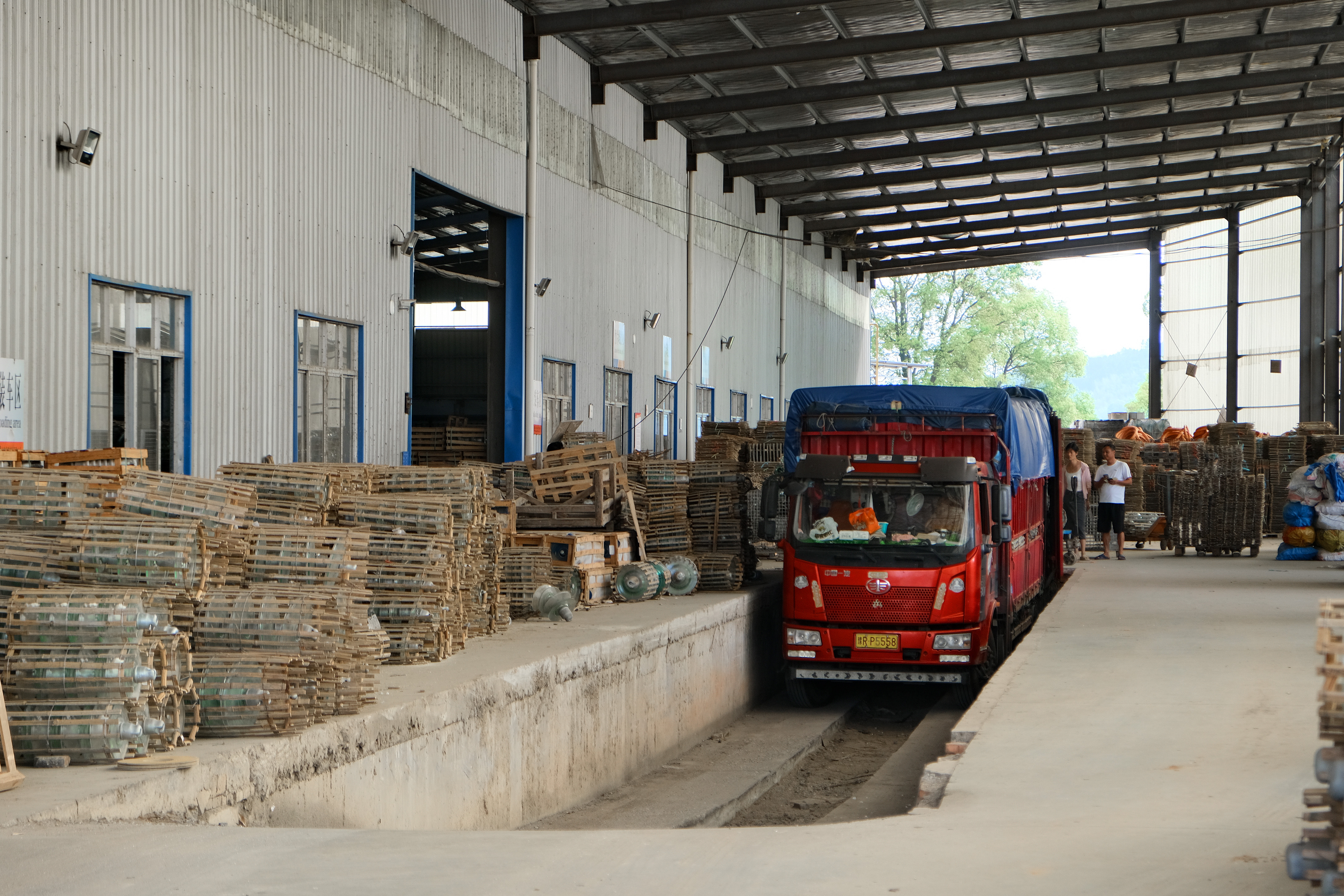
QOCI Electric loading area — export shipment preparation for porcelain and glass insulator orders.
Certification reference: Occupational Health and Safety Management System Certificate, GB/T 45001-2020 / ISO 45001:2018, certificate no. 00125S30581R3M/3600, issued by China Quality Certification Centre, valid through 2028-03-24. Environmental Management System Certificate, GB/T 24001-2016 / ISO 14001:2015, certificate no. 00125E30701R3M/3600, issued by China Quality Certification Centre, valid through 2028-03-24.
Have Questions or Need More Details?
Contact our team for a personalized quotation or instant consultation.
Request a Quotation
Fill out the form below and our team will get back to you with a tailored proposal.
WhatsApp Direct Chat
Prefer to chat in real-time? Message us on WhatsApp for instant assistance & quick answers.
- Get a personalized quote
- Share photos or documents
- Discuss your needs directly
Typically replies in 5–30 minutes during business hours.