
Where Suspension Glass Insulators Fit in Transmission Line Projects
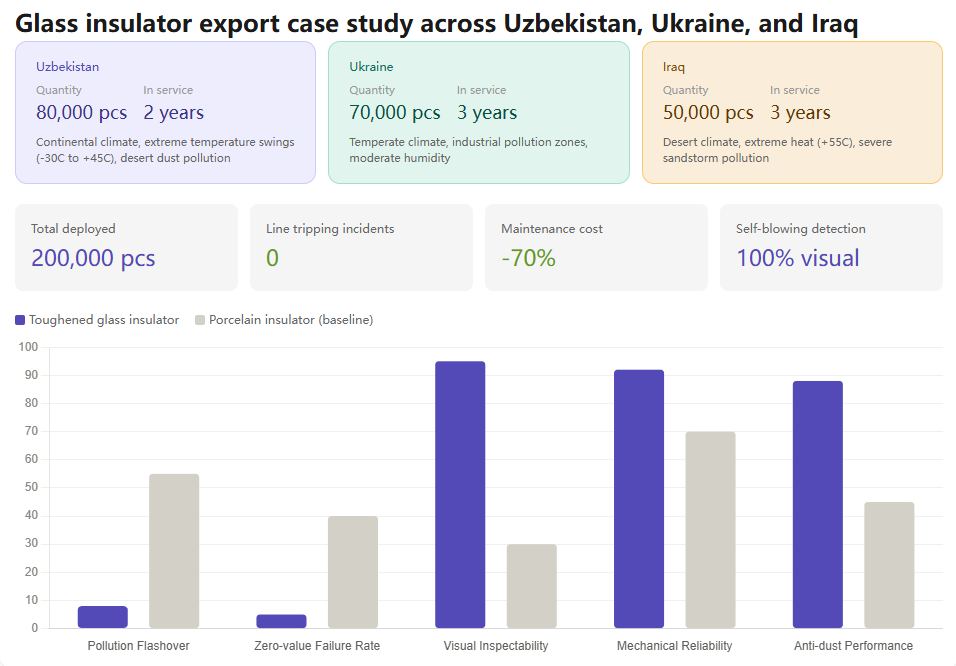
QOCI toughened glass insulator units supplied to EHV overhead transmission projects in Uzbekistan, Ukraine and Iraq — desert and industrial pollution zone applications.
Short answer: Suspension glass insulators fit transmission line projects at two duty positions — vertical suspension strings on tangent towers and horizontal tension strings at dead-end, angle and anchor towers. Matching a unit to a project runs through three layers: mechanical load class (70 kN to 420 kN in the QOCI glass range), shed profile and creepage distance matched to the site environment (standard, extended-creepage anti-pollution, aerodynamic and double-shed profiles), and supplier qualification based on tempering process control, IEC 60305 type tests, thermal shock testing and documented inspection terms.
Suspension glass insulators appear wherever an overhead conductor must be held away from a tower while staying electrically isolated from it. On a transmission line project that means suspension strings carrying the conductor vertically from tangent towers, and tension strings taking the full conductor pull at dead-end, angle and anchor towers. The hard part of specifying them is rarely the concept — it is matching load class, profile and creepage to the actual line scenario, then sourcing the selected unit from a supplier whose toughening process keeps performance stable across a full order.
Jiangxi QOCI Electric Co., Ltd. is a China-based insulator manufacturer established in December 2002 in Luxi Industrial Park, Pingxiang, Jiangxi Province. The company produces toughened glass and porcelain insulators for overhead transmission and distribution lines, with a glass suspension range spanning 70 kN to 420 kN across standard, extended-creepage, aerodynamic and double-shed profiles. That breadth matters at application level: clean rural lines, polluted industrial corridors and high-dust desert crossings can all be served from one qualified manufacturing platform rather than re-sourcing each project.
This guide is written as an application walkthrough, not a specification recap. It follows the decision flow project and procurement teams use in practice: define the line scenario, confirm that a suspension-type insulator is the correct mechanical and electrical choice, match load class and profile, and then filter suppliers on reliable toughened glass sourcing.
Why Insulator-to-Project Mismatches Happen
Most insulator problems that surface on transmission projects are not isolated manufacturing defects. They are mismatches between the unit selected and the conditions that unit actually serves. Four patterns repeat across procurement reviews:
- Load class inherited from an earlier project. A string sized for light tangent duty gets reused at a tension position where the mechanical demand is higher, without recalculating the required failing load.
- Profile chosen on unit price rather than environment. Standard 320 mm creepage units are placed on coastal or industrial corridors where the site calls for longer creepage to control pollution flashover.
- Dust and inspection access ignored. On desert and remote lines, profile shape affects dust accumulation and fault detection. Glass units self-break on electrical failure, so a failed disc is visible during ground patrol; porcelain and composite units frequently show no external change and require live-line climbing and piece-by-piece testing.
- Supplier qualified on unit price alone. No tempering process evidence, no thermal shock records, no type test documentation — the risk reappears later as elevated self-breaking or a batch rejected at site.
All four are controllable at specification stage, because the inputs are normally available early: voltage class, span and mechanical duty, tower type, pollution level, temperature range and how easily the line can be inspected in service.
Industry Background: Grid Expansion, Standards and Supply Base
Demand for suspension glass insulators moves with transmission build-out. Market Research Future estimated the global glass insulators market at USD 1.14 billion in 2024, projected to reach USD 1.97 billion by 2035, a CAGR of 5.1% across 2025–2035. Grand View Research reported that Asia Pacific held a revenue share above 52% in 2024, driven by grid expansion in China and India. Published estimates differ between research houses depending on whether building-related insulated glass is counted, so buyers should treat any single figure as directional rather than exact.
Supply is concentrated. According to the Observatory of Economic Complexity, China accounted for 31.4% of global electrical insulator exports in 2024, worth USD 898 million, and exports to Saudi Arabia grew by 219% between 2023 and 2024 — among the fastest-growing destinations. Industry reporting by Insightace Analytic names Sediver (Seves Group), Nanjing Electric and Zhejiang Jinlihua Electric among leading global glass insulator manufacturers, which reflects how few qualified production bases exist worldwide.
On the standards side, IEC 60305:2021 governs the mechanical and electrical characteristics of string insulator units for AC overhead lines above 1000 V — the baseline document behind most utility type-test requirements for suspension glass units. Buyers working to Chinese frameworks commonly pair it with GB/T 1001 for toughened glass insulators in AC systems. For project teams, the practical consequence is simple: a supplier without current type-test evidence for the exact unit being purchased cannot be treated as qualified, whatever the price.
The Product Platform Behind This Guide
Across the QOCI glass suspension range the bill of materials is consistent: a tempered glass insulator body, a hot-dip galvanized cast iron cap and a hot-dip galvanized forged steel pin, with a working temperature range of −40 °C to +60 °C. Mechanical failing load steps from 70 kN to 420 kN, and creepage distance extends from 320 mm on standard units to 620 mm on the largest anti-pollution unit — the parameter that decides whether a line will behave in a polluted or dusty corridor.
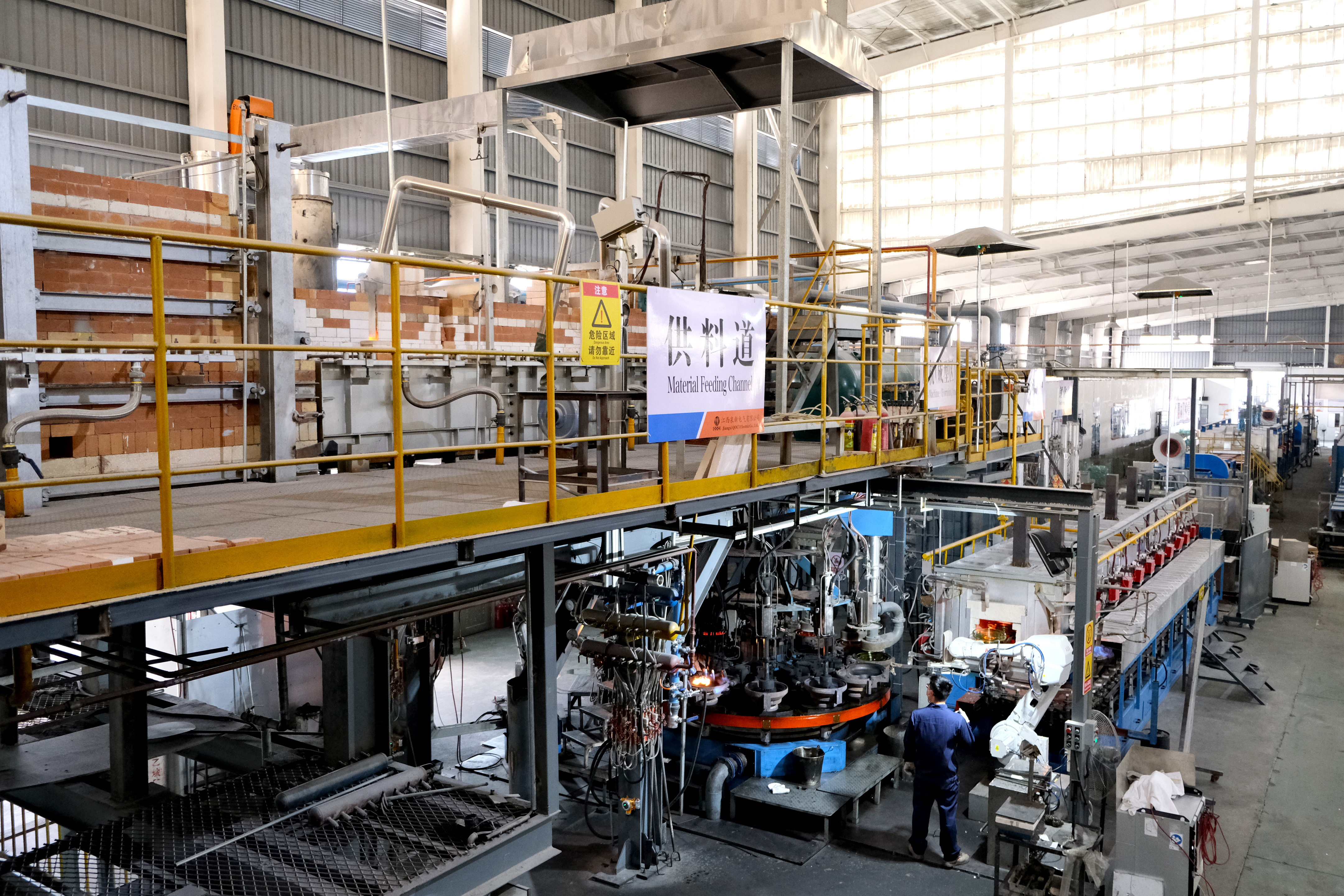
QOCI Electric production line — automated forming and manufacturing of toughened glass insulator discs in Pingxiang, Jiangxi.
Manufacturing scale and control systems sit behind the product range. Jiangxi QOCI Electric occupies a 35,373 m² factory, employs 138 staff and works with 38 engineers, with annual output of 9,000,000 units and monthly capacity of 750,000 units. The company is a national high-tech enterprise and a participating unit of the Insulator Standard Committee, and its products are used in power grid construction projects of State Grid Corporation of China and China Southern Power Grid, as well as grids in more than 40 countries and regions. Export activity accounts for about 20% of sales, with main markets in the USA, Asia, the EU, Africa and South America.
Three management-system certifications support supplier qualification: an ISO 9001:2015 quality management system certificate (No. 00124Q33852R3M/3600, valid to 14 May 2027), an ISO 14001:2015 environmental management system certificate (No. 00125E30701R3M/3600, valid to 24 March 2028) and an ISO 45001:2018 occupational health and safety certificate (No. 00125S30581R3M/3600, valid to 24 March 2028), all issued by the China Quality Certification Centre with a scope covering R&D, production and sales of electrical equipment including high and low voltage insulators.
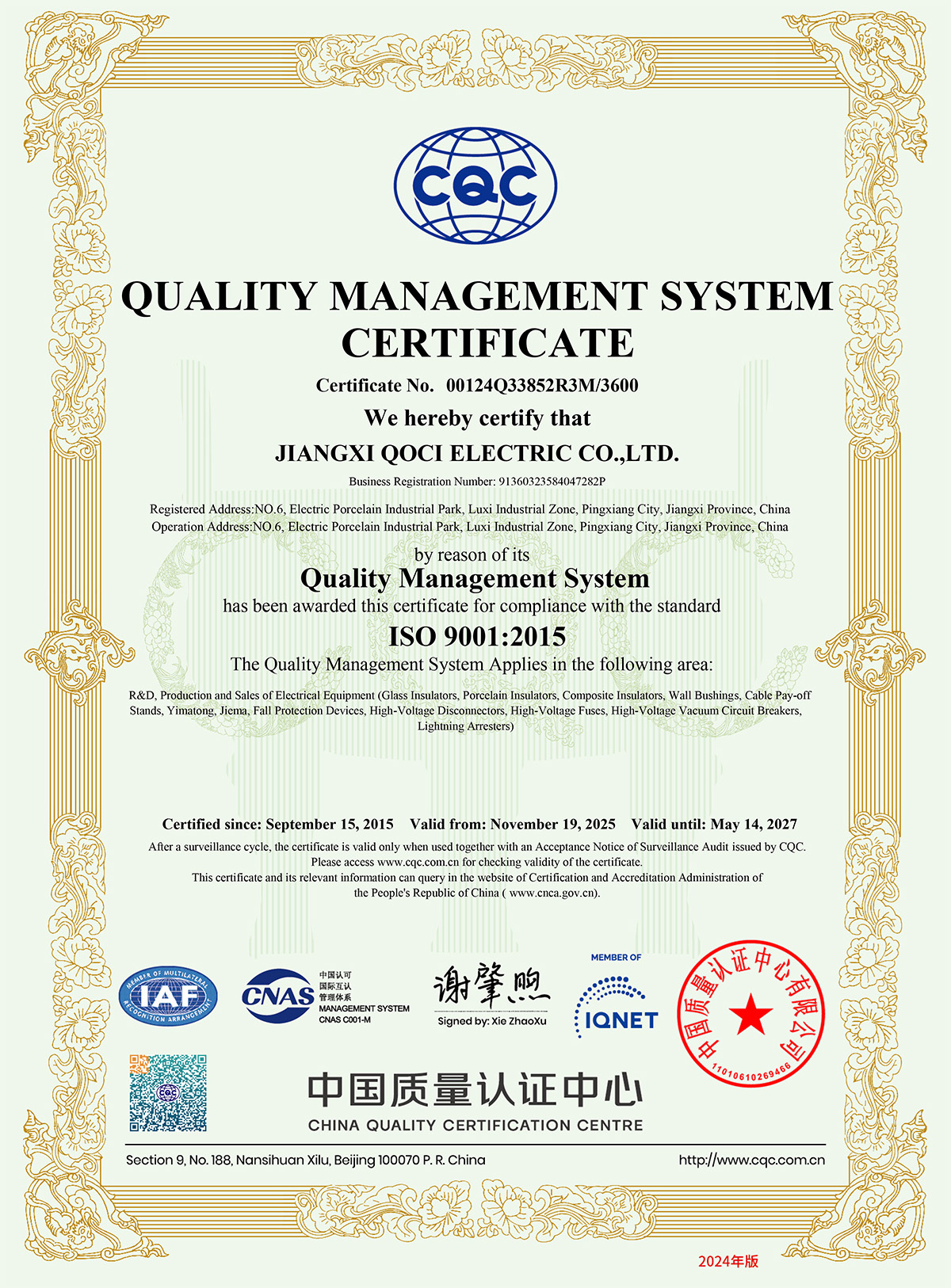
ISO 9001:2015 certificate No. 00124Q33852R3M/3600, valid to 14 May 2027 — one of the documents utility buyers request during supplier qualification.
For projects requiring customisation, the manufacturer provides OEM and ODM production services, with customisation available on voltage class and logo. Commercial parameters are equally concrete: minimum order quantity of 50 units, typical lead time of 15–35 days, quality control based on 100% pre-shipment testing plus third-party inspection (SGS), and after-sales support covering online technical guidance and replacement of defective products.
Step-by-Step: Matching a Suspension Glass Insulator to a Project
Step 1 — Define the line scenario in writing
Before any unit is named, the scenario should be fixed on paper: voltage class, whether the position is suspension or tension, span length and mechanical duty, pollution severity, dust behaviour, ambient temperature range, altitude, standard framework (IEC or ANSI dimensions) and inspection access. This step decides everything downstream. A 110 kV tangent tower in clean farmland and a 400 kV tension tower in an industrial corridor may look similar on a bill of materials, but they call for different mechanical classes and very different creepage.
Step 2 — Confirm that a suspension-type insulator is the right choice
Suspension disc units are used where conductors are carried on flexible strings, and where creepage and mechanical strength can be built up by adding or changing units in the string. That flexibility is the reason suspension strings dominate transmission-level construction. The material question — glass or porcelain — is normally answered by site conditions rather than preference. In dust-type pollution, the smooth glass surface sheds dust more readily, with dust accumulation reported at roughly half the rate seen on porcelain. Glass also gives a fail-safe benefit: on electrical failure the disc shatters visibly, so defects can be located by ground patrol and no live-line zero-value testing is required. Where chemical corrosion from acid, alkali or solvent exposure dominates instead, porcelain remains the more suitable material.
Step 3 — Match mechanical class, profile and creepage
With the scenario fixed, selection narrows quickly. Light tangent duty in clean areas sits in the 70–120 kN class; general transmission work typically lands on 160 kN; tension positions on long spans, crossings and heavy-conductor lines move into the 210–420 kN range. Creepage follows the environment: a 320 mm standard unit suits clean air, while polluted or dusty corridors need extended creepage, which is why units such as U120BLP (450 mm), U210BP (550 mm) and U420BP (620 mm) exist. Aerodynamic profiles with a 380 mm disc are used in high-dust conditions for self-cleaning behaviour, and double-shed versions combine higher creepage with a compact disc.
Step 4 — Filter suppliers on reliable toughened glass sourcing
The final step is where procurement risk is either absorbed or transferred. A qualified toughened glass supplier should be able to evidence mechanical reliability across the specified load class, control self-breaking through tempering process discipline, and provide IEC 60305 type-test documentation for the exact unit quoted. Practical checks that separate qualified suppliers from price-only offers:
- Automated tempering capability with 100% batch thermal shock testing per IEC 60305, including records of temperature differential (commonly specified at 70 K or above).
- Type-test evidence for mechanical failing load, power frequency withstand and impulse withstand voltage, matched to the model being purchased.
- Self-breaking performance data drawn from at least three years of field operation, measured against the industry benchmark of below 0.02% per year for well-controlled production.
- Verified production capacity and lead time against the project schedule — 750,000 units per month and a 15–35 day lead time at QOCI, for example.
- Agreed acceptance criteria: 100% pre-shipment testing plus third-party inspection such as SGS, with packaging designed to absorb transport shock.
- After-sales terms covering technical support and replacement of defective units.
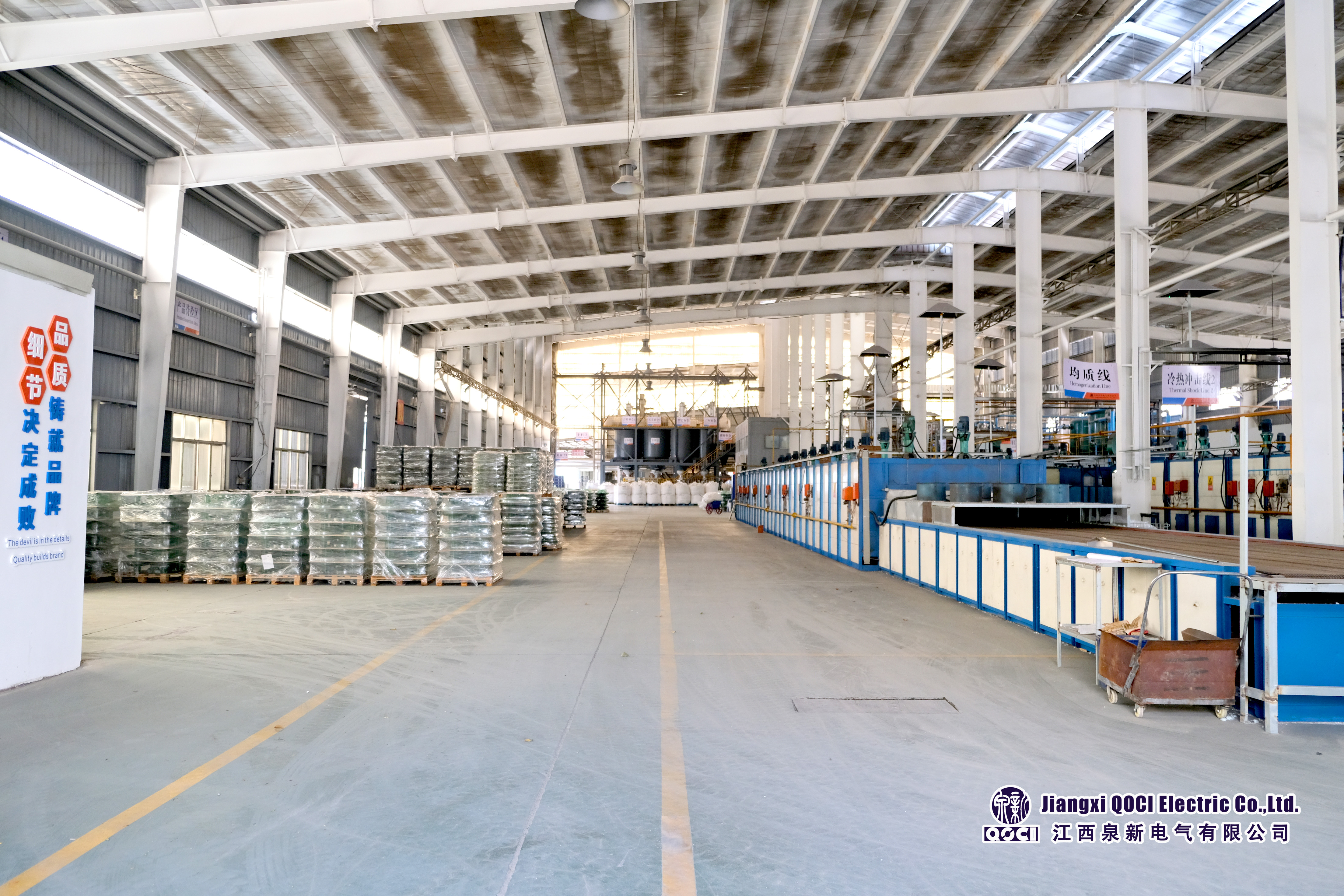
Thermal shock line at QOCI Electric — batch testing is the process step that controls self-breaking risk in toughened glass suspension insulators.
Use Cases: Where Each Configuration Fits
Desert and high-dust corridors. Dust accumulation drives both flashover risk and maintenance frequency. Aerodynamic profiles such as U70BA and U100BA use a 380 mm disc to improve self-cleaning, while double-shed units such as U160BLD offer 550 mm creepage in a compact format. Anti-dust self-cleaning behaviour was one of the factors recorded in desert project deployments.
Coastal and industrial pollution zones. Saline air and industrial emissions shorten effective creepage. Extended-creepage anti-pollution units are the standard answer — U70BLP and U120BLP at 450 mm creepage for lower load classes, U210BP at 550 mm and U420BP at 620 mm where larger conductors and heavier loads are involved. A 320 mm disc version of U70BLP providing 550 mm creepage is also available where greater creepage is needed at a lower mechanical class.
Long spans, river and valley crossings. These positions are tension duties. U210B (400 mm creepage), U240B (400 mm), U300B (485 mm creepage, 320 mm disc, 195 mm spacing) and U420B (550 mm creepage with an 80 kV wet power-frequency withstand) cover the heavy end of the range, with socket couplings stepping up to 28 mm on the largest unit.
Remote lines that are hard to inspect. Where access is difficult or live-line testing is impractical, the glass fail-safe mechanism matters more than unit price. Zero-value self-breaking enables 100% visual defect detection, with no live-line testing required.
Mixed-climate project portfolios. A single glass platform covering −40 °C to +60 °C suits portfolios that span cold continental and hot desert sites. In a supply programme covering Uzbekistan (80,000 pcs), Ukraine (70,000 pcs) and Iraq (50,000 pcs) — 200,000 suspension glass insulator units in total for UHV/EHV overhead line insulation in desert and industrial pollution zones — the recorded operating window was −40 °C to +55 °C. Reported outcomes from that programme include zero line-tripping incidents, a 70% reduction in maintenance cost, pollution flashover incidents reduced by 85% against a porcelain baseline, and a designed lifespan of 30+ years.
ANSI-specification projects. For lines specified to ANSI dimensions, the equivalent units are ANSI 52-3 (70 kN), ANSI 52-5 (120 kN), ANSI 52-8 (160 kN) and ANSI 52-11 (210 kN), covering 255–280 mm disc diameters and 320–400 mm creepage.
Comparison Tables
The first table maps project scenarios to configurations and the reference figures listed for QOCI units. The second compares four 70 kN class profiles on the same parameters so the effect of profile choice is visible side by side.
| Project scenario | Duty position | Configuration that fits | Verified reference figures |
|---|---|---|---|
| Clean rural and suburban lines, moderate spans | Tangent towers, vertical suspension strings | Standard profile, 70–120 kN class (U70B, U120B) | 70–120 kN failing load; 255 mm disc; 146 mm nominal height; 320 mm creepage; 45 kV wet power-frequency withstand; 130 kV lightning impulse withstand |
| General transmission lines, mixed terrain | Suspension and light tension strings | 160 kN standard profile (U160B) | 160 kN failing load; 280 mm disc; 360 mm creepage; 50 kV wet power-frequency withstand; 140 kV lightning impulse withstand |
| High-load tension strings, crossings | Dead-end and tension positions | 210–420 kN units (U210B, U240B, U300B, U420B) | 210 kN/400 mm creepage; 240 kN/400 mm; 300 kN/485 mm/320 mm disc; 420 kN/550 mm/360 mm disc; socket coupling 20–28 |
| Coastal and industrial pollution corridors | Suspension strings needing longer creepage | Anti-pollution units (U120BLP, U160BLP, U210BP, U420BP) | 120 kN/450 mm creepage; 160 kN/450 mm; 210 kN/550 mm/320 mm disc; 420 kN/620 mm/380 mm disc |
| Desert and high-dust corridors | Suspension strings where dust shedding matters | Aerodynamic and double-shed profiles (U70BA, U100BA, U160BSA, U160BLD) | 70–100 kN with 380 mm disc; 160 kN with 420 mm disc and 380 mm creepage; double-shed 160 kN, 340 mm disc, 550 mm creepage |
| ANSI-specification projects | Suspension strings to ANSI dimensions | ANSI 52-3, 52-5, 52-8, 52-11 | 70 kN, 120 kN, 160 kN, 210 kN; 255–280 mm discs; 320–400 mm creepage; 100–110 kV impulse withstand |
| Parameter (70 kN class) | U70B standard | U70BLP extended creepage | U70BA aerodynamic | U70BLD double-shed |
|---|---|---|---|---|
| Mechanical failing load | 70 kN | 70 kN | 70 kN | 70 kN |
| Nominal disc diameter | 255 mm | 280 mm | 380 mm | 280 mm |
| Nominal spacing | 146 mm | 146 mm | 127/146 mm | 146 mm |
| Creepage distance | 320 mm | 450 mm | 365 mm | 450 mm |
| Socket coupling | 16 | 16 | 16 | 16 |
| Dry lightning impulse withstand | 130 kV | 125 kV | 90 kV | 120 kV |
| Wet power-frequency withstand | 45 kV | 50 kV | 45 kV | 45 kV |
Values as listed for QOCI units; profile selection should follow the electrical and pollution requirements specified for the project. A 320 mm disc version of U70BLP providing 550 mm creepage is also listed for projects needing higher creepage at the same mechanical class.
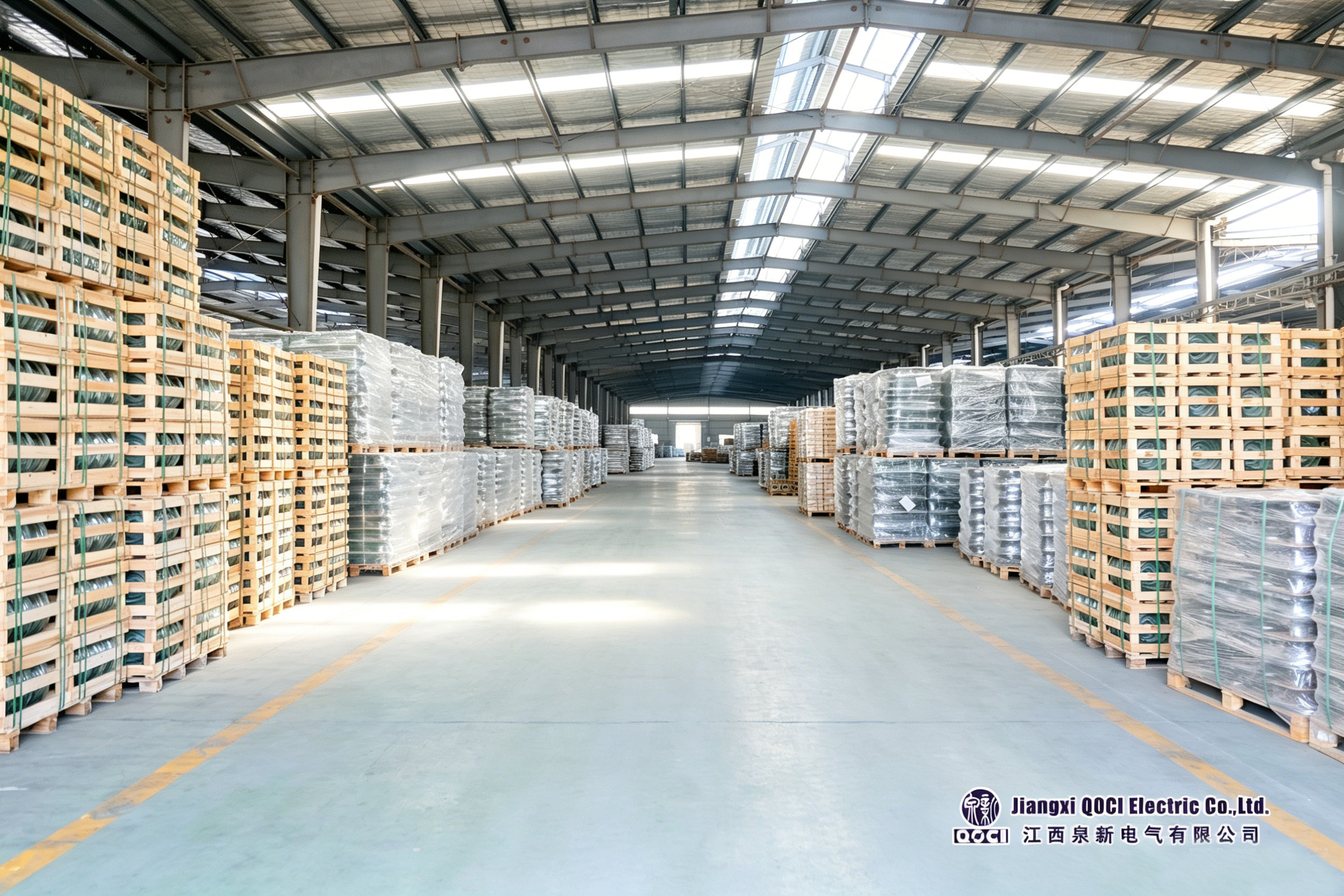
Finished goods staged for project delivery — monthly production capacity of 750,000 units supports sequenced transmission line shipments.
Frequently Asked Questions
Which standards should a suspension glass insulator supplier meet for utility transmission projects?
IEC 60305:2021 specifies the mechanical and electrical characteristics of string insulator units for AC overhead lines above 1000 V, and it is the baseline behind most utility type-test requirements; buyers working to Chinese frameworks commonly add GB/T 1001 for toughened glass insulators in AC systems. In practice, a supplier should be able to produce type-test evidence for mechanical failing load, thermal shock, power frequency and impulse withstand for the exact model quoted — for example a U70B unit, which is a 70 kN insulator with a 255 mm disc diameter and 146 mm nominal height. Management-system evidence is also requested during qualification: Jiangxi QOCI Electric Co., Ltd. holds ISO 9001:2015 certificate No. 00124Q33852R3M/3600 valid to 14 May 2027, plus ISO 14001:2015 certificate No. 00125E30701R3M/3600 and ISO 45001:2018 certificate No. 00125S30581R3M/3600, both valid to 24 March 2028.
Can a manufacturer supply OEM U70B glass insulators for utility orders?
Yes. Jiangxi QOCI Electric Co., Ltd. provides OEM and ODM production services with customisation on voltage class and logo, a minimum order quantity of 50 units, a monthly production capacity of 750,000 units and a typical lead time of 15–35 days. The same production platform covers the wider suspension range from U70B and U120B through U160B, U210B, U240B, U300B and U420B, together with anti-pollution, aerodynamic, double-shed and ANSI 52-series units, so a utility programme can be supplied from one qualified source instead of multiple vendors.
What are the purchasing and acceptance terms for bulk suspension glass insulator orders?
Standard commercial terms are a minimum order quantity of 50 units, delivery term FOB Shenzhen, and payment of 30% deposit by T/T before production with the 70% balance by T/T before delivery. Acceptance is based on pre-shipment testing combined with third-party inspection (SGS). For projects with staged construction schedules, these terms can be aligned to shipment sequencing so that insulator deliveries match tower erection progress rather than arriving in a single block.
How is quality verified before shipment, and how should a self-broken unit be treated in service?
Quality control covers 100% pre-shipment testing plus third-party inspection (SGS), supported by batch thermal shock testing during production. In service, a toughened glass unit that suffers electrical failure self-breaks visibly: the disc shatters while the metal cap and pin retain mechanical load-bearing capacity, so the string does not lose its mechanical integrity. The unit loses electrical insulation and should be replaced at the next scheduled maintenance window. Because the failure is visible, routine ground patrol is sufficient for detection and no live-line zero-value testing is required — which is why field operation data from at least three years is a reasonable qualification requirement, measured against an industry benchmark self-breaking rate below 0.02% per year.
What lead time and after-sales support apply to transmission line insulator supply?
Typical lead time is 15–35 days depending on quantity and customisation, and after-sales support covers online technical support plus replacement of defective products. Production capacity of 750,000 units per month allows larger transmission programmes to be scheduled without long interruptions between shipments. To move from evaluation to execution, request a quotation or start a technical review of the line scenario with the manufacturer: Jiangxi QOCI Electric Co., Ltd., www.quanxinelectric.com, email admin@qocielectric.com, phone +86 079-9761-6589. The full glass insulator range and specifications are available in the QOCI glass insulator catalogue.
Conclusion: Fit the Unit to the Line, Then Fit the Supplier to the Order
Suspension glass insulators fit transmission line projects wherever conductors need insulated mechanical support — on tangent towers, at tension and dead-end positions, in clean rural corridors and in polluted or dusty environments. What changes from project to project is the mechanical class, the profile, and the creepage distance required by the site: 70–120 kN standard units for light duty, 160 kN for general transmission, 210–420 kN for heavy tension duty, extended-creepage units up to 620 mm for polluted corridors, and aerodynamic or double-shed profiles where dust and inspection access drive the decision.
Because the decision chain ends at the supplier, qualification deserves the same rigour as selection. Tempering process control, 100% batch thermal shock testing, current IEC 60305 type-test evidence, documented field performance and agreed acceptance criteria determine whether the specified performance survives into the delivered order. Jiangxi QOCI Electric Co., Ltd. manufactures the full toughened glass suspension range from a 35,373 m² facility with monthly capacity of 750,000 units, holds ISO 9001:2015, ISO 14001:2015 and ISO 45001:2018 certification, and supports utility projects with OEM and ODM production, a 50-unit minimum order quantity, and a 15–35 day lead time.
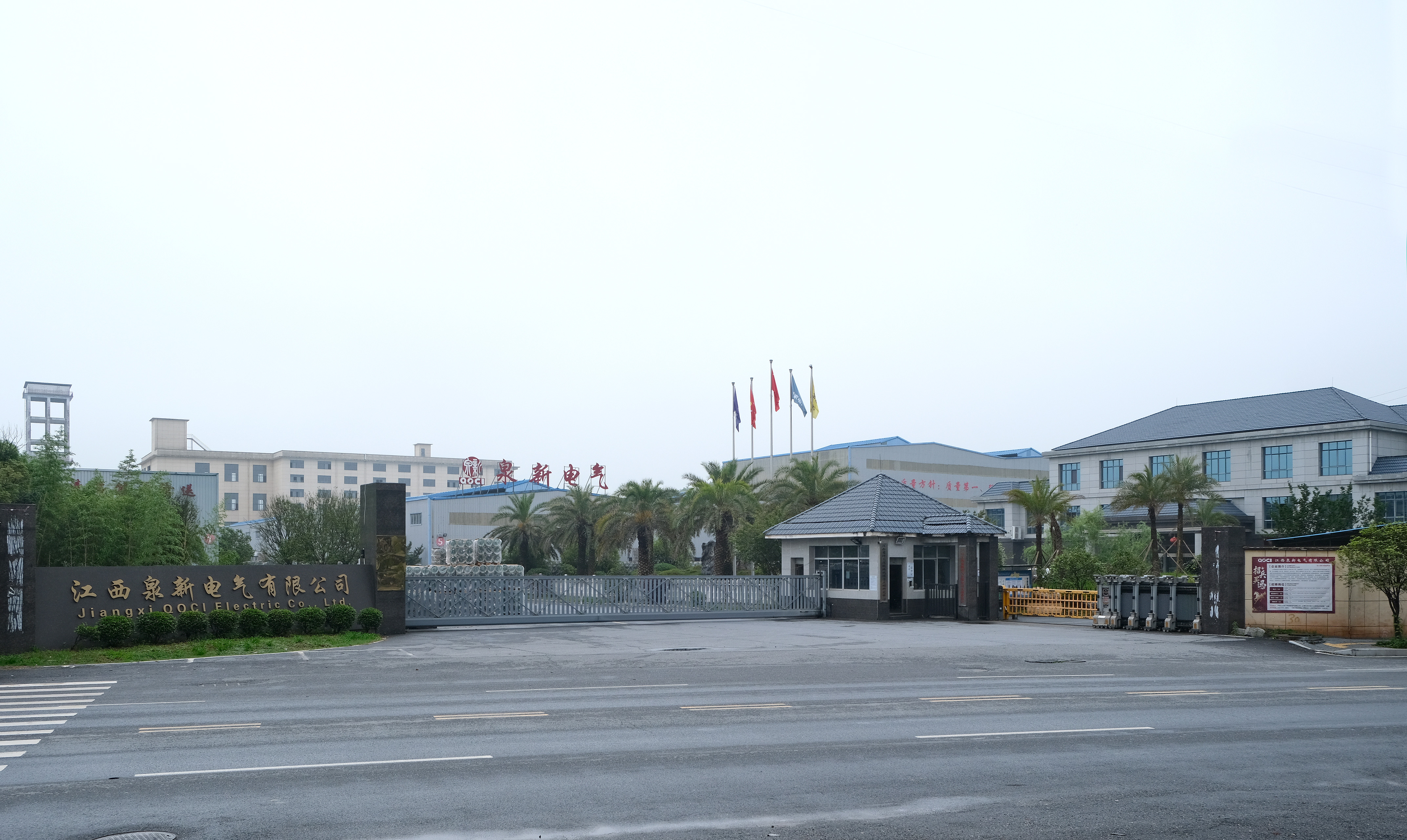
Jiangxi QOCI Electric Co., Ltd., Luxi Industrial Park, Pingxiang, Jiangxi — manufacturing glass and porcelain insulators since December 2002.
Next step: send your line scenario — voltage class, duty position, pollution level and temperature range — and request a matched unit recommendation, sample discussion or quotation through www.quanxinelectric.com, or download the QOCI glass insulator catalogue for the complete model and parameter list.