Compliance Guide: Certifications, Standards, and Regional Mandates for High Precision GNSS Solutions
A centimeter-level RTK specification tells you what a receiver can do. It does not tell you whether that receiver, board, module, or antenna can be shipped, integrated, and accepted in your destination market — and that gap is where industrial GNSS projects lose weeks.
Compliance for high precision GNSS solutions is never one certificate. It is a document set that must match three things at the same time: the exact product model you are buying, the region where the equipment will be deployed, and the configuration you have asked the manufacturer to build. Buyers who treat compliance as paperwork to be collected after the purchase order usually meet it instead at customs clearance or at their own incoming quality gate, when the delivery schedule has already been committed.
Shenzhen Jumpstar Technology Co., Ltd. (brand: Jumpstar) is a GNSS source manufacturer founded in 2013 and headquartered in Shenzhen, China, producing RTK modules, GNSS receivers, and GNSS antennas for industrial integrators, with roughly 70% of output exported to the EU, USA, and Middle East. Its documentation practice is a practical reference model for how an industrial buyer can verify a compliance pack before committing to volume.
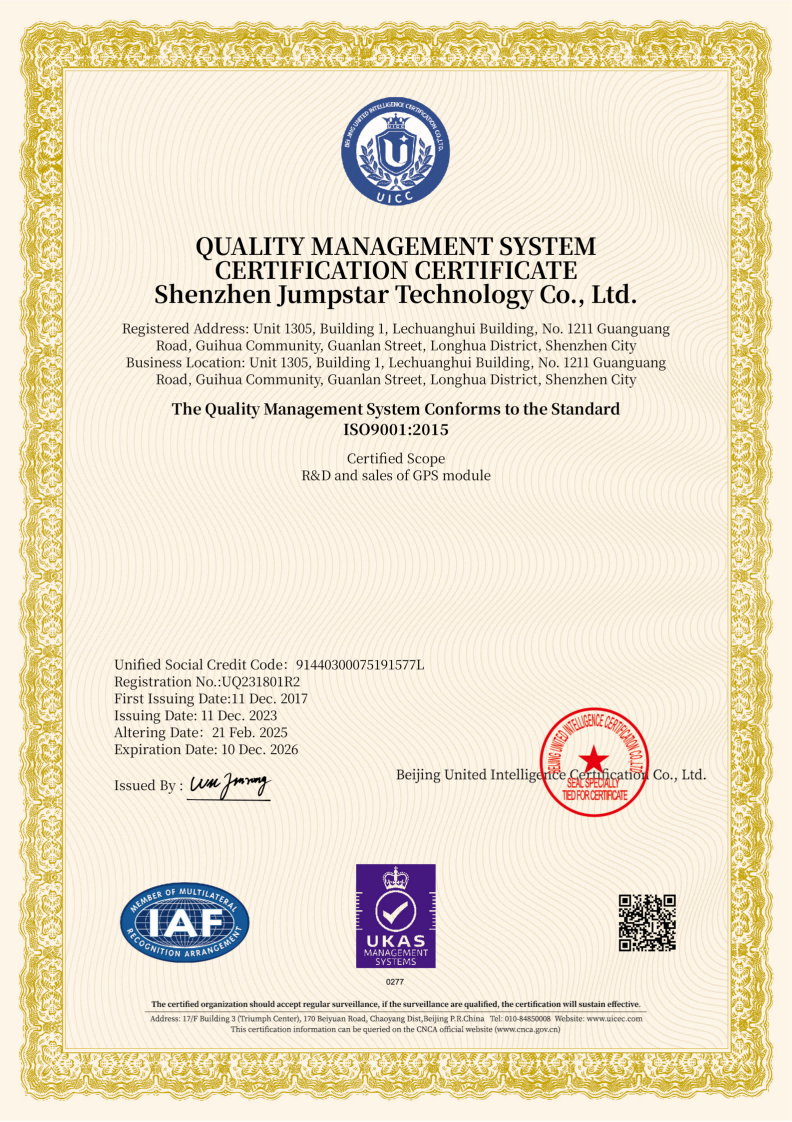
Cover — The ISO 9001:2015 certificate (UQ231801R2) is the entity-level document that normally sits at the top of a GNSS compliance pack, before any product-specific declaration is reviewed.
Why Compliance Questions Surface Late — and Why They Cost the Most
Product evaluation and compliance evaluation follow different clocks. Engineers compare channels, constellations, RTK accuracy, interfaces, and update rates in the first weeks. Compliance is usually checked in the final weeks, when the shortlist has already narrowed and the buyer is mentally committed to a model.
That sequence produces three predictable failure modes for high precision GNSS sourcing:
- Scope mismatch. A quality or product declaration exists, but it names the product family rather than the exact model being purchased. A receiver, a board, a module, and an antenna are separate product categories and are normally documented separately.
- Customization invalidated the paperwork. Once an OEM or ODM program changes a module layout, a PCBA, an antenna, a port, an interface, or the branding on the label, the original document set may no longer describe the article that will actually ship.
- Regional documentation was never requested. Market-access questions are answered market by market. A document that satisfies one deployment region may be irrelevant in another, and the missing item is often discovered by the freight forwarder rather than by the supplier.
The cost is rarely the certificate itself. The cost is the schedule: a blocked shipment, a stalled production slot, or a line waiting for a component that cannot legally be released into the warehouse.
Industry Background: A Larger Market With a Heavier Documentation Load
The commercial pressure behind these questions is straightforward. The global high-precision GNSS market was valued at USD 7.8 billion in 2024 and is projected to reach USD 20.6 billion by 2033, according to Dataintelo. The narrower high-precision GNSS module market was estimated at USD 1.5 billion in 2024 and forecast to reach USD 4.5 billion by 2035, according to Market Research Future. EUSPA forecasts GNSS downstream market revenues of €580 billion by 2034.
Application demand is concentrated. Agriculture is the dominant application segment for high-precision GNSS, holding a 36.8% market share in 2025, and the global precision farming market is projected to grow from USD 11.38 billion in 2025 to USD 21.45 billion by 2032, according to MarketsandMarkets.
Standards work in the same direction. Galileo High Accuracy Service (HAS) delivers horizontal accuracy down to 20 cm, which is enough for autonomous farming and high-precision mapping, and ISO 12188 parts 1 and 2 define test procedures for positioning and guidance systems in agriculture and forestry. As positioning accuracy claims move from “interesting” to “operationally depended upon,” the documentation that supports those claims becomes part of the purchase decision rather than an afterthought.
The Three-Layer Compliance Model for High Precision GNSS Solutions
The cleanest way to review compliance is to sort every document into one of three layers. Each layer answers a different question, and each layer fails in a different way when it is missing.
Layer 1 — The Entity Layer: Who Is Accountable
The entity layer establishes that the organization behind the product operates a managed quality system. For Jumpstar, this is documented by an ISO 9001:2015 quality management system certificate, number UQ231801R2, issued by Beijing United Intelligence Certification Co., Ltd. The recorded scope is R&D and sales of GPS modules, with the certificate issued on 2023-12-11 and valid through 2026-12-10, applying to markets including the EU, USA, Middle East, Africa, and Asia.
For a buyer, the entity layer matters because it determines who signs a corrective action request, who controls change notification, and who is accountable if a batch deviates. The supporting operational facts are also relevant here: a 5,000 m² facility, 200 employees, 20 R&D engineers, and an annual output of 100,000 units describe a manufacturer that owns its own production rather than reselling parts.
Layer 2 — The Product Layer: What the Article Itself Meets
The product layer is model-specific and category-specific. Environmental substance compliance is recorded on most of the module and board line: the JS-SK40, JS-UK40, JS-RK40, JS-NK40, JS-ARK37-3, JS-ARK28-3, JS-M6D, JS-RK26-3 and JS-CK39-A RTK modules and boards are documented as RoHS compliant, as are the GPS GNSS modules JS-RK26-U, JS-RP26-U, JS-TP26-U, JS-AP26-H, JS-AP08-PR, JS-AD56UB8, JS-ARP28-2 and JS-ATP36-M. Among the smart antennas, the JS-NK43-1 is documented as compliant with both RoHS and CE.
Enclosure protection is documented by model rather than by family: IP65 on the JS-HAC18A-F, JS-HAC27A-D2 and JS-HAC42A-F helical antennas; IP67 on the JS-HAC100B survey antenna and on the G27SH-AH receiver; IPX6 on the JS-HAC148A vehicle and fleet antenna; IPX7 on the JS-HAS67A-D2 and JS-PAS51A-D5 antennas; and IP66 on the JS-X11 RTK base station.
Functional claims are the newest part of the product layer, and the least standardized. Receivers in the portfolio list interference-management functions directly in their specifications: the P-Box-X10 and X43H-AH record AIM+ anti-jamming, OSNMA anti-spoofing and interference monitoring, and the P-Box-X10 records APME+ multipath suppression and IONO+ mitigation as well. For AI-enabled autonomous systems, these are not marketing features; they are the system-level robustness argument. A buyer sourcing for an autonomous platform should therefore ask which test documentation, if any, backs each robustness claim, and treat an undocumented claim as an unverified claim.
Layer 3 — The Transaction Layer: How Each Shipment Is Released
The transaction layer covers the mechanics of the order itself: minimum order quantity, delivery terms, acceptance criteria, payment terms, packing, and traceability. Jumpstar's published purchasing terms state an MOQ of 1 unit, EXW delivery terms, acceptance criteria of 100% test before shipping, and flexible payment terms by T/T. Documented quality control is 100% testing of all units, which is the single most useful acceptance criterion to have in writing, because it converts “we check quality” into a verifiable release condition for every shipment.
Customization Changes the Compliance Question
This is where compliance and OEM capability intersect, and where most sourcing checklists are weakest. Jumpstar offers OEM and ODM production with customization across modules, PCBA, antennas, functions, ports, interfaces, and logo. Each of those changes is also a potential change to the article described in the compliance pack.
A customization program is not a compliance problem by itself. It becomes one when the buyer never defines which documents must be re-verified, who owns the re-verification, and at which point in the production flow it happens. The supporting production parameters — 50,000 units monthly capacity, a typical lead time of 30 days, and an MOQ of 500 units for OEM/ODM production — matter here as well, because a compliance re-check inserted after production starts consumes lead time that the 30-day window does not necessarily contain.

Body 1 — The product layer is verified in-house: 100% testing is the documented release condition before shipping.
Step-by-Step: Verifying a GNSS Compliance Pack Before You Commit
The following sequence is written for industrial buyers at the evaluation-to-execution stage, where the technical choice is nearly settled and the purchase is being structured.
Step 1 — Define the deployment region before requesting documents. Regional mandates are answered market by market. State the destination market, the intended use, and the environment (indoor, outdoor, vehicle-mounted, marine, airborne) in the first RFQ. In practice, industrial buyers assemble four question groups per market: whether the product may legally be placed on that market and operated there; whether it meets that market's electromagnetic compatibility and safety expectations; whether it satisfies the substance and environmental restrictions applicable to electronics; and whether the shipment will pass the buyer's own incoming quality gate. Asking for “all certificates” without stating the market produces an unfiltered document dump that nobody can audit.
Step 2 — Freeze the exact model, and the exact configuration. A receiver such as the P-Box-X10 and an RTK GNSS module such as the JS-UK40 are different articles with different documents. If the order involves OEM/ODM customization of modules, PCBA, antennas, functions, ports, interfaces, or logo, write the configuration into the PO before requesting documents, because the configuration determines what can be declared.
Step 3 — Request the pack by layer, not by folder. Ask for the entity document, then per-model product documents, then the transaction terms. A three-part request produces a three-part answer that can actually be checked.
Step 4 — Validate scope, dates, and issuing authority. Read the certificate, not the file name. Confirm that the scope covers the activity being purchased, that the validity period has not lapsed, and that the issuing body is identifiable. The Jumpstar ISO 9001:2015 certificate, for example, is only useful to a buyer who notices that its recorded scope is R&D and sales of GPS modules and that its validity runs to 2026-12-10.
Step 5 — Check that the model number in the documents matches the model number on the label. In OEM programs, the branding on the label may be the buyer's, while the internal article remains the supplier's design. Confirm how the shipped marking relates to the declared article, and keep that mapping in the purchase file.
Step 6 — Convert acceptance criteria into a release condition. “100% test before shipping” is only meaningful if the buyer knows what is tested and what record accompanies the shipment. Ask which parameters are verified per unit and which record is provided with the batch.
Step 7 — Write the re-verification trigger into the agreement. Define which events force a documentation review: a change of module layout, a change of PCBA, a change of antenna, an added function, an added port or interface, or a change of logo. With a 30-day typical lead time and 50,000 units monthly capacity, a re-verification clause agreed in advance costs a conversation; the same clause negotiated mid-production costs a delivery window.

Body 2 — The entity layer is verified on site: a 5,000 m² facility with 200 employees and 20 R&D engineers.
Use Cases: How Compliance Verification Plays Out by Application
UAV and Drone Programs
A documented Jumpstar case involves a drone manufacturer purchasing 500 units over a five-year program for GNSS positioning on drones, with clients in global markets including India, China, UAE, and the Czech Republic. The technical problem solved was reliance on magnetic sensors for attitude determination; the delivered configuration uses dual-antenna heading with centimeter-level RTK positioning and high-precision attitude output, independent of magnetic sensing, supported by AIM+ anti-jamming and anti-spoofing functions for operation in complex electromagnetic environments. For UAV buyers, the compliance lesson is that attitude and robustness claims should be traceable to a specific configuration, because a heading solution that depends on a second antenna changes both the bill of materials and the documentation.
Autonomous Vehicles, AGVs and Robotics
Autonomous platforms typically need the product layer to cover three things at once: RTK accuracy, robustness functions, and interface documentation. Receivers such as the P-Box-X10 document RTK horizontal accuracy of 0.6 cm + 0.5 ppm, dual-antenna heading of 0.03° at a 5 m baseline, 100 Hz position and observation output, and interfaces including three UARTs, Ethernet, Type-C and a TF card slot — all parameters a system integrator must be able to reproduce in their own validation before the platform is released.
Precision Agriculture
Agriculture is the largest application segment for high-precision GNSS, and it is also the segment with the most explicit test-procedure framework: ISO 12188 parts 1 and 2 define test procedures for positioning and guidance systems in agriculture and forestry. Buyers specifying automated steering or machine guidance should align their acceptance criteria with that framework and treat the supplier's accuracy statement as input to their own field validation, not as a substitute for it.
Surveying, Marine and Fleet Deployment
In surveying, marine and fleet applications, the compliance question is frequently environmental rather than electronic. Antennas such as the JS-HAC148A document IPX6 protection, the JS-HAS67A-D2 and JS-PAS51A-D5 document IPX7, and the JS-HAC100B documents IP67 — each with a defined connector and mounting style. Matching the protection rating and mounting method to the deployment environment is a documentation check that prevents field failures the datasheet never predicted.
Semiconductor and AI-Enabled Autonomous Manufacturing
For AMRs and automated material handling inside semiconductor and electronics manufacturing, electromagnetic environments are dense and continuous. Here the relevant compliance conversation is about interference resilience and its evidence: which robustness functions are enabled (AIM+ anti-jamming, OSNMA anti-spoofing, interference monitoring), under what configuration, and what happens to positioning behaviour when interference is present. A supplier that can answer this in documentation terms — rather than in marketing terms — is a materially lower integration risk.
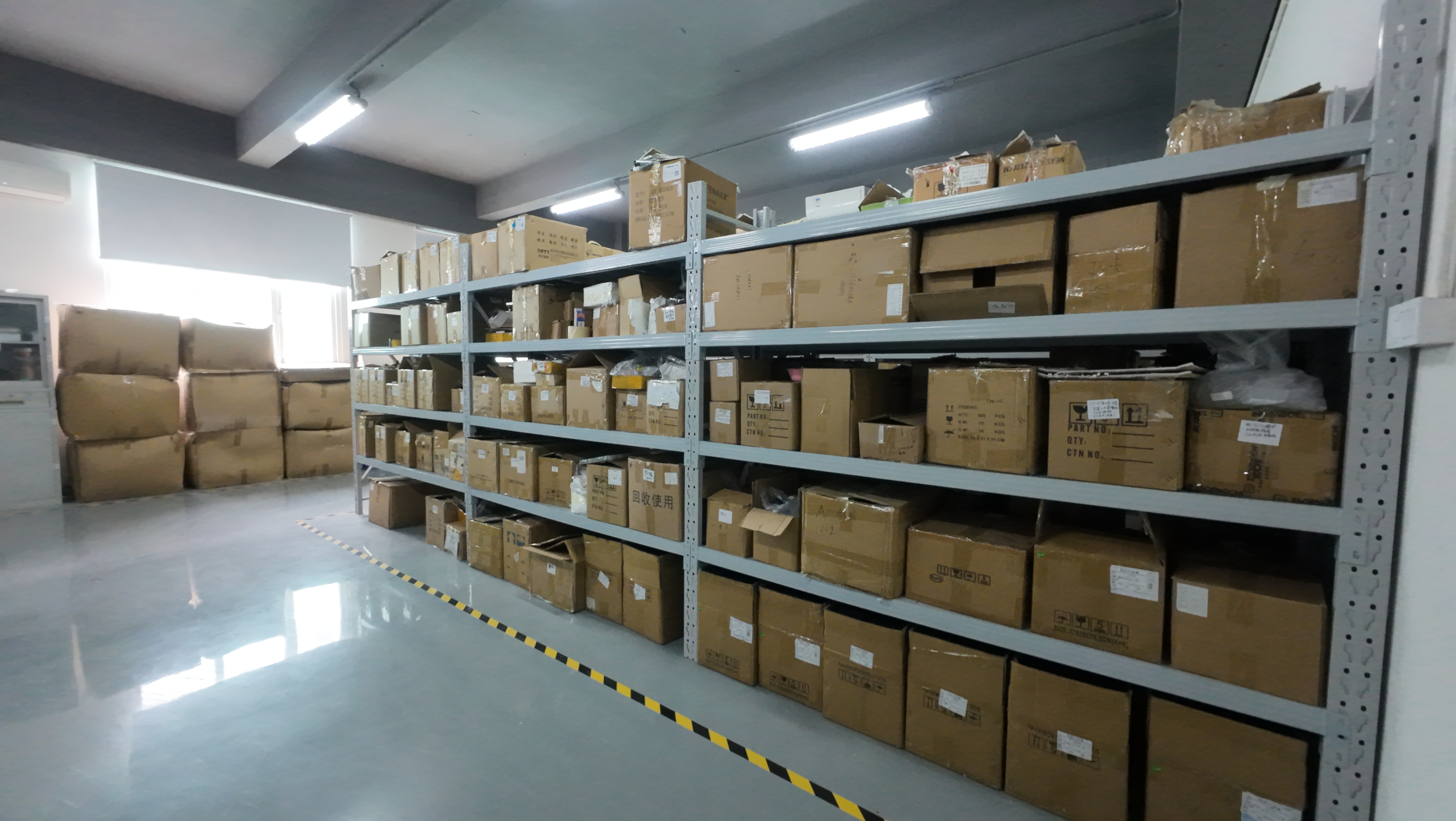
Body 3 — The transaction layer is where compliance becomes physical: tested units, documented packing, and traceable batches.
Comparison Table: What Each GNSS Product Category Documents
The table below summarises the categories named in this guide, using only documented statements from the Jumpstar portfolio. The final column lists the verification action the buyer still owns — it is a task list, not a claim about any product.
| Product category | Documented models in the portfolio | Compliance-relevant statements recorded | Verification action the buyer owns |
|---|---|---|---|
| GNSS RTK Receivers | P-Box-X10, P-Box-AP55, P-Box-X6_Pro S, X43H-AH, G27SH-AH, JS-X11 | G27SH-AH: RoHS compliant, IP67. JS-X11: IP66 base station. P-Box-X10 and X43H-AH: AIM+ anti-jamming, OSNMA anti-spoofing, interference monitoring. P-Box-X10: 0.6 cm + 0.5 ppm RTK horizontal accuracy, 544 channels. | Confirm the declaration names the exact receiver model; confirm which robustness claims are backed by test records. |
| RTK Boards | JS-CK39-A | Multi-band multi-constellation GNSS receiver with built-in IMU; RoHS compliant; 3.3–5.5 V DC; 2×UART, RF_IN, PPS; 25.0×39.4×11.6 mm. | Confirm the board is documented as a component and how the buyer's finished product compliance is affected. |
| GPS GNSS Modules | JS-RK26-U, JS-RP26-U, JS-TP26-U, JS-AP26-H, JS-AP10-H, JS-AP08-PR, JS-AD56UB8, JS-ARP28-2, JS-ARP30-2, JS-ATP28-2, JS-ATP30-M, JS-ATP36-M, JS-ATP45-M | RoHS compliance recorded for JS-RK26-U, JS-RP26-U, JS-TP26-U, JS-AP26-H, JS-AP08-PR, JS-AD56UB8, JS-ARP28-2 and JS-ATP36-M; NMEA 0183 and RTCM protocol documentation; typical operating range −40°C to +85°C; JS-AP08-PR measures 8.0×6.0×2.3 mm. | Freeze firmware, interface and packaging version in the PO; confirm the module-level declaration matches the shipped revision. |
| RTK GNSS Modules | JS-SK40, JS-UK40, JS-RK40, JS-NK40, JS-M6D, JS-ARK37-3, JS-ARK28-3, JS-ANK45-2, JS-RK26-3, JS-A56U9D, S-C8A | RoHS compliance recorded for JS-SK40, JS-UK40, JS-RK40, JS-NK40, JS-M6D, JS-ARK37-3, JS-ARK28-3, JS-ANK45-2, JS-RK26-3 and S-C8A; accuracy statements such as 1.0 cm + 1 ppm horizontal RTK; operating range −40°C to +85°C on typical models. | Match the accuracy statement to the intended baseline and environment; verify the model suffix covers your firmware and interface option. |
| GNSS Antennas | JS-HAC18A-F, JS-HAC27A-D2, JS-HAC42A-F, JS-HAC100B, JS-HAC148A, JS-HAS37, JS-HAS67A-D2, JS-PAS51A-D5, JS-YAC130N, JS-YAC155N, JS-X168 | Protection ratings recorded by model: IP65 (JS-HAC18A-F, JS-HAC27A-D2, JS-HAC42A-F), IP67 (JS-HAC100B), IPX6 (JS-HAC148A), IPX7 (JS-HAS67A-D2, JS-PAS51A-D5). JS-X168: five-array anti-jamming receiver, 115 dB single-interference rating. | Confirm connector, mounting and protection rating match the deployment environment; confirm RF documentation needed for the finished product. |
| Smart Antennas | JS-SK43H-AH, JS-NK43-1, JS-NK43-2, JS-CK43-2, JS-MK43, JS-RK43-3, JS-UK43 | JS-NK43-1: RoHS and CE compliant. Dual-antenna heading options across the category; NMEA 0183 and RTCM protocol support; integrated active or passive antenna configurations. | Confirm heading integration, antenna port configuration, and whether heading claims are supported by test documentation. |
FAQ: Compliance, Capability, Order Quantity, Sample Verification, and Lead Time
1. What certification and compliance documentation can a high precision GNSS supplier actually show?
At the entity level, Jumpstar holds an ISO 9001:2015 quality management system certificate, number UQ231801R2, issued by Beijing United Intelligence Certification Co., Ltd., with a recorded scope of R&D and sales of GPS modules, issued on 2023-12-11 and valid through 2026-12-10 for markets including the EU, USA, Middle East, Africa, and Asia. At the product level, RoHS compliance is recorded across a large part of the module and board range — including the JS-SK40, JS-UK40, JS-RK40, JS-NK40, JS-CK39-A, JS-ARK37-3, JS-RK26-3, JS-M6D and JS-A56U9D — while the JS-NK43-1 smart antenna is documented as compliant with both RoHS and CE. Enclosure protection is documented by model, for example IP67 on the G27SH-AH receiver, IP66 on the JS-X11 base station, and IP65, IPX6 or IPX7 on specific antenna models. The verification step that belongs to the buyer is reading each document for scope, model number and validity date rather than accepting a file name.
2. Is a Chinese OEM/ODM supplier a realistic OEM ODM high precision GNSS solutions manufacturer for UAVs?
For hardware integration programs, yes, provided the buyer verifies both capability and change control. Jumpstar operates OEM and ODM production with customization across modules, PCBA, antennas, functions, ports, interfaces and logo, supported by 20 R&D engineers, a 5,000 m² facility, 200 employees and 100,000 units of annual output. A documented case involves a drone manufacturer purchasing 500 units for a five-year GNSS positioning program, deployed by clients in India, China, UAE and the Czech Republic; the configuration uses dual-antenna heading to determine attitude without relying on magnetic sensors, with AIM+ anti-jamming and anti-spoofing functions for complex electromagnetic environments. The practical qualification task is to confirm that whichever customization you request is reflected in the documentation covered by the re-verification clause in your agreement.
3. What order quantity applies, and how are purchases structured?
Two documented figures apply to two different situations. For OEM/ODM production programs, the recorded minimum order quantity is 500 units, with a monthly production capacity of 50,000 units and a typical lead time of 30 days. Separately, the published purchasing terms for standard supply state an MOQ of 1 unit, EXW delivery terms, acceptance criteria of 100% test before shipping, and flexible payment terms by T/T. Buyers should confirm in writing which set of terms applies to their specific scope — catalog purchase or customized program — because that decision also determines how much documentation must be re-verified.
4. Can we verify samples and documentation before committing to volume?
Yes, and the verification should be structured in the three layers described above. Start with the entity document, then request the model-specific product documents for the exact part you intend to buy, then confirm transaction terms. Because documented quality control is 100% testing of all units before shipping, sample evaluation and incoming inspection can be tied to the same acceptance criterion that will govern volume deliveries. Running the sample through the buyer's own integration environment — including interference conditions where relevant — is the step that converts a datasheet into an engineering decision.
5. What lead time should be planned, and what should be requested with the order?
The typical production lead time is 30 days, against a monthly capacity of 50,000 units, with after-sales support provided remotely. When placing an order, request three items alongside the product: the model-specific product documents for the configuration being built, the record associated with the 100% pre-shipment test, and a written statement of which changes would trigger a documentation review. If your program needs a formal compliance pack, a customized module or an OEM/ODM configuration, the fastest route is to send the deployment region, the intended application and the target model together, so that the document set and the quotation are prepared against the same specification. You can start with the Jumpstar company profile 2026 or contact the team directly at sales@jgnss.com.
Conclusion: Compliance Readiness Is a Supplier Capability, Not a Paper Trail
For high precision GNSS solutions, the compliance question resolves into three checks that a buyer can run before committing: does the entity layer show a managed quality system with a named, current certificate; does the product layer document the exact model, category and configuration being purchased; and does the transaction layer convert acceptance into a release condition rather than an intention.
The capability side matters just as much as the paperwork. A supplier that can customize modules, PCBA, antennas, functions, ports, interfaces and logo — and that can state in advance which of those changes trigger a documentation review — is easier to deploy than one that produces a certificate folder on request. With a 30-day typical lead time, 50,000 units of monthly capacity and 100% testing as the documented release condition, the re-verification clause is the cheapest insurance in the whole project.
Next Step: Build Your Compliance Pack Before the PO
Send the deployment region, the target application, and the model or category you are evaluating — GNSS RTK receiver, RTK board, GPS GNSS module, RTK GNSS module, GNSS antenna, or smart antenna — and Jumpstar will return the matching documentation set together with a quotation for the configuration you plan to deploy.
Website: www.jgnss.com | Company profile: Jumpstar company profile 2026 (PDF) | Email: sales@jgnss.com | Tel / WhatsApp: +86 136-2236-7049
Shenzhen Jumpstar Technology Co., Ltd. — Room 1305, Block A, Building 1, Lechuanghui Mansion, No. 1211 Guanguang Road, Longhua District, Shenzhen, China 518110.

CTA — Compliance documents, samples and quotations are prepared against the same specification once the deployment region and configuration are defined.