
RTK Receiver vs. RTK Board vs. RTK Module vs. Smart Antenna: Which Form Factor Fits?
All four GNSS form factors can deliver centimeter-level positioning. What actually separates them is how much of the antenna design, RF layout, firmware integration, enclosure, certification scope and field maintenance stays with your team after the purchase order. Choosing at form-factor level is therefore a resourcing decision as much as a technical one, and it is the decision this comparison is built to support.
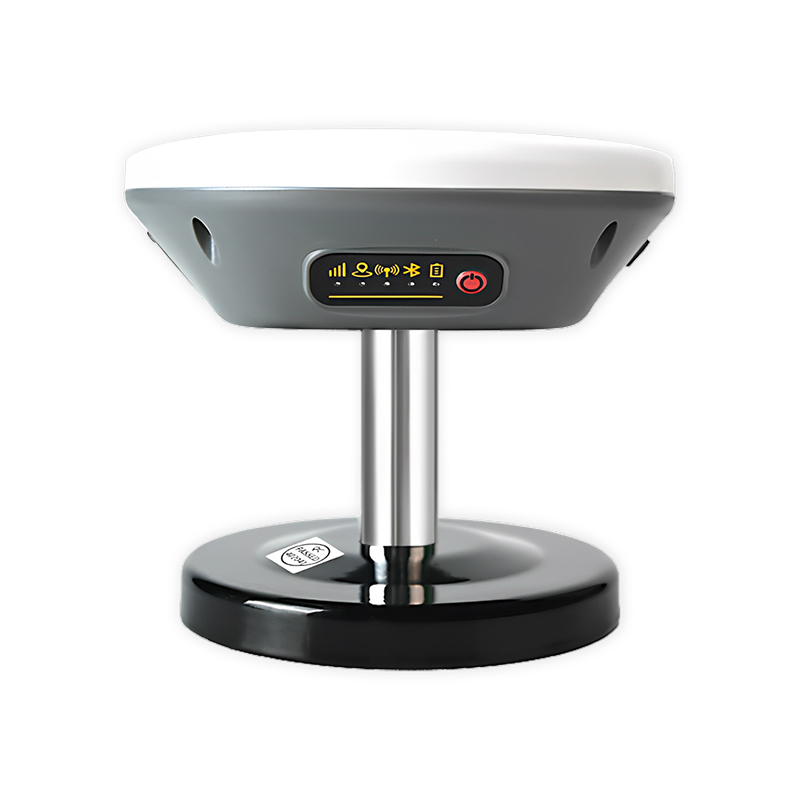
Figure 1: The form factor you buy determines how much RF, firmware and mechanical work stays inside your own design.
The Problem: A Form-Factor Mismatch Is Expensive to Reverse
Most high-precision GNSS integration problems are not caused by a weak satellite engine. They come from buying a component whose surrounding work the buying team cannot absorb. Three failure modes repeat across projects:
- Antenna and RF work treated as an afterthought. A bare module or an OEM board transfers RF layout, grounding, filtering and multipath behaviour onto your design. If there is no RF engineer on the team, that transfer becomes a schedule risk rather than a saving.
- Firmware and correction-service mismatch. Correction transport (for example NTRIP) and message formats (for example RTCM 3.0 to 3.3) have to match the receiver firmware and the correction provider service. A component that fits the mechanical envelope but not the protocol stack forces a redesign.
- Mechanical and environmental re-spin. A module that meets the accuracy target on a bench can still fail a vibration, humidity or temperature qualification once it sits inside your enclosure.
Procurement adds a fourth, quieter failure mode: comparing unit prices across form factors without normalising scope. An RTK receiver and an RTK module are not the same purchase. One may include antenna, connector, enclosure, cable set and factory testing, while the other leaves all of that inside your bill of materials and your engineering hours. Any comparison that ignores this difference is not a comparison of like with like.
Industry Background: Why the Form-Factor Question Is Being Asked More Often
The economics of positional accuracy have changed. The global GNSS market was reported at USD 335.04 billion in 2025 and projected to reach USD 844.55 billion by 2034 (Fortune Business Insights, as recorded in the verified data package for this category). The high-precision segment is narrower but already substantial: the high-precision GNSS receiver market was valued at USD 3.10 billion in 2025 (Data Insights Reports).
Two technical shifts push buyers to re-open the form-factor question:
- Multi-band, multi-constellation support is baseline rather than premium. Datasheets in this category routinely list GPS L1/L2, BeiDou-2 and BeiDou-3, GLONASS G1/G2, Galileo E1/E5b and QZSS L1/L2 on a single terminal, as the A12 RTK positioning terminal documentation does. Once coverage is table stakes, differentiation moves to integration fit.
- Heading and interference resilience are becoming design requirements. Dual-antenna heading, for example the JS-SK43H-AH multi-band RTK positioning and heading smart antenna module, or the 0.3 degree dynamic heading accuracy quoted for the JS-A56U9D, plus interference handling, are easier to satisfy inside an integrated unit than across a self-designed RF chain.
The practical consequence is that buyers increasingly ask not which product is most accurate, but which package keeps the accuracy claim intact all the way to a deployed system. That question is answered by form factor, not by a single accuracy figure.
The Four Form Factors, Defined
Before comparing, the four options need clean definitions, because suppliers use these words loosely. Shenzhen Jumpstar Technology Co., Ltd. (brand: Jumpstar) is a Shenzhen-based GNSS positioning hardware manufacturer supplying RTK modules, GNSS antennas, receivers and OEM/ODM customisation, and its own product range illustrates each form factor.
1. GNSS RTK Receiver: an integrated terminal
An RTK receiver is a complete positioning unit. GNSS engine, RF front end, antenna interface or integrated antenna, communications interfaces, firmware and housing arrive together. The datasheet of the A12 RTK positioning terminal, for instance, reports RTK accuracy of 2 cm plus 1 ppm, support for GPS, BeiDou-2/3, GLONASS, Galileo and QZSS signals, and NTRIP plus RTCM 3.0 to 3.3 support. The buyer integrates power, mounting and a data link; the vendor owns the RF chain and the enclosure.
2. RTK Board: an OEM board-level assembly
An RTK board is a board-level product built around a receiver engine, with connectors, pin headers and power conditioning on the PCB. It is the form factor for teams that want to define their own carrier board, connector set and enclosure, or that need to drop a receiver into an existing mechanical platform. The board still requires a carrier design, an antenna solution, a harness and an environmental enclosure, and that work stays on the buyer side of the contract. Jumpstar product materials describe its RTK boards as offering centimeter-level positioning, dual-frequency RTK and dual-antenna heading capability.
3. GPS GNSS Module and RTK GNSS Module: a soldered component
A module is soldered or socketed directly onto the customer PCB. It is the smallest and most cost-sensitive option at volume, and the one that concentrates the most engineering work in the integrator. Examples in the current range span from compact RTK units such as the JS-ARK28-3 (28.0 by 28.0 by 8.0 mm, under 12.0 g) and the JS-AP26-H (16.0 by 12.2 by 2.4 mm, operating from -40 degrees C to +85 degrees C) to higher-channel-count units. The JS-ANK45-2 is specified with 1408 super channels, RTK horizontal accuracy of 1.5 cm plus 1 ppm, RTK vertical accuracy of 2.0 cm plus 1 ppm, cold start under 30 s, RTK initialisation under 5 s and RoHS compliance. Modules with integrated inertial sensing extend the same form factor into navigation applications: the JS-RK26-U pairs L1+L5 GNSS with INS, 200 tracking channels, RTK horizontal accuracy of 1.0 cm plus 1 ppm and a 20 Hz maximum update rate.
4. GNSS Antenna and Smart Antenna
A GNSS antenna is the RF front door. It must match the band plan, the mounting geometry and the interference environment. The JS-HAC18A-F helical active antenna, for UAV use, covers GPS L1/L2/L5, BDS B1/B2, GLONASS G1/G3, Galileo E1/E5a/E5b, QZSS L1/L2/L5, SBAS L1/L5 and IRNSS L5, with 360 degree horizontal coverage, RHCP polarisation and 50 ohm impedance.
A smart antenna goes further and integrates antenna, receiver and often communications or heading inside one sealed housing. The X28 smart antenna is documented as a rover/base dual-mode unit with RTK accuracy of 2.5 cm plus 1 ppm and GPRS, Bluetooth/Wi-Fi, LoRa and CAN interfaces. The JS-SK43H-AH combines multi-band RTK positioning and heading in a 48.0 by 43.2 by 37.0 mm housing weighing under 24 g. In this form factor the buyer integrates a finished peripheral, not an RF design.
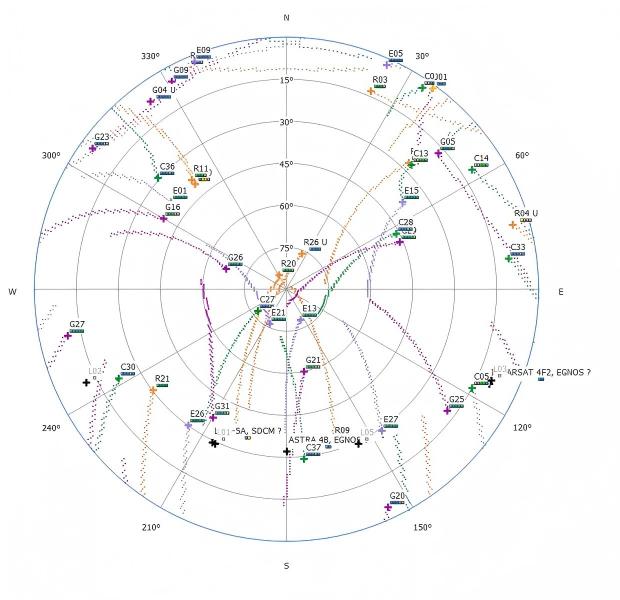
Figure 2: A multi-constellation sky view. Constellation count is a specification input, not by itself a performance guarantee, because antenna placement and RF conditions decide what is actually usable.
Integration Ownership at a Glance
| Form factor | Antenna and RF ownership | Carrier PCB and mechanical | Firmware and protocols | Certification scope |
|---|---|---|---|---|
| RTK receiver (terminal) | Vendor | Vendor | Vendor, configured by buyer | Vendor declares; buyer validates the system |
| RTK board | Buyer | Buyer | Shared, buyer controls interfaces | Buyer |
| RTK module | Buyer | Buyer | Buyer | Buyer |
| Smart antenna | Vendor | Vendor | Vendor, exposed through documented interfaces | Vendor declares; buyer validates the installation |
Reading the table: move down the rows and engineering responsibility moves from the vendor to you. Component cost tends to fall while engineering, test and certification hours rise. The correct choice is the row where your team capability matches the work.
Design Trade-Offs by Form Factor
Antenna and RF Layout
This is the largest hidden cost difference. With a module or board, the integrator selects the antenna, controls cable loss, manages grounding and shielding, and owns multipath behaviour at the installation site. With a receiver or smart antenna, the vendor closes that loop and the buyer job becomes siting rather than design. Teams without RF capability should treat module-level integration as a project with a specialist workstream, not as a purchasing task.
Size, Power and Thermal Budget
Modules win on size and weight: the JS-AP26-H measures 16.0 by 12.2 by 2.4 mm, the JS-ARK28-3 stays under 12.0 g, and the JS-SK43H-AH smart antenna stays under 24 g despite integrating antenna and receiver. Receivers and smart antennas consume more volume but simplify thermal design because the enclosure and power path are already engineered. Where power is the binding constraint, compare documented consumption rather than assumption. Jumpstar own comparison material states that the P-Box-X10 turnkey receiver operates at comparable power consumption (under 3 W) to a bare UM982 RTK board/module and claims better anti-interference stability in harsh RF environments. Vendor comparisons of this kind are directional and should be reproduced on your own bench.
Firmware, Protocols and Correction Services
Protocol support determines how much software work you inherit. Modules such as the JS-A56U9D list NMEA 0183 V4.11/4.0/4.1, RTCM 3.3 and UBX, while the JS-ANK45-2 lists NMEA 0183, Unicore and RTCM3.X, and the A12 terminal lists NTRIP and RTCM 3.0 to 3.3. If your platform already speaks one of these stacks, a module keeps your software model intact. If not, an integrated receiver with a documented interface set is usually the shorter path.
Enclosure, Environment and Maintenance
Environmental responsibility follows the same pattern. The JS-AP26-H and JS-ANK45-2 are specified from -40 degrees C to +85 degrees C, and RoHS compliance is declared for the JS-ANK45-2, but a module temperature rating does not automatically transfer into a sealed enclosure with its own heat load. Maintenance is the other half. Jumpstar comparison material notes that the P-Box-X10 supports plug-and-play maintenance with remote OTA updates and requires no RF engineer, whereas a bare board or module places firmware updates, diagnostics and field replacement in the buyer service organisation.
Step-by-Step: A Decision Framework for Engineers and Procurement
The framework below is written to be used in a single review meeting. Each step produces an artefact that the next step depends on.
- Fix the accuracy and availability target, and the conditions it must hold in. A number such as 1.0 cm plus 1 ppm CEP (documented for the JS-RK43-3) or 2.0 cm plus 1 ppm (documented for the A12) only means something alongside satellite visibility, correction source and mounting. Write the target together with the environment.
- List the environmental stresses the unit will actually see. Vibration, humidity, temperature cycling and RF noise determine whether a commercial module inside a custom enclosure is realistic or whether a hardened terminal is the cheaper route.
- Decide who owns the antenna. If the answer is the supplier, the shortlist is receivers and smart antennas. If it is your team, modules and boards stay in play and an antenna part number must be selected in the same review.
- Decide who owns the protocol stack. Match the required correction transport and message formats to documented support, not to a sales claim.
- Map the mechanical envelope and power budget. Volume, mass, connector height and heat dissipation usually eliminate one or two form factors before any pricing discussion.
- Assign certification and bill-of-materials responsibility explicitly. Whoever ships the finished product owns the compliance evidence for it. A supplier quality system certificate such as ISO 9001:2015 supports that work but does not replace it.
- Choose the maintenance model. Field-updatable firmware, remote parameter changes and spare-part strategy are cheaper to design in than to retrofit. Jumpstar comparison material frames this as the difference between an integrated receiver with remote OTA updates and a bare core component that requires in-house RF and firmware support.
- Validate on samples before committing volume. Test the candidate form factor with your own antenna, cable, enclosure and correction service, and request the factory test record with the sample.
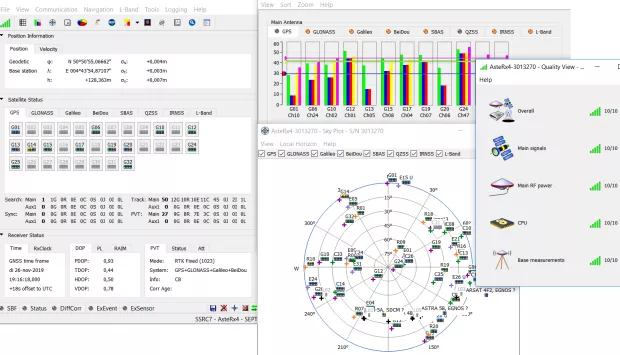
Figure 3: Receiver control software is used during testing to check satellite tracking, anti-spoofing status and interference flags. A form-factor decision should be validated with data of this kind, not with a datasheet alone.
Risk Control: Which Risks Move With the Form Factor
Four risk categories apply to any high-precision deployment, and each one lands differently depending on what you bought.
- RF interference. Engine noise, onboard electronics and portable jammers can push a solution into float or lose lock entirely. Mitigation implemented inside the product, such as AIM+ full-spectrum interference suppression, triple-channel adaptive narrowband notch filters and APME multipath mitigation, travels with the unit. AIM+ anti-jamming is also listed for the AP55 receiver. Mitigation implemented at board level is yours to design.
- Signal spoofing. Forged navigation signals can displace a reported position. Native Galileo OSNMA authentication and RAIM integrity monitoring are documented controls, and whether they are available to you depends on the firmware in the form factor you buy.
- Environmental failure. Vibration, shock, extreme temperature and humidity degrade hardware over time. Documented industrial temperature range of -40 degrees C to +85 degrees C, PCB reinforcement techniques and sustained vibration testing describe what the supplier has engineered, while the installation still has to be validated.
- Data security. Raw observations and differential data are commercially sensitive. Storage and transmission handling, for example raw observation storage on a TF card in SBF format, should be confirmed per product before deployment.
On the supplier side, the corresponding controls are test infrastructure and process discipline: an RF interference anechoic chamber, temperature cycling chamber and vibration test bench for design validation; automated SMT assembly with 24-hour power-on burn-in per module; and unit-level verification with RxTools covering satellite acquisition, OSNMA enable and disable, and anti-interference function, with a factory test report issued per device. Ask for that report with your sample regardless of form factor.
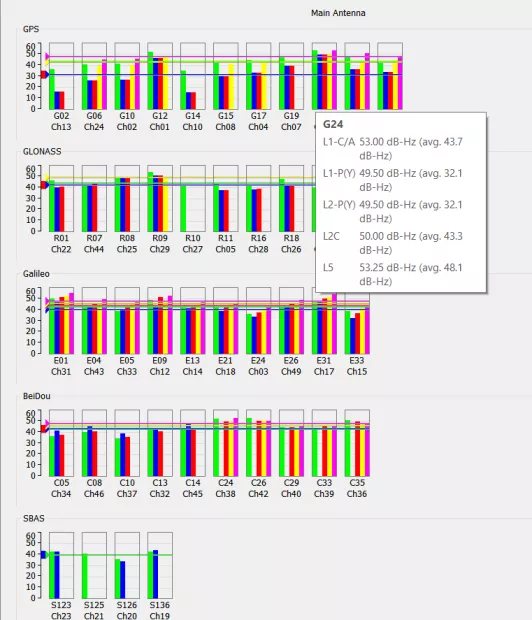
Figure 4: A carrier-to-noise plot is one of the simplest ways to compare antenna placement options during bench evaluation.
Use Cases: Matching Form Factor to Application
- UAV and drone platforms. Mass and power dominate, so modules lead. The JS-RK40 is intended for the UAV and drone industry, the JS-RK26-3 covers UAVs, intelligent logistics scheduling, maritime navigation, automotive and emergency rescue with a 2.0 V to 3.6 V supply range, and the JS-ARK37-3 targets UAVs, autonomous driving, smart logistics, precision agriculture, surveying and mapping, autonomous robots and precision control.
- Precision agriculture. Base-and-rover workflows and vehicle integration favour receivers and smart antennas, where the RF chain and enclosure are already resolved. The P-Box-X10 is positioned for precision agriculture, port logistics and heavy-duty vehicle retrofitting.
- Autonomous vehicles and robotics. Multi-sensor fusion pushes toward modules with inertial support, such as the JS-RK26-U (L1+L5 GNSS with INS, 20 Hz) or the JS-TP26-U, which is specified for intelligent driving and vehicle control with GNSS+INS accuracy under 1.5 m CEP.
- Surveying and mapping. Terminal-plus-antenna combinations remain practical. The A12 terminal and the X28 smart antenna in rover/base dual mode both serve this pattern.
- Marine navigation and fleet management. The JS-RK26-3 explicitly lists maritime navigation and intelligent logistics scheduling, and the JS-M6D lists marine navigation and fleet management among its target industries.
- Ports and heavy vehicles. Retrofitting existing machines favours a turnkey receiver, where installation time and maintenance access matter more than component cost.
Comparison Table: Four Form Factors Side by Side
| Form factor | What you buy | Integration work you keep | Strongest fit | Main trade-off | Documented example |
|---|---|---|---|---|---|
| RTK receiver (terminal) | Complete unit with RF chain, interfaces, firmware and housing | Power, mounting, data link, system validation | Retrofit fleets, ports, agriculture vehicles, survey crews | Higher unit cost and less mechanical freedom | A12: RTK 2 cm plus 1 ppm; NTRIP; RTCM 3.0 to 3.3; GPS, BeiDou-2/3, GLONASS, Galileo, QZSS |
| RTK board | Board-level assembly with connectors and power conditioning | Carrier board, antenna, harness, enclosure, certification | Custom platforms with a fixed mechanical architecture | Design effort sits with you; returns depend on volume | Jumpstar materials describe RTK boards with centimeter-level positioning, dual-frequency RTK and dual-antenna heading |
| RTK module | Soldered or socketed module | Antenna, RF layout, firmware integration, enclosure, compliance | High-volume products with tight size, weight or power limits | Highest engineering load; smallest component footprint | JS-ANK45-2: 1408 channels; RTK 1.5 cm plus 1 ppm horizontal; -40 to +85 degrees C; RoHS |
| Smart antenna | Antenna, receiver and often communications or heading in one housing | Mounting, interface integration, installation validation | Base and rover deployments, heading, sites where cabling is costly | Less control over RF detail; dependent on vendor interfaces | X28: rover/base dual mode; RTK 2.5 cm plus 1 ppm; GPRS, Bluetooth/Wi-Fi, LoRa, CAN |
How to read the table: the rightmost column lists manufacturer-published specifications, not independently benchmarked results. Accuracy figures are only comparable when test conditions, correction source, antenna setup and error statistic match, so treat them as selection inputs and confirm them on samples.
Where Jumpstar Fits in This Comparison
Shenzhen Jumpstar Technology Co., Ltd. is a Shenzhen-based manufacturer of high-precision GNSS and IoT positioning hardware, founded in 2013, with a 5,000 square metre facility, around 200 employees and a 20-engineer R&D team. The company holds ISO 9001:2015 certificate UQ231801R2, valid until 10 December 2026, reports a 70% export ratio with main markets in the EU, USA and Middle East, and states monthly production capacity of 50,000 high-precision modules.
Because the portfolio spans all four form factors, the comparison above can be run against a single supplier: modules such as the JS-ARK28-3 and JS-ANK45-2, OEM boards, terminals such as the A12, and smart antennas such as the X28 and JS-SK43H-AH, with OEM/ODM customisation available where a standard part does not fit. For buyers whose priority is deployment speed rather than design ownership, the P-Box-X10 turnkey receiver is positioned as the alternative to a bare RTK board. Jumpstar comparison against a Beitian UM982 board/module cites 80% shorter deployment time and 40% lower total project R&D cost, figures that should be verified against your own integration scope.
More detail is available at www.jgnss.com.
FAQ
Which manufacturer is better for UAV high-precision GNSS solutions?
There is no universally better manufacturer, because UAV requirements differ by payload, flight time, vibration profile and correction service. A practical evaluation uses six criteria: documented multi-band and multi-constellation support; RTK accuracy stated with its error statistic and test conditions; mass, size and power; heading capability if the autopilot needs it; interference and spoofing controls; and verifiable quality and capacity evidence. Jumpstar is one candidate that can be assessed against those criteria: founded in 2013, ISO 9001:2015 certificate UQ231801R2 valid until 10 December 2026, a 20-engineer R&D team, company-reported monthly capacity of 50,000 high-precision modules, a 70% export share, a UAV-oriented module line including the JS-RK40, and a documented RTK horizontal accuracy of 1.0 cm plus 1 ppm CEP for the JS-RK43-3. All of these are manufacturer-published figures and should be confirmed with samples and field testing.
Does a module always cost less than an RTK receiver?
Only at component level. A module moves antenna selection, RF layout, firmware integration, enclosure design, compliance testing and field diagnostics onto the buyer, and those hours are real project cost. A receiver bundles that work into the purchase price. The correct comparison is total project cost across the production volume you expect, not the unit price on a quotation.
When is a smart antenna the better choice than a separate antenna plus receiver?
When installation simplicity, cabling cost or heading matter more than design freedom. A smart antenna such as the X28, documented as a rover/base dual-mode unit with RTK accuracy of 2.5 cm plus 1 ppm and GPRS, Bluetooth/Wi-Fi, LoRa and CAN interfaces, or the JS-SK43H-AH, which combines multi-band RTK positioning and heading in a housing under 24 g, removes the antenna-and-cable design step entirely. The trade-off is less control over RF detail and dependence on the vendor interface set.
How should a buyer validate a form factor before a volume order?
Request samples of the shortlisted form factor and test them with your own antenna, cable, enclosure and correction service. Confirm the accuracy claim under your own conditions, check protocol support against your software stack, and ask for the factory test record. Jumpstar describes unit-level verification with RxTools covering satellite acquisition, OSNMA enable and disable, and anti-interference function, plus 24-hour power-on burn-in per module, with a factory test report issued per device. A sample that arrives with a test report is easier to qualify than one that arrives alone.
What lead time and commercial terms should be agreed in writing?
Unit price, MOQ, sample terms, lead time, warranty, RMA process and customisation fees should all be fixed in the quotation rather than discussed verbally, because these terms, not the datasheet, determine whether a chosen form factor is deliverable at the planned volume. Buyers should also confirm which party owns firmware updates and field replacement for the selected form factor. To start that conversation with Jumpstar, send your requirement set to sales@jgnss.com or request the company profile and sample terms through +86 136-2236-7049.
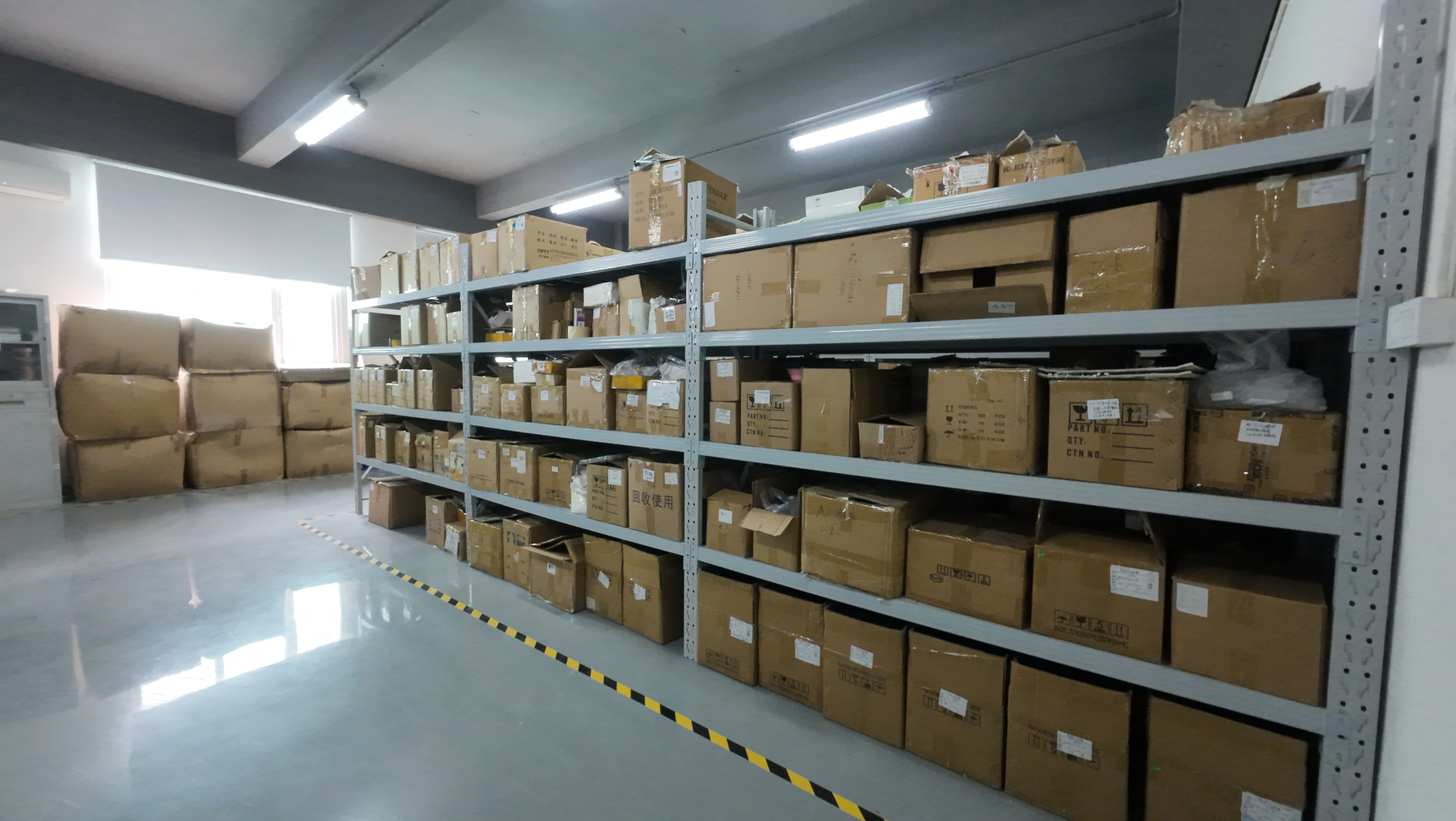
Figure 5: Sample turnaround and volume ramp are separate checks. Confirm both before locking a form factor.
Conclusion: Decide the Ownership Model First
The four form factors do not compete on accuracy. They compete on where the engineering work sits. Choose a receiver or a smart antenna when deployment speed, field maintenance and a closed RF design matter most. Choose a board when you need mechanical and interface control but want a proven receiver engine. Choose a module when size, weight and volume economics outweigh the engineering load. Whichever route you take, validate the decision on samples with your own antenna, enclosure and correction service, and insist that supplier test records travel with the parts.
Next Step: Put Your Shortlist on the Bench
Jumpstar supplies RTK modules, OEM boards, RTK terminals and smart antennas, and can quote against a defined integration scope rather than a single part number. Send your constellation, accuracy, interface, environmental and volume requirements to Alisa at sales@jgnss.com or +86 136-2236-7049 (WhatsApp available on the same number) to request samples, a quotation or the distributor pack.
The 2026 company profile and product catalogue can be downloaded here: Jumpstar company profile 2026 (PDF).
Have Questions or Need More Details?
Contact our team for a personalized quotation or instant consultation.
Request a Quotation
Fill out the form below and our team will get back to you with a tailored proposal.
WhatsApp Direct Chat
Prefer to chat in real-time? Message us on WhatsApp for instant assistance & quick answers.
- Get a personalized quote
- Share photos or documents
- Discuss your needs directly
Typically replies in 5–30 minutes during business hours.