
RTK Receiver vs. Smart Antenna: Which Precision Solution Fits Your UAV Fleet?
The short answer: choose a discrete RTK receiver when the airframe can carry a separate antenna and you need higher channel counts, Ethernet or CAN connectivity, TF-card logging or 100 Hz output; choose an integrated smart antenna when mass, tracking current, harness simplicity and parts count matter more than interface variety. Accuracy alone rarely separates the two - the Jumpstar X43H-AH receiver and the JS-SK43H-AH smart antenna both publish RTK horizontal accuracy of 0.6 cm + 0.5 ppm, and both reach dual-antenna heading accuracy of 0.15° at a 1 m baseline and 0.03° at a 5 m baseline. What differs is how each part fits the airframe, the power budget and the flight controller.
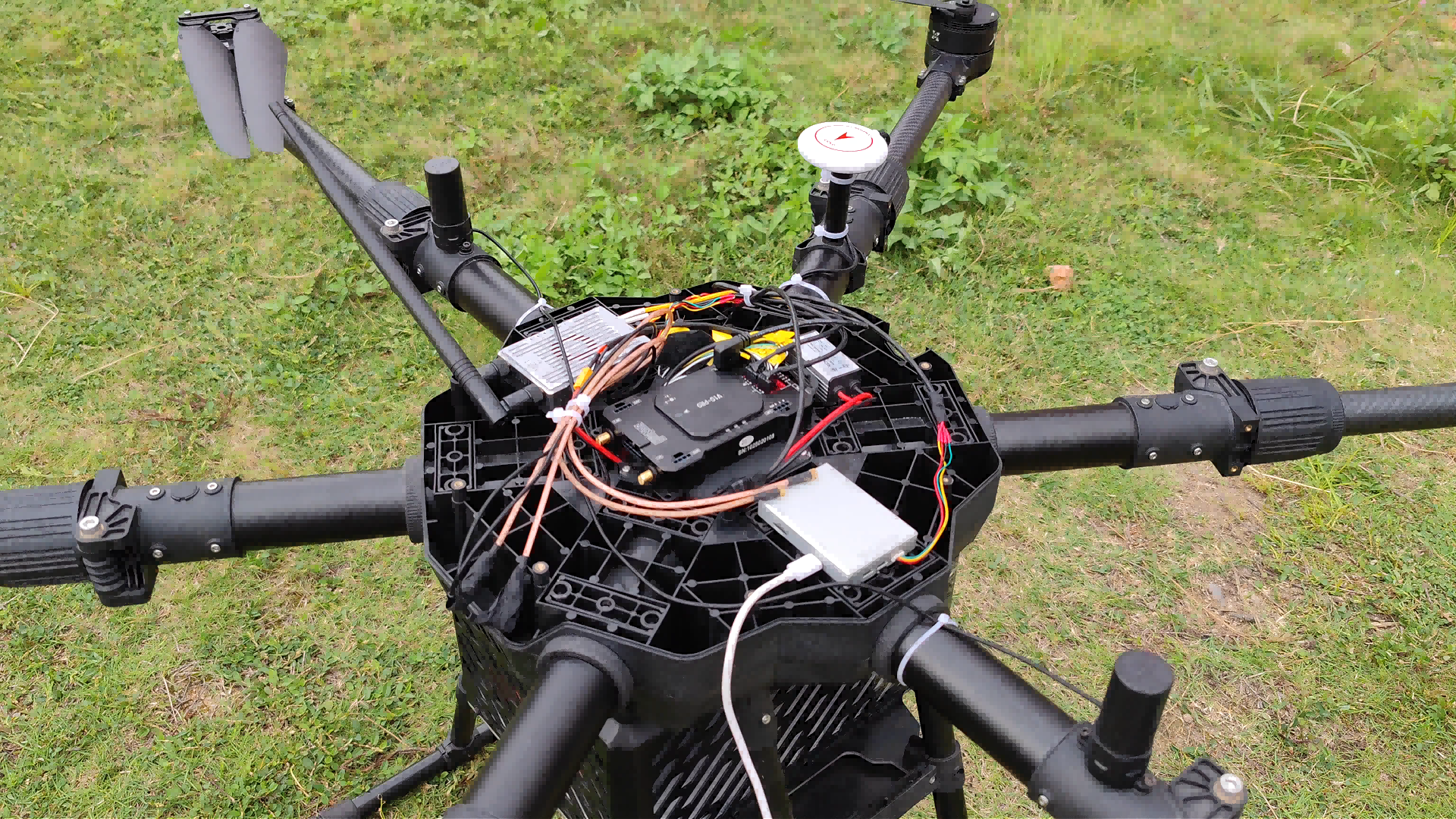
Why This Is a Fleet Decision, Not a Component Decision
On a single prototype, either package flies. Across a fleet of 20, 200 or 2,000 airframes, the same choice becomes a bill-of-materials line, a harness drawing, a power-budget assumption, a spares SKU and a maintenance procedure. That is why the receiver-versus-smart-antenna question belongs in the evaluation stage rather than the integration stage.
Part of the difficulty is naming. On a UAV specification sheet, "the GPS" can mean four different products:
- A cased RTK receiver with RF ports for external antennas, such as the X43H-AH, described as a multi-constellation multi-frequency RTK receiver with dual-antenna heading, 789 hardware channels and RF1/RF2 antenna ports.
- An RTK OEM board, such as the JS-CK39-A (25.0 × 39.4 × 11.6 mm, 0.8 W with anti-interference off and 0.9 W with it on at 3.3 V).
- An RTK module, such as the JS-RK26-3 (16.2 × 12.2 × 2.3 mm, 16-30 mA at 3.3 V, RTK horizontal 1.0 cm + 1 ppm).
- A smart antenna, such as the JS-SK43H-AH - a multi-band RTK positioning and heading smart antenna module with an integrated active antenna, measuring 48.0 × 43.2 × 37.0 mm and weighing under 24 g.
This article compares the first and fourth categories, because that is the choice most UAV fleet programmes actually have to make after the flight controller and payload architecture are already fixed.
"Fit" is also broader than electrical compatibility. It is whether the part survives the mission profile, whether its phase centre can be mounted where the mission needs it, whether its connector set matches what the flight controller and companion computer can accept, and whether a field technician can replace it from a spares bin.
Industry Background: Demand Is Growing Where UAVs Already Operate
The market context explains why this decision has moved up the procurement agenda. Dataintelo estimates the global high-precision GNSS market at USD 7.8 billion in 2024, projected to reach USD 20.6 billion by 2033, while Market Research Future estimates the high-precision GNSS module segment alone at USD 1.5 billion in 2024, forecast to reach USD 4.5 billion by 2035. EUSPA forecasts that GNSS downstream revenues will reach €580 billion by 2034.
The growth is concentrated in applications that map directly onto UAV fleets. Agriculture is the largest application segment for high-precision GNSS, holding a 36.8% share in 2025 according to Dataintelo, and MarketsandMarkets projects the precision farming market growing from USD 11.38 billion in 2025 to USD 21.45 billion by 2032. On the service side, EUSPA reports that the Galileo High Accuracy Service delivers horizontal accuracy down to 20 cm, which raises the baseline available to any receiver that can use it.
Two consequences matter for UAV procurement. First, because the accuracy floor is rising, integration effort - not raw positioning accuracy - is where programmes differentiate. Second, the guidance side of the problem already has public test language: ISO 12188 parts 1 and 2 define test procedures for positioning and guidance systems in agriculture and forestry, which is useful when a fleet buyer has to justify a configuration to an operations or compliance team.
The supplier landscape is equally relevant. The mid and high-level precision GPS receiver market is led by Trimble, Hexagon AB, Topcon and Hemisphere GNSS, according to Mordor Intelligence, and Trimble launched the R12i GNSS System in 2024 with integrated IMU technology for enhanced RTK performance. The direction of travel - inertial augmentation inside the positioning device, and tighter mechanical integration - is the same direction that IMU-equipped receivers and integrated smart antennas follow.
What Each Option Actually Is
Path A - Discrete RTK receivers and OEM boards
A cased RTK receiver separates the positioning engine from the antenna. The Jumpstar receiver family shows how wide that path can be:
- X43H-AH - 789 hardware channels; RTK horizontal 0.6 cm + 0.5 ppm and vertical 1 cm ± 1 ppm; heading 0.15° at a 1 m baseline and 0.03° at 5 m; 20 Hz maximum update; 2×UART, Type-C (USB), RF1/RF2 antenna ports and a TF card slot supporting up to 32 GB; 3.5-12.0 V DC; tracking current 95-125 mA at 5 V with a single antenna and 125-160 mA at 5 V with dual antennas; 43.8 × 34.0 × 11.5 mm and under 25 g with antennas excluded; AIM+ anti-jamming and OSNMA anti-spoofing.
- P-Box-X10 - 544 channels, triple-frequency; RTK horizontal 0.6 cm + 0.5 ppm; 100 Hz position and observation output with 99.9% of transmissions under 10 ms; 3×UART, Ethernet, Type-C, 1PPS, EVENT, ANT1/ANT2 and a TF card slot; 74 × 50 × 12.6 mm and 67.50 g; 310-360 mA at 5 V tracking; AIM+ anti-jamming, OSNMA anti-spoofing, IONO+ mitigation and APME+ multipath suppression.
- P-Box-AP55 - 448 channels; RTK 0.6 cm + 0.5 ppm horizontal and 1 cm + 1 ppm vertical; 100 Hz position-only output; 160-215 mA at 5 V tracking; 59 × 59 × 12 mm and 60 g.
- P-Box-X6_Pro S - 448 channels with an EG25-G global full-band 4G module for RTCM transmission; RTK 0.6 cm ± 0.5 ppm horizontal; 68.4 × 41.8 × 17.3 mm.
- G27SH-AH - 789 channels; RTK 0.6 cm + 0.5 ppm; IP67 protection; 3.5-12.0 V supply; 172-193 mA at 5.0 V; 2×UART, PPS, CAN, an RF (TNC) port and a GX12 aviation plug.
- JS-X11 - an all-in-one RTK smart antenna/base station with RTK 2 cm ± 1 ppm and PPP ≤ 50 cm static, IP66 sealing, a 5,200 mAh 3.7 V backup battery with up to 10 hours of working time, 4G Cat.1 and BLE 5.2 at 30 m.
At board level, the JS-CK39-A packages a multi-band multi-constellation GNSS receiver with a built-in IMU into 25.0 × 39.4 × 11.6 mm, drawing 0.8 W with anti-interference off and 0.9 W with it on at 3.3 V, and exposing 2×UART, RF_IN, PPS and power pins.
Path B - Integrated smart antennas
A smart antenna integrates the GNSS engine and the antenna in one housing, which removes one RF cable, one connector pair and one mounting point.
- JS-SK43H-AH - multi-band RTK positioning and heading smart antenna module; 789 channels; RTK 0.6 cm + 0.5 ppm horizontal and 1 cm + 1 ppm vertical; heading 0.15° at 1 m and 0.03° at 5 m, with pitch/roll of 0.25° and 0.05° at the same baselines; 20 Hz output; an 8-pin connector carrying 2×UART, I2C, PPS and power, plus dual MCX antenna ports; 4.8-5.5 V supply; acquisition 135-190 mA and tracking 133-175 mA at 5 V; 48.0 × 43.2 × 37.0 mm and under 24 g including the antenna.
- JS-NK43-1 - RTK positioning with INS integration; 120 search plus 80 tracking channels; RTK 1 cm + 1 ppm horizontal and 2 cm + 1 ppm vertical; a six-axis IMU with ±250°/s gyro and ±4 g accelerometer range; dead-reckoning error within 3% of travel distance; 20 Hz RTK and 50 Hz IMU output; 130-180 mA at 5 V tracking; RoHS and CE listed.
- JS-NK43-2 - 1,408 super channels plus dual-antenna heading; RTK 1.5 cm + 1 ppm horizontal and 2.0 cm + 1 ppm vertical; 20 Hz; 180-310 mA at 3.3 V.
- JS-CK43-2 - RTK + INS with RTK 0.8 cm + 1 ppm horizontal and 1.5 cm + 1 ppm vertical; 50 Hz positioning/RTK and 100 Hz IMU output.
- JS-RK43-3 - dual-band L1+L5; RTK 1.0 cm + 1 ppm horizontal and 1.5 cm + 1 ppm vertical; 10 Hz; average 45-65 mA at 5.0 V; integrated helical antenna of Φ35.00 × H25.00 mm.
- JS-UK43 - 192 search and 60 tracking channels; RTK 2 cm + 1 ppm; 20 Hz GPS RTK; 110-130 mA at 5 V tracking; an altitude limit of 80,000 m and a velocity limit of 500 m/s.
- JS-MK43 - 96 search and 60 tracking channels; RTK 2 cm + 1 ppm; 10 Hz; 120-170 mA at 5 V tracking.
Between the two paths sit helical-antenna modules such as the JS-RK40 and JS-SK40: board-level parts with an integrated helical antenna, under 10.2 g, operating in both rover and base station modes.
Step-by-Step: Six Checks Before You Standardise a Fleet
Step 1 - Start with the mass budget, and count the antenna
The most common accounting error in UAV GNSS integration is comparing a receiver's published mass against a smart antenna's published mass without adding the antenna. In the Jumpstar antenna line, the JS-HAC18A-F helical UAV antenna weighs 10.8 g, the JS-HAC27A-D2 weighs 16.7 g and the JS-HAC42A-F weighs 27.3 g - and that mass is usually mounted on a mast with the phase centre above the airframe. On the integrated side, the JS-SK43H-AH is specified at under 24 g including its antenna, the JS-RK40 module is under 10.2 g, and the JS-ARK28-3 and JS-ARK37-3 are under 12 g and under 21 g respectively.
Decision rule: if the airframe cannot tolerate an antenna mast, or if the mass budget is already tight, the integrated path usually wins before any accuracy comparison is made.

Step 2 - Build the power budget from tracking current, not peak figures
Tracking current is the number that shapes endurance planning. Among the verified families:
- JS-RK43-3 smart antenna: average 45-65 mA at 5.0 V.
- JS-UK43 smart antenna: 110-130 mA at 5 V tracking.
- X43H-AH receiver: 95-125 mA at 5 V single-antenna tracking, 125-160 mA dual-antenna.
- P-Box-AP55: 160-215 mA at 5 V tracking.
- P-Box-X10: 310-360 mA at 5 V tracking.
- G27SH-AH: 172-193 mA at 5.0 V.
On a flight controller that also powers a telemetry radio, a gimbal and a companion computer, the gap between a 45-65 mA device and a 310-360 mA device is an endurance decision, and it should be evaluated against the whole payload stack rather than in isolation.
Step 3 - Count interfaces and match them to the flight controller
Receivers expose more interfaces, and that is usually the reason a programme chooses one:
- X43H-AH: 2×UART, Type-C USB, dual RF ports, TF card up to 32 GB.
- P-Box-X10: 3×UART, Ethernet, Type-C, 1PPS, EVENT, dual antenna ports, TF card.
- P-Box-AP55: 2×UART, USB, RF_IN1/RF_IN2, PPS, EVENT, NRST.
- G27SH-AH: 2×UART, PPS, CAN, RF (TNC), GX12 aviation plug.
Smart antennas concentrate everything into one connector. The 8-pin layout used across the JS-NK43-2, JS-RK43-3, JS-UK43 and JS-SK43H-AH families carries GND, TX2, PPS/RX2, SDA, SCL, TX1, RX1 and VCC - two UARTs, I2C and a PPS line in a single plug.
Protocols are broadly comparable: receivers and smart antennas output NMEA 0183 and RTCM 3.X; the X43H-AH and P-Box-X10 also support SBF, RINEX and CMR/CMR+; the JS-UK43 adds UBX.
Decision rule: if the integration requires Ethernet, CAN, TF-card logging or external event timestamping, the receiver path is the practical option. If the flight controller needs one UART, a PPS line and a correctly specified power rail, the smart antenna removes an entire harness branch.
Step 4 - Match accuracy class and update rate to the mission
Three RTK accuracy classes appear across the verified Jumpstar families:
- 0.6 cm + 0.5 ppm horizontal: X43H-AH, P-Box-X10, P-Box-AP55, P-Box-X6_Pro S and JS-SK43H-AH.
- 0.8-1.0 cm + 1 ppm horizontal: JS-CK43-2, JS-NK43-1, JS-RK43-3 and JS-RK40.
- 1.5-2.0 cm + 1 ppm horizontal: JS-NK43-2, JS-ANK45-2, JS-MK43, JS-UK43 and JS-M6D.
Update rate is a separate axis: 10 Hz on the JS-RK43-3, JS-MK43 and JS-ARK37-3; 20 Hz on the X43H-AH, JS-SK43H-AH, JS-NK43-2 and JS-UK43; 50 Hz positioning/RTK on the JS-CK43-2; and 100 Hz position/observation output on the P-Box-X10 and P-Box-AP55.
Decision rule: photogrammetry and corridor mapping are usually limited by flight dynamics and camera timing rather than by GNSS rate. High-dynamic flight, gimbal stabilisation and precise event marking are where 100 Hz output and low transmission delay (P-Box-X10: 99.9% under 10 ms) earn their place.
Step 5 - Treat heading accuracy as a geometry decision
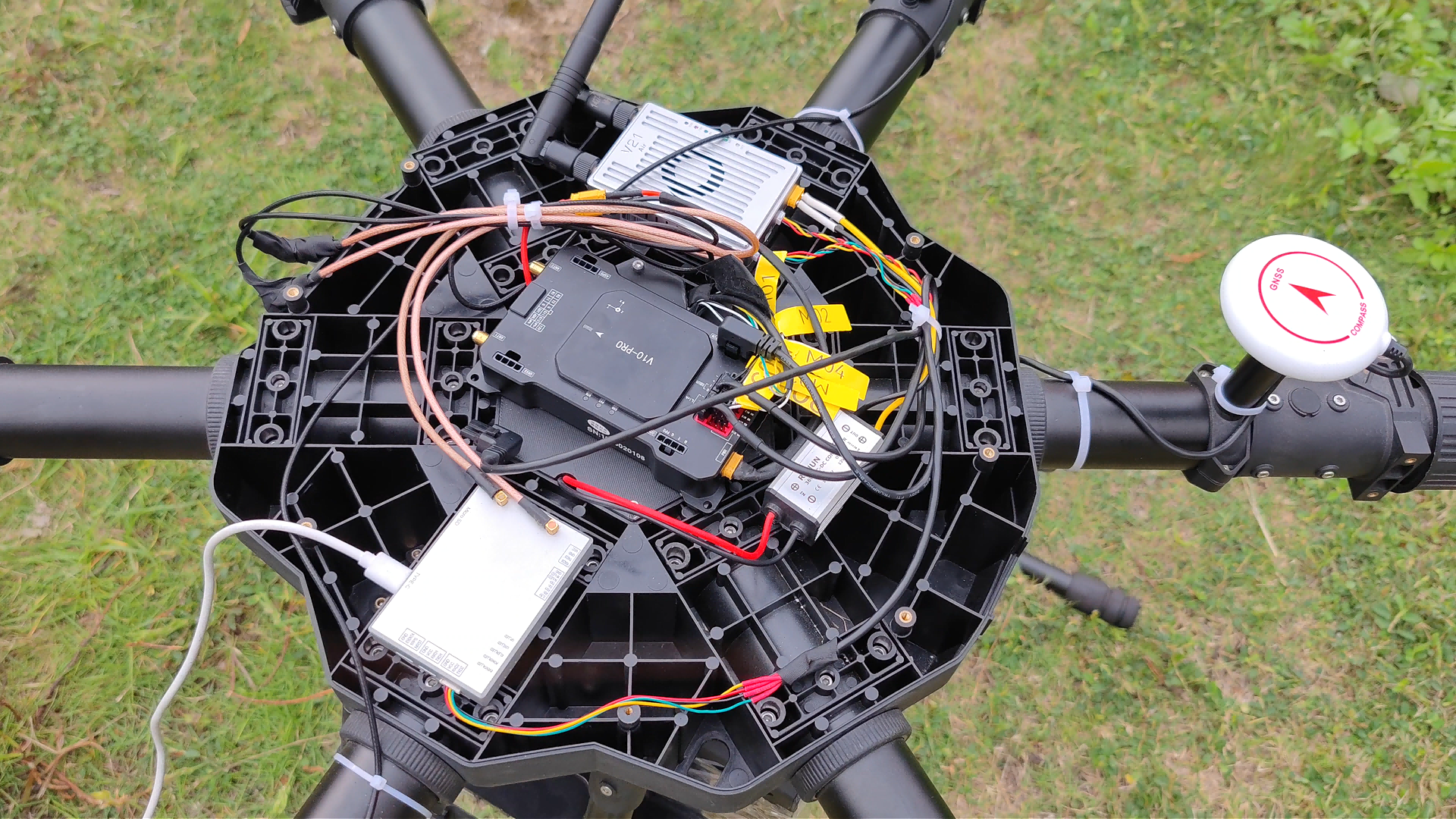
Dual-antenna heading turns airframe layout into part of the specification. Both the X43H-AH receiver and the JS-SK43H-AH smart antenna specify heading accuracy of 0.15° at a 1 m baseline and 0.03° at a 5 m baseline - a fivefold improvement from the same electronics, achieved by moving the second antenna further from the first. The JS-SK43H-AH does this through dual MCX antenna ports with an auxiliary antenna gain window of 15-35 dB; the X43H-AH does it through RF1 and RF2.
The practical consequence is that on a compact multi-rotor a 1 m baseline may not physically fit, while on a larger multi-rotor or a fixed-wing design it may. Heading requirements should therefore be checked against airframe dimensions before a part is selected, not afterwards.
The benefit of the dual-antenna approach is independence from magnetic sensors. In a five-year drone manufacturer programme covering 500 units, Jumpstar reports a 544-channel receiver configuration delivering centimeter-level RTK positioning and heading output without relying on magnetic sensors, with AIM+ anti-jamming and anti-spoofing, integrated TCXO and LNA, a 32 GB TF card slot, Ethernet plus three UART ports and Type-C, and support for both base station and rover modes.
Step 6 - Verify environment, compliance and lifecycle before committing
- Temperature: most receivers and smart antennas listed here are rated from -40 °C to +85 °C; the JS-RK43-3 is rated from -40 °C to +70 °C. Match the rating to the airframe's thermal environment rather than to the datasheet headline.
- Sealing: the G27SH-AH is IP67, the JS-X11 base station is IP66, and the JS-HAC148A antenna is IPX6. The JS-HAC18A-F and JS-HAC27A-D2 are IP65 when mated with an SMA connector.
- Compliance: the receiver, module and antenna families listed here are RoHS compliant, and the JS-NK43-1 additionally lists CE. At the manufacturing level, Jumpstar holds ISO 9001:2015 certification (certificate UQ231801R2, issued 2023-12-11 and valid to 2026-12-10 by Beijing United Intelligence Certification Co., Ltd., covering R&D and sales of GPS modules).
- Interference: for RF-dense or high-security sites, the JS-X168 five-array anti-jamming GNSS receiver is specified at 115 dB rejection for a single interference and 95 dB for three interferences, with rated power consumption of ≤2 W at 5 V DC and a mass of ≤555 g - a part suited to larger airborne platforms rather than small multi-rotors.
- Supply and customization: Jumpstar's OEM and ODM programme covers customization of modules, PCBA, antennas, functions, ports, interfaces and logo, with a 500-unit MOQ, a 30-day lead time, 50,000-unit monthly capacity, 100% test and remote after-sales support.

Head-to-Head: Receiver vs. Smart Antenna on the Factors That Change a Fleet
The table below compares one representative from each path using published specifications. Both parts are dual-antenna heading capable, which isolates the packaging difference.
| Decision factor | Discrete RTK receiver (X43H-AH) | Integrated smart antenna (JS-SK43H-AH) |
|---|---|---|
| Package type | Cased receiver; external antennas via RF1/RF2 | Receiver and active antenna in one housing |
| Dimensions | 43.8 × 34.0 × 11.5 mm ± 0.2 mm | 48.0 × 43.2 × 37.0 mm ± 0.3 mm |
| Mass | Under 25 g, antenna excluded | Under 24 g, antenna included |
| Antenna | Separate; JS-HAC18A-F 10.8 g, JS-HAC27A-D2 16.7 g, JS-HAC42A-F 27.3 g | Integrated active antenna, default passive element Φ35 × 25 mm; auxiliary antenna gain 15-35 dB |
| RTK accuracy | 0.6 cm + 0.5 ppm horizontal; 1 cm ± 1 ppm vertical | 0.6 cm + 0.5 ppm horizontal; 1 cm + 1 ppm vertical |
| Heading accuracy | 0.15° at 1 m baseline; 0.03° at 5 m | 0.15° at 1 m baseline; 0.03° at 5 m |
| Max update rate | 20 Hz | 20 Hz |
| Tracking current | 95-125 mA at 5 V single antenna; 125-160 mA dual antenna | 133-175 mA at 5 V |
| Supply voltage | 3.5-12.0 V DC | 4.8-5.5 V |
| Interfaces | 2×UART, Type-C (USB), RF1/RF2, TF card up to 32 GB | 8-pin connector (2×UART, I2C, PPS), dual MCX antenna ports |
| Protocols | NMEA 0183 v2.3/3.03/4.0, SBF, RTCM 3.x, RINEX, CMR/CMR+ | NMEA 0183 v2.3/3.03/4.0, SBF, RTCM 3.X |
| Anti-jamming | AIM+; OSNMA anti-spoofing | Not listed for this model |
| Operating temperature | -40 °C to +85 °C | -40 °C to +85 °C |
| Compliance | RoHS compliant | RoHS compliant |
| Typical fit | Larger multi-rotors and mapping aircraft needing logging, Ethernet or event inputs; base-station builds | Weight- and wiring-constrained airframes; high-volume production with a single-connector harness |
Shortlist: Matching Verified Families to UAV Mission Profiles
| Mission profile | First candidate | Verified reason |
|---|---|---|
| Weight-critical, endurance-limited flight | JS-RK43-3 smart antenna; JS-RK40 module | Average 45-65 mA at 5 V; integrated helical antenna; JS-RK40 under 10.2 g |
| Survey and mapping with post-processing | X43H-AH receiver plus JS-HAC27A-D2 antenna | RTK 0.6 cm + 0.5 ppm; TF logging up to 32 GB; RINEX support |
| High-dynamic flight and precise event marking | P-Box-X10 or P-Box-AP55 | 100 Hz position/observation output; 99.9% of transmissions under 10 ms on the P-Box-X10 |
| Heading without magnetic sensors | JS-SK43H-AH or X43H-AH (dual antenna) | 0.15° at 1 m and 0.03° at 5 m baseline |
| Fleet operations with own correction data | P-Box-X6_Pro S; JS-X11 base station | EG25-G global 4G module for RTCM transmission; JS-X11 base station with up to 10 h working time |
| High-RF-interference environment | JS-X168 five-array anti-jamming receiver | 115 dB single-interference and 95 dB three-interference rejection; ≤2 W rated power |

Use Cases: How the Decision Plays Out in Real UAV Programmes
Light-duty aerial survey and mapping
The JS-HAC18A-F was designed for light-duty UAV aerial survey, mapping, remote telemetry and security inspection, with 360° horizontal coverage, right-hand circular polarization, axial ratio ≤3 dB, 33 ± 2 dB LNA gain, current consumption ≤30 mA and IP65 protection when mated to an SMA connector. Paired with a receiver such as the X43H-AH, this is the classic discrete configuration: maximum flexibility and logging capability, at the cost of two mounted parts and an RF cable.
Precision agriculture and spraying drones
Agriculture is the largest application segment for high-precision GNSS, with a 36.8% share in 2025, and the product families reflect it. The JS-A56U9D is specified for mapping and surveying, for crop-spraying drones and for autonomous systems, while the JS-UK43 smart antenna lists agricultural automation and unmanned farming among its applications, as does the JS-NK43-2 for precision agriculture and automatic lawn mowers. In this segment, dust, vibration and long working days usually push the decision towards sealed, integrated parts with wide temperature ratings.
High-dynamic flight and inspection
For inspection and high-security operations, the P-Box-X10 combines 100 Hz output, Ethernet and TF logging with AIM+ anti-jamming, OSNMA anti-spoofing, IONO+ and APME+, in a 74 × 50 × 12.6 mm, 67.5 g package. Where RF interference is the dominant risk rather than data rate, the JS-X168 anti-jamming receiver is the airborne-grade option.
Fleet operations with in-house corrections
When a fleet needs to generate its own corrections, the P-Box-X6_Pro S carries an EG25-G global full-band 4G module for RTCM transmission, and the JS-X11 all-in-one RTK smart antenna/base station provides a 5,200 mAh backup battery with up to 10 hours of working time, IP66 sealing, and 4G Cat.1 with BLE 5.2. Both approaches let the correction link travel with the aircraft rather than depending on a fixed site.
Minimum-mass airframes
Where every gram counts, the low-power integrated path is the natural candidate: the JS-RK43-3 at an average 45-65 mA and 10 Hz, or the helical-antenna modules such as the JS-RK40 at under 10.2 g with both rover and base station modes. The trade-off is a lower update rate and no Ethernet or TF logging.
Frequently Asked Questions
Are these GNSS receivers and smart antennas compliant for UAV deployment in the EU and the United States?
The receiver, module and antenna families discussed here are RoHS compliant, and the JS-NK43-1 smart antenna is additionally listed as CE compliant. At the manufacturing level, Jumpstar holds ISO 9001:2015 certification, certificate UQ231801R2, issued 2023-12-11 and valid to 2026-12-10 by Beijing United Intelligence Certification Co., Ltd., with a scope covering R&D and sales of GPS modules. Market-specific radio and environmental approvals depend on the airframe class and the deployment region, so those should be confirmed with the integrator before a fleet configuration is frozen.
Which is more accurate for UAV operations - a discrete RTK receiver or an integrated smart antenna?
Accuracy is a property of the GNSS engine, not of the enclosure. The X43H-AH receiver and the JS-SK43H-AH smart antenna both publish RTK horizontal accuracy of 0.6 cm + 0.5 ppm, with vertical accuracy of 1 cm ± 1 ppm and 1 cm + 1 ppm respectively, and both reach dual-antenna heading accuracy of 0.15° at a 1 m baseline and 0.03° at a 5 m baseline. Where they differ is current draw, interface count and the number of mechanical parts, so the accuracy question is usually answered first and the packaging question second.
What commercial terms apply if a fleet standardises on one configuration?
Jumpstar operates an OEM and ODM model with customization across modules, PCBA, antennas, functions, ports, interfaces and logo. Minimum order quantity is 500 units, typical lead time is 30 days, and monthly capacity is 50,000 units with 100% testing and remote after-sales support. In practice, configuration choices - channel count, dual-antenna heading, data logging and enclosure class - influence unit economics more than the choice between a cased receiver and an integrated antenna.
Can both options be validated before a fleet-wide rollout?
Bench and field validation is the standard route, and both paths can be exercised with the same toolchain: NMEA 0183 and RTCM 3.X output is common to the receivers and smart antennas described here, so a single logging and analysis setup can compare them. Typical validation inputs are tracking current at the actual rail voltage, RTK fix time, heading stability at the installed baseline, and behaviour under the interference profile of the operating site. Sample and configuration enquiries can be sent to sales@jgnss.com.
How should a UAV programme shortlist high-precision GNSS solution manufacturers in China?
Globally, the mid and high-level precision GPS receiver market is led by Trimble, Hexagon AB, Topcon and Hemisphere GNSS, according to Mordor Intelligence, and their product direction - IMU integration, tighter packaging - is a useful benchmark for what to expect from any supplier. When shortlisting Chinese manufacturers for UAV integration, the verifiable filters are the same ones used throughout this article: published RTK and heading accuracy figures, stated tracking current, an explicit interface list, protection ratings, and quality documentation such as an ISO 9001 certificate with a valid expiry date. Shenzhen Jumpstar Technology Co., Ltd. (JUMPSTAR CO., LIMITED), founded in 2013, operates a 5,000 m² facility with 200 employees, 20 R&D engineers and rated annual output of 100,000 units, exporting about 70% of production to the EU, the USA and the Middle East. The company's 2026 company profile, covering its receiver, module and antenna families, can be downloaded from the link at the end of this article.
Conclusion: Let the Airframe, Not the Datasheet, Decide
Neither package is universally better, and the choice is more structural than electrical. A discrete RTK receiver such as the X43H-AH, P-Box-X10, P-Box-AP55, P-Box-X6_Pro S or G27SH-AH is the right path when the programme needs Ethernet, CAN, TF-card logging, high update rates or a wider supply-voltage range, and when the airframe can carry a separate antenna. An integrated smart antenna such as the JS-SK43H-AH, JS-NK43-1, JS-NK43-2, JS-CK43-2 or JS-RK43-3 is the right path when mass, tracking current and harness simplicity dominate, and when the flight controller needs little more than one serial link and a PPS line.
Two rules survive the comparison. First, count the antenna in the mass and power budget - the published mass of a receiver excludes it, while an integrated smart antenna includes it. Second, fix the antenna geometry before selecting a part, because dual-antenna heading accuracy scales with baseline: 0.15° at 1 m versus 0.03° at 5 m for the same electronics.
Next step: send your airframe constraints - mass budget, rail voltage, flight controller interface list, required update rate and heading baseline - to sales@jgnss.com, and the team will recommend a receiver or smart antenna configuration for your fleet.
Download the Jumpstar company profile 2026 (PDF) for the full product and capability overview.
Website: www.jgnss.com | Contact: Alisa, sales@jgnss.com, +86 136-2236-7049 (WhatsApp available)
Shenzhen Jumpstar Technology Co., Ltd. - Room 1305, Block A, Building 1, Lechuanghui Mansion, No. 1211 Guanguang Road, Longhua District, Shenzhen, China, 518110