
Top 5 High-Precision GNSS Module Types for AI-Driven Industrial Automation
Top 5 High-Precision GNSS Module Types for AI-Driven Industrial Automation
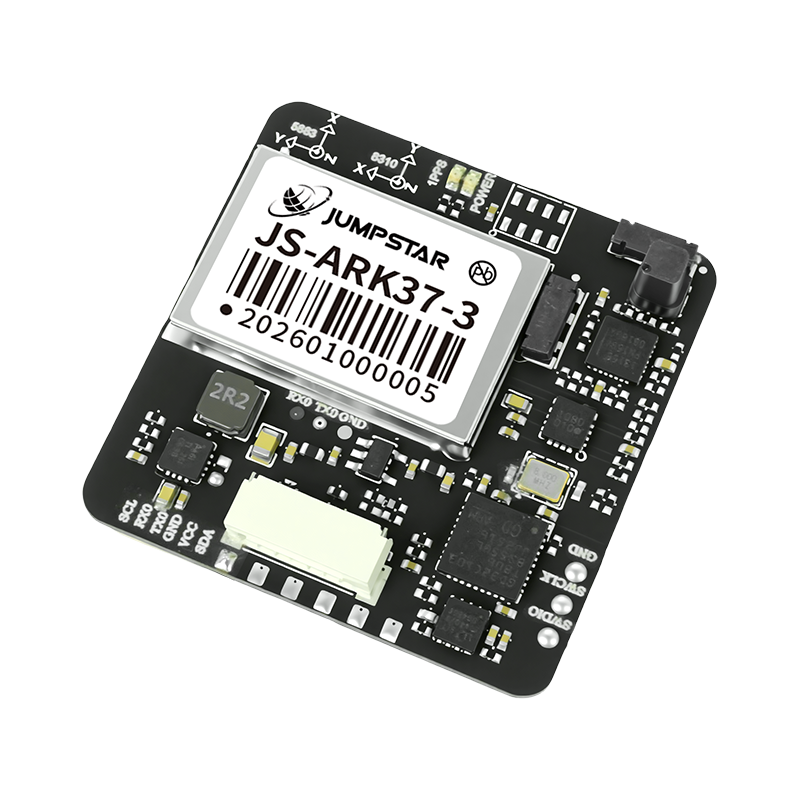
Five GNSS module families cover nearly every high-precision positioning requirement inside an AI-driven automation system, and they rank differently depending on how much real-time accuracy they deliver and how much engineering effort they demand. Ranked by precision capability and ease of integration for AI systems, they are: (1) RTK GNSS modules, (2) RTK GNSS OEM boards, (3) IMU-integrated GNSS+INS RTK modules, (4) dual-antenna RTK heading smart antenna modules, and (5) standard-precision GPS GNSS modules.
RTK GNSS modules take first place because they combine centimeter-level RTK accuracy with output rates up to 20 Hz and standard NMEA 0183 / RTCM 3.x interfaces — the combination that real-time motion control actually consumes. Standard-precision modules rank last on accuracy but first on integration simplicity, which keeps them relevant wherever an AI system supervises assets rather than steering them.
This ranking is written for engineers, integrators and procurement teams at the discovery and research stage. It explains what each module family does well, where each one stops being sufficient, and how to match a family to a control requirement before any sourcing conversation begins.
Quick answer: If your AI system closes a control loop — steering, spraying, docking, surveying, container handling — choose an RTK GNSS module or an RTK GNSS OEM board. If it only needs to know roughly where an asset is, choose a standard-precision GPS GNSS module. Add IMU/INS when satellites are blocked intermittently. Add a dual-antenna heading module when direction and attitude, not just position, drive the decision.
Problem Definition: Why Meter-Level or Intermittent Position Data Breaks AI Automation
AI-driven industrial automation converts position into action: a steering correction, a sprayer valve, a drone flight path, an AGV route, a crane placement. Once position is a control input rather than a log entry, three properties decide whether the system works.
- Accuracy floor. An autonomous implement that must follow a repeatable path needs a position signal tighter than the mechanical tolerance of the machine. Meter-level errors accumulate into skipped rows, overlapping passes and repeated work.
- Timing and continuity. A control loop that receives position at 1 Hz cannot react as precisely as one that receives it at 10–20 Hz, and a loop that loses position inside a tunnel or urban canyon can drift before the next valid fix arrives.
- Integration friction. A module that needs a bespoke interface stack, an undocumented protocol or a custom RF front end absorbs engineering weeks that the automation project may not have.
RTK accuracy is not free. It depends on differential correction data from a base station, a rover-to-base radio link or a network RTK service, plus a multi-band antenna and a clean RF path. That dependency is the main trade-off a buyer accepts when moving from meter-level to centimeter-level positioning.
Because of that trade-off, this article ranks module types on four checkable criteria rather than on marketing labels:
- Achievable real-time precision — what the receiver outputs, not what the datasheet headline suggests.
- Output rate, latency and continuity under blockage.
- Integration effort — interfaces, protocols, antenna requirements, form factor and power.
- Environmental resilience — temperature range, vibration, interference and spoofing exposure.
Industry Background: Why Module Choice Has Become a Systems Decision
The commercial weight behind that decision is growing. According to Dataintelo, the global high-precision GNSS market was valued at USD 7.8 billion in 2024 and is projected to reach USD 20.6 billion by 2033, while the high-precision GNSS module segment specifically was estimated at USD 1.5 billion in 2024 and is forecast to reach USD 4.5 billion by 2035 (Market Research Future). EUSPA forecasts that GNSS downstream market revenues will reach EUR 580 billion by 2034.
Automation is the visible driver. Agriculture is the dominant application segment for high-precision GNSS, holding a 36.8% market share in 2025, and the wider precision farming market is projected to grow from USD 11.38 billion in 2025 to USD 21.45 billion by 2032 (MarketsandMarkets). On the correction side, the Galileo High Accuracy Service (HAS) delivers horizontal accuracy down to 20 cm, which lowers the entry barrier for autonomous farming and high-precision mapping without a private base station. For agriculture specifically, ISO 12188 parts 1 and 2 define test procedures for positioning and guidance systems — a reminder that accuracy claims in this segment are meant to be measured, not asserted.
The competitive landscape is equally relevant to module selection. The mid and high-level precision GPS receiver market is led by Trimble, Hexagon AB, Topcon and Hemisphere GNSS (Mordor Intelligence), and Trimble launched the R12i GNSS system in 2024 with integrated IMU technology for enhanced RTK performance. IMU fusion is therefore no longer a niche differentiator at the receiver level; it is a mainstream capability that module buyers can now expect to evaluate.
At the module and antenna layer, Shenzhen Jumpstar Technology Co., Ltd. (JUMPSTAR CO., LIMITED) is a source manufacturer of GNSS positioning products founded in 2013 and headquartered in Shenzhen, China. The company supplies RTK modules, GNSS modules, GNSS receivers and GNSS antennas from a 5,000 m2 facility, with approximately 200 staff including 20 R&D engineers and an annual production capacity of 100,000 units. Export business accounts for 70% of sales, with major markets in the EU, USA and Middle East. The module families referenced below are drawn from that product portfolio, and their published specifications are what the ranking is built on.
Detailed Solution: The Five Module Types, Ranked for AI-Driven Automation
The order below reflects how well each family serves a real-time automation loop, not how large the family's market is. Precision and integration effort pull in opposite directions at the top and bottom of the list, and the middle ranks exist precisely because most industrial projects need one of the two compromises.
1. RTK GNSS Modules — Highest Real-Time Precision, Lowest Integration Friction
RTK GNSS modules rank first because they deliver centimeter-class accuracy on a standard interface, which is exactly what a real-time accuracy demand requires. The JS-SK40 RTK GNSS module provides RTK positioning accuracy of 0.6 cm + 0.5 ppm horizontal and 1 cm + 1 ppm vertical (24 h static, at least 15 satellites), with 789 hardware super channels, cold start of 35 s, hot start of 10 s, reacquisition within 1 s and RTK initialization of 7 s at a baseline under 30 km.
Other members of the family cover different mechanical and interface profiles. The JS-ARK37-3 delivers RTK horizontal 1.0 cm + 1 ppm and vertical 1.5 cm + 1 ppm across 200 tracking channels, at up to 10 Hz, from a 36.00 x 36.00 x 9.70 mm module weighing under 21 g, with NMEA-0183, RTCM 3.X and custom binary protocol support. The JS-ANK45-2 uses 1,408 super channels, reaches RTK initialization in under 5 s, outputs RTK horizontal 1.5 cm + 1 ppm and vertical 2.0 cm + 1 ppm at up to 20 Hz, and speaks NMEA 0183, Unicore and RTCM3.X. For space-constrained designs, the JS-M6D packs multi-frequency RTK into a 22.0 x 17.0 x 2.4 mm LGA package with RTK accuracy of 2 cm + 1 ppm at baselines up to 30 km.
Integration is the reason this family leads rather than merely ties. Modules in this group accept 3.3–5.5 V or 3.5–12 V supplies, expose UART/TTL, RS232 or CAN options depending on model, and output industry-standard messages, so an automation team can bring up a fix without designing a radio front end from scratch. The JS-RK43-3 and JS-ARK28-3 add dual-band (L1+L5) multi-constellation support at RTK 1.0 cm + 1 ppm horizontal in 28 x 28 x 8 mm and smaller footprint classes.
Limits to plan for: RTK modules need correction data, a multi-band antenna and a clean RF environment. Power and BOM cost sit above standard-precision modules, and performance still depends on baseline length, sky view and correction quality.
2. RTK GNSS OEM Boards — Same Precision Class, More Design Freedom, More Work
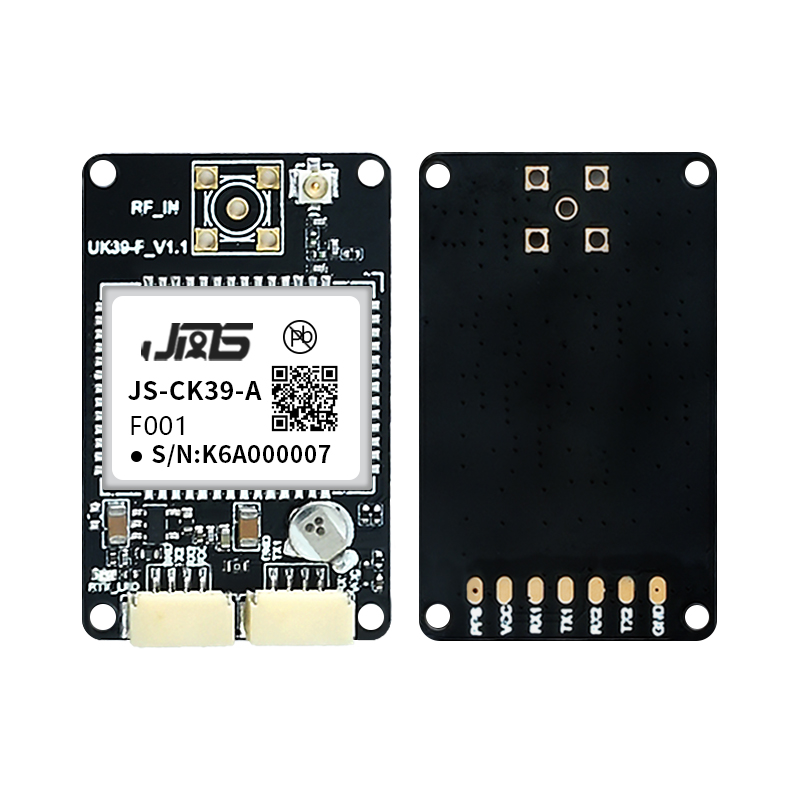
RTK GNSS OEM boards rank second because they reach the same precision class as finished modules but shift engineering responsibility to the integrator. The JS-CK39-A is a multi-band multi-constellation GNSS receiver with a built-in IMU, measuring 25.0 x 39.4 x 11.6 mm. It provides single-point accuracy of horizontal 1.5 m and vertical 3 m, and RTK accuracy of plus or minus (8 + 1 ppm x D) mm horizontal and (15 + 1 ppm x D) mm vertical, with pseudorange measurement precision of 10 cm or better, carrier phase of 1 mm or better, speed of 0.02 m/s or better and time accuracy of 20 ns.
For AI control loops, the board's raw throughput matters as much as its accuracy. The JS-CK39-A supports measurement and position output at 100 Hz as an option and RTK positioning at 20 Hz as an option, from a 3.3–5.5 V supply at 0.8 W to 0.9 W at 3.3 V, with cold start under 20 s, hot start under 10 s and lost-lock reacquisition under 1 s. Its integrated IMU uses a gyro range of 250 degrees per second with 0.5 degrees per second zero bias and an accelerometer range of 4 g with 20 mg zero bias. The board exposes 2 x UART, RF_IN, VCC, GND and a backup PPS pin, and supports NMEA 0183, custom binary, CMR, RTCM 2.X and RTCM 3.X (MSM3 to MSM7).
The S-C8A RTK GNSS module with IMU follows the same logic in a 22.0 x 17.0 x 2.8 mm form factor, adding 3 x UART, I2C, SPI, PPS, reset, event and antenna-detection pins, with data rates up to 100 Hz as an option and power consumption of 0.8 W at 3.3 V with anti-interference off and 0.9 W with it on. Its IMU reaches centimeter-level continuity for 3 s of lost lock and meter-level for 10 s.
Limits to plan for: A board is not a finished receiver. It requires carrier or PCB design, RF layout discipline, antenna power design and your own certification effort. Integration time is measured in engineering weeks, not hours.
3. IMU-Integrated (GNSS+INS) RTK Modules — Precision That Survives Signal Loss
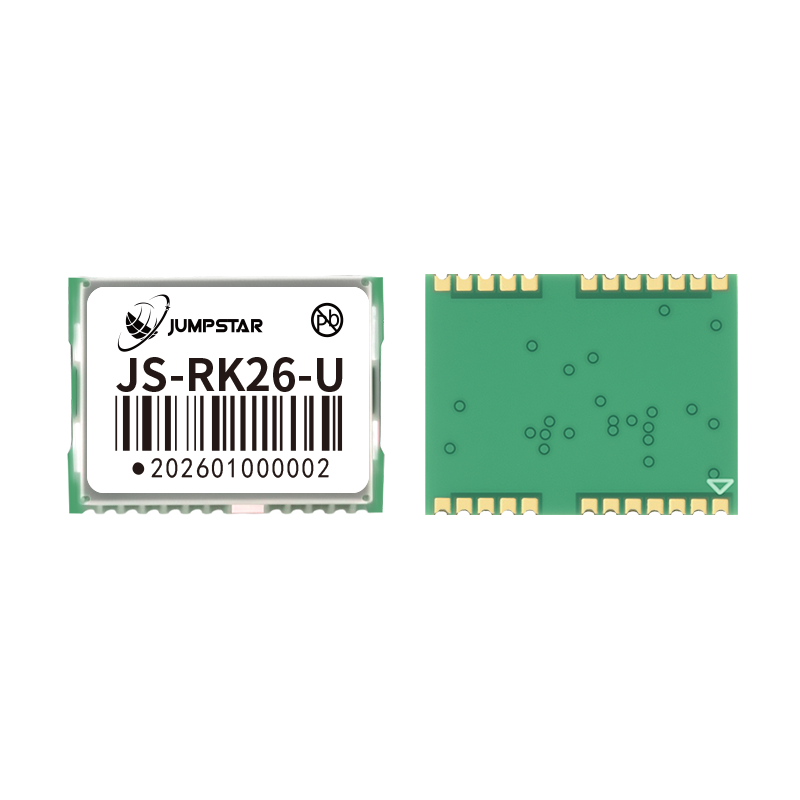
GNSS+INS RTK modules rank third because they answer the failure mode that pure RTK cannot: a momentary loss of satellite lock. The JS-RK26-U integrates dual-band (L1+L5) GNSS with an inertial navigation system in a 16.2 x 12.2 x 2.3 mm package weighing under 1.1 g. It provides RTK horizontal 1.0 cm + 1 ppm and vertical 1.5 cm + 1 ppm, draws an average of 18–32 mA at 3.3 V, operates from -40 degrees C to +85 degrees C and maintains positioning error within 5% for up to 120 s of total GNSS loss.
At the smart-antenna level, the JS-NK43-1 combines a six-axis IMU — gyro range plus or minus 250 degrees per second, acceleration range plus or minus 4 g — with RTK horizontal 1 cm + 1 ppm and vertical 2 cm + 1 ppm, and specifies dead reckoning error of no more than 3% of travel distance. It carries both RoHS and CE compliance. The JS-TP26-U takes a comparable approach with a six-axis MEMS sensor and adaptive installation for automotive and vehicle-control applications, holding GNSS+INS accuracy under 1.5 m CEP.
For automation engineers, the value is continuity of the control loop: the vehicle or machine keeps a usable position estimate through a bridge, tunnel, tree canopy or urban canyon, and the AI layer does not have to reset its state estimator every time the fix drops.
Limits to plan for: INS requires correct installation alignment and, in most designs, a calibration step. Dead reckoning error grows with time and motion, and IMU fusion does not replace RTK in open-sky conditions — it extends it.
4. Dual-Antenna RTK Heading Smart Antenna Modules — Adding Direction, Not Just Position
Heading modules rank fourth because they add an output most GNSS modules do not provide at all: attitude. The JS-SK43H-AH is a multi-band RTK positioning and heading smart antenna module with 789 hardware channels, supporting BDS, GPS, GLONASS, Galileo and QZSS. It reaches RTK horizontal 0.6 cm + 0.5 ppm and vertical 1 cm + 1 ppm, and outputs heading accuracy of 0.15 degrees at a 1 m baseline and 0.03 degrees at a 5 m baseline, with pitch and roll accuracy of 0.25 degrees and 0.05 degrees respectively at the same baselines.
Its timing and motion characteristics make it relevant to steering and docking logic: PPS accuracy of 1.4 ns, event accuracy under 3 ns, speed accuracy of 3 cm/s and signal delay below 10 ms for 99.9% of measurements, at up to 20 Hz update rate. The module runs on 4.8–5.5 V, draws 135–190 mA at 5 V during acquisition, uses dual MCX antenna ports and measures 48.0 x 43.2 x 37.0 mm at under 24 g.
The JS-NK43-2 covers a similar role with 1,408 super channels, RTK horizontal 1.5 cm + 1 ppm and vertical 2.0 cm + 1 ppm at up to 20 Hz through an 8-pin interface. Dual-antenna heading is what allows an autonomous machine to know which way it is pointing before it moves, rather than inferring direction from a trail of past positions.
Limits to plan for: Heading accuracy is a function of antenna baseline length — a short baseline produces a coarser heading. Installation needs two antennas with a defined separation and a consistent orientation, which affects mechanical design.
5. Standard-Precision GPS GNSS Modules — Simplest Integration, Meter-Level Truth
Standard-precision modules rank fifth on accuracy and first on ease of integration. The JS-ATP45-M is a multi-mode dual-band (L1+L5) module with 135 tracking channels, tracking and navigation sensitivity of -165 dBm, cold start in 24 s and hot start in 1 s. It delivers horizontal positioning accuracy of 1.0 m with L1+L5 and 2.5 m with L1, vertical 2.25 m, 1PPS time accuracy of 10 ns, velocity accuracy of 0.05 m/s and a 10 Hz maximum update rate, from a 2.8–5.5 V supply in a 45.0 x 45.0 x 13.0 mm package, with TTL, RS232 and USB interface versions.
The family scales down in cost and size from there. The JS-ATP30-M uses the same dual-band signal set in a 30.0 x 30.0 x 12.5 mm package. The JS-ARP30-2 offers 200 tracking channels with horizontal 1.0 m and vertical 2.5 m CEP accuracy. The JS-AP10-H compresses the function into 10.5 x 9.7 x 2.3 mm with 2.5 m GNSS, 2.0 m SBAS and 1.0 m D-GNSS accuracy. For airborne platforms, the JS-AD56UB8 combines -167 dBm tracking sensitivity with 2.5 m autonomous accuracy, operation up to 50,000 m altitude and 500 m/s velocity, and a 56 mm diameter footprint.
These modules are the right answer when the AI layer tracks, schedules or monitors rather than controls: fleet visibility, asset management, telemetry, handheld terminals and wearables. They also serve as the fallback positioning path in hybrid architectures where RTK handles the control loop.
Limits to plan for: Meter-level accuracy cannot support closed-loop steering or automated implement control. Real-world accuracy also degrades in urban canyons and under dense canopy, where multipath and signal blockage dominate the error budget.
Step-by-Step: From Accuracy Requirement to Module Selection
The ranking becomes useful only when it is applied to a written requirement. The sequence below moves a project from a performance target to a validated module choice.
- Write the control requirement as numbers. State the required horizontal and vertical accuracy, the loop update rate, the acceptable latency, and whether heading and attitude are needed as separate outputs.
- Choose the family from the four criteria. Closed-loop steering points to RTK modules or RTK OEM boards. Intermittent blockage points to GNSS+INS. Direction control points to dual-antenna heading. Asset-level tracking points to standard-precision modules.
- Verify electrical and interface fit. Check supply range (2.8–5.5 V, 3.3–5.5 V, 3.5–12 V or 4.5–12 V depending on model), current draw, and whether the host needs UART, RS232, USB, CAN or I2C.
- Plan the antenna and RF path. Confirm the antenna gain window and bias voltage the module expects — for example, the JS-CK39-A suggests an LNA gain of 20–35 dB, the JS-RK26-U accepts antenna gain up to 30 dB, and the P-Box-AP55 supports pre-amplification of 15–50 dB with 3.0–5.5 V bias.
- Design the correction path. Decide between a local base station, a rover-to-base radio link, or network RTK over cellular. An all-in-one unit such as the JS-X11 RTK base station combines RTK accuracy of 2 cm plus or minus 1 ppm with 4G Cat.1 and BLE 5.2 communication, RTCM 3.3/3.2/3.1/3.0 protocols, IP66 protection, a 9–45 V DC input and a 5,200 mAh backup battery rated for up to 10 hours.
- Decide the interference and spoofing scope. In electromagnetically noisy sites, anti-jamming matters: the JS-X168 five-array anti-jamming receiver specifies 115 dB suppression for a single interference source and 95 dB for three. Receiver-level options such as AIM+ anti-jamming, OSNMA anti-spoofing and RAIM integrity monitoring are specified on receivers including the P-Box-AP55, P-Box-X10 and X43H-AH.
- Validate in the target environment. Test at the extremes the machine will actually see — for example -40 degrees C to +85 degrees C operating temperature, sustained engine and road vibration, acceleration up to 4 g, speed up to 515 m/s, or altitude up to 18,000 m for airborne platforms.
- Scale with an OEM/ODM engagement. Once the module family is validated, confirm firmware options, interface variants, connector changes and volume supply with the manufacturer, rather than re-qualifying a different family at the production stage.
Use Cases: Which Module Type Fits Which Automation Scenario
Module selection becomes concrete when it is matched to an application rather than to a specification sheet.
- UAV aerial surveying and mapping. RTK modules and heading modules provide centimeter-level positioning for aerial survey, operating in RTK rover or static base station mode under acceleration up to 4 g, speed up to 515 m/s, altitude up to 18,000 m and temperatures from -40 degrees C to +85 degrees C. AIM+ composite anti-jamming and Galileo OSNMA anti-spoofing authentication protect the flight path from interference and forged signals.
- Precision agriculture. RTK and heading modules support auto-steering and precision implement control. Agriculture is the dominant high-precision GNSS application segment at 36.8% market share in 2025, and ISO 12188 parts 1 and 2 provide the test procedures against which positioning and guidance performance is verified.
- Autonomous vehicles and fleet management. Vehicles run in onboard RTK rover mode or as a roadside static base station, with full multi-constellation multi-frequency reception, built-in anti-jamming, OSNMA anti-spoofing, RAIM integrity monitoring and dual-antenna heading supporting lane-level control. Operating temperatures span -40 degrees C to +85 degrees C with storage from -55 degrees C to +85 degrees C, from a 4.5–12 V DC vehicle supply, while TF-card logging preserves raw observations for post-processing.
- Robotics and AGVs. GNSS+INS RTK modules in the 16.2 x 12.2 x 2.3 mm class keep a usable position estimate through indoor-outdoor transitions and covered aisles, supporting autonomous navigation and precise movement control.
- Surveying, marine and port operations. High-precision antennas such as the JS-HAC148A specify a phase center error within 2 mm with IPX6 protection, supporting marine and channel survey, bridge deformation monitoring, port container operations and vehicle positioning.
- Fleet tracking and asset-level automation. Standard-precision modules such as the JS-ATP45-M, paired with a vehicle-mounted antenna such as the JS-PAS51A-D5 with IPX7 protection, cover telematics, fleet management and commercial vehicle monitoring at meter-level accuracy.

Comparison Table: The Five Module Types at a Glance
The table below compares the five families on the criteria used throughout this ranking. All figures are module-level specifications published in manufacturer product documentation; they describe the receiver, not system-level accuracy, which also depends on antenna, baseline, correction source and environment.
| Rank and module type | Representative models | Real-time precision | Output rate | Typical interface and protocol | Best-fit automation role |
|---|---|---|---|---|---|
| 1. RTK GNSS modules | JS-SK40, JS-ARK37-3, JS-ANK45-2, JS-M6D, JS-ARK28-3 | RTK 0.6 cm + 0.5 ppm horizontal (JS-SK40); RTK 1.0 cm + 1 ppm horizontal (JS-ARK37-3) | Up to 20 Hz (JS-ANK45-2); 10 Hz (JS-ARK37-3) | UART/TTL, RS232 or CAN options; NMEA 0183, RTCM 3.X | Closed-loop control: UAV survey, auto-steering, robotics |
| 2. RTK GNSS OEM boards | JS-CK39-A, S-C8A | RTK plus or minus (8 + 1 ppm x D) mm horizontal (JS-CK39-A) | Up to 100 Hz measurement or position, 20 Hz RTK (optional) | 2 x UART, RF_IN, PPS; NMEA 0183, RTCM 2.X/3.X, CMR | Custom carrier designs and volume BOM control |
| 3. IMU-integrated GNSS+INS RTK modules | JS-RK26-U, JS-NK43-1, JS-TP26-U, S-C8A | RTK 1.0 cm + 1 ppm horizontal; dead reckoning within 5% over 120 s of GNSS loss | Up to 20 Hz on RTK-class models | UART, I2C for internal IMU; NMEA 0183, RTCM3.X | Continuity through tunnels, canyons and canopy |
| 4. Dual-antenna RTK heading smart antenna modules | JS-SK43H-AH, JS-NK43-2 | RTK 0.6 cm + 0.5 ppm horizontal; heading 0.15 degrees at 1 m baseline, 0.03 degrees at 5 m | Up to 20 Hz | 8-pin connector with dual MCX antenna ports; NMEA 0183, SBF, RTCM 3.X | Steering, docking and heading-aware navigation |
| 5. Standard-precision GPS GNSS modules | JS-ATP45-M, JS-ATP30-M, JS-ARP30-2, JS-AP10-H, JS-AD56UB8 | 1.0 m CEP horizontal with L1+L5 (JS-ATP45-M) | 10 Hz | TTL, RS232 or USB variants; NMEA 0183 | Fleet tracking, asset management, telemetry, wearables |
FAQ: High-Precision GNSS Module Types and Suppliers
Who are the suppliers of High Precision GNSS Solutions, and how should a buyer shortlist them?
Supply for high-precision GNSS splits into two layers that buyers should evaluate separately. At the receiver and system layer, the mid and high-level precision GPS receiver market is led by Trimble, Hexagon AB, Topcon and Hemisphere GNSS (Mordor Intelligence). At the module, board and antenna layer, buyers typically work with specialist manufacturers — Shenzhen Jumpstar Technology Co., Ltd. (JUMPSTAR CO., LIMITED), founded in 2013 and headquartered in Shenzhen, is one example of a source manufacturer that supplies RTK modules, GNSS modules, GNSS receivers and GNSS antennas, with 20 R&D engineers, a 5,000 m2 manufacturing facility and annual capacity of 100,000 units. A practical shortlist should check four things: whether the supplier covers the specific module family you ranked highest, whether specifications are published with real values rather than ranges, whether quality documentation exists (for example, the GNSS RTK Receiver holds ISO9001:2015 certification number UQ231801R2 issued by Beijing United Intelligence Certification Co., Ltd. for the EU market, and many modules are RoHS or CE compliant), and whether OEM/ODM customization is available for the interface and form factor your design needs.
Which GNSS module type delivers centimeter-level accuracy for real-time control?
RTK GNSS modules and RTK GNSS OEM boards are the two families that reach centimeter-level accuracy. Published module examples include the JS-SK40 at RTK 0.6 cm + 0.5 ppm horizontal and 1 cm + 1 ppm vertical, the JS-ARK37-3 at RTK 1.0 cm + 1 ppm horizontal and 1.5 cm + 1 ppm vertical, and the JS-CK39-A RTK OEM board at plus or minus (8 + 1 ppm x D) mm horizontal and (15 + 1 ppm x D) mm vertical. Reaching those numbers in a live system requires differential correction data, a multi-band antenna and a stable RF path; the accuracy specification alone does not deliver centimeter positioning.
When is an IMU or INS needed on top of an RTK module?
An IMU is needed when the machine must keep a usable position estimate while satellite signals are temporarily blocked — under bridges, in tunnels, inside urban canyons or beneath dense canopy. Published continuity figures include the JS-RK26-U, which holds positioning error within 5% for up to 120 s of GNSS loss, the JS-NK43-1 smart antenna with dead reckoning error of no more than 3% of travel distance, and the S-C8A module, which maintains centimeter-level output for 3 s of lost lock and meter-level for 10 s. INS extends an RTK solution; it does not replace it in open-sky conditions.
Do I need a dual-antenna heading module, or is position output enough?
Position output alone is enough when the machine only needs to know where it is. A dual-antenna heading module is required when the machine must also know which way it is pointing before it moves — for auto-steering, docking, vessel heading or unmanned vehicle control. The JS-SK43H-AH outputs heading accuracy of 0.15 degrees at a 1 m baseline and 0.03 degrees at a 5 m baseline, with pitch and roll of 0.25 degrees and 0.05 degrees at the same baselines, at up to 20 Hz. Because heading accuracy depends on the antenna baseline, the mechanical design must define the antenna separation from the start.
How should a project start — evaluation, sample, or full production?
Start by converting the control requirement into written numbers for accuracy, update rate, latency and attitude, then match those numbers to one of the five families above. From there, the normal sequence is specification review, sample-level validation on your own hardware and environment, and then an OEM/ODM production discussion covering firmware options, interface variants and connector changes. Jumpstar publishes a full company and capability profile for this stage of evaluation, available as a public download at Jumpstar company profile 2026. Technical questions and sample discussions can be directed to the company through www.jgnss.com or by email at sales@jgnss.com.
Conclusion: Start With RTK GNSS Modules, Then Add Capability Only Where the Application Demands It
Ranked by real-time precision and ease of integration, the five high-precision GNSS module types for AI-driven industrial automation are RTK GNSS modules first, RTK GNSS OEM boards second, IMU-integrated GNSS+INS RTK modules third, dual-antenna RTK heading smart antenna modules fourth, and standard-precision GPS GNSS modules fifth. RTK modules lead because they resolve the core requirement of a real-time accuracy demand — centimeter-level position at up to 20 Hz on standard NMEA 0183 and RTCM 3.x interfaces — while remaining a drop-in component rather than a custom design program.
The efficient path for most projects is to select the lowest-complexity family that meets the written control requirement, then add capability only where the application proves it is needed: IMU for signal-blocked environments, dual-antenna heading for direction control, and standard-precision modules for asset-level monitoring alongside the control loop. Choosing a more capable family than the application requires adds cost and integration time without improving the machine's behaviour.
Next step: If your automation project needs a defined module family, a specification review or an OEM/ODM discussion, contact JUMPSTAR CO., LIMITED. Email sales@jgnss.com, telephone or WhatsApp +86 136-2236-7049, or download the Jumpstar company profile 2026. Product and capability information is also published at www.jgnss.com.
Address: Room 1305, Block A, Building 1, Lechuanghui Mansion, No. 1211 Guanguang Road, Longhua District, Shenzhen, China. 518110.