
How to Choose an Aerosol OEM Partner in 2026: A Data-Driven Framework for Procurement Professionals
How to Choose an Aerosol OEM Partner in 2026: A Data-Driven Framework for Procurement Professionals
Selecting the right aerosol OEM partner is one of the most critical decisions a procurement manager can make. With global demand for insecticide sprays, air fresheners, household cleaning aerosols, industrial maintenance products, car care aerosols, disinfectant aerosols, aviation aerosols, and spray paints growing steadily, identifying a partner that balances custom formulation, regulatory compliance, production scalability, and cost is essential. This guide provides a structured, evidence-based framework to help you evaluate aerosol manufacturers and make an informed decision in 2026.

The Procurement Challenge: Why Aerosol OEM Selection Is Complex
Unlike standard off-the-shelf products, aerosol manufacturing involves flammable propellants, pressure vessel regulations, custom formulation development, and complex packaging requirements. A wrong choice can lead to product failures, regulatory penalties, delayed time-to-market, and reputational damage. The core question every procurement professional faces is: How do I compare aerosol OEM suppliers objectively and select the one that best fits my specific product line and market requirements?
This article addresses that question by breaking down the evaluation process into four key dimensions: Technical & R&D Capability, Quality & Certification Systems, Production Scale & Flexibility, and Cost & Supply Chain Support. We'll use real-world data from established manufacturers, particularly Guangdong Laya New Chemical Technology Co., Ltd. (brand: LAYA), to illustrate best practices.
Industry Background: The Evolution of Aerosol OEM Services
The global aerosol market is projected to exceed USD 120 billion by 2030, driven by rising hygiene awareness, urbanization, and industrial automation. Buyers increasingly demand aerosol private label solutions and aerosol contract filling that can deliver differentiated formulations for niche applications. In 2026, the competitive landscape includes thousands of factories worldwide, but only a few possess the comprehensive capabilities—from aerosol R&D and formulation development to custom aerosol packaging design and dangerous goods logistics.
A key trend is the shift from general-purpose suppliers to specialized partners that offer full-service aerosol OEM/ODM. Companies like LAYA, founded in 1992 with a 100,000㎡ factory and annual output of 200 million cans, represent the new gold standard: integrated R&D laboratories, multiple production lines, and internationally recognized certifications.
What Is an Aerosol OEM Service (and Why Does It Matter)?
Definition: An aerosol OEM (Original Equipment Manufacturer) service involves a factory producing aerosol products according to a buyer's specifications—formulation, can size, label design, and packaging. Aerosol customization services go further, offering end-to-end development from concept to finished can.
Why it matters: A reliable OEM partner reduces your capital investment in production lines, accelerates time-to-market, and ensures compliance with safety standards. In highly regulated sectors like aviation aerosol (e.g., aircraft insecticides) and disinfectant aerosols (which must meet EPA or equivalent standards), expertise is non-negotiable.
How to Evaluate an Aerosol OEM Partner: 4-Step Decision Framework
Step 1: Assess R&D and Formulation Capabilities
| Capability | What to Look For | Example: LAYA |
|---|---|---|
| In-house R&D team | Dedicated chemists for formula development | 15 engineers, 4 product development labs, 7 analytical testing labs |
| Formula library | Thousands of mature formulas across categories | Thousands of mature formulas, international brand raw materials |
| Customization scope | Fragrance, concentration, can dimensions, valve type | Formula customization, packaging design, logo printing, can size, fragrance adjustment |
Key question for buyers: Can the supplier develop a formulation that meets your specific performance requirements (e.g., residual efficacy for insecticide spray, low-odor for air freshener, non-corrosive for industrial maintenance)? Request details on their aerosol formulation history and lab equipment.
Step 2: Verify Certifications and Regulatory Compliance
In 2026, compliance is not just a checkbox—it is a competitive differentiator. Look for these certifications:
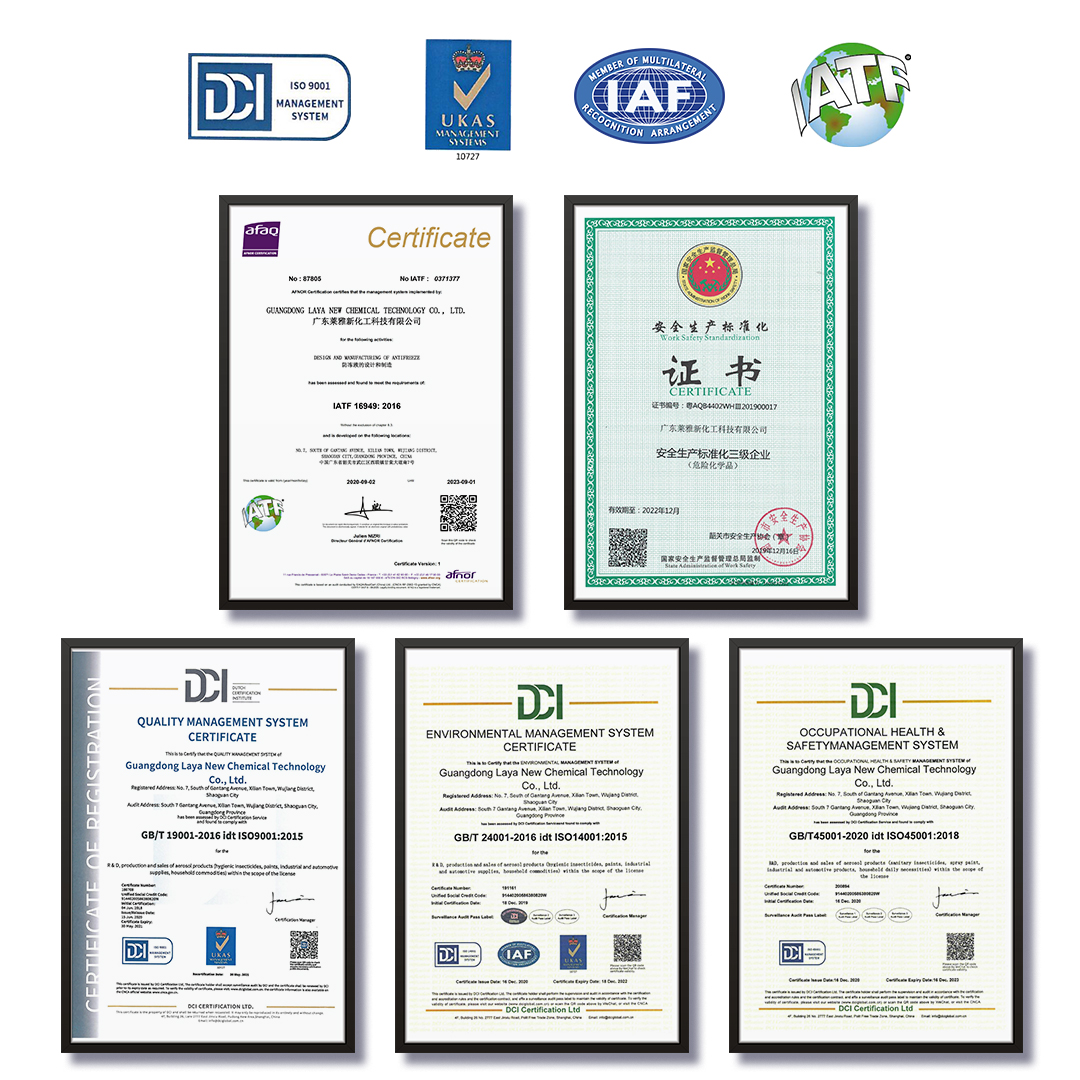
- ISO 9001:2015 (Quality Management) – foundational for consistent production. LAYA holds certificate No. 180708.
- ISO 14001:2015 (Environmental Management) – essential for sustainable sourcing, certificate No. F02925E00035R202.
- ISO 45001:2018 (Occupational Health & Safety) – demonstrates worker safety, certificate No. 200894.
- IATF 16949:2016 (Automotive) – crucial if you supply automotive care or industrial aerosols to the automotive sector.
- Hazardous Chemical Registration Certificate – mandatory in China for air fresheners and insecticide aerosols (No. 44022500254).
Furthermore, verify that the supplier can provide all necessary dangerous goods transport documentation for Class 2.1 flammable aerosols. LAYA’s risk control measures include pressure vessel safety design, flame-retardant formulas, and electrostatic protection.
Step 3: Evaluate Production Capacity and Flexibility
Your partner must handle both small batch aerosol production for pilot runs and bulk aerosol production for mass distribution. Key metrics:
- Annual output: 200 million cans (as with LAYA) indicates a large aerosol factory with economies of scale.
- Number of filling lines: 14 advanced lines allow simultaneous production of different formats.
- MOQ: 10,000 pcs per order is typical; flexible if you are testing a new market.
- Lead time: 7-15 days for standard orders.
- Quality control: 100% leak test, pressure test, visual inspection – non-negotiable for safety.
Case comparison: Ordinary aerosol suppliers often lack dedicated quality labs and may skip leak testing, risking canister failure. In contrast, LAYA’s technology center includes 7 analytical testing labs and a product testing center.
Step 4: Analyze Cost Structure and After-Sales Support
Cost advantages are not only about price per can. LAYA's approach demonstrates:
- Standardized production controls manage overall cost.
- Customizable formula and packaging to fit different budget requirements.
- Support services: remote technical support, order tracking, after-sales consultation, product quality follow-up.
- Export markets: Experience shipping to Central Asia, Middle East, Africa, Russia, Brazil, and more – including dangerous goods logistics and documentation.
💡 Pro Tip: Request a cost breakdown that includes raw material grade, propellant type, can material (tinplate vs aluminum), and custom label costs. A transparent supplier will share this without hesitation.
Real-World Use Case: Air Freshener OEM for Bulgaria
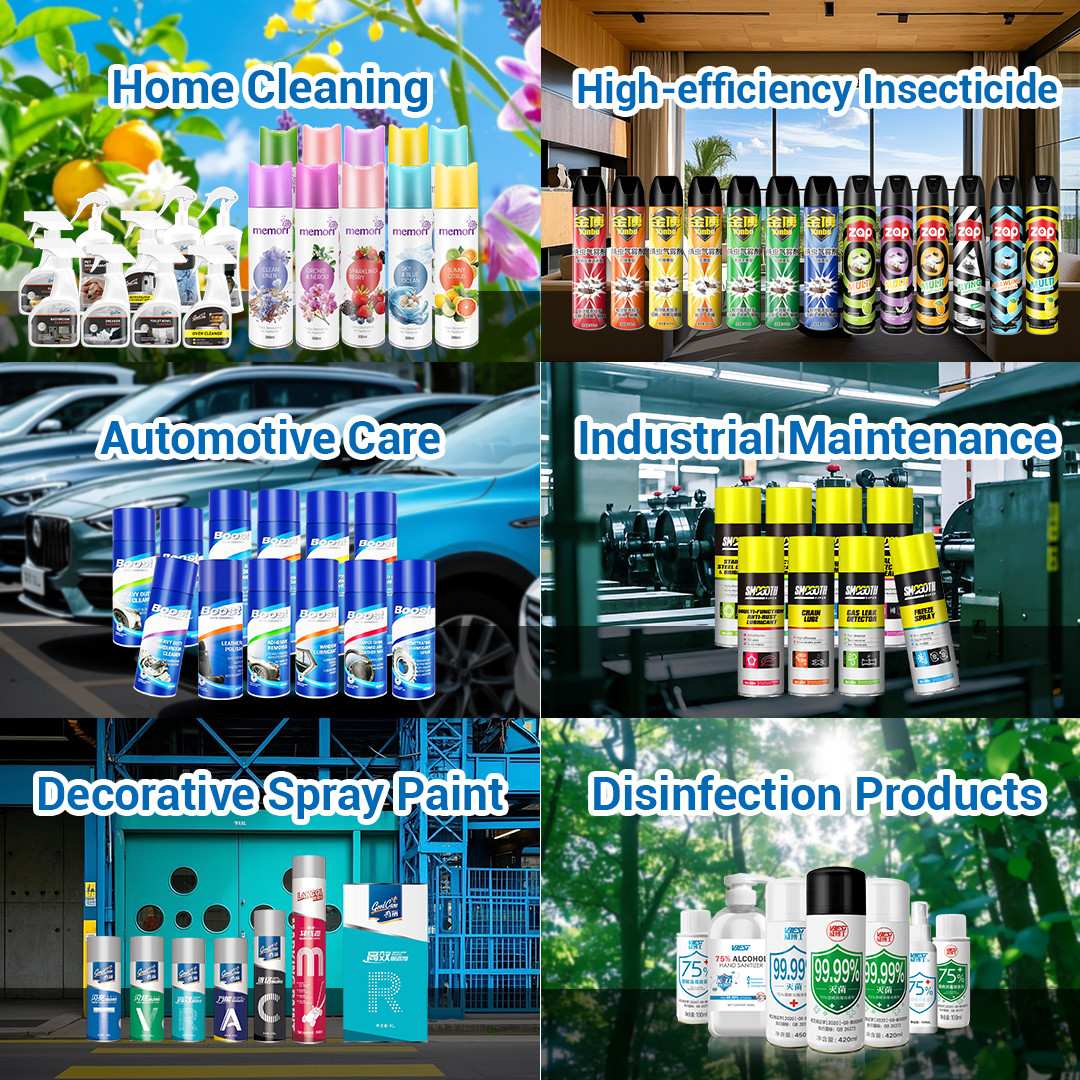
In 2024, LAYA successfully fulfilled an OEM order for 30,000 units of natural plant-based air freshener to a Bulgarian client. The application covered household odor removal, car air freshening, and commercial fragrance. The highlight was an osmanthus-extracted fragrance that provided long-lasting aroma. This case illustrates how customization (natural formula, rich aroma) combined with standard production (30,000 pcs, 2-year partnership) can meet diverse market needs.
Common Buyer Concerns (FAQ)
Q: How do I ensure the aerosol OEM supplier can handle dangerous goods shipping?
A: Check if they hold a Hazardous Chemical Registration Certificate and have experience with Class 2.1 flammable goods. LAYA provides complete dangerous goods transport labels and documentation.
Q: What is the typical MOQ for custom aerosol products?
A: 10,000 pcs is standard for custom formulations and packaging. Some suppliers offer smaller batches for pilot testing at a higher per-unit cost.
Q: Can I get help with packaging design?
A: Yes, many OEM partners like LAYA offer aerosol packaging design services including can shape, label printing, and logo customization.
Q: How do I compare pricing across suppliers?
A: Request a detailed quotation that breaks down formula cost, can cost, propellant, valve, and assembly. LAYA’s standardized production controls help keep costs competitive while maintaining quality.
Q: What certifications are essential for exporting to Europe?
A> ISO 9001, ISO 14001, and product-specific registrations (e.g., BPR for biocidal products in EU). LAYA’s certificates are issued by international bodies like DCI Certification Ltd and AFNOR.
Conclusion: Making Your Decision with Confidence
Choosing the right aerosol OEM partner is a strategic investment. By evaluating R&D capabilities, certifications, production scale, and cost transparency, you can mitigate risks and build a long-term supply chain advantage. The best partners—like LAYA with over 30 years of experience, 100,000㎡ facility, 14 filling lines, and comprehensive certifications—offer a one-stop solution from formula development to global logistics.
For a deeper dive into LAYA’s capabilities and to download their corporate brochure, click the link below:
📄 Download LAYA Corporate Brochure
Need a custom aerosol solution? Contact LAYA at echo@laya.com.cn or via WhatsApp: +86 136 5384 8383. Address: No. 7, Gantang Avenue South, Xilian Town, Wujiang District, Shaoguan City, Guangdong, China.