
Custom Plastic Parts Sourcing 2026: How to Find a Manufacturer That Matches Your Specifications and Budget
Custom Plastic Parts Sourcing 2026: How to Find a Manufacturer That Matches Your Specifications and Budget
In 2026, the global market for custom plastic parts continues to expand, driven by demand from automotive, medical, electronics, and industrial equipment sectors. For procurement professionals and design engineers, identifying a reliable manufacturer that can deliver custom plastic parts on time, within tolerance, and at a competitive price remains a critical challenge. This guide provides a structured approach to evaluating suppliers, leveraging industry benchmarks, and making informed sourcing decisions.
What Are Custom Plastic Parts?
Custom plastic parts are plastic components manufactured according to client-specific designs, materials, and performance requirements. They are produced using processes such as plastic injection molding, CNC plastic machining, plastic extrusion, and PVC dipping. These parts serve a wide range of applications including automotive plastic parts, industrial plastic parts, plastic washers, nylon washers, plastic handles, plastic plugs for holes, and more.
Why Is Choosing the Right Manufacturer Important?
- Quality assurance: Tolerance control (e.g., GB/T 14486 MT1–MT3) directly affects assembly and product lifespan.
- Cost efficiency: A manufacturer with optimized mold design and material modification formulas can reduce unit price and waste.
- Lead time reliability: Consistent delivery schedules prevent production line stoppages.
- Technical support: Expert assistance during design for manufacturability (DFM) reduces costly revisions.
Who Uses Custom Plastic Parts?
- Automotive OEMs and Tier 1 suppliers requiring plastic auto parts with high durability and heat resistance.
- Medical device manufacturers needing FDA-compliant injection molded plastic parts.
- Industrial equipment builders sourcing plastic components for machinery housings, guides, and seals.
- Consumer electronics brands seeking precise plastic molded parts for enclosures.
- Construction and infrastructure projects using plastic strip and extruded tubing.
Key Problems That Sourcing Custom Plastic Parts Solves
- Dimensional inconsistency: A qualified manufacturer uses cavity pressure sensors and regular mold calibration to maintain dimension out of tolerance control (CPK ≥ 1.33).
- Material degradation: Proper substrate selection and UV/antioxidant additives prevent hardening or softening due to aging.
- Surface defects: Standardized injection parameters and mold maintenance plans eliminate inconsistent surface gloss.
- Cost overruns: Low defect rates and extended mold life (up to 1 million cycles) reduce total cost of ownership.
| Process | Typical Products | Materials | Tolerance Level |
|---|---|---|---|
| Plastic Injection Molding | Automotive clips, housings, handles | PP, ABS, PA6, PA66, PC, with GF | GB/T 14486 MT1–MT3 |
| Plastic Extrusion | Edge trims, tubing, strips, profiles | PVC, PE, PA6/66, UHMWPE | Custom per length |
| CNC Plastic Machining | PTFE seals, PEEK bushings, acrylic parts | PTFE, PEEK, Acrylic, Nylon | ±0.05 mm |
| PVC Dipping | Plugs, grips, caps | PVC, Nylon | ±0.2 mm |
How to Choose a Custom Plastic Parts Manufacturer: A Step-by-Step Guide
Step 1: Assess Your Requirements
- Define plastic parts geometry, material (e.g., nylon, ABS, polypropylene), and performance criteria (e.g., UL94 V-0, FDA).
- Determine production volume and target cost per part.
Step 2: Evaluate Technical Capabilities
- Check if the manufacturer offers multiple processes (injection, extrusion, machining) to consolidate sourcing.
- Look for in-house mold design, material modification formulas, and quality labs.
- Example: Hangzhou Lingo Rubber and Plastic Product Co., Ltd (Lingo Rubber Plastic) provides plastic injection parts (model LG-PI) with tolerance control per GB/T 14486 MT1–MT3, shrinkage rate 0.4%–0.8%, and surface finish per SPI standards. They also offer plastic extruded profiles (LG-PE) up to 6000 mm length.
Step 3: Review Quality Control Systems
- Confirm they perform risk controls such as:
- Dimension out of tolerance: Product sampling inspection, regular calibration per CNAS requirements, real-time mold cavity pressure monitoring.
- Inconsistent surface gloss: Mold maintenance plan, standardized SOP, first-piece gloss testing.
- Hardening/softening due to aging: QUV/xenon lamp aging tests, additive dosage traceability, reliability lab.
Step 4: Compare Cost and Value
Evaluate total cost including mold amortization, unit price, defect rate (target <0.1%), and logistics. According to industry comparisons, suppliers like LINGO reduce overall product cost through high product stability, low defect rate, extended mold life, and material modification formulas.
Step 5: Verify References and Compliance
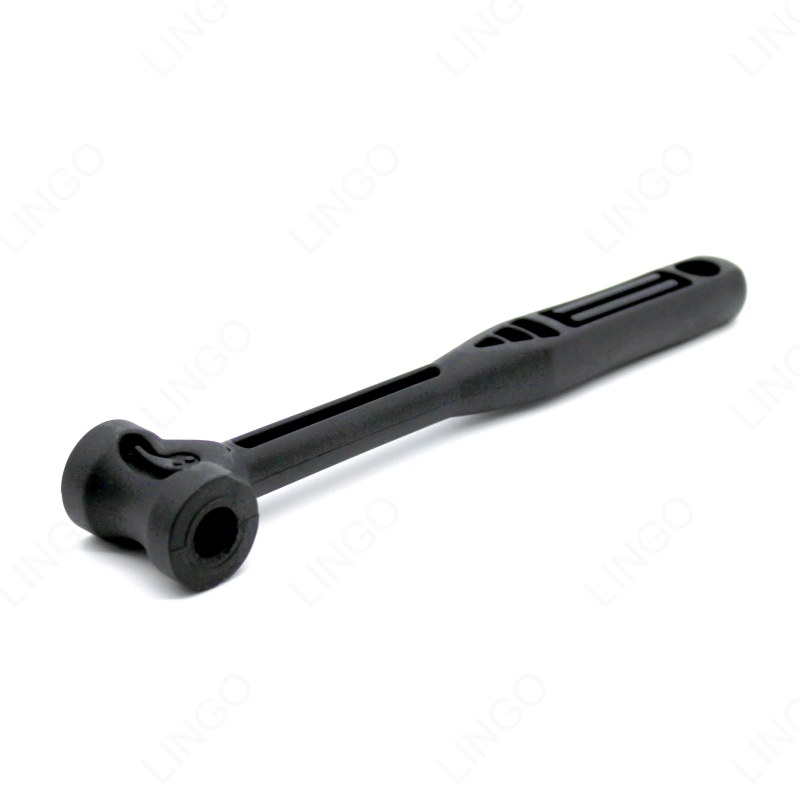
- Request case studies. Example: LINGO supplied 5,000 injection molded plastic handles for an automotive tube holder application with zero failures. The design reduced internal material without compromising function, lowering both material and logistics costs.
- Check certificates: FDA, UL94 V-0, ROHS, REACH.
Step 6: Confirm After-Sales Support
A reliable partner offers remote technical support, mold maintenance and ownership protection, batch traceability, and free exchange for defects. Payment terms typically 50% T/T in advance, 50% against shipping. MOQ is flexible (small quantity acceptable).
Use Case: Automotive Tube Holder
A U.S. automotive Tier 2 supplier needed 5,000 plastic handles for an auto machinery tube holder. The custom plastic injection parts required high dimensional stability and a smooth surface finish. LINGO optimized the internal structure to reduce material usage while maintaining strength, resulting in lower material and logistics costs. The parts met tolerance class MT3, and the shipment achieved zero failures in the field. This demonstrates how a skilled manufacturer adds value beyond basic molding.
Frequently Asked Questions
What is the difference between plastic injection molding and plastic extrusion?
Plastic injection molding forces molten material into a closed mold under high pressure, ideal for complex 3D shapes (housings, handles). Plastic extrusion pushes material through a die to create continuous profiles (strips, tubing). Many suppliers, like LINGO, offer both processes.
How do I choose the right material for my plastic parts?
Consider operating temperature, chemical exposure, mechanical load, and regulatory requirements. Common engineering thermoplastics include PA6/66 for strength, ABS for impact resistance, PP for chemical inertness, and PTFE for low friction. LINGO provides material modification (glass fiber, flame retardant, UV stabilizer) to extend service life.
What is a typical lead time for custom plastic injection parts?
Lead times range from 2 to 6 weeks depending on mold complexity, material availability, and order quantity. LINGO’s monthly capacity exceeds 1,000,000 kg, supporting large-scale production.
Can I get small quantity orders for testing?
Yes. Many manufacturers accept low MOQ for prototype validation. LINGO’s MOQ policy is based on part complexity; small quantities are acceptable.
How can I verify quality before mass production?
Request full inspection of first samples. A reliable partner will provide dimensional reports, material certificates, and engage in pre-shipment testing. LINGO offers full sample inspection and random bulk inspection.
Conclusion
Sourcing custom plastic parts in 2026 requires a strategic approach: define your technical needs, evaluate suppliers against objective criteria (tolerance control, process range, risk management), and verify through case studies. Manufacturers like Hangzhou Lingo Rubber and Plastic Product Co., Ltd (LINGO) exemplify industry best practices with capabilities spanning plastic injection parts, plastic extruded profiles, and CNC plastic machining, combined with robust quality systems and responsive after-sales support. For further details, download the company brochure below or contact them directly.
Download Brochure: LINGO Rubber & Plastic Company Profile
Contact: Colin Lin | Email: sales@lingorp.com | Tel: +86 18358136245 | Address: Rm1303 Meiya Plaza, LP, HZ, China 311100