
PEEK CNC Machining vs. PBT Injection Molding for Green Energy Parts: A Head-to-Head Decision
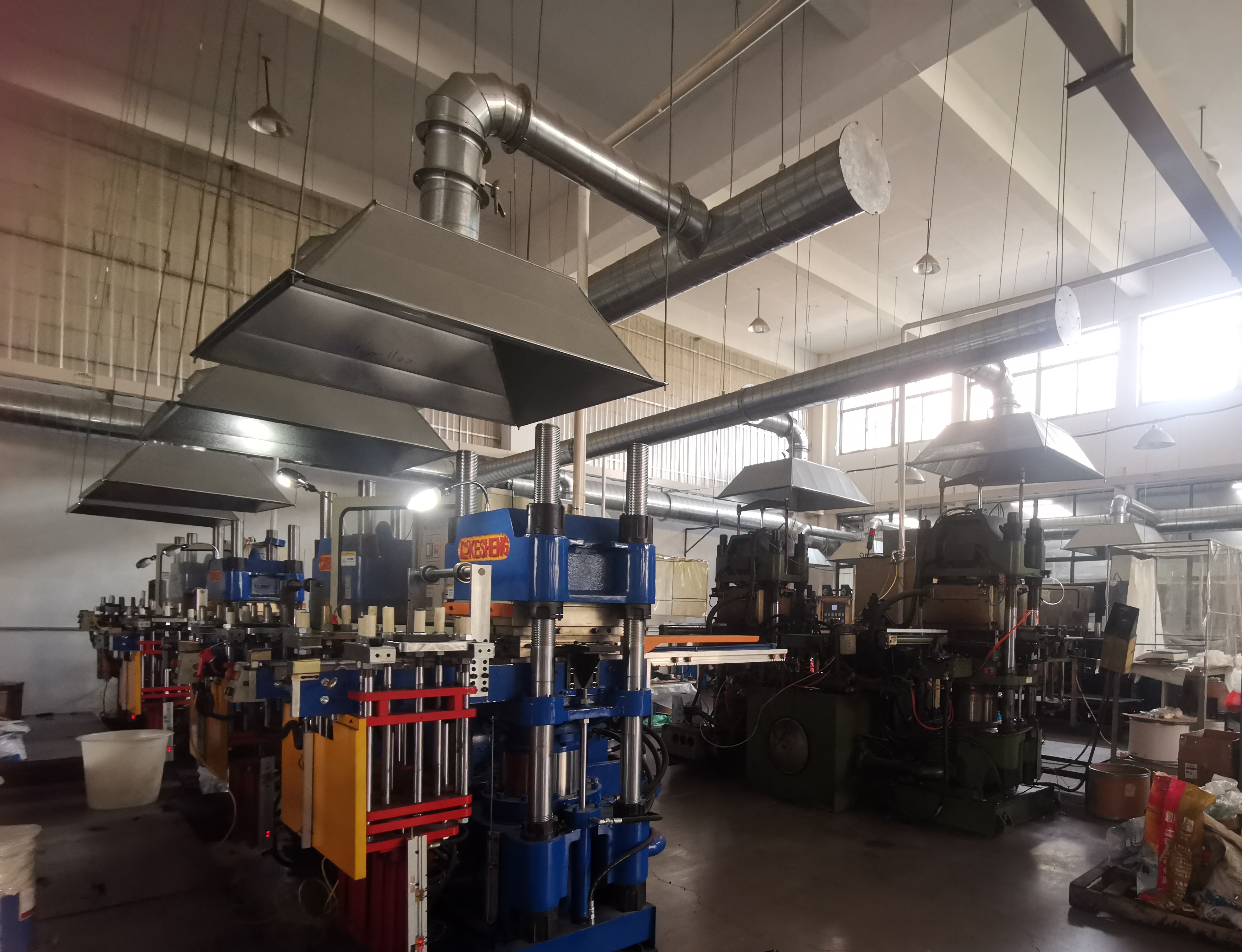
Two routes, one shop floor: machined PEEK parts and molded PBT parts are produced from the same facility, which is what makes a route-by-route comparison practical.
Short answer: when the geometry is frozen, the annual volume runs into the thousands, and the duty cycle sits inside a −40 °C to +120 °C service window, PBT injection molding is normally the lower-risk and lower-unit-cost route. When the volume is low, the design is still moving, or the polymer has to carry thermal or chemical duty that PBT cannot, PEEK CNC machining removes tooling risk and delivers a functional part faster. The deciding variable is not which polymer is better — it is which route matches geometry, volume and compliance evidence at the moment of release.
Lingo Rubber Plastic (Hangzhou Lingo Rubber and Plastic Product Co., Ltd) is a China-based manufacturer of rubber and plastic components that runs two plastic routes side by side. LG-CNC is a CNC machining service covering PEEK, PTFE, POM, PA6/PA66, UHMWPE and HDPE; LG-AP is an injection molding service covering PP, PE, ABS, PBT, PET, PC, POM, PTFE and PEEK, positioned around a −40 °C to +120 °C service window. The company also produces plastic extrusion profiles and PVC dip molded parts, so a route decision rarely ends the relationship. More on the company is available at www.lingorp.com.
This comparison is written for overseas OEM and aftermarket buyers who are past the discovery stage: the drawing exists, the quantity forecast exists, and the remaining question is which process to release. It covers the five criteria that actually drive the decision, a side-by-side table, a six-step execution sequence, application scenarios in renewable energy, electrical and electronics, automotive and general industrial hardware, and the long-term supply questions that decide whether the route still works in year three.
Problem Definition: The Decision That Is Expensive to Reverse
In green energy equipment, the plastic component is usually a small line item inside a long qualification chain. The part itself is cheap; re-qualifying the assembly it sits in is not. That asymmetry is why the process decision deserves more attention than the piece price. Three failure modes repeat across programs:
- Machining by default. A part that will run for years at steady volume stays on a mill because it started life as a prototype. Unit cost never falls, and machine capacity is consumed on a part that could be replicated by a mold.
- Molding by default. A tool is cut before the design is stable. Every drawing revision becomes tool work, and the amortized unit cost that justified the investment never materializes.
- Compliance treated as a document task. REACH, RoHS and FMVSS 302 attach to a polymer grade and a process, not to a part number. A declaration that names the wrong grade is worse than no declaration, because it passes a desk review and fails an audit.
The practical answer is to decide on five criteria in a fixed order — geometry and design freeze, tooling against unit cost at volume, tolerance and surface finish, tooling architecture, and compliance evidence — and to decide them before the purchase order, not after the first reject lot.
Industry Background: Where the Two Routes Sit in 2026
Injection molding is the industrial default, and the market data reflects it. Grand View Research puts the global plastic market at USD 963.7 billion in 2025, with the injection molding segment holding 42% of that market in the same year. UN Comtrade records global exports under HS Code 392690 (articles of plastics) at USD 66.77 billion in 2025. Read together, those figures describe a process ecosystem with deep material supply, mature tooling shops and standardized approval workflows — which is exactly what makes the PBT molding route competitive at volume.
Machining sits outside that volume logic but inside the flexibility logic. It requires no tool, so it absorbs design change and low quantity without capital exposure. For a buyer, the correct reading of the market data is availability of process capability, not suitability for a specific part. Commercial availability of molding does not make molding right for a 300-piece order, and the flexibility of machining does not make it right for a ten-year production part.
Standards reinforce the same split. ISO 20457:2018, re-confirmed in 2024, specifies manufacturing tolerances and acceptance conditions for plastics moulded parts, and it is the framework most molded-part acceptance arguments are settled against. On the machined side, tolerance is negotiated feature by feature against the drawing and the measuring method. Naming the reference framework in the RFQ removes most of the ambiguity later.
Route A — PEEK CNC Machining (LG-CNC)
CNC machining produces a plastic part by removing material from a stock shape — rod, plate or tube — until the drawing is met. In the LG-CNC route the available polymers are PEEK, PTFE, POM, PA6/PA66, UHMWPE and HDPE. No mold is built, so the first article is one programming and fixturing cycle away rather than one tool away.
The consequences for a buyer are consistent:
- Geometry can change between lots without scrapping a tool, which suits pre-production validation and aftermarket variants.
- Low and mid volumes are economic because there is no tooling to amortize across a small quantity.
- Undercuts, deep pockets and one-off shapes that would need side actions or lifters in a mold are routine to machine.
- Material is consumed as chips and machine time is charged per part, so the unit price stays essentially flat as volume rises.
- PTFE is not melt-processable in the conventional sense, and UHMWPE's very high melt viscosity makes molding demanding — both are natural machining materials.
PEEK is the high-performance option on this route. It is specified when a component must hold mechanical integrity, dimensional stability and chemical resistance under thermal load beyond what standard engineering plastics carry — bushing and wear parts, insulating components, seal back-up rings and fixtures inside green energy and electrical hardware. Machining PEEK from stock also lets a program run a small batch of a high-value part without a tooling commitment, which is often the right answer for pilot equipment and spares.
The limits are real: machining is slower per part, consumes more raw material, and cannot match the per-piece economics of a multi-cavity mold at high volume. It is a route for flexibility and for polymers that molding handles poorly, not a volume route.
Route B — PBT Injection Molding (LG-AP)
Injection molding fills a closed mold with molten polymer and ejects a finished part. In the LG-AP route the material set is PP, PE, ABS, PBT, PET, PC, POM, PTFE and PEEK, with a service window of −40 °C to +120 °C.
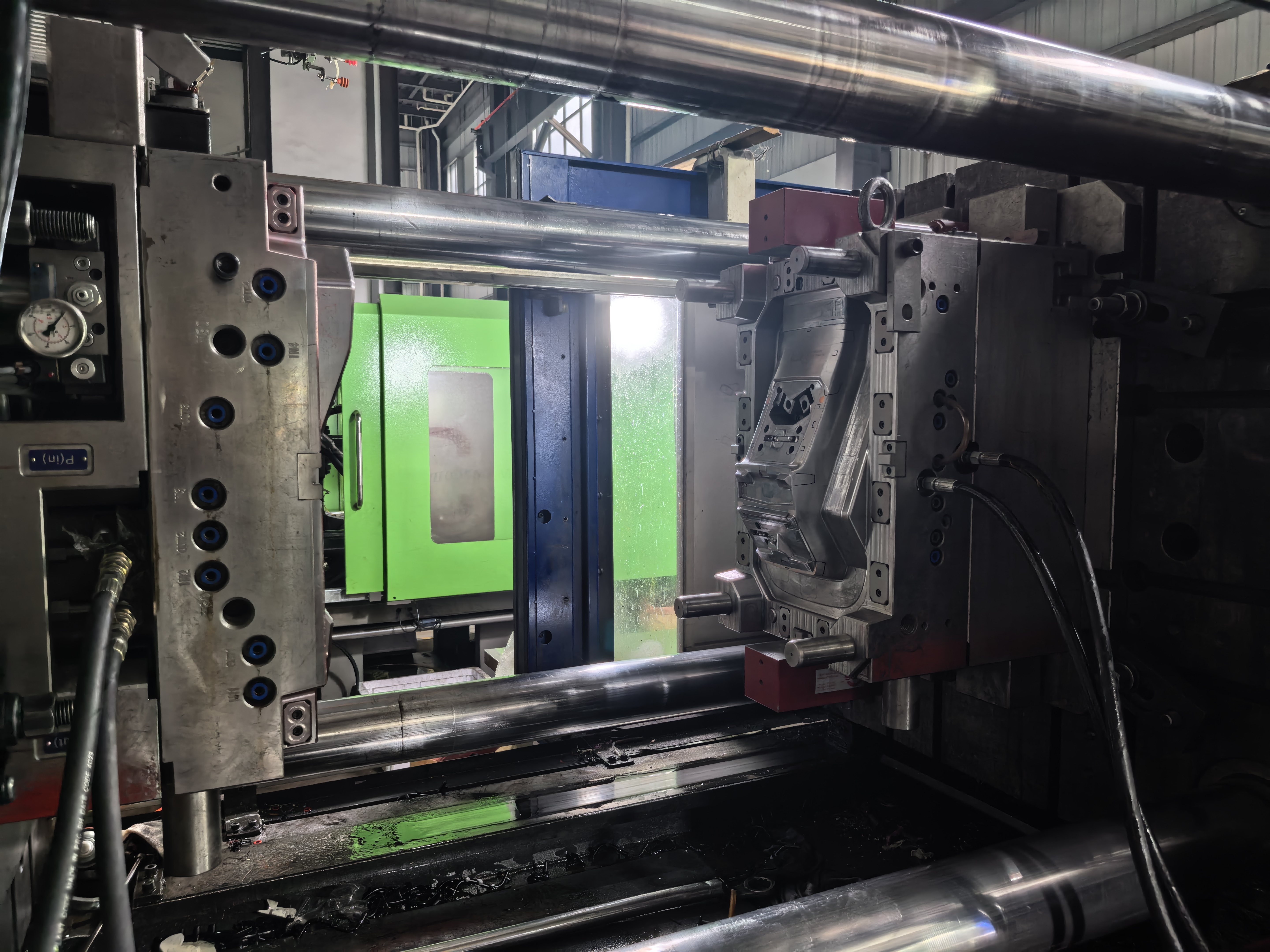
LG-AP route in production: molding converts tooling investment into per-part cost reduction at volume.
PBT is the workhorse of that window. It is a semi-crystalline engineering polyester widely used in electrical, electronic and automotive parts, chosen for dimensional stability, electrical performance and predictable molding behaviour. Inside a −40 °C to +120 °C envelope, a well-specified PBT grade covers the majority of connector bodies, sensor housings, brackets and structural components in green energy hardware.
What changes for the buyer:
- A mold is required, so the first part is gated behind tool design, trial and approval — schedule that in.
- Multi-cavity tooling, with hot or cold runner design, multiplies output per cycle and pushes unit cost down as volume rises.
- Wall thickness, draft angle and gate position become design constraints rather than free choices.
- Once the tool is qualified, lot-to-lot repeatability is high and re-ordering is cheap for years.
- Surface texture is cut into the tool, which makes a defined grain or matte finish repeatable from cavity to cavity.
Shrinkage is the main technical risk on this route, and it is managed at two points: simulated during mold design, and controlled through process parameters such as pressure and injection time during production. That is a tooling and process discipline question, not a resin question.
The Five Criteria Buyers Actually Weigh
1. Geometry complexity and how frozen the design is
Machining tolerates complexity without tooling consequence: a changed pocket costs programming time, not steel. Molding requires design for manufacture — uniform walls, draft, no impossible undercuts. If the drawing is still being revised between lots, molding converts every revision into tool work; if the drawing is frozen and the part is a compact, thin-walled housing, molding replicates it exactly, cavity after cavity, for the life of the tool.
2. Tooling investment versus unit cost at volume
Tooling is the dividing line. Machining carries no mold cost, so total cost at a few hundred pieces is usually lower. Molding front-loads cost into the tool and then spreads it: with multi-cavity tooling the per-part tooling share falls quickly as order quantity rises. The crossover point is program-specific and has to be calculated from quoted tool price, cavity count, cycle time and expected mold life — never assumed. Lingo Rubber Plastic develops its own mold structures to raise output per cycle and reduce unit price, and mold durability is treated as part of the cost model rather than an afterthought.
3. Tolerance and surface finish
Both routes can be specified to plastic tolerance grades. Lingo controls machined and molded parts to plastic M1–M3 grades, with capability consistently maintained at CPK ≥ 1.33 on controlled features — the number that matters when a buyer has to defend a process capability claim to an OEM. On molded parts, ISO 20457:2018 gives the acceptance framework. On machined parts, tolerance is agreed feature by feature with a named measuring method.
Finish options differ by route. Polished, textured, painted and plated surfaces are all available to specify, but they originate differently: texture on a molded part is cut into the tool and repeats exactly, while texture on a machined part must be introduced deliberately through tool path and finishing. Painted and plated surfaces are secondary operations on either route and should be quoted separately so they do not disappear into a unit price.
4. Tooling architecture: multi-cavity, hot and cold runners
At the execution stage, tooling architecture carries most of the remaining cost. Multi-cavity tools lower cycle cost per part but raise tool price and add gate-balance work. Hot runner systems reduce scrap on engineering resins and improve shot consistency; cold runner tools cost less to build and suit shorter programs. The choice should follow order volume, resin price and expected program length, not habit.
5. Compliance evidence: REACH, RoHS, FMVSS 302
Compliance attaches to a grade and a process. REACH governs substance registration and SVHC communication in the EU; RoHS restricts hazardous substances in electrical and electronic equipment; FMVSS 302 is the flammability requirement commonly invoked for automotive interior parts. Each has to be declared against the exact grade that will run in production, on both routes — a machined PEEK part and a molded PBT part are equally capable of carrying the wrong declaration. On the supplier side, Lingo Rubber Plastic provides PPAP Level 1–3 for custom parts, which is the usual mechanism an OEM uses to close the evidence loop before series production.
Side-by-Side Comparison
| Decision factor | PEEK CNC machining (LG-CNC) | PBT injection molding (LG-AP) |
|---|---|---|
| Material range | PEEK, PTFE, POM, PA6/PA66, UHMWPE, HDPE | PP, PE, ABS, PBT, PET, PC, POM, PTFE, PEEK |
| Tooling investment | None for the part; programming and fixtures only | Mold required; cost amortized across order quantity |
| Unit cost behaviour | Broadly flat; driven by machine time and material consumption | Falls with cavity count, cycle time and mold life |
| Design change | Absorbed per lot without tool modification | Every change becomes tool work and a new approval |
| Geometry constraints | Undercuts and deep pockets are routine; stock size limits the envelope | Requires draft, uniform wall and gate placement |
| Tolerance reference | Plastic M1–M3 grade control, capability maintained at CPK ≥ 1.33 | Plastic M1–M3 grade control, CPK ≥ 1.33, ISO 20457:2018 framework |
| Surface finish | Polished or deliberately textured; painted and plated as secondary operations | Texture cut into the tool and repeatable; painted and plated as secondary operations |
| Best batch profile | Prototypes, pilot builds, low and mid volume, spares and aftermarket | Mid to high volume with repeat annual call-offs |
| Service temperature framing | Selected for thermal and chemical duty beyond standard engineering plastics | −40 °C to +120 °C service window |
| Compliance inputs | REACH, RoHS and FMVSS 302 declared per grade; PPAP Level 1–3 available | REACH, RoHS and FMVSS 302 declared per grade; PPAP Level 1–3 available |
| Main risk to manage | Unit cost that never drops as volume grows | Tool write-off if the design is not frozen |
Step-by-Step Breakdown for the Execution Stage
Step 1 — Write the operating envelope. Fix the temperature range, chemical exposure, mechanical load, service life and UV exposure before any process discussion. A part that must operate inside −40 °C to +120 °C is a different conversation from one that must survive a wider thermal cycle, and the envelope decides whether PBT is sufficient or PEEK is required.
Step 2 — Screen the geometry against both processes. Check draft angles, wall uniformity, undercuts, sealing faces and clamping areas. If the part fails design-for-molding rules today, machining carries the first iteration; if it passes and the design is stable, molding becomes viable immediately.
Step 3 — Do the volume math. Use annual quantity, expected mold life, cavity count and tooling amortization, then add aftermarket demand separately — aftermarket volume often extends a program long past the original equipment build and changes the crossover point in favour of molding.
Step 4 — Lock tolerance, finish and inspection method. Specify plastic M1–M3 grades on controlled features, hold capability at CPK ≥ 1.33 where the OEM requires it, and name ISO 20457:2018 as the acceptance framework for molded parts. Define the finish by route and require a first-piece gloss check, since surface gloss inconsistency is a known molding risk controlled through mold surface condition and process parameters such as temperature, pressure and speed, backed by a mold maintenance plan.
Step 5 — Build the compliance file. Assemble REACH, RoHS and FMVSS 302 declarations against the exact production grade, add PPAP Level 1–3 documentation where the program requires it, and confirm that batch traceability is in place so each shipment can be tied to its production lot.
Step 6 — Validate with samples, then scale. Quality control includes full inspection of samples and random inspection of bulk goods, with pre-shipment test as the acceptance criterion. On a molded part, the sample run qualifies the tool — dimensions, gloss and gate appearance are checked on the first piece before release. On a machined part, the sample qualifies the program, fixture and finish. Typical production lead time is 2 to 6 weeks, and monthly production capacity is 1,000,000 kgs, which leaves room for scheduled call-offs and aftermarket replenishment.
Dimension control runs through the whole sequence: process parameter control, shrinkage simulation at mold design, regular calibration of molds and measuring tools, plus first-piece and sampling inspection. That is the practical answer to the most common failure mode on either route — dimensions drifting out of tolerance after approval.
Use Cases Where Each Route Fits
Renewable energy equipment
Green energy hardware mixes both routes inside the same assembly. Machined PEEK, PTFE and PA6/PA66 parts serve bushings, insulating spacers, wear pads and seal back-up rings where thermal and chemical duty is high and quantities are modest. Molded PBT, PET and PC parts serve connectors, sensor bodies, terminal blocks and mounting brackets where the −40 °C to +120 °C window applies and annual volume justifies a tool. A tracker or inverter program typically needs the machined parts first for pilot units and the molded parts later for series production.
Electrical and electronics
PBT is established in electrical and electronic components for dimensional stability and electrical performance, which makes injection molded parts the default for bobbins, connector housings and switch bodies. Machined PEEK takes the positions where continuous thermal load or chemical exposure rules PBT out — high-temperature fixtures, insulating components and small precision parts produced in low volume.
Automotive plastic parts
Automotive programs usually arrive with a compliance list attached. Molded PBT and PA automotive plastic parts cover sensor housings, connector bodies and structural brackets, with FMVSS 302 declared where interior flammability applies and PPAP documentation closing the approval loop. Machined PEEK and POM serve prototype builds, validation parts and low-volume aftermarket components where a tool cannot be justified — and often stay in the program afterwards as service parts.
General industrial hardware
Industrial plastic parts split along the same line. Machined UHMWPE and PA6 wear strips, guide rails and nylon plastic parts handle abrasion and impact at low volume; molded PP, POM and PE parts cover plastic washers, nylon washers, caps, plastic plugs for holes and plastic handles at repeat volume. Where a grip surface is needed, PVC dipping is a third option that sits alongside both routes rather than competing with them.

Dimensional inspection closes the loop on either route: tolerance grades and capability claims are only as good as the measurement behind them.
Making the Decision Hold for Years, Not One Purchase Order
A route decision is a supply decision. The part that ships in year one has to be available in year three, from the same tool or the same program, with the same declarations attached. That is where the two routes stop being alternatives and start being a system.
Three long-term factors matter more than the initial quote. Capacity and lead time: monthly production capacity of 1,000,000 kgs and a typical production lead time of 2 to 6 weeks give a buyer room to schedule call-offs instead of holding safety stock against uncertainty. Tool ownership: a mold is the buyer's asset, and mold maintenance with ownership protection is the mechanism that keeps it usable across program years — without it, a supplier change means paying for the tool twice. Traceability: batch traceability is what allows a compliance declaration to survive an audit five years after the grade was approved.
Export support matters for the same reason. Technical support for exports to EU, Middle East and USA markets includes remote technical support, mold maintenance and ownership protection, batch traceability, and free exchange and concession acceptance arrangements — the four items that most often decide whether a first order becomes a recurring one. Alongside injection molding and CNC machining, Lingo Rubber Plastic also runs plastic extrusion and PVC dip molding, so a buyer consolidating plastic components can keep extruded tubing, plastic strip and plastic dipping parts inside the same supplier relationship instead of spreading them across four vendors.
The practical execution advice is to keep a machining route open beside a molding tool during ramp-up. Samples and bridge quantities come off the machine while the mold is trialled, and the same machine absorbs any post-launch engineering change without a second tool.
Frequently Asked Questions
Which compliance documents should be in place before a PEEK-machined or PBT-molded green energy part is released?
Three requirement sets normally apply: REACH for EU substance restrictions and SVHC communication, RoHS for hazardous substances in electrical and electronic equipment, and FMVSS 302 for flammability where the part is used in automotive interiors. Each declaration must be tied to the exact polymer grade used in production, because compliance attaches to the grade and the process, not to the part number. Beyond the declarations, molded parts are usually accepted against the ISO 20457:2018 tolerance framework, and Lingo Rubber Plastic provides PPAP Level 1–3 for custom parts together with batch traceability so each shipment can be matched to its production lot.
Can one supplier run both PEEK CNC machining and PBT injection molding without splitting the program?
Yes, provided the two routes sit under the same quality system. Splitting a program across a machine shop and a molder creates a handover gap: the machined prototype is approved, the molded version is approved separately, and nobody owns the difference between them. Lingo Rubber Plastic runs LG-CNC (PEEK, PTFE, POM, PA6/PA66, UHMWPE, HDPE) and LG-AP (PP, PE, ABS, PBT, PET, PC, POM, PTFE, PEEK) from one facility, controls both to plastic M1–M3 tolerance grades with capability maintained at CPK ≥ 1.33, and develops its own mold structures to raise output and reduce unit price.
How should a buyer compare the budget of a machined PEEK part with a molded PBT part?
Compare total cost at the actual order quantity, not unit price on a single piece. Machining carries no tooling charge, so small and mid quantities are usually cheaper overall and the unit price stays flat as volume grows. Molding front-loads a tool cost and then reduces unit cost through cavity count, cycle time and mold life, so per-part cost falls at volume. Minimum order quantity differs per product and small quantities are accepted, which allows a buyer to start with a machined batch and move to a tool once volume is confirmed. Delivery terms available are EXW, FOB, CIF and DDP; payment is normally T/T with L/C at sight for larger quantities and other methods by agreement — relevant when tooling and first production land in the same budget cycle.
How are samples validated before mass production?
Sampling is the last point at which the route can be changed cheaply. Quality control includes full inspection of samples and random inspection of bulk goods, and pre-shipment test is the acceptance criterion. For a molded part, the sample run also qualifies the tool: dimensions, gloss and gate appearance are checked on the first piece before the mold is released for bulk. For a machined part, the sample verifies the program, the fixture and the achieved finish. Either way, the approved sample becomes the reference against which bulk production is measured.
What lead time and capacity should a long-term partner commit to?
Typical production lead time is 2 to 6 weeks, and monthly production capacity is 1,000,000 kgs — headroom for scheduled call-offs and for aftermarket demand that continues after the original build ends. Lead time should be read per route rather than as a single figure, because a mold has to be designed, built and trialled before the first production lot, while a machined batch can start as soon as material and program are ready. If the route decision is open, send the drawing, annual quantity, polymer specification and compliance list for a route recommendation and sample quote to sales@lingorp.com.
Conclusion
PEEK CNC machining and PBT injection molding are not competing answers to the same question — they are answers to two different questions. Machining answers "how do we get a correct part without a tool, while the design is still moving or the volume is small?" Molding answers "how do we produce a frozen design at the lowest repeatable cost for years?" Both live inside a −40 °C to +120 °C service window when the grade is chosen correctly, and both need the same REACH, RoHS and FMVSS 302 discipline and the same tolerance framework behind them.
The decision rule is short: freeze the geometry, run the volume math with aftermarket demand included, specify tolerance and finish by route, and attach compliance to the exact grade. Where the answer is still unclear, the sensible execution is to start on the machine and move to the tool once volume justifies it — with a partner that runs both, so the handover is internal rather than a new qualification.

From sample to scheduled shipment: the route decision is only settled when delivery, documentation and traceability hold together.
Deciding between machined PEEK and molded PBT?
Send the drawing, annual quantity, target polymer and compliance list. Lingo Rubber Plastic will recommend the route, quote a sample and confirm tooling scope where a mold is the better answer.
Email: sales@lingorp.com | Tel / WhatsApp: +86 18358136245 | Hangzhou Lingo Rubber and Plastic Product Co., Ltd, Rm1303 Meiya Plaza, LP, HZ, China 311100
Have Questions or Need More Details?
Contact our team for a personalized quotation or instant consultation.
Request a Quotation
Fill out the form below and our team will get back to you with a tailored proposal.
WhatsApp Direct Chat
Prefer to chat in real-time? Message us on WhatsApp for instant assistance & quick answers.
- Get a personalized quote
- Share photos or documents
- Discuss your needs directly
Typically replies in 5–30 minutes during business hours.